How to Use a Project Timeline Template to Plan Your Grant Proposal
By Dr. Zubair Khalid, DVM, MS, PhD ·

By the end of this article you will be able to build a grant proposal timeline template from scratch, run a backward-planning calculation that turns a funder deadline into dated milestones, and fill the same template with the two timelines every competitive application needs. You will need the funding announcement, its submission deadline, a list of your co-investigators, and any spreadsheet program such as Excel, Google Sheets, or LibreOffice Calc. An optional step uses Python 3, which is free to install.
Why a Timeline Is Part of the Proposal, Not Just Your Calendar
Grant reviewers judge feasibility, and one of the clearest signals of feasibility is a realistic timeline with targeted deliverables. In practical guidance on drafting research grant proposals, the authors note that a strong organizational structure showing how funds will be managed, together with realistic deliverables and a research timeline, helps convince funding bodies that the team can actually handle the project [1]. A synthesis of 53 articles on grant success identified "develop a timeline for the proposal process" as one of ten recurring recommendations for faculty seeking funding [2].
There are two distinct timelines, and confusing them is the most common early mistake:
- The proposal development timeline governs your team's work between now and the submission deadline. It covers reading the guidelines, the literature review, partnership agreements, budgeting, drafting, internal review, and submission.
- The project timeline appears inside the proposal itself. It shows reviewers how you will spend the awarded months or years, mapped to your specific aims.
Both belong in your grant proposal planning, and a single template can hold both. Educational guidance on grant writing advises developing a timeline with the key milestones of background, partnership, budget, writing, peer evaluation, and submission [3]. That six-part skeleton is the backbone of the template built below.
Timelines can also be compressed deliberately. A 2025 trauma surgery study tested a 12-step approach that uses artificial intelligence tools and agile methodology to cut clinical guidance development from more than 24 months to 24 weeks, with expert review built in at defined points [4]. The lesson for applicants is not that every project should take 24 weeks. The lesson is that a timeline is a design object. You decide where time goes, and you can shorten a phase only if you have planned where the slack comes from.
What a Grant Proposal Timeline Template Contains
A usable template has seven columns and two blocks of rows.
The seven columns are Phase, Task, Owner, Start date, End date, Business days, and Status. A final column for Deliverable is worth adding because it forces every task to produce something checkable, which mirrors the way reviewers read deliverables in the project narrative [1].
The two row blocks are:
- Block A, pre-award rows. Every task between today and submission, grouped under the six milestone phases from the grant-writing literature: background, partnership, budget, writing, peer evaluation, and submission [3].
- Block B, post-award rows. One row set per specific aim, broken into quarters or years, showing recruitment, data collection, analysis, and reporting.
Objectives in Block B should be written so each one can be checked off. Grant-writing guidance recommends making research objectives SMART, meaning Specific, Measurable, Achievable, Realistic, and Time-Sensitive, rather than DUMB, meaning Diverse, Unmeasurable, Mediocre, and Basically-Unachievable [3]. A time-sensitive objective is one that has a date attached, and the date comes from your template.
Choosing a Grant Proposal Timeline Template Format
The format matters less than the columns, but each format has a best use.
| Format | Best for | Watch out for |
|---|---|---|
| Spreadsheet table | Solo applicants and small teams, easiest to share and audit | No automatic reminders, someone must own the dates |
| Gantt chart | Multi-aim projects where tasks overlap across years | Overly precise bars that imply certainty you do not have |
| Kanban board (Trello, Notion) | Managing the writing workflow across co-authors | Weak at date dependencies, pair it with a spreadsheet |
| Shared calendar | Submission checkpoints and funder webinars | No ownership column, tasks get lost |
Most successful teams run a spreadsheet as the master template and mirror its submission checkpoints into a shared calendar. A project management view adds value only when more than three or four people write sections.
If you start from a free grant proposal timeline template downloaded from a university grants office or software vendor, audit it against three questions before trusting it. Does it separate the pre-award schedule from the post-award schedule? Does every task name an owner? Does it include an internal review window before the deadline? Templates missing any of those three are decoration, not planning tools.
Step-by-Step Walkthrough
Step 1. Work Backward From the Deadline
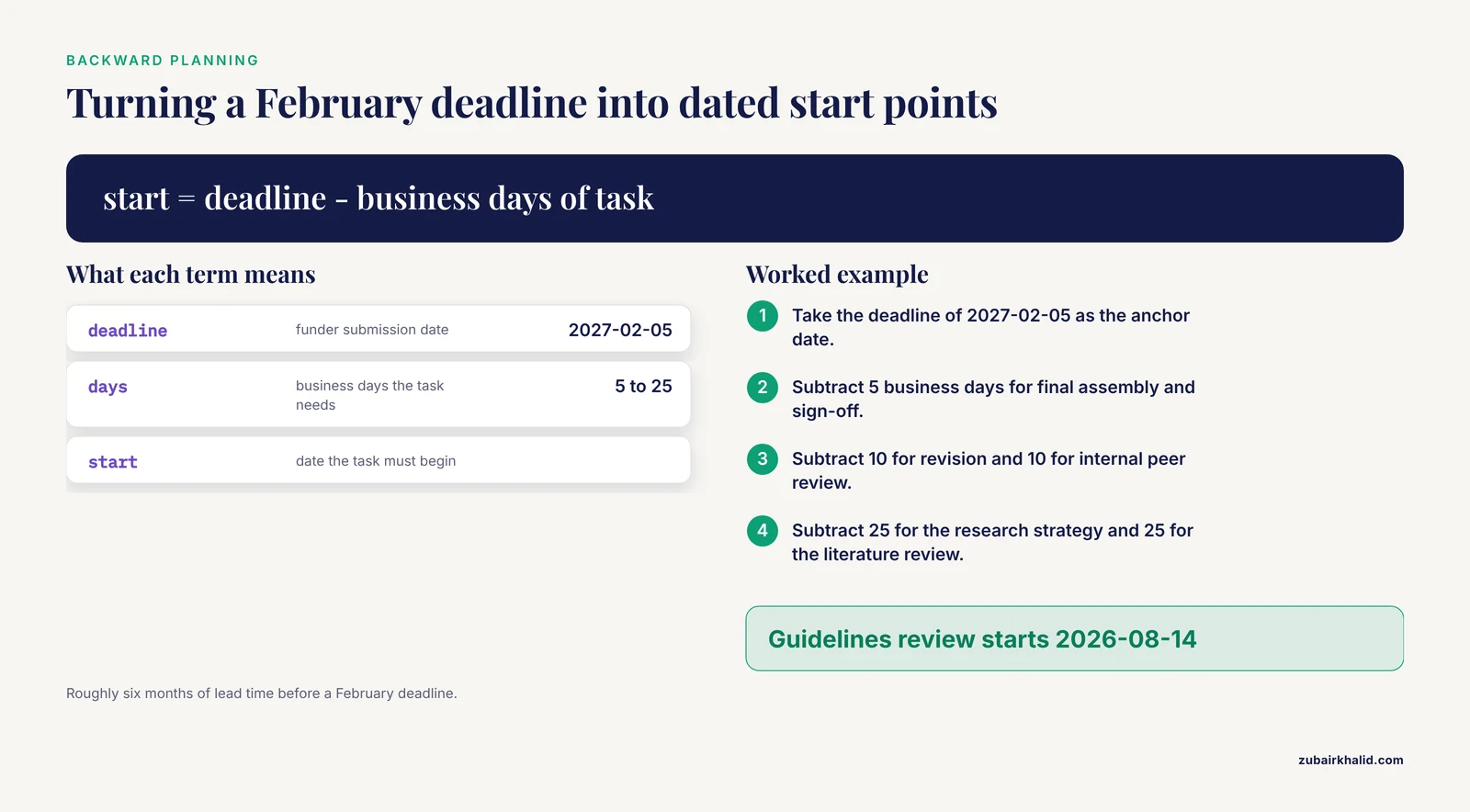
Open the funding announcement and record three dates: the submission deadline, any letter-of-intent deadline, and the earliest possible start date for awards. Letters of intent often fall four to six weeks before full proposals, so they become their own milestone.
Then compute the start date of every task by subtracting its duration from the deadline. Here is a Python script that does the arithmetic in business days, so weekends never absorb your writing time.
from datetime import date, timedelta

DEADLINE = date(2027, 2, 5)

# (task, business days the task needs), listed nearest to the deadline first
TASKS = [
    ("Assemble final draft, get sign-off, submit", 5),
    ("Revise after internal peer review", 10),
    ("Internal peer review window", 10),
    ("Assemble full draft from sections", 10),
    ("Draft specific aims and research strategy", 25),
    ("Finalize budget with grants office", 15),
    ("Confirm collaborators and support letters", 20),
    ("Literature review and gap analysis", 25),
    ("Read funder guidelines and build the checklist", 5),
]

def subtract_business_days(start, days):
    current = start
    while days > 0:
        current -= timedelta(days=1)
        if current.weekday() < 5:
            days -= 1
    return current

cursor = DEADLINE
print("Backward-planned schedule from", DEADLINE.isoformat())
for name, days in TASKS:
    cursor = subtract_business_days(cursor, days)
    print(cursor.isoformat(), name)
Running the script prints the date each task must begin so that the deadline is met with no weekends counted as work time.
Backward-planned schedule from 2027-02-05
2027-01-29 Assemble final draft, get sign-off, submit
2027-01-15 Revise after internal peer review
2027-01-01 Internal peer review window
2026-12-18 Assemble full draft from sections
2026-11-13 Draft specific aims and research strategy
2026-10-23 Finalize budget with grants office
2026-09-25 Confirm collaborators and support letters
2026-08-21 Literature review and gap analysis
2026-08-14 Read funder guidelines and build the checklist
Read the output from the bottom up. In this example, a February 5, 2027 deadline requires starting the guidelines review in mid-August 2026, roughly six months of lead time. The two longest tasks, drafting the research strategy and completing the literature review, each get 25 business days, five working weeks.
Step 2. Define the Milestones Before the Tasks
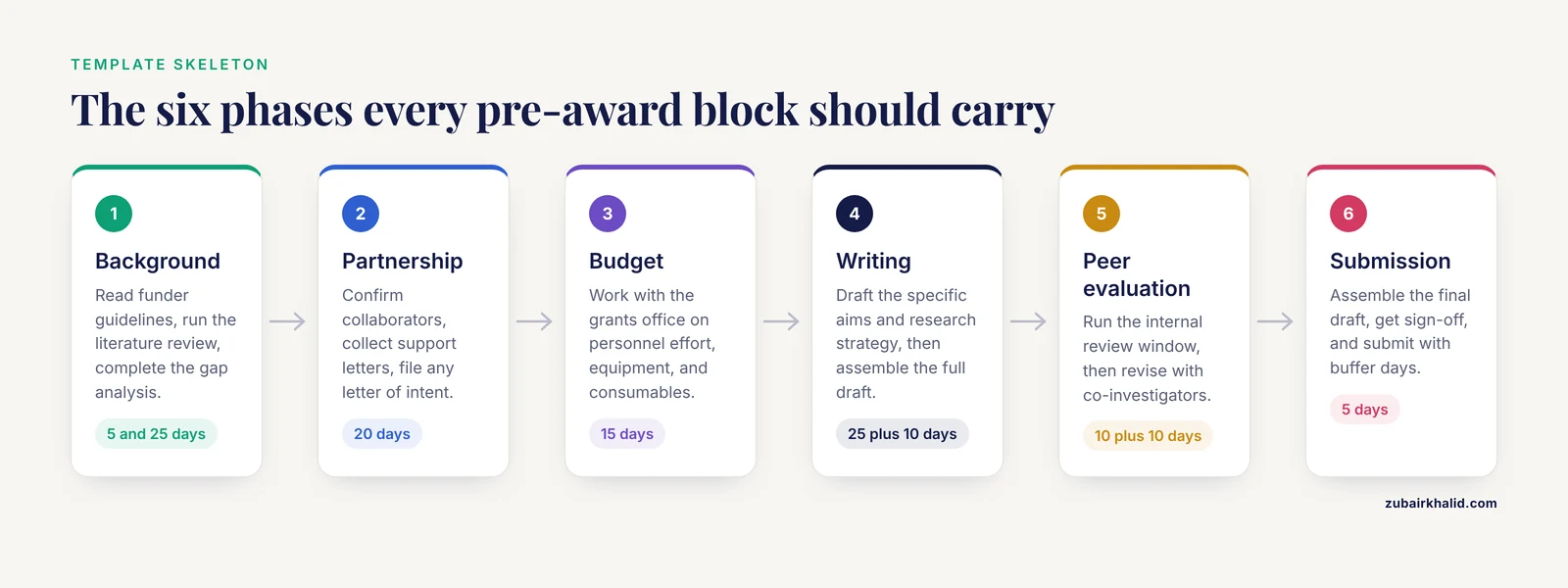
The grant-writing literature gives you the phase labels, and they are worth keeping even if you rename them locally, because they force you to schedule the unglamorous work. The recommended key milestones are background, partnership, budget, writing, peer evaluation, and submission [3]. Map your tasks from Step 1 into those phases:
- Background. Reading funder guidelines, the literature review, and the gap analysis.
- Partnership. Confirming collaborators, support letters, and any letters of intent. Collaboration with well-known, published colleagues and established centers strengthens an application and is a prerequisite for some funding mechanisms [1].
- Budget. Personnel effort, equipment, and consumables. Guidance on grant writing advises determining early what skilled people, equipment, and consumables are needed to reach the research goal [3].
- Writing. Drafting the aims page, research strategy, and all administrative sections.
- Peer evaluation. Internal review and revision.
- Submission. Final assembly, sign-off, and portal submission with buffer days.
Scheduling peer evaluation as its own phase is not optional polish. Seeking review and feedback from colleagues appears among the ten recommendations extracted from the published literature on grant success [2], and drafting guidance goes further, recommending that a more experienced grant writer review the proposal before submission [1].
Step 3. Build the Template in a Spreadsheet
Create the seven columns and enter one row per task. A minimal version of the file, saved as CSV, looks like this.
Phase,Task,Owner,Start,End,Business days,Status,Deliverable
Background,Read funder guidelines and build checklist,PI,2026-08-14,2026-08-20,5,Not started,Completed compliance checklist
Background,Literature review and gap analysis,PI + librarian,2026-08-21,2026-09-24,25,Not started,Annotated reference list
Partnership,Confirm collaborators and support letters,PI,2026-09-25,2026-10-22,20,Not started,Signed support letters
Budget,Finalize budget with grants office,PI + grants officer,2026-10-23,2026-11-12,15,Not started,Approved budget justification
Writing,Draft specific aims and research strategy,PI + co-Is,2026-11-13,2026-12-17,25,Not started,Complete research strategy draft
Writing,Assemble full draft from sections,PI,2026-12-18,2027-01-01,10,Not started,Full proposal draft
Peer evaluation,Internal peer review window,Senior mentor,2027-01-02,2027-01-14,10,Not started,Written critique
Peer evaluation,Revise after internal peer review,PI + co-Is,2027-01-15,2027-01-28,10,Not started,Revised proposal
Submission,Assemble final draft, get sign-off, submit,PI,2027-01-29,2027-02-04,5,Not started,Submitted application
If you prefer to compute dates inside the spreadsheet instead of pasting them from Python, three functions cover everything.
=NETWORKDAYS(D2, E2)      counts business days between the start and end date
=WORKDAY(E2, -10)         returns the date 10 business days before the end date
=IF(E2 < $B$1, "Past deadline", "On track")   flags overdue tasks against a deadline cell
The Business days column in row 2 would then read =NETWORKDAYS(D2, E2), and any planned start date can be derived with =WORKDAY pointing backward from the next task's end date.
Step 4. Add the Post-Award Project Timeline
Below the pre-award block, add one sub-block per specific aim. Reviewers read this block as evidence of feasibility, and a simple, logical, feasible study design appropriate to the research questions is itself one of the published recommendations for proposal success [2]. A three-year project with two aims fills in like this.
Aim,Timeline period,Activity,Deliverable
Aim 1,Year 1 Q1-Q2,Recruit cohort and finalize instruments,Enrollment target met and instruments validated
Aim 1,Year 1 Q3-Q4,Collect baseline data,Cleaned baseline dataset
Aim 1,Year 2 Q1-Q2,Analyze baseline data,Aim 1 results section drafted
Aim 2,Year 2 Q3-Year 3 Q2,Intervention and follow-up data collection,Complete follow-up dataset
Aim 2,Year 3 Q3-Q4,Analysis and dissemination,Manuscript submitted and final report
Keep the granularity at the level of quarters, not weeks. A reviewer who sees weekly entries in a three-year plan reads inexperience, because real projects cannot be forecast that precisely. Budget reasonableness is likewise among the ten published recommendations, and an unrealistic project timeline undermines the budget's credibility just as an unrealistic budget undermines the timeline [2].
Step 5. Build In Review Loops and Ownership
Assign every row exactly one owner. Multi-investigator projects fail on coordination as often as on science. In a review of statewide academic practice partnership projects funded through grants, reported barriers included provider participation, adherence to project timelines, communication, and the navigation of group dynamics [5]. Your template is the antidote only if each task has a name in the Owner column and a status that someone updates weekly.
For teams collaborating across institutions, ask each partner to confirm their dates in writing before the template is final. The trauma guidance study that compressed a 24-month process into 24 weeks succeeded partly by planning multidisciplinary involvement explicitly rather than assuming it would happen [4].
Step 6. Check Against the Funder Checklist
Before submission, audit the proposal against the funding body's guidelines using a checklist, a step that grant-drafting guidance describes as essential [1]. Your timeline template supports this directly. Add a compliance row per funder requirement, such as page limits, biosketch formats, data management plans, and letters, each with its own owner and date. Then a more experienced grant writer reviews the assembled proposal, as recommended in the drafting literature [1], and the revision window you scheduled in Step 1 absorbs their comments.
A Worked 16-Week Example With a Real Date Check
Suppose you are writing to a mechanism with a March 1, 2028 deadline and your institution requires five business days for institutional sign-off. Backward planning gives the following compressed schedule, which you can verify by hand or by changing DEADLINE in the Step 1 script to date(2028, 3, 1) and rerunning it.
DEADLINE = date(2028, 3, 1)The script then prints start dates beginning in late 2027, and the important output line is the last one, the date you must begin reading the guidelines. If that date falls before you can realistically start, for example because a co-investigator is on fieldwork, you either shorten a phase, start earlier, or choose a different cycle. That is the entire point of running the calculation before writing anything. Lead times can be long in ways that surprise new applicants. Developing a hybrid operating room program at one Veterans Affairs center, for example, involved architectural plans beginning in 2010 to 2011, vendor approval in 2012, and fundamentals training in February 2013, and the authors documented the timeline for each approval process precisely because multi-year lead times must be planned, not discovered [6].
Common Errors and How to Fix Them
Excel shows #VALUE! in the business days column. This happens when the Start or End cell contains text that Excel cannot parse as a date, typically a date typed with a stray space, a two-digit day like 2026-8-14, or a date pasted from a PDF. Re-enter the dates as YYYY-MM-DD or use =DATEVALUE(TRIM(D2)) in a helper column.
Google Sheets reports "Function NETWORKDAYS parameter 2 expects date values." The second argument is text, not a date. This usually means the column was imported as plain text during CSV upload. Select the column, use Format, Number, Date, and the formula recalculates.
Python raises ValueError: time data '2026-08-14' does not match format '%m/%d/%Y'. Your date string uses hyphens but your format string uses slashes. Match them, using "%Y-%m-%d" for 2026-08-14 style dates.
The backward plan lands on a holiday or institutional closure. The script counts only weekends as non-working days. If a milestone start lands in late December or on a recognized closure, subtract additional business days manually or extend the days value for the adjacent task.
Two tasks claim the same owner on the same dates. Sort the template by Owner and scan for overlaps. Overloaded principal investigators are the single most common cause of the timeline adherence problems reported in funded partnership projects [5].
How to Check That Your Timeline Is Right
Run four checks before you trust the template.
- Arithmetic check. Sum the business days from the earliest start date to the deadline. The total must equal the NETWORKDAYS count between those two dates exactly. Any gap means two tasks overlap or a task was dropped.
- Reviewer check. Hand the post-award block to a colleague who has never seen the project and ask them to state the aims and the year each aim completes. If they cannot, the timeline is unclear, and unclear timelines fail the persuasion test that the published recommendations emphasize for describing activities clearly and concisely [2].
- Mentor check. Ask a funded investigator whether each pre-award duration is realistic at your institution. Budget offices, for instance, often need more than the 15 business days allotted in the example during peak submission seasons.
- Buffer check. Confirm that at least five business days of pure buffer exist between final sign-off and the deadline. Portals fail, signatories travel, and submission-day uploads of large PDFs take longer than expected.
Adapting a Free Template Without Breaking It
Free templates from university research offices, funding agencies, and software vendors are a reasonable starting point, and many granting programs provide direct support to applicants, including technical assistance, workshops, training, and program websites [7]. When you adopt one, make three edits before entering a single date.
First, delete any pre-filled example dates so stale rows cannot masquerade as your plan. Second, add the Owner and Deliverable columns if they are missing, because without ownership a template tracks nobody. Third, split any merged pre-award and post-award sections, since the two schedules answer different questions for different audiences. If the template came from a community granting program, note that such programs differ in how they administer grants and support awardees, so read the program's own applicant materials rather than assuming a generic template matches its cycle [7].
Pairing the Template With Training
A template enforces structure, but it cannot teach you what reviewers reward. A research grant writing course fills that gap, and the published guidance behind this article comes largely from structured grant-writing education itself, including workshop-based papers from the Write a Scientific Paper series [1] and educational papers delivered through clinical nutrition congresses [3]. If your institution offers a course or a mentorship program, take it before your first major submission, then bring your completed template to the course as a working example. Synthesis work on grant success also highlights institution-level support as an area needing further development [2], so if no course exists locally, ask your research development office whether they can host one, or look for university-run courses that accept external participants.
Common Mistakes and Limitations
- Starting with the narrative instead of the timeline. Applicants who draft first and schedule later almost always compress peer review, which the literature identifies as a success-critical step [2]. Build the template before writing a word.
- One timeline doing two jobs. Your personal planning schedule and the timeline inside the proposal serve different audiences. Keep them in separate blocks with separate granularity.
- Optimistic durations with no review window. A template with drafting dates but no internal review dates signals to a mentor that revision was never planned. Schedule the review window first if you must cut something.
- Unowned tasks. Rows labeled "team" get skipped. Name one person per row.
- Overly precise post-award schedules. Weekly detail in a multi-year plan reads as naivety. Quarters are the standard resolution for most project timelines.
- Ignoring institutional sign-off. Universities, medical centers, and government facilities each impose approval steps with their own durations, and documentation of approval timelines in complex institutional projects shows these steps are real schedule items, not formalities [6].
- Template as substitute for strategy. A timeline cannot rescue a project that lacks a novel, high-impact question or an exhaustive literature review, both of which appear in the published recommendations for proposal success [2]. The template sequences the work. It does not do the work.
- The general limitation. Durations in this article are worked examples, not institutional standards. Your grants office, your funder's cycle, and your team's capacity determine the real numbers, and any specific proposal needs review by your own institution's research administration staff.
Frequently Asked Questions
What is a grant proposal timeline template?
It is a pre-structured table, usually a spreadsheet, that lists every task needed to produce and submit a grant application, with an owner, start and end dates, and a deliverable for each task. A complete template holds both your pre-award development schedule and the post-award project timeline that appears in the proposal itself.
How far in advance should I start grant proposal planning?
Plan for roughly four to six months of lead time for a major research proposal, which is what the backward-planning example in this article required for a February deadline. Complex projects with institutional approvals can require far longer, so run the backward calculation from your specific deadline before committing to a cycle.
What is the difference between a proposal development timeline and a project timeline?
The proposal development timeline schedules your team's work up to the submission deadline, including writing, budgeting, and internal review. The project timeline schedules the research itself across the awarded period and is read by reviewers as evidence of feasibility.
Where can I find a free grant proposal timeline template?
University research development offices, funding agencies, and spreadsheet software vendors publish free templates, and some community granting programs provide applicant support materials as well. Audit any template for three features before using it, namely separated pre-award and post-award blocks, an owner column, and a scheduled internal review window.
What milestones should every template include?
Use the six phases recommended in the grant-writing literature, which are background, partnership, budget, writing, peer evaluation, and submission [3]. Every task you list should map to one of these phases.
How detailed should the post-award project timeline be?
Quarter-level detail for most projects, with one block per specific aim and a checkable deliverable per period. Finer detail such as weekly entries in a multi-year plan implies a precision you cannot deliver and can weaken reviewer confidence in the whole application.
Can a research grant writing course help me use a template better?
Yes. Courses teach what reviewers reward, such as persuasive but concise descriptions of significance and feasible study designs, which are documented recommendations from the grant-success literature [2]. Bring your filled-in template to the course so feedback lands on a real plan rather than a hypothetical one.
How do I handle a timeline when co-investigators miss deadlines?
Re-plan rather than escalate silently. Shift the affected task's dates in the template, check whether the internal review window still holds, and shorten a lower-risk phase if the review window is threatened. Documented experience from funded collaborative projects shows that timeline adherence, communication, and group dynamics are the recurring friction points, so weekly status updates against the template catch slippage early [5].
Sources
- WASP (Write a Scientific Paper): Writing a Research Grant - 2, Drafting the Proposal.
- Recommendations for Writing Successful Grant Proposals: An Information Synthesis.
- Presentation and publication skills: How to develop a protocol and write a grant.
- Better way: initial acceptability testing of using artificial intelligence tools to accelerate development of trauma clinical guidance.
- Academic practice partnerships: A review of a statewide population health nursing leadership initiative.
- Development of a Veterans Affairs hybrid operating room for transcatheter aortic valve replacement in the cardiac catheterization laboratory.
- Mobilizing community-driven health promotion through community granting programs: a rapid systematic review.