Grant Proposal Timeline Review Checklist: Template and Examples
By Dr. Zubair Khalid, DVM, MS, PhD ·

By the end of this article you will be able to build a backward-planned submission schedule for a research grant, run a structured review pass over your own timeline section, and catch the schedule errors that reviewers flag most often. To follow along you need three things on hand: the funder's call for proposals with its deadline, a draft or outline of your proposal, and a calendar you can edit. A spreadsheet helps but is not required.
The timeline matters for two reasons. First, a realistic, well-organized research timeline is one of the concrete elements that convinces an assessment panel your team can actually deliver the project, alongside budget management and defined deliverables [1]. Second, timeline quality is a recognized review axis in its own right. When researchers probed grant review systematically, they treated timeline as one of six core quality dimensions of a proposal, alongside funding, competency, alignment, clarity, and impact [2]. A weak timeline can undermine an otherwise strong scientific case.
This guide gives you a complete grant proposal timeline review checklist, a reusable template, a filled-in example, and the review logic behind each item.
Why Reviewing the Timeline Deserves Its Own Pass
Most applicants proofread their aims and budget carefully but skim the timeline. Review panels do not. Analysis of how funding panels actually make decisions shows that procedures, panel composition, and panel dynamics all shape outcomes, and that applicants who understand the review process are better positioned within it [3]. Reviewers themselves differ in what they emphasize. A study of 39,280 peer review reports from the Swiss National Science Foundation found that review reports varied systematically in length, tone, and focus across disciplines, with some fields concentrating on the applicant's track record and others on the proposed work [4]. You cannot control which reviewer you draw, so your proposal, including its schedule, must survive multiple reading styles.
Two findings make a dedicated timeline review pass especially worthwhile:
- Consistency drops when proposals have weaknesses. In an experiment with 605 experienced reviewers evaluating NIH-style overall impact statements, judgments were generally consistent within and between reviewers, but agreement fell when a proposal contained identified weaknesses [5]. A shaky schedule is exactly the kind of weakness that invites divergent, unpredictable criticism.
- Structured review tools work. Guidance on the final stages of grant writing emphasizes that structured checklists, external perspectives, and meticulous proofreading strengthen both compliance and persuasiveness [6]. The same logic applies to the preparation phase, where reviewing funder guidelines with a checklist before drafting prevents compliance problems from ever forming [7].
In short, the timeline is a scored element, reviewers punish vagueness in it, and a checklist is the tool with demonstrated value for catching its problems.
The Grant Proposal Timeline Review Checklist Template
The template below is organized into five parts. Copy it into a document or spreadsheet and work through it twice, once during grant proposal planning before you draft, and once in the final week before submission. The same template doubles as a review instrument if you are checking a colleague's proposal or serving as an internal reviewer.
GRANT PROPOSAL TIMELINE REVIEW CHECKLIST
Proposal title:
Funder and call number:
Submission deadline (portal close, with time zone):

SECTION A. DEADLINE AND SUBMISSION MECHANICS
[ ] A1. Deadline verified on the funder's own page, not a secondary listing
[ ] A2. Portal close time and time zone recorded
[ ] A3. Registration, credentials, and any letters of intent completed
[ ] A4. Internal institutional deadline set 5 or more working days before the funder deadline
[ ] A5. All required signatures and institutional approvals scheduled
[ ] A6. Format rules checked: page limits, fonts, file types, file naming

SECTION B. SCHEDULE ARITHMETIC
[ ] B1. Start date matches the earliest allowable award start
[ ] B2. Every task has a start and end point that fit inside the award period
[ ] B3. No task overlaps in a way that assumes more person-hours than the budgeted effort
[ ] B4. Milestones fall before, not on, reporting deadlines
[ ] B5. Total duration matches the project period requested in the budget
[ ] B6. Time zones and holiday closures accounted for in any dated deliverable

SECTION C. SCIENTIFIC AND LOGICAL SEQUENCE
[ ] C1. Tasks that depend on earlier results come after those results
[ ] C2. Long-lead items (animal work approvals, ethics review, equipment, hiring) start early
[ ] C3. Each aim on the Specific Aims page appears in the timeline
[ ] C4. The timeline and the text describe the same number of aims
[ ] C5. A go/no-go decision point exists where a branch or failure is plausible
[ ] C6. Contingency time appears for at least the highest-risk task

SECTION D. DELIVERABLES AND REPORTING
[ ] D1. Every promised deliverable has a date
[ ] D2. Deliverables map onto the funder's reporting schedule
[ ] D3. Publications, datasets, or other outputs appear at plausible points, not all at the end
[ ] D4. Personnel milestones (hiring, training) precede the tasks that need them

SECTION E. REVIEW AND SIGN-OFF
[ ] E1. A reader outside the project has checked the timeline for sense
[ ] E2. An experienced grant writer or mentor has reviewed the full proposal [1]
[ ] E3. The checklist itself was run against the funder's submission guidelines [1]
[ ] E4. Every flagged item is either fixed or has a written justification

Reviewer name and date:
Use this grant proposal timeline review checklist format as your baseline and delete or add rows to match your funder. A small internal grant may need only Sections B and C. A multi-institution consortium needs all of Section A expanded into a formal submission calendar.
Numbered Walkthrough: Backward Planning From the Deadline
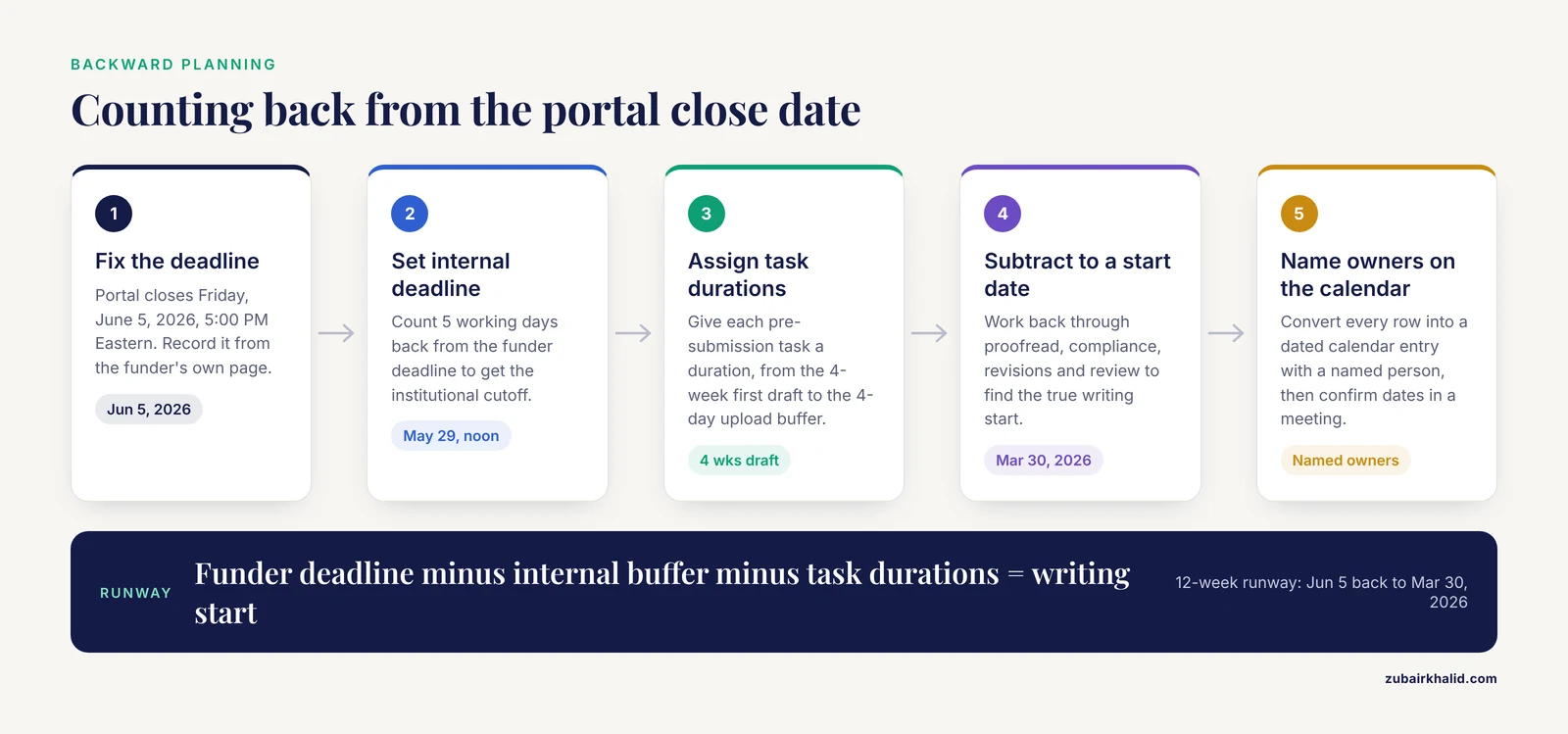
The single most useful calculation in grant proposal planning is the backward schedule. You start at the funder's deadline and count backward, assigning each pre-submission task a finish date. Here is a worked example using a 12-week runway, which is a realistic minimum for a first-time applicant.
Step 1. Fix the immovable date.
Funder portal closes: Friday, June 5, 2026, 5:00 PM Eastern
Internal institutional deadline: 5 working days earlier
Working days back from Jun 5: Jun 4, 3, 2, 1, (weekend), May 29
Internal deadline: Friday, May 29, 2026, noon
Expected output: two dates on your calendar, the funder deadline and an earlier internal deadline. The internal deadline exists because institutional review, sign-off, and portal submission almost always take longer than applicants expect, and structured submission procedures are treated in the literature as accountability practices that demonstrate institutional preparedness [6].
Step 2. Assign durations to each pre-submission task and subtract.
Task                          Duration   Finish by
Full first draft                4 wks    Apr 27
Budget and justification draft  2 wks    May 11 (parallel)
Internal expert review          2 wks    May 12
Revisions from review           1.5 wks  May 21
Compliance and format check     3 days   May 27
Final proofread and sign-offs   2 days   May 29
Portal upload and buffer        4 days   Jun 5 (funder deadline)
Step 3. Compute your true writing start date.
Working backward from May 29:
May 29  minus  2 days (proofread)   = May 27
May 27  minus  3 days (compliance)  = May 22
May 22  minus  7.5 working days     = May 12
May 12  minus  10 working days      = Apr 27
Apr 27  minus  20 working days      = Mar 30
So the writing start date is Monday, March 30, 2026.
Expected output: a start date about 10 weeks before the internal deadline, plus a review window and a buffer before portal close. If your real start date is later than this, cut scope from the pre-submission plan, not from the review steps. The final review passes are the steps applicants most often sacrifice, and they are the steps the evidence supports most strongly. A more experienced grant writer reviewing the proposal before submission, combined with a checklist assessing adherence to the funder's guidelines, is described as essential practice in guidance on drafting research grants [1].
Step 4. Convert the plan into calendar entries with named owners.
For a solo application you own every row. For a team application, assign each row a person and a date, then confirm the dates out loud in a meeting. Proposals fail submission on coordination, not on science.
Reviewing the Timeline Section Inside the Proposal
The checklist above governs your path to submission. A second job is reviewing the research timeline that appears inside the proposal itself, the figure or table that shows what happens in year 1, year 2, and year 3. Reviewers read this section against the funder's criteria, and although wording differs across agencies, a comparison of 10 US federal funding agencies found that most review criteria reduce to eight fundamental questions about mission fit and return on investment [8]. Feasibility and likelihood of success sit inside those questions, and your schedule is where feasibility becomes visible.
Run this second pass after your scientific content is stable.
- Read the Specific Aims page and list every aim. Read the timeline and list every task. The two lists must match. A missing aim in the timeline is a flag any reviewer can spot in seconds.
- Check the arithmetic. If Aim 2 requires reagents or data from Aim 1, Aim 2 cannot start before Aim 1 produces them. Reviewers who probed proposals with structured perturbations found that timeline inconsistencies are detectable flaws, and that reviewing section by section, rather than skimming the whole document, substantially improved detection of such problems [2]. You can borrow that finding directly: review your own timeline as a standalone section, detached from the persuasive flow of the narrative, and inconsistencies surface faster.
- Check the effort budget against the schedule. If two aims overlap for six months and each is budgeted at 100 percent of one postdoc's effort, something is wrong. Fix the overlap, the effort, or the staffing.
- Place decision points. For any aim with a plausible failure branch, mark a go/no-go milestone. This signals scientific maturity and gives reviewers a reason to trust the rest of the schedule.
- Date every deliverable. Deliverables without dates are treated as aspirations. Deliverables dated in the final month of the award look like padding. Spread outputs across the award period where the science supports it.
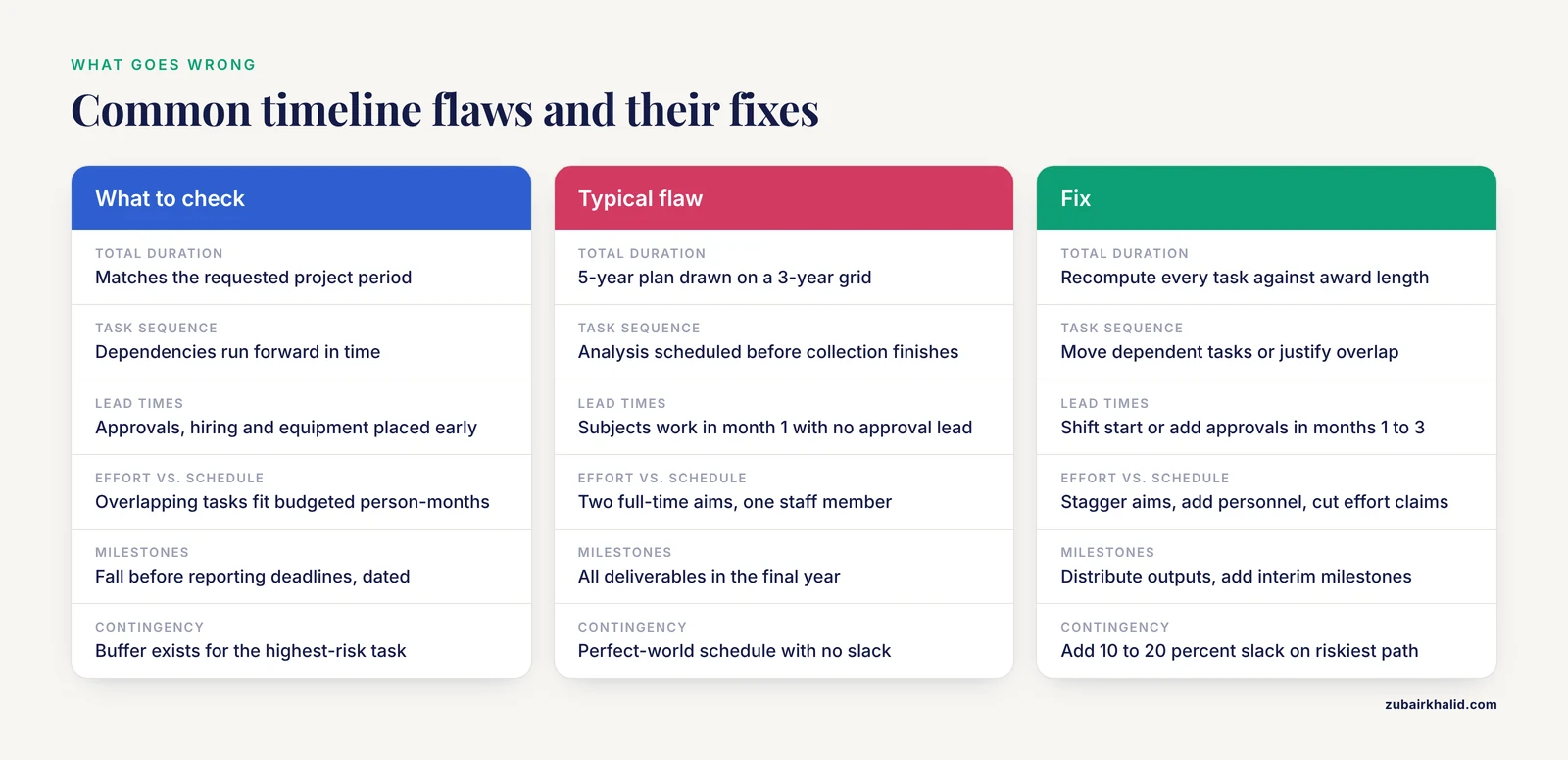
The table below summarizes the parameters that matter most when you review a timeline, the typical flaw, and the fix.
| Parameter | What to check | Common flaw | Fix |
|---|---|---|---|
| Total duration | Matches the requested project period | 5-year plan drawn on a 3-year grid | Recompute every task against the award length |
| Task sequence | Dependencies run forward in time | Data analysis scheduled before data collection finishes | Move dependent tasks, or justify overlap in the text |
| Lead times | Ethics approvals, hiring, and equipment placed early | Animal or human subjects work starting in month 1 with no approval lead time | Shift start or add an explicit approvals task in months 1 to 3 |
| Effort vs. schedule | Overlapping tasks fit the budgeted person-months | Two full-time aims run in parallel with one staff member | Stagger aims, add personnel, or reduce effort claims |
| Milestones | Fall before reporting deadlines, with dated deliverables | All deliverables in the final year | Distribute outputs, add interim milestones |
| Contingency | Buffer exists for the highest-risk task | Perfect-world schedule with no slack | Add 10 to 20 percent slack on the riskiest path and say so |
| Aim coverage | Every aim appears once and only once | An aim present in the narrative but absent from the timeline | Add the aim or cut it from the narrative |
A Filled-In Grant Proposal Timeline Review Checklist Example
The following grant proposal timeline review checklist example shows the template in use for a hypothetical 3-year bench research project. Details are invented for illustration, and the structure is what matters.
Proposal title: Mechanisms of antibiotic persistence in biofilm communities
Funder and call: University internal seed grant, RFA-2026-14
Submission deadline: Friday, June 5, 2026, 5:00 PM Eastern

SECTION A. DEADLINE AND SUBMISSION MECHANICS
[x] A1. Deadline verified on funder portal, Apr 3
[x] A2. Portal closes 5:00 PM Eastern
[x] A3. PI portal credentials confirmed, Apr 3
[x] A4. Internal deadline set: May 29, 2026, noon
[x] A5. Department chair sign-off scheduled May 26
[x] A6. 12-page limit, 11 pt font, single PDF confirmed Apr 3

SECTION B. SCHEDULE ARITHMETIC
[x] B1. Award start Sept 1, 2026, earliest allowable
[x] B2. All 9 tasks fit inside Sep 2026 to Aug 2029
[x] B3. Found overlap error: Aims 2 and 3 both assumed
       the same technician in months 14-20. Fixed by
       staggering Aim 3 start to month 22
[x] B4. Annual progress reports due each Aug 31,
       year-1 milestone set July 15
[x] B5. Timeline total = 36 months = budget period, OK
[x] B6. Institutional closure Dec 24-Jan 1 excluded
       from month 4 data collection window

SECTION C. SCIENTIFIC AND LOGICAL SEQUENCE
[x] C1. Transcriptomic analysis (month 7) follows
       biofilm harvest (months 4-6)
[x] C2. IACUC protocol submission listed in months 1-3,
       animal work starts month 5
[x] C3. All 3 aims from the Specific Aims page appear
[x] C4. Timeline shows 3 aims, narrative shows 3 aims
[x] C5. Go/no-go at month 12: proceed with Aim 3 only if
       persistence phenotype reproduces in 2 strains
[x] C6. Two months of contingency added after Aim 2

SECTION D. DELIVERABLES AND REPORTING
[x] D1. Deliverables dated: dataset mo 8, manuscript 1
       mo 20, manuscript 2 mo 34, final report mo 36
[x] D2. Milestones precede Aug 31 reporting dates
[x] D3. Two manuscripts spaced at mo 20 and mo 34
[x] D4. Technician hire listed in month 2, before
       month 4 data collection

SECTION E. REVIEW AND SIGN-OFF
[x] E1. External read by lab colleague, May 14,
       flagged month-4 bottleneck, resolved
[x] E2. Mentor review completed May 21 [1]
[x] E3. Funder checklist crosswalk completed May 27
[x] E4. Two flagged items fixed, one (shared equipment
       access) justified in a note to the program officer

Reviewer: A. Mentor, May 21, 2026
This example illustrates the checklist's main value. Item B3 caught an effort-overlap error before any reviewer could. Item C5 added a decision point that strengthens the feasibility argument. Neither fix changes the science. Both change how a reviewer scores it.
Building Review Into the Process
A checklist is necessary but not sufficient. Structured human review adds the most value, and the evidence points to specific ways of organizing it.
Use peer review early and according to funder criteria. Programs that train early-career researchers to review proposals against NIH criteria show what structured peer practice looks like. The Indiana CTSI Postdoc Challenge has postdoctoral scholars write proposals and serve as reviewers of each other's applications, following NIH review guidelines. Since 2014 the program has funded 54 postdoctoral researchers, with 276 applications reviewed, and it reports strengthening participants' grant writing and reviewing skills [9]. The design lesson is portable. If you can serve as a reviewer once, even for an internal award, you will read your own timeline differently afterward.
Formalize internal review with feedback cycles. A coaching clinic model for proposal development, built on intensive mentoring with continuous feedback and an internal quality assurance mechanism, improved proposal quality and review pass rates in a higher education setting, with 12 proposals approved and 12 more passing the review stage after the intervention [10]. The transferable element is the loop: draft, review, revise, review again, on a schedule you set in advance, which is exactly what the backward-planned calendar in the walkthrough above creates.
Write review reports that align with the criteria. Analyses of review reports show that reviews aligned closely with stated evaluation criteria are measurably different from loose ones, and that reviewer characteristics such as discipline shape length, tone, and focus [4]. When you ask a colleague for feedback, hand them the funder's criteria and ask for comments organized under those headings. You will get more usable comments, and your revisions will map onto the scorecard the real reviewers use.
Accept that some criticism is noisy. In the experiment with 605 experienced reviewers, evaluations were mostly consistent, but proposals with weaknesses drew less consistent judgments [5]. If two mentors give contradictory advice about your timeline, resolve the disagreement by checking the underlying facts, the dependency logic and the dates, rather than averaging their opinions.
Know what panels respond to. Observational work on grant review panels found that panel procedures, composition, and dynamics influence decisions, sometimes in ways applicants cannot see from outside [3]. A clean, dated, logically ordered timeline survives panel discussion better than an ambitious schedule that collapses under two minutes of scrutiny. A field experiment run with the Dutch Research Council even found that panel rankings did not detectibly change when panelists saw only a CV and a one-paragraph summary instead of the full proposal [11]. Whatever one concludes about that result, it reinforces the practical point that a short, sharp summary and a defensible high-level schedule carry a large share of the persuasive load.
AI Tools and the Timeline Review
AI assistants now appear at two points in the workflow, drafting support and review support, and both come with evidence-backed limits.
On the review side, researchers tested language-model reviewers on real grant proposals using structured perturbations across six quality axes, including timeline. Section-by-section AI review outperformed single-pass and panel-style AI review at detecting problems, but detection varied sharply by flaw type. Alignment issues were readily caught while clarity flaws were largely missed, and human evaluators found the AI feedback valid but skewed toward compliance checking rather than holistic assessment. Applied to timelines, this suggests an AI pass is reasonable for catching internal inconsistencies, a task scheduled before its dependency, a deliverable outside the award period, but weak at judging whether the overall plan is scientifically sound.
Scoring studies reinforce the caution. When medium-sized open-weight language models were compared with expert peer review scores on a historical fellowship dataset, the models correlated weakly with expert averages, and the best model reached only about half the correlation that human reviewers achieved with each other [12]. Treat any AI score as a weak signal.
On the drafting side, a systematic review of AI use in research institutions reported sizable efficiency gains, including an estimated 45 percent median reduction in supervisor feedback-cycle time and grant-award hit rates rising from 12 percent to 19 percent when algorithmic tools matched researchers to funding calls, alongside new risks around plagiarism, data provenance, and authorship that require governance safeguards [13]. The practical takeaway for a timeline review is to let AI tools accelerate mechanical checks and literature matching while keeping dependency logic, feasibility judgments, and go/no-go decisions under human control.
Common Mistakes and Limitations
- Planning forward instead of backward. Applicants who ask "how long will writing take" from today get a rosy answer. Starting from the portal-close date and subtracting real durations produces an honest start date, and the arithmetic example above is the way to do it.
- Treating the internal deadline as soft. Institutional approvals, sign-offs, and portal validation are organizational accountability steps, not paperwork formalities [6]. If they slip, the buffer absorbs the slip, which is what the buffer is for.
- Drawing the timeline to match the narrative instead of the facts. The timeline must reflect lead times for ethics review, hiring, and equipment. A schedule that ignores these reads as inexperience.
- Reviewing the timeline inside the document only. Reviewing the timeline as a standalone section improves flaw detection compared with reading the full document straight through, a result demonstrated for both human-structured and AI-assisted review. Print the timeline figure alone and interrogate it.
- Running the checklist once, at the end. The template works best in two passes, one during grant proposal planning and one before submission. Preparation-phase checklists prevent compliance problems, and final-stage checklists catch what drafting introduced [7] [6].
- Letting AI or uncalibrated reviewers assign scores. Model-based scores correlate only weakly with expert judgments [12], and even trained human reviewers diverge most on flawed proposals [5]. Use feedback to find specific fixable problems, not to predict your score.
- Assuming the timeline is a minor element. It is a scored review axis, it feeds directly into feasibility judgments embedded in shared federal review criteria [8], and funder guidance explicitly names a realistic research timeline and targeted deliverables as elements that convince assessment boards the team can handle the project [1].
- Skipping training when you are new. A research grant writing course, a structured program like the Indiana CTSI Postdoc Challenge [9], or a coaching clinic with iterative mentoring [10] compresses the learning curve far more than reading alone. If your institution offers any of these, enroll before your first submission rather than after your first rejection.
Finally, one general limitation applies to everything above. Every funder, call, and institutional process differs, so individual cases need to be checked against the specific funder's current guidelines and your own research office's requirements.
Frequently Asked Questions
What is a grant proposal timeline review checklist?
It is a structured list of checks applied to both your submission schedule and the research timeline inside your proposal, covering deadline mechanics, schedule arithmetic, task dependencies, deliverables, and sign-offs. The template in this article has five sections you can run in about 30 minutes per pass.
When should I start grant proposal planning before a deadline?
For a first-time applicant, start about 10 weeks before the internal deadline, which sits roughly 12 weeks before the funder deadline. The backward-planning walkthrough above shows the arithmetic for a 12-week runway, and experienced applicants with ready preliminary data can compress the writing block but should keep the review and buffer periods intact.
What should a grant proposal timeline review checklist template include?
At minimum it should cover six areas, the verified deadline and portal mechanics, schedule arithmetic against the award period, scientific task dependencies, dated deliverables mapped to reporting requirements, contingency for high-risk tasks, and a human review and sign-off step. The full template in this article expands these into 25 discrete items.
Can I see a grant proposal timeline review checklist example filled in?
Yes. The article includes a completed example for a hypothetical 3-year biofilm research project, showing real entries for each section, including a caught effort-overlap error, a go/no-go milestone, and dated deliverables spread across the award.
How detailed should the research timeline inside my proposal be?
Detailed enough that every aim, every major task, every hire, every approval, and every deliverable has a place and a date, but no more. Reviewers check that the timeline matches the aims, that dependencies run forward, and that effort claims fit the schedule, and the shared federal review criteria make feasibility a scored element [8].
Who should review my proposal and when?
Two readers minimum. A colleague outside the project should read the timeline as a standalone section about two weeks before your internal deadline, and an experienced grant writer or mentor should review the full proposal before your compliance pass, a practice described as essential in grant drafting guidance [1].
Can AI tools review my proposal timeline?
Partially. AI review reliably catches mechanical inconsistencies and compliance issues but misses clarity problems and cannot judge scientific feasibility, and model scores correlate only weakly with expert reviewer scores [12]. Use AI for consistency checks and use humans for judgment calls.
Do I need a research grant writing course before my first submission?
You do not strictly need one, but structured training with iterative feedback demonstrably improves proposal quality and success rates [10] [9]. A research grant writing course, a mentored internal program, or a coaching clinic is the fastest way to internalize review expectations before real money is at stake.
Sources
- WASP (Write a Scientific Paper): Writing a Research Grant - 2, Drafting the Proposal.
- Evaluating LLM-Based Grant Proposal Review via Structured Perturbations
- ‘Are you siding with a personality or the grant proposal?’: observations on how peer review panels function
- Gender and disciplinary differences in grant proposal peer review: Content and sentiment in 39,280 reports
- An experimental study of simulated grant peer review: Gender differences and psychometric characteristics of proposal scores
- Proposal Review and Submission: Ensuring Quality and Compliance in Grant Applications
- Preparing to Write a Grant Proposal: Foundations of Effective Non-Profit Funding Applications
- How Do I Review Thee? Let Me Count the Ways: A Comparison of Research Grant Proposal Review Criteria Across US Federal Funding Agencies
- 177 The Indiana CTSI Postdoc Challenge: Catalyzing early-career success using experiential training in grant proposal writing and peer review
- Coaching Clinic on Community Service Proposal Development: An Approach to Increasing Grant Acceptance Success in Higher Education Institutions
- Do grant proposal texts matter for funding decisions? A field experiment
- Can Large Language Models Evaluate Grant Proposal Quality? Revisiting the Wennerås and Wold Peer Review Data
- Ethical AI Integration in African Higher Education: Enhancing Research Supervision, Grant Discovery, and Proposal Writing Without Compromising Academic Integrity