Common Timeline Mistakes in Grant Proposals and How to Fix Them
By Dr. Zubair Khalid, DVM, MS, PhD ·

Most grant proposal timeline failures share a single root cause. The writer planned backward from the sponsor deadline and left no room for anything else. The first thing to check is simple. Open your institution's office of sponsored programs or research administration website and find their internal submission deadline. That date is almost always earlier than the sponsor's posted deadline, sometimes by several business days, and it is the real deadline your timeline has to obey.
Once you know that date, you can diagnose the rest. This article walks through the most common grant proposal timeline mistakes, ranked from the ones that nearly every applicant makes at least once to the rare failures that end careers of careful people. For each mistake you get the mechanism behind it, a way to confirm that it is happening in your draft, and a concrete fix. A troubleshooting table in the middle of the article collects all of this in one place, and the final sections cover prevention habits that make the mistakes much less likely on your next application.
Why Timelines Fail in Grant Proposals
A proposal timeline fails in one of two places. It fails on the page, where a reviewer reads the timeline in your research plan and decides the project is not feasible. Or it fails in the calendar, where the proposal never gets submitted at all because internal approvals, formatting, or collaborator materials were not ready.
The two failures have different mechanisms, and most writers mix them up. The on-the-page failure is a persuasion problem. Study sections and review panels read the timeline as evidence that you understand how long experiments actually take, how long approvals take, and how the pieces of your project depend on one another. A timeline that looks invented, with every aim finishing neatly at the end of a year and no contingency, signals inexperience. The calendar failure is a logistics problem. Universities, medical centers, and institutes have routing systems, signature chains, budget checks, and compliance reviews that take real days, and those days come out of your writing time whether you planned for them or not.
Both failures trace back to the same underlying cause. Grant proposal planning is treated as a writing task instead of a scheduling task. Writers budget their time for prose and figures and then discover, in the last week, that the timeline itself, the approvals it depends on, and the people who must sign off were never scheduled at all.
Grant Proposal Timeline Mistakes, Ranked From Most to Least Common
1. Planning backward from the deadline with zero buffer
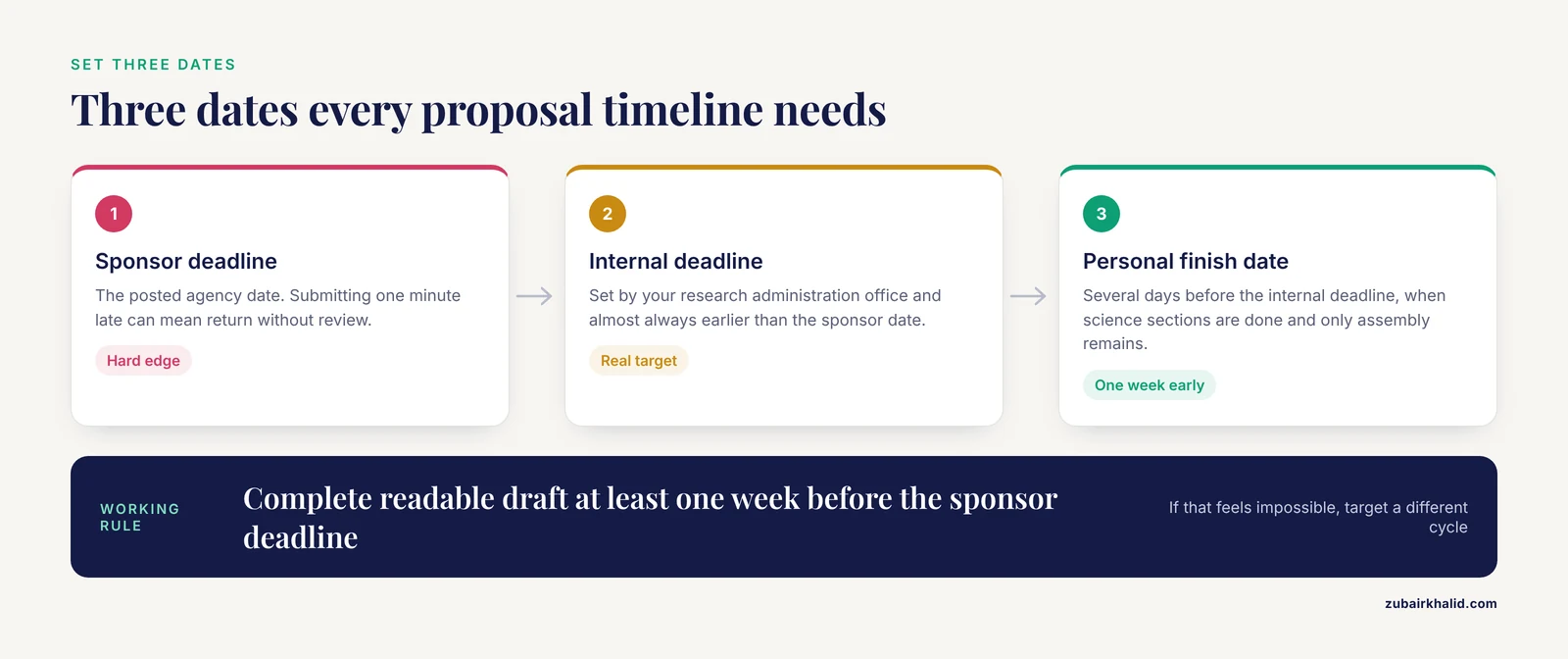
This is the single most common mistake, and it produces almost every other mistake on this list. The writer takes the sponsor deadline, counts backward the days they think writing will take, and starts. Any surprise, a sick child, a failed preliminary experiment, a slow collaborator, eats directly into the deadline with nothing to absorb it.
The mechanism is a misunderstanding of how deadlines behave. A sponsor deadline is a hard edge. Submitting one minute late can mean the proposal is returned without review, so every process that touches your proposal, from institutional sign-off to the submission portal itself, carries risk that increases as you approach that edge. A plan with zero buffer treats that risky edge as if it were normal working time.
The fix is to define three dates, not one. The first is the sponsor deadline. The second is your institution's internal deadline for submitted proposals, which your research administration office sets. The third is a personal finish date, several days before the internal deadline, by which the science sections are done and only final assembly remains. A widely used rule among experienced applicants is to have a complete, readable draft of the whole proposal at least one week before the sponsor deadline, then use the remaining time for polishing. If that rule feels impossible for your next cycle, that is the signal to target a different cycle rather than a compressed attempt.
2. Ignoring institutional review, routing, and signature requirements
Federal agencies such as the National Institutes of Health and the National Science Foundation do not accept a proposal from an individual. They accept it from an authorized institutional representative at your organization. That means your proposal must pass through a routing system with signatures or electronic approvals from your department, your dean or director, and the sponsored programs office before anyone can press submit.
Many first-time applicants learn this in the worst possible way. They finish the science at the internal deadline and then discover that routing itself takes days, that the grants office wants the budget finalized well in advance, and that the authorized representative may be traveling. Institutional deadlines exist precisely because of this. A typical research office asks for the complete package several business days before the sponsor deadline, and some institutions, especially large medical centers, ask for budgets and compliance documents a week or more ahead.
The fix is to contact your grants administrator before you write a single sentence. Ask for three things in writing. First, the internal deadline for this specific opportunity. Second, a list of every document that must be routed, including the budget, budget justification, biosketches, current and pending support documents, letters of commitment, and any data management or sharing plans. Third, the name of the person who actually submits in the portal. Treat that person as a collaborator on your timeline, and give them a draft budget early even if it is imperfect, because budgets almost always take longer to finalize than the science does.
3. A research plan timeline that reviewers cannot believe
The timeline inside your research plan, usually shown as a set of milestones mapped onto the project years, is a scored element of feasibility. Reviewers know how long things take. When they see a five-year project where every aim starts on day one, produces results in perfect sequence, and leaves no room for a failed experiment or a slow animal cohort, they do not conclude that you are efficient. They conclude that you have never run the experiments.
The mechanism of this mistake is optimism on paper. Writers compress timelines because they fear that honest durations will look slow. The paradox is that honest durations are what make a plan credible. A realistic timeline includes negative results, repeats, and gaps between steps, and it says what decision you will make at each milestone if a step fails.
The fix has three parts. First, anchor every estimate to something real, either your own past experiments or durations published in the methods of papers you admire. If a mouse breeding scheme needs two generations before an experiment, count the generations and the gestation and weaning intervals explicitly. Second, add explicit contingency language, for example a statement that if aim one's assay lacks sensitivity by the end of year one, you will switch to the validated alternative approach already in your preliminary data. Third, align the timeline with the budget periods. Reviewers check that year one spending matches year one activities, so an aim that consumes half the budget in year one but starts in year two is a red flag.
4. Missing compliance approvals for human subjects, animals, and hazardous materials
If your project involves human participants, vertebrate animals, recombinant DNA, select agents, or radioactive materials, the relevant institutional review board, institutional animal care and use committee, or biosafety committee must approve the work before funds are spent, and in many cases before an award can even be issued. These committees meet on fixed schedules with submission cutoffs, and review cycles commonly take weeks to a few months depending on the protocol and the committee's calendar.
The timeline mistake here is subtle. Applicants often put the research itself on the timeline but leave the approvals off it, which produces a year-one plan full of activity that legally cannot begin yet. Reviewers and grants officers notice. The other version of the mistake happens before submission, when an applicant decides to start a pilot experiment for preliminary data using a hazardous reagent or an animal model before the relevant approval is in place.
A short caution belongs here. Never order or handle regulated materials, animal subjects, or human specimens before the applicable committee has approved the specific protocol, even for pilot work. Delaying an experiment by a few weeks is recoverable. An unapproved use of animals or human subjects is a compliance incident that can affect an entire laboratory.
The fix is to add an approvals row at the top of your project timeline, before any experimental activity. Note the committee's submission schedule, and plan your first experimental month to begin after the earliest realistic approval date, not the date you hope to submit the protocol.
5. Treating tasks as independent when they depend on each other
A list of tasks with dates next to them is not a timeline. A timeline is a network of dependencies, where step B cannot start until step A produces its output. Many proposals fail review because the timeline ignores these dependencies in ways a working scientist spots immediately. The aim promises proteomics on samples from aim one, but the sample collection in aim one finishes too late in the year for the mass spectrometry core to process the batch. The training-year plan has the student learning a technique in month four, but the collaborator who teaches it is only available in month two.
The mechanism is that writers build timelines aim by aim, in the order the aims appear in the proposal, rather than chronologically across the whole project. The fix is to rebuild the timeline chronologically on a single page. List every major activity in true calendar order, draw the dependencies between them, and check that each downstream activity starts after its upstream output actually arrives. Include the external constraints, such as core facility scheduling, shared instrument queue times, collaborator availability, field season windows, cohort enrollment seasons, and conference dates when you need data before an abstract deadline. This one-page chronological build is also the fastest way to spot gaps where nothing in the project is scheduled to happen, which reviewers read as padding.
6. Overcommitted personnel and effort that the calendar cannot support
Every proposal lists the percent effort of each key person. Reviewers cross-check that effort against the timeline. When the same co-investigator appears on the timeline performing intensive activities in the same months on two different grants, or when a single graduate student is shown recruiting subjects, running assays, and analyzing data simultaneously across three aims, the timeline loses credibility.
The mechanism is that effort percentages are often filled in at the end, by the budget office or by habit, without reconciling them against the calendar of activities. The fix is a simple reconciliation exercise. For each named person, list their months of activity on your timeline, estimate the hours those activities genuinely require, and compare the total against the effort committed on this grant plus their known obligations elsewhere. If a person is shown at substantial effort on your project, your timeline should show what they actually do in those months. Vague entries such as "advise and oversee" attached to heavy effort invite questions.
7. Subaward and collaborator timelines treated as afterthoughts
Multi-institution proposals fail on calendars more often than single-institution proposals, and the failure mode is consistent. The subaward partner's budget, scope, letters, and internal approvals arrive last, after your own package is otherwise complete. Some subrecipient institutions have their own internal deadlines that are earlier than your lead institution's deadline, and their administrative staff may be unavailable in the final week.
The mechanism is asymmetric urgency. Your deadline feels urgent to you, and feels like an ordinary workday to your collaborator's grants office. The fix is to contact every subaward institution the moment you decide to include them, give them the full package requirements and the true internal deadline, and ask for their materials two weeks before your internal date. Confirm whether their institution requires its own routing and sign-off, because many do. Send a reminder at the midpoint and again one week out. If a letter of commitment is needed, draft it yourself and let the collaborator edit and sign, which is standard, accepted practice and saves everyone time.
8. No plan for equipment, vendor, and core facility lead times
Some timeline failures have nothing to do with writing or committees. A major instrument has a procurement and delivery lead time that can stretch to many months, a sequencing core has a queue, an antibody or specialized reagent is back-ordered, and a new software license or data use agreement sits in legal review. When the timeline shows aim two beginning in month seven and the instrument arrives in month ten, reviewers who have run facilities will see the gap.
The mechanism is that writers plan around scientific logic and forget commercial and institutional logistics. The fix is to add a procurement and services row to your timeline. For every major piece of equipment, every core facility service, and every external data or material transfer, note when the order or request must be placed for the resource to arrive when the science needs it. Data use agreements and material transfer agreements deserve special attention, because they require signatures from lawyers at multiple institutions and routinely take longer than anyone expects. If a long-lead purchase is required in year one, say so in the budget justification so the grants office can process it promptly at award.
9. Resubmission timelines that repeat the first mistake
Resubmitting a previously reviewed proposal feels easier than starting fresh, and that feeling causes its own timeline error. Writers assume that because the text exists, the revision needs only a few weeks. They then underestimate the new preliminary experiments that reviewers requested, the revised figures, the rewrite of the approach section, and, once again, the full institutional routing cycle, which applies to resubmissions exactly as it does to new proposals.
The mechanism is anchoring on the old document rather than on the new work required. The fix is to build the resubmission timeline from the reviewer response, not from the old draft. List every critique, classify each one as requiring new data, a new argument, or a clarification, and estimate the bench time for the new-data items honestly. Then add the standard writing and routing phases on top. If the requested experiments cannot be completed before the resubmission deadline, the correct move is to target the following cycle rather than to submit a revision with thin responses, because a pattern of poorly addressed critiques damages a program's reputation with a study section over time.
Troubleshooting Table
Use this table as the core diagnostic tool. Find the symptom you are seeing in your own draft or calendar, confirm the cause, and apply the fix.
| Symptom | Likely cause | How to confirm | Fix |
|---|---|---|---|
| Writing is still incomplete in the final week | Backward planning with no buffer | Your personal finish date is the same as the sponsor deadline | Set a finish date at least one week early. If impossible, target the next cycle |
| Proposal finished, but submission blocked or rushed | Institutional routing not scheduled | Check whether signatures and budget sign-off occurred before the internal deadline | Contact the grants office first in future cycles and route the budget early |
| Reviewers call the plan ambitious or not credible | Compressed research plan timeline | Every aim finishes neatly at year end with no contingency | Anchor durations to real experiments and add explicit fallback plans at milestones |
| Year one shows activity that cannot legally start yet | Compliance approvals left off the timeline | Compare the first experimental month against committee approval dates | Add an approvals row before all experimental activity and match it to committee calendars |
| Timeline has hidden impossible overlaps | Dependencies ignored | Rebuild the timeline chronologically and check that inputs exist before outputs | Sequence activities by calendar order with dependencies visible on one page |
| Reviewer questions about a person's effort | Effort percentages never reconciled with activities | List each person's timeline activities and compare with committed effort | Match named activities to stated effort and reduce effort where the calendar cannot support it |
| Collaborator materials arrive after your deadline | Subaward timelines treated as afterthoughts | Check when subaward budgets and letters actually arrived in past cycles | Contact subrecipients at project start, request materials two weeks early, send reminders |
| Planned start of an aim precedes the arrival of equipment or data | Vendor, core, and agreement lead times ignored | Ask facilities and vendors for current lead times and compare with your timeline | Add a procurement row and state long-lead purchases in the budget justification |
| Resubmission is rushed and responses to critiques are thin | Anchoring on the old draft instead of the new work | List the reviewer requests and the bench time each one needs | Build the timeline from the critique list and defer to the next cycle if experiments cannot finish |
| Nothing is scheduled in parts of a project year | Timeline built aim by aim rather than chronologically | Look for months with no activity on the one-page build | Fill real activities or shorten the plan honestly |
A Diagnostic Sequence You Can Follow
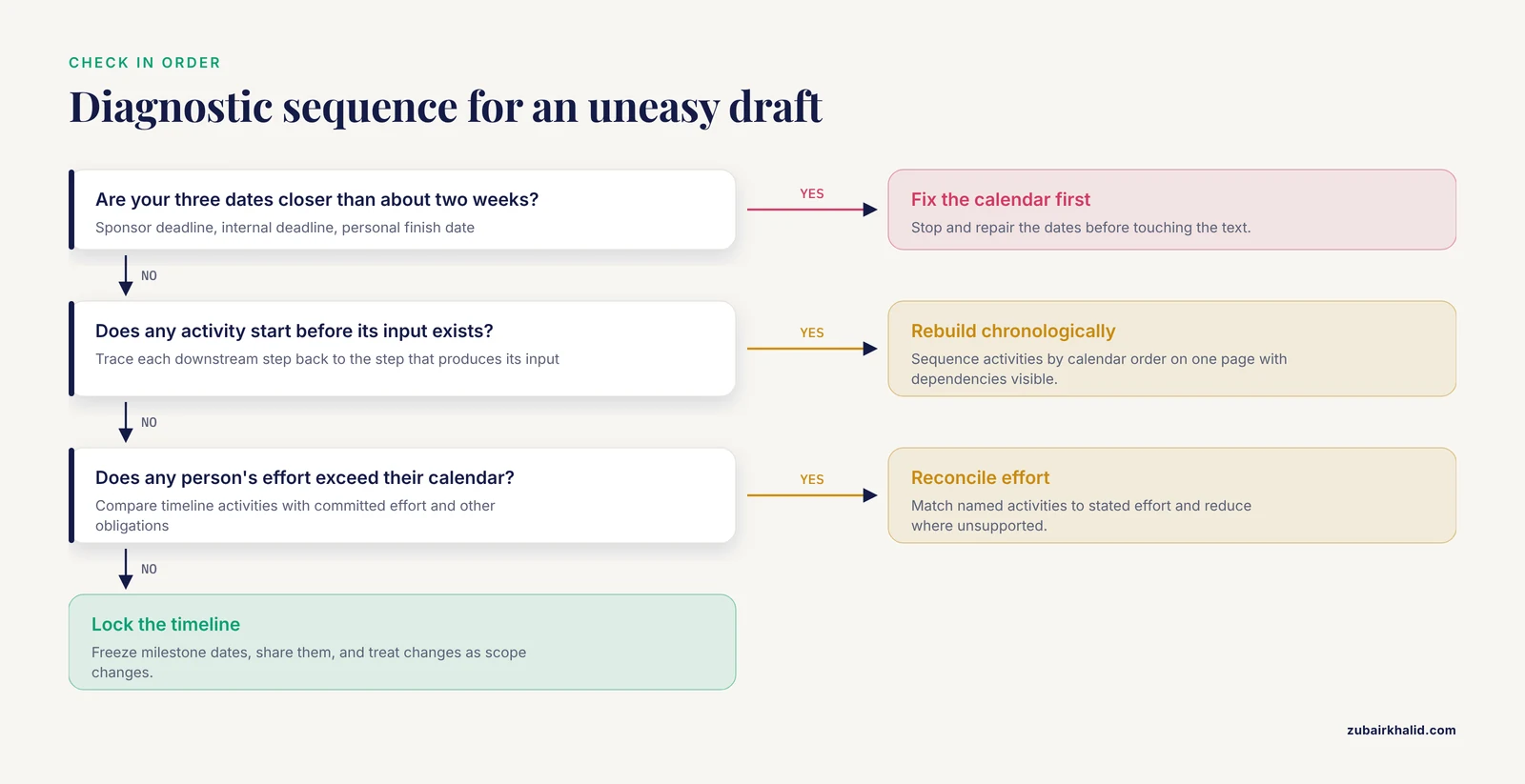
If you are staring at a draft with an uneasy feeling about the calendar, work through this sequence in order. It moves from the cheapest checks to the most involved ones, and each step either clears a common failure or points to the next.
- Write down the sponsor deadline, your institution's internal deadline, and your personal finish date. If the three dates are closer together than about two weeks, stop and fix the calendar before touching the text.
- Confirm with your grants administrator that the budget, biosketches, other support documents, letters, and administrative sections are either complete or have named owners and due dates.
- Check that every compliance approval your project needs is represented on the timeline before the activity that depends on it.
- Rebuild the project timeline chronologically on one page and trace each downstream activity back to the activity that produces its input. Fix any step that starts before its input exists.
- Reconcile each named person's effort against their timeline activities and their other known obligations.
- Read your timeline as a hostile reviewer would. Ask where you would attack it. Every place you feel the urge to say "we expect this will go quickly" is a place that needs either a real duration or a contingency statement.
- If the timeline survives all six checks, lock it. Freeze the milestone dates, share them with every collaborator, and treat changes to them as scope changes that require a conscious decision.
Common Mistakes and Limitations
Even with the fixes above, several traps recur. Each of the following is a specific, practical pitfall that applicants hit repeatedly.
First, timelines drift toward the writing style of the proposal rather than the reality of the work. If your aims are written in parallel-sounding language, the timeline will inherit a parallel structure even when the work is sequential. Always derive the timeline from the chronological build, never from the aim headings.
Second, buffers get spent as soon as they are created. The point of finishing early is to absorb surprises, not to start a new revision spiral. Decide in advance what the buffer is for, such as final formatting, portal glitches, and a last read by a colleague, and resist adding new experiments during it.
Third, holidays and academic calendars distort real capacity. A two-week winter closure, a field season, a clinical service month, or the start of a semester changes how much work a person can do in a calendar month. Timelines written in July for a December deadline often ignore December entirely.
Fourth, digital submission systems have their own failure modes. Portals slow down on deadline days, registration and credential requirements can take days to activate for a new investigator or a new institution, and formatting validators reject files for reasons that take time to fix. Complete your portal registration and a full system test well before the final week.
Fifth, a limitation worth stating plainly. Specific lead times for committee review, procurement, and portal processing vary enormously across institutions and agencies, and this article deliberately avoids inventing precise numbers. Your own grants office, core facility managers, and committee administrators are the authoritative sources for durations at your institution. Ask them, record their answers, and reuse those numbers in every future timeline.
Finally, remember that a beautiful timeline cannot rescue weak science, and strong science can survive an imperfect timeline if the plan is honest about its risks. Reviewers evaluate the fit between what you promise and what you can deliver. The timeline is where that fit becomes visible.
Grant Proposal Planning Habits That Prevent Timeline Problems
Fixing mistakes is reactive. The habits below prevent them, and together they form the practical core of grant proposal planning that experienced applicants rely on.
Keep a standing proposal calendar template. When you learn your institution's internal deadlines and committee cycles once, reuse that knowledge. A template with fixed rows, sponsor deadline, internal deadline, draft complete, routing, approvals, subaward materials, assembly, and buffer, turns every new application into a fill-in exercise instead of a fresh negotiation with the calendar.
Start with the budget and the timeline, not the aims text. This feels backwards to most scientists, but the budget forces you to decide what you will actually do, who will do it, and when. A draft budget in week one surfaces the personnel, procurement, and compliance questions while there is still time to answer them.
Maintain a milestones document for your laboratory at all times. Record how long your standard procedures actually took the last time you ran them, from animal cohort generation to assay batches to sequencing turnaround. When you write the next proposal, the durations come from your records instead of from optimism.
Build contingency into the plan as visible structure, not as vague reassurance. Name the alternative approach for each risky step and the decision point at which you will switch. Reviewers reward plans that anticipate failure, because anticipating failure is what experienced investigators do.
Schedule the internal review you want. Ask a colleague who has served on a study section, or a mentor, to read the full package by a date two weeks before your finish date, and put that date on their calendar when you start writing. A research grant writing course can also compress years of trial and error into a semester, and many universities and professional societies offer them. The most useful courses treat timeline building, budget development, and aims design as linked exercises, which is exactly how reviewers read them.
Close every proposal cycle with a short retrospective. After submission, or after the review comes back, write down where the calendar slipped and why. Over three or four cycles, your institution-specific timeline estimates become accurate, and the most common grant proposal timeline mistakes stop happening to you.
Frequently Asked Questions
How far in advance should I start writing a grant proposal?
Start the calendar, not the writing, at least three to four months before the sponsor deadline for a standard single-PI proposal, and earlier for multi-institution or complex budgets. Actual writing generally occupies the final six to eight weeks, with the last week reserved for assembly and internal routing.
What is the single most common grant proposal timeline mistake?
Planning backward from the sponsor deadline with no buffer for internal review, approvals, or surprises. The first fix is always the same. Identify your institution's internal submission deadline and treat it, not the sponsor date, as your real target.
How do I build a timeline that reviewers will believe?
Anchor every duration to real experience, sequence activities chronologically with visible dependencies, and state a concrete alternative plan at each milestone in case a step fails. A credible timeline shows gaps, repeats, and decision points rather than perfectly consecutive successes.
How much time should I leave for institutional review before the deadline?
Ask your office of sponsored programs, because requirements vary widely by institution and opportunity. Many offices want the complete package several business days before the sponsor deadline, and budgets or compliance documents earlier still. Confirm the exact requirement in writing before you start.
Should my research plan timeline match the budget periods?
Yes. Reviewers check that year one spending corresponds to year one activities. If an aim requires most of the equipment or personnel costs in a later year, the timeline and budget justification should explain that sequencing explicitly.
What if my experiments will take longer than the grant project period?
Restructure the aims so that a meaningful, publishable milestone falls within each budget period, and describe longer-term work as building on those milestones. If the core question genuinely cannot be answered in the available time, reduce the scope of the proposal rather than promising more than the calendar allows.
Can a research grant writing course help with timeline planning?
Yes. Good courses teach timeline and budget construction alongside aims design, often with feedback from experienced reviewers. University research offices, professional societies, and continuing education programs commonly offer them, and they are especially valuable for trainees writing a first federal or foundation application.
How do I fix a timeline after reviewers say my plan is not feasible?
Treat the comment as a dependency problem. Rebuild the plan chronologically, shorten the scope to what the project period honestly supports, add contingency language at each milestone, and, if new preliminary data were requested, budget real bench time for those experiments before targeting the resubmission deadline.