Scientific Presentation Template for Grant Proposals
By Dr. Zubair Khalid, DVM, MS, PhD ·

By the end of this guide, you will be able to build a complete funding pitch deck, time it against a real review-session limit, rehearse it with a feedback loop that actually improves the talk, and handle the question period without losing your composure. You will need a laptop with PowerPoint, Keynote, Google Slides, or LaTeX Beamer installed, a kitchen timer or phone stopwatch, your written proposal, and a way to record yourself, such as a phone camera on a stack of books.
A funding pitch is a specific form of oral presentation delivered during competitive review procedures to complement a written proposal. In many grant programs, oral presentations are an integral part of the evaluation process, not an optional extra [1]. The goal is different from a conference talk. You are trying to convince a panel of two things at once, that the project itself is strong and excellent, and that you are the right researcher to lead it [1]. This article gives you a scientific presentation template for grant proposals that puts those two goals into a concrete slide-by-slide format you can reuse for every application.
What a Funding Pitch Is and Why It Needs Its Own Template
A funding pitch is short, competitive, and judged by people who have usually already read your written proposal. Published guidance on the topic emphasizes three pillars, careful content selection, clear structuring, and convincing scientific argumentation, supported by deliberate practice and professional handling of critical questions [1].
That combination is why a grant proposal presentation template differs from a seminar or conference template. A seminar carries the audience from ignorance to understanding, so it needs background, methods detail, and a long results narrative. A funding pitch assumes the panel has read the proposal and wants three questions answered fast:
- Is the problem important and the gap real?
- Is the plan logical and feasible?
- Can this applicant deliver it?
Every slide in the template below serves one of those three questions. If a slide serves none of them, delete it.
Grant Proposal Presentation Template Format: A 12-Slide Structure
The following grant proposal presentation template format assumes a 10-minute pitch followed by discussion, which is a common format for competitive review sessions. Adapt the proportions to the time limit stated in your call for applications. The structure follows the logic recommended for funding pitches, moving from problem to hypothesis to plan to feasibility to impact, with clear signposting between blocks [1].
| Slide | Title on the slide | Purpose | Minutes in a 10-minute pitch | Most common error |
|---|---|---|---|---|
| 1 | Title | Name the project, yourself, institution, and call | 0.5 | Cluttered title slide with logos and grant numbers |
| 2 | Unmet need | Show the problem matters and affects people | 1.0 | Starting with methods instead of motivation |
| 3 | Knowledge gap | State what current approaches cannot do | 1.0 | Listing papers instead of naming one sharp gap |
| 4 | Central hypothesis | One testable sentence, large on the slide | 0.5 | A vague hypothesis nobody can falsify |
| 5 | Aims | All aims on one slide, three is typical | 0.5 | Aims that overlap or do not test the hypothesis |
| 6 | Approach: Aim 1 | Design, key methods, readout, expected result | 1.5 | Method lists with no expected result |
| 7 | Approach: Aim 2 | Same structure as Aim 1 | 1.5 | Losing the thread back to the hypothesis |
| 8 | Approach: Aim 3 | Same structure, include the fallback plan | 1.0 | No alternative if the experiment fails |
| 9 | Feasibility and team | Preliminary data, equipment, who does what | 1.0 | Hiding the applicant behind the science |
| 10 | Innovation and impact | What changes if the hypothesis holds | 1.0 | Overclaiming cures or applications |
| 11 | Summary | Repeat hypothesis, aims, one takeaway sentence | 0.5 | Introducing new content at the end |
| 12 | Backup divider | Signals the start of answer-ready material | 0.0 | No backup slides at all |
Two structural choices in this format deserve explanation. Slide 4, the central hypothesis, gets its own slide because reviewers should be able to point at a single sentence that the entire application tests. Slide 12, the backup divider, is an intentionally blank slide placed after your summary. When a question arrives, you click past it to the specific backup slide that answers the question. This keeps you from flipping frantically through the deck in front of the panel.
Building the Deck Step by Step
The walkthrough below uses Python with the python-pptx library, which works on Windows, macOS, and Linux. If you prefer LaTeX, a Beamer version follows in Step 4. The steps produce the same content either way.
Step 1: Set up your working folder
Create a folder for the application and keep every version of the deck in it. Reviewers and administrators sometimes ask for earlier drafts, and a clean folder makes that painless.
mkdir grant_pitch
cd grant_pitch
python -m venv venv
source venv/bin/activate
pip install python-pptx
Expected output of the install step:
Successfully installed python-pptx-1.0.2 ...The exact version number you see may differ. Any recent version works.
Step 2: Generate the 12-slide skeleton
Save this script as make_deck.py in your folder. It builds the slide titles and placeholder text for every slide in the template.
from pptx import Presentation

deck = [
    ("Title", "Project title, your name, institution, call, date"),
    ("Unmet need", "The problem, who it affects, why it matters now"),
    ("Knowledge gap", "What current approaches cannot do"),
    ("Central hypothesis", "One testable sentence"),
    ("Aims", "Aim 1, Aim 2, Aim 3 on one slide"),
    ("Approach: Aim 1", "Design, methods, readout, expected result"),
    ("Approach: Aim 2", "Design, methods, readout, expected result"),
    ("Approach: Aim 3", "Design, methods, readout, expected result, fallback"),
    ("Feasibility and team", "Preliminary data, equipment, roles"),
    ("Innovation and impact", "What changes if the hypothesis holds"),
    ("Summary", "Hypothesis, aims, one takeaway sentence"),
    ("Backup", "Divider slide before answer-ready material"),
]

prs = Presentation()
layout = prs.slide_layouts[1]
for title, body_text in deck:
    slide = prs.slides.add_slide(layout)
    slide.shapes.title.text = title
    slide.placeholders[1].text_frame.text = body_text

prs.save("grant_pitch.pptx")
print(len(deck), "slides written to grant_pitch.pptx")
Run it:
python make_deck.pyExpected output:
12 slides written to grant_pitch.pptxOpen grant_pitch.pptx and confirm you see 12 slides with the titles from the list. This skeleton is your grant proposal presentation template example in editable form. Now replace every placeholder line with real content drawn from your written proposal, keeping each slide to at most five bullet lines.
Step 3: Apply the one-idea-per-slide test
Go slide by slide and ask whether the title alone tells the reviewer the conclusion of that slide. Weak titles such as "Methods" force the panel to read bullets to learn anything. Strong titles state the finding, for example "Aim 2 uses an inducible knockout to establish causality." This habit is part of the clear structuring that published pitch guidance treats as a pillar of effective funding pitches [1].
Step 4: LaTeX Beamer alternative
If your institution works in LaTeX, this minimal Beamer file reproduces one body slide of the template.
\documentclass[aspectratio=169]{beamer}
\usetheme{default}
\begin{document}
\begin{frame}{Approach: Aim 2 establishes causality in vivo}
  \begin{itemize}
    \item Design: inducible deletion in the target cell population
    \item Readout: targeted assay with an independent replicate cohort
    \item Expected result: phenotype disappears when the gene is removed
    \item Pitfall: incomplete deletion, fallback is a second guide strategy
  \end{itemize}
\end{frame}
\end{document}
Compile it with:
pdflatex grant_pitch.texExpected output ends with:
Output written on grant_pitch.pdf (1 page).The Design, Readout, Expected result, Pitfall pattern on this frame is the pattern to repeat on slides 6 through 8 of the template. It forces every aim to end with a falsifiable expectation, which is the core of convincing scientific argumentation in a pitch [1].
Step 5: Calculate your speaking budget
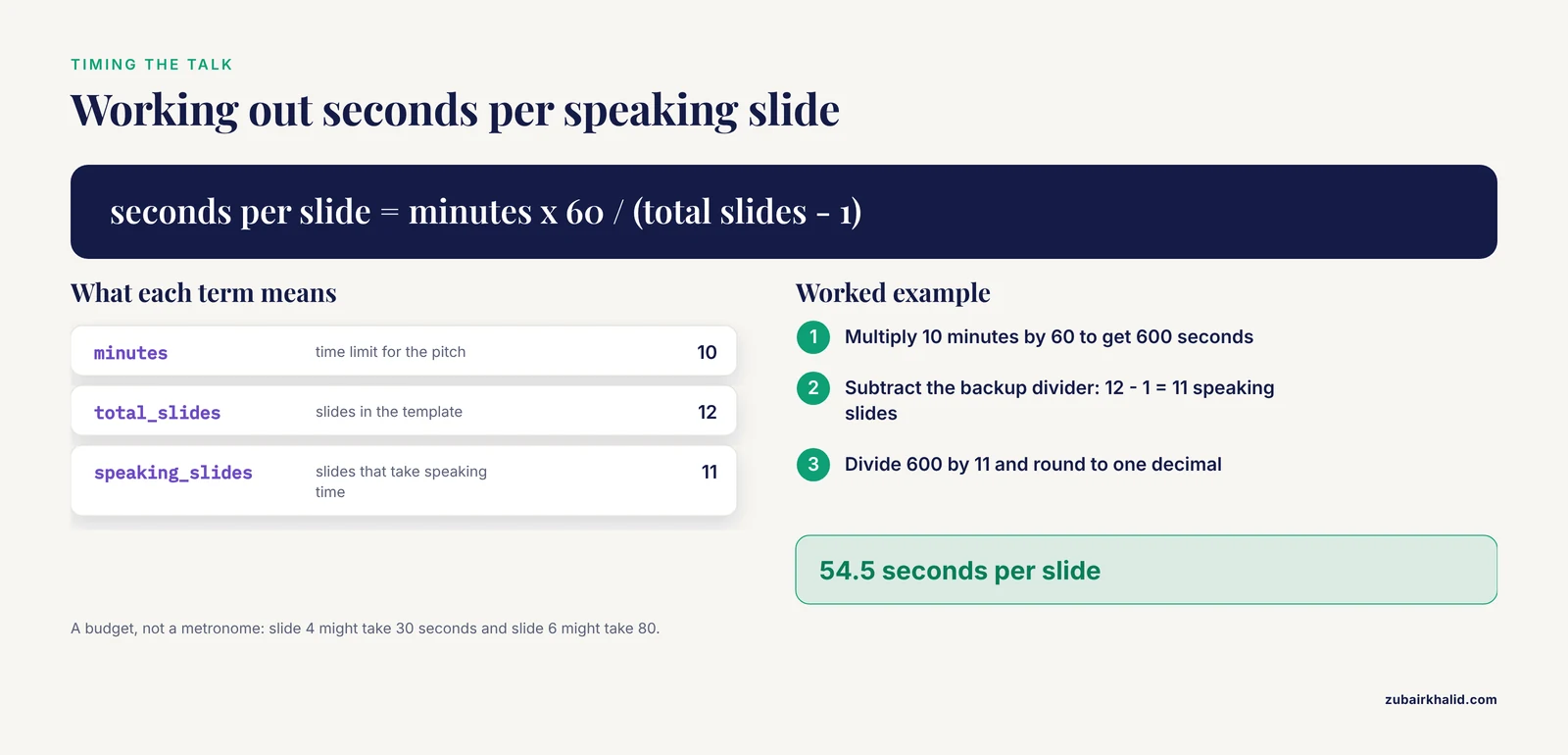
Panel sessions enforce time limits strictly, and running over reads as poor planning. Compute your per-slide budget before the first rehearsal.
minutes = 10
total_slides = 12
speaking_slides = total_slides - 1   # the backup divider takes no speaking time
seconds_per_slide = minutes * 60 / speaking_slides
print(round(seconds_per_slide, 1), "seconds per slide")
Expected output:
54.5 seconds per slideThat number is a budget, not a metronome. Slide 4, the hypothesis, might take 30 seconds while slide 6 takes 80. What matters is that the total lands under the limit. Rehearse with a stopwatch and adjust.
Step 6: Log rehearsals with a research template
Treat rehearsal data the way you treat experimental data. A simple research template, kept in a spreadsheet or plain text file, records each run and what went wrong:
run | date       | time    | problems
1   | 2026-11-02 | 11:40   | Aim 2 ran 90 s, dropped two bullets
2   | 2026-11-04 | 10:20   | forgot fallback plan on Aim 3
3   | 2026-11-06 | 09:55   | summary slide clean
Published guidance on funding pitches highlights practice and feedback as decisive, not optional [1]. Recording times and defects turns vague advice into a checklist you can actually clear.
Selecting Content and Structuring the Argument
Content selection is where most pitches fail, because applicants treat the pitch as a compressed version of the written proposal. Guidance on funding pitches is explicit that the pitch is a distinct form with its own goals of convincing reviewers about both the project and the person [1]. Practical selection rules follow from that distinction.
Cut background to one slide. The panel read your proposal. Slide 2 establishes stakes, slide 3 establishes the gap, and nothing else in the way of introduction.
Make each aim a self-contained argument. For each of slides 6 through 8, answer four questions in order: what will you do, how will you measure it, what result supports the hypothesis, and what will you do if the result contradicts it. A pitch that names its own weak points and answers them reads as confidence rather than vulnerability, and reviewers raise those points in discussion anyway.
Show the person on slide 9. Because the pitch exists partly to demonstrate your suitability as a researcher [1], the feasibility slide should make your track record visible. Preliminary data that proves you can run the key assay, a photograph or list of the critical instrument you already have access to, and one line per team member stating their role all belong here.
Keep numbers honest and few. One convincing pilot result with an effect size you can explain beats six figures the panel cannot absorb. If you claim a result, be ready to defend the sample size and the control in the question period.
A useful structural device is verbal signposting between blocks. Short sentences such as "That is the gap. Here is our hypothesis." or "Aim 2 tests whether that correlation is causal." tell the panel where they are in the argument. Explicit signposting is one of the clearest structuring practices recommended for funding pitches [1].
Rehearsal, Feedback, and Timing Under Pressure
The ten simple rules framework for funding pitches singles out practice and feedback, and the reason is mechanical. A pitch is a performance under a hard timer, and performance skills only develop through repetition with outside eyes.
A rehearsal plan that works:
- Run 1 to 3, alone, timed. Use the per-slide budget from Step 5. Expect the first run to run long. Cut bullets rather than speaking faster.
- Run 4 to 6, with one listener from outside your subfield. If they cannot restate your hypothesis afterward, the problem is your wording, not their attention.
- Run 7, with a hostile questioner. Ask a colleague to interrupt with the three hardest questions they can invent. This converts the question period from a threat into a rehearsed exercise.
- Final run, recorded on video. Watch for filler words, back-turning toward the screen, and the habit of reading slides aloud.
Feedback should be specific. "It felt long" is unusable. "You spent two minutes on Aim 2 methods and never said the expected result" is a fixable instruction. This is the same discipline you apply to a lab notebook template pdf, where each entry records what was done, what was observed, and what to change next. The pitch rehearsal log is that same research template applied to a communication experiment, with your speaking time as the measured variable.
One practical timing trick: rehearse with the backup slides included in the click-through, but not in the speaking time. You should know exactly which backup slide answers which question, so that in discussion you reach it in one click.
Handling Questions and Critical Discussion
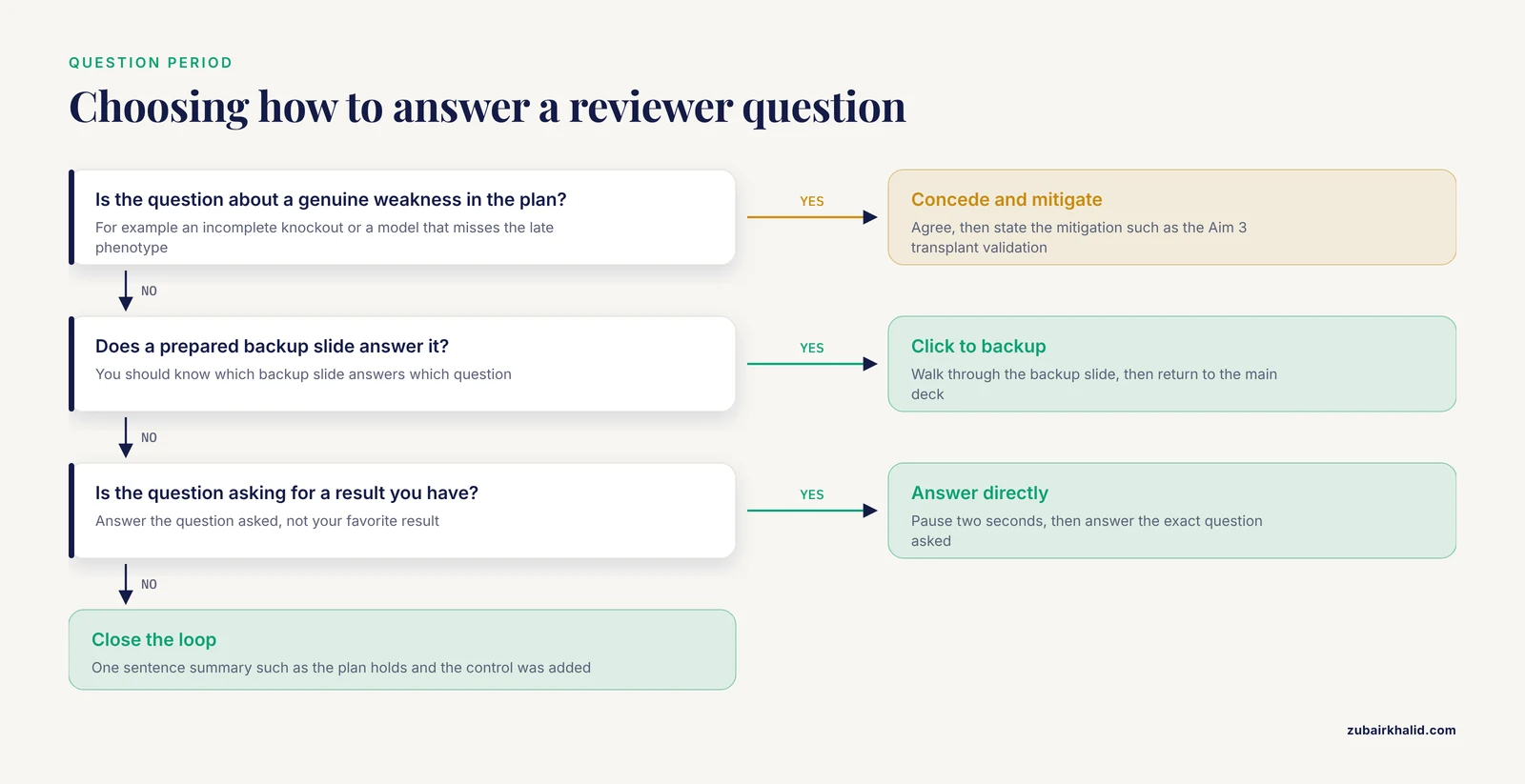
The discussion after a funding pitch is part of the evaluation, and published guidance stresses handling it professionally rather than merely surviving it [1]. Panelists use questions to probe depth, honesty, and how you think under pressure. Several strategies help.
Pause before answering. Two seconds of silence feels long to you and reads as thoughtfulness to the panel. It also stops you from blurting the first half-formed sentence.
Answer the question asked. If the question is "what is your fallback if the knockout is incomplete," answer that. Do not redirect to your favorite result. Reviewers notice evasion immediately, and evasive answers damage the suitability judgment that the pitch is designed to build [1].
Concede real weaknesses. If a panelist identifies a genuine flaw, agree, then state the mitigation. "You are right, that model does not recapitulate the late phenotype. That is why Aim 3 includes the transplant validation." Concession plus mitigation demonstrates scientific maturity.
Use the backup slides. Click to the relevant backup slide, walk through it, and return to the main deck. Prepared backup material shows the panel you anticipated the hard questions.
Close the loop. If the discussion surfaces a concern you can address in one sentence, a brief closing statement such as "To summarize, the plan holds, and we have added the dose-response control you raised" leaves a final impression of composure.
Turning Your Lab Records Into Slides
A grant pitch is only as strong as the preliminary data behind it, and preliminary data lives in your notebooks. This is where a lab notebook template pdf earns its place in your grant workflow. A structured notebook page, whether paper or PDF, with fixed fields for date, experiment ID, protocol version, reagent lots, raw observations, and a decision line, gives you slide-ready evidence months later.
The workflow:
- During experiments, record results in the notebook template with enough context that a stranger could interpret them.
- When writing the proposal, extract the two or three results that prove feasibility for slide 9.
- When building backup slides, pull the controls and dose-response curves that anticipate reviewer objections.
- During the pitch cycle, log rehearsal runs and deck versions in the same filing system.
The result is a pipeline where the lab notebook template pdf feeds the research template, which feeds the pitch deck. Nothing on slide 9 is reconstructed from memory, which matters because panels can ask exactly which experiment produced a given figure.
Common Mistakes and Limitations
These are the errors that appear most often when scientists adapt their written proposals for oral review.
- Reading the proposal aloud. The pitch is a distinct genre with its own goal of convincing reviewers on both project and person [1]. A compressed paper is neither.
- Too many slides for the time. Twenty slides in ten minutes guarantees a rushed finish. Twelve slides with a per-slide budget near 55 seconds fits a 10-minute pitch.
- No hypothesis slide. If the panel cannot find one testable sentence, every aim sounds like a fishing expedition.
- Expected results missing. Each approach slide must state what outcome would support the hypothesis. Without it, the argument is a plan, not a test.
- No fallback plans. Reviewers ask what happens when the key experiment fails. A pitch with no alternatives looks fragile.
- Hiding the applicant. The pitch assesses suitability as a researcher [1]. A deck with no track record or team roles wastes that opportunity.
- Skipping hostile rehearsal. The first hostile question should not be the first hostile question you have ever heard. Rehearsed interruption is the fix.
- Ignoring the stated format. Time limits, slide requirements, and whether questions come during or after the talk vary by program. Read the call documents and the review procedure for your specific competition before you fix the format, because the numbers in this article are a worked example for a 10-minute session, not a universal standard.
A final limitation to state plainly. Review panels differ in culture and format, and no template guarantees an outcome. Individual pitches need to be checked against the specific instructions of the funding body and rehearsed with people who know that body's expectations.
Frequently Asked Questions
What is a grant proposal presentation template?
It is a prestructured slide framework with a fixed number of slides, each assigned a specific argumentative job, such as stating the gap, the hypothesis, or a feasibility proof. You fill in content per application instead of redesigning the talk from scratch each time.
How long should a grant proposal presentation be?
Follow the time limit in the call for applications, since programs vary widely. For a common 10-minute pitch, the 12-slide template in this article allocates about 55 seconds per speaking slide, with the backup divider taking no speaking time.
Can I reuse my written proposal slides?
You can reuse figures and data, but not the structure. The written proposal builds background slowly for a reader, while the pitch must answer importance, feasibility, and suitability quickly for a panel that already read the document.
What is the difference between a funding pitch and a conference talk?
A funding pitch is delivered during a competitive review to complement a written proposal, and it must convince reviewers of both the project's excellence and the applicant's suitability. A conference talk informs peers and assumes no one is scoring you on feasibility.
How many slides do I need for a 10-minute pitch?
Eleven speaking slides plus one backup divider works well, which gives 11 content slides at roughly 55 seconds each. If your program allows more or less time, scale the count so the total stays under the limit.
Where can I find a free grant proposal presentation template?
Google Slides and PowerPoint include free built-in themes, LaTeX Beamer is free and produces clean scientific decks, and many university communications offices provide branded slide masters at no cost. The slide structure in this article works in any of them.
How do I handle hostile reviewer questions?
Pause, answer the exact question asked, concede genuine weaknesses and state your mitigation, and use a backup slide when one fits. Published guidance treats professional handling of critical discussion as part of the pitch itself, not an afterthought.
Should I include failed preliminary data?
Include it if it demonstrates that you identified a problem and designed around it, for example a pilot that failed and led to the fallback plan in Aim 3. Include it if it proves feasibility of a harder alternative. Do not include it merely as confession.