Grant Call Analysis Template and Worksheet
By Dr. Zubair Khalid, DVM, MS, PhD ·

By the end of this article you will be able to take any funding call, extract its hard requirements and evaluation criteria, score how well your project fits, and decide whether writing the proposal is worth your next six to ten weekends. You will build a reusable worksheet in a spreadsheet, fill it in with a worked example, and finish with a documented go or no-go decision you can defend to your collaborators.
You need three things on hand: the full call document (the call text, the evaluation criteria, and the submission guidelines, usually three separate PDFs from the funder), a spreadsheet application such as Microsoft Excel, Google Sheets, or LibreOffice Calc, and about two focused hours for the first pass.
Why analyze a call before writing anything
Most rejected proposals fail at the fit stage, not the writing stage. The team had a good idea but aimed it at a funder whose priorities, budget ceiling, or review culture could never reward it. A structured analysis done before drafting protects your most scarce resource, which for many researchers is protected time rather than money. A discursive analysis of nursing research funding found that limited protected time for research activities, weak institutional infrastructure, and scarce academic career pathways are persistent structural barriers that keep talented researchers from competing for grants at all [1]. A call analysis does not remove those barriers, but it stops you from spending your limited protected time on calls you cannot win.
A second reason is that funders score against published criteria, and those criteria are usually visible before you write a word. In a trial of distributed peer review run by the Volkswagen Foundation for an interdisciplinary call, every applicant reviewed four or five competing proposals and supplied both an overall score and separate scores for each funding criterion, and proposals were ranked using a trimmed mean of those scores [2]. That structure tells you something practical. Separate criterion scores exist, reviewers record them, and arithmetic turns them into a ranking. Your analysis worksheet should therefore mirror the funder's own scoring structure, field by field.
A third reason is consistency. Structured, criterion-based assessment is how careful research groups evaluate almost anything now, from medical devices to screening programs. The PRAISE-U prostate cancer screening readiness assessment, for example, built 47 indicators across 11 domains and scored each on a standardized 0 to 2 scale before aggregating results [3]. The same logic, a small number of explicit indicators scored on a defined scale, works perfectly for judging whether your project matches a call.
The grant call analysis template format
The template has four blocks. Each block is a section of one spreadsheet tab, or four tabs if you prefer separation. This is the format you will fill in during the walkthrough.
| Block | Purpose | Key fields |
|---|---|---|
| A. Call facts | Hard administrative constraints | Deadline, budget ceiling, project duration, eligibility, cofunding rules, submission portal |
| B. Criteria decoder | What reviewers actually score | Each criterion verbatim, its weight, evidence the funder expects |
| C. Alignment matrix | Line-by-line match of your project to each criterion | Requirement, your evidence, alignment score 0 to 3, gap action |
| D. Decision | Weighted fit score and go or no-go | Weighted score, effort estimate, decision, revisit date |
Block A prevents administrative rejection. Block B prevents substantive rejection. Block C turns vague anxiety into a list of gaps you can either close or accept. Block D converts everything into one number plus one judgment.
Numbered walkthrough with a worked example
The worked example below uses a clearly hypothetical call so you can see every field filled in. Replace the example content with the real call you are analyzing. Nothing in the example represents any real funder's rules.
Step 1. Extract the hard facts into Block A
Open the call document and copy the exact wording for each field. Do not paraphrase eligibility rules or budget caps, because paraphrasing is where errors creep in.
Create a CSV file like this one, or type the rows directly into a sheet.
Field,Value,Source page,Verified
Call title,Hypothetical Interdisciplinary Biosystems Initiative 2027,p.1,yes
Submission deadline,2027-03-15 17:00 local funder time,p.2,yes
Full proposal or preproposal,Two-stage, preproposal first,p.2,yes
Maximum budget,"EUR 450,000 total, no more than EUR 180,000 per partner",p.4,yes
Project duration,36 months,p.4,yes
Eligibility,"PI must hold a PhD, be based at an eligible institution in an eligible country, and have no active grant from this funder",p.3,yes
Cofunding required,None,p.5,yes
Indirect cost rate,Funder flat rate, see guidelines annex,p.5,NO
Submission portal,GrantPortal URL listed on p.2,p.2,yes
Required attachments,"CV, track record table, letters of support from each partner, [data management](/blog/guides/data-management-basics-principles-processes-and-best-practices) plan",p.6,yes
The Verified column is your audit trail. Anything marked NO is a task. In the example, the indirect cost rate is unresolved, so that becomes action item one.
Step 2. Decode the evaluation criteria into Block B
Find the section usually titled Evaluation Criteria, Assessment Procedure, or Review Process. Copy each criterion verbatim into row one of a new table, then record the weight the funder assigns. If the funder publishes no numeric weights, write "unstated" and estimate later from the order and length of the criteria descriptions.
Criterion,Verbatim wording (abbreviated),Weight,Funder expects
Excellence,"Novelty and scientific quality of the approach",40%,A clear advance over state of the art, testable hypotheses
Methodology,"Soundness of study design and analysis plan",25%,Detailed work plan, milestones, risk mitigation
Impact,"Relevance to call themes and expected uptake",20%,Explicit link to call objectives, dissemination plan
Team,"Complementarity of the consortium and track record",15%,Each partner has a defined role, prior collaboration evidence
Two details from real review systems should shape how you fill this block. First, where applicants themselves serve as reviewers, as in the distributed peer review trial, reviewers are working scientists who read several proposals in one call and can compare yours directly against the pool, so generic claims without concrete evidence stand out badly [2]. Second, the trial used a trimmed mean, which means extreme scores from a single reviewer were dropped before ranking [2]. One enthusiastic reviewer cannot carry a weak proposal, so aim to satisfy every criterion, not to dazzle on one.
Step 3. Build the alignment matrix in Block C
This is the analytical core. For each criterion, list two to five concrete demands the funder implies, then score your current project against each demand on a 0 to 3 scale:
- 0 means no evidence at all
- 1 means weak or indirect evidence
- 2 means solid evidence that needs writing up
- 3 means evidence already exists in publishable or documented form
Here is the filled example for the Excellence criterion.
Demand,Your evidence,Score (0-3),Gap action
Novelty vs state of the art,Lab has 2 unpublished datasets on the mechanism,2,Draft one paragraph citing both datasets
Testable hypotheses,Draft hypotheses exist from internal grant,3,None
Advance over prior art,Not yet benchmarked against 2024-2025 literature,0,Assign a 1-day literature scan
Fit to call theme,Theme is metabolism, project is metabolism-adjacent,1,Rewrite specific aims around theme keywords
Repeat for Methodology, Impact, and Team. A typical matrix for one call holds 12 to 18 demand rows across all criteria.
Structured scoring like this mirrors established practice in other assessment contexts. Competency frameworks developed for dental practitioners, for instance, assessed 112 items across 14 domains using parallel five-point Likert-type scales, with content validity checked by expert review [4]. Parallel scales across defined domains are exactly what your matrix is doing, and expert review is exactly what a mentor or senior colleague provides when you ask them to sanity-check your scores.
Step 4. Compute the weighted fit score in Block D
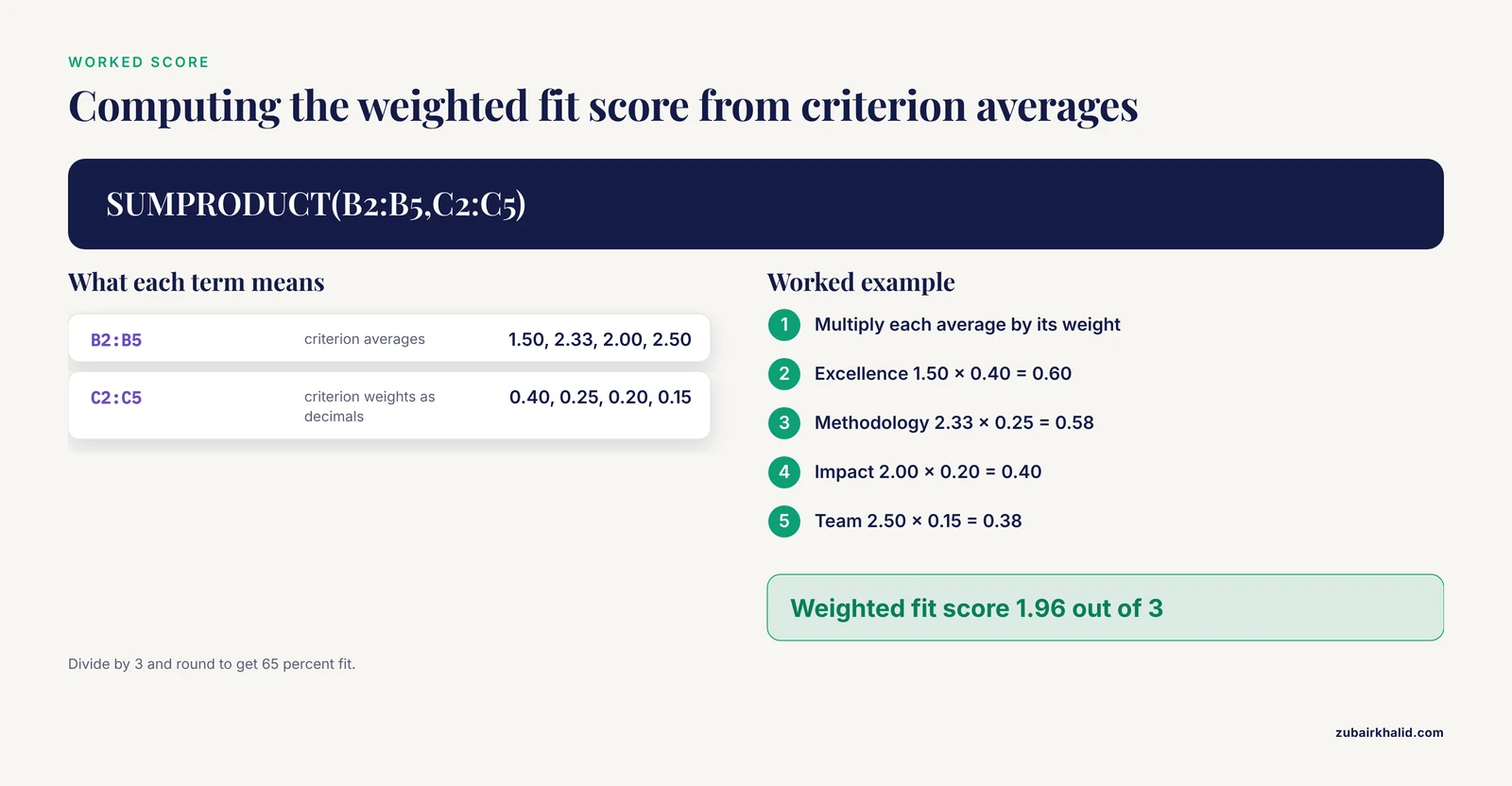
Average the demand scores within each criterion, then multiply by the criterion weight. In your spreadsheet, suppose criterion averages sit in cells B2 to B5 and weights in C2 to C5, with weights expressed as decimals (0.40, 0.25, 0.20, 0.15).
=SUMPRODUCT(B2:B5,C2:C5)For the example, assume these criterion averages:
Excellence  average 1.50  weight 0.40  contribution 0.60
Methodology average 2.33  weight 0.25  contribution 0.58
Impact      average 2.00  weight 0.20  contribution 0.40
Team        average 2.50  weight 0.15  contribution 0.38
                        Weighted fit score  1.96 out of 3
Convert to a percentage for a human-readable number:
=ROUND(SUMPRODUCT(B2:B5,C2:C5)/3*100,0)Expected output: 65, meaning 65 percent fit.
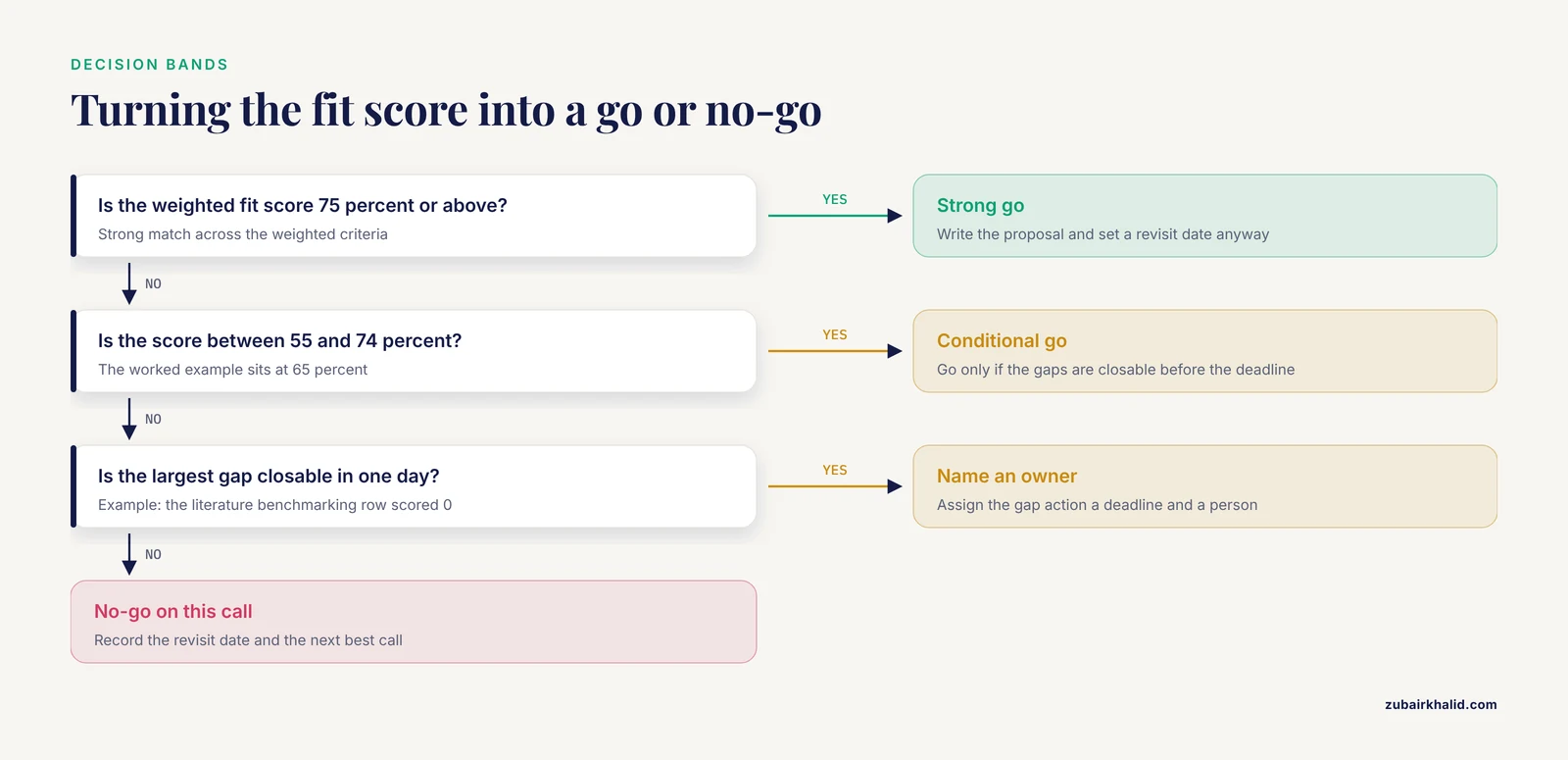
Interpretation bands are your choice, but a workable default is 75 percent or above for a strong go, 55 to 74 percent for go only if the gaps are closable before the deadline, and below 55 percent for no-go on this call. The example sits at 65 percent, and the largest single gap (the literature benchmarking row scored 0) is closable in one day, so the example decision is a conditional go.
Step 5. Add the review-process row
Block D should include one row describing how the call will actually be reviewed, because process shapes strategy. Note whether review is by a panel, by external reviewers, or by applicants themselves. The distributed peer review trial combined a staff shortlist, a small reviewer panel, and a final panel discussion in its conventional track, and compared that against applicant-led review of the same 140 proposals [2]. If the call you are analyzing uses distributed review, add a preparation task: write so that a busy peer applicant, reading four or five proposals in a row, can find your criterion evidence without effort. If it uses a panel, add a task instead: make the proposal scannable by section so panelists who read quickly still hit each scored criterion.
Step 6. Check eligibility and expectation compliance against current funder norms
Funders increasingly encode expectations into calls that go beyond science. Read any paragraph about study design requirements carefully. A systematic review of women's cardiovascular health research in Aotearoa New Zealand found that most studies provided minimal gender analysis beyond demographic representation, and the authors issued recommendations aimed directly at researchers and funders, including appropriate sample sizing for equal explanatory power and mandatory sex-disaggregated reporting [5]. When a call mentions equity, sex as a biological variable, or stakeholder engagement, treat those phrases as scored criteria, copy them into Block B, and give them demand rows in Block C. Reviewers who care about these points will find their absence within the first two pages.
Step 7. Record the decision and the revisit date
Finish Block D with three fields: decision (go, conditional go, or no-go), effort estimate in hours to a submittable draft, and a revisit date if the decision is no-go (the next cycle of the same call, or a better-matched call you found while analyzing).
Decision,Conditional go
Effort estimate,80 hours across 9 weeks
Revisit condition,If literature scan finds prior art blocks the novelty claim, switch to no-go by week 2
Next best call,Identified during search, flag for next quarter
A free grant call analysis template you can copy
The four CSV blocks above constitute the free grant call analysis template in full. To turn them into a working sheet:
- Create a new spreadsheet with four tabs named Facts, Criteria, Matrix, Decision.
- Paste each CSV block into its tab using Data, then Split text to columns, with comma as the delimiter.
- On the Decision tab, put criterion averages in B2 to B5 and weights in C2 to C5, then enter the SUMPRODUCT formula from Step 4.
- Add a column to Matrix named
Scorewith data validation set to allow whole numbers between 0 and 3, which prevents accidental 10s and typos. - Add a conditional formatting rule on the Score column so 0 cells fill red and 3 cells fill green. The red cells are your worklist.
Reusing the same file for every call builds a personal database of funder behavior over time. After three or four calls you will know which funders publish weights, which bury eligibility exceptions in annexes, and which rewrite their impact criteria between cycles.
Common errors and exact fixes
#VALUE! in the weighted score cell
Excel and Google Sheets return #VALUE! when SUMPRODUCT ranges contain text, which happens when a weight cell holds 40% typed as text with a stray space, or when a criterion average cell holds the word unstated. Fix by selecting C2 to C5, checking each cell with =ISNUMBER(C2) (expected output TRUE for every row), and replacing text entries with real numbers. If a weight is genuinely unstated, assign your estimate and add a note in the adjacent cell.
Formula parse error in Google Sheets
Google Sheets returns #ERROR! with the message "Formula parse error." when locale settings expect semicolons instead of commas as argument separators. Since many European locales do this, either switch the spreadsheet locale under File, then Settings, or write the formula with semicolons:
=SUMPRODUCT(B2:B5;C2:C5)Criterion averages computed across blank rows
If a criterion has three demand rows but you only scored two, a plain =AVERAGE(B2:B4) silently ignores the blank and inflates the average. Use =AVERAGEIF(B2:B4,">=0") to force every row to carry a score, or fill every row with a number before averaging. The honest 0 is more informative than a blank, because a 0 generates a gap action while a blank generates nothing.
PDF text extraction garbles the criteria wording
Some call PDFs are scanned images. If copy-paste produces gibberish, run the PDF through optical character recognition before copying criterion text. Verbatim wording matters because your matrix demands must quote the funder, and a paraphrased criterion is easy to get subtly wrong.
How to check that your analysis is right
Run four checks before trusting the output.
First, the verbatim check. Every demand row in Block C should trace to a quoted phrase in the call document. If you cannot point to where a demand comes from, it is your assumption, and you should verify it against the funder's FAQ page or ask the contact officer. Funders answer eligibility and scope questions, and a short email before the deadline is cheaper than a desk rejection.
Second, the stranger test. Give the completed Matrix tab to a colleague outside your subfield for ten minutes. If they cannot tell from your evidence column what you would actually do, your proposal will have the same problem for real reviewers.
Third, the weight sum check. Weights must total 1.00. Add =SUM(C2:C5) in a spare cell and confirm it displays 1. A common slip is entering four weights of 0.25 each when the call actually specifies unequal weights, which flattens your score and hides where the funder places emphasis.
Fourth, the sensitivity check. Change the weakest demand score from 0 to 2 and see how much the weighted total moves. If the total barely moves, the criterion is heavily weighted and your gap is expensive, which argues for no-go. If the total jumps, closing one gap changes your decision, which argues for a conditional go with a named owner and deadline for that gap.
Connecting the worksheet to grant proposal planning
The completed worksheet is the first artifact of grant proposal planning, and everything downstream should trace back to it. The alignment matrix becomes your proposal outline, because each demand row maps naturally to a section or subsection. The gap actions become your writing task list, ordered by deadline. The criteria weights become your page budget, so a 40 percent Excellence weight justifies spending your best prose and most revisions on the aims and novelty sections rather than on padding the budget justification.
Planning around structural barriers also matters at this stage. The analysis of barriers to nurse-led research funding highlighted that targeted funding schemes, integrated clinical-academic roles, and mentorship programs significantly enhance research output and clinical impact where they exist [1]. Translate that into planning terms: if your institution lacks grant support staff, your worksheet should include a row for administrative effort, and you should recruit a mentor to review the matrix precisely because no office will do it for you. Where mentorship programs exist, use them at the matrix stage rather than the final proofreading stage, when comments arrive too late to change the argument.
Many researchers formalize these habits through a research grant writing course, and the worksheet is an excellent companion to one. Most courses teach narrative structure, aims logic, and reviewer psychology, while the worksheet supplies the front-end analysis that decides whether those skills get applied to a winnable call. If you enroll in one, bring your completed worksheet for the call you intend to pursue. Course instructors can critique a scoring matrix in minutes, and the feedback improves every proposal you write afterward, not just one.
Common Mistakes and Limitations
- Analyzing the call from the summary page only. The two-page call announcement is marketing. The binding constraints live in the guidelines PDF and the annexes, so never complete Block A from the summary.
- Copying an old template without re-reading the criteria. Funders revise criteria between cycles. A worksheet filled from memory or from last year's call produces confident errors.
- Scoring yourself generously. Self-scores drift upward because you know your own work's context that reviewers will never see. Counter this by having a colleague score the same matrix independently and averaging the two, or by requiring a citation or document reference for every score of 2 or 3.
- Treating "unstated" weights as equal weights. When a funder lists criteria without numbers, the order and word count still signal emphasis. Note your reasoning in the sheet rather than defaulting silently to equality.
- Confusing fit with quality. A high weighted score means the project matches the call. It does not guarantee the science is sound or the consortium can deliver. The matrix and the scientific review are separate filters, and you need both.
- Ignoring review mechanics. A trial in which 323 applicants reviewed proposals for the same call showed how much reviewer identity and review format shape outcomes, with distributed review recommending ten proposals for funding while the conventional panel track made its own recommendations [2]. Whatever the format, assume tired readers with a stack, and write the matrix evidence so it survives a fast read.
- Doing the analysis once, alone, and never revisiting. Set the revisit date in Block D even for a go decision. Calls get extended, corrected, or reissued, and a worksheet that is three months stale is a liability.
- Expecting the template to substitute for judgment. The number at the bottom of Block D is a structured summary of your reasoning, not a replacement for it. Individual funding decisions involve context no template captures, including your lab's bandwidth and your institution's support, so treat the score as an input to a conversation, not the conversation itself.
One further limitation deserves plain acknowledgment. No template predicts reviewer taste. Structured analysis raises your floor by preventing avoidable rejections, and the evidence that criterion-by-criterion scoring drives rankings [2] supports that. What it cannot do is guarantee funding in a system where, as demonstrated in the distributed peer review evaluation, different review methods applied to identical proposals produced different funding recommendations [2]. Budget your emotional energy accordingly.
Frequently Asked Questions
What is a grant call analysis template?
A grant call analysis template is a structured worksheet that breaks a funding call into its hard administrative facts, its scored evaluation criteria, and a point-by-point comparison against your project. It produces a weighted fit score and a documented go or no-go decision before you invest time in writing.
Where can I get a free grant call analysis template?
The four CSV blocks in this article form a complete free template, and you can rebuild them in Excel, Google Sheets, or LibreOffice Calc in about fifteen minutes using the setup steps listed above. Copy them, adapt the field names to your field, and reuse the same file for every call.
What does a standard grant call analysis template format include?
The standard format has four blocks: call facts such as deadline and budget ceiling, a criteria decoder that captures each criterion verbatim with its weight, an alignment matrix scoring your evidence against each implied demand on a 0 to 3 scale, and a decision block with a weighted score and an effort estimate.
How long does a thorough call analysis take?
Plan on roughly two focused hours for the first call you analyze, mostly spent locating and quoting the binding documents. Subsequent analyses take forty-five to sixty minutes because the template structure and your scoring habits are already in place.
How do I score fit without fooling myself?
Score each demand on the anchored 0 to 3 scale, require a concrete evidence reference for any score of 2 or 3, and have a colleague score the same matrix independently. Compare the two score sets and discuss every row where they differ by more than one point.
Can a good call analysis really improve my chances of funding?
Yes, indirectly but substantially. Reviewers award scores criterion by criterion, and rankings are computed from those scores [2], so matching every published criterion is the controllable part of the problem. The analysis cannot control reviewer taste or competition levels, but it eliminates the most common cause of rejection, poor fit.
How does the worksheet feed into grant proposal planning?
The alignment matrix becomes your proposal outline, the gap actions become your writing task list with deadlines, and the criteria weights become your page and revision budget. Each proposal section should trace back to a demand row, which keeps the draft anchored to what the funder scores.
Should I take a research grant writing course if I already use a template?
A course and a template teach different layers. The template handles pre-writing analysis and decision making, while a course develops narrative craft, aims logic, and reviewer psychology. Doing both, ideally bringing your completed worksheet to the course for critique, gives you the full pipeline from call selection to submitted proposal.
Further Reading
Sources
- A Call to Action for Nurse Researchers: Overcoming Barriers to Research Funding.
- Applicants as reviewers: a mixed methods evaluation of the risks, benefits, and potential of distributed peer review for grant funding allocations.
- Mapping the readiness landscape for prostate cancer screening in Europe: analysis of health system capacity across the PRAISE-U pilots.
- A call for lifelong learning: development and preliminary pilot testing of a discipline-specific performance appraisal framework for general dentists in Dubai.
- The gender data gap in women's cardiovascular health research in Aotearoa New Zealand: a call to action.