Common Reasons Grant Applications Are Returned Without Review
By Dr. Zubair Khalid, DVM, MS, PhD ·

The most common reason a grant application is returned without review is administrative noncompliance with the funding announcement. A missing required attachment, a section that exceeds the page limit, an incomplete budget justification, or an application submitted to the wrong funding mechanism will stop an application before any scientist reads a word of it. The first thing to check is the return notice itself, followed by the funding announcement's checklist of required materials. Most returns trace back to a specific, named defect that can be corrected within days.
This matters because a return is not a scientific rejection. When a grant application is returned without review, peer reviewers never scored the science. The application failed a compliance gate that comes before scientific evaluation. That distinction should shape your response. A returned application is a correctable paperwork and planning problem, and early-career researchers who understand the mechanics of the process recover from it quickly [1].
What "Returned Without Review" Means
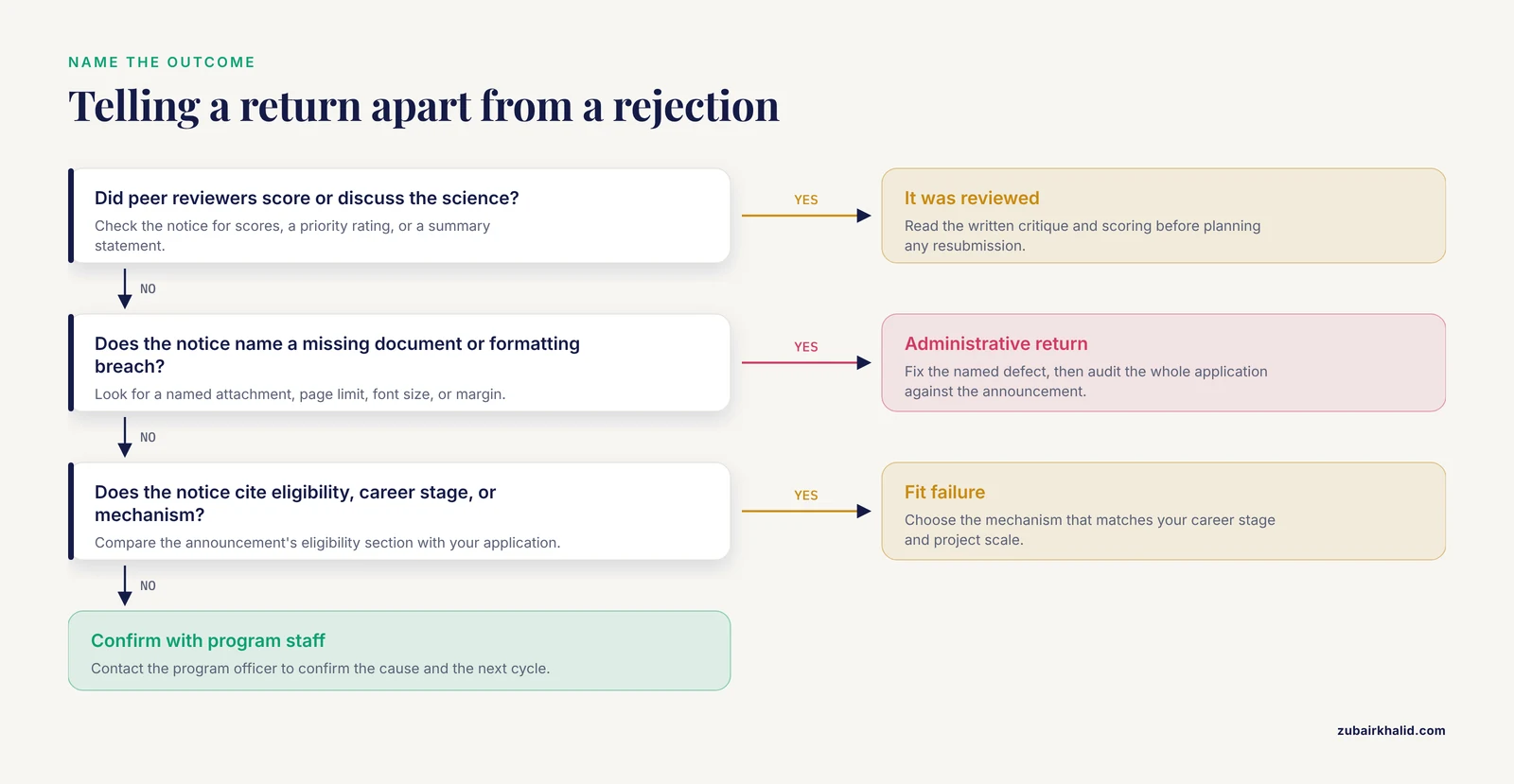
Grant funding agencies run a two-stage evaluation. In the first stage, administrative staff verify that the application is complete, eligible, and compliant with the announcement. In the second stage, peer reviewers, meaning independent experts in the field, evaluate the scientific merit of the application and assign scores or priority ratings [2].
A returned application never reaches the second stage. Staff or the electronic submission system identified a defect, and the application was sent back to the applicant with an explanation. Common synonyms include "returned for corrections," "administratively withdrawn," or "incomplete." The key point is that no reviewer judged the hypothesis, the methods, or the significance. Those judgments still lie ahead once the defect is fixed.
This differs from two other unfavorable outcomes. An application that is "unscored" or "not discussed" was reviewed and failed to make it onto the shortlist for scoring. An application that is "rejected" received a full written critique. All three outcomes are setbacks, but the causes and the fixes are completely different, which is why diagnosing the outcome correctly is the first step.
Common Reasons Grant Applications Are Returned Without Review
The causes below run from the most frequent to the rarest. In practice, most agencies report that the majority of returns involve the first three categories, which are entirely preventable with careful grant proposal planning.
Administrative and Formatting Noncompliance
This is the leading category, and it covers defects that have nothing to do with the quality of the science.
Typical defects include:
- A required attachment is missing, such as a biographical sketch, a data management or sharing plan, current and pending support forms, a budget justification, or letters of support.
- The application violates formatting rules. Page limits, minimum font sizes, and margin requirements are the usual offenders. Reviewers often cannot evaluate overlong pages, so agencies enforce these limits mechanically.
- The wrong application form version or an outdated template was used. Agencies update form packages periodically, and an application built on a retired version can be returned automatically.
- Required electronic fields were left blank, or the project summary and abstract exceed their character limits.
- Signatures or institutional authorizations are missing, meaning the applicant's office of sponsored research did not complete its own submission steps.
The mechanism behind these returns is straightforward. Compliance checks are performed against a fixed checklist, sometimes by software and sometimes by grants staff working through a list. There is no discretion to overlook a missing document, because accepting a noncompliant application would be unfair to applicants who followed the rules.
Eligibility and Fit Failures
An application can be perfectly written and still be returned because the applicant, the project, or the institution does not match the funding mechanism.
Common examples include an early-career applicant applying for an award restricted to established investigators, a basic science project submitted to a mechanism reserved for community-partnership or implementation work, or a proposal from an institution type that the program does not fund. Grant types differ sharply in their intended audience. A pilot or seed grant exists to generate preliminary data, a career development award supports a mentored researcher's transition to independence, and an independent research grant funds a mature project, and each carries its own eligibility rules and expectations [1].
Fit problems often reflect skipped planning. The Primer literature for early-career researchers emphasizes that determining whether a specific grant is the right fit, and deciding whether to apply at all, is a distinct step that comes before writing a single page [1]. An application submitted to a mechanism it does not match is returned without the science ever being read, because the mismatch is visible from the cover page and the budget alone.
Submission and Timing Errors
Electronic grant portals reject or return applications for reasons that are easy to overlook.
- The application arrived after the deadline, sometimes by minutes, because the applicant counted the deadline in the wrong time zone.
- The portal flagged validation errors, and the applicant assumed they were warnings. Most systems distinguish warnings from errors, and errors block acceptance.
- Letters of support or reference letters were never uploaded by the letter writers before the deadline. The application shows as incomplete on the agency's side even though the applicant submitted everything they controlled.
- The applicant started the submission on the due date and hit a system outage, a registration problem, or an institutional e-signature bottleneck. Institutional registration with funding agencies can take days to weeks for first-time applicants, which is why experienced administrators insist on registering long before a deadline.
Budget and Justification Errors
Budgets receive detailed administrative scrutiny because they represent public or institutional funds.
Frequent problems include a budget with no justification explaining how each cost supports the proposed research, requests for costs the program does not allow, salaried effort that exceeds institutional limits, missing subaward documentation when a collaborator at another institution will receive funds, and arithmetic errors between the summary budget pages and the detailed pages. Some agencies also require cost or value documentation for larger requests, and reviewers of the administrative kind verify that the request is internally consistent before anything moves forward.
Missing Regulatory and Compliance Documentation
Applications involving human participants, animal subjects, or hazardous materials require proof that the necessary oversight approvals exist or are pending.
Safety note: If your project involves human participants, it needs approval from an Institutional Review Board (IRB), the committee that reviews research to protect participant safety and rights. Work with vertebrate animals requires approval from an Institutional Animal Care and Use Committee (IACUC). Work with pathogenic organisms or hazardous agents may require institutional biosafety committee review. Submitting an application without these approvals documented, or with a human subjects section left incomplete, is a recognized cause of administrative returns. The approvals protect real people and animals, so treat them as substantive requirements, not paperwork.
Weak Grant Proposal Planning
Some applications are returned because the plan itself cannot survive even a brief administrative or programmatic read.
The classic version is a timeline that does not match the award period. If the mechanism funds twelve months and the project aims describe a three-year study, the mismatch is apparent to any reader. Another version is an aims page that promises a full research program under a mechanism designed to fund a pilot study. Pilot and seed grants are intended to generate the preliminary data and feasibility evidence that later support a larger application, and an application that treats a seed grant as a full project grant fails the fit test [1].
Weak planning also shows up as undefined or unmeasurable outcomes. Strong applications state what will be produced, on what timeline, and how success will be judged. A useful illustration of bounded, well-scoped planning comes from published pilot study protocols. One retrospective pilot protocol on extracting clinical data from medical charts specified the exact number of charts to review, the date range, the specific models to be tested, and how the charts would be partitioned into development, training, and held-out test sets [3]. Every element was sized to what a pilot could actually deliver. An application with that level of specificity survives compliance screening because the plan is internally consistent and matches the mechanism.
Planning failures extend to the downstream story as well. Agencies increasingly want applicants to articulate what their funded work will produce beyond publications. Structured frameworks exist for this purpose. The Buxton-Hanney Payback Framework, for example, organizes research outcomes into defined domains so that the eventual payoff of a funded project can be documented and audited, and it has been applied to catalog the outcomes of government-sponsored health research programs [4]. An application that has thought about how its outcomes will be categorized and demonstrated presents a far more coherent plan than one that stops at "we will publish papers."
Scope Mismatch and Duplication Problems
The rarest causes include applications whose subject matter falls clearly outside the funder's stated priorities, applications submitted simultaneously to multiple funders without the required disclosure, and applications withdrawn by the applicant institution because of unresolved internal issues such as an unapproved cost share. Some agencies also screen for overlap with existing funded projects, and an application duplicating already-supported work can be administratively pulled. These returns are less common, but they are permanent defects if uncorrected, because the same mismatch will recur at the next agency.
Troubleshooting Table
| Symptom | Likely cause | How to confirm | Fix |
|---|---|---|---|
| , - | , - | , - | , - |
| Return notice lists a missing attachment | Administrative noncompliance | Compare the notice against the announcement's required-materials list | Upload the named document and verify the complete attachment list before resubmission |
| Return notice cites page limits, font, or margins | Formatting violation | Measure the offending section against the announcement's formatting rules | Reformat, then run a compliance pass on every section, not just the named one |
| Application never passed portal validation | Submission system error | Log into the portal and read the error and warning history | Clear every error, allow time for revalidation, and submit at least several days early |
| Reference or support letters never arrived | Letter-writer delay | Check the portal status page for received letters | Contact letter writers weeks ahead and confirm receipt before the deadline |
| Returned with a statement about eligibility | Fit or career-stage mismatch | Read the eligibility section of the announcement word for word | Identify the mechanism that matches your career stage and project type [1] |
| Returned for an incomplete or missing budget justification | Budget administrative error | Compare the budget pages against the justification line by line | Rewrite the justification so every requested cost is explained and allowable |
| Returned with comments about the timeline or aims | Grant proposal planning failure | Check whether the aims fit the award period and mechanism | Resize the project to the mechanism, usually by cutting to a pilot-scale question [1] |
| Returned citing missing regulatory approvals | Compliance documentation gap | Check IRB, IACUC, or biosafety documentation status | Obtain or document the approvals, or defer submission until they are in place |
A Diagnostic Sequence
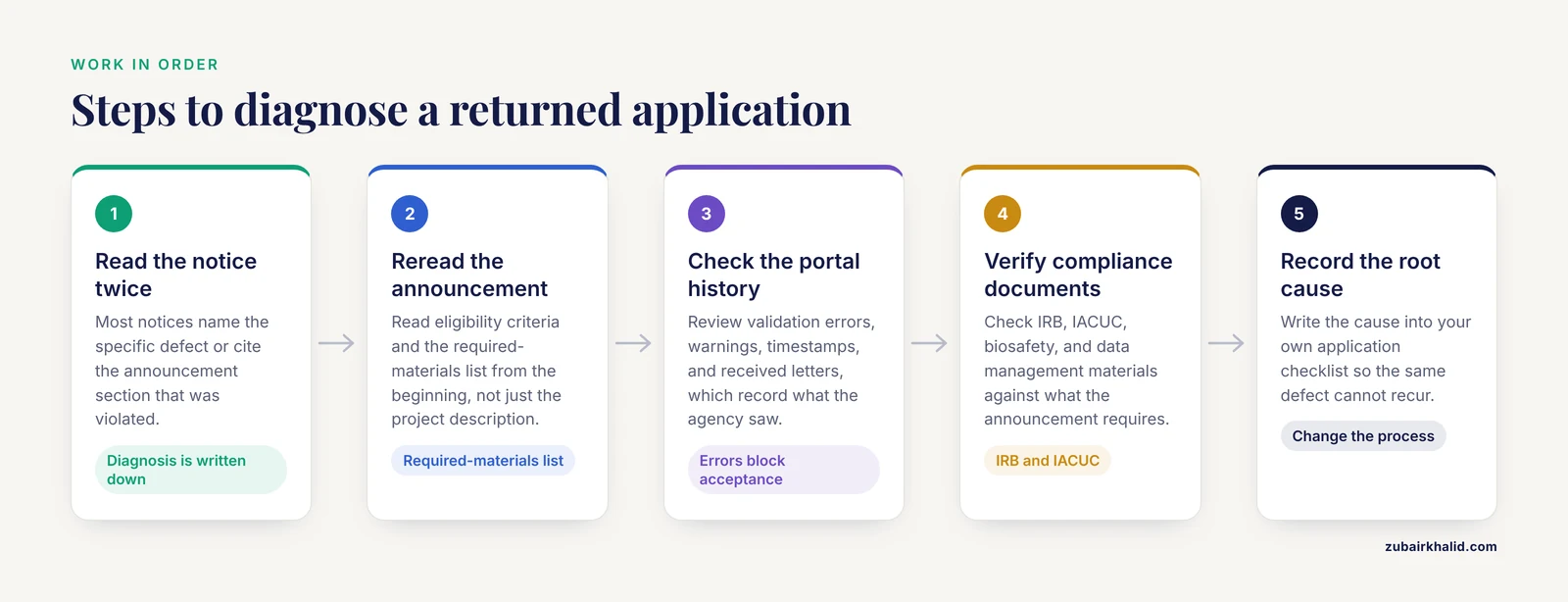
When a grant application is returned without review, work through these steps in order.
- Read the return notice completely, twice. Most notices name the specific defect or cite the announcement section that was violated. The diagnosis is usually written down for you.
- Pull up the funding announcement and read the eligibility criteria and required-materials list from the beginning. Many applicants never read past the project description requirements.
- Log into the submission portal and review the full submission history, including validation errors, warnings, timestamps, and received letters. Portals record exactly what the agency saw.
- Check your compliance documentation, including IRB, IACUC, biosafety, and data management materials, against what the announcement requires.
- Verify that the mechanism you chose matches your career stage, your institution, and the scale of the project. If the announcement describes pilot awards and your aims describe a multi-year program, fit is your problem [1].
- Contact the program officer or grants management officer named in the announcement. Program staff can confirm the cause of the return, clarify the rules, and tell you whether the corrected application can be submitted to the next cycle [1].
- Write down the root cause in your own application checklist so the same defect cannot recur. A return that is fixed without a process change tends to repeat.
How to Fix a Returned Grant Application
The solution depends on the cause, but the sequence of actions is consistent.
For administrative and formatting defects, correct exactly what was named, then audit the rest of the application against the announcement. A returned application that names one missing attachment often has a second near-miss hiding elsewhere, because the same inattention produced both. Build a line-by-line checklist from the announcement and verify every item before resubmission.
For fit and eligibility problems, the fix is not rewriting the application but choosing the right target. Funders support a range of mechanisms, including pilot or seed grants, travel grants, career development awards, engagement or community partnership grants, and independent research grants, drawn from federal agencies, foundations, professional societies, institutional programs, and commercial sponsors [1]. If your project was returned from an independent research mechanism because it lacked preliminary data, a seed grant from a foundation or your own institution may be the correct next step, with the larger application following once the pilot data exist. Programs dedicated to helping early-career researchers choose among these options exist precisely because fit errors are so common and so costly [1].
For timing and portal errors, the fix is procedural. Confirm the next deadline, complete registration and portal validation well in advance, and set internal deadlines that fall days before the official ones so letter writers and institutional signatories have slack.
For scientific presentation problems, gather the feedback you received and treat it seriously. After a setback, the practical move is to convert the critique into a concrete revision plan rather than into discouragement. Guidance on responding to peer review across scholarly work emphasizes identifying the right target, tailoring the submission to that target, and reframing rejection as part of scholarly growth, principles that apply to grant resubmission as much as to journal articles [2]. Resubmission is an expected part of the funding system, and interpreting the feedback you receive is a defined step in the process rather than an optional courtesy [1].
Finally, communicate before you resubmit. A short message to the program officer confirming that the defect is corrected, and asking whether anything else would prevent acceptance, costs one email and can save an entire cycle.
Prevention: Grant Proposal Planning That Prevents Returns
Every cause described above is preventable, and prevention is a planning activity, not a writing activity.
Start early. A realistic grant proposal planning window for a first-time applicant is measured in months, not weeks, because the application depends on institutional registrations, letters, compliance approvals, and internal review, each of which has its own lead time. Work backward from the deadline. If the deadline is June 5, letters should be requested in April, the near-final draft should reach internal reviewers by early May, and the application should be uploaded and validated several working days before the deadline.
Read the announcement as a specification document. Funding announcements are contracts. Every page limit, required attachment, eligibility criterion, and formatting rule in that document will be checked. Print the required-materials list and turn it into a checklist. This one habit eliminates the single largest category of returns.
Use your institution. Most research institutions have an office of sponsored research or grants office whose staff review applications for compliance before submission. Route your application through internal review early enough that their comments can be acted on, and never treat the institutional deadline as negotiable, because it exists to protect you from the errors that cause returns.
Invest in training. Formal instruction shortens the learning curve. A research grant writing course, whether offered by a professional society, a university, or a funding agency's own webinar series, teaches the compliance structure and the review logic that new applicants otherwise learn through failure. Guides written for early-career researchers make the same case, walking readers through grant sources, grant types, fit decisions, and the steps after submission, including how to interpret feedback and when to resubmit [1]. Mentorship from a colleague with a track record of funded applications is the informal version of the same training, and asking a mentor to read your announcement checklist is one of the highest-yield twenty-minute conversations available.
Frame the value of the work. When you justify a budget, connect the requested costs to the outcomes the funder cares about. In health-related fields, economic arguments increasingly matter. A systematic review of cost-benefit analyses for food environment interventions found that these interventions can offer positive returns and concluded that more standardized methodological approaches would strengthen future evaluations [5]. You do not need to be a health economist, but an application that states clearly what the investment will produce, and how that production will be demonstrated, reads as a planned project rather than a wish.
Define success before you write. Decide in advance what the project will deliver, how outcomes will be categorized, and how the funder will be able to see the payoff. Structured outcome frameworks such as the Buxton-Hanney Payback Framework, which catalogs research outcomes across defined domains and has been used to audit the yield of government-funded projects, offer a template for this kind of forward planning [4]. Applications built this way rarely fail compliance screening, because every section answers a question the staff checklist is asking.
Common Mistakes and Limitations
- Treating a return as a scientific verdict. The science was never judged. Applicants who abandon a project after a return are quitting over a missing attachment or a formatting error, not over their hypothesis.
- Fixing only the named error. Returns often name one defect while others lurk nearby. A full audit against the announcement, not a spot fix, is the correct response.
- Confusing returns with other outcomes. "Returned without review," "unscored," and "rejected after review" have different causes and different fixes. Diagnose before you act.
- Resubmitting without changing the process. If the root cause was rushing, a missing institutional step, or skipping internal review, correcting the document alone guarantees a repeat. Change the process, not just the pages.
- Assuming eligibility is obvious. Career-stage, institutional, and topic restrictions are narrower than applicants expect. Read the eligibility section literally, and ask the program officer when anything is ambiguous.
- Overlooking regulatory approvals until the last minute. IRB and IACUC approvals take real time. An application that arrives before its compliance documentation is complete, or before those approvals are even requested, risks both a return and a delayed project start.
- Individual circumstances vary. Funding agencies differ in their rules, their forms, and their definitions of a return, and this article describes general patterns rather than any single agency's policy. The announcement and the program officer for your specific grant are the authoritative sources for your case.
Frequently Asked Questions
What does "returned without review" actually mean?
It means administrative staff or the submission system found a defect, such as a missing document, a formatting violation, or an eligibility mismatch, before peer reviewers evaluated the science. Your application was not scored or judged on merit.
Is a return without review the same as a rejection?
No. A rejection follows scientific review, with written critiques and scoring. A return happens before review, usually for a correctable compliance problem, and says nothing about the quality of your idea.
Can I resubmit after my grant application is returned without review?
Yes, in most cases. Correct the named defect, audit the full application against the announcement, and submit to the next deadline. Confirm the corrected application's status with the program officer before the cycle closes.
What is the single most common cause of a return?
Administrative noncompliance, especially missing required attachments and formatting violations. These defects are checked mechanically, so they cannot be argued around, only prevented with a checklist built from the announcement.
How do I know whether my project fits a particular funder?
Read the announcement's eligibility criteria and the mechanism's purpose, then compare them against your career stage, your institution, and the scale of your project. Guides for early-career researchers treat fit assessment as a distinct step before writing, covering pilot grants, career development awards, and independent research grants among others [1].
Do formatting rules really cause returns?
Yes. Page limits, font sizes, and margins are enforced because they keep review fair and workable. An application over the page limit can be returned even if every page is excellent.
Which compliance documents are most often missing?
Biographical sketches, current and pending support, data management plans, budget justifications, and letters of support lead the list. For projects involving people or animals, missing IRB or IACUC documentation is a serious and common gap.
How early should I start grant proposal planning?
Months before the deadline, not weeks. Work backward from the due date to schedule internal review, letter requests, compliance approvals, and portal validation, and submit several working days early. Formal training, such as a research grant writing course, can compress this learning curve considerably [1].
Further Reading
Sources
- Introduction to Grant Funding: A Primer for Early Career Researchers.
- Educator's Blueprint: Seven Strategies for Turning Peer Review Into Scholarly Growth.
- Large Language Models for Clinical Data Extraction in Workplace Injury Rehabilitation: Protocol for a Retrospective Pilot Study of Accuracy, Fairness, and Methodological Considerations in Workers' Compensation Medical Chart Review.
- Application of the Buxton-Hanney Payback Framework to Department of War Sponsored Research on the Ukrainian Health and Trauma System Following the Russian Invasion, 2022-2025.
- Systematic review on the use of cost-benefit analysis to evaluate food environment interventions.