Common Mistakes When Interpreting Grant Calls and How to Avoid Them
By Dr. Zubair Khalid, DVM, MS, PhD ·

The most common cause of grant application mistakes is not weak science. It is a mismatch between what the call document actually says and what the applicant assumes it says. Applicants read the title, skim the topic areas, and start writing. They miss the funding scheme type, the eligibility rules, the evaluation criteria, or the budget restrictions that sit further down the page. Reviewers then judge the proposal against rules the applicant never applied, and the proposal fails on compliance rather than on merit.
The first thing to check, before you write a single sentence, is the call document itself. Download it directly from the funder's own website, confirm the version and publication date, and read the full guidelines rather than a summary on a third-party database. Funding agencies revise calls between cycles, and a template paragraph saved from last year's call is one of the most frequent sources of error. Even experienced researchers fall into this trap. Piet Borst, reviewing decades of work on multidrug resistance, documented a list of erroneous concepts that kept reappearing in papers and grant applications long after the underlying science had been corrected, and he attributed much of the persistence to authors recycling old text instead of re-reading the current evidence [1]. Grant calls behave the same way. Assumptions carried over from a previous application are the single largest source of interpretation errors.
This article works through those errors in order, from the most common to the rarest, explains the mechanism behind each one, and gives you a diagnostic sequence and a set of prevention practices built around disciplined grant proposal planning.
Why Grant Application Mistakes Happen
Most grant application mistakes causes trace back to three habits, not to a lack of skill.
The first habit is reading selectively. A grant call is a contract. It contains a scientific remit, administrative rules, evaluation criteria with weightings, budget rules, and a submission process. Applicants tend to read the scientific remit closely and treat the rest as boilerplate. The rest is where most rejections originate.
The second habit is mapping the call onto a familiar template. If you have written ten proposals for one funder, you carry its structure, page limits, and budget conventions into the next application, even when the new funder works differently. The call is not asking you to reproduce your last proposal. It is asking a specific question in a specific format for a specific panel.
The third habit is optimizing for the science rather than for the reviewer's scoring sheet. Reviewers do not assign a single holistic grade in most schemes. They score defined criteria, each with a stated weight. A proposal that presents brilliant work organized around the wrong criteria loses points in every box.
A parallel from medical imaging shows how experts misapply structured rules even with training. Radiologists using the LI-RADS system, a standardized algorithm for interpreting liver scans, make recurring errors when they apply the algorithm to patients outside the intended high-risk population or misread its defined features, and published reviews of those pitfalls recommend deliberate checks against the written criteria rather than reliance on memory [2]. Grant calls impose the same kind of structured decision framework on reviewers, and the same cure applies. Work from the written criteria, not from habit.
Troubleshooting Table: Symptoms, Causes, and Fixes
Use this table as the core diagnostic tool. Find the symptom you are seeing, confirm the cause, and apply the fix before you invest more writing time.
| Symptom | Likely cause | How to confirm | Fix |
|---|---|---|---|
| Administrative rejection before scientific review | Eligibility, format, or eligibility-document error | Compare your applicant profile and attachments line by line with the eligibility and submission-checklist sections | Correct the deficiency and move the proposal to a call you actually fit |
| Reviewer comment says the work is out of remit | You read the topic keywords as a broad invitation instead of a defined scope | Highlight every remit sentence in the call and check whether each specific aim maps to one | Narrow or reframe the aims to the call's own vocabulary, or choose a better-matched call |
| Strong science, low scores on approach or feasibility | You ignored the evaluation criteria and their weights | Build a two-column map of criteria against proposal sections | Reorganize the proposal around the scored criteria in their stated proportions |
| Panel asks why the budget is wrong | Budget rules were skimmed, so ineligible costs or the wrong cost categories appear | Audit each budget line against the call's eligible-cost rules and cost-category definitions | Rebuild the budget from the call's rules, with justification tied to each work package |
| Proposal arrives late or the portal rejects it | Deadline, timezone, or file-format misread | Check the exact deadline statement, the portal's own clock, and the format requirements | Submit early, and test the file requirements days before the deadline |
| Reviewers misunderstand the central idea | Overloaded jargon, overclaimed significance, or buried aims | Ask a colleague outside your subfield to state your central question back to you | State the question in plain language on page one, define every term at first use |
| Resubmission scores worse than the original | You copied a previous application without re-reading the new call | Diff the new call text against the old one and list every changed requirement | Rewrite the affected sections against the current call, not the remembered one |
The Mistakes, From Most Common to Rarest
Mistake 1: Reading the Topic but Missing the Scheme
The most frequent interpretation error is confusing a funding scheme's purpose with its topic list. A call can share keywords with your work while belonging to a scheme that funds a different stage of research. A training fellowship, a pilot grant, an infrastructure grant, and a full research project grant can all name the same disease area, yet each expects a fundamentally different application.
The mechanism is simple. Grant titles are written to be findable, so they lead with broad topic words. The actual contract, what the money buys and what deliverables it requires, lives in the body of the document. An applicant who sees a familiar disease name and stops reading submits a five-year research program to a two-year pilot call, or proposes infrastructure to a scheme that funds personnel.
The fix is a scheme-type check. Before anything else, answer three questions in writing. What does this scheme buy? What must the money produce by the end date? Who is the intended applicant? If your project cannot be described in one sentence as the thing the scheme buys, stop and find a better-matched call.
Mistake 2: Ignoring Eligibility Rules
The second most common error is assuming you are eligible. Eligibility sections look like fine print, so applicants skip them. They contain the rules that administrative staff check first, often before any scientist sees the proposal: degree requirements, years since the doctorate, appointment type, institutional eligibility, country or residence requirements, limits on the number of applications per investigator, and career-stage definitions.
The mechanism behind this mistake is psychological rather than procedural. Eligibility language is negative. It lists who cannot apply, and readers skim text that appears to exclude other people. A parallel from diagnostic medicine is instructive. Reviews of LI-RADS application errors found that one of the biggest sources of misclassification was applying the algorithm in populations for which it was never intended, precisely because the practitioner focused on the features of the case and not on whether the case belonged in the framework at all [2]. Grant calls fail applicants the same way. The proposal can be excellent and still be inapplicable because the applicant is not the person the call was written for.
The fix takes five minutes. Copy the eligibility section into a checklist, put your own details next to each line, and have your research office verify the institutional items. If any line is ambiguous, that is a question for the funder's program officer, asked in writing before you invest weeks of work.
Mistake 3: Treating Keywords as an Invitation to Widen the Scope
Many applicants treat every keyword in a call's remit as a topic they should include. A call that mentions genomics, bioinformatics, and clinical translation gets a proposal that touches all three shallowly. The result is a panel comment that the proposal lacks focus, which is fatal, because focus is one of the few qualities every panel agrees on.
The mechanism is a misreading of how remits work. A remit is a boundary, not a shopping list. Funders list the areas they will and will not fund so that reviewers can reject out-of-scope applications quickly. The strongest proposals usually sit deep inside one corner of the remit, not spread across all of it.
The fix is the highlight test described in the table. Highlight every sentence of the remit text, then check whether each specific aim falls inside the highlighted region. Anything that falls outside, cut or reframe. If you find yourself inventing a subproject purely to match a keyword, the match is cosmetic and reviewers will see it.
Mistake 4: Misreading Evaluation Criteria and Their Weights
The fourth error is writing a well-organized proposal that is organized around the wrong criteria. Calls state what reviewers score, for example significance, approach, investigator team, environment, and sometimes impact or knowledge transfer, and they often state the relative weight of each criterion. Applicants who organize their narrative by laboratory logic rather than by scoring criteria force reviewers to hunt for the material each box demands.
The mechanism here is a transfer error. The applicant knows the science and assumes the reviewer will reconstruct its logic. Reviewers, who each handle a stack of proposals under time pressure, do not reconstruct. They score what they find where they expect to find it.
The mechanism of missed errors has also been studied in evaluation contexts outside funding. Work on machine-learning validation in biomedical diagnostics showed that overall performance scores hide inconsistent, sample-level mistakes, and that explicitly examining where and how often the errors occur produces more reliable systems than aggregate metrics alone [3]. Grant proposals behave the same way. A proposal can look sound as a whole while carrying inconsistent or unsupported claims in specific places, and those are exactly the places reviewers find. The fix is a criteria-to-section map. List the scored criteria in one column, name the section that addresses each in the second column, and confirm the depth of each section matches the criterion's weight. Then hunt for the specific weak claims, not just the general impression.
Mistake 5: Misreading Budget Rules
Budget misinterpretation is less common than scope errors but more damaging, because a funded project with an unworkable budget fails after the award. Recurring budget misreads include treating overhead and indirect costs as interchangeable, assuming equipment can be bought without prior approval, including ineligible costs such as some travel or publication fees, missing a required match or co-funding share, and budgeting across years at flat rates when the call requires year-by-year justification.
The mechanism is that budget rules are written in the funder's accounting vocabulary, not the applicant's. Terms such as direct costs, indirect costs, and allowable costs have scheme-specific definitions. An applicant reading them through the conventions of a previous funder will produce a compliant-looking budget that fails audit.
The fix is a line-by-line audit against the call's eligible-cost section before submission, and again a question to the program officer whenever a definition is unclear. Where the project involves hazardous materials or regulated work, budget rules interact with safety rules. A short safety note applies here: if any work package involves biohazardous agents, radioactive materials, controlled substances, or animal work, confirm early that the call permits such work, that the required institutional biosafety or ethics approvals can be obtained within the project timeline, and that any compliance costs are budgeted as eligible items. Discovering an approval bottleneck after award is a common and preventable cause of delayed starts.
Mistake 6: Deadline and Submission Mechanics Errors
These errors are the most mundane and among the most heartbreaking, because the proposal is finished and never gets reviewed. The recurring forms are reading the deadline in the wrong timezone, confusing a letter-of-intent deadline with a full-proposal deadline, missing a required institutional internal deadline that sits days earlier, uploading a file in the wrong format or over a page or file-size limit, and forgetting that both the applicant and the institution must complete separate portal steps.
The mechanism is that deadlines in grant calls are layered. There is the funder's deadline, the institution's internal deadline, the reference-letter deadline, and the portal's own cutoff behavior, and any one of them can end the application. The fix is a single written timeline that includes all four layers, with the personal target set at least several days before the funder's deadline.
Mistake 7: Overstating the Science to Fit the Call
The seventh mistake is adjusting the description of the science to sound like a perfect fit for the call. Applicants soften limitations, generalize preliminary findings, or describe exploratory work as established. Reviewers, who read hundreds of proposals in the field, recognize overclaiming quickly, and it damages trust in the entire application.
The mechanism has a documented history in scientific writing. In his retrospective on multidrug resistance research, Borst cataloged erroneous concepts about ABC transporters that persisted in papers and grant applications long after knockout-mouse studies had corrected them, and he framed the persistence as a failure of authors to check their claims against the current primary evidence [1]. The lesson generalizes directly to proposals. Every claim in a grant application should trace to current primary data, and every limitation should be stated. A reviewer trusts a proposal that names its own weaknesses more than one that hides them.
The fix is a claim audit. List every factual claim in the proposal, attach the supporting reference or dataset, and delete or soften any claim without support. State the limitations section plainly. This costs nothing and consistently improves reviewer confidence.
Mistake 8: Recycling a Previous Application Without Re-Reading the Call
The rarest but most costly mistake belongs to experienced applicants. They reuse a strong past proposal, update the science, and submit it to a new call whose requirements have changed. The new call may have new criteria, new budget caps, new eligibility definitions, or a different intended outcome. The recycled proposal answers last year's question.
The mechanism is cognitive economy. Writing a full proposal takes weeks, so reusing proven text feels efficient. The error is treating the proposal as the fixed object and the call as the variable, when in reality the call is fixed and the proposal must be rebuilt around it each time.
The fix is a call-diff. Before writing, compare the current call text with the text of the call your previous application targeted, and list every difference. Then decide which sections must change. Often the aims survive and the framing, deliverables, and budget do not.
A Diagnostic Sequence Before You Write
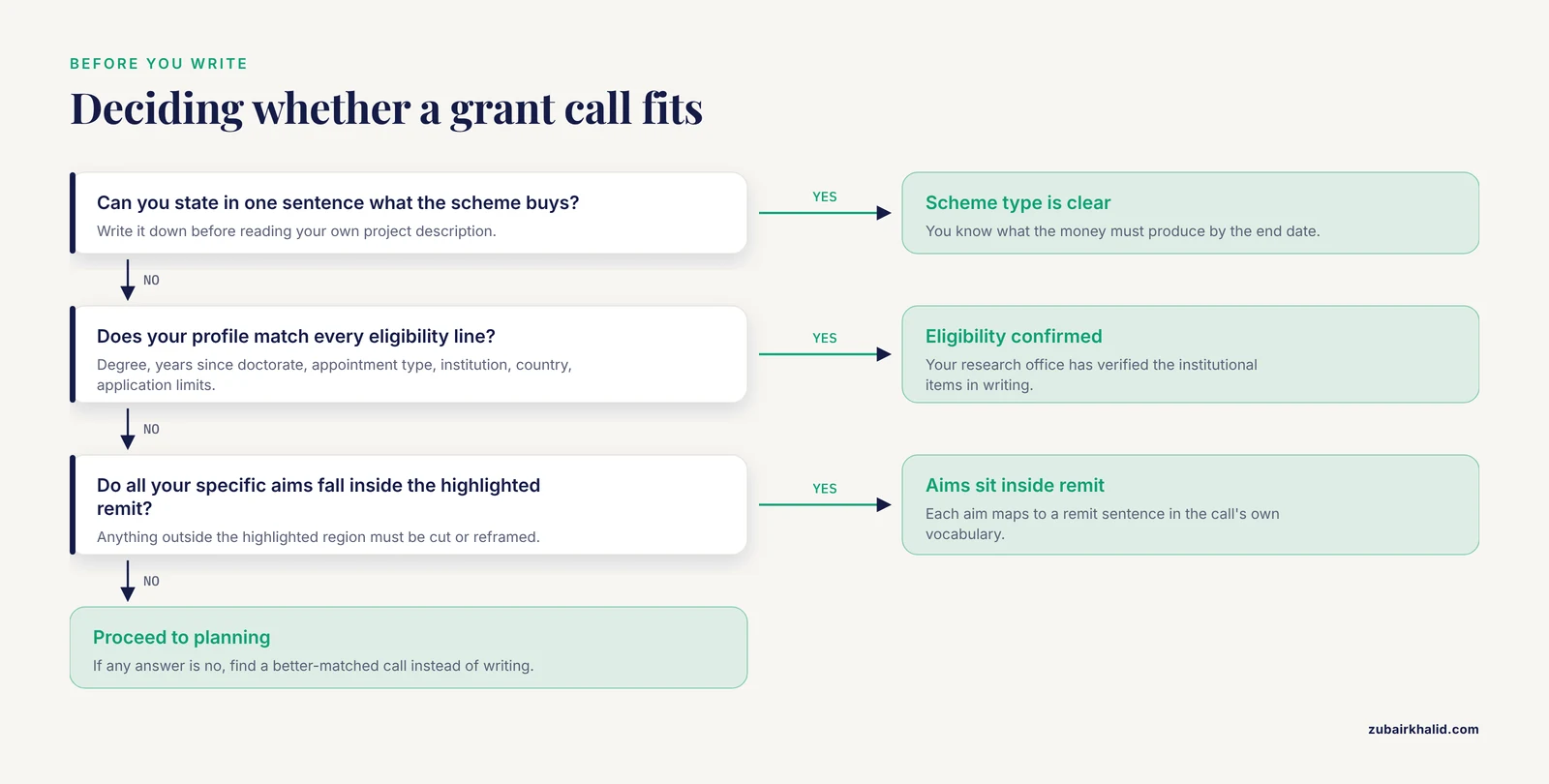
Run this sequence in order for every new call. It takes under an hour and catches most grant application mistakes before they exist.
- Download the call document and all linked guidelines from the funder's own site, and record the version date.
- Identify the scheme type and write one sentence describing what the scheme buys.
- Complete the eligibility checklist with your own details and your institution's details.
- Highlight the remit text and write your project's central question in the call's own vocabulary.
- List the evaluation criteria and their weights, if stated.
- List the budget rules, including eligible costs, indirect-cost treatment, and any match requirement.
- List every deadline, including the institutional internal deadline and the portal cutoff.
- Ask the program officer, in writing, about anything ambiguous, and keep the reply.
- Decide go or no-go based on the fit between your one-sentence project description and the scheme's stated purpose.
If steps 2 through 4 produce a coherent one-sentence match, proceed to grant proposal planning. If they do not, the correct solution is to find a better-matched call, which is far cheaper than a rejected application.
How to Fix Grant Application Mistakes After Submission
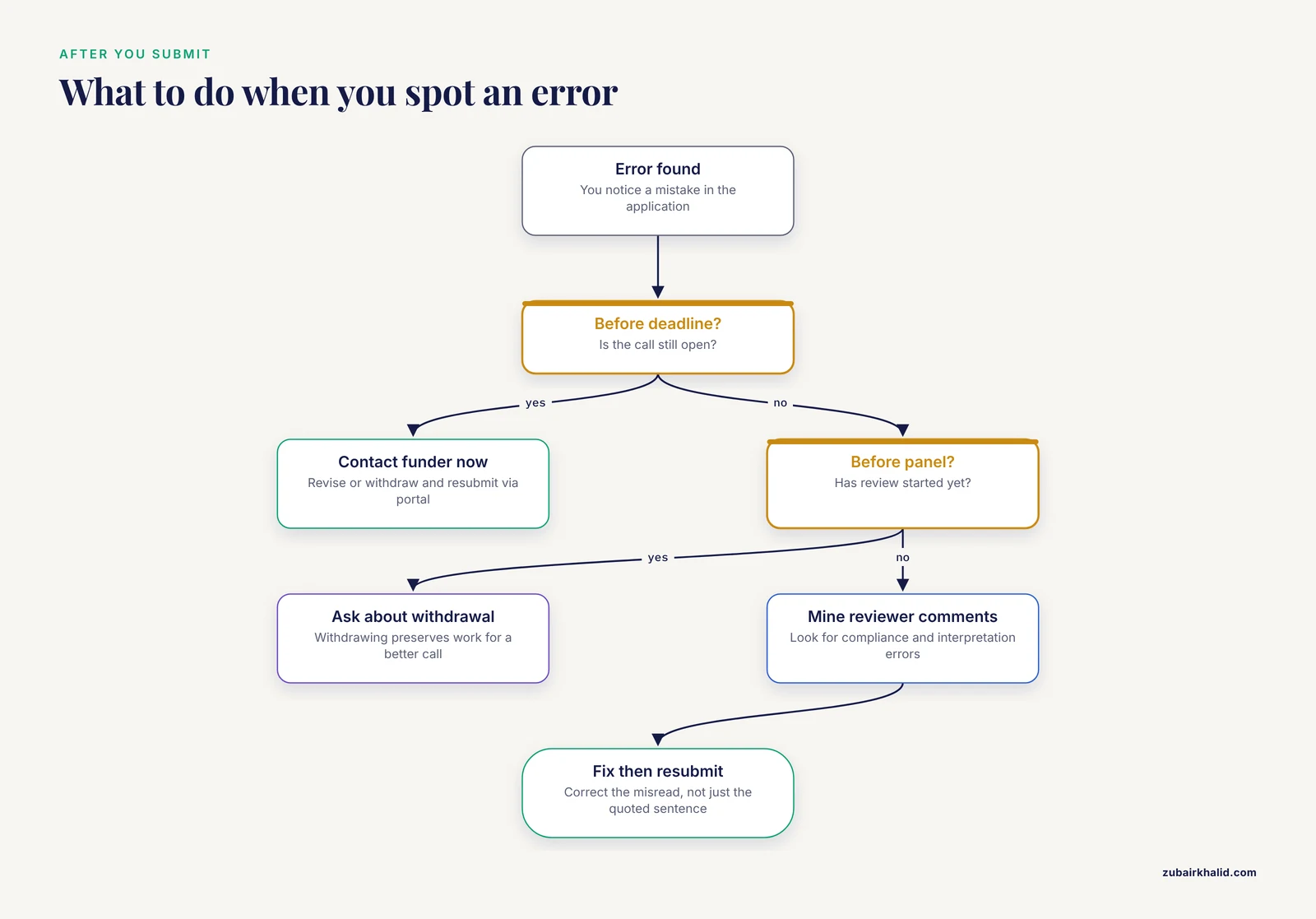
Grant application mistakes solutions differ depending on when you notice the error.
Before the deadline, most funders allow revisions or full withdrawal and resubmission through the portal. If you discover an eligibility problem, a budget error, or a scope mismatch while the call is open, contact the program officer immediately in writing, state the issue plainly, and ask what correction the funder accepts. Program officers answer these questions routinely and would far rather fix a submission than waste panel time on an ineligible one.
After submission but before panel review, your options narrow. Some funders allow withdrawal on request. If the error is fatal, withdrawing preserves the work for a better-matched call later.
After rejection, the reviewer feedback is the diagnostic asset. Read the comments for two signals. First, look for comments about compliance and interpretation, such as out-of-remit statements or budget complaints, because those indicate misreads of the call that must be fixed before any resubmission anywhere. Second, look at where points were lost across reviewers. As the biomedical AI validation literature shows, examining the specific pattern of mistakes is more informative than the aggregate score, because aggregate results conceal where and how consistently the errors occur [3]. Map each recurring criticism to the criterion it targets, fix the underlying interpretation error rather than only the sentence the reviewer quoted, and only then resubmit.
If the feedback conflicts between reviewers, ask the program officer for the panel discussion summary where available. Conflicting reviews usually mean the proposal sat at the boundary of the remit, which itself is information about call fit.
Grant Proposal Planning That Prevents Misreads
Prevention is cheaper than repair, and it is structural rather than heroic. Effective grant proposal planning starts before the call is published.
Build a funder watchlist. Most funders publish forward workplans or rolling calls, and research offices circulate upcoming opportunities. Knowing which calls are likely six months ahead lets you plan experiments and draft text in advance instead of writing against a deadline.
Maintain a compliance matrix. For each call, keep a one-page table with the scheme type, eligibility lines, remit sentences, criteria and weights, budget rules, deadlines, and required attachments. Fill it from the current call document, never from memory. This one habit eliminates most of the mistakes in the table above.
Write to the scoring sheet. Draft each section with its criterion and weight visible. If impact carries the heaviest weight, it gets the clearest, most explicitly argued section, not a closing paragraph.
Build review loops. Before submission, have one colleague inside your field check the science and one colleague outside it check clarity and call fit. The outside reader is the closest available proxy for a tired panel member.
Use your research office. Institutional administrators see rejections and compliance failures across the whole portfolio, and they know the funders' unwritten expectations. Involve them at the planning stage, not the packaging stage.
Invest in training. A structured research grant writing course compresses years of trial and error into explicit instruction on call analysis, criteria mapping, and reviewer psychology. Many institutions offer them through their research development offices, and professional societies run them as workshops. If you write proposals regularly, the course pays for itself the first time it prevents one misread call.
Keep a personal error log. Every time a reviewer or administrator flags a problem, record the symptom, the cause, and the fix. Over three or four applications the log becomes your own evidence-based checklist, which is exactly the practice that Borst recommended for scientific writing in general, checking claims and habits against the record rather than against memory [1].
Common Mistakes and Limitations
This section consolidates the practical points and states the limits of the advice.
First, the highest-yield habit is the plainest one. Read the entire call document from the funder's own site before forming any opinion about fit, and check the version date. Most grant application mistakes begin as skipped pages.
Second, eligibility and remit errors are cheap to detect and expensive to ignore. Five minutes of checklist work against the eligibility section prevents administrative rejection that no amount of good science can cure.
Third, evaluation criteria are the reviewer's instructions to you. A proposal organized by criteria and weights outperforms a proposal of equal science organized by laboratory habit.
Fourth, overclaiming damages credibility in ways that honest limitations never do. Documented analyses of recurrent scientific errors show that unsupported concepts persist in proposals when authors recycle text instead of checking current evidence, so audit every claim against primary data.
Fifth, structured frameworks fail when applied outside their intended population. The LI-RADS experience in diagnostic imaging demonstrates that even trained experts make systematic errors when they skip the population check, and the grant-call equivalent is the eligibility and scheme-type check [2].
Sixth, individual calls differ from each other and from the general patterns described here. Funders change rules between cycles, and no general guide can substitute for the current call text. For anything ambiguous about a specific call, the correct authority is that funder's program officer, contacted in writing.
Seventh, nothing here replaces institutional rules. Your institution's research office, biosafety committee, and ethics board impose requirements that run in parallel with the funder's rules, and both sets must be satisfied for the project to start on time.
Frequently Asked Questions
What is the most common mistake applicants make when reading a grant call?
The most common mistake is reading the topic keywords while skipping the scheme type, eligibility rules, and evaluation criteria. Applicants assume a familiar topic means a good fit, then discover at review or administrative screening that the call funds a different stage of research, a different applicant group, or a different deliverable. Read the full call document from the funder's own site before judging fit.
How do I find out what a grant call actually wants?
Work from the document, not from summaries. Identify the scheme type, write down what the money must produce by the end date, highlight the remit sentences, list the evaluation criteria and weights, and list the budget rules. If anything stays ambiguous, email the program officer and keep the written reply as your reference.
Can I contact the program officer, and what should I ask?
Yes, and you should. Program officers exist to answer fit and compliance questions. Ask in writing, before investing weeks of writing, about eligibility ambiguities, whether your project idea sits inside the remit, and how the funder treats specific budget items. Describe your project in three sentences and ask a closed, specific question.
How do I fix a mistake after I have already submitted?
It depends on timing. Before the deadline, most portals allow revision or withdrawal and resubmission, so contact the funder immediately. After submission, ask whether withdrawal is possible if the error is fatal. After rejection, mine the reviewer comments for compliance and interpretation errors, fix those before resubmitting anywhere, and map recurring criticisms to the scored criteria.
What does fit mean in grant calls?
Fit means your project is the thing the scheme buys, you are the applicant the scheme funds, and your aims sit inside the remit boundary. A one-sentence test works. State what the scheme purchases, then state your project in one sentence in the call's own vocabulary. If the two sentences do not align, the fit is weak regardless of the science.
How far ahead should grant proposal planning start?
Start at the planning level months before a specific call closes. Track funder workplans for upcoming opportunities, prepare preliminary data and budgets in advance, and hold a compliance matrix ready to fill from any new call. Treat each call's publication date as the start of a written timeline that includes the institutional internal deadline, not just the funder's deadline.
Is a research grant writing course worth the time?
For anyone submitting regularly, yes. A structured research grant writing course teaches call analysis, criteria mapping, budget construction, and reviewer expectations explicitly, which prevents the recurring interpretation errors that self-taught applicants repeat for years. Look for courses run by your institution's research development office or by professional societies in your field.
Why do scientifically strong proposals still get rejected?
Strong science loses to weak fit. Reviewers score against the call's stated criteria, and administrative staff screen against the call's stated rules, so a proposal that misses the remit, the eligibility rules, or the scoring structure loses points or never reaches review, no matter how good the underlying work is. Fit and compliance are scored qualities, and they respond to preparation.
Sources
- Looking back at multidrug resistance (MDR) research and ten mistakes to be avoided when writing about ABC transporters in MDR.
- Common pitfalls and diagnostic challenges in the application of LI-RADS CT/MRI algorithms: a comprehensive review.
- Error Consistency for Machine Learning Evaluation and Validation with Application to Biomedical Diagnostics.