How to Write a Good Enough Dissertation Draft: Step-by-Step Guide
By Dr. Zubair Khalid, DVM, MS, PhD ·
By the end of this guide, you will have a complete dissertation draft: every chapter written start to finish, every figure numbered and captioned, every claim either cited or flagged for later attention. You will not have a perfect manuscript. You will have something your advisor can read and mark up, which is the only kind of draft that ever turns into a dissertation.
Before you start, put these within reach:
- Your graduate school's dissertation handbook and official template, in Word or LaTeX
- Your data, figures, and lab notebook gathered into one folder
- A reference manager such as Zotero, Mendeley, or EndNote
- A timer, physical or on your phone
- One project folder on your computer where the entire draft will live
The method below rests on one idea. A good enough draft dissertation is complete before it is good. Writing and polishing are different jobs, and doing them at the same time is the most reliable way to never finish. The steps separate them for you.
What a Good Enough Dissertation Draft Actually Means
A good enough draft has four properties, and only four.
Complete. Every chapter exists from its first sentence to its last. No section says TBD, no paragraph is a bullet list of intentions, no chapter ends mid-thought. Where you lack information, you write the sentence anyway and mark it with a flag rather than leaving a hole.
Connected. Each chapter opens with a short statement of what it covers and closes with a sentence pointing to the next chapter. A reader can move through the document without wondering why a section is there.
Citable. Every factual claim from another source carries a citation inserted by your reference manager. Every claim of your own that needs a number you have not computed yet carries a flag instead of a placeholder.
Revisable. Your advisor can read any chapter and give specific feedback. That means readable prose, labeled figures, and consistent terminology. It does not mean elegant prose.
What good enough does not mean matters as much. It does not mean publication-ready figures. It does not mean a literature review covering every paper indexed in PubMed on your topic. It does not mean your best sentences. Those are revision tasks, and revision only becomes possible once a full draft exists.
The old academic saying is blunt: a good dissertation is a done dissertation. A committee cannot approve a polished half. It can, and routinely does, turn a rough whole into a strong dissertation through a few rounds of revision.
Dissertation Planning: Budget Words and Weeks First
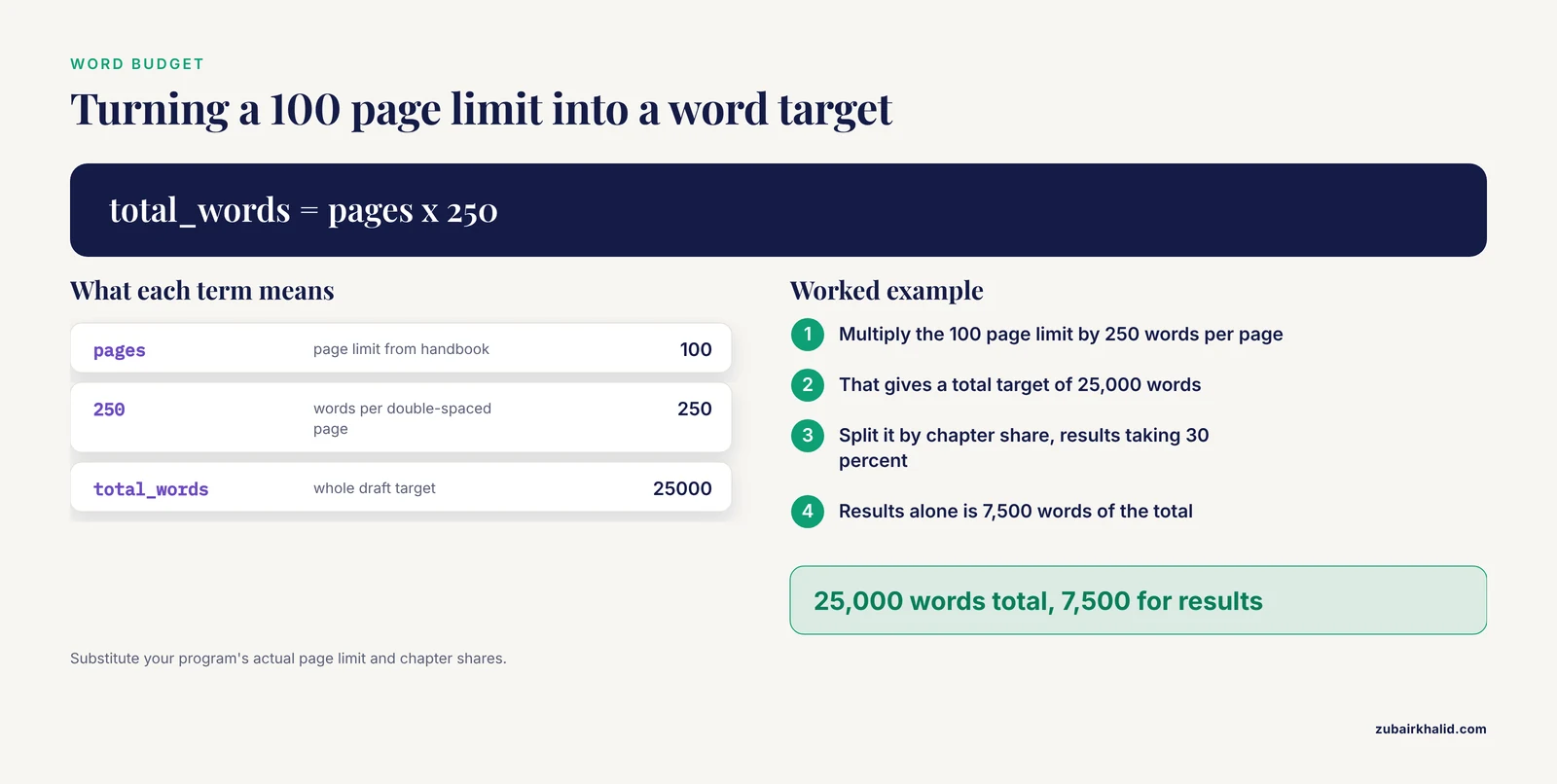
Dissertation planning comes down to two numbers you set before writing anything: a total word target and a finish date. Both come from outside you. The length limit lives in your graduate school handbook or in your advisor's expectations. The deadline is your defense date, real or provisional.
Convert pages to words if your program limits pages. A double-spaced page in 12 point type with 1 inch margins holds about 250 words, so a 100 page limit is a target of roughly 25,000 words. Substitute your program's actual number everywhere below.
Then split the total across chapters. The shares in the script below suit a typical experimental life science dissertation. Adjust them if your program weights chapters differently, for example with a standalone literature review chapter.
total_words = 25000

budget = {
    "introduction": 0.10,
    "literature_review": 0.20,
    "methods": 0.15,
    "results": 0.30,
    "discussion": 0.20,
    "conclusion": 0.05,
}

for chapter, share in budget.items():
    print(f"{chapter}: {int(total_words * share)} words")
Expected output:
introduction: 2500 words
literature_review: 5000 words
methods: 3750 words
results: 7500 words
discussion: 5000 words
conclusion: 1250 words| Chapter | Share of total | Main job |
|---|---|---|
| Introduction | 10% | State the question, why it matters, and what you did about it |
| Literature review | 20% | Establish the gap your work fills |
| Methods | 15% | Let a competent stranger repeat the work |
| Results | 30% | Report findings without interpretation |
| Discussion | 20% | Interpret, compare with prior work, concede limits |
| Conclusion | 5% | Answer the question and name the next steps |
Now the timeline. At 300 finished words per writing day, a 25,000 word draft takes about 84 writing days. At five writing days per week, that is roughly 17 weeks, a little over four months. Add two to four weeks of slack for analysis gaps and advisor turnaround. If the resulting date is impossible, change the daily target or the scope, not the plan. A plan you cannot keep is not a plan.
Write the budget where you will see it. A plain file called PROGRESS.md in the project folder, listing each chapter, its target, and its current count, is enough.
Step by Step: Writing the Good Enough Draft
The walkthrough assumes a folder-based workflow that behaves the same in Word or LaTeX. Commands are shown in bash, the shell built into macOS and available on Windows through Git Bash or WSL. Every step has a point-and-click equivalent if you prefer not to use a command line, noted as we go.
Step 1: Create the project folder and put it under version control
mkdir -p dissertation/{00_frontmatter,01_introduction,02_literature_review,03_methods,04_results,05_discussion,06_conclusion,figures,refs}
cd dissertation
ls
Expected output:
00_frontmatter
01_introduction
02_literature_review
03_methods
04_results
05_discussion
06_conclusion
figures
refs
Version control is a system that records a snapshot of your files whenever you ask, so no edit is ever truly lost. Git is the standard tool, and a snapshot is called a commit.
git init
git add .
git commit -m "Create dissertation skeleton"
Expected output (your file counts will differ):
Initialized empty Git repository in /Users/you/dissertation/.git/
[main (root-commit) 1a2b3c4] Create dissertation skeleton
 2 files changed, 12 insertions(+)
 create mode 100644 PROGRESS.md
From now on, run git add . and a commit at the end of every writing session. If you would rather click than type, create the folders in Finder or File Explorer and rely on OneDrive or Dropbox version history instead of Git. The principle is identical: dated, recoverable snapshots.
Step 2: Build the skeleton from your program's official template
Download the dissertation template from your graduate school website before writing a word. It fixes margins, heading styles, the title page, and the reference format, and retrofitting format at the end is miserable. Put the template in the project folder, then create one draft file per chapter:
for chapter in 01_introduction 02_literature_review 03_methods 04_results 05_discussion 06_conclusion
do
  touch "$chapter/draft.md"
done
ls */draft.md
Expected output:
01_introduction/draft.md
02_literature_review/draft.md
03_methods/draft.md
04_results/draft.md
05_discussion/draft.md
06_conclusion/draft.md
Under each chapter heading, paste the section headings you expect to need. In results, one heading per experiment or dataset. In methods, one heading per technique. You are building the outline you will write into, which turns a blank page into a checklist.
Step 3: Write results first
Start where your knowledge is strongest. You ran the experiments, so results is the chapter you can draft with the least additional work. For each results section, move the relevant figures into the figures folder, write a caption under each, and write the paragraph that reports what the figure shows. Report, do not interpret. "Treatment A delayed symptom onset compared with the control group" belongs in results. "This suggests the treatment acts through the immune system" belongs in discussion.
Write methods alongside results. Every time a results paragraph assumes the reader knows how something was done, go write or extend that methods section the same day, while the detail is fresh from your lab notebook. Methods reconstructed from memory months later are the ones examiners attack.
Step 4: Draft each chapter with the topic-sentence skeleton
A topic sentence states the single point of a paragraph. The skeleton method writes only topic sentences first, one per planned paragraph, then expands each into its paragraph.
For a results section on a growth experiment, the skeleton might read:
- The knockout strain grew slower than the wild type under glucose limitation.
- The growth defect disappeared when the medium was supplemented with the missing metabolite.
- Complementation restored wild-type growth.
Read the sentences in order before expanding anything. If the sequence has a gap, an argument step no sentence covers, fix the plan now. Rewriting three wrong paragraphs costs an evening. Rewriting three sentences costs minutes.
Then expand, one paragraph per sentence, in order, without editing. If you cannot find the right phrasing, write the clumsy version and move on. Clumsy is revisable. Blank is not.
Step 5: Manage citations with a reference manager as you write
A reference manager stores the record for every paper you cite and inserts formatted citations into your draft. Zotero is free and open source, and Mendeley and EndNote are the common alternatives. Collect records as you read: the browser connector saves a paper from a journal page, PubMed, or Google Scholar in two clicks, PDF attached.
Insert citations while drafting, not in a later pass. In Word, the Zotero plugin adds citations as you type and builds the reference list in your program's required style. In LaTeX, export a BibTeX file from Zotero (the Better BibTeX extension automates this) and cite by key:
@article{AuthorYearTopic,
  author  = {Lastname, F. and Lastname2, F.},
  title   = {Full title of the cited paper},
  journal = {Journal Name},
  year    = {2024},
  volume  = {12},
  pages   = {100-110}
}
The line after the @ is the cite key. Pick one convention, author-year-topic is a good one, and never reuse a key. In the text you cite it as \cite{AuthorYearTopic}.
Step 6: Track words and flags with two commands
Two short commands tell you where you stand at the end of each week.
Word counts per chapter:
wc -w */draft.mdExpected output:
   2480 01_introduction/draft.md
   3150 02_literature_review/draft.md
   3900 03_methods/draft.md
   6100 04_results/draft.md
      0 05_discussion/draft.md
    410 06_conclusion/draft.md
  16040 total
Compare each number against the budget from the planning section. A chapter at zero is your next writing target.
A flag is a fixed marker you leave in the text wherever the draft needs something you do not have yet. Use three: TODO for a missing decision, CHECK for a claim you are unsure of, CITE for a missing citation. Find them all with:
grep -nE "TODO|CHECK|CITE" */draft.mdExpected output:
03_methods/draft.md:14: CITE antibody vendor and catalog number
04_results/draft.md:52: CHECK rerun stats with the updated sample size
05_discussion/draft.md:8: TODO reconcile with the reviewer comment
Count them:
grep -oE "TODO|CHECK|CITE" */draft.md | wc -lExpected output:
3That number is your gap list. It should shrink toward zero during revision, and a handful of deliberate flags you can defend aloud is acceptable in a good enough draft.
Step 7: Close every session on purpose
End each session in the middle of a sentence, or at least with the next sentence planned. Write the next action at the top of the chapter file, for example "Next: expand the complementation paragraph, figure 4 needs error bars". Starting tomorrow from a written instruction removes the twenty minutes of re-reading that kills momentum. Then commit:
git add .
git commit -m "Results chapter, growth experiment section drafted"
Errors you will hit, and their fixes
- Citations render as [?] or bold author names, and the log shows:
LaTeX Warning: Citation 'AuthorYearTopic' on page 5 undefined on input line 42.The bibliography tool has not processed the new key. Run the full sequence (latex, bibtex, latex, latex), or in Overleaf confirm the .bib file is in the project and click Recompile. The warning clears once the key resolves. ! LaTeX Error: File 'fig_growth.png' not found.The filename in\includegraphicsdoes not match a file in the figures folder. Check spelling and extension (a file named fig_growth.PNG is not fig_growth.png on case-sensitive systems), or add\graphicspath{{figures/}}to the preamble.fatal: not a git repository (or any of the parent directories): .gitYou ran a git command outside the project folder. Change into it, or rungit initonce if you never initialized.- grep finds no flags but you know you left some. The pattern is case sensitive, and lowercase todo does not match TODO. Search with
grep -inE "todo|check|cite" */draft.md. - A Word file will not open, or shows recovered fragments. You kept one file and edited it for months. Recover from OneDrive or Dropbox version history if you have it, then adopt per-chapter files and commits as in Step 1.
The Chapter Order That Works for Life Science Dissertations
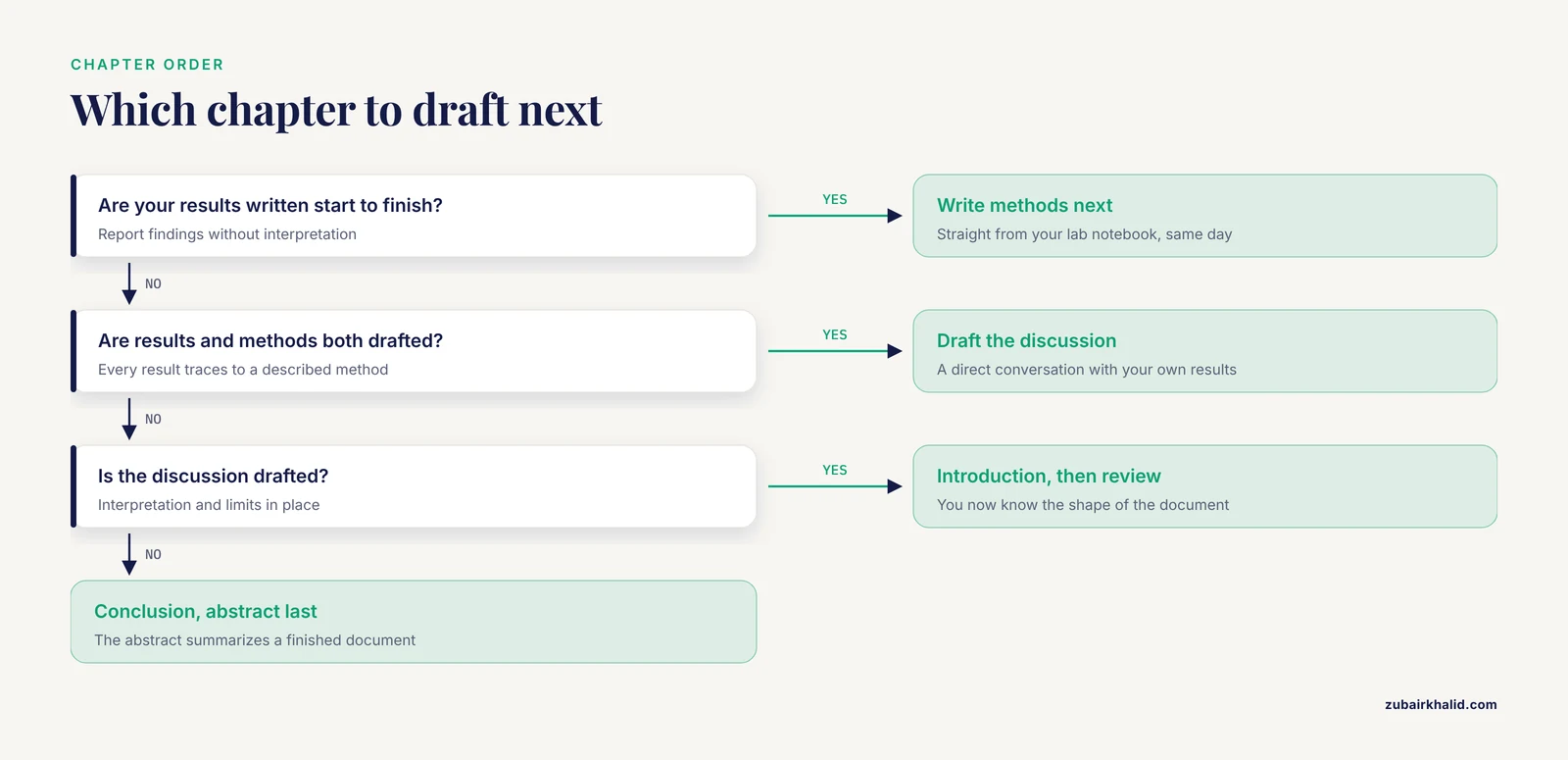
Write in this order: results, methods, discussion, introduction, literature review, conclusion, abstract.
Results come first because you know them best and they generate everything else. Methods come second, alongside results, straight from your lab notebook. Discussion comes third, because it is a direct conversation with your own results. Introduction comes fourth, because you cannot introduce a document whose shape you have not written. Literature review comes fifth, because by then you know which prior work actually matters to your argument rather than everything you ever read. Conclusion comes sixth, a short chapter that answers the question from the introduction and names the next experiments. The abstract comes last, always, because it summarizes a finished document.
This order also matches how committees read. They check that results are supported by methods, that the discussion follows from the results, and that the introduction promises exactly what the results deliver. Writing in this order makes those alignments deliberate instead of lucky.
Good Enough Draft Dissertation Tips for Daily Momentum
These good enough draft dissertation tips decide whether the draft gets finished.
Separate drafting from editing completely. Draft in one session, edit in a different session or a different day. Never open yesterday's pages to improve them before producing today's new words. Editing feels like writing but produces no draft.
Write in timed blocks. A pomodoro is a fixed block of focused work, classically 25 minutes, followed by a 5 minute break, with a longer break after four blocks. Twenty-five minutes is short enough that you will start even when you do not feel like it. Three blocks a day finishes chapters in weeks rather than months.
Lower the entry bar with notes to yourself. If a paragraph resists prose, write it as five bullet points addressed to you, then convert each bullet to a sentence the same session. Converting notes is easier than composing from nothing, and it keeps you moving.
Dictate the methods. Methods prose is formulaic, which makes it ideal for voice dictation while you walk through the protocol from your notebook. Clean up the transcript later.
End mid-sentence. Covered in Step 7, and worth repeating because it is the highest-yield habit on this list. The fastest way to start tomorrow is to leave today unfinished on purpose.
Protect the same time daily. A fixed 90 minute block beats a heroic eight-hour Saturday that never arrives. Log the streak in PROGRESS.md so a missed day stays visible.
Send pieces to your advisor early. A short methods section gets feedback in days. A full draft sits in an inbox for weeks. Early small submissions also spread the emotional cost of criticism across the year instead of concentrating it at the end.
Common Mistakes and Limitations
These mistakes end more dissertations than any missing dataset, so treat each one as a rule with a fix.
Editing while drafting. The most common failure by far. You open chapter one to fix a few things and lose a month. Fix: separate sessions, as above.
Starting with the introduction. The introduction is the hardest chapter to write before the rest exists, because it must promise exactly what the results deliver. People who write it first rewrite it three times. Fix: write it fourth, per the chapter order.
Polishing chapter one for months. Same cure as above: forward motion only until a full draft exists.
Waiting for complete data. You do not need final data to draft methods, introduction, or literature review. Waiting for a perfect dataset before writing a word is how dissertations stall for a year. Fix: draft the data-independent chapters now, and draft each results section as its experiment closes.
Unflagged gaps. A sentence with a missing citation and no flag is invisible to future you. Fix: the TODO, CHECK, CITE system from Step 6, applied the moment you notice a gap.
One giant file named final_v7_REAL.docx. No version history, no recovery, no way to compare drafts. Fix: per-chapter files plus commits, or at minimum dated copies.
Ignoring format rules until the end. Margins, heading styles, and reference formats differ by program, and retrofitting them across a full draft is days of mechanical work. Fix: write inside the official template from Step 2.
Writing in isolation. Without external deadlines, the draft competes with everything else forever. Fix: a writing group, one accountability partner, or scheduled chapter submissions to your advisor.
Limitations. Programs differ in length rules, chapter structure, and committee expectations, so treat your graduate school handbook and your advisor as the final authority on format and scope. A good enough draft is also a milestone, not a guarantee. Committees can and do require substantial revision after reading a complete draft. That is the system working, not a sign the draft failed.
How to Check That the Draft Is Good Enough
Run this checklist before you declare the draft done.
- Completeness. Every chapter runs from first sentence to last. No placeholders like TBD or [insert analysis].
- Figures. Every figure has a number, a caption, and at least one reference in the text. Pull every figure number mentioned in the chapter files and compare it against your figure inventory:
ls figures
grep -ohE "Figure [0-9]+" */draft.md | sort -u
If the inventory contains Figure 7 and the grep list does not, the figure is orphaned. If the grep list contains Figure 8 and the inventory does not, the text references a figure that does not exist.
- Citations. No [?] in a LaTeX build, no error fields in Word, and no reference list entries that never appear in the text.
- Flags are deliberate. Run the flag count from Step 6. Every remaining flag should be one you can explain and defend, not one you forgot.
- Abstract test. Read only your abstract, then read only your conclusion. They must tell the same story with the same emphasis. If they disagree, the draft has a coherence problem the individual chapters hide.
- Methods-results match. Every result traces back to a described method, and every described method produces at least one reported result. Cut methods that produced nothing you report, or move them to an appendix if your program allows.
- Format pass. Page size, margins, spacing, heading styles, and reference style, checked against the handbook checklist.
If all seven pass, the draft is good enough by definition. Send it.
After the Draft: How to Finish the Dissertation
How to finish dissertation revisions without drowning: revise in passes, one concern per pass, in this order.
- Structure pass. Read only chapter titles, section headings, and the first sentence of every paragraph. You are checking the argument's skeleton, not the prose. Fix order, gaps, and redundancy here.
- Paragraph pass. One paragraph at a time, confirm it makes one point, that the point sits in the topic sentence, and that it connects to the paragraph before it.
- Sentence pass. Now, and only now, fix grammar, clarity, and wordiness. Read aloud, because the ear catches what the eye skips.
- Citation pass. Resolve every CITE flag, verify each citation points to the intended source, and format the reference list to your program's style.
- Format pass. The handbook checklist, margins through reference style.
Send chapters to your advisor as they finish rather than as one block. Incorporate feedback with tracked changes in Word or a new commit in Git, so your advisor can see what changed. Keep a response log, a simple table of comment, action taken, and location, because advisors and committees forget what they asked for, and the log proves you answered.
Then comes committee review, then the defense. Defense preparation is its own project, and it starts from this draft: your slides will largely be your figures, and your talk will largely be your results chapter told out loud.
Frequently Asked Questions
How long does it take to write a good enough dissertation draft?
It depends on your word budget and your number of writing days, and you can calculate it in two lines of arithmetic. Divide your total word target by a realistic daily output, then divide by writing days per week, and add slack for advisor turnaround. The worked example in the planning section shows the full calculation.
Should I write the introduction first?
No. Write results and methods first, then discussion, then introduction, then literature review, then conclusion, and the abstract last. The introduction must promise exactly what the results deliver, and you cannot know that until the results chapter exists.
How rough can a good enough draft be?
Rough in sentences, complete in structure. Every chapter runs start to finish in full sentences, every figure has a caption, and every claim is cited or flagged. Clumsy prose is fine. Missing sections, placeholder paragraphs, and unflagged uncited claims are not.
Can I draft chapters before my data are complete?
Yes for methods, introduction, and literature review. No for results, which need final numbers, and mostly no for the discussion, which interprets them. Drafting the data-independent chapters while experiments run is exactly how the timeline stays short.
Should I write in Word or LaTeX?
Use whichever your program's template supports and you already know. Word with a reference manager plugin is the default in most life science programs. LaTeX through Overleaf handles heavy math and complex figure layouts well. Switching tools mid-project costs more time than either tool saves, so decide once and move on.
How do I stop editing while I draft?
Separate drafting and editing into different sessions, and draft against a timer. Do not reread previous pages before producing new words, and if you catch yourself polishing mid-draft, leave a flag and keep typing forward.
What if my advisor is slow to give feedback?
Send small pieces early, ask for a specific kind of feedback on each piece, and keep drafting the next chapter while you wait. A methods section is a short turnaround for most advisors, a full draft is a multiweek one. Never let one pending review stop your forward motion.
What comes after the good enough draft?
Structured revision passes in order: structure, paragraph, sentence, citation, format. Then advisor review of the full document, committee review, and defense preparation. The draft you built with this guide is the raw material for all three.