Generalist vs. Domain-Specific Repositories: A Decision Framework
By Dr. Zubair Khalid, DVM, MS, PhD ·

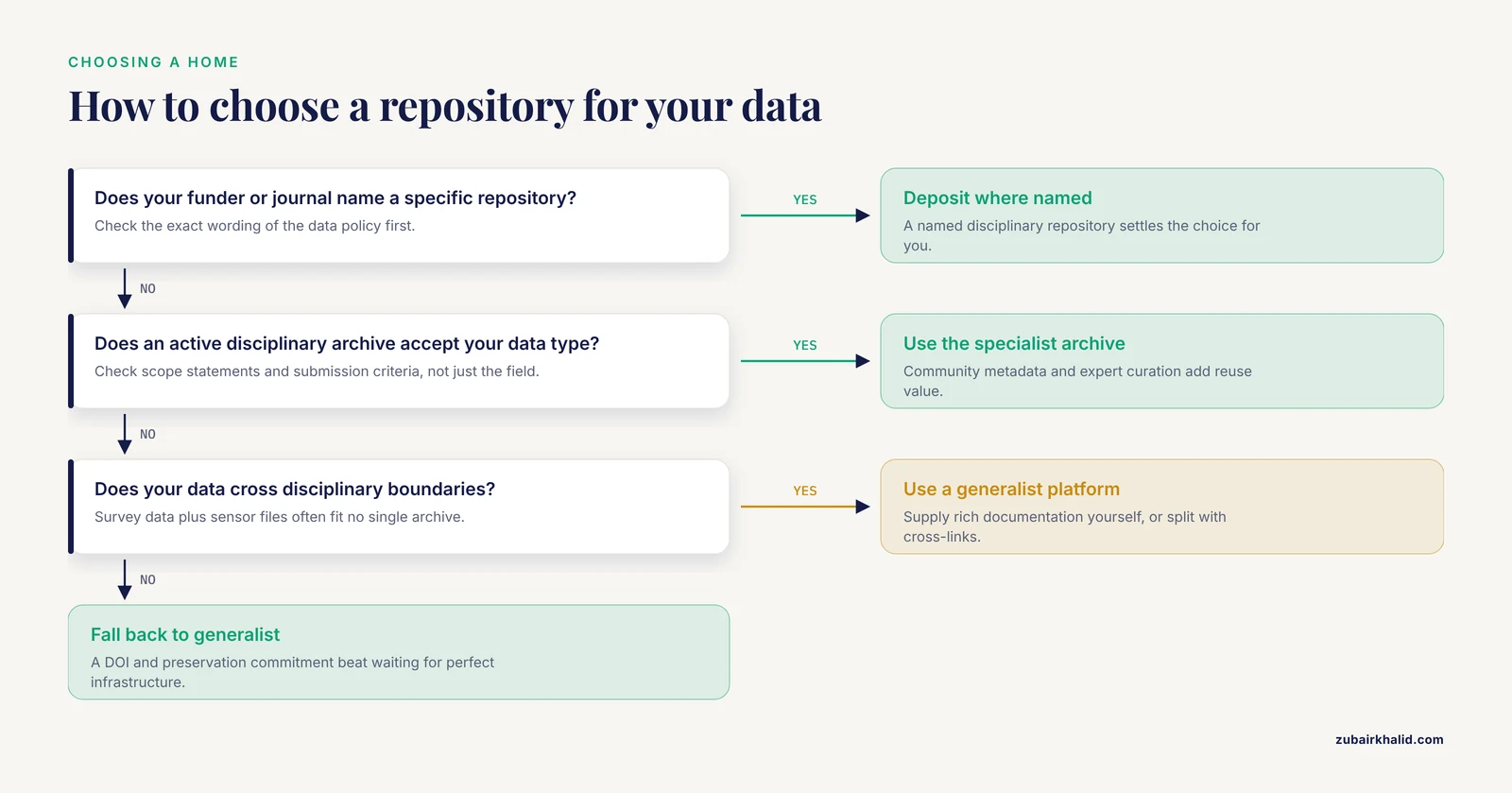
A generalist repository accepts data from any discipline and stores it in a largely uniform way, while a domain-specific repository accepts data from one field and curates it with the standards, formats, and expertise of that field. The rule of thumb is simple: deposit in a domain-specific repository when one exists for your data type and your community uses it, and fall back to a generalist repository when no suitable disciplinary home exists, when your data crosses disciplinary boundaries, or when you need a guaranteed acceptance path to satisfy a funder or journal.
That rule hides real judgment calls. A well-run generalist repository can preserve and expose your data better than a neglected disciplinary archive. A well-run domain-specific repository can make your data discoverable and reusable in ways no cross-disciplinary platform can match. This article explains how each type works, compares them on the criteria that actually decide real choices, walks through worked scenarios, and flags the mistakes researchers make most often when choosing where to share data.
Generalist vs. Domain-Specific Data Repository: The Core Difference
The difference comes down to breadth versus depth. A generalist repository is built to accept anything: tabular data, images, code, software, preprints, and mixed file types, from any research area. Its value is universal access, stable persistent identifiers, and predictable services. A domain-specific repository is built around one scientific community. It enforces community-specific formats and metadata, employs curators who understand the data, and often connects deposits to other community resources.
Surveys of the repository landscape, such as analyses of entries registered in the re3data registry, treat these two types as distinct categories and track how each implements trustworthy, FAIR-aligned data sharing, where FAIR stands for findable, accessible, interoperable, and reusable. Most research fields today have both options available, which is exactly why the choice requires a framework rather than a default.
What a Generalist Repository Is
A generalist repository is a cross-disciplinary platform that accepts datasets regardless of subject area, data format, or research community. Typical features include:
- Acceptance of nearly any file type, with size limits that vary by platform
- Assignment of a persistent identifier, usually a DOI, to each dataset
- A general metadata schema, often aligned with the DataCite standard, rather than a discipline-specific schema
- Open, searchable listings that make deposits visible to anyone
- Long-term preservation commitments backed by institutional or national infrastructure
National-scale services illustrate the model. The Federated Research Data Repository (FRDR) in Canada was built as a single platform through which research data from any discipline can be ingested, curated, preserved, discovered, cited, and shared, precisely because researchers faced uncertainty about where to deposit data for discovery, reuse, and preservation when no disciplinary home fit [2]. Institutional repositories and cross-disciplinary platforms serve the same fallback role at university or national level.
The strength of the generalist model is reliability and universality. Its weakness is shallow domain context. A generalist platform cannot check whether your sequencing metadata follows community conventions or whether your survey instrument was documented the way social scientists expect, because it does not employ curators embedded in your field.
What a Domain-Specific Repository Is
A domain-specific repository serves one scientific community. It does more than store files. It typically provides:
- Community-accepted metadata standards and file formats
- Curation by staff who understand the science behind the data
- Integration with other community resources, such as sequence databases, ontologies, or analytical tools
- Quality control steps tuned to the data type
- Discovery interfaces that specialists actually use in daily work
Examples span the sciences. The Biological and Chemical Oceanography Data Management Office (BCO-DMO) is a domain-specific repository for oceanographic data contributed by researchers around the world [3]. In veterinary medicine, researchers at the University of Pennsylvania built a canine data repository from routine clinical records at a veterinary hospital using a two-phase method, first a semantic data-cleaning phase and then a domain-specific data-cleaning phase, and validated the result against known breed predispositions for mitral valve disease, atrial fibrillation, and osteosarcoma [4]. That validation step, which confirmed expected breed associations at statistical significance, is the kind of domain-informed quality control a generalist platform could not perform.
The strength of the domain-specific model is depth. Its weakness is coverage and sustainability. A disciplinary repository may not accept adjacent data types, may depend on short grant cycles, and may struggle with visibility outside its niche. Researchers in technical and professional communication who were surveyed about building a disciplinary repository weighed exactly these tradeoffs, examining whether colleagues would contribute and use de-identified data and what the pros and cons of a field-specific resource would be [5].
Side-by-Side Comparison
The table below summarizes the data repository comparison on the dimensions that matter most in practice.
| Dimension | Generalist repository | Domain-specific repository |
|---|---|---|
| , - | , - | , - |
| Scope | Any discipline, any data type | One field, community-defined data types |
| Metadata | General schemas, often DataCite-aligned | Community standards, ontologies, field-specific fields |
| Curation | Basic format and completeness checks | Scientific curation by domain experts |
| Discovery | Broad visibility, general search | High visibility within the specialist community |
| Interoperability | Limited, depends on depositor | Often linked to databases, ontologies, and tools |
| Compliance fit | Reliable fallback for funder and journal requirements | Preferred when a funder or journal names the field repository |
| Preservation | Institutional or national commitment | Varies, can be strong or grant-dependent |
| Reuse context | Data stand alone, context supplied by depositor | Data sit alongside related community datasets |
| Typical weakness | Shallow domain context, generic metadata | Narrow scope, uneven sustainability and funding |
The Criteria That Decide Real Choices
Findability and retrieval quality
Where will the right audience find your data? Domain knowledge improves retrieval. In one study spanning 104,683 datasets collected from 13 research data repositories, researchers fine-tuned a retrieval model on domain-specific semantic representations and improved the NDCG@10 score, a ranking-quality metric, by about 5 percent compared with a domain-independent model [6]. The practical lesson is that repositories and search systems enriched with domain-specific semantics surface relevant datasets more accurately for specialist queries.
The same generalist-versus-specialist pattern appears in machine learning. A study of music genre recognition found that models trained on domain-specific data outperformed a generalist model on classification within that domain, even when trained on a smaller dataset, and the effect was strongest for underrepresented genres such as Brazilian styles [7]. The analogy carries to repositories. A specialist archive knows the vocabulary, structures, and edge cases of its field, so it organizes and retrieves deposits the way specialists actually search. A generalist platform treats every deposit with the same generic machinery.
Curation depth and data quality
Curation is where the two models diverge most. Domain-specific repositories add value through expert review, format enforcement, and domain-informed cleaning, as the canine clinical data repository demonstrated with its two-phase semantic and domain-specific cleaning method that retained 99.8 percent of the data while preserving quality [4]. Generalist repositories typically verify that files open, metadata fields are filled, and licenses are stated, and little more.
Ask yourself two questions. First, does my field have community standards that a generic deposit form cannot express? Second, would expert curation change whether my data are reusable, or only whether they are downloadable? If expert curation matters, the domain-specific option gains ground.
Compliance with funders and journals
Many funders and journals require data deposition in an appropriate repository as part of research data sharing policies. When a policy names a specific disciplinary repository, the choice is made for you. When it requires only an appropriate repository, both types usually qualify, and the generalist option provides a dependable acceptance path because it imposes no scope restrictions. The Canadian FRDR example shows this fallback function at national scale, designed to help researchers comply with institutional and funding agency data management requirements when disciplinary options do not fit.
Interoperability and long-term access
Domain-specific repositories often connect deposits to larger information infrastructure. CollecTF, a community database of experimentally validated transcription factor binding sites in bacteria, moved beyond the conventional data-repository paradigm by adopting established ontologies and identifiers and becoming a submission portal that passes annotations to RefSeq, UniProtKB, and the Gene Ontology Consortium [8]. That architecture gives deposits both specialist depth and long-term visibility inside stable, heavily used resources.
The interoperability picture has a catch. Domain-specific repositories across a field frequently grew up independently, with different technologies, data models, and ontologies. An analysis of environmental research data repositories found that this independent development limits cross-repository effectiveness and proposed a shared community platform with agreed standards for curation and dissemination to advance cross-domain interoperability [9]. If your research is interdisciplinary, a field of disconnected specialist archives can be harder to work across than one well-built generalist platform.
Hybrid architectures are one response to this tension. In the image storage domain, a comparative analysis of traditional and hybrid repository models under big data workloads identified distinct advantages and limitations of each approach in speed, power, and scalability, and recommended matching the model to the specific scenario rather than assuming one design fits all. Repository selection follows the same logic.
Reuse value and the data lifecycle
Reuse is the point of research data sharing, and documentation is what makes reuse possible. A use case from the SoDaNet research data repository in migration research argued that comprehensive documentation adds value to data, and that this value is recycled back to the repository and to future reusers through each reuse cycle [10]. Domain-specific repositories are positioned to generate that documentation because their curators understand what a future analyst in the field will need to know.
Domain-specific repositories also fill gaps that generalist platforms leave open when a field lacks shared data infrastructure. The DR-AIR project was created to bridge the data gap in AI reliability research, where academic researchers lacked ready access to reliability datasets, and it curates datasets specifically for that research area while encouraging the community to contribute. A follow-on publication extends that effort. When a field has no specialist archive, establishing one, or contributing to a new one, is often the higher-value move than dispersing datasets across generalist platforms where they are hard to find as a coherent collection.
Worked Scenarios
Scenario 1: Oceanographic cruise measurements
You have hydrographic and chemical measurements from a research cruise. The oceanography community has a purpose-built home in BCO-DMO, a domain-specific repository for oceanographic data from around the world [3]. Depositing there places your data next to comparable cruise datasets, under oceanographic metadata conventions, where the scientists most likely to reuse them already search. A generalist repository would preserve the files, but it would strip away the community context. Decision: domain-specific.
Scenario 2: Clinical data from a veterinary hospital
You want to build a research resource from years of routine clinical records. The PennVet canine repository project shows the domain-specific path: a semantic cleaning phase followed by a domain-specific cleaning phase produced a validated population of 84,405 dogs from 194 breeds, with known breed-disease associations recovered at significance after adjusting for multiple comparisons and precision between 60 and 83 percent [4]. Only domain expertise could define what "clean" means for veterinary clinical records. Decision: domain-specific, with the caveat that building such a resource is a project in itself, not a deposit.
Scenario 3: An interdisciplinary dataset with no natural home
Your project spans social science survey data and environmental measurements. Specialist archives exist on each side, but a social science archive may not accept sensor files, and an environmental repository may not accept survey instruments. This is the gap that partnerships among social science researchers, institution-based repositories, and domain-specific data archives were proposed to address, with each type of institution contributing what it does best [11]. A generalist or federated platform such as FRDR, built to serve research data across disciplines from a single point of ingestion, curation, preservation, and discovery, is a reasonable single home, provided you supply rich documentation yourself. Decision: generalist, or a coordinated split deposit with cross-links.
Scenario 4: A small dataset accompanying a paper, in a niche field
You have a modest dataset from a subfield where the disciplinary repository is inactive, has unclear sustainability, or does not accept your data type. Waiting for perfect infrastructure risks losing the data entirely. A generalist repository with a DOI and a preservation commitment is the pragmatic choice. Document the data thoroughly, because in a generalist setting your documentation carries the full burden of reuse value, the factor that SoDaNet's migration research use case identified as central to recycling value through reuse [10]. Decision: generalist.
Scenario 5: A field with an evolving repository model
If you are helping govern a community resource, note that the model itself can evolve. CollecTF's shift from standalone repository to submission portal feeding RefSeq, UniProtKB, and Gene Ontology shows a domain-specific resource leveraging stable external hubs for long-term access and visibility while keeping its specialist curation role [8]. Community-driven efforts, such as the survey of technical and professional communication scholars weighing whether a disciplinary repository was feasible for their field [5], are often the first step toward that kind of infrastructure.
Common Mistakes and Limitations
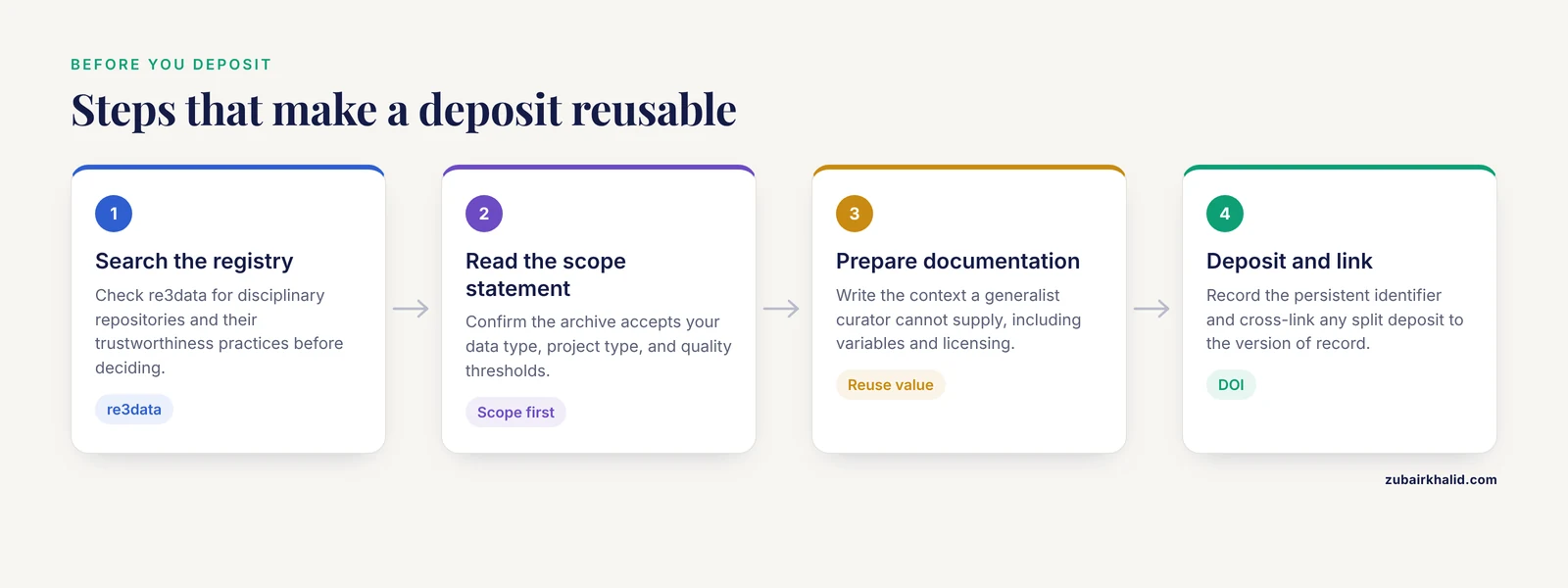
- Defaulting to the generalist option without checking for a disciplinary home. Use re3data, the registry that catalogs domain-specific and generalist repositories and their trustworthiness practices [1], before you decide. Many researchers skip the search and lose the curation and discoverability benefits of a specialist archive.
- Assuming a domain-specific repository accepts everything from the field. Scope statements matter. Some accept only particular data types, only data from funded projects, or only data passing defined quality thresholds. Check the submission criteria before you commit.
- Treating a generalist deposit as self-documenting. In a specialist archive, curators and community standards supply context. In a generalist archive, you supply it. Thin documentation is the most common reason cross-disciplinary deposits go unreused.
- Ignoring interoperability between specialist repositories. Independent development has left environmental repositories, and many other fields, with divergent technologies and ontologies, which an analysis of that domain identified as an efficiency problem for both depositors and synthesis scientists [9]. If your project feeds multiple archives, plan the identifiers and standards mapping early.
- Assuming the specialist choice always wins on quality. A funded, well-run generalist platform can outperform a fragile disciplinary archive on preservation and uptime. Evaluate the specific repository, not just the category.
- Overlooking reuse limits. Data reuse carries real constraints, including documentation gaps, licensing ambiguity, and the effort needed to harmonize variables, all of which the SoDaNet use case discussed alongside its benefits [10]. Budget time for the reuse side, not just the deposit side.
- Confusing repository type with repository quality. Both categories range from excellent to poorly maintained. Look for sustained funding, preservation commitments, and FAIR-aligned practice rather than assuming the category determines the quality.
- A note on scope. Repository choice applies to research data. Individual cases in clinical or applied settings need judgment from the relevant professional, and no repository decision substitutes for that.
Frequently Asked Questions
What is the difference between a generalist and a domain-specific data repository?
A generalist repository accepts data from any discipline with generic metadata and basic curation, while a domain-specific repository serves one field with community standards, expert curation, and connections to other resources in that field. The generalist maximizes access, the specialist maximizes context.
When should I use a generalist repository?
Use a generalist repository when your data are interdisciplinary, when no active domain-specific repository accepts your data type, when the disciplinary archive lacks sustainability, or when you need a guaranteed acceptance path to meet a funder or journal requirement. Compensate with thorough documentation.
Do journals and funders accept both repository types?
Most policies accept either type as long as the repository is appropriate and provides persistent identifiers and open access. When a policy names a specific disciplinary repository, that requirement controls. Check the exact wording of your funder's data management plan guidance and the journal's data policy before depositing.
Can I deposit the same dataset in both a generalist and a domain-specific repository?
Sometimes, but avoid creating duplicate records that fragment citations and confuse reusers. If a split deposit is necessary, link the records to each other through their persistent identifiers and state clearly which copy is the version of record.
How do I find a domain-specific repository for my field?
Search re3data, the registry that catalogs research data repositories and describes their scope, standards, and trustworthiness features. Also ask your data librarian, check the recommendations of your professional society, and look at where comparable papers in your field deposit their data.
What makes a data repository trustworthy?
Trustworthy repositories commit to long-term preservation, assign persistent identifiers, follow FAIR principles, and apply recognized curation and governance practices, requirements that guidelines and registry analyses have converged on [1]. Look for sustained institutional backing, transparent policies on licensing and access, and evidence of active curation rather than passive file storage.
Sources
- The construction practice and prospects of global scientific data repository platform
- Exploring the Canadian Federated Research Data Repository Service
- [Biological & Chemical Oceanography Data Management Office : a domain-specific repository for oceanographic data from around the world [poster]](https://www.semanticscholar.org/paper/a58cf3286af13f3cb3e2cc450af3cea0c5dced3f)
- Applied Veterinary Informatics: Development of a Semantic and Domain-Specific Method to Construct a Canine Data Repository
- Exploring the Feasibility of a Domain-specific DAta ReposiTory (DART) for Scholars in Technical and Professional Communication
- Learning Domain-specific Semantic Representation from Weakly Supervised Data to Improve Research Dataset Retrieval
- On Generalist and Domain-Specific Music Classification Models and Their Impacts on Brazilian Music Genre Recognition
- From data repositories to submission portals: rethinking the role of domain-specific databases in CollecTF
- Facilitating and Improving Environmental Research Data Repository Interoperability
- Data reusability for migration research: a use case from SoDaNet data repository
- Building partnerships among social science researchers, institution-based repositories and domain specific data archives