How to Write a Grant Proposal for a Foundation
By Dr. Zubair Khalid, DVM, MS, PhD ·

By the end of this guide you will be able to plan a foundation application on a realistic timeline, draft every standard section of the narrative, build a defensible budget with a written justification, and design an engagement plan that satisfies funders who expect community or patient partners to be genuine collaborators. You will also know the most common reasons foundation proposals get declined and how to check your draft before it leaves your desk.
Everything here applies to academic researchers, nonprofit program staff, and early-career scientists writing their first institutional application. To follow the worked examples, have on hand the funder's published guidelines, your project summary in one page or less, biosketches or CVs for key personnel, a blank budget form from the funder if one exists, any required letters of support, and proof of your organization's tax status such as an IRS determination letter if the funder requires it.
What Foundation Grant Proposal Writing Involves
A foundation is a private philanthropic organization that gives money from an endowment or from individual and corporate donations. Foundations differ from government agencies in three ways that shape how you write. First, foundation programs usually fund a defined mission, such as health equity, early childhood education, or conservation, so the fit between your project and the funder's stated priorities matters more than the technical elegance of your science. Second, foundation applications are usually shorter than federal applications, often a letter of intent followed by a narrative of a handful of pages rather than dozens. Third, foundations tend to expect visible community benefit and frequently expect the people affected by the work to have a voice in it.
That last expectation has become formalized. Guidance published for researchers in value assessment and health economics and outcomes research describes patient engagement as a partnership that must be meaningful and authentic rather than simple participation as study subjects, and it builds its recommendations around the Patient-Centered Outcomes Research Institute's six foundational expectations for research partnerships [1]. When you write for a foundation, especially a health-focused one, the engagement section is not an appendix. It is often the section reviewers read most closely.
Grant Proposal Planning: Start Months Before You Write
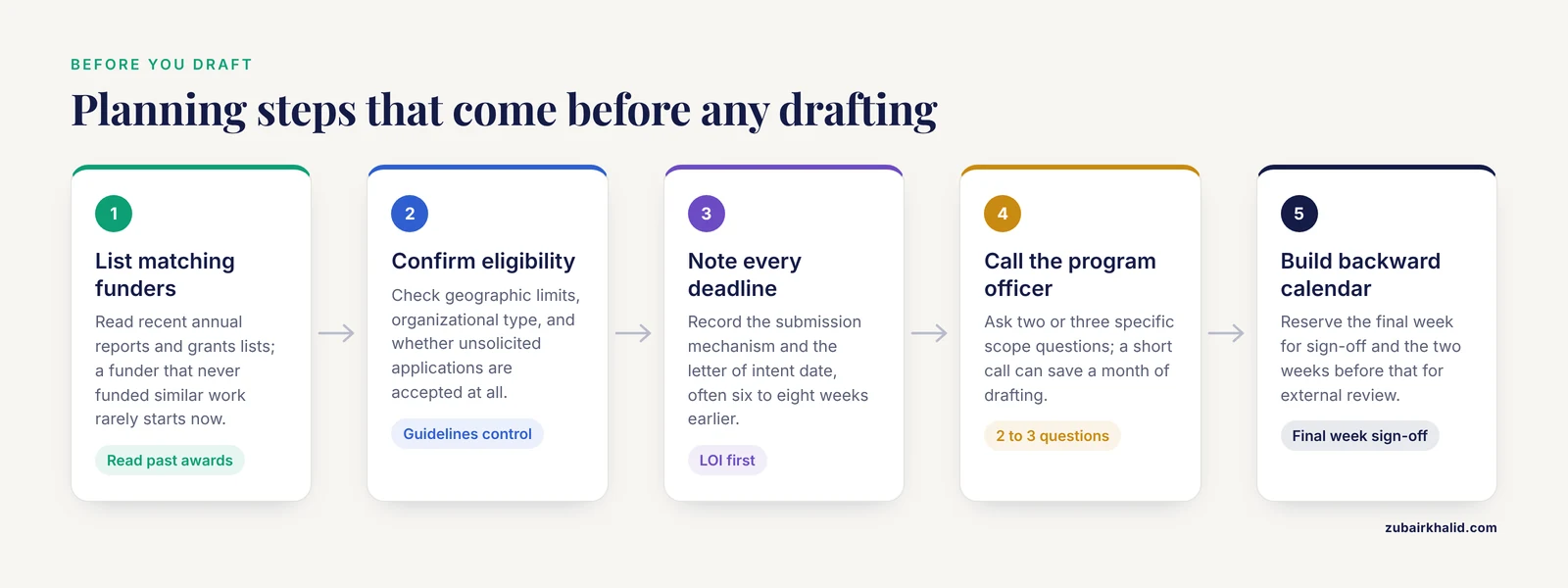
Grant proposal planning is the phase where you identify the funder, confirm eligibility, and reverse-engineer the deadline. Most first-time writers skip this and start drafting, then discover too late that the foundation only funds organizations in certain states, or only funds organizations with a specific nonprofit designation, or only accepts applications during a two-week window once a year.
Work through this sequence before writing a word of narrative:
- List funders whose published mission overlaps your project topic. Read their most recent annual report and their grants list. A foundation that has never funded a project like yours rarely starts with yours.
- Confirm eligibility rules on the funder's website, including geographic restrictions, organizational type, and whether they accept unsolicited applications. Some foundations only accept proposals they invite.
- Note the submission mechanism and every deadline, including the letter of intent deadline if there is one, which often sits six to eight weeks before the full proposal deadline.
- Contact the program officer with two or three specific questions. Program officers answer scope questions honestly, and a short call can save you a month of drafting a proposal they cannot fund.
- Build a backward calendar from the submission deadline. A practical internal schedule reserves the final week for sign-off by your institution's sponsored programs office or equivalent approver, the two weeks before that for external review of the draft, and everything before that for drafting.
A common planning error is treating the budget as something you build at the end. Reviewers read the budget as a translation of the methods, so build them together.
Foundation Grant Proposal Writing Step by Step
The following walkthrough covers a full proposal for a hypothetical project, a community-partnered study of how a new care-coordination service affects outcomes for people managing a chronic condition at a neighborhood clinic. The same structure works for education, environment, or arts proposals with the domain language swapped.
Step 1. Open With Fit, Not With Your Interests
Your opening paragraph should state what the funder cares about, then connect it to what you will do. Reviewers at foundations look for their own mission reflected back at them in the first page. Write the opening after you finish the methods so you can state the connection precisely.
Step 2. Write a Needs Statement With a Specific Problem
The needs statement defines the problem, the population, and the gap between what exists and what is needed. Keep it evidence-based but brief, and cite published sources or your own preliminary data. A weak needs statement says a problem is large. A strong needs statement says a specific problem affects a defined group, existing services miss part of it, and your organization is positioned to address that missed part.
Step 3. Define Objectives You Can Measure
Each objective should name a change, a direction, a population, and a timeframe. Compare these two:
- Weak: "Improve chronic disease management in the community."
- Strong: "Among 120 adults enrolled at the clinic within 12 months, increase the proportion completing a follow-up visit within 30 days of enrollment from the baseline rate to at least 25 percentage points higher."
Every objective needs a matching measure in the evaluation plan. If you cannot name the measure, rewrite the objective.
Step 4. Describe Methods at the Level of a Workday
The methods section answers what will actually happen. Name who does each activity, how often, with what materials, and how participants are recruited and retained. For a partnered study, describe how partners participate in decisions, not just recruitment. Guidance on engagement in research proposals emphasizes early and ongoing engagement, meaning partners contribute from the design phase onward rather than appearing only when subjects are needed [1].
Step 5. Build the Budget and Justification Together
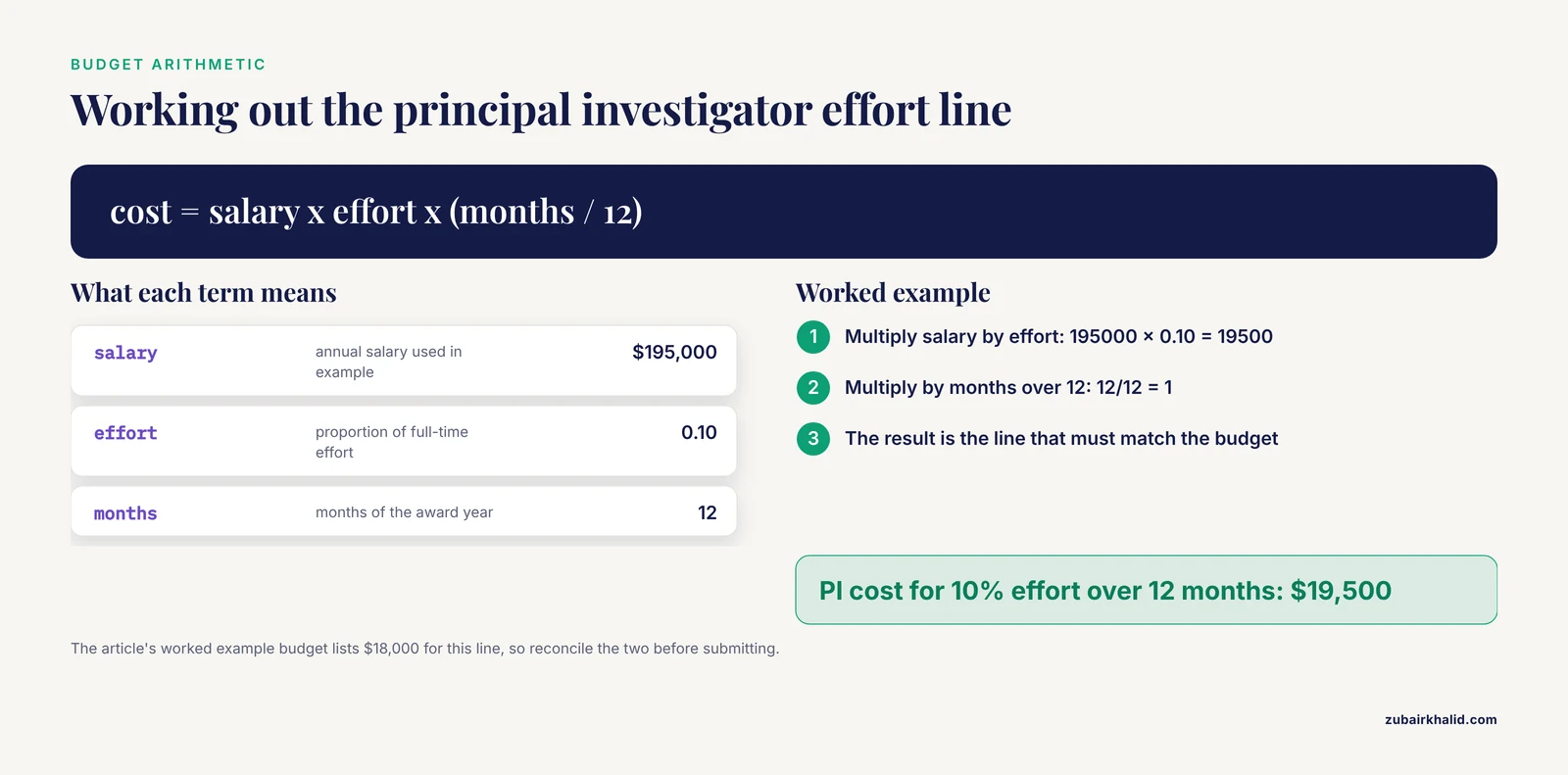
Build the budget directly from the methods. Every line item should trace to an activity a reviewer can find in the narrative. Here is a worked example for the hypothetical project, with illustrative numbers you would replace with your institution's actual salary figures:
Direct costs (worked example, hypothetical project)

Personnel
  Principal investigator, 10% effort, 12 months        $18,000
  Research coordinator, 50% effort, 12 months          $32,500
  Community partner stipends, 4 partners x $1,500       $6,000
Supplies and materials                                  $2,400
Participant incentives, 120 participants x $40          $4,800
Dissemination, one open-access article fee              $2,300
                                             Direct   $66,000
Indirect costs at the rate the funder allows
Now show the expected output of a quick effort calculation so your numbers survive scrutiny:
from datetime import date, timedelta

salary = 195000  # annual salary used for the worked example
pct_effort = 0.10
months = 12

pi_cost = salary * pct_effort * (months / 12)
print(f"PI cost for 10% effort over 12 months: ${pi_cost:,.0f}")
Expected output:
PI cost for 10% effort over 12 months: $19,500If your budget justification says 10 percent effort, the arithmetic in the justification must match the line in the budget to the dollar. Mismatches between narrative and budget are among the fastest ways to lose reviewer trust. Note the community partner stipends line. Dedicated funds for engagement and partner compensation is one of the expectations that funder frameworks treat as foundational for partnered research, so proposals that compensate partners directly signal seriousness [1].
Step 6. Lay Out a Timeline the Reviewer Can Verify
Convert your milestones into dates. A simple script keeps them honest:
from datetime import date, timedelta

award_start = date(2026, 7, 1)
milestones = {
    "Hire coordinator, finalize protocol approvals": 30,
    "Complete onboarding and training with partners": 60,
    "Begin enrollment": 90,
    "Reach half of enrollment target": 180,
    "Complete data collection": 300,
    "Analysis and draft manuscript": 330,
    "Final report to funder": 365,
}

for task, days in milestones.items():
    print(f"{task:<48} {award_start + timedelta(days=days)}")
Expected output:
Hire coordinator, finalize protocol approvals    2026-07-31
Complete onboarding and training with partners   2026-08-30
Begin enrollment                                 2026-09-29
Reach half of enrollment target                  2026-12-28
Complete data collection                         2027-04-27
Analysis and draft manuscript                    2027-05-27
Final report to funder                           2027-07-01
Check the output against your methods. If enrollment begins 90 days after the award but your approval process typically takes longer, the timeline is a promise you cannot keep, and reviewers notice.
Step 7. Write the Evaluation Plan
State each objective, its measure, the data source, the collection schedule, and who analyzes the data. Foundations generally want to know what changed and how you will know. If your project includes a partnered component, evaluate the partnership itself, not only the outcomes. Frameworks for engagement in research proposals call for ongoing review and assessment of the partnership and for the work to produce benefit to patients and the groups involved, which means the evaluation should capture whether partners experienced the collaboration as useful [1].
Step 8. Design the Engagement Plan
This step deserves its own attention because funders increasingly score it. A widely used framework defines eight expectations for authentic partnerships in research proposals [1]:
- Representative involvement, meaning the partners reflect the population the project serves.
- Early and ongoing engagement across the project life cycle.
- Building capacity to work as a team, often through orientation or training so partners and researchers understand each other's roles.
- Dedicated funds for engagement and partner compensation in the budget.
- Meaningful inclusion in decision-making, with named mechanisms such as a steering group with voting seats.
- Ongoing review and assessment of how the partnership is functioning.
- Informational exchange and mutual learning, so knowledge flows both directions between partners and the research team.
- Benefit to patients and involved groups, meaning the project produces value the participants themselves recognize.
The same guidance is candid about scope. Including all eight expectations may not be feasible in every proposal, and the framework exists to push researchers toward progressively stronger engagement practices rather than to demand perfection in a single application [1]. In your proposal, name which expectations you address and how. A table mapping each expectation to a concrete activity and a budget line is often the clearest format.
Step 9. Draft the Abstract Last
The abstract, usually called an executive summary in foundation templates, is the only section many initial screeners read. Write it after the narrative is complete, state the problem, the approach, the population, the requested amount, and the expected outcome, in that order, in plain language with no disciplinary jargon.
Step 10. Assemble, Check, and Submit
Confirm every required attachment, the formatting rules, the deadline, and the submission portal mechanics at least a week early. Portal failures on deadline day are a documented and entirely avoidable cause of lost applications.
Key Sections at a Glance
| Section | Question it must answer | What reviewers check first |
|---|---|---|
| Executive summary | What do you want and why should this funder care? | Fit with stated priorities, requested amount |
| Statement of need | What specific problem, in what population, is unmet? | Evidence, specificity, no recycled generalities |
| Objectives | What measurable change will occur, by when? | Whether each objective has a matching measure |
| Methods | What will actually happen, week to week? | Feasibility, role clarity, partner involvement |
| Evaluation | How will you know it worked? | Data sources, timing, who analyzes |
| Engagement plan | Who is affected and how do they shape decisions? | Named mechanisms, compensation, early involvement |
| Budget and justification | Does the money match the plan? | Line-by-line match to methods, allowable costs |
| Timeline | Can this be done in the grant period? | Milestones that match the methods |
| Organizational capacity | Why your team and institution? | Track record, letters of support, key personnel |
Foundation Grant Proposal Writing Tips
These practices separate funded proposals from near misses.
- Write for a screener first. Many foundations use a two-stage review, so the summary and needs statement carry the early round on their own.
- Use the funder's own vocabulary. If their materials say "neighborhood health" rather than "community-based participatory research," adopt their phrase in your fit statement.
- Name people, not categories. "Four patient advisors who received the clinic's care" reads stronger than "patient stakeholders."
- Budget real money for partners. Compensation is not a courtesy. It is an expectation in partnered research, and proposals that treat it as a line item with a rate and a schedule read as more credible [1].
- Keep a reusable template of your boilerplate, including organizational descriptions and standard budget justifications, then customize every proposal anyway. Reviewers can detect an unmodified form letter from across the room.
- Ask the program officer one clarifying question you genuinely cannot answer from the guidelines. It demonstrates diligence and often reveals scoring priorities.
- If your writing needs structure, a research grant writing course can accelerate the learning curve, particularly for abstract writing and budget logic. Institutional research offices and professional societies commonly offer short courses, and many universities run internal workshops each grant cycle.
Common Mistakes and Limitations
These are the errors that appear again and again in declined foundation proposals, with the note a reviewer typically writes and the fix.
- Mission mismatch. Reviewer note: "The project is interesting but does not align with our current funding priorities." Fix: filter your funder list before drafting and write the fit statement around their published language.
- Budget that does not match the narrative. Reviewer note: "The budget includes effort not described in the methods." Fix: build both documents together and reconcile them line by line before submission.
- Engagement as decoration. Reviewer note: "Patient involvement is mentioned but its role in decisions is unclear." Fix: state who partners are, when they join, what decisions they influence, and how they are compensated, echoing the expectation that inclusion in decision-making be meaningful rather than nominal [1].
- Unmeasurable objectives. Reviewer note: "Outcomes cannot be verified." Fix: attach a measure, a data source, and a timeframe to every objective.
- Timeline optimism. Reviewer note: "The schedule appears infeasible given required approvals." Fix: build the timeline from actual turnaround times for approvals and hiring, not from best-case assumptions.
- Missing attachments or formatting violations. Reviewer note: "Application incomplete." Fix: run an attachment checklist against the guidelines the day before submission.
- Jargon-heavy abstract. Reviewer note: "Summary was difficult to follow for nonspecialists." Fix: have someone outside your field read only the abstract and say back what the project does.
One limitation applies to everything above. Funder expectations, formats, and review processes vary widely between foundations, and this guide describes general professional practice rather than any single funder's rules, so always treat the specific guidelines document as the controlling authority for your application. For projects involving human subjects, the ethical and regulatory review requirements of your institution also apply and are beyond the scope of proposal writing advice.
How to Check Your Proposal Before Submission
Run this review sequence on the final draft.
- Cold read. Someone outside your project reads the summary and the statement of need and states back the problem, the approach, and the ask. If they cannot, revise before anything else.
- Budget reconciliation. Compare every line in the budget to a sentence in the methods and a figure in the justification. The three must agree.
- Objective-to-measure mapping. List each objective in one column and its measure in another. Any empty cell is a revision.
- Engagement audit. Against the eight expectations for partnered research, mark which ones your proposal demonstrates, where, and with what funding [1]. Where you cannot demonstrate one, say what you will build toward rather than staying silent, which is consistent with the framework's expectation of progressive improvement [1].
- Formatting pass. Fonts, margins, page limits, file naming, attachment order. Funders enforce these mechanically.
- Internal sign-off. Route through your sponsored programs or grants office with their stated lead time, which is often longer than first-time applicants expect.
Frequently Asked Questions
How long does it take to write a foundation grant proposal?
Plan on several weeks to a few months depending on complexity. The planning and funder research phase often takes as long as the drafting itself, and institutional sign-off adds time at the end.
What is a letter of intent and do I need one?
A letter of intent is a short introductory document, often one to two pages, that some foundations require before inviting a full proposal. Check the funder's guidelines, because if a letter of intent is required, skipping it usually disqualifies the application.
How do I find foundations that fund my topic?
Search funder databases and professional society funding lists, then read the grants each candidate foundation has actually awarded in the last two years. Past awards are the most reliable signal of what a foundation will fund next.
How much money should I request?
Request what your methods genuinely require and stay within any range the funder publishes. Reviewers judge the fit between the budget and the plan, not the absolute size of the request.
Do I need a fiscal sponsor or nonprofit status?
Many foundations award only to tax-exempt organizations, and universities or hospitals typically qualify through their own status. If your organization lacks that status, some foundations allow applications through a fiscal sponsor, so confirm the rule in the guidelines or ask the program officer.
What is patient or community engagement in a proposal?
Engagement means affected people participate as partners in shaping the research, from design through dissemination, rather than serving only as subjects. Current guidance for research proposals lays out expectations including representative involvement, early and ongoing participation, and dedicated compensation funds for partners [1].
Is a research grant writing course worth taking?
For most first-time applicants, yes. A structured research grant writing course compresses the feedback loop by having experienced reviewers critique your draft, which is difficult to arrange on your own.
What happens after I submit?
Most foundations confirm receipt, screen applications against eligibility and fit, then send shortlisted proposals to review. Expect a decision in a few months, and if you are declined, request feedback, because reviewer comments are the cheapest mentoring available for your next application.