How to Write a Project Narrative for a Foundation Grant: A Template
By Dr. Zubair Khalid, DVM, MS, PhD ·

By the end of this guide you will be able to draft a complete project narrative for a foundation grant, section by section, using a reusable template with word budgets, model sentences, worked calculations, and a checklist you can run before anyone else reads the draft. The project narrative is the prose core of any foundation grant proposal template, the part where you argue the case. The cover letter, budget forms, and attachments exist to support the claims the narrative makes.
Gather four items before you start:
- The funder's request for proposals (RFP), the document that states priorities, eligibility, length limits, deadlines, and evaluation criteria
- The funder's most recent annual report or IRS Form 990, the public tax return that US nonprofits file, to confirm mission fit
- One or two abstracts from projects the funder has already supported
- A word processor with a word count, plus your CV and a draft budget
If you want to run the checks exactly as shown in the walkthrough, install nothing beyond a plain text editor and the free command-line tools wc and grep, which are built into macOS, Linux, and Windows Subsystem for Linux.
A running example carries the walkthrough. PondWatch is a fictional project in which a community college biology instructor asks a regional health foundation for $18,400 to train high school students to measure antibiotic resistance genes in local ponds. Every number attached to PondWatch is illustrative, so substitute your own.
What a Project Narrative Is and What Foundations Look For
The narrative sits in the middle of a proposal package. A letter of inquiry (LOI), a short first contact asking whether the funder would welcome a full proposal, sometimes comes before it. After the narrative come the budget, the budget justification, and attachments such as letters of support. Reviewers score the narrative against the criteria printed in the RFP, so the narrative is where funding is won or lost.
Two bodies of work describe what reviewers expect. A genre analysis of the National Science Foundation's proposal and funding process mapped the proposal as a system of documents with expected moves, and found that reviewers rely on those moves to locate the science quickly [1]. Classic grantsmanship advice makes the same point from the foundation side: a foundation reads a proposal asking whether the project fits its priorities, whether the plan is credible, and whether the applicant can deliver [2]. Guidance written for National Science Foundation applicants frames the same sections in research terms, with the plan, the personnel, and the resources argued as one package [3], and workshops that introduce the Wenner-Gren Foundation and NSF programs teach applicants to answer the program's stated questions in the program's own order [4].
Foundation proposals also come in many shapes. A data science training organization proposed a national program to the Moore Foundation. The Niswonger Foundation proposed a rural literacy initiative to the US Department of Education [5]. A high school leadership program went to the Coca-Cola Foundation [6]. A 1958 research proposal to the NSF by Joshua Lederberg shows how far back the genre runs [7]. The eight-part template below flexes across all of these.
How Grant Peer Review Reads Your Narrative
Narratives are read by people, and evidence on how those people write is now substantial. Between 2016 and 2023, the Swiss National Science Foundation collected peer review reports on 11,385 Project Funding proposals across 21 disciplines. One analysis of 39,280 reports used supervised machine learning to classify more than 1.3 million sentences by evaluation criterion and by sentiment [8]. Three results matter for a first-time applicant.
First, review style varies by field. Reviews in the social sciences and humanities ran longer and more critical, with less attention to the applicant's track record, the documented record of completed work. Reviews in mathematics, informatics, natural sciences, and technology were shorter, more positive, and more focused on track record. Life sciences sat between those poles [8]. Second, reviewer identity shapes the report. Female reviewers wrote longer reviews that hewed closer to the stated evaluation criteria and expressed more positive sentiment than male reviewers [8]. Third, sentiment aimed at applicants varied with applicant gender, with female applicants receiving slightly more positive reviews on average [8].
The practical lesson is to write for the criteria, not for an imagined reviewer. You cannot control who reads the proposal, but every criterion printed in the RFP can be answered in a named section with named evidence. Because some fields lean harder on track record than others [8], life scientists should place concrete completed results at the top of the team section rather than at the end. Funding systems are also under review themselves. Reform proposals would couple awards to preregistered study protocols accepted by journals, which would shift weight toward a rigorous, reproducible methods section. Writing methods a stranger could execute is a safe bet under any future system.
Grant Proposal Planning Before You Write
Strong narratives are planned before they are drafted, and three planning tools do most of the work.
First, deconstruct the RFP. In a course project at George Mason University, undergraduates spent about six weeks working from the actual guidelines of the American College Health Foundation, which makes annual awards of $2,500 for proposals that foster healthy behaviors on college campuses and require alignment with Healthy Campus 2020 objectives [9]. The sequence they followed mirrors professional practice: identify the factors framing the guidelines, choose the funded objective your project serves, research the problem, draft, present, and evaluate against the award's own criteria [9]. Step 1 below turns that sequence into a checklist.
Second, map the project's logic. The Business Model Canvas, a one-page planning grid with nine blocks (customer segments, value proposition, channels, customer relationships, revenue streams, key resources, key activities, key partnerships, and cost structure), served as the analytical basis for a business capital grant proposal to the Gugah Nurani Indonesia Foundation [10]. The same nine questions adapt to a research or education project: who benefits, what value you create, how it reaches them, what relationship you keep, what money sustains it, what you must have, what you will do, who helps, and what it costs. Answering all nine in outline form prevents the most common planning gap, a project with activities but no delivery or cost logic.
Third, name the funding line. Foundations fund through defined programs, and a proposal to the Volkswagen Foundation's priority program on global structures and their governance was written explicitly for that program rather than as a generic research plan [11]. Cite the program name in your opening summary so the reader never has to guess why you chose them.
The Foundation Grant Proposal Template Format
The template assumes a mid-length narrative of 1,800 words, which fits many foundation full proposals. Three parameters control it: the total word budget, the per-section split, and the success thresholds you set in the evaluation plan. Change the total to match the RFP, keep the split roughly proportional, and set thresholds you can measure with records you already keep.
PROJECT NARRATIVE TEMPLATE (foundation grant)

1. Opening summary (120 words)
   Project title, applicant, amount requested, one-sentence core
2. Statement of need and significance (350 words)
   Problem, evidence, who is affected, why this funder
3. Goals and measurable objectives (200 words)
   One goal, two to four objectives with numbers and dates
4. Methods, activities, and timeline (450 words)
   What you will do, who does it, when, with what safeguards
5. Evaluation plan (250 words)
   Indicators, data collection tools, targets, thresholds
6. Team and organizational capacity (200 words)
   Roles, relevant completed results, facilities, partners
7. Budget narrative (130 words)
   Line-by-line justification tied to activities
8. Sustainability and impact (100 words)
What continues after the grant, where results go| Section | Word budget (of 1,800) | Question the reviewer is asking | Most common failure |
|---|---|---|---|
| Opening summary | 120 | What are you asking for? | Buries the request |
| Need and significance | 350 | Why does this matter? | Assertion without evidence |
| Objectives | 200 | What will change? | Unmeasurable verbs |
| Methods and timeline | 450 | Can this actually work? | Activity list without logic |
| Evaluation plan | 250 | How will you know it worked? | Outputs confused with outcomes |
| Team and capacity | 200 | Why you? | CV recitation, not relevance |
| Budget narrative | 130 | Is the money justified? | Numbers disconnected from methods |
| Sustainability | 100 | What happens after? | Nothing after the grant |
If the RFP sets a different limit, scale every budget by the same factor:
scaled_budget = round(section_words * (rfp_limit / 1800))

Example: RFP allows 900 words
Methods: round(450 * (900 / 1800)) = round(225) = 225 words
Need:    round(350 * (900 / 1800)) = round(175) = 175 words
A foundation grant proposal template example with filled-in numbers appears at every step of the walkthrough below.
Step-by-Step Walkthrough: From RFP to a Finished Narrative
Step 1: Extract the evaluation criteria
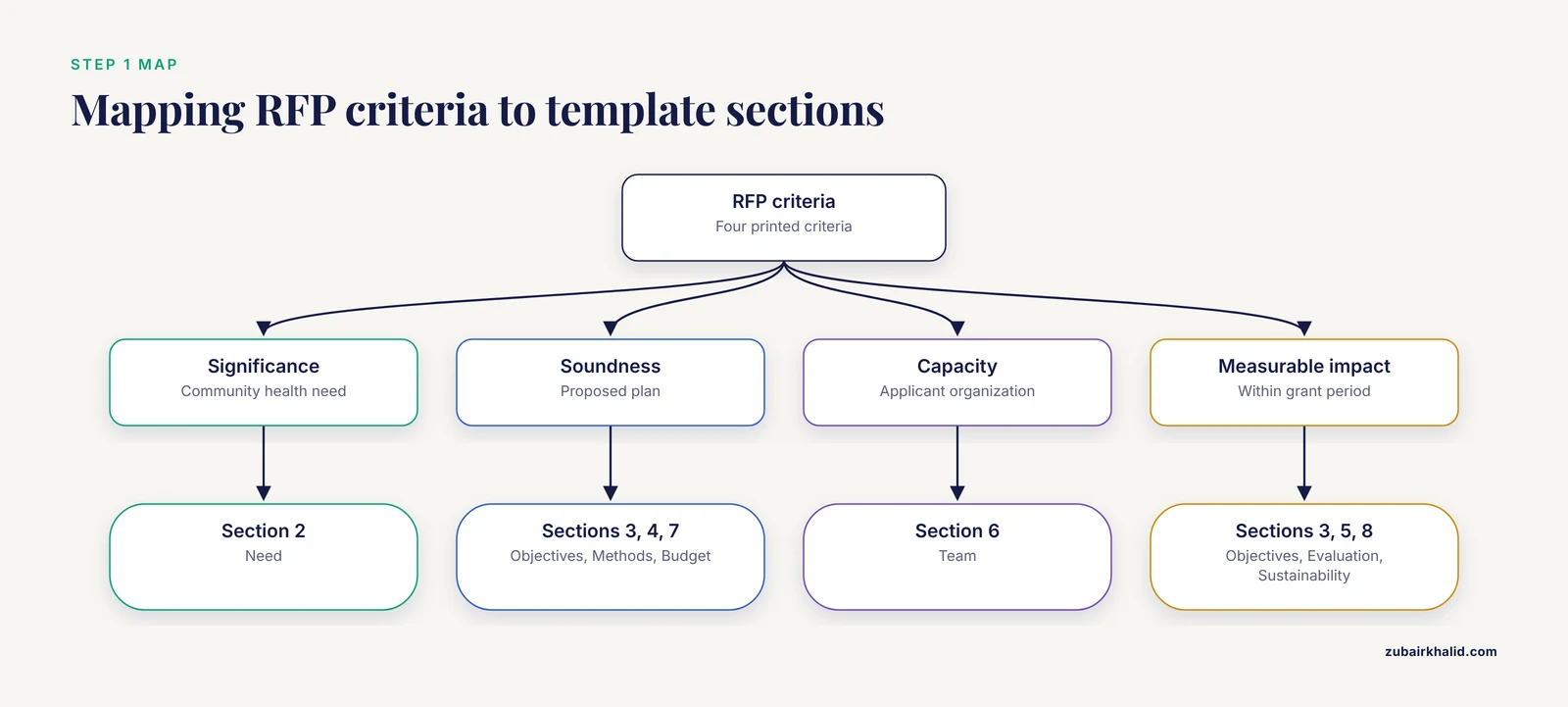
Copy the RFP's evaluation paragraph into a file and map each criterion to the template section that answers it.
RFP text (excerpt):
"Proposals will be evaluated on (a) significance of the community
health need, (b) soundness of the proposed plan, (c) capacity of
the applicant organization, and (d) likelihood of measurable
impact within the grant period."

Criteria-to-section map:
a. Significance      -> Section 2 (Need)
b. Soundness         -> Sections 3, 4, 7 (Objectives, Methods, Budget)
c. Capacity          -> Section 6 (Team)
d. Measurable impact -> Sections 3, 5, 8 (Objectives, Evaluation, Sustainability)
Expected output: a one-page checklist. Keep it visible while drafting, because peer review evidence shows that reviews which track the printed criteria are the norm you should write for [8].
Step 2: Write the one-sentence core
Use the formula: who or what, will do what, measured how, over what period, for whose benefit.
Weak:  "We will study antibiotic resistance in local ponds."

Strong (PondWatch):
"PondWatch will train 60 high school students to measure
antibiotic resistance genes in 12 county ponds over 18 months,
producing a public water-quality dataset and a briefing for the
county health department."
Expected output: one sentence under 40 words that names the population, the action, the measure, and the timeframe. This sentence becomes the first sentence of your opening summary and the spine of every other section.
Step 3: Draft the need and significance section
Section 2 skeleton (350 words):
Sentence 1: The problem in one sentence, with a number.
Sentences 2-3: Evidence, with sources named.
Sentence 4: Who is affected locally and how.
Sentence 5: Why existing responses fall short.
Sentence 6: Why this funder, using the funder's own priority words.

PondWatch (illustrative):
"Antibiotic-resistant bacteria are a growing concern in surface
water, yet counties rarely hold local resistance data to guide
testing or advisories. National surveillance tracks clinical
infections, but environmental reservoirs in ponds and streams
remain largely unmonitored at the county level. In our county,
140 private ponds sit within one mile of public schools, and no
routine resistance screening exists for any of them. Students can
close part of that gap while learning standard microbiology
methods. This proposal responds directly to the foundation's 2026
priority on community-based environmental health monitoring."
Every factual claim here carries a named source in a real submission. Unsupported significance statements are the easiest target for a critical reviewer.
Step 4: Write objectives reviewers can verify
Objectives should be SMART: specific, measurable, achievable, relevant, and time-bound.
Template:
Objective [n]: By [month], [population] will [measurable verb]
[quantity], measured by [tool or record].

PondWatch objectives:
Objective 1: By month 6, recruit and train 60 students from 3
county high schools, measured by signed rosters.
Objective 2: By month 12, complete 24 sampling runs (12 ponds in
spring and fall), each documented in a laboratory log.
Objective 3: By month 18, deposit one public dataset with a
digital object identifier (DOI), a permanent link assigned to
archived data, and deliver one briefing to the county health
department.
Replace vague verbs such as "raise awareness," "explore," and "enhance understanding" with countable actions: train, collect, sequence, deposit, present, publish.
Step 5: Describe methods and a timeline
PondWatch methods (illustrative, condensed):
Sampling: At each pond, collect 500 mL of surface water at three
points, filter on site, and freeze filters for transport.
Laboratory: Extract DNA with a commercial kit, quantify with
fluorometry, and screen each sample for the intI1 and tetM genes
by quantitative PCR (qPCR), a technique that counts target gene
copies. Include a no-template control on every plate.
Analysis: Report gene copies per 100 mL, compare spring and fall
with a paired test, and map results by pond.

Timeline:
Months 1-3    Recruit students, order supplies, pilot 2 ponds
Months 4-6    Classroom and field training, finalize protocols
Months 7-12   Full sampling (spring and fall) and qPCR screening
Months 13-15  Analysis, dataset cleanup, internal review
Months 16-18  Dataset deposit, health department briefing, report
The reform trend toward preregistered, journal-accepted protocols signals that executable methods are gaining weight across funding systems, so write this section as if a stranger must run it.
Step 6: Build the evaluation plan
Distinguish outputs (countable products, such as training sessions held) from outcomes (changes for people, such as students who can perform a technique correctly).
Indicator              Tool                  Target
Students trained       Signed rosters        60 by month 6
Sampling runs done     Laboratory log        24 by month 12
Genes quantified       qPCR records          100% of runs with controls
Dataset released       Archive DOI           1 public dataset by month 18
Stakeholder uptake     Briefing minutes      1 briefing, 1 follow-up meeting

Threshold sentence template:
"The project will be judged successful if at least [threshold]
of [indicator] is achieved by [month], as documented by [record]."
Step 7: Present the team and capacity
Template sentence per person:
[Name], [role], brings [credential] and [one relevant result].

PondWatch (illustrative):
Dr. A. Rivera, project director, teaches general microbiology and
has supervised 14 undergraduate research projects.
J. Okafor, laboratory coordinator, runs the college's qPCR
facility and maintains its calibration records.
The county health department has agreed in writing to receive the
final dataset and briefing (letter of support, Attachment C).
Because reviews in some disciplines weight track record more heavily than reviews in others [8], lead with completed results rather than job titles.
Step 8: Write the budget narrative
Rule: every dollar traces to an activity in Section 4.
PondWatch supplies line (illustrative):
qPCR consumables: 24 runs x 96 reactions = 2,304 reactions.
At an assumed $0.90 per reaction, consumables total $2,073.60,
budgeted as $2,150 to cover pipette tips and controls.

Personnel: project coordinator at 0.15 full-time equivalent
(FTE), the fraction of one full-time position, for 18 months.
Expected output: a short paragraph per budget line in which the arithmetic is visible and each line names the activity it funds.
Step 9: Assemble, trim, and verify
Paste the sections in template order, then check the count and the language.
$ wc -w pondwatch_narrative.txt
1806 pondwatch_narrative.txt
If the count exceeds the RFP limit, apply the scaling formula from the template section, cutting background sentences before methods detail.
$ grep -inE "raise awareness|explore|enhance understanding" pondwatch_narrative.txt
14: we hope to enhance understanding of local resistance patterns
Expected output: line numbers with flagged phrases. Rewrite each flagged line with a countable verb and a number.
Step 10: Simulate review before you submit
Give the draft to two colleagues for 30 minutes each and have them score it against your Step 1 checklist.
Review simulation sheet (score 1-5, write one fix per row)
Significance: Section 2 cites local evidence           4  add county testing citation
Soundness: every objective has a method and a date     5  none
Capacity: each role named with one relevant result     3  add qPCR facility record
Impact: Section 5 names a numeric threshold            4  set follow-up date
Fit: narrative reuses the funder's priority words      5  none
Budget: every line traces to a Section 4 activity      4  itemize shipping
Working from real award guidelines, as the George Mason students did when they evaluated each other's proposals against the actual criteria [9], is what makes this step more than proofreading. Revise within a week while the feedback is fresh.
Common Mistakes and Limitations
Portal messages and reviewer comments use predictable language. Here are the ones you are most likely to meet, with fixes.
- Length violation. Message: "The project narrative exceeds the maximum length specified in the program guidelines." Fix: run the scaling formula, cut background sentences first, and move protocols to appendices where the RFP allows them.
- Vague outcomes. Comment: "The anticipated outcomes are described in general terms and cannot be verified." Fix: rewrite each objective with a quantity, a date, and the record that documents it.
- Budget disconnect. Comment: "The budget is not clearly justified by the described activities." Fix: add the line-by-line trace shown in Step 8.
- Priority mismatch. Comment: "The proposal does not clearly address the foundation's stated funding priority." Fix: open each section with a sentence that reuses the RFP's own criterion words.
- Undefined success. Comment: "The proposal does not define what success looks like." Fix: give every indicator a numeric target and a month, as in Step 6.
- Buried track record. Peer review evidence shows some fields weight the applicant's track record more than others [8]. Do not park completed results at the end of the team section.
- Overclaiming. Reviews in some disciplines run longer and more critical than in others [8], and unsupported superlatives hand a critical reader an easy target. Replace "groundbreaking" with the specific gap your project closes.
Three limitations apply to any template. Review tone and focus vary systematically by discipline and by reviewer [8], so no template guarantees a score. Each funder's guidelines override the budgets printed here. And funding models themselves are in flux, with reform proposals that would tie awards to journal-accepted preregistered protocols, so keep methods rigorous and executable. For institution-specific rules such as indirect cost rates and authorized signers, work with your office of sponsored programs or an experienced mentor before you submit.
Next Steps: Courses, Examples, and Feedback
Three moves turn a first draft into a repeatable skill.
Take structured instruction. A research grant writing course compresses years of trial and error into weeks. The George Mason model, in which students carry a real RFP from the American College Health Foundation through literature review, drafting, presentation, and peer evaluation in about six weeks, is a model for what to look for in any course [9]. Workshops that introduce the Wenner-Gren Foundation and NSF programs teach applicants to answer the funder's stated questions in the funder's own order [4], and library guides that collect Foundation Center grant resources point to funder profiles and sample documents [12].
Read funded proposals. Published examples show how the same eight sections flex across fields: ImpactStory's proposal to the Sloan Foundation, a trustee grant proposal to the Alfred P. Sloan Foundation [13], a Marian Chace Foundation proposal for de-escalation training in dance/movement therapy [14], and a letter proposal to the North Dade Medical Foundation [15]. Read two or three from your field and mark where each criterion is answered.
Keep the checklist. Reuse the criteria-to-section map from Step 1 for every submission. The peer review evidence shows that writing aligned to printed criteria is visible in how reviews come back [8], which makes the map the highest-leverage page in your files.
Frequently Asked Questions
What is a project narrative in a foundation grant proposal?
The project narrative is the prose core of the proposal. It states the problem, objectives, methods, evaluation plan, team, and budget justification in continuous text, and reviewers score it against the criteria printed in the funder's RFP.
How long should a project narrative be?
Whatever the RFP says. This template defaults to 1,800 words and scales proportionally, so a funder that allows 900 words gets every section budget cut in half.
How is a foundation grant different from a federal grant?
Foundations fund missions while federal agencies fund fields. Foundation awards are often smaller, review may be by staff or trustees rather than a rotating study section, and mission fit carries more weight, so say why the funder's own priority applies to your project.
What should a foundation grant proposal template format include?
Eight parts: opening summary, need and significance, objectives, methods and timeline, evaluation plan, team and capacity, budget narrative, and sustainability. The table above gives a word budget and a reviewer question for each.
Where can I find a free foundation grant proposal template?
University grant offices, library guides that collect Foundation Center grant resources, and the funder's own forms are the best free starting points, and the eight-section skeleton in this article is free to reuse. A template pays off only after you map it to the funder's criteria and limits.
How do I write objectives that reviewers accept?
Use the formula: by what month, who, a measurable verb, what quantity, measured by what record. Replace phrases like "raise awareness" with countable actions such as "train 60 students by month 6, documented by signed rosters."
Do I need preliminary data for a foundation grant?
It depends on the program. Research-oriented programs usually expect pilot data or a documented method, while community and education programs often accept a needs assessment or a small pilot instead. Read the RFP's soundness and capacity criteria before deciding what to include.
How do I practice grant writing before my first submission?
Work a real RFP end to end, the way students do in structured course projects that run from guideline analysis through peer evaluation, then run the review simulation in this guide with two colleagues and revise within a week.
Sources
- System Mapping: A Genre Field Analysis of the National Science Foundation's Grant Proposal and Funding Process
- Grantsmanship: What Will a Foundation Look for When You Submit a Grant Proposal?.
- Writing a Grant Proposal for the National Science Foundation
- How to Write a Grant Proposal: An Introduction to Grants and Programs at the Wenner-Gren Foundation and the National Science Foundation
- Abstract Niswonger Foundation Educational Innovation and Research Proposal Project Title: Rural LIFE: Literacy Initiative Focused on Effectiveness The Niswonger Foundation (NF) submits this proposal to the U.S. Department of Education for a mid-phase grant. This proposal addresses Absolute Priority
- High school leadership program : a grant proposal to the Coca- Cola Foundation
- "Research Proposal to the National Science Foundation" Grant Proposal, 1958
- Gender and disciplinary differences in grant proposal peer review: Content and sentiment in 39,280 reports
- Reading, Writing, and Research for Undergraduates: Introducing Scholarly Inquiry by Writing a Grant Proposal
- Business Model Canvas (BMC) for Es Mambolicious MSME: Business Capital Grant Proposal for the Gugah Nurani Indonesia (GNI) Foundation
- Arguing and Persuasion in Multilateral Negotiations Grant Proposal to the Volkswagen Foundation Schwerpunkt : “ Globale Strukturen und ihre Steuerung
- Guides: PADM 4220: Proposal Writing and Grants Administration: Foundation Center Grant Resources
- A Trustee Grant Proposal to The Alfred P. Sloan Foundation
- A Marian Chace Foundation grant proposal for dance/movement therapy based training in de-escalation and violence prevention
- Grant proposal letter to North Dade Medical Foundation