Fellowship Application Template with Examples
By Dr. Zubair Khalid, DVM, MS, PhD ·

By the end of this guide you will have a complete fellowship application draft built on a reusable template, a filled example for every major section, a word-budget method for tight page limits, and two terminal audits that catch the errors reviewers notice first. Before you start, gather four things: the call for applications from the fellowship you are targeting, your current CV, your mentor's written commitments, and your research records, such as notebook entries, accepted abstracts, and manuscripts in progress. A plain-text editor is enough for every template here, and all commands run in a standard terminal on macOS or Linux.
The guide gives you a fellowship application template you can copy, a fellowship application template example filled in section by section, and the format rules that keep a reviewer reading past page one.
Why a Template Helps When Mentorship Falls Short
A template is a reusable scaffold that lists the sections of a document, their order, and the question each section answers. The same idea scales across research writing, and any reusable scaffold, from a notebook entry form to a protocol outline, counts as a research template.
Structure matters because many applicants never receive it. Dermatology is one of the most competitive and least diverse specialties in United States medicine, and research experience has carried more weight in residency applications since the United States Medical Licensing Examination Step 1 moved to pass/fail scoring. In a national 34-question survey of medical students distributed through the Dermatology Interest Group Association from March to June 2024, 94 of 115 respondents completed the survey. Among the 73 participants who were in or had completed research fellowships, students underrepresented in medicine (URiM) reported barriers at significantly higher rates than peers: 91.3 percent lacked guidance or mentorship, 87.0 percent did not know how to find a fellowship, and 52.2 percent had no home dermatology program [1].
A fellowship application template does not replace a mentor. It standardizes the advice a strong mentor would give, so the structure of a competitive application stops depending on who is in your corner.
Fellowship Application Template Format: What Reviewers Expect
The fellowship application template format used by most biomedical research programs follows one skeleton: summary, background and significance, gap statement, central question or hypothesis, specific aims, research design and methods, expected outcomes with alternatives, timeline, training plan, mentorship and environment, references, and sometimes a budget. The call for applications sets exact page limits, fonts, and margins, and those rules override any template, including this one.
Three parameters matter more than raw length. First, tense and voice: write the proposed work in future tense (we will measure) and your accomplishments in past tense (I completed). Second, specificity: every aim names a population or system, a variable or intervention, an outcome, and a comparison. Third, traceability: every background claim points to a reference, and every method names its data source.
The table summarizes each section, the question it answers, a length guide, and the failure reviewers flag most often.
| Section | Question it answers | Length guide | Common failure |
|---|---|---|---|
| Abstract | What is this project? | 150 to 250 words | Written last, stays vague |
| Background | Why does this matter? | 1 to 2 pages | Literature list, no argument |
| Gap statement | What is missing? | 1 paragraph | "Understudied" instead of a named link |
| Hypothesis | What do you claim? | 1 to 2 sentences | An aim restated with a question mark |
| Specific aims | What will you do? | Often 1 page | Tasks, not testable questions |
| Methods | How, exactly? | 2 to 4 pages | No decision points |
| Alternatives | What if it fails? | 1 paragraph per aim | No plan B |
| Timeline | Is it feasible? | 1 table | All work stacked at the start |
| Training plan | Why this fellowship? | 1 page | Goals disconnected from aims |
| Mentorship | Who backs you? | Letters plus a plan | Letter repeats the abstract |
| References | Can I verify this? | As needed | Citations never discussed |
Treat the length guide as a starting point and replace it with the numbers in your call. Reviewers forgive a short section with a sharp argument, never a long one without one.
The Master Fellowship Application Template (Copy and Fill)
Copy the block below into a plain-text file named application.md and replace every bracketed prompt. Keep the numbering, because the walkthrough refers to sections by number.
FELLOWSHIP APPLICATION MASTER TEMPLATE
Replace every [BRACKETED] prompt. Keep the numbering, the walkthrough
refers to sections by number.

1. HEADER
   Applicant: [Name, degrees, current position]
   Program: [Fellowship name and sponsor]
   Mentor: [Name, degrees, department]
   Title: [Working title, 15 words or fewer]

2. ABSTRACT (use the limit in the call, often 150 to 250 words)
   [One sentence of background. One sentence on the gap. One sentence
    stating the central question or hypothesis. One sentence per aim.
    One sentence on the expected outcome and career impact.]

3. BACKGROUND AND SIGNIFICANCE
   3a. The problem today: [What goes wrong, with numbers if you hold them]
   3b. What is known: [Three to five findings that frame the problem]
   3c. The gap: [The specific missing link, named in one sentence]

4. CENTRAL QUESTION OR HYPOTHESIS
   [One sentence, testable and falsifiable]

5. SPECIFIC AIMS (often one page, check the call)
   Aim 1: [Determine, define, or test] [variable] in [population or system]
     Rationale: [One sentence tied to the gap]
     Hypothesis: [One sentence]
   Aim 2: [Same structure]
   Aim 3: [Same structure]
   Logic chain: Aim 1 output feeds Aim 2 because [reason]

6. RESEARCH DESIGN AND METHODS (repeat for each aim)
   Design: [Study type, sample or system, comparison group]
   Framework and reporting standard: [Name them when they apply]
   Data sources: [Databases, cohorts, instruments, listed exactly]
   Outcomes and analysis: [Primary outcome and analysis method]
   Decision point: [If X, then Y. If not X, then Z]

7. EXPECTED OUTCOMES AND ALTERNATIVE STRATEGIES
   Per aim: [Expected result, main pitfall, alternative approach]

8. TIMELINE
   [Months 1 to 3: ...  Months 4 to 8: ...  Months 9 to 12: ...]

9. TRAINING PLAN AND CAREER GOALS
   Skills to acquire: [List]
   Activities that build them: [Courses, clinics, analyses, writing]
   Position in five years: [Target role]

10. MENTORSHIP AND ENVIRONMENT
    Mentor commitments: [Meeting frequency, data access, career support]
    Environment: [Core facilities, cohorts, mentor track record]

11. REFERENCES
    [Cite only what you discuss, every claim traceable]

12. BUDGET AND JUSTIFICATION (when required)
    [Stipend, supplies, travel, in the sponsor's categories]
Fellowship Application Template Example: A Filled Draft
The example below comes from a second-year internal medicine resident applying for a research fellowship. It adapts the design of a published scoping review protocol on digital diabetes health coaching for adults with uncontrolled type 2 diabetes [2], which makes it a realistic model for applicants whose strongest current asset is protocol-level thinking rather than a finished dataset.
The Project in Brief
Title: Mapping Digital Diabetes Health Coaching for Adults With Uncontrolled Type 2 Diabetes to Build an Adaptable Intervention.
Background: Digital health advances have enabled coaching programs that deliver personalized, data-driven, and adaptive support, but the evidence is scattered, has never been comprehensively synthesized, and the diversity of theories and models behind these interventions makes it hard to build one adaptable, evidence-based program [2].
Gap: No comprehensive map exists of which coaching approaches, theoretical models, and outcomes have been tested in adults with uncontrolled type 2 diabetes.
Central question: Which digital coaching approaches have been evaluated in this population, with what theoretical grounding and outcomes, and where are the critical gaps?
The Aims Page, Filled
A scoping review is a study type that maps the breadth of evidence on a topic without pooling effect estimates, which makes it a strong first project for an applicant without a dataset. This version runs well under a one-page budget, leaving room for the mentor paragraph most programs expect.
SPECIFIC AIMS (example, filled)

Adults with uncontrolled type 2 diabetes need support that adapts to
their data and their lives. Digital health coaching can deliver
personalized, data-driven guidance, but the evidence behind these
programs is scattered across theories, populations, and outcome
measures, and no comprehensive synthesis exists. Without that map,
intervention designers cannot tell which features work for which
patients. Our central question is which digital coaching approaches
have been evaluated in adults with uncontrolled type 2 diabetes, with
what theoretical grounding, outcomes, and gaps.

Aim 1: Map the evidence. We will systematically search PubMed, Embase,
CINAHL, the Cochrane Central Register of Controlled Trials, and APA
PsycInfo for studies of digital diabetes coaching in adults with
uncontrolled type 2 diabetes, following the Joanna Briggs Institute
methodology and the population-concept-context framework, and
reporting per the PRISMA-ScR guideline [2].

Aim 2: Appraise the evidence. We will assess the methodological quality
of included randomized and quasi-experimental studies with the JBI
critical appraisal tools [2].

Aim 3: Convert the map into design rules. We will synthesize coaching
features, behavior-change theories, and outcomes into a
feature-by-population matrix that specifies the adaptable intervention
our next-phase trial will test.

Outcome: A public evidence map, a quality-appraised study set, and a
design blueprint that closes the gap between scattered trials and a
coherent intervention science for digital diabetes coaching.
Methods That Survive Reviewer Scrutiny
Each aim needs a design, named data sources, an analysis, and a decision point. For the example above, the design is a systematic search of five databases with dual screening, quality appraisal with published tools, and a synthesis matrix. PRISMA-ScR, the Preferred Reporting Items for Systematic Reviews and Meta-Analyses extension for Scoping Reviews, is the reporting checklist that gives reviewers a standard to hold the plan against. The decision points read like this:
- If few eligible studies report implementation outcomes, we will synthesize intervention features and behavior-change techniques instead of effectiveness estimates.
- If appraisal shows a high risk of bias across most included studies, we will present the evidence map as descriptive and frame Aim 3 as hypothesis generation.
A methods section without decision points reads as a plan that assumes everything works. Reviewers read decision points as evidence that you have thought about failure.
Three Writing Moves From the Recent Literature
The strongest background sections borrow rhetorical moves from published reviews. Three recent papers show the pattern.
Move 1: compress the problem into a short list of difficulties. A review of biomarkers in neuropathic pain, a refractory subtype of chronic pain, opens with three difficulties: diagnosis rests on patient complaints, physicians struggle to recognize the disease early, and judging treatment response is slow. It then surveys biochemical, electrophysiological, imaging, genetic, and epigenetic biomarker research and argues that high heterogeneity limits the clinical value of any single biomarker, so multimodal integration is required [3]. Your background can use the same two steps: name the difficulties as a list, then name the limitation that forces your approach.
Move 2: define an emerging method, then state its translational path. A narrative review of optogenetics, a technique that uses light to manipulate genetically targeted neurons, screened 58 articles and included 9 on multiple sclerosis. The included studies showed that optogenetic stimulation promoted remyelination by driving oligodendrocyte precursor cells to become myelinating cells and restored normal cognitive function in animal models, and the review closes by calling for optimization toward clinical use in drug delivery, remyelination, and gene therapy [4]. If your project uses a new technique, mirror that arc in three sentences: definition, mechanism you will exploit, clinical gap you will close.
Move 3: turn a mechanism into a decision rule. A clinical review of infliximab, an anti-TNF biologic used as rescue therapy, in acute severe ulcerative colitis (ASUC), where corticosteroid-refractory disease remains a key management challenge, explains that drug clearance rises during the illness through proteolytic degradation, target-mediated drug disposition, fecal losses, and possibly early anti-drug antibody formation. Pharmacokinetics describes what the body does to a drug, pharmacodynamics what the drug does to the body, and current models miss both the time-varying clearance and the two-way relationship between them. The practical result is a decision rule: patients with high clearance risk pharmacokinetic failure and may benefit from escalated induction, and pre-treatment clearance can be estimated from factors such as higher body weight and male sex [5]. In an application, this move reads as mechanism, model limitation, and the rule your project will test.
From Blank Page to Submitted Draft: A Numbered Walkthrough
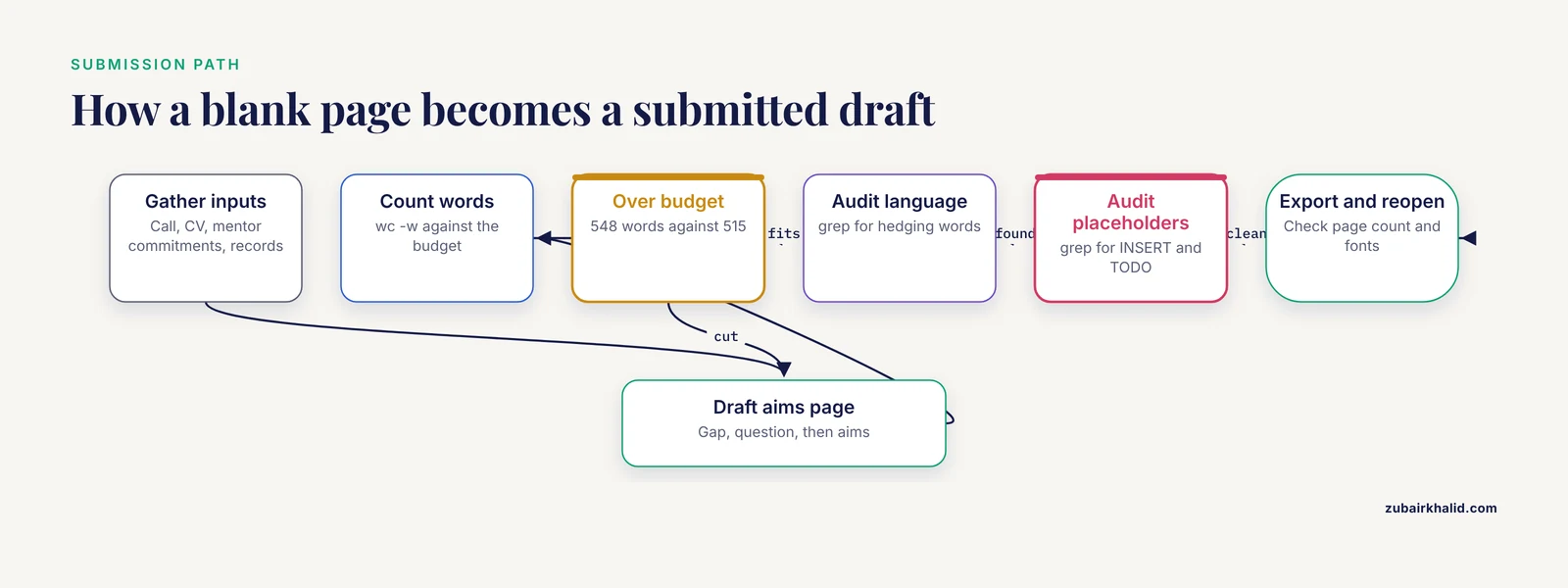
- Collect inputs. Lay out the call for applications, your CV, your mentor's written commitments, letters in progress, and your research records. Copy the call's section list into the master template, because the call's order wins over any template.
- Build your evidence record. Reviewers trust claims that trace to dated records. Many universities publish a lab notebook template pdf, and any version works if it captures date, objective, data source, result, and next step, like this filled entry from the example applicant:
## 2026-03-14 | Query 012 | App features in clinic panel
Objective: Count which digital coaching features our patients already use
Data source: De-identified clinic report, adults with uncontrolled diabetes (n=42)
Result: 61 percent used at least one feature, logging gaps were common
Next step: Use as local context in the background, label as preliminary
Keep a one-line tracker beside the notebook so the track record section writes itself:
type,title,venue,year,status
abstract,App feature use in our clinic,Regional IM meeting,2026,poster
protocol,Scoping review on digital coaching,In preparation,2026,draft
manuscript,Coaching features and engagement,Target journal,2026,outline- Set the word budget. Do the arithmetic before drafting so you know the ceiling:
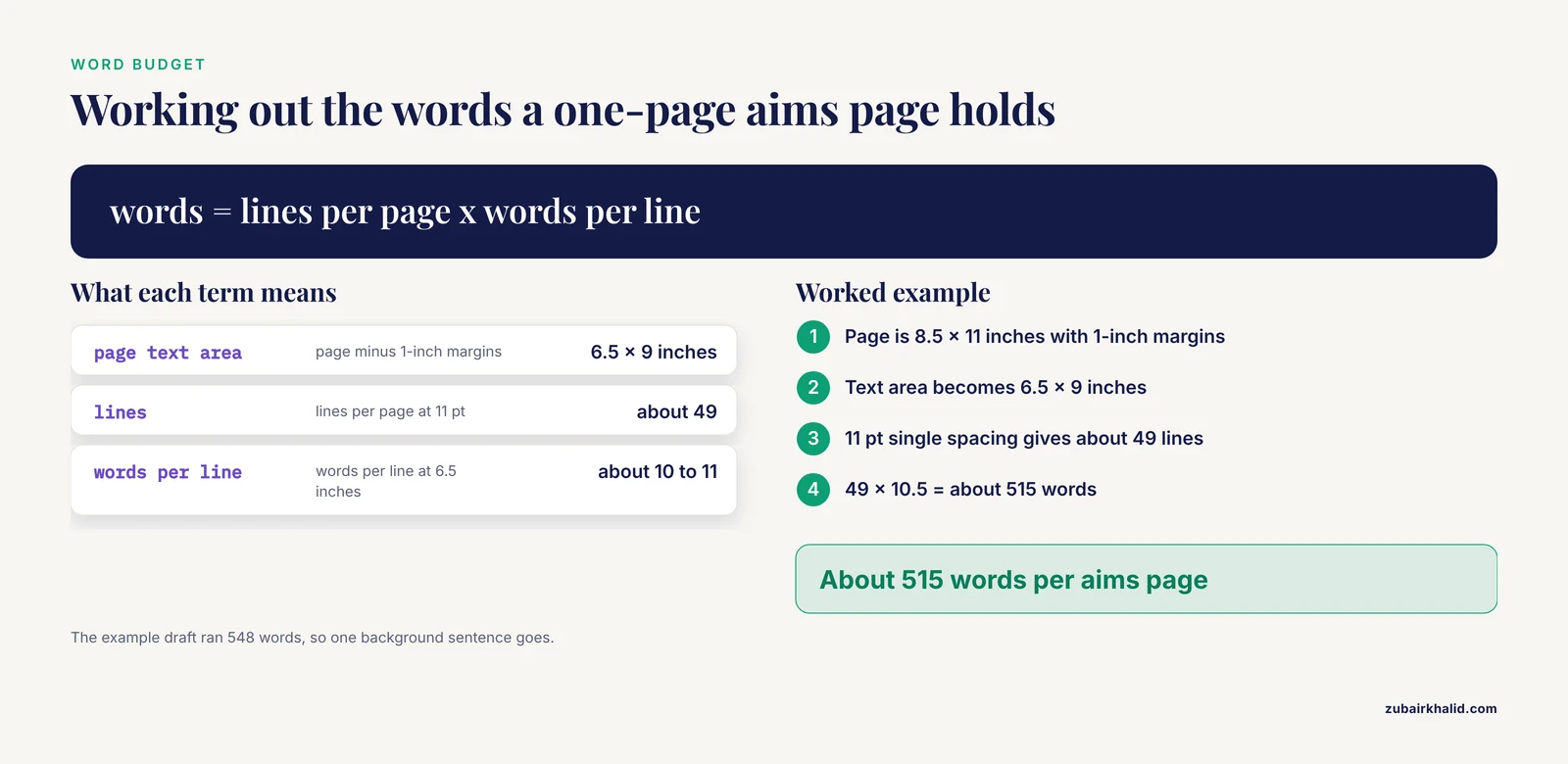
One-page aims budget (worked example)
Page: 8.5 x 11 inches, 1-inch margins -> 6.5 x 9 inches of text
Type: 11 pt, single spacing -> about 49 lines per page
Words per line at 6.5 inches: about 10 to 11
Budget: 49 x 10.5 = about 515 words- Draft the aims page first. The aims page is the application in miniature, and every later section expands it. Write the gap sentence, the central question, then the aims, and stop at the budget.
- Count and cut. The wc command counts words in a file:
$ wc -w aims.txt
  548 aims.txt
548 words against a 515-word budget means one background sentence goes.
- Audit the language. Hedging reads as doubt, and reviewers fund certainty backed by design. The grep command prints every line that matches:
$ grep -nE "hope|try to|attempt to|somewhat|perhaps|possibly" aims.txt
12:We hope to define which coaching features drive engagement
27:The review will possibly reveal gaps in adolescent populations
Line 12 becomes "We will define which coaching features drive engagement." Line 27 becomes "The review will identify gaps in adolescent populations."
- Audit for placeholders. Leftover template text is the most common avoidable error:
$ grep -nE "\[(INSERT|TODO|XXX)" application.md
application.md:38:[INSERT MENTOR NAME] will provide weekly oversight
Replace line 38 with the mentor's actual commitments from their letter.
- Reverse outline, mentor pass, export. Read only the first sentence of every paragraph and confirm the argument holds without the rest. Send your mentor a one-page summary with the call's checklist and ask for line edits on the aims and methods only. Check page count, fonts, margins, and file naming against the call, export, then reopen the exported file to confirm nothing shifted. After submission, log every reviewer comment into your master template and keep the notebook and tracker running, because the next application starts from your records, not from zero.
How to Use a Free Fellowship Application Template Template Without Getting Burned
A free fellowship application template template, whether a departmental shared document, a program office download, or a past successful application your mentor lends you, saves setup time. Searching the phrase returns many options of uneven quality, so vet each one against five checks:
- Match the current call. Section order and limits change between cycles.
- Confirm required sections. Some templates omit training plans or attachment lists your program requires.
- Check the styles. Heading levels and page breaks must survive copy-paste into your editor.
- Strip the sample text. Leftover example sentences are the error reviewers notice first.
- Keep a master copy. Fold every improvement back into your own version so the next application starts ahead.
What Track Records Predict: Evidence From Fellowship Graduates
Bibliometrics, the quantitative analysis of publication records, offers the clearest published picture of what a track record predicts. In a bibliometric study of 232 graduates of complex general surgical oncology (CGSO) fellowships, the accredited training track for surgeons who treat cancer, 45.7 percent were female, 50.9 percent practiced at a university-based flagship hospital, and 43.2 percent published on average more than two manuscripts per year after at least two years in independent practice, with a median of three years since graduation. Only 10.3 percent published basic science or translational research after fellowship. In a linear regression, publications before fellowship, publications during fellowship, institution type, and years since graduation each predicted post-fellowship publication volume, and graduates at university-based flagship hospitals averaged an estimated 7.1 publications versus 2.8 at other institutions [6].
Two lessons transfer to any application. First, output before and during the fellowship both predict later productivity, so the track record section of your application and the protected research time you request deserve equal care. Second, most post-fellowship output in that specialty was clinical rather than basic science, so align your aims with the research environment you are actually joining.
Common Mistakes and Limitations
- Aims written as tasks. "We will collect survey data" describes labor, not a testable question. Rewrite as "We will determine whether X changes Y in Z."
- No alternatives. Reviewers write comments like "The applicants do not address what they will do if Aim 1 fails." Give one pitfall and one alternative per aim.
- Background without an argument. If a paragraph could move to another application unchanged, it is a summary, not a case for your project.
- A mentor letter that repeats your abstract. The letter should add evidence of the environment, the mentor's track record, and specific commitments.
- Placeholder text left in the file. A submitted PDF containing "[INSERT MENTOR NAME]" tells reviewers you did not proofread. Run the placeholder audit before export.
- Ignoring the call's format rules. Portals enforce page limits, file types, and naming rules, and noncompliant files can be returned or rejected without review.
- Overclaiming preliminary data. Label pilot results as preliminary, give the sample size, and say what still needs replication.
- One template for every program. A research template is a starting scaffold, and each call overrides it.
- Starting late. Mentor letters, institutional approvals, and internal deadlines consume weeks that drafting does not.
The survey and bibliometric numbers cited here come from one specialty's applicants and one surgical fellowship, so they describe those settings rather than all programs. Templates standardize structure, they do not generate ideas, and a competitive application still depends on a real gap, feasible methods, and a committed mentor. Requirements differ across programs and change between cycles, so confirm every detail against the current call for applications before you submit.
Frequently Asked Questions
What is a fellowship application template?
A fellowship application template is a reusable scaffold that lists the required sections of an application, their order, and the question each section answers, so you spend your time on content instead of structure.
How long should a fellowship application be?
As long as the call for applications specifies. Most programs set a page limit per section, and a one-page aims page holds roughly 500 words at standard margins and 11-point type.
Can I use the same template for every fellowship?
No. Keep one master template, then adapt section order, page limits, and required attachments to each program's current call.
What goes on the aims page?
Two or three sentences of background, the gap, your central question or hypothesis, and two to four numbered aims connected by an explicit logic chain.
How do I find a fellowship to apply to?
Start with your mentor and department, then search professional society career pages and the fellowship listings of institutions where you want to train.
Do publications matter for fellowship applications?
Yes. A documented record of abstracts, protocols, and manuscripts strengthens an application, and research output before and during a fellowship predicts later scholarly productivity.
What if I have no preliminary data?
Propose a project sized to the evidence you already hold, such as an evidence synthesis or secondary analysis, and show feasibility through your methods and your mentor's resources.
When should I start preparing an application?
Several months before the deadline, because mentor letters, institutional signoff, and internal review take longer than the writing itself.
Sources
- Barriers to Securing Dermatology Research Fellowships Among Medical Students and a Review of Existing Literature.
- Digital Diabetes Health Coaching for Adults With Uncontrolled Type 2 Diabetes: Protocol for a Scoping Review.
- Research progress and clinical application of biomarkers in neuropathic pain.
- The Emerging Role of Optogenetics in Multiple Sclerosis Research.
- Review: optimizing rescue therapy in acute severe ulcerative colitis using infliximab pharmacokinetics-a practical guide for clinicians.
- An In-depth Bibliometric Study of Complex General Surgical Oncology (CGSO) Fellowship Graduates Within the First 5-year Period of Independent Practice.