How to Assess the Effectiveness of Research Ethics Training
By Dr. Zubair Khalid, DVM, MS, PhD ·

By the end of this article you will be able to evaluate research ethics training at your institution in a structured way. You will define what the training was supposed to change, choose metrics for each level of effect, run a pre-post analysis with a worked statistical example, plan a follow-up measurement to test retention, and write up the results so a committee can act on them. You need the training's stated learning objectives, attendance or completion records, a knowledge quiz or scenario instrument you can administer before and after the course, and a spreadsheet or a Python environment for the calculations.
The core problem is well documented. Research ethics training, sometimes called responsible conduct of research (RCR) training, is widely delivered, yet institutions often cannot say what changed because of it. Reviews of research integrity education note that actionable knowledge about what works and what does not remains scarce, and that institutions should share evaluation results openly so others can learn from them [1]. A rigorous evaluation closes that gap for your own program.
What Effectiveness Means in Research Ethics and Responsible Conduct of Research
Research ethics covers the principles and rules that govern honest, accountable, and respectful research practice. Responsible conduct of research is the practical application of those principles: authorship, data management, plagiarism, conflicts of interest, human and animal welfare, and mentorship. Training programs aim to move learners through several stages that have been described in the academic integrity literature as informing, training, integration into the educational process, control and assessment, and support and motivation [2]. An evaluation that measures only the first stage, informing, will overstate effectiveness.
Effectiveness therefore has at least four dimensions:
- Knowledge, meaning learners can state the relevant rules and principles.
- Skill, meaning learners can apply those principles to ambiguous cases.
- Behavior, meaning learners actually change how they document data, attribute credit, or disclose conflicts.
- Culture, meaning the surrounding environment supports ethical choices rather than undermining them.
Institutional reviews consistently argue that ethical behavior depends on culture, leadership, and policy alignment, not on training alone [3] [1]. This matters for evaluation design because a training can succeed at the knowledge level and still fail to change behavior if the surrounding culture penalizes honest reporting. Good evaluations separate these levels so the program is judged on what it can plausibly control.
Start With Learning Objectives, Not With Metrics
The most common design error in evaluating ethics training is choosing metrics before defining objectives. An analysis of research integrity training materials from four European Union funded projects examined 46 stated learning objectives against three learning taxonomies: the revised Bloom's Taxonomy, the SOLO Taxonomy, and the Taxonomy of Significant Learning [4]. The projects generally used constructivist or socioconstructivist models of learning, deployed activating and engaging activities, and emphasized higher order objectives such as analysis and judgment rather than pure recall [4].
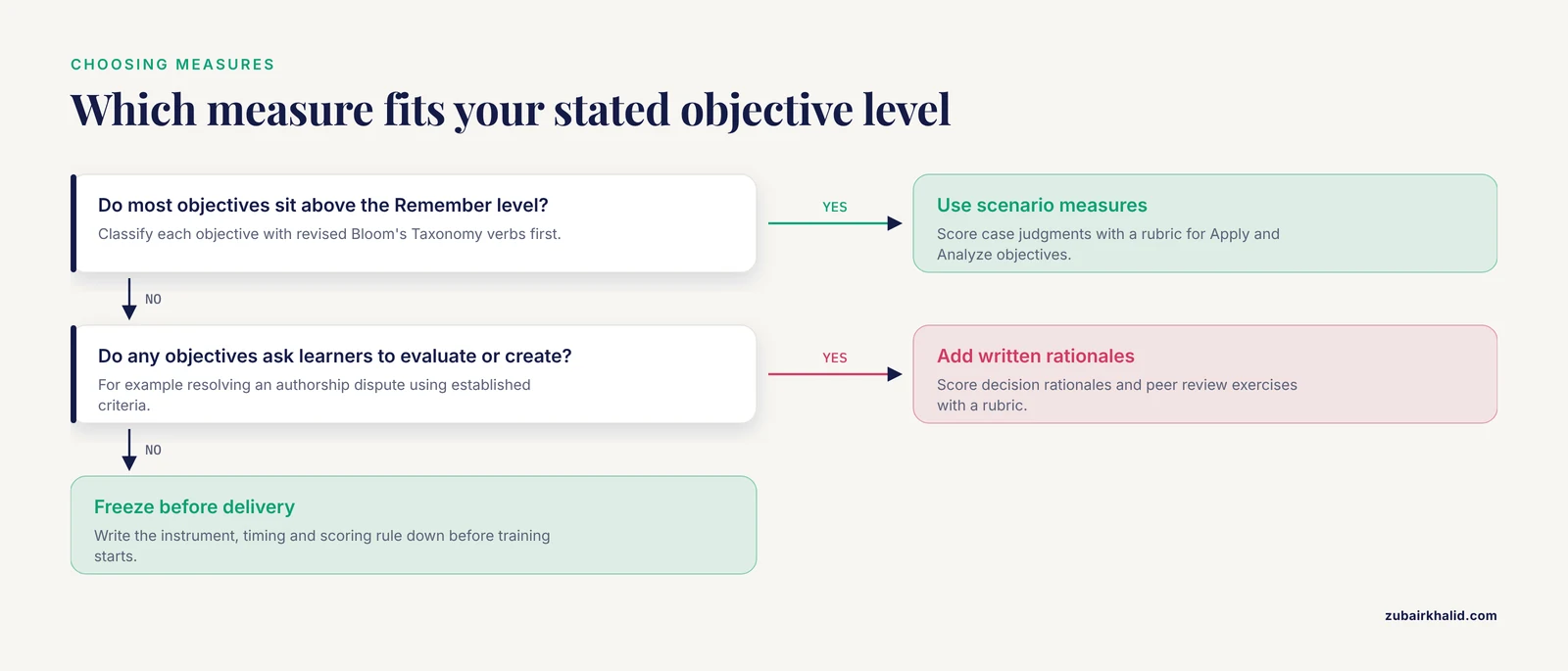
That analysis suggests a practical rule for your own evaluation. If your training claims higher order objectives, for example "students will resolve an authorship dispute using established criteria," then a recall quiz is the wrong outcome measure. Match the measure to the taxonomic level:
- Remember level objectives: multiple choice or short answer quizzes.
- Apply and analyze level objectives: scenario-based judgments, case discussions scored with a rubric.
- Evaluate and create level objectives: written decision rationales, peer review exercises, mentored case resolutions.
A curriculum case study from a Ugandan vocational institute found that a hybrid strategy, combining stand-alone ethics modules with ethics infused into technical courses, improved trainees' cognitive grasp of integrity, confidentiality, and professional responsibility, but practical application remained inconsistent, partly because of the hidden curriculum and a shortage of realistic ethical dilemmas in training [5]. That finding is a direct evaluation lesson. If your post-test shows knowledge gains but supervisors report no behavioral change, the training content, the case realism, or the institutional environment may be the cause, and your evaluation should be able to distinguish among them.
The Evaluation Framework
Adapt the classic Kirkpatrick training evaluation model, which is standard textbook material in training evaluation, to research ethics. The levels and suitable metrics are summarized below.
| Level | Question answered | Example metrics | Timing |
|---|---|---|---|
| , - | , - | , - | , - |
| 1. Reaction | Did learners find it relevant and engaging? | Post-course survey, relevance and usability ratings | Immediately after |
| 2. Learning | Can learners state and apply principles? | Pre-post knowledge quiz, scenario rubric scores | Before and immediately after |
| 3. Behavior | Does practice change? | Supervisor ratings, documented decisions, disclosure and authorship records | 3 to 6 months after |
| 4. Culture and results | Does the environment and output improve? | Ethical climate survey, misconduct reports, data audit findings | 6 to 12 months after |
Two cautions frame this table. First, a longitudinal study of comprehensive ethics training in Colombian organizations found that ethical culture perceptions rose one to two months after training of senior leaders but the gains were not sustained nine to ten months later, with interviews suggesting poor transfer of training from the trained leaders to the wider hierarchy [6]. Second, corporate integrity research argues for outcome-based evaluation that captures behavioral impact beyond headcount and completion indicators, supported by maturity models for continuous improvement [7]. In other words, measure behavior and culture on a schedule that includes a delayed follow-up, and treat completion rates as administrative data rather than evidence of effectiveness.
Evaluate Research Ethics Training Step by Step
This walkthrough produces a defensible evaluation report for one training cycle, for example a semester-long RCR course or a two-day workshop with a follow-up survey.
Step 1: Collect and Classify the Learning Objectives
Pull every objective from the syllabus or training materials. Classify each one with the revised Bloom's Taxonomy verbs. A simple tally sheet in a spreadsheet works. For example, suppose your course has 12 objectives and you classify them as follows.
Objective classification tally
--------------------------------
Remember     : 3
Apply        : 5
Analyze      : 3
Evaluate     : 1
--------------------------------
Total        : 12
Higher-order : 9 of 12 (75%)
If most objectives sit above the Remember level, your knowledge quiz alone will miss most of what the training promises. You need at least one scenario-based measure per higher-order objective. This classification step mirrors the approach used in the analysis of the four EU training projects, where stated objectives were coded deductively against learning taxonomies [4].
Step 2: Choose One Metric per Level and Freeze the Instruments
Select exactly one primary metric per evaluation level and write down its instrument, timing, and scoring rule before the training starts. Freezing the plan prevents accidental cherry picking later. Sensible choices:
- Reaction: a five item relevance scale after the final session.
- Learning: a 10 item scenario quiz administered in week one and again in the final week.
- Behavior: a structured supervisor or mentor rating at three months, or counts of concrete artifacts such as data management plans filed, authorship forms completed, or conflict of interest disclosures submitted.
- Culture: a validated ethical climate survey given before training and again at follow-up.
For the culture level, there is precedent for instrument choice. A randomized controlled trial of virtue ethics based research integrity training with first year medical students used the Ethical Climate Questionnaire (ECQ) as its primary outcome and concluded that the ECQ is a useful instrument for assessing research integrity training even though the specific virtue-based intervention produced no significant change in climate perceptions between groups [8]. That trial is also a reminder that well designed evaluations can produce null results, and that null results are findings, not failures of the evaluation.
Step 3: Run the Pre-Post Knowledge Analysis
Administer the same scored instrument before and after. Record scores for everyone who completes both administrations. Here is a worked analysis in Python. Install the needed package first.
pip install scipyfrom scipy import stats
# Paired scores on a 10-item scenario quiz, same 40 learners
pre = [6, 5, 7, 6, 8, 5, 6, 7, 4, 6, 7, 5, 6, 8, 5, 6,
7, 6, 5, 7, 6, 8, 5, 6, 7, 6, 5, 6, 7, 5, 6, 8,
6, 5, 7, 6, 5, 6, 7, 6]
post = [8, 7, 8, 7, 9, 7, 8, 8, 6, 7, 9, 7, 8, 9, 6, 7,
8, 8, 7, 8, 7, 9, 7, 8, 8, 7, 7, 8, 8, 7, 7, 9,
8, 7, 8, 7, 7, 8, 8, 7]
t_stat, p_value = stats.ttest_rel(post, pre)
diffs = [p - x for p, x in zip(post, pre)]
n = len(diffs)
mean_diff = sum(diffs) / n
sd = stats.tstd(diffs)
dz = mean_diff / sd
print(f"n paired = {n}")
print(f"mean pre = {sum(pre)/n:.2f}")
print(f"mean post = {sum(post)/n:.2f}")
print(f"mean diff = {mean_diff:.2f}")
print(f"sd diff = {sd:.2f}")
print(f"t({n-1}) = {t_stat:.2f}, p = {p_value:.5f}")
print(f"Cohen's dz = {dz:.2f}")Expected output:
n paired = 40
mean pre  = 6.15
mean post = 7.70
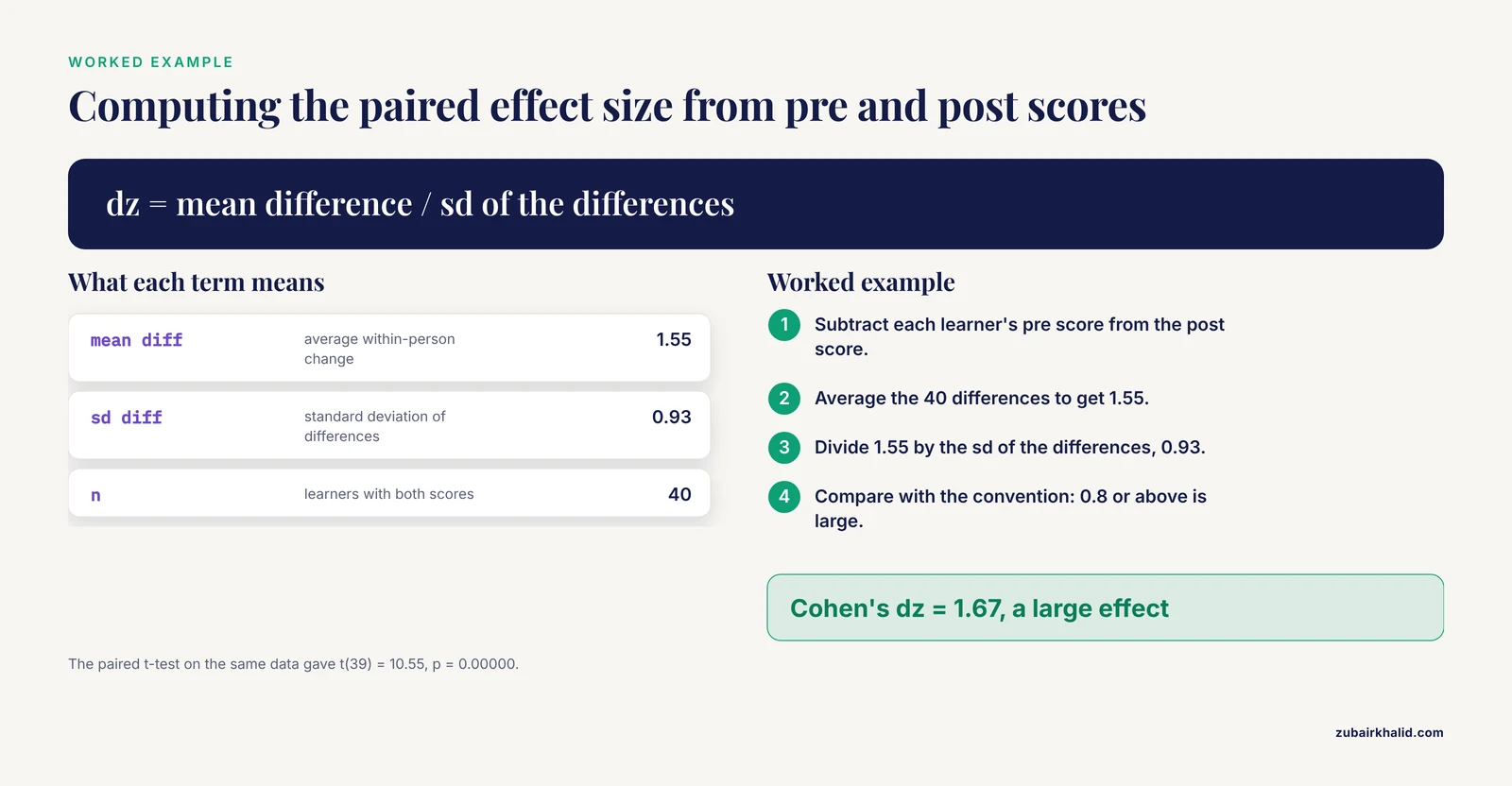
mean diff = 1.55
sd diff   = 0.93
t(39) = 10.55, p = 0.00000
Cohen's dz = 1.67
Read the numbers like this. The paired t-test asks whether the average within-person change differs from zero. Cohen's dz is the standardized effect size, computed as mean difference divided by the standard deviation of the differences. In this synthetic example dz is large. As a rough convention from standard statistics texts, dz around 0.2 is small, around 0.5 is medium, and 0.8 or above is large. If your real analysis yields a positive but small effect with a wide confidence interval, report that honestly. Knowledge gains from a single course are often modest, and small measured gains are more useful to your institution than inflated ones.
Also report the mastery rate, which non-statisticians on committees understand immediately.
mastery = 8  # items correct required to pass
pre_masters  = sum(1 for s in pre  if s >= mastery)
post_masters = sum(1 for s in post if s >= mastery)
print(f"Mastery pre:  {pre_masters}/{n} = {100*pre_masters/n:.0f}%")
print(f"Mastery post: {post_masters}/{n} = {100*post_masters/n:.0f}%")
Expected output:
Mastery pre:  0/40 = 0%
Mastery post: 8/40 = 20%
A 20 percent mastery rate after training is a finding, not a failure to report. It tells the curriculum committee that the scenario items are hard, the instruction is uneven, or the mastery threshold is set too high for a first pass.
Step 4: Measure Behavior at Three to Six Months
Behavioral metrics must be observable in records. Three practical options:
- Document counts, such as the proportion of new projects with a completed data management plan, or the proportion of authorship disputes resolved with a written agreement.
- Structured mentor ratings on a short behaviorally anchored scale, for example rating each trainee on record keeping quality and attribution practices.
- Case performance, meaning scores on new, unseen ethical dilemmas administered months later, which test transfer rather than recall.
Tie the behavior metric back to the objectives you classified in Step 1. If objectives emphasized analyzing authorship conflicts, count written authorship agreements or score trainee rationales on a published rubric. Curriculum research on ethics integration found that application of principles often lags comprehension, particularly when learners see few realistic dilemmas in training [5]. Your behavioral measure is the check on whether that gap exists in your program.
Workplace research using structural equation modeling with 307 employees found that ethics training significantly and positively influenced ethical culture, which in turn substantially influenced performance, and that training also had a direct effect on performance [9]. While that study comes from an industrial setting, its logic transfers. If you can measure an ethical culture score for your lab, department, or program, that score becomes the mediating variable you expect training to move.
Step 5: Plan the Delayed Follow-Up
Schedule a culture or behavior measurement nine to twelve months after training. The reason is direct. In the Colombian longitudinal study, ethical culture gains measured one to two months after training were no longer detectable at nine to ten months, and qualitative interviews attributed the decay to weak transfer of the trained leaders' influence through the organizational hierarchy [6]. A single post-test therefore systematically overstates durability.
The follow-up also lets you test the mechanism that reviews of organizational ethics emphasize, namely that regular ethics training supports ethical culture only when embedded in leadership behavior, open communication, and organizational policy [10] [11]. If your nine-month culture survey shows decay, your report should recommend reinforcement mechanisms such as periodic case discussions, leader-led debriefs of real incidents, and updated policy communication, rather than simply repeating the same workshop.
Step 6: Interpret, Report, and Iterate
Assemble a one page report with the following elements:
- Objectives and their Bloom's level classification.
- One table of metrics by evaluation level, with pre, post, and follow-up values.
- Effect size and mastery rate for learning, with plain language interpretation.
- Behavioral and climate findings, including any null results.
- Three concrete recommendations, each tied to a specific metric that fell short.
Corporate integrity research recommends maturity models as benchmarks for continuous improvement, where each evaluation cycle moves the program to a more developed stage rather than starting over [7]. Treat your first evaluation as baseline data for that cycle. Reviews of institutional research integrity policy likewise group actionable advice into policies and procedures, handling of breaches, and education and training, and call for open sharing of what works so institutions can learn from one another [1]. Publishing your evaluation internally, or in a teaching and learning venue, contributes to that shared evidence base.
Evaluate Research Ethics Training Tips
- Freeze instruments and analysis plans before delivery. Pre-registration of your evaluation, even informally within your institution, protects against post hoc metric shopping.
- Use scenario items for anything above the Remember level. Scenario judgment scores predict application better than definition quizzes, and the highest quality RI training materials analyzed to date emphasize higher order objectives [4].
- Measure the environment, not just the learner. The ECQ has been used successfully as a training outcome in a randomized design and distinguishes perceived from preferred ethical climates [8].
- Involve leaders and mentors in the transfer plan. Training gains decayed when trained leaders could not cascade practices through the hierarchy [6], and leadership commitment is repeatedly identified as the decisive factor in whether integrity initiatives take hold [7] [12].
- Update content for emerging risks. Academic integrity in the era of generative artificial intelligence requires training that addresses ethical, social, and technical dimensions of AI use rather than simple prohibition, with an emphasis on reflective and contextual decision making [13]. Evaluations of AI ethics training should therefore include items on transparency, attribution of AI assistance, and accountability for AI-assisted output.
- Track participation as an early warning signal, not as effectiveness. In one large organizational study, training participation itself fell below target, a measurable program health problem distinct from learning outcomes [9].
Common Mistakes and Limitations
Counting completions as effectiveness. Attendance and certificate counts are administrative records. Outcome-based evaluation asks what changed in knowledge, behavior, or culture, and integrity program research explicitly distinguishes quantitative participation indicators from behavioral outcome measures [7].
Measuring only immediately after the course. Without a delayed follow-up you cannot detect decay. The Colombian study found short-term gains that vanished within a year [6]. A follow-up at nine to ten months is a defensible default schedule.
Using the same quiz questions for pre and post without safeguards. Learners may share items between cohorts. Use parallel forms, or reorder and rotate items, and never reuse a high-stakes item bank across cohorts in the same term.
Attributing all change to the training. Learners also mature, receive mentoring, and encounter institutional policies during the measurement window. Without a comparison group, describe your results as pre-post change in that cohort, not as proof of causation. When feasible, randomize or use a waitlist control, as the medical student trial did when it assigned students to a lecture-only control or a lecture plus virtue-based training arm [8].
Ignoring the hidden curriculum. Trainees learn from what their supervisors actually do. The Ugandan case study attributed inconsistent application of ethical principles partly to the hidden curriculum and surrounding societal factors [5]. If behavior does not change despite knowledge gains, audit what role models and incentive structures communicate.
Evaluating the training in isolation from policy. Academic integrity scholarship emphasizes continuous effort, transparency, and institutional commitment rather than one-off courses [3], and reviews of workplace complexity recommend participatory policy development and leadership training alongside ethics education [11]. A training evaluated in a policy vacuum will look ineffective even when it is working as hard as it can.
Expecting climate change from a single workshop. Ethical climate reflects leadership, procedures, and history. The randomized virtue-based trial produced no significant climate change after one training increment, and the authors called for further research on long-term effects [8]. Treat climate as a multi-year metric.
Overlooking AI related integrity items. Generative AI has reshaped how knowledge is created and assessed, and scholarship argues that traditional plagiarism prevention alone is insufficient, calling instead for comprehensive AI ethics training across the academic community [13]. If your training predates widespread generative AI use, its instruments probably do not measure the competencies that now matter.
Frequently Asked Questions
What is the simplest credible way to evaluate research ethics training?
Run a paired pre-post knowledge or scenario assessment, report the mean change and effect size, and add one supervisor rated behavior measure at three months. This covers the learning and behavior levels with modest effort.
How long after training should I measure retention?
Plan a follow-up at nine to ten months. Longitudinal evidence shows ethical culture gains measured within two months of training were no longer present at that interval, so earlier follow-ups alone overstate durability [6].
Which metric proves the training worked?
No single metric does. Effectiveness is a pattern across levels, with knowledge gains, behavioral evidence, and stable or improved ethical climate measurements taken together.
Can I evaluate a training without a control group?
Yes, but describe findings as pre-post change rather than causal effects. If causal claims matter, use randomization or a waitlist control as done in a randomized trial of virtue-based research integrity training [8].
What is the Ethical Climate Questionnaire and why use it?
The ECQ is a survey instrument that measures employees' or members' perceptions of the ethical climate of their organization. A randomized controlled trial demonstrated its value for assessing research integrity training outcomes [8].
How do I handle a null result in my evaluation?
Report it with the same rigor as a positive result. Null results, such as the absence of climate change after virtue-based training in a controlled trial [8], guide resource allocation and prevent the institution from relying on interventions that do not move the measured outcome.
Should completion rates appear in my effectiveness report?
Yes, but as program health data rather than effectiveness data. Research on integrity program evaluation distinguishes participation indicators from outcome-based behavioral measures [7].
How often should the training content itself be reviewed?
At least each major revision cycle, and sooner when new risks emerge. Ethics codes and curricula should be regularly reviewed to stay relevant as contexts change [14], and generative AI has already changed the integrity issues that research ethics training must address [13].
Sources
- Fostering a Research Integrity Culture: Actionable Advice for Institutions
- Fostering a culture of academic integrity among higher education students
- Fostering a Culture of Academic Integrity in Higher Education: A Critical Review
- Fostering Research Integrity through Training: The training materials of four EU-funded projects through the lens of pedagogical underpinnings and three taxonomies of learning
- Fostering Responsible Conduct Among Trainees Through Integration of Ethics into the Curriculum: A Case Study of Nsamizi Training Institute of Social Development
- Enhancing the Ethical Culture of Organizations: A Longitudinal Study Using a Comprehensive Ethics Training
- Corporate Integrity Programs and Ethical Culture: Maturity, Metrics, and Leadership
- Virtue ethics-based research integrity training intervention to change medical students’ attitudes and perceptions of organizational ethical climate: A randomized controlled trial
- The Influence of Ethics Training and Human Resource Competence on Ethical Culture and its Impact on Employee Performance
- Fostering Ethical Business Practices: A Bibliometric Review of the Linkages of Organizational Culture, Environment, and Business Ethics
- Navigating Complex Ethical Dilemmas in Modern Workplaces: Comprehensive Strategies for Fostering Sustainable Organizational Integrity and Accountability
- The Role of Business Ethics in Promoting Organizational Integrity and Sustainability
- Redefining Academic Integrity in the Age of Generative Artificial Intelligence: The Essential Contribution of Artificial Intelligence Ethics
- Ethics in Translation and Interpreting Training: Cultivating Integrity from Classroom to Professional Practice