Ethnographic Research Questions: Framework and Examples
By Dr. Zubair Khalid, DVM, MS, PhD ·

By the end of this article you will be able to write ethnographic research questions that survive contact with a real field site. You will learn a five-part framework for building a question, a fill-in template you can reuse, a worked example from a biology setting, and a library of question types with real examples from published studies.
To follow along, you need three things on hand: a general topic you care about, a candidate site or group where that topic plays out in daily life, and a notebook or document where you can draft and rewrite questions. No software is required at the drafting stage.
What Makes a Question Ethnographic
Ethnography is the study of a group or setting through sustained participation in and observation of its everyday life. The defining commitment is long-term fieldwork and close engagement with the people being studied, not a short visit with a questionnaire. Millar argues that labeling site visits, interviews, and focus groups as ethnography without sustained fieldwork strips the term of its meaning, because the value of ethnography lies in what only prolonged engagement reveals about local experience [1].
That commitment shapes what a good question looks like. Ethnographic research questions ask about practices, meanings, and social contexts as they unfold over time. They differ from survey questions, which ask a fixed set of respondents to answer fixed items. The difference matters more than it first appears. A think-aloud study of young people answering mental health survey items found that respondents interpreted the same words in inconsistent ways, experienced "stress" as both positive and negative, and read the same time frames differently. Responses reflected the participants' interpretations of the questions as much as the phenomena the questions were meant to capture [2]. Ethnographic questions are built to absorb that kind of interpretive mess rather than standardize it away.
A useful starting contrast:
| Feature | Survey question | Ethnographic question |
|---|---|---|
| Form | Fixed wording, fixed response options | Open, revisable, often broad at first |
| Setting | Administered to many people | Pursued within a lived setting over time |
| Assumption | Meanings are shared and stable | Meanings are situated and must be discovered |
| Failure mode | Wording is misread by respondents | Question turns out to assume what it should ask |
The Five-Part Framework
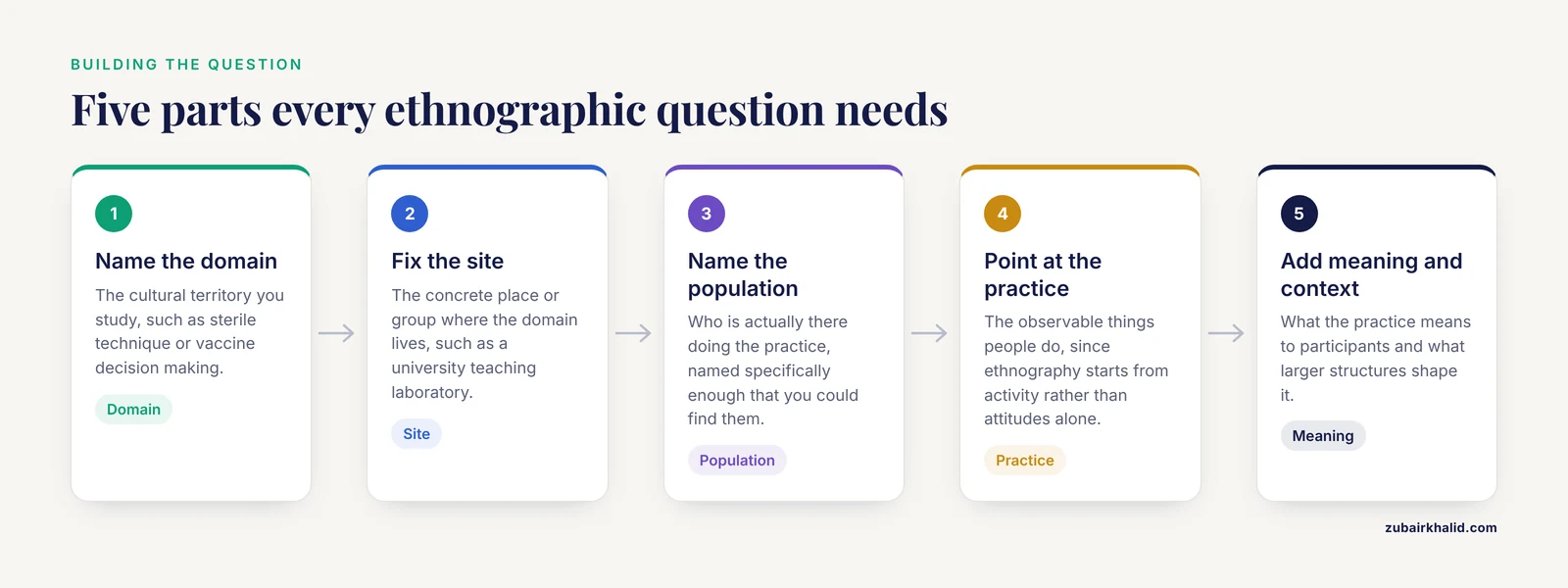
Every strong ethnographic research question names five things. If any one is missing, the question tends to collapse into either a survey item or a vague topic statement.
- Domain. The cultural territory you are studying, such as sterile technique, vaccine decision making, or farm partnership meetings. LeCompte and Schensul treat the domain as the basic unit around which ethnographic design is organized [3].
- Site. The concrete place, group, or setting where the domain lives, such as a university teaching laboratory or a county vaccine coalition.
- Population. Who is actually there doing the practice, named specifically enough that you could find them.
- Practice. The observable things people do, since ethnography starts from activity rather than from attitudes alone.
- Meaning and context. What the practice means to participants and what larger structures shape it. Critical ethnographers insist that lived experience be situated within structures of power, not treated as free-floating [4].
The framework is a checklist. A question that names only a domain and a population ("How do nurses feel about night shifts?") is a topic, not yet an ethnographic question, because nothing in it requires fieldwork to answer.
How to Write a Research Question: A Numbered Walkthrough
This walkthrough produces one broad question and three or four sub-questions. Expect the process to take several drafting sessions, not one sitting.
Step 1. Name the domain and site
Write one line: "I want to understand [domain] among [population] at [site]." Keep it concrete. "I want to understand aseptic technique among second-year microbiology students in a university teaching lab" beats "I want to study lab culture."
Step 2. Draft a broad opening question
Use the template below. It is deliberately structured so that each line of the template maps to one component of the framework.
Domain:      [cultural domain]
Site:        [setting]
Population:  [who, named specifically]
Practice:    [observable activity]
Meaning:     [what the activity means to participants]
Context:     [structures, rules, or pressures shaping it]

Broad question:
How do [population] at [site] learn, perform, and make sense of
[practice], within [context]?
Step 3. Fill it in and check the output
Here is the template filled with a worked example from a biology setting. This is what a completed draft should look like.
Domain:      Aseptic technique
Site:        Second-year microbiology teaching laboratory
Population:  Undergraduate students in their first bench-work course
Practice:    Transferring culture between flasks without contamination
Meaning:     Cleanliness, professional identity, fear of "ruining the batch"
Context:     Graded practical exams, fixed lab schedules, shared equipment

Broad question:
How do first-year microbiology students learn, perform, and make sense
of aseptic transfer in a graded teaching laboratory?

Descriptive sub-question:
What steps do students actually follow when transferring culture,
including the steps instructors do not demonstrate?

Contrast question:
How do students distinguish a "good" transfer from a "failed" one,
and whose judgment do they trust to make that call?

Meaning question:
What does contamination mean to students, and how does that meaning
shape what they do when a culture turns cloudy?

Context question:
How do grading rules and shared equipment schedules shape which
shortcuts students take?
Notice what the template forces. The broad question cannot be answered by a survey. The sub-questions point at observations you could actually make during weeks in the lab, and at conversations you could actually have.
Step 4. Add contrasting questions
Spradley-style contrast questions, which ask how people within a setting distinguish one thing from another, are a core engine of ethnographic analysis. In an ethnographic study of local culinary heritage in Simalungun Regency, Indonesia, researchers used selective observation and contrasting questions to identify dimensions of contrast among residents, distinguishing main dishes such as "dayok nabinatur" and "saksang" from desserts such as "lapet boras" and "marlakop-lakop," then used those contrasts in a componential analysis of culinary categories [5]. Contrast questions work because categories that feel obvious to outsiders ("food," "clean," "success") turn out to be internally structured once you ask what distinctions insiders actually make.
Step 5. Run the familiarity check
Before you commit, ask whether your question assumes the answer. Allan, building on Delamont's arguments, describes strategies for fighting familiarity in ethnographic research, using historical accounts and autobiography to make the taken-for-granted strange again, because familiar subjects become "prey to historical amnesia" and escape genuine questioning [6]. Apply this by writing down what you already believe about your site, then writing a second version of each question that would still make sense if your beliefs were wrong. "Why do students skip aseptic steps?" assumes skipping. "When do students treat aseptic steps as optional, and what logic guides those moments?" does not.
Step 6. Plan for revision
Treat your questions as version 1.0. In the CommuniVax coalition's rapid ethnographic work on COVID-19 vaccine access, research plans evolved as community priorities, the pandemic, bureaucratic mechanisms, and political conditions shifted, and the authors highlight the critical decision points where questions had to be reworked in response [7]. The same discipline applies outside emergencies. Build a written log of question revisions from day one, with a one-line note on each change explaining what observation triggered it.
Question Types and Ethnographic Research Question Examples
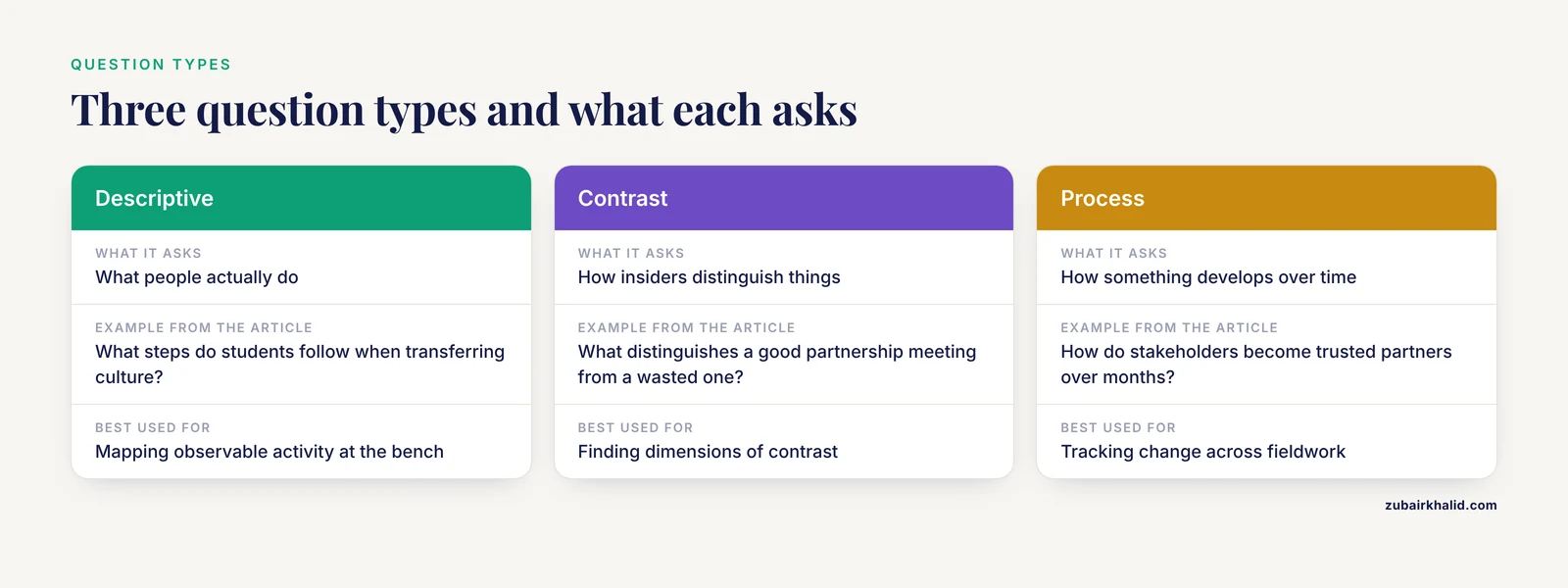
The template above produces one common shape. Published ethnographies use a wider repertoire. The table below summarizes the main types, what each is good for, and where the example comes from.
| Type | Definition | Example question | Source of example |
|---|---|---|---|
| Descriptive | Asks what people actually do | What steps do students follow when transferring culture? | Built from the walkthrough above |
| Contrast | Asks how insiders distinguish things | What distinguishes a "good" partnership meeting from a wasted one? | Componential analysis logic [5] |
| Process | Asks how something develops over time | How do stakeholders become trusted partners over months of collaboration? | Vetter's Farm Herefordshire study [8] |
| Meaning | Asks what practices signify | What does contamination mean to students when a culture fails? | Standard perspective question [3] |
| Critical | Asks how structure and power shape the practice | How do restrictive immigration policies organize the daily routines of mixed-status families? | Miranda's critical ethnography [4] |
| Reflexive | Asks how the researcher's position shapes the question | How did my own access to the field depend on assumptions my participants did not share? | Bachrach on the uncertain researcher self [9] |
A few of these deserve elaboration, because their wording does specific work.
Process questions. Vetter's study of the Farm Herefordshire partnership, which works on agricultural diffuse pollution in the Wye catchment, starts from an observation about gaps in the literature. Benefits of partnership working are widely reported, but the day-to-day practicalities receive little attention. The questions that follow are exemplary: What does it mean to work together on a day-to-day basis? How do stakeholders become trusted partners, bridge interests, and coordinate their actions? What collaborative working culture becomes established, and how does that culture affect wider governance outcomes? Each question names a practice and a mechanism, not just a topic [8].
Critical questions. Miranda's work with mixed-status immigrant families shows how a question can be built to connect everyday life with political and economic structure. Her approach treats positionality, structure and agency, and social justice as central to the design rather than as afterthoughts [4]. A critical version of any question in your set asks who benefits, who is constrained, and by what.
Synthesis questions. Not every ethnographic question requires new fieldwork. Meta-ethnography is a systematic approach that synthesizes findings from multiple qualitative studies to generate new conceptual insights, following the seven steps developed by Noblit and Hare, from getting started through determining how studies relate, translating them into one another, and expressing the synthesis [10]. A meta-ethnographic question might ask: "Across published studies of teaching laboratories, how do students and instructors conceptualize error, and do those conceptions translate into one another?"
Using Your Questions in the Field
Questions do work at three points in a project. Knowing which point you are at changes how you phrase them.
Questions as design tools
At the design stage, questions determine where you go, whom you watch, and what you record. LeCompte and Schensul organize the entire design process around the domains your questions name [3]. A descriptive question about aseptic technique sends you to the bench. A context question about grading rules sends you to the course syllabus and the scheduling office.
Questions as interview guides
In fieldwork, your broad questions become open-ended interview prompts, not scripts. Trundle, Gardner, and Phillips describe an ethnographic disposition toward interviewing built on seven epistemic commitments: humility, a readiness to revise core assumptions about the topic, attentiveness to context, relationality, openness to complexity, attention to ethnographic writing, and consideration of the method's politics and history. They deliberately decouple the ethnographic interview from the requirement that participant observation always accompany it, which gives researchers flexibility across settings [11]. In practice this means you ask "Walk me through what happened at the bench today" rather than "Do you follow the protocol," and you let the answer redirect you.
Questions as analysis tools
During analysis, your questions decide which field notes get pulled apart. Neubert and Trischler describe ethnographic data production as material theorizing, introducing the concept of "pocketing" to capture how and when data materializes through practice, whether as bodies affected by architecture in one study or as distributed records in a company database in another [12]. The practical lesson for question writing is that data and theory grow together. If a question never gets revised after you start noticing what your pocket notes actually contain, you are probably ignoring your own best evidence.
A Second Worked Example: Culinary Heritage
To show the framework generalizes beyond the laboratory, here is a compressed version modeled on the Simalungun study.
Domain:      Local Batak culinary knowledge
Site:        Four tourist destination areas in Simalungun Regency
Population:  Residents who cook and serve traditional foods
Practice:    Preparing, naming, and presenting local dishes
Meaning:     Local wisdom, identity, hospitality
Context:     Growing food-tourism economy

Broad question:
How do residents of Simalungun's tourist destinations prepare,
name, and give meaning to local dishes, and what potential does
this hold for culinary tourism?

Contrast questions embedded in the analysis:
What distinguishes main dishes (dayok nabinatur, saksang) from
desserts (lapet boras, marlakop-lakop)?

Categorization dimensions used:
1) Naming in the Batak language
2) Cultural themes behind presentation
3) Base ingredients
4) Local spices and herbs
5) Cooking process
The published study used observation and ethnographic interviews with three tiers of informants: key informants, main informants, and supporting informants. The question structure and the informant structure mirror each other, which is a hallmark of a well-built design [5].
Common Mistakes and Limitations
Writing questions a survey could answer. If your question has a fixed answer set, it belongs on a questionnaire. The think-aloud evidence on survey misinterpretation shows the cost of assuming shared meaning, since respondents read the same items in divergent ways, which complicates long-term trend analysis itself [2]. Ethnographic questions presuppose that meaning must be discovered.
Fighting the last war of familiarity. Questions written from settled assumptions produce findings that merely confirm those assumptions. Allan's argument about fighting familiarity, and about using historical and autobiographical material to destabilize what seems self-evident, applies directly to question drafting [6]. If your question already contains the word "obviously," rewrite it.
Ignoring omissions and silences. Silverman's commentary distinguishes omissions, the neglect of potentially relevant information driven by theoretical orientation, judgments of pertinence, and the demands of time, from silences, which involve a negative intentionality to leave information unreported. Both often become visible only in retrospect. A practical safeguard is to add one reflexive question to your set: "What is this study not asking about, and who might know why?"
Treating a short visit as ethnography. Millar's argument against applying the ethnographic label to work better described as site visits, interviews, or focus groups is a caution about scale. If your timeline is two days, write your questions as rapid assessment questions and say so, rather than borrowing the authority of the ethnographic tradition.
Rigid questions in shifting settings. The CommuniVax experience shows that plans must evolve as circumstances shift, with real trade-offs at each decision point about how to proceed [7]. Rigid adherence to version 1.0 questions in a moving field produces answers to questions nobody is asking anymore.
Separating data from theory prematurely. If you treat question writing, data collection, and theory as three sequential stages, you will miss the ways, described by Neubert and Trischler, in which theorizing happens in every step of research practice, including how and when data physically materializes [12]. Keep your questions and your emerging notes in the same document.
Overwriting positionality. A short positionality statement is standard, but Bachrach argues that simple statements are insufficient, and that researchers should write about the messiness of fieldwork, including moments of misreading how they were received by interlocutors, because the researcher self is formed in that writing [9]. Your reflexive questions should expect confusion, not just declare identity categories.
Forgetting individual cases. Ethnographic findings describe patterns in a setting, not predictions about any one person. Where your question touches health, safety, or legal decisions, individual cases need an appropriately qualified professional.
Frequently Asked Questions
What is an ethnographic research question?
It is a question about practices, meanings, and social contexts that can only be answered through sustained engagement with a group in its everyday setting. It names a domain, a site, a population, an observable practice, and the structures surrounding them.
How many research questions should an ethnographic study have?
Most projects work well with one broad question plus three to five sub-questions of different types. More than that and you cannot follow them all with the observation time fieldwork requires.
How do I write a research question for ethnography rather than for a survey?
Use open wording that presupposes meaning must be discovered, such as "how do" and "what does it mean to," rather than fixed items with predetermined response options. If you can imagine a Likert scale answering it, rewrite it.
Can ethnographic research questions change during fieldwork?
Yes, and they should. Published rapid ethnographic work documents deliberate, logged revisions when community priorities and conditions shifted, treating flexibility as a requirement of credible research rather than a design flaw.
How do I turn my questions into interview questions?
Convert each question into an open prompt that asks the participant to narrate concrete experience, such as "Walk me through the last time this happened." Approach the interview with humility and a readiness to revise your core assumptions about the topic, which are two of the seven epistemic dispositions described for the ethnographic interview.
Can I write a biology research question using ethnography?
Yes. Laboratory studies, field courses, and research groups are all legitimate ethnographic sites. A question such as "How do first-year microbiology students learn, perform, and make sense of aseptic transfer in a graded teaching laboratory?" is a biology research question that requires fieldwork rather than a bench experiment.
What is a good format or template for ethnographic research questions?
Use a five-line template naming domain, site, population, practice, and meaning/context, followed by a broad question and three or four sub-questions of different types. The filled-in teaching laboratory example above shows the expected output.
How do I know if my question is too broad or too narrow?
Too broad, and no field site could contain it, as in "How does science work?" Too narrow, and observation adds nothing to what you already know, as in "How many minutes does one pipetting step take?" A well-sized question can be pursued for weeks in one setting and still surprise you.
Sources
- Ethnographic Peace Research: The Underappreciated Benefits of Long-term Fieldwork
- How young people understand mental health survey questions: a qualitative think-aloud study from the Swedish National Public Health Survey.
- Designing & conducting ethnographic research : an introduction
- Ethnographic borders and crossings: Critical ethnography, intersectionality, and blurring the boundaries of insider research
- Ethnographic Research: Potential of Local Culinary as a Tourist Attraction Object in Simalungun Regency, Indonesia
- Using the once familiar to make the familiar strange once again: engaging with historical inquiry and autobiography in contemporary ethnographic research
- Adapting rapid ethnographic research in an evolving emergency: Generalizable lessons in resilience
- Co-producing better land management? An ethnographic study of partnership working in the context of agricultural diffuse pollution.
- Uncertain Self in Ethnographic Research and Writing
- Meta-ethnography in healthcare research: a guide to using a meta-ethnographic approach for literature synthesis
- The Ethnographic Interview: An Interdisciplinary Guide for Developing an Ethnographic Disposition in Health Research
- “Pocketing” Research Data? Ethnographic Data Production as Material Theorizing