How to Write an Ethics Statement for Your Research Paper: A Template
By Dr. Zubair Khalid, DVM, MS, PhD ·

By the end of this article you will be able to write a complete ethics statement for your research paper, matched to your study type, in under an hour. You will need four things on hand before you start: the name of the committee that reviewed your study, your approval number and date, the consent or assent process you actually used, and your data handling plan. If your study used animals, you will also need your animal care protocol number.
This article gives you a reusable ethics statement for research paper template, three worked examples you can adapt, a summary table of what each study type requires, the errors reviewers most often flag, and a short checklist for checking your own draft. The advice is grounded in the responsible conduct of research literature and in guidance written for people preparing ethics applications and manuscripts for the first time 1.
What an Ethics Statement Is and What It Is Not
An ethics statement is a short section of your manuscript, usually 50 to 200 words, that declares how your research addressed the ethical dimensions of the work. It tells editors, reviewers, and readers four things in plain language: whether the study was reviewed by an ethics committee, under what approval number, how participants or animals were protected, and how data were handled.
An ethics statement is not the same thing as the ethics approval itself. The approval is the formal decision document from your institutional review board, research ethics board, or ethics committee. The statement is your public, written record of that approval and of the safeguards you used. Reviewers read the statement to confirm that the approval covers the work described in the paper, which matters because committees vary widely in what they review and how they interpret their own policies 2.
It is also not a philosophical essay. Journals want verifiable facts, not a discussion of ethical theory. A generic statement of scientific ethics, written once and pasted into every paper, has been criticized in the literature precisely because it says nothing specific about the study at hand 3. Specific beats sweeping, every time.
Where the Ethics Statement Goes in Your Paper
Most journals place the ethics statement in one of three locations. Check the author guidelines before you write, because placement requirements differ.
- In the Methods section, usually as the first or last subsection, often under a heading such as "Ethics" or "Ethical considerations."
- In the Declarations section at the end of the manuscript, alongside competing interests, funding, and data availability statements.
- In the acknowledgments or a footnote, which some older journals still use.
If the journal accepts both placements, put the statement in Methods. Reviewers looking for consent and approval details read Methods first. If the journal uses a structured declarations page, keep the detailed consent and welfare description in Methods and put a one- or two-sentence version in the declarations so both locations are covered.
The Ethics Statement Format That Journals Expect
Almost every journal ethics statement contains the same core fields. The exact ethics statement for research paper format varies by discipline, but the underlying structure is stable. Your statement should answer, in this order:
- Review status. Was the protocol reviewed and approved, or reviewed and granted an exemption, by a named committee?
- Identification. The committee's full name, the approval or protocol number, and the approval date.
- Consent. How consent was obtained from human participants, or assent plus parental consent for minors, or waiver of consent if applicable.
- Welfare. For animal studies, the welfare framework and welfare body that oversaw the work.
- Data protection. How data were de-identified, stored, and who controlled access.
- Deviations. Any waiver, amendment, or exception, stated honestly.
A statement missing the approval number is the single most common reason editors send an ethics query back to authors. The number is what allows the journal to verify the claim later.
The Core Template
Here is a fill-in template you can copy. Replace the bracketed fields. Delete any line that does not apply to your study, but think carefully before deleting the data protection line, because data handling is now part of nearly every review.
ETHICS STATEMENT TEMPLATE

Review status:
This study was [approved / exempted / reviewed and registered] by
[full committee name, e.g., the Institutional Review Board of
X University] on [approval date] under protocol number
[approval number].

Human participants (delete if not applicable):
All participants provided [written informed consent / electronic
informed consent / verbal consent documented by the researcher]
before taking part. [If minors or dependent adults were involved:
Participants under 18 years provided written assent, and a parent
or legal guardian provided written consent.] Participation was
voluntary, and participants could withdraw at any point without
penalty.

Animals (delete if not applicable):
All procedures were approved by the [name of animal care
committee] under protocol [number] and followed [name of the
welfare framework your institution applies]. The study minimized
animal use and distress through [one concrete measure, e.g.,
behavioral observation rather than repeated sampling].

Data protection:
Data were [de-identified / anonymized] before analysis. Identifiable
information was [removed at collection / replaced with study codes
keyed separately]. Data are stored [on encrypted university servers /
in a secure project repository] with access limited to the study
team. [If data are shared: De-identified data are available from
[repository name] under accession [identifier].]

Waivers or deviations (delete if none):
The committee granted a waiver of [written consent / documentation
of consent] because [one-sentence justification].
Numbered Walkthrough: Building Your Statement
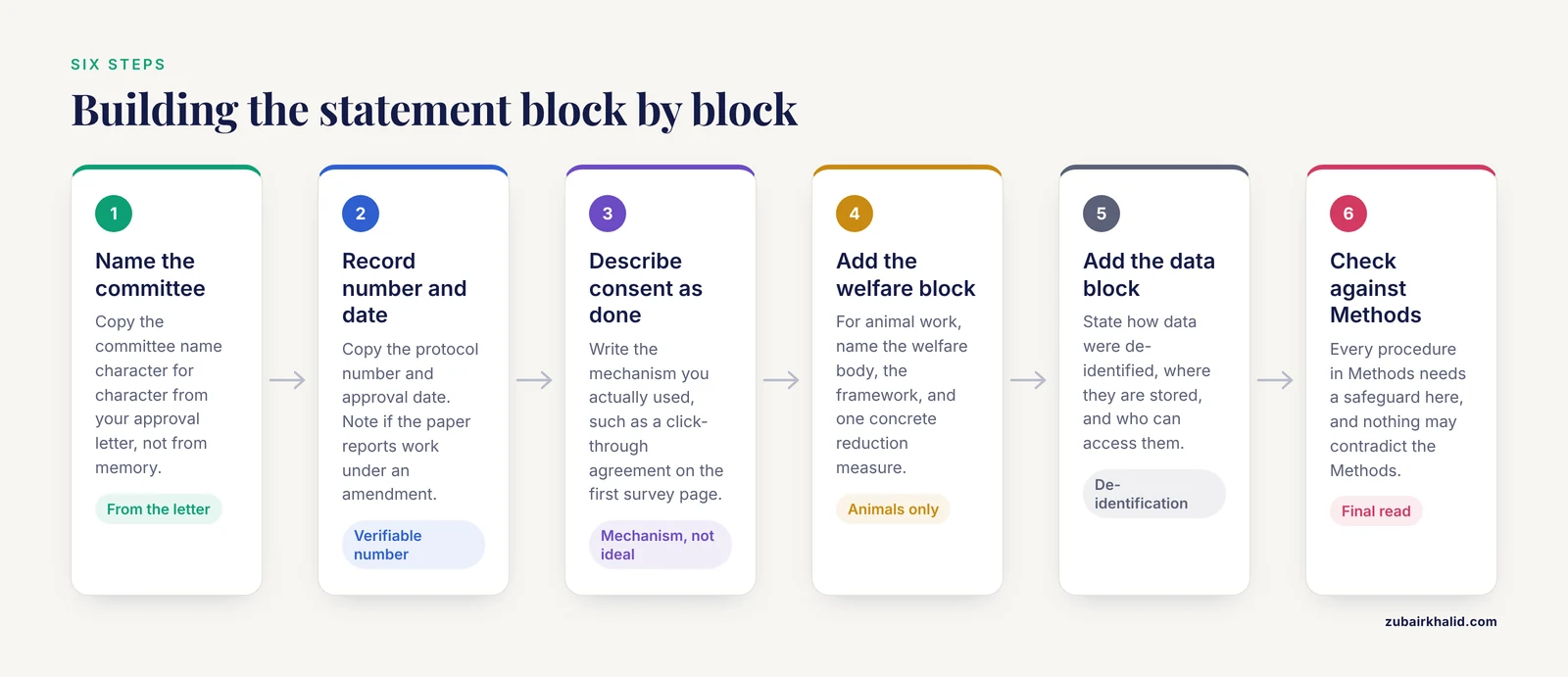
Work through these six steps in order. Each step produces one block of finished text.
Step 1. Name the committee exactly
Find your approval letter and copy the committee name character for character. Do not abbreviate "Institutional Review Board" to "IRB of" unless your institution's own letterhead does. Committees vary in name even within one country, and reviewers at multi-site projects have documented how differently these bodies operate and document their decisions 2.
Step 2. Record the approval number and date
Copy the protocol number and the approval date from the letter, not from memory. If the study was amended, note whether the paper reports work under the original approval or under an approved amendment.
Step 3. Describe consent as it actually happened
Write the mechanism, not the ideal. If you used an online survey with a click-through information page, say "electronic informed consent was obtained via a click-through agreement on the first survey page." If your committee waived written documentation, say so and give the one-sentence justification from your approval letter. Guidance for new researchers consistently emphasizes matching the consent description to what the committee actually approved 1.
Step 4. Add the welfare block for animal work
Name the welfare body and the framework it applies. Beyond the classic 3 Rs framework of replacement, reduction, and refinement, contemporary animal research ethics also weighs principles of social benefit and animal welfare directly, so naming your harm-benefit reasoning in one sentence strengthens the statement 4.
Step 5. Add the data block
State how participants were made unidentifiable, where data live, and who can access them. If your work involves secondary use of health or administrative data, note the legal or governance basis for reuse, since data governance frameworks increasingly require researchers to state that basis explicitly 5.
Step 6. Read it against your Methods section
Check that every procedure mentioned in your Methods appears somewhere in the ethics statement, and that nothing in the statement contradicts the Methods. A statement that claims anonymization while Methods reports collection of names is the kind of internal contradiction reviewers catch immediately.
Worked Example 1: Interview Study With Human Participants
Input values: committee is the Human Research Ethics Committee of a university, approval 2024-118, approved March 3, 2024, recorded verbal consent, de-identified transcripts, encrypted university server.
This study was approved by the Human Research Ethics Committee of
Aldergate University on March 3, 2024 (protocol 2024-118). All
participants received a written information sheet and provided
recorded verbal consent before the interview began. Participation
was voluntary and participants could withdraw at any time or decline
any question. Interviews were transcribed with all names, workplaces,
and identifying details replaced by participant codes. De-identified
transcripts are stored on encrypted university servers accessible
only to the research team.
Expected output check: four sentences, every required field present, approval number verifiable, consent mechanism concrete rather than generic.
Worked Example 2: Animal Study
Input values: animal care committee approval A-2023-041, behavioral observation design, welfare framework named by the institution.
All procedures were approved by the Institutional Animal Care and
Use Committee of Ridgemont University (protocol A-2023-041) and
followed the institution's animal welfare framework. The study used
non-invasive behavioral observation of existing colonies, so no
additional animals were bred or acquired, and no procedure caused
pain or distress beyond routine handling. Observers recorded
behavior from outside the enclosure to avoid disturbing the animals.
Expected output check: the statement names the committee, the protocol number, and one concrete reduction measure, which is what animal ethics reviewers look for 4.
Worked Example 3: Secondary Data or Non-Human Non-Animal Study
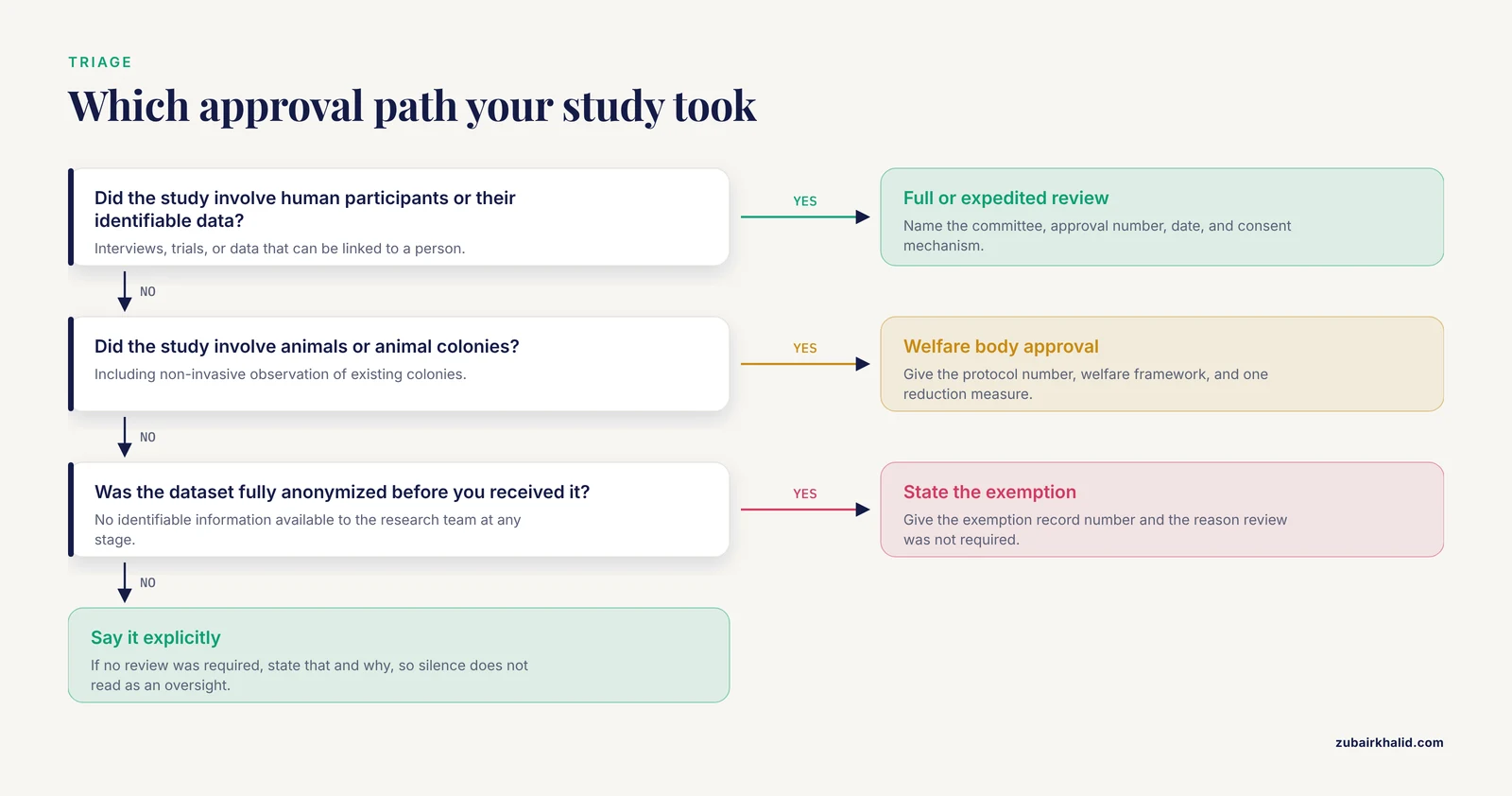
Input values: fully anonymized administrative dataset, exempt review, no participants.
The study used a fully anonymized administrative dataset obtained
under a data sharing agreement with the regional health authority.
The Institutional Review Board of Hartwell University determined
that the project did not meet the regulatory definition of human
subjects research and granted an exemption (exemption record
EX-2025-229) on January 14, 2025. No identifiable information was
available to the research team at any stage.
Expected output check: the statement explains why approval was not required rather than staying silent, which prevents an editor from assuming you simply skipped review.
Summary Table: What Each Study Type Requires
| Study type | Approval needed | Must appear in the statement | Common extra element |
|---|---|---|---|
| , - | , - | , - | , - |
| Interventional human study | Full committee review | Committee name, approval number, date, consent process | Registration number if a trial |
| Survey or interview study | Full review or expedited review | Committee name, approval number, consent mechanism, withdrawal rights | Waiver of written documentation, if granted |
| Secondary data analysis | Often exempt | Exemption record and justification | Data sharing agreement or governance basis |
| Animal research | Welfare body approval | Protocol number, welfare framework, reduction or refinement measures | Species and numbers if the journal requires them |
| Lab work with no humans or animals | Sometimes none | Statement that no approval was required, or institutional biosafety review if applicable | Biosafety or biosecurity approval number for work with pathogens |
| Community-engaged research | Committee review plus community involvement | Both the committee record and how community members shaped the study | Description of public or patient involvement |
The last row matters because public and patient involvement has become a central component of health and social care research, and research ethics committees increasingly expect researchers to describe how lay contributors were included and protected 6.
Common Errors, Their Messages, and Fixes
Reviewers and editors flag the same problems repeatedly. Here are the five most common, phrased as the query you will actually receive, with the fix.
"Please provide the name of the approving committee and the approval number." You wrote a vague statement such as "ethical approval was obtained." Fix by adding the full committee name, protocol number, and date from your approval letter.
"Please clarify how consent was obtained." You wrote "informed consent was obtained from all participants" without a mechanism. Fix by naming the exact process, whether written, electronic, verbal and recorded, or waived.
"Please confirm that the approval covers the work described in this manuscript." Your paper reports an analysis that differs from the approved protocol, perhaps a new subgroup or an added site. Fix by adding a sentence stating that the analysis was covered by the original approval or by an approved amendment, with the amendment number.
"Please describe data storage and de-identification procedures." You described consent but not data handling. Fix by adding the data block from the template.
"Please justify the absence of ethics review." You wrote nothing about ethics at all. Fix by adding an explicit statement that review was not required, or an exemption record, so the omission reads as a documented decision rather than an oversight.
A related trap: researchers adapting a statement from a colleague's paper in a different discipline often import requirements that do not apply to their field. Ethical expectations differ substantially across disciplines, and sociologists reading human research policy documents have documented how unfamiliar those expectations can feel when you cross fields 7. Always rebuild the statement from your own approval documents.
Checking That Your Statement Is Right
Run this five-point check before submission.
- Every number in the statement matches a document you can produce if the editor asks.
- Every participant-facing procedure in Methods has a corresponding safeguard in the statement.
- The statement names a person or office, not just a policy, when it describes oversight.
- No sentence in the statement contradicts any sentence in Methods, the abstract, or the data availability statement.
- A reader who knows nothing about your project can tell from the statement alone whether humans or animals were involved and how they were protected.
If you completed formal training in the responsible conduct of research, some journals also accept a line noting that training, and evidence of researcher training in ethical research is one of the domains that strengthens ethics applications and manuscripts 1. Modern research integrity training increasingly uses case-based and dialogical methods that teach exactly this kind of concrete, verifiable writing 8.
Ethics Statements for Harder Cases
Some studies sit in gray zones, and the template needs adjustment.
Internet and online community research. If you analyzed public forum posts or social media data, state whether the platform terms permitted research use, whether you quoted content verbatim or paraphrased it, and why you judged the community public or private. Policy frameworks for research involving humans have been repeatedly revised to keep pace with cyberspace research, and the underlying questions about consent in online settings remain live ones 9.
Research with gender and sexually diverse participants. Safety and privacy concerns are heightened when disclosure of identity through participation carries real-world risk. Recent work has articulated inclusive ethical principles that center participant autonomy at every stage, and your statement should say how you protected participants against involuntary disclosure, for example by omitting demographic fields that could identify individuals in small communities 10.
Practice-based and professional research. Journalists, teachers, and other practitioners conducting research inside their own professional settings face dual responsibilities to professional codes and to research ethics. Where the standard application categories fit poorly, the guidance itself often contains built-in flexibilities you can use, and your statement should name the flexibility you invoked(https://doi.org/10.1080/14682753.2016.1248193). Instructor-researchers in particular should consult both their teaching ethics obligations and their human research policy documents together, because the two frameworks overlap but do not coincide 11.
Sensitive monitoring or surveillance-adjacent designs. If your methods touch on tracking or locating people, your statement should weigh privacy and data security risks directly rather than assuming that research purpose alone justifies the design. Position statements from ethics panels reviewing geolocalisation research, for example, concluded that real privacy and data security concerns outweighed largely hypothetical benefits in that context 12.
Common Mistakes and Limitations
- Copying a generic statement across papers. A boilerplate statement of scientific ethics tells the editor nothing about the specific study and invites suspicion 3. Write each statement from the study's own approval record.
- Confusing anonymity with confidentiality. Anonymous means you never collected identifiers. Confidential means you hold identifiers but protect them. Use the correct word, because the two describe different data situations.
- Citing an approval that predates the analysis. If you added analyses after approval, get an amendment or state honestly that the committee approved the original protocol and the analyses fall within its scope.
- Omitting the statement for qualitative work. Interview and ethnographic studies need the statement as much as clinical trials do, and committee expectations for such work differ from biomedical norms 7.
- Describing involvement without describing governance. If public contributors helped design or govern the study, say how their input was recorded and how their participation was itself ethically managed, since embedding lay members in committee structures raises its own questions about legitimacy and readiness 6.
- Treating the statement as a legal shield. The statement documents good practice, it does not create it. If consent or data handling was flawed, fix the practice, not the wording.
- Individual cases vary. Committee requirements differ between institutions and countries, so treat this template as a structure to fill with your own committee's actual decisions rather than as a universal standard. When your situation is unclear, ask your ethics committee or research office directly rather than guessing.
Frequently Asked Questions
What is an ethics statement in a research paper?
It is a short section declaring how your study addressed research ethics, including committee review, approval number, consent, welfare protections, and data handling.
Where should the ethics statement go in my paper?
Put it in the Methods section or in the declarations section, following the specific placement in the journal's author guidelines.
How long should an ethics statement be?
Most statements run 50 to 200 words, long enough to cover approval, consent, welfare, and data, but short enough to stay factual.
What do I write if my study did not require ethics approval?
State explicitly that review was not required or that the committee granted an exemption, and give the reason and any exemption record number.
Can I reuse the same ethics statement across papers?
No, write a fresh statement for each paper, because each one must match that study's approval, consent process, and data handling.
What is the difference between an ethics statement and ethics approval?
Approval is the formal committee decision document, and the statement is your written public record of that approval and of the safeguards you used.
Do journals require an ethics statement for animal research?
Most journals that publish animal work require one, typically naming the welfare committee, the protocol number, and the welfare framework applied.
What should I do if I cannot find my approval number?
Contact your ethics committee or research office for a replacement approval letter before submitting, since the number is the part editors verify.
Sources
- Demystifying human research ethics committee applications.
- What’s the protocol? Canadian university research ethics boards and variations in implementing Tri-Council policy
- A Generalized Statement of Scientific Ethics Intended to Cover All Forms of Scientific Endeavor with the Primary Purpose of Protecting the Independent Researcher
- Beyond the 3 Rs to a More Comprehensive Framework of Principles for Animal Research Ethics.
- [[Position paper on the processing of personal data in clinical and outcomes research.].](https://pubmed.ncbi.nlm.nih.gov/42831711/)
- From guidance to governance: A perspective review of embedding public and patient involvement within an institutional research ethics committee.
- Evolving ethics envy-New Zealand sociologists reading the Canadian Tri-Council Policy Statement: Ethical Conduct for Research Involving Humans
- Fostering Research Integrity through Training: The training materials of four EU-funded projects through the lens of pedagogical underpinnings and three taxonomies of learning.
- The Tri-Council Policy Statement and Research in Cyberspace: Research Ethics, the Internet, and Revising a ‘Living Document’
- Research Ethics with Gender and Sexually Diverse Persons
- Teaching and Researching Ethically: Guidance for Instructor-Researchers, Educational Developers, and Research Ethics Personnel
- Geolocalisation of athletes for out-of-competition drug testing: ethical considerations. Position statement by the WADA Ethics Panel