Ethical Considerations in Systematic Reviews
By Dr. Zubair Khalid, DVM, MS, PhD ·

A systematic review differs from a narrative literature review in that its ethical duties are explicit and auditable: every search decision, every inclusion, and every exclusion must be reproducible by a stranger, while a narrative review leaves those judgments to the discretion of the author. The rule of thumb for choosing how much ethical scaffolding you need is simple. If a reader cannot reconstruct your decisions from your written methods alone, you have an ethical problem, not just a methods problem.
A systematic review is a structured synthesis that uses a predefined, reproducible process to identify, select, appraise, and synthesize all studies that answer a clearly framed question. Because the output of a review often informs clinical guidelines, policy, or further research, sloppy or selective conduct at the synthesis level can propagate harm far beyond a single lab. This article lays out the main options for handling ethics in a review, compares their pros and cons, and shows how real projects resolve the tradeoffs.
The Two Layers of Ethics in Evidence Synthesis
Ethical considerations in systematic reviews operate on two distinct layers, and confusing them is the most common source of trouble for new reviewers.
The first layer is the ethics of conducting the review itself. This covers transparency, protocol fidelity, honest reporting, fair treatment of the studies you cite, and protection of any people whose data flow through your synthesis. A review that silently drops inconvenient trials, cherry-picks outcomes, or buries disagreements between screeners misleads every reader downstream, even though no human participant was ever directly involved.
The second layer is ethics as subject matter. Many modern reviews exist precisely to map the ethical issues inside a field. Reviews of health technology assessment have evaluated which methodological guidance documents exist for judging ethical considerations in that domain [1]. Reviews of large language models in surgery research have explicitly organized their findings around the four classic principlist categories of autonomy, beneficence, nonmaleficence, and justice [2]. Reviews of artificial intelligence in nursing have synthesized ethical challenges such as patient autonomy, data privacy, algorithmic bias, and accountability [3]. In these projects, ethics is not a side constraint on the review. Ethics is the thing being measured.
Underneath both layers sit foundational moral theories. Work on ethical conduct in qualitative data collection traces the field's core duties to deontology, utilitarianism, rights-based thinking, and virtue ethics [4]. Those same traditions justify why reviewers owe duties to readers, to the authors of included studies, and to the people behind the data, even when those people never consented to your specific project.
If You Are Learning How to Write a Literature Review, Start Here
Students often learn how to write a literature review as an essay exercise: read some papers, group them by theme, and summarize. That workflow carries almost no formal ethical machinery, and that is exactly the habit you must unlearn before attempting a systematic review.
In a narrative review, you decide what counts as relevant as you go. In a systematic review, those decisions are fixed in advance in a written protocol, applied by multiple people independently, and documented at every step so that a second team could repeat the work. The ethical weight shifts from the conclusions you draw to the integrity of the process that produced them. A narrative review with a biased selection misleads readers. A systematic review with an undisclosed exclusion rule corrupts the evidence base that other researchers will build on, because the review masquerades as exhaustive when it is not.
This is why reporting standards matter ethically, not just editorially. The Preferred Reporting Items for Systematic Reviews and Meta-Analyses (PRISMA) framework governs how reviews document their search, screening, and synthesis decisions, and published reviews across fields from nursing [3] to surgery [2] to rehabilitation protocols [5] declare PRISMA adherence as a first statement of methodological intent. Declaring a standard is itself an ethical act. It invites audit.
Your Options for Handling Ethical Considerations in a Systematic Review
There is no single mandatory ethics package for every review. Instead, you choose among five overlapping options, and most rigorous projects combine several. The best ethical considerations in systematic reviews share one property: each one converts an informal judgment into a documented, checkable step.
Option 1: Protocol Transparency and Pre-Registration
Write the protocol before you search. Specify your research question, eligibility criteria, search strategy, screening process, and data extraction plan, then register or publish the protocol before results begin to accumulate. Published review protocols show what this looks like in practice: they state the databases to be queried, the framework for screening, the plan for resolving disagreements between reviewers, and the reporting standard that will govern the final write-up [6]. A protocol for a postural-control review, for example, declared PRISMA-P adherence and PICOS criteria (population, intervention, comparison, outcomes, study design) before any searching began [5].
The ethical function of pre-registration is deterrence against outcome switching. If your protocol says you will report insulin sensitivity as a secondary outcome [7], you cannot later quietly drop it because the result was uninteresting. Reviewers who register protocols bind themselves in advance, which protects readers from post hoc narrative shaping.
Option 2: Ethics Approval and Governance for the Synthesis Itself
Many reviewers assume that because they collect no new primary data, an ethics board is irrelevant. That assumption is weakening. Recent methodological work on artificial intelligence in evidence synthesis lists obtaining ethics approval as one of ten formal recommendations for AI-supported reviews [8], and researchers working with social media data routinely confront privacy questions that no IRB blanket exemption resolves.
The governing question is whether your synthesis uses data about identifiable or vulnerable people in ways those people could not anticipate. A review of 134 studies using Reddit data found that researchers repeatedly faced tensions around privacy, vulnerable populations, and unintended consequences, and that ethically motivated methodological decisions, such as aggregate reporting or paraphrasing quotes to defeat search, were often made silently rather than reported [9]. Governance for a review means deciding those questions in advance and writing down the answers, whether or not a formal board signs off.
Option 3: Ethical Appraisal of Included Primary Studies
A systematic review inherits the ethical posture of everything it includes. Two appraisal traditions matter here. Risk-of-bias tools such as the Cochrane risk-of-bias instrument for randomized trials and the ROBINS-I instrument for non-randomized studies judge whether a study's design supports its claims [10]. Measurement-focused syntheses apply the COSMIN checklist (COnsensus-based Standards for the selection of health Measurement INstruments) and GRADE grading (Grading of Recommendations Assessment, Development and Evaluation) to judge instrument quality [11].
Ethical appraisal goes one step further than methodological appraisal: it asks whether the included studies treated their participants defensibly. Reviews of interventional evidence routinely conduct dual, independent risk-of-bias ratings and grade certainty of evidence with GRADE before any meta-analysis [12], and that same dual-reviewer discipline is what an ethical appraisal of participant protections requires.
Option 4: Making Ethics an Explicit Synthesis Outcome
The most demanding option is to treat ethical considerations as data. In health technology assessment, a systematic review of guidance documents mapped which methodological tools exist for evaluating ethics alongside efficacy and cost [1]. In surgical AI research, reviewers coded 53 included articles for how often each principlist category appeared and found that autonomy was the most explicitly cited principle while accuracy dominated the practical concerns, at 45 of 53 articles, or 84.9 percent [2]. In antimicrobial resistance research, a scoping review applied a gender and equity lens, arguing that ignoring intersectional disadvantage is itself an ethical failure with consequences for who benefits from interventions [13].
This option requires a coding framework, usually anchored in an established structure such as the four principlist categories or a purpose-built synthesis framework. One evidence-informed framework developed from a meta-narrative review of 20 studies, called ACAP, organizes evaluation ethics into six accountabilities, patterns of ethical concern, stakeholder agency, and five meta-categories of ethical principles [14]. Adapting a published framework rather than inventing your own improves reproducibility and makes your ethical coding contestable in the good sense: others can see exactly what you counted.
Option 5: Governing AI Use Inside the Review
The fastest-moving ethical frontier is the use of AI tools in the review workflow itself. An umbrella review of 62 studies on AI in evidence synthesis found that AI can shape which literature gets retrieved, prioritized, or excluded, that abstract-screening tools reduced workload but showed unclear benefits for recall, specificity, and precision, and that performance varied by tool, dataset, and task. The same review distilled ten recommendations, including selective AI use, matching the tool to the task, human-AI workflow design, supervising AI output, obtaining ethics approval, reporting AI performance, and acknowledging AI limitations.
Parallel reviews in applied domains reinforce the concern. A systematic review of generative AI across industries identified transparency, bias, and accountability as persistent deployment challenges [15]. A scoping review of large language models in education found insufficient privacy and beneficence considerations alongside low replicability across 118 papers [16]. A review of big data and AI in evaluation found no consensus on appropriate use and flagged ethical, methodological, and data-ownership concerns as unresolved [17]. The consistent lesson: AI in a review is an ethical decision about who or what is allowed to make inclusion judgments that affect the evidence base.
Side-by-Side Comparison of the Options
| Option | What it involves | Main pros | Main cons | Best fit |
|---|---|---|---|---|
| Protocol transparency | Written protocol, registration, PRISMA reporting | Prevents outcome switching, invites audit, low cost | Requires discipline before results are known, locks you into early decisions | Every systematic review, without exception |
| Ethics approval and governance | IRB consultation or documented self-governance for secondary data | Protects third parties, satisfies journals increasingly asking about AI and data provenance | Time cost, unclear boundaries for non-interventional reviews | Reviews using social media, health records, or AI pipelines [9], [8] |
| Ethical appraisal of included studies | Risk-of-bias tools plus participant-protection judgments | Filters unreliable or unethical evidence, standardizes judgment with COSMIN, GRADE, Cochrane tools [11], [10] | Adds screening workload, tools are methodological rather than ethical in origin | Clinical and intervention reviews |
| Ethics as synthesis outcome | Coding ethical themes with a published framework | Produces actionable ethical maps for a field [1], [2], [14] | Highest analytic burden, requires framework expertise | Health technology assessment, AI in care, emerging technologies |
| AI governance | Documented AI tasks, performance reporting, human oversight | Recovers screening capacity while keeping humans accountable [8] | Evolving norms, tool performance varies by task and dataset [8], [15] | Large evidence bases, rapid-evidence requests |
Pros and Cons on the Criteria That Decide Real Choices
When reviewers weigh ethical considerations systematic review options against each other, four criteria do the deciding work.
Reproducibility. Protocol transparency wins on this criterion at near-zero cost, which is why it anchors every other choice. Ethical coding frameworks also score well when borrowed from published sources [14], and poorly when improvised. AI tools score worst unless performance is reported, because an unreported screening model is a black box sitting between the literature and your conclusions.
Burden. Dual independent screening with a third reviewer for disagreements, as specified in published protocols [6], roughly doubles screening labor but is the accepted standard. AI-assisted screening reduces the workload of discarding irrelevant records, though the benefits for screening accuracy were less clear across the umbrella review's 62 studies. The honest trade is capacity against verifiability, and you should state which side you chose and why.
Risk to third parties. Most of the risk concentrates in secondary data. Reddit research shows that even public posts can carry re-identification risk, harm vulnerable communities, and produce unintended consequences that participants never anticipated [9]. Nursing-focused reviews of AI in patient care raise the mirror-image concern for data subjects: privacy, security, and accountability for algorithmic decisions [18]. If your review aggregates data about people, Option 2 stops being optional.
Expectations of journals and funders. Reviews in clinical fields increasingly report both PRISMA adherence and their approach to ethical themes [3], [2], [18]. Journals publishing AI-assisted syntheses increasingly expect the disclosure practices the ten recommendations describe. Building the documentation in advance is cheaper than retrofitting it at revision stage.
The Ethics of the Systematic Literature Search
The search stage has its own ethical character, because the systematic literature search is where comprehensiveness is won or lost. A search that queries too few databases quietly narrows the evidence base while the PRISMA flow diagram still looks legitimate.
Published protocols illustrate the accepted floor. Reviews have queried MEDLINE, Embase, Web of Science, and Scopus at minimum [6], with additions such as CINAHL, the Cochrane Library, and regional databases where relevant [10], [19], plus grey literature sources such as CORDIS and ProQuest for material that never reaches journals [19]. Two reviewers screening independently, with a third arbitrator, is the recurring design [6], and GRADE grading of the resulting evidence closes the loop [12], [11].
Equity is the search-stage ethical issue most often missed. Work on antimicrobial resistance argues that a gender and equity lens is an ethical and social justice imperative, because evidence that ignores the interplay of gender with socio-economic status, race, disability, age, and sexuality will systematically misjudge who is vulnerable and which interventions will work in practice [13]. Operationally, this means your search and eligibility criteria should be checked for whether they can even detect evidence about marginalized populations, rather than assuming the literature will surface it on its own.
Worked Scenarios
Scenario A: A review of AI in clinical practice. Suppose you are synthesizing studies of AI decision support in nursing. Two of your options activate immediately. You make ethics an explicit outcome by thematically coding privacy, accountability, transparency, and human-centered care across included studies, exactly as a PRISMA-guided review of 13 studies identified those four themes and added stakeholder engagement, education, and governance frameworks as implementation requirements [18]. A parallel review of 17 studies on AI and machine learning in nursing found five themes, including algorithmic bias challenges and public engagement in regulatory frameworks, and concluded that nursing-specific ethical guidelines are missing [3]. Both reviews show that ethics-as-outcome is achievable with standard systematic machinery.
Scenario B: A review built on social media data. Suppose your synthesis includes studies analyzing Reddit posts from patient communities. Option 2 becomes central. The systematic review of Reddit research found that researchers across 134 papers confronted privacy, vulnerable-population, and unintended-consequence issues, and that the field's ethical reasoning often stayed implicit [9]. Your review should require each included study's ethical handling to be extracted as a data item, and your own project should document decisions about quoting, aggregating, and describing community membership before screening begins.
Scenario C: A large evidence base with a tight deadline. Suppose 3,482 records need screening, the scale seen in an umbrella review that started from exactly that many records. You deploy an AI tool for abstract screening. Under Option 5, you keep humans in the workflow, supervise the model's decisions, report its performance on your dataset, and acknowledge its limitations in your methods, following the ten recommendations distilled for evidence synthesis. You do not let the model make final exclusions alone, because the review found that AI shapes which literature is retrieved, prioritized, or excluded, and that its screening benefits beyond workload reduction were less clear.
Common Mistakes and Limitations
The recurring failures in this area are practical, and each has a direct fix.
Treating PRISMA compliance as ethics compliance. PRISMA is a reporting standard. Following it makes your process visible but does not, by itself, address participant privacy in secondary data or bias in your AI pipeline,. Report both.
Adopting AI tools silently. The single most common current omission is failing to report where AI was used, how it performed, and who supervised it. The umbrella review's recommendations exist because silent adoption erases accountability. State the task, the tool class, the supervision arrangement, and the measured performance.
Improvised ethical coding. Reviews that invent ad hoc categories for ethical themes produce findings nobody can update or replicate. Borrow a published framework, whether principlist categories [2], an HTA guidance mapping [1], or a dedicated evaluation-ethics framework [14].
Search narrowness disguised as rigor. A search confined to two databases, or to English-language journal articles only, silently excludes whole evidence streams. Published protocols routinely combine four or more databases with grey literature [6], [19], and reviews concerned with equity deliberately interrogate whether their search can find evidence about disadvantaged groups at all [13].
Ignoring the human behind the data point. Ethical duties toward participants do not evaporate when data become secondary. The qualitative-interview literature frames the core duties as anonymity, voluntary participation, privacy, confidentiality, an option to opt out, and avoiding misuse of findings [4]. In synthesis, the analogous duties are careful aggregation, dignified description, and refusal to quote identifiable material without need.
Confusing the two layers mid-project. Teams sometimes build elaborate ethical-coding schemes while their own screening decisions go undocumented, or the reverse. Audit both layers separately at protocol stage.
One limitation deserves plain language: individual projects raise questions that depend on your institution, your funder, and your subject matter, and no article can settle them for you. Treat your research ethics office or institutional review board as the final checkpoint for any review involving human-derived data or AI-mediated decisions.
Frequently Asked Questions
Do systematic reviews need ethics committee approval?
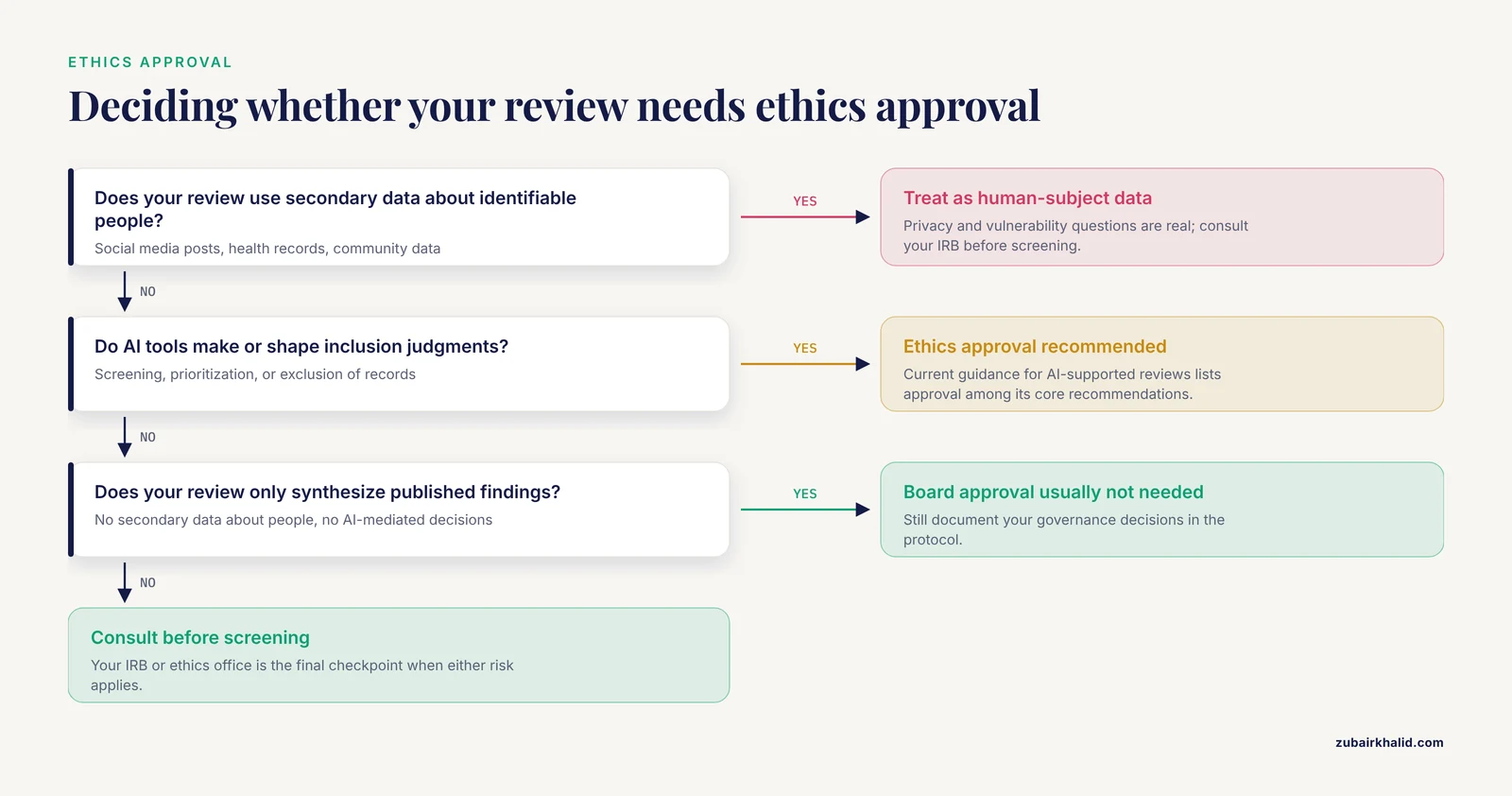
Sometimes, and the trend is toward yes. Reviews that only synthesize published findings have traditionally operated without board approval, but current guidance for AI-supported reviews lists obtaining ethics approval among its core recommendations, and reviews using social media or other secondary data about people face genuine privacy and vulnerability questions [9]. Consult your IRB or ethics office before screening begins if either applies to you.
How do ethics differ between a narrative literature review and a systematic review?
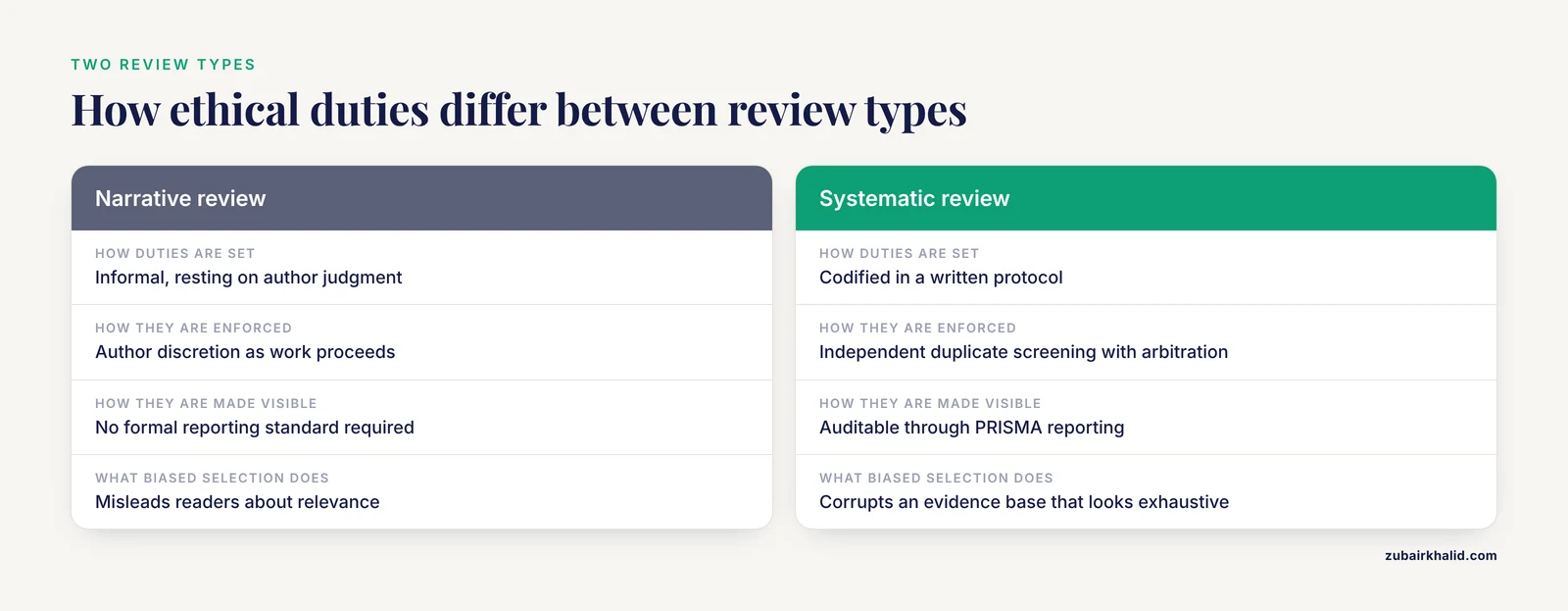
In a narrative review, ethical obligations are informal and rest on author judgment. In a systematic review, they are codified in a protocol, enforced through independent duplicate screening, and made auditable through reporting standards such as PRISMA [3], [2]. The systematic review's promise of exhaustiveness is what raises the stakes, because undisclosed selectivity in a systematic review misleads readers who believed the process was complete.
Can I use AI tools such as large language models in my review?
Yes, with documented governance. Evidence from 62 studies shows AI can reduce abstract-screening workload but that accuracy benefits vary by tool, dataset, and task. Recommended practice includes matching the tool to the task, keeping a human-AI workflow, supervising outputs, reporting performance, and acknowledging limitations. Domain reviews add cautions about bias, transparency, and accountability in generative AI generally, [16].
Do I need to evaluate the ethics of the primary studies I include?
You need to evaluate their methodological quality at minimum, using tools such as the Cochrane risk-of-bias instrument, ROBINS-I [10], COSMIN [11], and GRADE [11], [12]. Evaluating participant protections goes further and is expected when your review aims to map ethical issues [1], [2] or when included studies involve sensitive populations [9].
How should I handle data from social media platforms in a synthesis?
Treat platform data as human-subject data with heightened risk. The systematic review of Reddit research identified privacy, vulnerable populations, and unintended consequences as the recurring issues, and found researchers making ethically motivated choices, such as paraphrasing quotes, that often went unreported [9]. Extract each included study's ethical handling as part of your data collection and document your own decisions on quotation and aggregation in advance.
What is the single best starting point for ethical rigor in a systematic review?
A registered, written protocol combined with PRISMA-guided reporting. Every other ethical safeguard, from dual screening with arbitration [6] to AI governance to equity-sensitive searching [13], depends on decisions being fixed and documented before results accumulate. Transparency is the option that costs the least and enables all the others.
Sources
- Methodological guidance documents for evaluation of ethical considerations in health technology assessment: a systematic review
- AI and Ethics: A Systematic Review of the Ethical Considerations of Large Language Model Use in Surgery Research
- Ethical and regulatory considerations in the use of AI and machine learning in nursing: A systematic review.
- Ethical consideration dilemma: systematic review of ethics in qualitative data collection through interviews
- The evaluation of dual-task conditions on static postural control in the older adults: a systematic review and meta-analysis protocol
- A comparison of international modelling methods to evaluate health economics of colorectal cancer screening: a systematic review protocol
- Evaluation of the effect of insulin sensitivity-enhancing lifestyle- and dietary-related adjuncts on antidepressant treatment response: protocol for a systematic review and meta-analysis
- Artificial intelligence in systematic reviews and meta-analyses: capabilities and methodological and ethical considerations
- Remember the Human: A Systematic Review of Ethical Considerations in Reddit Research
- Comparison of robot-assisted versus fluoroscopy-guided transforaminal lumbar interbody fusion (TLIF) for lumbar degenerative diseases: a systematic review and meta-analysis of randomized controlled trails and cohort studies
- The psychometric properties of instruments measuring ethical sensitivity in nursing: a systematic review
- Comparison of transcatheter aortic valve implantation with other approaches to treat aortic valve stenosis: a systematic review and meta-analysis
- Gender and equity considerations in AMR research: a systematic scoping review
- The “What” and “Why” of (Un)Ethical Evaluation Practice: A Meta-Narrative Review and Ethical Awareness Framework
- A systematic review of generative AI: importance of industry and startup-centered perspectives, agentic AI, ethical considerations & challenges, and future directions
- Practical and ethical challenges of large language models in education: A systematic scoping review
- Artificial intelligence and big data-driven evaluation research and practices: A systematic literature review
- Navigating ethical considerations in the use of artificial intelligence for patient care: A systematic review.
- Economic evaluation of healthcare-associated infection prevention and control in long-term care: a systematic review protocol