Justifying Equipment Purchases in Grant Proposals
By Dr. Zubair Khalid, DVM, MS, PhD ·

By the end of this guide you will be able to write an equipment justification in a grant proposal that answers the questions reviewers actually ask, build a defensible budget line for the purchase, and decide whether to buy, lease, or use a shared facility instead. You will also learn the most common mistakes that sink otherwise strong proposals and how to check your own justification before submission.
Have these on hand before you start:
- The funding opportunity announcement (FOA) or request for proposals (RFP) for your target program
- Your draft budget, with personnel and supply costs already sketched out
- At least one formal vendor quote, and ideally two or three for comparison
- Your institution's facilities and administration (F&A) rate agreement, if the equipment touches shared space or renovation
- Contact information for your office of sponsored programs (OSP) or research administration office, which approves budgets before submission
No special software is required. A spreadsheet and a text editor are enough for everything in this article.
What Reviewers Are Actually Checking
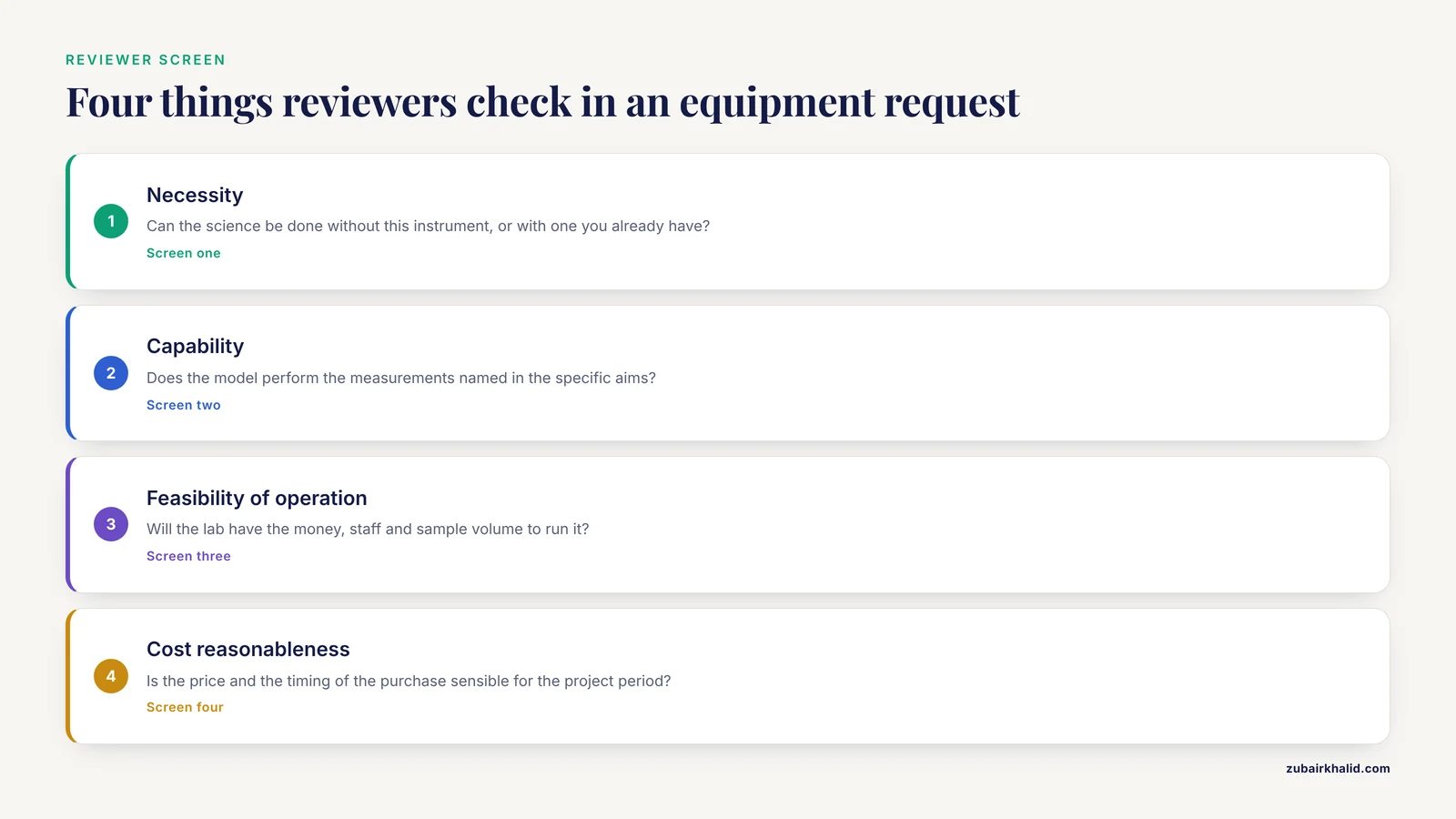
Grant proposal planning starts with understanding the reviewer's job. When a panel sees an equipment request, it screens the justification for four things:
- Necessity. Can the science be done without this instrument, or with an existing one?
- Capability. Does the model described actually perform the measurements in the specific aims?
- Feasibility of operation. Will the lab have the money, staff, and sample volume to run it?
- Cost reasonableness. Is the price, and the timing of the purchase, sensible for the project period?
Most US federal agencies draw a line between equipment, meaning tangible personal property with a useful life of more than one year and a per-unit cost above a threshold set in the agency's cost principles, and supplies, meaning consumables and inexpensive items. The threshold is defined in the Uniform Guidance that governs federal awards, and individual agencies publish their own interpretation in their proposal guides. Check the current definition in your agency's proposal instructions rather than relying on an older number, because thresholds have been revised over time.
The practical consequence is simple. If your item clears the equipment definition, it usually needs its own budget line, its own narrative justification, and sometimes its own placement rules in the proposal (for example, equipment is often excluded from modular budget caps at NIH). If it falls below the line, it goes in supplies and needs only a line-item cost. Misclassifying an item is one of the fastest ways to draw an administrative query during review or after award.
Equipment Justification in Grant Proposal, Step by Step
This walkthrough takes you from "we need a new instrument" to a finished justification paragraph and a checked budget line. Work through the steps in order, because each one feeds the next.
Step 1: Tie the Instrument to a Specific Aim
Write down, in one sentence, which specific aim fails without the equipment. Not "the lab needs a confocal microscope" but "Aim 2 requires three-dimensional imaging of cleared tissue sections at subcellular resolution, which our existing widefield microscope cannot resolve."
A useful test: if you delete the sentence, does the justification lose its anchor? If you cannot write the sentence, you are not ready to justify the purchase, and you should either redesign the aim or plan to access the capability elsewhere.
Expected output at this step: one sentence per instrument, each naming a specific aim and the technical gap.
Step 2: Rule Out Access Before You Request a Purchase
Almost every federal and private funder expects you to document that you tried existing resources first. In practical terms, do this:
- Search your institution's core facility catalog for the capability.
- Email the core director and ask two questions: what is the current hourly or per-sample rate, and what is the earliest realistic booking window during your project period.
- Check nearby institutions and regional consortia for shared instruments, especially for expensive categories such as cryo-electron microscopy, flow cytometry sorters, and mass spectrometry.
- Note whether the existing instrument is technically adequate. If a shared confocal exists but lacks the laser lines or detectors your experiment needs, say exactly which specification is missing.
Record what you find. This becomes a paragraph in the justification and, if the shared option wins, saves the entire equipment line.
Step 3: Gather and Normalize Quotes
Request written quotes from at least two vendors for the same or functionally equivalent configuration. Normalize them before comparing, because sticker prices rarely include the same items. Make each quote cover:
- Base instrument with the exact configuration you named in Step 1
- Required accessories, modules, and software licenses
- Installation, site preparation, and any facility modification
- First-year service contract, and quote year 2 through 5 separately
- Training for your staff
A quote that looks 20 percent cheaper may cost more once installation and service are added. Put the normalized numbers in a spreadsheet.
Step 4: Run the Cost Math
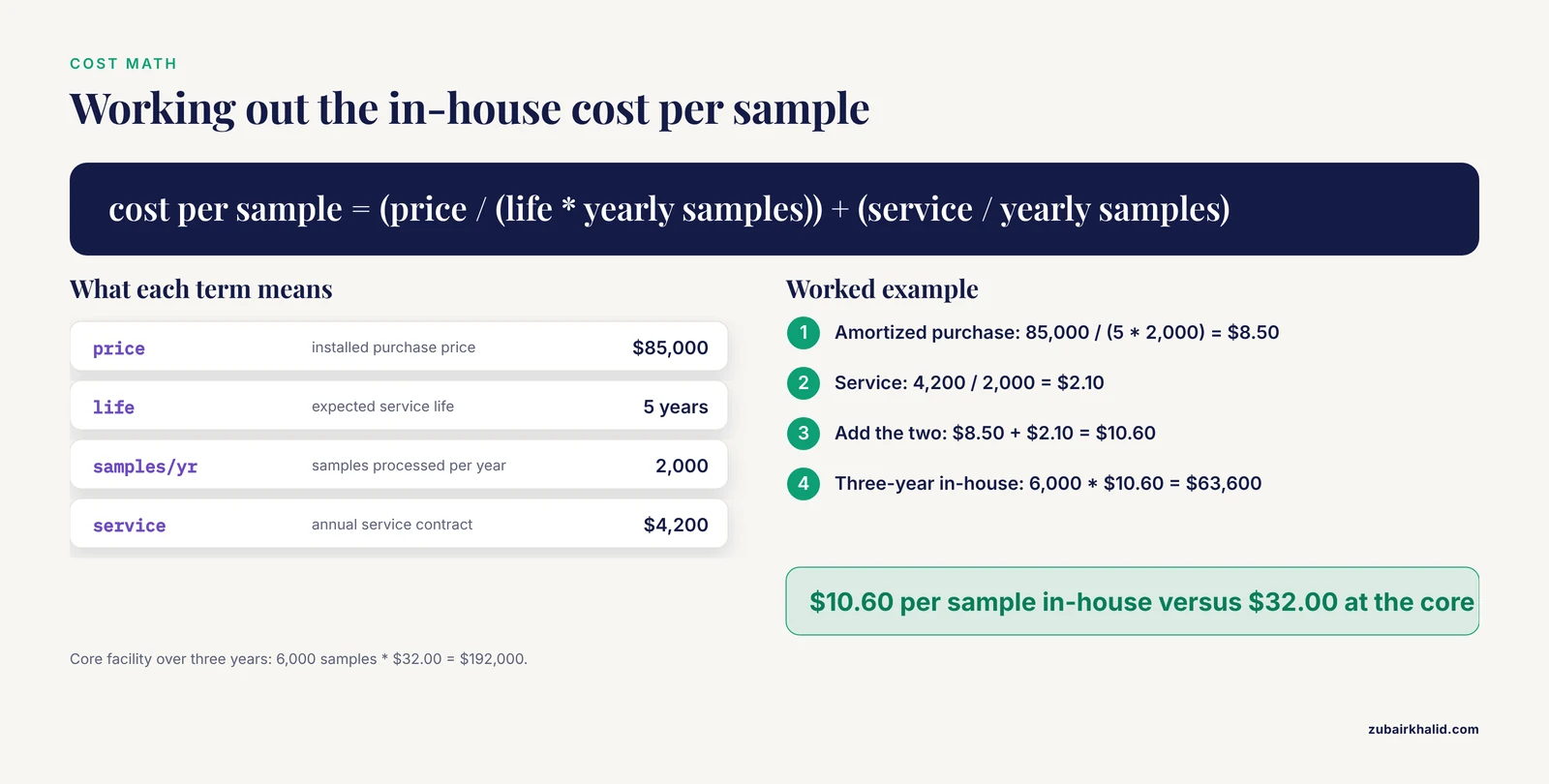
This is where many justifications win or lose. Reviewers respond to a per-sample or per-experiment cost comparison much more strongly than to a raw price. Work the numbers in a spreadsheet or by hand.
Here is a worked example for a mid-range imaging system. The figures are illustrative, so substitute your own quotes.
INPUTS
Purchase price (installed):          $85,000
Annual service contract:             $ 4,200
Expected service life:                5 years
Samples your lab processes per year:  2,000
Core facility rate (per sample):     $32.00
Samples needed over the 3-year grant: 6,000

CALCULATIONS
Amortized purchase cost per sample
    = 85,000 / (5 years * 2,000 samples per year)
    = 85,000 / 10,000
    = $8.50 per sample

Service cost per sample
    = 4,200 / 2,000
    = $2.10 per sample

Total in-house cost per sample
    = 8.50 + 2.10
    = $10.60 per sample

THREE-YEAR COMPARISON
In-house total:    6,000 samples * $10.60 = $63,600
Core facility:     6,000 samples * $32.00 = $192,000
Expected output: a per-unit cost for the in-house option, a total cost comparison across the project period, and a clear verdict. In this example, in-house operation costs roughly one third as much as sending samples to the core, which is a strong argument, provided the usage projection is credible.
If the math goes the other way, that is a finding, not a failure. It tells you to budget core access fees instead of a purchase, and your proposal becomes cheaper and easier to review.
Step 5: Write the Justification Narrative
Most equipment narratives belong in the budget justification document, typically limited to a page or less for the equipment portion. Structure it in four short paragraphs:
- The gap. Name the specific aim and the technical limitation of current options, including shared facilities you considered and why they are insufficient (Step 2).
- The instrument. Name the model, the key specifications that matter to the aims, and the quoted cost with vendor. Avoid specification dumps. List only the two or three specs that map directly to your experiments.
- The economics. Give the per-sample or per-hour calculation from Step 4 and the comparison to alternatives.
- Operations. State who will operate it, where it will sit, how usage will be tracked, and who maintains it. If you plan to open it to other labs, say so, because shared use strengthens cost-effectiveness arguments.
Keep total equipment narrative length proportional to cost. A $2,000 piece of supporting hardware needs one sentence. A $300,000 instrument deserves the full four-paragraph treatment.
Step 6: Place the Budget Line Correctly
Follow the agency's instructions exactly. The typical pattern for a federal proposal looks like this:
BUDGET CATEGORY: Equipment
  Item:      Benchtop fluorescence imaging system, Model XYZ
  Vendor:    ABC Scientific
  Unit cost: $85,000 (installed, includes training)
  Qty:       1
  Year:      Year 1
  Total:     $85,000

  (Service contract of $4,200 per year goes under
   Contractual or Other Direct Costs, not Equipment,
   because service is a recurring cost, not property.)
Three placement rules cause most errors. First, service contracts, extended warranties, and software subscriptions are usually costs other than equipment even when they attach to the instrument. Second, installation and site modification may be includable in the equipment line under some agency rules but must be broken out under others, so follow your agency's proposal guide. Third, some programs cap or exclude equipment from total direct cost limits, which changes whether the purchase fits the budget at all. Your OSP can confirm all three before you commit to a number.
Step 7: Review and Pressure-Test
Before submission, read your justification and ask the four reviewer questions from the first section. Then have two people read it: a colleague who does not use the instrument, to check clarity, and your grant administrator, to check compliance. Fix anything either of them flags.
Summary Table: The Equipment Justification Checklist
| Element | What the reviewer wants | Example sentence |
|---|---|---|
| Gap statement | A named specific aim and a technical failure of alternatives | "Aim 2 requires single-molecule sensitivity that the department's shared imager, which lacks avalanche photodiode detectors, cannot provide." |
| Access check | Evidence you evaluated cores and nearby instruments | "We requested rates from the University Core for NMR access ($XX per hour) and found booking delays exceed six weeks during academic terms." |
| Specifications | Two or three specs tied directly to experiments | "The system's 405 to 640 nm laser lines match the four fluorophores in our panel." |
| Cost basis | A dated, itemized vendor quote | "ABC Scientific quote dated March 3 lists $85,000 installed." |
| Cost per unit | Amortized math compared to alternatives | "At $10.60 per sample in-house versus $32.00 at the core, the purchase pays for itself within the project period." |
| Operations plan | Named operator, location, maintenance funding | "The instrument will be housed in Room 214 and operated by the lab manager, with service covered under the annual contract." |
| Shared use | Broader benefit beyond one project | "Two collaborating labs have committed to 20 percent usage, documented in letters of support." |
Equipment Justification in Grant Proposal Tips
These tips come from the patterns that separate funded from unfunded equipment requests.
Lead with the science, not the gadget. Reviewers are scientists first. The gap statement should occupy your first three sentences. The brand name can wait until paragraph two.
Right-size the request. If a $15,000 configuration meets 90 percent of your needs, resist the $85,000 one that meets 100 percent. Reviewers notice over-specification, and a modest, clearly matched request is easier to fund. If a future aim might need the bigger system, mention that a later supplement or a different mechanism can support the upgrade.
Show the demand curve, not just the peak. A usage projection that assumes full utilization from day one reads as wishful. Break the projection into a ramp: months 1 to 6 for installation and validation, then steady state. Reviewers trust projections that acknowledge start-up time.
Use letters strategically. A letter from a collaborator committing to shared use, or from the core director confirming that their facility cannot meet your need, converts your claims into third-party evidence. Two short letters beat one long one.
Match narrative tone to mechanism. A pilot grant on a small budget needs a lean justification. A center or instrumentation program (which fund equipment as the primary purpose) expects a much deeper case, including institutional commitment, management plans, and sustainability after the award. If you are aiming at an instrumentation program, consider a research grant writing course that covers those mechanisms specifically, because their review criteria differ substantially from standard research project grants.
Keep quotes current. A quote older than about 90 days may no longer be honored, and reviewers occasionally flag stale pricing. Refresh quotes within the submission window when possible.
Write the justification before the budget. Drafting the narrative first forces you to confirm the need and the numbers. The budget line then falls out of the narrative rather than the other way around.
Document your alternatives table. Keep a simple internal sheet listing each option you considered, its cost, and why you rejected it. Reviewers will not see it, but it prevents contradictions if a program officer asks follow-up questions.
Common Mistakes and Limitations
These are the errors that appear most often in unfunded equipment requests, with the fix for each.
- Asking for equipment without a funded specific aim that needs it. If the instrument supports an aim that starts in year 4 of a 3-year project, or an aim that is exploratory, the purchase looks like a lab-building move. Fix: align the purchase year with the year the aim begins.
- No documented access attempt. Writing "no comparable instrument exists on campus" without checking the core catalog is risky, because reviewers at your institution often serve on the panel and know the core inventory. Fix: do the Step 2 search and cite it by name.
- Sticker price instead of total cost. Omitting installation, service, and training understates the request, and the discrepancy surfaces later as a budget revision or an unfunded gap. Fix: present the installed and five-year operating cost together.
- Unrealistic usage projections. Claiming 2,000 samples per year when your lab historically ran 200 undermines every other number. Fix: base projections on your own throughput data or published protocols, and state the ramp.
- Buying what a colleague already has. Duplicating an instrument one floor away, without a scheduling conflict or a technical mismatch, reads as convenience. Fix: if duplication is genuinely necessary, document the scheduling bottleneck with booking records or the core director's letter.
- Hiding equipment inside supplies. Splitting an instrument across multiple sub-$threshold supply lines to dodge scrutiny is a compliance problem, not a strategy, and it can trigger disallowed costs after award. Fix: classify honestly against the agency's definition.
- Forgetting renovation and space costs. Instruments that need new electrical circuits, cooling, vibration isolation, or biosafety approval carry facility costs that may require institutional commitment letters. Fix: talk to facilities management early and budget accordingly.
- Ignoring the sustainment plan. Reviewers ask what happens when the grant ends and the service contract comes due. A one-line answer naming the department's commitment or a planned recharge mechanism is usually enough, but silence on sustainment is a known weakness.
- Generic justification text recycled between proposals. Reviewers on multiple panels recognize boilerplate, and recycled text often contradicts the current aims. Fix: rewrite the gap statement for every proposal, even when the instrument is the same.
One limitation applies to everything above. Agencies differ in their equipment definitions, budget caps, placement rules, and justification formats, and those rules change over time. This article describes general practice, so treat your funding opportunity announcement and your institution's sponsored programs office as the final authority for any specific submission. Individual awards also carry their own terms, which can restrict equipment purchases in ways a general guide cannot predict.
Frequently Asked Questions
What counts as equipment versus supplies in a grant proposal?
Equipment generally means a single item of tangible personal property with a useful life over one year and a per-unit cost above your agency's published threshold. Anything below the threshold, including consumables and most small accessories, is budgeted as supplies. Check the current definition in your agency's cost principles and proposal guide, because agencies apply the rules differently.
How long should an equipment justification in a grant proposal be?
Match length to cost and complexity. A minor item needs one or two sentences in the budget justification. A major instrument typically needs a few tight paragraphs covering the gap, the specifications, the cost math, and the operations plan. A dedicated instrumentation program expects a far longer, structured case, so follow that program's own format.
Should I buy equipment or use a core facility?
Run the per-sample comparison from Step 4. Cores usually win when your volume is low, the technique is occasional, or the instrument needs dedicated staff to maintain. Purchasing usually wins when volume is high, turnaround time matters, or the shared instrument lacks a specification you need. Document whichever answer you reach, because reviewers want to see the comparison either way.
Can equipment costs be included when a funding cap applies?
It depends entirely on the mechanism. Some programs exclude equipment from direct cost caps, some include it, and some treat modular budgets with their own rules. Read the funding opportunity announcement section on budget limits and confirm with your grants administrator before you commit to a purchase in a capped budget.
How do I justify equipment when reviewers think it is too expensive?
Anchor the price to the science and the math rather than defending the sticker. Show that the configuration is the minimum that meets the aims, present the amortized per-sample cost, compare it to the realistic alternatives, and document shared use that spreads the cost. If the price still exceeds the program's typical awards, consider leasing, phasing the purchase, or targeting an instrumentation-specific program.
Is leasing equipment a legitimate strategy in a grant proposal?
Yes, and it can be the right call for short projects or rapidly evolving technologies. Lease payments usually appear as a contractual or rental cost rather than an equipment line, and the rules for allowability vary by agency. The justification burden is the same either way: show the cost comparison and tie the lease term to the project period.
Do I need vendor quotes before submitting a proposal?
You need a documented cost basis, and a written quote is the strongest one. Some agencies accept catalog or published prices for budgeting, with the final procurement handled after award under your institution's purchasing rules. Getting at least two quotes strengthens the reasonableness argument for any large item and protects you if a reviewer questions the number.
Who can I ask for help with equipment justification on my campus?
Start with your office of sponsored programs or research administration, which reviews budgets for compliance and knows the agency rules in force. Core facility directors can supply rate letters and access documentation, and many institutions run internal grant writing workshops or seminars where senior faculty review draft budget justifications before submission.