Electronic Signatures in Lab Notebooks: What They Mean
By Dr. Zubair Khalid, DVM, MS, PhD ·

An electronic signature in a lab notebook is a recorded, attributable statement that a named person created, checked, or approved a specific entry at a specific time. It carries the same three meanings as a handwritten signature on a paper page, authorship, review, and accountability, but it binds those meanings to a digital record through identity verification, timestamps, and an audit trail rather than through ink.
If you have ever wondered what a "Sign" button in an electronic lab notebook (ELN) really does, or what legal and scientific weight a signed digital entry carries, this article explains electronic signatures in lab notebooks in plain language. It covers what the signature attests to, how the underlying technology makes that attestation trustworthy, how to interpret a signed record, and what to look for when your lab compares ELN options or designs a lab notebook template.
What Electronic Signatures in Lab Notebooks Mean
A signature is a human act of taking responsibility. On paper, you demonstrate that act by writing your name at the end of an entry. In an electronic lab notebook, you demonstrate the same act through a software action, typically entering your credentials or confirming your identity inside the system at the moment you sign.
The meaning does not come from the ink or the button. It comes from what the signature claims. In research records, a signature can make one of three distinct claims:
- Authorship. "I performed this work and this record accurately describes it." This is the daily signature a bench scientist places on an experimental entry.
- Verification or review. "I have checked this record and confirmed it is accurate and complete." In quality-controlled environments, a second person often reviews and signs after the author.
- Approval. "I authorize this record, or the action it documents, to proceed." This might be a supervisor approving a protocol change or a quality unit releasing a batch record.
Each of these claims needs to state the meaning of the signature alongside the signer's identity. A bare name next to an entry is ambiguous. A good signature event records who signed, when, and why, for example "Reviewed by J. Ortiz on 2026-03-14, meaning: second-person verification of data accuracy."
The two meanings students most often confuse
Students frequently treat signing as a formality, a box to tick before leaving the lab. Treat it instead as a scientific and legal act. When you sign an entry, you are personally attesting that the recorded methods, observations, and data are faithful to what happened. If a record later turns out to be wrong, a fabricated value, a missing failed condition, an unreported correction, the signed entry becomes evidence about what you claimed and when.
The second confusion is between the signature and the record itself. A signature does not make an entry true. It makes the entry attributable. Data integrity in the record plus attribution through the signature together produce a trustworthy experimental account.
Why Lab Notebook Signatures Exist at All
The signature convention in laboratory records grew out of the paper notebook tradition. In the paper world, a notebook page typically contained the date, the entry written in ink, and the signer's name and signature. Witnesses sometimes countersigned. The purpose was evidentiary. A signed, dated, contemporaneous notebook could establish who invented what and when, support patent claims, defend the integrity of reported results, and demonstrate to auditors or regulators that records were made at the time of the work.
That evidentiary purpose carried over directly into the digital world, and it shaped how ELNs were designed. Early electronic lab notebooks were built explicitly to reproduce the essential capabilities of paper records in a collaborative digital form. One well-documented example is eCAT, an online ELN developed by Axiope Limited. By late 2006 its designers had settled on a concept of a highly scalable, web-based collaboration tool that possessed the basic capabilities of commercial ELNs, including a permissions system, controlled sharing, an audit trail, electronic signature, and search, with a front end designed to look like the electronic counterpart to a paper notebook [1].
Two details of that development history are worth noting for anyone trying to understand what electronic signatures in lab notebooks mean. First, eCAT was developed in close collaboration with working laboratory scientists, and it was the first ELN targeted at researchers in non-commercial institutions such as universities [1]. Second, feedback came from groups with serious regulatory obligations, including the FDA's Center for Biologics Evaluation and Research, alongside academic groups such as Uppsala University, Children's Hospital Boston, the Garvan Institute in Sydney, and Imperial College. More than 100 individuals and groups participated in beta testing between September 2008 and June 2009 [1]. The presence of both academic and regulated-industry users explains why the electronic signature ended up treated as a core ELN capability rather than an optional extra. Academics wanted attribution and witnessing for notebooks and even for meeting minutes. Regulated users needed signatures that could survive an audit.
How Electronic Signatures Work in an ELN
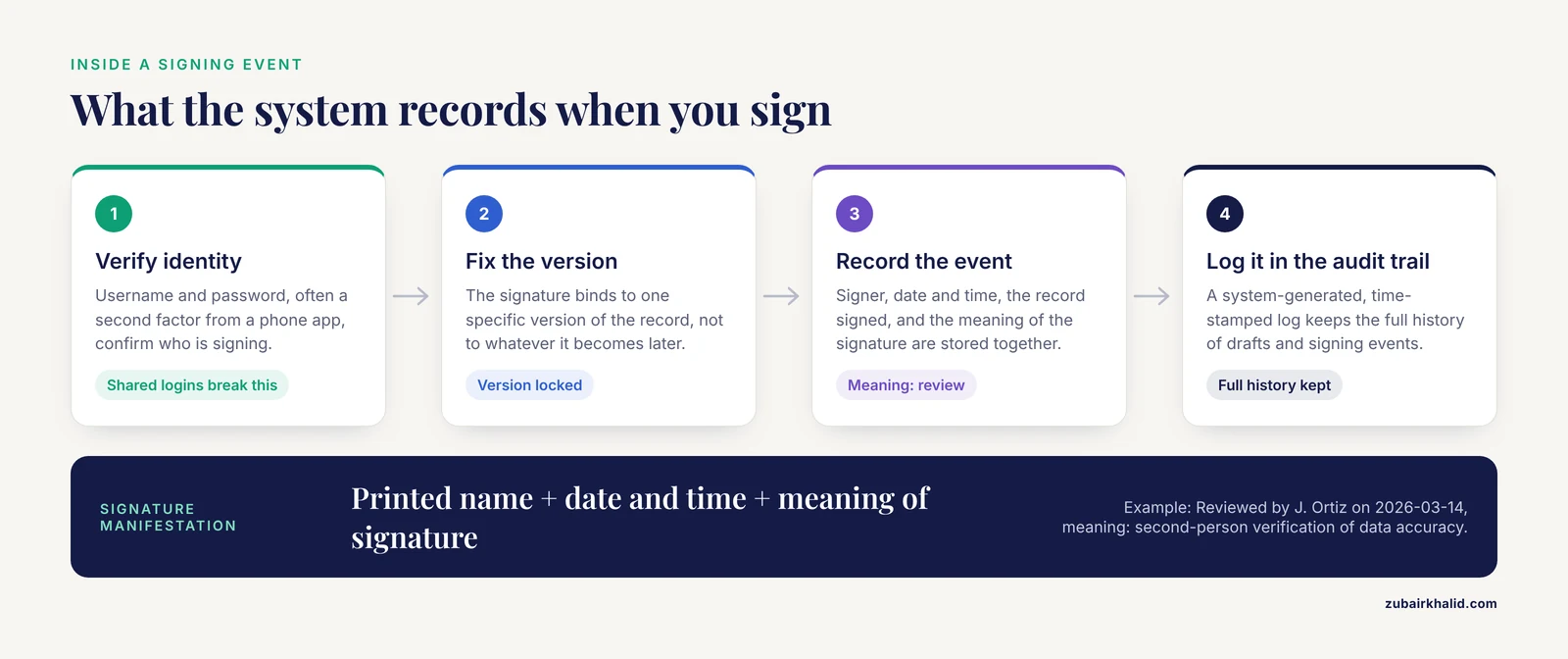
To interpret a signed entry, you need to know what happens under the hood when someone clicks "Sign." Four mechanisms work together.
1. Identity authentication
Before you can sign, the system verifies that you are who you claim to be. In most ELNs this means a username and password, and increasingly a second factor such as a code from a phone app. The strength of this check matters because the signature is only as trustworthy as the identity check behind it. If credentials are shared around the lab, every signature becomes ambiguous.
2. The signing event and its meaning
When you sign, the system records an event that includes, at minimum, the identity of the signer, the date and time, the specific record or version being signed, and the meaning of the signature. The requirement to record the meaning of the signature comes from regulated practice. Under the FDA's regulation of electronic records and electronic signatures in regulated research and manufacturing, a signed electronic record should show the printed name of the signer, the date and time of signing, and the meaning of the signature, such as review, approval, responsibility, or authorship. The same principle applies in academic ELNs even when no regulator is watching, because a signature without a stated meaning cannot be interpreted later.
3. The audit trail
An audit trail is a system-generated, time-stamped log of who did what to a record and when. It captures creation, edits, copying, and signing events. This is the feature that gives electronic records much of their evidentiary power. On paper, a clever person can backdate an entry or remove a page in ways that are hard to detect. In a well-implemented ELN, the audit trail preserves the full history of the record, including the sequence of drafts that led to the signed version.
In the eCAT design, the audit trail was one of the core capabilities listed alongside permissions, controlled sharing, electronic signature, and search [1]. The pairing is deliberate. A signature without an audit trail is a claim with no supporting history. An audit trail without signatures is a history with no one taking responsibility. Together they establish both attribution and integrity.
4. Binding the signature to the record
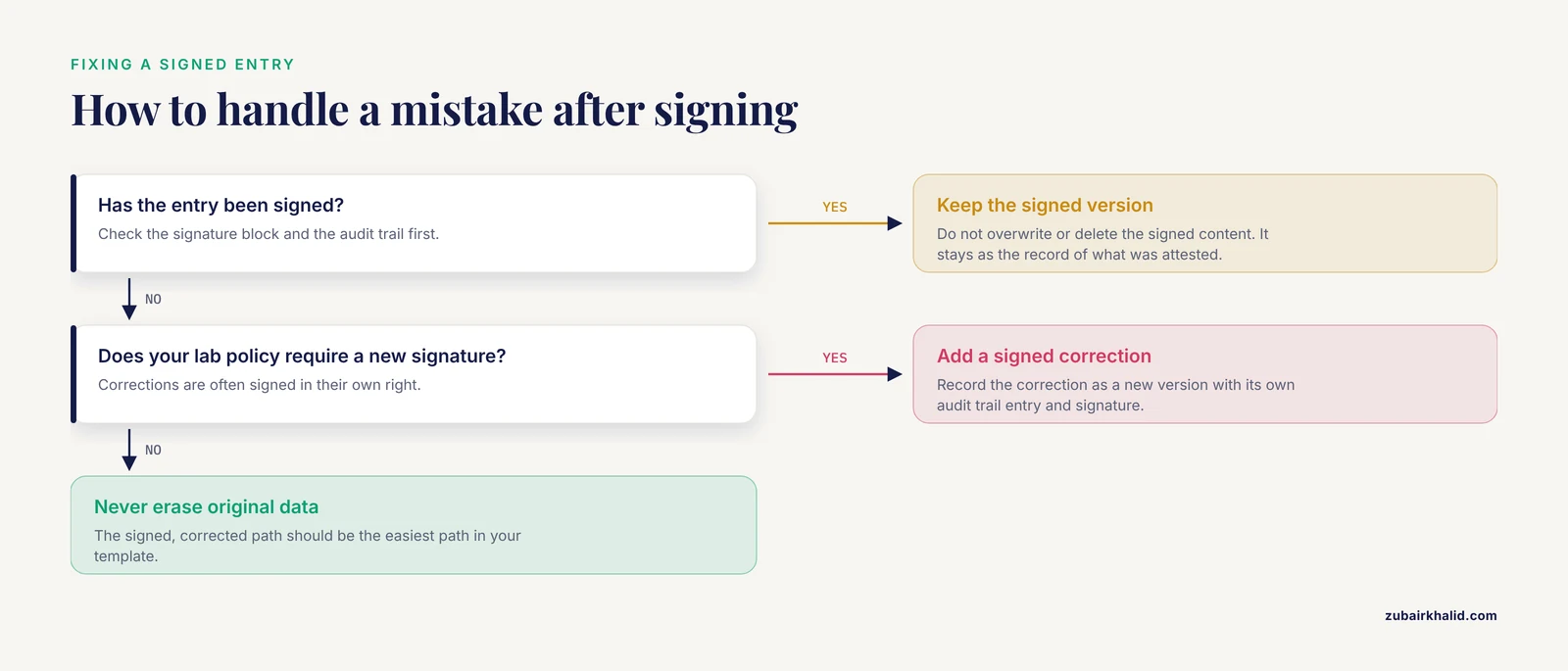
A meaningful signature must be bound to a specific, unalterable version of the record. After you sign, the ELN typically locks the signed version or records a checksum, a computed value that changes if the content changes in any way. If the record must be corrected after signing, the system does not overwrite the signed version. It keeps the signed version intact and adds a correction, often with its own signature. This preserves the honest history of the work, including the mistakes, which is exactly what a good paper notebook does when you cross out an error and initial the change rather than erasing it.
Electronic signature versus digital signature
Students often use "electronic signature" and "digital signature" interchangeably. They are related but distinct.
- An electronic signature is the broad concept, any electronic action that expresses intent to sign and is attributable to the signer. Typing your name, clicking a sign button with an authenticated account, or drawing a signature on a tablet can all qualify, depending on context and controls.
- A digital signature is a specific cryptographic technique. A mathematical operation, based on a key pair held by the signer, generates a value that detects any later alteration of the signed content and links the content to the key holder.
In practice, an ELN signing event often combines both. The user performs an electronic signature action, and the system may use cryptographic methods internally to seal the record. For everyday interpretation, remember the simple distinction. Electronic signature is the legal and practical concept of signing electronically. Digital signature is one engineering method for making that concept tamper-evident.
Interpreting a Signed Entry: What You Can Conclude
Electronic signatures lab notebooks interpretation comes down to a chain of reasoning. When you see a signed entry, what can you actually conclude?
You can conclude who attested to the record. Provided the authentication system is sound and credentials were not shared, the signature identifies the person who took responsibility for the entry at that moment.
You can conclude when they attested to it. The system timestamp fixes the signing moment more reliably than a handwritten date, which can be added later or written incorrectly.
You can conclude what role they claimed. The recorded meaning of the signature tells you whether the signer claims authorship, review, or approval. A record with an author signature but no reviewer signature tells a different story than one with both.
You can conclude what version they attested to. Because the signature binds to a specific version, later edits do not silently inherit the old signature. A revised record after the signing event is visible in the audit trail.
You cannot conclude things the signature never claimed. A signed entry is not proof that the experiment was performed correctly, that the conclusion is right, or that the signer was competent. It is proof of attribution, timing, and stated intent. Peer review, replication, and quality systems address the rest.
This chain of reasoning is why signed electronic records carry real weight in patent disputes, regulatory inspections, and research integrity investigations. The combination of a contemporaneous, attributable record and an intact audit trail answers the questions these proceedings ask. Who did the work. When. Whether the account changed afterward and, if so, who changed it.
Electronic Lab Notebook Comparison: Paper Versus Digital Signatures
If you are choosing between paper notebooks, hybrid approaches, and ELNs, the signature capabilities differ in ways that matter. The comparison below summarizes the key attributes.
| Attribute | Paper notebook signature | Electronic signature in an ELN |
|---|---|---|
| Identity of signer | Inferred from handwriting, weakly verified | Verified by account credentials, optionally a second factor |
| Date and time | Handwritten by the signer, can be wrong or backdated | System-generated timestamp, difficult to alter |
| Meaning of signature | Usually implied or written as a note | Recorded explicitly as a field (reviewed, approved, authored) |
| Tamper evidence | Limited, depends on habits like ink and witness signatures | Audit trail and version locking preserve full history |
| Attribution of edits after signing | Ambiguous unless initialed | Each change logged with identity and time, new signatures required as configured |
| Witnessing and remote collaboration | Requires physical presence | Second person can review and sign from anywhere, with controlled sharing |
| Search and retrieval | Manual, slow | Built into the platform, as in eCAT's inclusion of search among its core capabilities [1] |
| Regulatory acceptance | Long-standing, well understood | Accepted when the system implements appropriate controls, as required under FDA rules for electronic records and signatures |
Two points in this table deserve expansion. The first is witnessing. In paper practice, a colleague signs as witness only if they are physically present. In an ELN with controlled sharing and permissions, a supervisor in another building can review the actual record and apply their own signature, which makes second-person verification more consistent. The eCAT design treated permissions and controlled sharing as inseparable from signature capability for exactly this reason [1].
The second point is regulatory acceptance. Electronic records and signatures are fully acceptable in regulated work when the system supports controls that make them trustworthy and equivalent to paper signatures. Those controls include identity verification, a signature manifestation showing signer, date, time, and meaning, secure record retention, and audit trails. Labs operating under good laboratory practice or good clinical practice frameworks should confirm that any ELN they adopt supports these controls and should document how they use them.
When your lab performs an electronic lab notebook comparison, signature capability should sit near the top of the evaluation list, alongside whether the system stores the file types your lab actually produces. Biologists generate images, spreadsheets, and other diverse data collections, and one academic lab using eCAT described using it as an electronic notebook to compile exactly those collections, and even to take minutes of meetings [1]. A tool your team will actually adopt is worth more than a tool with a perfect feature list that nobody opens.
Lab Notebook Templates and Where Signatures Fit
A lab notebook template is a pre-defined structure for entries, so that every experiment is recorded with the same essential elements. Templates reduce missing information and make entries easier to review and sign. Whether on paper or in an ELN, a sound template for an experimental entry typically includes:
- A title and a unique identifier for the experiment.
- The date, and in ELNs, automatic time stamping of the entry.
- The objective or hypothesis.
- Materials, reagents, and equipment, with identifiers such as lot numbers and instrument IDs where relevant.
- The protocol actually followed, including any deviations from the planned protocol.
- Raw data and observations, including failed runs and unexpected results.
- An analysis or interpretation section, clearly separated from the raw observations.
- A signature block, with space for the signer, the date and time, and the meaning of the signature, and a second block for a reviewer or witness where your lab's policy requires one.
The signature block is part of the template, not an afterthought. Designing it in advance forces the question your lab should answer anyway. Who signs what, and when. A common academic pattern is that the person who performed the work signs each entry, and the principal investigator signs periodically, for example weekly or monthly, to attest that they reviewed the notebook. In an ELN, that periodic review can be recorded as an explicit signing event with the meaning "supervisory review," which is far clearer than a vague stack of unsigned pages.
Templates also help with the problem of corrections. A good template includes a defined correction convention. On paper, that is a single line through the error, the correct value, initials, and date. In an ELN, the correction convention is usually built into the software, with the original version retained and the change logged. Either way, the template should tell users never to delete or obscure original data, and it should make the signed, corrected path the easiest path to follow.
Practical Implications for Students, Researchers, and PIs
For a student or new lab member, the practical rule is simple. Sign your own entries, sign them when the entry is complete and accurate, and never sign for anyone else. If your ELN requires credentials to sign, that requirement is your protection. Your signature on your work is what distinguishes you as the person who did it, which matters for authorship discussions, recommendation letters, and any future inquiry into the record.
For a principal investigator or lab manager, signatures are a management tool. Decide and document your lab's signing policy. Which entry types require author signatures. Which require second-person review. How often do you review and sign. Build these steps into your lab notebook template so the policy is enacted by the workflow rather than remembered from a meeting. If you adopt an ELN, evaluate whether its signature, permissions, and audit trail features support your policy, and train the group that signing is a scientific act, not a chore.
For anyone preparing for regulated work, such as a move from academia into biotech or pharmaceutical research, signed electronic records are the daily currency. The habits that matter are the ones described above, contemporaneous recording, accurate attribution, preserved corrections, and explicit signature meanings. Learning them in an academic ELN, even one used informally, transfers directly.
Common Mistakes and Limitations
Several recurring mistakes undermine the meaning of electronic signatures in lab notebooks.
Sharing credentials. The single most damaging habit. If two people use one account, no signature from that account identifies anyone. Each person needs an individual account, and signing must happen under the signer's own login.
Signing incomplete entries. Signing before the data are entered, or signing entries that contain placeholder values, converts the signature into a formality. Sign when the entry is a faithful account of work performed.
Treating the signature as verification of truth. As explained above, a signature attests to attribution and stated intent, not to the correctness of the science. Reviewers who sign without actually checking the entry undermine the whole chain, and their signatures will not protect them in an inquiry.
Letting the meaning of the signature default to something vague. If your ELN allows a free-text meaning field, write the actual claim, "author and performer of this experiment" or "second-person data review." A signature meaning of "sign" tells a future reader nothing.
Ignoring the audit trail when reconstructing events. When a question arises about a record, people often read only the final entry. The audit trail is part of the record. Read the full change history before drawing conclusions about what happened and when.
Assuming all ELNs are equivalent. Signature features vary widely between products in how they authenticate users, what they record in the signature manifestation, and how thoroughly they log changes. This is why a structured electronic lab notebook comparison, focused on the signature and audit trail requirements of your own work, is worth doing before adoption.
Overlooking backups and retention. A signature attests to a record that must remain readable for years. Labs should know where records live, how they are backed up, and how they will be exported if the ELN vendor changes or closes.
A final limitation concerns scope. This article explains what signatures mean and how the systems behind them work. It does not replace your institution's record-keeping policy, your funder's requirements, or, where they apply, regulatory requirements specific to your field. When an individual situation involves a dispute, an audit, or an investigation, consult your institution's research integrity office or the responsible compliance function, because the governing rules depend on the specific context.
What Is Still Uncertain
The meaning of a signature is stable, but practice around ELN signatures continues to evolve. Adoption of ELNs outside regulated industry settings is far from universal, and many academic labs still rely on paper or on hybrid arrangements where data live in files that never touch a notebook. The eCAT development story illustrates the point. Its designers explicitly aimed to bring commercial ELN capabilities, including electronic signature, to researchers in non-commercial institutions, and its beta testing drew more than 100 individuals and groups worldwide between September 2008 and June 2009 [1]. Despite that early momentum, questions about long-term data export, cross-platform portability of signed records, and how patent offices and courts will weigh signatures from any given system remain matters that each lab should assess for its own risk profile rather than assume away. Standards and software will keep changing. The core meaning, attribution, timing, and stated intent, has not changed since the paper era, and it is unlikely to change in any digital system.
Frequently Asked Questions
What does an electronic signature in a lab notebook mean?
It means a named person has taken a defined form of responsibility, authorship, review, or approval, for a specific notebook entry at a recorded time. The system binds that statement to the record through authentication, a timestamp, and an audit trail.
Are electronic signatures in lab notebooks legally valid?
Yes, when the system applies appropriate controls. Regulated environments follow requirements such as those in the FDA's rules on electronic records and electronic signatures, which expect the signature to identify the signer, show the date and time, and state its meaning.
What is the difference between an electronic signature and a digital signature?
An electronic signature is the broad concept of signing electronically with intent and attribution. A digital signature is a specific cryptographic method that makes the signed content tamper-evident and links it to a key holder. ELNs often use digital signature techniques to implement electronic signing.
Do I need to sign every entry in my electronic lab notebook?
Follow your lab's written policy. A common pattern is that the person who performed the work signs each completed entry, and the supervisor signs periodically to confirm review. Sign when the entry is complete and accurate, not before.
Can I correct an entry after I have signed it?
Yes, and you should. In a well-designed ELN the signed version stays intact and the correction is added as a new version with its own audit trail entry, and often its own signature. Never delete or overwrite signed content.
Can someone else sign my notebook entry for me?
No. A signature is a personal attestation by the named individual. If someone signs under your credentials, or you sign under theirs, attribution is destroyed and every record touched by that account becomes questionable.
What should a lab notebook template include about signatures?
Include a signature block with fields for the signer, the date and time, and the meaning of the signature, plus a second block for reviewer or witness signatures if your lab requires them. Build the correction convention into the template as well.
How do I compare ELNs on signature capability?
Check four things. How the system verifies identity, what it records with each signing event including the meaning of the signature, how complete and tamper-evident its audit trail is, and how it handles corrections to signed records. Then match those features against your lab's signing policy and any regulatory requirements that apply to your work.