Electronic Lab Notebooks (ELNs) for Data Sharing: A Buyer's Guide
By Dr. Zubair Khalid, DVM, MS, PhD ·

An electronic lab notebook (ELN) is the system of record for your day-to-day experiments, while a data repository is the long-term, searchable archive where finished datasets live for outside reuse. The rule of thumb for choosing: buy the ELN around how your bench actually works, then choose the repository around how outsiders will find and reuse the data, because no single product does both jobs equally well.
This guide walks through a full electronic lab notebook comparison built around one question that matters more than feature lists: which option will make your data shareable without a painful re-entry project later. It covers the main electronic lab notebook comparison options, their pros and cons, the criteria that decide real purchases, three worked scenarios, and the mistakes labs make most often.
Why the ELN Is the Front Door for Research Data Sharing
Research data sharing fails or succeeds at the moment of capture. A result typed into a structured ELN record arrives with sample ID, instrument settings, reagent lots, and dates attached. The same result photographed from a paper notebook and pasted into a slide deck arrives with none of that context, and rebuilding the context months later is the expensive part of every data sharing effort.
The payoff for structured capture is measurable. In one industrial setting, researchers extracted a reaction dataset directly from an ELN and used it to build and validate a machine learning reaction classification model with 336 classes, then compared its behavior against reactions harvested from the medicinal chemistry literature [1]. That study would not have been possible if the ELN records were free-text paragraphs. The ELN data carried enough chemical structure and condition detail to feed a data-driven model, and the exercise exposed exactly how ELN records and literature records differ in completeness.
This is the core argument for taking the ELN decision seriously. The ELN is not clerical software. It is the first and often only place where the metadata that makes sharing possible gets attached to the data, and a poor choice at this stage taxes every downstream consumer of the data, including your future collaborators, your funders, and the models you may want to train on your own archive.
ELNs, Repositories, and Other Sharing Channels: How They Fit Together
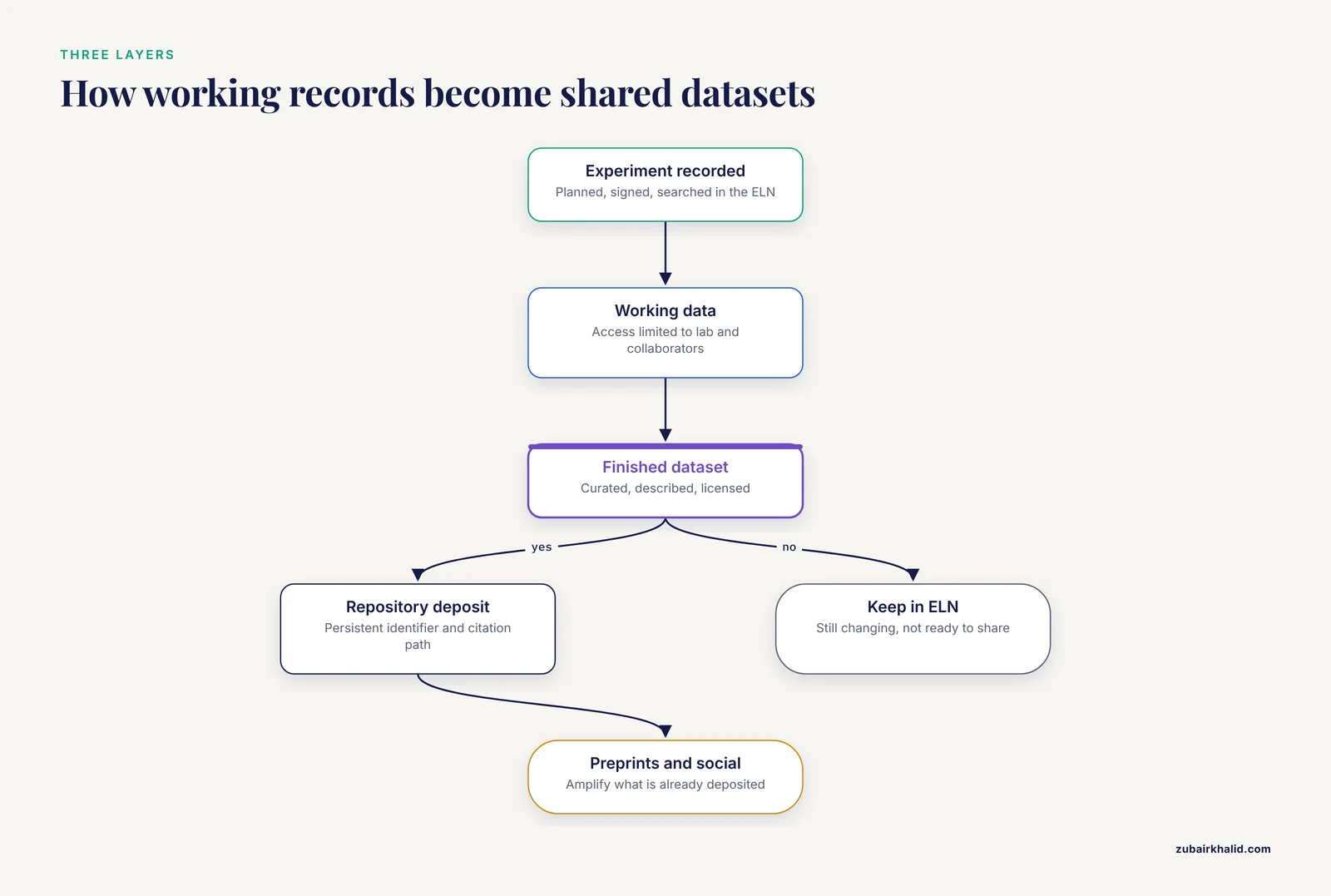
Before comparing ELN products, it helps to separate three layers that buyers often blur together.
The ELN layer. This is where experiments are planned, recorded, signed, and searched during active work. Access is limited to the lab and its collaborators. Data here is working data, still changing.
The repository layer. A data repository holds curated, described, and usually finished datasets with a persistent identifier, a license, and a citation path. Repositories differ widely in scope. Some are institutional, like the C-BIG Repository at the Montreal Neurological Institute-Hospital, which was built after The Neuro declared itself an Open Science organization in January 2016 and collects biospecimens alongside clinical, imaging, and genetic data from neurological disease patients and healthy controls [2]. That project shows what institution-level repositories require beyond software: governance, ethics review, computational resourcing, training, and reporting structures, all coordinated across stakeholders [2]. Other repositories are community or domain specific, and conservation biology offers a useful model there. The EAZA Biobank runs a decentralized four-hub network of zoological institutions storing samples, and it leans on ZIMS, an established data-sharing platform for zoos, so that specimen records stay consistent across a widely distributed network [3].
The dissemination layer. Preprint servers and social platforms sit downstream of both. Recent analysis of biomedical communication describes preprint repositories such as bioRxiv and medRxiv accelerating access to findings, while platforms including X, LinkedIn, Mastodon, Threads, and Bluesky carry rapid discourse, cross-disciplinary connections, and public engagement, along with real risks of misinformation and premature release of preliminary data [4]. This layer amplifies what you share but should never be the system of record for it.
A practical data repository comparison therefore asks two questions. First, which repository will hold the curated datasets your ELN feeds? Second, does your ELN make feeding that repository cheap, through clean exports, standard formats, and good metadata? The buyer's comparison below is organized around the second question, with the first handled in the option breakdown.
The Core Electronic Lab Notebook Comparison Table
The table compares six realistic options for a lab deciding where experimental records and shareable data should live. Names of product categories matter more than brand names here, because vendors change features faster than buyers can audit them. Verify every cell against a live demo before signing anything.
| Option | What it is | Strengths for data sharing | Weaknesses for data sharing | Best fit |
|---|---|---|---|---|
| Commercial SaaS ELN | Subscription notebook software hosted by the vendor, with templates, inventory links, and signing workflows | Polished capture, built-in sharing with collaborators, vendor-managed backups, structured templates | Export quality varies by vendor, exit costs can be high, data lives on someone else's terms | Labs that want supported software and can pay per seat |
| Open-source ELN | Community-developed notebook software your institution or lab hosts | Full control of your data and code, no per-seat licensing, export formats are inspectable | Your team owns hosting, backups, updates, and security | Small labs with computing help or institutions with IT capacity |
| Code-centric electronic lab journal | A computational environment such as Jupyter notebooks wired to a database layer and a domain data standard | Data is born structured and analysis-ready, queries and reuse are built in, designed for sharing from day one | Steep learning curve, overkill for wet-lab-only records, needs programming comfort | Computational and neurophysiology labs, pipelines with heavy data analysis |
| Institutional data repository | A repository operated by your university or institute for curated outputs | Governance, ethics, and curation handled at the institution level, persistent sharing, discoverability | Holds finished datasets, not working records, so it complements rather than replaces an ELN | The destination for datasets leaving any ELN |
| Public domain or community repository | External archives where datasets are deposited for open reuse | Broad visibility, funder compliance, citation through persistent identifiers | Deposits must be curated and documented by you, deposit standards differ by domain | Final publication of datasets referenced in papers |
| Paper notebooks and ad hoc spreadsheets | The status quo in many labs | Zero software cost, familiar, no training | No search, no access control, no metadata structure, sharing requires manual transcription | Nobody, except as a legal signed record alongside an ELN |
Two readings of this table are useful. Read down a column to see what each option type is good at. Read across a row to see the trade you are accepting. Almost every ELN dispute between colleagues is really a disagreement about which column of weaknesses a lab can live with.
Decision Criteria for the Best Electronic Lab Notebook Comparison
Feature matrices from vendors all look similar. The criteria below are the ones that decide whether data sharing actually happens, and each one deserves a concrete test during a trial.
Structure and Search at Capture Time
Ask how the ELN records the things that make data reusable. Can a template force entry of sample identifiers, instrument parameters, reagent lots, and units? Can you later filter all experiments that used a particular antibody lot or cell line? The industrial chemistry study cited above depended on exactly this kind of structure, because reaction records had to be converted into machine-readable form for classification modeling [1]. During a demo, enter one of your own real experiments, not the vendor's sample record, and check what the system captured without free-text improvisation.
Export Formats and the Exit Path
Every subscription ends eventually, through contract choice, vendor acquisition, or a lab moving institutions. Before buying, perform the export. Download a representative experiment set in whatever formats the platform offers and ask whether the exported files preserve structure, attachments, signatures, and metadata, or whether they collapse into flattened documents. An ELN whose export is a pile of PDFs has made your data strictly less shareable than it was inside the system. This single test eliminates more candidates than any feature list.
Data Standards and Interoperability
A data standard is an agreed format that describes how a data type is structured and stored, so that software from different groups can read the same files. The neurosciences offer the clearest worked example. The Neurodata Without Borders (NWB) standard unifies diverse modalities of neurophysiology data in a single format, and combining NWB with the DataJoint database interface inside Jupyter notebooks produces an electronic lab journal where sharing, combining data from diverse sources, and retrospective queries are demonstrated capabilities rather than aspirations [5]. Systems built on these principles underpin analytical infrastructure used by the Allen Institute and the International Brain Laboratory [5]. The lesson generalizes. If your field has an accepted data standard, prefer the ELN path that stores or exports to that standard natively, because conversion is where data quality dies.
Access Control, Audit Trails, and Intellectual Property
Data sharing still requires control. Ask three questions in sequence. Who can read a given notebook entry, and can access be granted to an external collaborator for one project only? Does the system keep a signed, timestamped audit trail suitable for patent work and regulatory contexts? Can you restrict export of sensitive records while allowing export of publishable ones? A lab with patentable work has different requirements than a lab running federally funded open science, and the ELN should be configured for your situation, not the vendor's default.
Adoption Burden
The best ELN on paper fails if the lab will not use it. Adoption of digital tools for research communication is a documented challenge even among highly published academics. A survey of 1,977 university lecturers across 24 African countries assessed awareness of and engagement with 20 digital tools for research sharing and recorded the challenges respondents faced using them [6]. The relevant purchasing lesson travels across borders and disciplines. Budget for training, expect a transition period during which paper and digital run in parallel, and favor the option your least enthusiastic senior scientist can tolerate, because data sharing pipelines break at the first person who quietly reverts to a personal spreadsheet.
Hosting, Governance, and Institutional Fit
Decide early whether the ELN will be vendor-hosted, institution-hosted, or lab-hosted, because this decision shapes everything from security review to what happens when a student graduates. Institutional context matters here. The C-BIG Repository succeeded because The Neuro treated open science as an institutional commitment spanning governance, ethics, workflows, and physical design, not as a software installation [2]. Ask your institution what it already operates. A lab that joins an existing institutional ecosystem often gets better long-term data stewardship than one that negotiates alone with a vendor.
The Main Options, With Pros and Cons
Commercial SaaS ELNs
Pros. Fast to deploy, professionally maintained, strong template and inventory features, responsive support, and collaboration controls that work out of the box. For most wet-lab academic groups and small biotechs, this category delivers the shortest path from paper to structured digital records.
Cons. You pay per seat indefinitely, your data sits in a vendor's cloud under the vendor's terms, and the depth of structured export is the single most variable quality across this category. Some products export beautifully to open formats. Others treat full-fidelity export as an enterprise-tier feature. Test it before you commit, and get the export terms in writing.
Open-Source ELNs
Pros. No licensing fees, complete control over your data, and transparency about exactly how records are stored. An institution with IT capacity can host an open-source ELN, integrate it with local authentication, and guarantee that the database file itself is the lab's property in a form it can read forever.
Cons. Someone must own hosting, upgrades, backups, and security patches. Feature development depends on community momentum rather than a sales contract. Labs without a committed technical person should not choose this category on cost savings alone, because the hidden labor is real.
Code-Centric Electronic Lab Journals
Pros. When the lab's output is primarily data plus analysis, this approach is the strongest for sharing. The NWB and DataJoint demonstration shows the pattern in practice. Behavioral data consisting of X and Y coordinates was converted to NWB format, processed through a DataJoint pipeline, and shared through notebooks that also showed querying, combining sources, and retrospective analysis [5]. In this model the notebook and the shared data are the same artifact, so there is no export step to fail.
Cons. Everyone writing records needs programming comfort, and the approach assumes a database design effort up front. It is a poor fit for labs whose primary record is a photograph of a gel and a paragraph of observations.
Institutional Data Repositories
Pros. These handle the governance half of research data sharing that no ELN can. Curation, ethics documentation, controlled vocabularies, and dissemination workflows are managed at the institution level, which is precisely what made C-BIG workable for aggregating rare-disease datasets across projects and locations [2]. For a lab, the practical pro is that deposit becomes a supported process with people to ask.
Cons. A repository is not a notebook. It expects finished, described datasets and cannot absorb your messy daily records. Budget the curation time between the two.
Public and Community Repositories
Pros. Broad discoverability, funder compliance, and citation through persistent identifiers. Domain repositories also connect your data to communities already searching for it.
Cons. You are responsible for meeting the repository's format and metadata standards, and standards differ between domains. Consistency pays here too. Conservation biology shows the value of a shared platform backbone, since the EAZA Biobank's reliance on ZIMS keeps specimen data consistent across a distributed four-hub network and lets genomic data repositories link back to physical samples [3].
Worked Scenarios
Scenario 1: A University Molecular Biology Lab
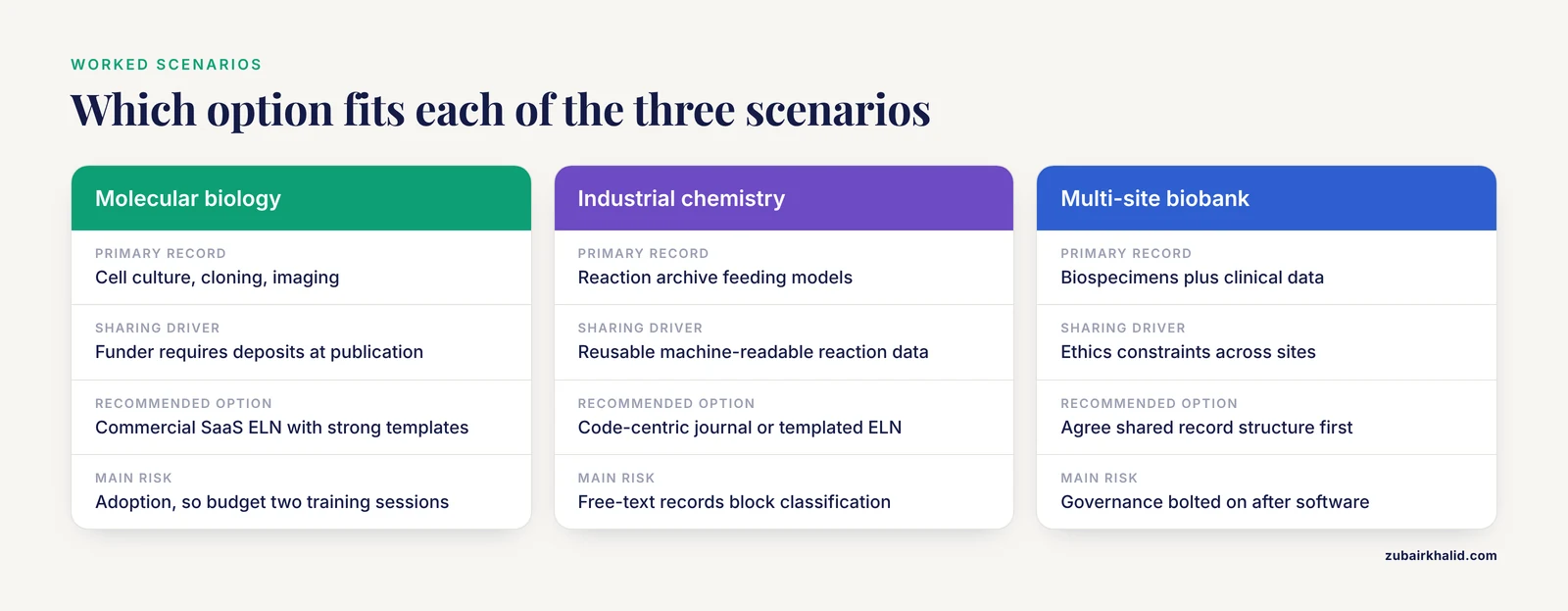
A ten-person academic lab runs cell culture, cloning, and imaging. Its data sharing obligations come from a funder that requires deposited datasets at publication. The best electronic lab notebook comparison outcome here is usually a commercial SaaS ELN with strong templates, chosen after an export test, paired with the institution's repository guidance for final deposits. The ELN captures experiment structure so that, at publication, assembling a deposit is a curation task rather than an archaeology project. The lab budgets two training sessions and accepts a two-month parallel period with paper.
Scenario 2: An Industrial Chemistry Group That Wants Reusable Data
A medicinal chemistry organization wants its reaction archive to feed machine learning models rather than sit as unread text. This is the scenario the reaction classification study illuminates. The team drew a reaction dataset from its industrial ELN, built a 336-class data-driven classification model inside a Conformal Prediction framework that attaches confidence estimates to predictions, and showed that filtering out fewer than 15 percent of uncertain classifications left 95 percent of the remaining predictions correct [1]. Their buying criteria therefore weight machine-readable structure, reaction schema, and export fidelity above document formatting and mobility. A code-centric journal or a heavily templated commercial ELN both fit. A free-text-first product does not, regardless of its other virtues.
Scenario 3: A Multi-Site Biobank or Consortium
A network of institutions collects biospecimens and clinical data and must share across sites while respecting ethics constraints. Two lessons from the literature apply directly. From C-BIG, the lesson is that governance, ethics, computational resourcing, and training must be designed as a system, not bolted on after software selection [2]. From the EAZA Biobank, the lesson is that a decentralized physical network can stay coherent when all sites write to a shared data platform with consistent specimen records [3]. The buying decision here is less about a single ELN and more about agreeing on the shared record structure first, then choosing ELN tools at each site that can write records in that structure.
Common Mistakes and Limitations
Choosing on feature count instead of exit quality. A longer feature list is worthless if the export flattens your data into unreadable documents. Run the export test on real data before every signature.
Treating the ELN as the final sharing destination. Collaborators outside your access control cannot browse your ELN. Plan the repository layer, and the curation effort it requires, from the start.
Ignoring domain data standards. If your field has an NWB-style standard, storing data in a proprietary format creates a permanent conversion tax. The NWB case shows how a standard plus a database layer turns the lab record into shared infrastructure [5].
Assuming adoption will happen by mandate. The survey evidence on digital tool engagement shows that awareness and active use are different things, and that users report concrete challenges even with motivated populations [6]. Assign ownership, schedule training, and audit usage in the first quarter.
Underestimating governance. Data sharing is a legal and ethical process, not a file transfer. Institutions that succeeded, such as The Neuro with C-BIG, built ethics and governance structures alongside the technical platform [2].
Pushing preliminary data into fast channels. Social platforms and preprints accelerate visibility, and the same analysis that documents their benefits documents the risks of premature dissemination and misinformation [4]. Match the channel to the maturity of the data.
Expecting one tool to do everything. A fair limitation statement: no ELN replaces a repository, no repository replaces a notebook, and no comparison table substitutes for a hands-on trial with your own experiments. Individual labs and projects vary, so the final call needs your own data, your own collaborators, and your institution's compliance requirements in the room.
Frequently Asked Questions
What is the difference between an ELN and a data repository?
An ELN records experiments as you do them, with restricted access for your lab and collaborators. A data repository stores finished, curated datasets publicly or institutionally, with persistent identifiers so others can find and cite them. You need both, in that order.
Which ELN features matter most for research data sharing?
Structured templates, reliable full-fidelity export, support for your field's data standards, and fine-grained access control. Search and inventory features matter for daily work, but the four listed features determine whether data can leave the system intact.
Are open-source ELNs a good choice for a small lab?
They are a good choice if someone in the lab or the institution can own hosting, backups, and updates. Without that person, the operational burden outweighs the licensing savings, and a hosted commercial product is usually the safer path.
Do I need a data standard like NWB to share data?
You need your data to be readable outside your lab, and an accepted domain standard is the most reliable way to achieve that. If your field has one, prefer ELN workflows that store or export to it natively. If it does not, use the repository's recommended formats and metadata schema.
How do I move my data out of an ELN when a contract ends?
Run the export before you commit, and periodically thereafter. Request a complete export of a representative experiment set, verify that structure, attachments, and metadata survive, and confirm the export terms in the contract. This test should happen during the trial, not during the departure.
Should ELN data go straight to social media or preprints?
No. Social platforms and preprint servers are dissemination channels for mature outputs, not systems of record, and rapid sharing carries documented risks of premature release and misinformation. Curate the dataset, deposit it properly, and then use those channels to point people at the deposit.
Sources
- Development and Application of a Data-Driven Reaction Classification Model: Comparison of an Electronic Lab Notebook and Medicinal Chemistry Literature.
- The C-BIG Repository: an Institution-Level Open Science Platform.
- Integrating Biobanking Into Conservation Practice: The Development and Impact of the EAZA Biobank.
- Beyond Traditional Publishing: Social Media as a Catalyst for Biomedical Research Dissemination and Collaboration.
- Core principles for the implementation of the neurodata without borders data standard.
- Dataset of the adoption of digital tools for research sharing among academics in African Varsities during the COVID-19 pandemic in 2020.