Dynamic Consent in Biobanking
By Dr. Zubair Khalid, DVM, MS, PhD ·

By the end of this article you will be able to explain what dynamic consent is, argue its ethical strengths and weaknesses with specific references, design a consent data model for your own biobank, wire consent checks into a sample release workflow, and plan an evaluation of the system you build. To follow the walkthrough you need a biobank or study with ethics approval in progress, a web developer or an existing consent platform, and a sample management system whose records you can read programmatically.
Biobanks store human biospecimens and the data attached to them for future research. That future is exactly where consent breaks down. A donor signs a form on day one, and years later a researcher proposes a use the donor never imagined. Dynamic consent is the leading proposal for closing that gap.
What Dynamic Consent in Biobanking Actually Means
Dynamic consent is an approach that lets people, through an interactive digital interface, make granular decisions about their ongoing participation in research [1]. Instead of one signature on one paper form, the participant holds a living consent record. The record can be reviewed, updated, and expanded as the research relationship continues.
The model was developed for fields where ongoing contact with participants is unavoidable, especially biobanking and genomics [1]. Its proponents make two practical claims. First, dynamic consent can enhance decisional autonomy by giving participants real choices rather than a single yes. Second, it can improve communication between researchers and participants, which supports recruitment, retention, and consent management over the life of a collection [2].
A concrete example shows the difference. In a longitudinal biobanking study such as SCANDARE, tumor tissue and blood are collected from cancer patients at diagnosis, after neoadjuvant chemotherapy, at surgery, at recurrence, and at progression after treatment [3]. Each time point creates new material and new possible uses. Under static consent, all of those uses rest on whatever the participant signed at enrollment. Under dynamic consent, the participant can revisit decisions as the study evolves, for example when sequencing data become available or when a new substudy opens.
Why Traditional Consent Models Strain Under Biobanking
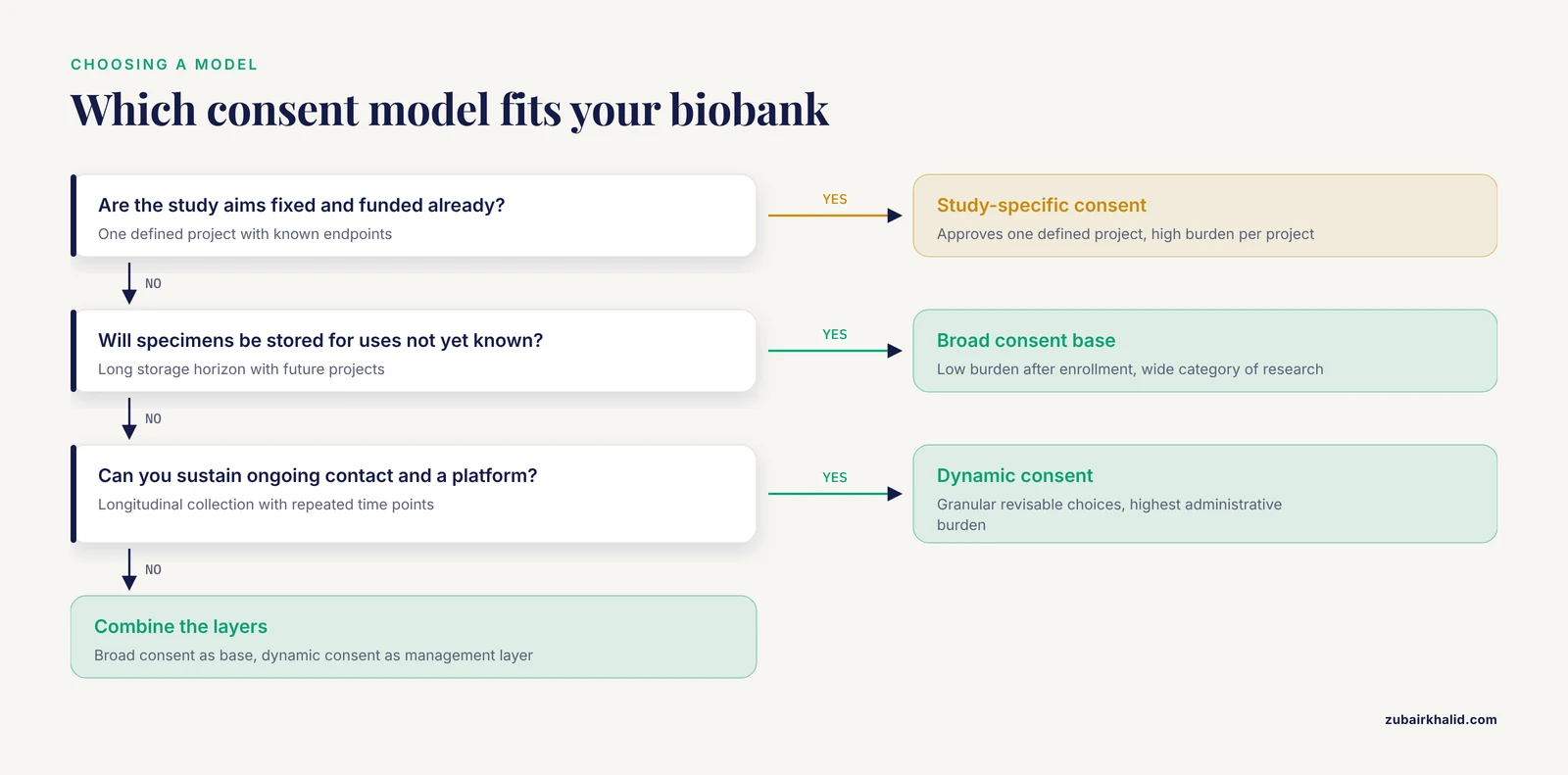
The principle of informed consent came under pressure as biobanks and large data infrastructures grew. Study-specific consent, in which a participant approves one defined project, becomes unfeasible when specimens sit in a bank waiting for projects that do not yet exist [4]. Most biobanks therefore use broad consent, in which the donor approves a wide category of future research at the outset.
Broad consent makes research possible, but ethicists have criticized it as insufficient to secure a truly informed decision [4]. The donor does not know what they are agreeing to, because nobody knows yet. Pathology-based biobanks face this directly, since their core work involves secondary use of biospecimens collected for diagnosis, alongside confidentiality protection and systematic information technology systems that must track what each donor actually approved [5].
Dynamic consent sits between these poles. It keeps the breadth of broad consent but adds mechanisms for the donor to see, question, and modify the terms. Whether that mechanism actually delivers the ethical goods is contested, which brings us to the research ethics debate.
The Ethics Debate: Autonomy, Control, and Honest Claims
The strongest ethical argument for dynamic consent runs through autonomy. If donors can make fine-grained, revisable choices, they control what happens to their bodies and data, and autonomy is respected. A 2026 analysis in the Journal of Medical Ethics tested this argument in two versions, an information-focused version and a control-focused version, and found that both fail to establish the moral superiority of dynamic consent over broad consent [4].
The critique has two parts worth internalizing before you build anything. First, autonomous choices are a specific kind of choice, shaped by understanding and by the absence of distortion, not merely by the number of toggle switches an interface offers. More options do not automatically mean more meaningful control [4]. Second, even if a dynamic interface lets a participant express a preference, it does not follow that acting on every expression of preference is ethically justifiable. Some choices, such as consent to research that a review board would never approve, cannot be honored no matter how the interface records them [4].
This does not make dynamic consent pointless. It relocates the justification. Dynamic consent earns its place as a practical tool for communication, transparency, and consent management, not as a moral trump card over broad consent [4][2]. Teams that pitch dynamic consent to ethics committees as ethically mandatory tend to overpromise. Teams that pitch it as a better consent management system with real autonomy benefits, honestly stated, tend to keep those promises.
Dynamic Consent Biobanking Implementation Step by Step
The walkthrough below assumes a hospital-based biobank collecting tumor tissue and blood for cancer research, modeled on the structure of real longitudinal studies [3]. Adapt the details to your institution.
Step 1: Map Your Consent Questions Before You Write Any Code
Dynamic consent fails when teams digitize a bad consent form. Start with the decisions a participant can meaningfully make. Typical axes for a biobank are:
- Sample types. Fresh frozen tissue, formalin-fixed paraffin-embedded tissue, serum, plasma, buffy coat, urine.
- Data types. Clinical data, genomic data, imaging, generated multi-omics data.
- Use categories. Controlled academic access, public deposition of summary results, commercial use, return of incidental findings.
- Recontact. Invitations to new studies, notification of results, consent renewals.
Workshop evidence from clinicians, ethicists, lawyers, and patient representatives identifies recruitment, informed consent attainment, retention, and consent management as the tasks dynamic consent serves best [2]. Your question map should cover all four. Ask your patient advisory panel which of these axes they actually want to control. Granularity that participants do not want is administrative burden dressed up as empowerment.
Step 2: Design the Consent Record as Structured, Versioned Data
The consent record is the core artifact. Treat it like a database schema, not a PDF. A minimal workable structure looks like this:
{
  "participant_id": "SC-2026-00417",
  "consent_version": "2.1",
  "recorded_at": "2026-03-14T09:30:00Z",
  "decisions": {
    "sample_types": {
      "tumor_tissue_fresh_frozen": "granted",
      "tumor_tissue_ffpe": "granted",
      "blood_serum": "granted",
      "blood_buffy_coat": "granted"
    },
    "data_sharing": {
      "controlled_access_research": "granted",
      "public_release_of_summary_results": "granted",
      "commercial_use": "denied"
    },
    "recontact": {
      "new_study_invitations": "granted",
      "return_of_incidental_findings": "granted"
    }
  },
  "signature": {
    "method": "digital_signature",
    "record_hash": "sha256:b3f19c..."
  }
}
Every field matters. The consent version number lets the system detect when the underlying consent document has changed and the participant must review the new terms. The recorded timestamp establishes which decision was in force when a sample was released. The record hash supports later audit. Participants must be able to change any granted decision to denied, and denied to granted, through the interface at any time, because that revisability is what makes the consent dynamic [1].
Step 3: Build the Interface Around Ongoing Communication
The interface is a two-way channel, not a settings page. At minimum it should let participants review their current choices in plain language, change a choice, see what has been done with their specimens, and receive messages from the research team. The communication function matters as much as the control function, because ongoing contact between researchers and participants is a documented benefit of the approach [2].
The platform does not need exotic technology. A web application backed by a relational database satisfies the definition. More ambitious architectures exist. A framework piloted for low-dose CT lung cancer screening in Taoyuan, Taiwan registers consent records as hashes on a blockchain, stores de-identified imaging and biobank data on infrastructure compliant with ISO 27001, and targets about 15,000 enrolled participants [6]. Blockchain registration strengthens traceability of who agreed to what and when, but it is an optional hardening layer, not a prerequisite.
Step 4: Wire Consent Checks Into the Sample Release Workflow
The consent record only matters if the release pipeline enforces it. Insert a check function between every request for specimens or data and the physical or digital release:
def evaluate_release(consent_record, request):
    if consent_record["consent_version"] != CURRENT_CONSENT_VERSION:
        return "RECONSENT_REQUIRED", (
            "participant must review consent version "
            + CURRENT_CONSENT_VERSION
        )
    material = request["material"]   # e.g. "tumor_tissue_fresh_frozen"
    scope = request["scope"]         # e.g. "controlled_access_research"
    if consent_record["decisions"]["sample_types"].get(material) != "granted":
        return "CONSENT_SCOPE_MISMATCH", material + " not covered by active consent"
    if consent_record["decisions"]["data_sharing"].get(scope) == "denied":
        return "CONSENT_DENIED", scope + " excluded by participant"
    return "RELEASE_APPROVED", "log request and consent hash to audit trail"
Running the function against the record from Step 2 produces this expected output:
>>> evaluate_release(record, {"material": "tumor_tisease_ffpe",
...                           "scope": "controlled_access_research"})
('RELEASE_APPROVED', 'log request and consent hash to audit trail')

>>> evaluate_release(record, {"material": "tumor_tissue_fresh_frozen",
...                           "scope": "commercial_use"})
('CONSENT_DENIED', 'commercial_use excluded by participant')
The parameters you must get right are the material key, which must match the biobank's specimen vocabulary exactly, and the scope key, which must match the use categories in the consent document. A mismatch between the vocabulary used by the freezer inventory and the vocabulary used by the consent interface is the single most common silent failure in real deployments.
Step 5: Anchor Consent Records for Auditability
For each consent decision, compute a digest of the canonical record and append it to an append-only log:
digest = sha256(canonical_json(consent_record)).hexdigest()
anchor = audit_log.append({"digest": digest, "recorded_at": consent_record["recorded_at"]})
print(anchor["entry_id"], digest[:16])
# expected output: 48112 b3f19c02e7a4d815
The hash approach means that any later dispute about what a participant approved can be resolved by recomputing the digest and comparing it to the anchored value. This is the traceability property that the Taoyuan framework builds its governance model around [6]. A plain append-only database table achieves the same property without blockchain if your institution does not need distributed verification.
Step 6: Pilot Small, Then Scale Geographically
Every successful deployment in the literature followed a staged rollout. SCANDARE began in 2017 as a monocentric study at Institut Curie and became multicentric only after the single-center operation worked, eventually enrolling 676 patients across repeated collection time points [3]. The Taoyuan dynamic consent platform is being piloted within one regional screening program before any wider expansion [6]. A US academic medical center piloted a decentralized biobanking application for a large breast cancer biobank over a ten-week enrollment window and reached 1,080 participants, roughly 10 percent of the existing biobank with about 4,000 linked biospecimens, before evaluating the results [7].
Run your pilot at one site, with one tumor type or one screening population, for long enough to see a full consent review cycle, then extend.
Step 7: Evaluate Against a Published Framework Before You Claim Success
There is currently a lack of evidence about the measurable effects of dynamic consent tools, and an evaluation and reporting framework exists precisely to fix that [1]. The framework is built on a logic model derived from the evidence for enhanced modes of informed consent. In practice this means you should define, before launch, which outcomes you will measure, such as comprehension scores, preference change rates, withdrawal rates, and recruitment numbers, and you should report them in enough detail that other teams can replicate the evaluation [1]. Teams that skip this step produce case studies that cannot be compared with anyone else's, which is how the field stays short on evidence.
Comparison of Consent Models for Biobanks
| Model | Participant control | Administrative burden | Best fit |
|---|---|---|---|
| , - | , - | , - | , - |
| Study-specific consent | Approves one defined project | High per project, low per donor | Single funded studies with fixed aims |
| Broad consent | Approves a wide category of future research once | Low after enrollment | Large biobanks with long storage horizons [5] |
| Dynamic consent | Granular, revisable choices through a digital interface | Highest, requires platform and support | Longitudinal collections with ongoing contact [1][2] |
| Dynamic consent plus decentralized tracking | Adds specimen-level visibility and feedback to donors | Highest, plus app maintenance | Biobanks prioritizing donor engagement [7] |
Implementation Tips From Real Deployments
Keep the choice set bounded. Offer meaningful categories, not dozens of toggles. The ethics critique applies here directly, since a long list of options does not guarantee meaningful autonomous choice and may just exhaust participants [4].
Integrate collection into clinical routine. Longitudinal biobanking works when specimen collection is folded into the patient's existing journey, with samples taken at diagnosis, during treatment, at surgery, and at recurrence under one consent umbrella [3]. If consent friction at each time point is high, the collection collapses.
Manage stakeholder expectations early. In the decentralized biobanking pilot, physicians and institutional stakeholders surfaced challenges around managing expectations, balancing participant empowerment against clinical and research workflows, and navigating power dynamics among patients, physicians, scientists, and leadership [7]. Budget meetings for these conversations before launch, not after the first complaint.
Plan the feedback loop. Biobanks often lack standard mechanisms to keep donors connected to their biospecimens, which weakens trust and engagement [7]. A dynamic consent platform is the natural place to close that loop with research updates and result notifications.
Budget for persistence, not just launch. Information technology systems for biobanks must handle collection, systematic recording, backup, and protection of clinical information over years [5]. A consent platform that is not maintained becomes a stale record that is worse than paper, because it looks authoritative while silently drifting from participant intent.
Common Mistakes and Limitations
Mistake 1: Claiming ethical superiority over broad consent. The two autonomy arguments for dynamic consent, information-focused and control-focused, both fail to establish that dynamic consent is morally superior to broad consent [4]. Present dynamic consent as a tool with benefits and costs, and your ethics review will go smoother and more honestly.
Mistake 2: Deploying without an evaluation plan. The evidence base for measurable effects of dynamic consent is thin, and reporting studies without a replicable design keeps it that way [1]. Commit to measuring comprehension and preference stability from day one.
Mistake 3: Overgranular consent menus. Splitting consent into 40 micro-decisions produces decision fatigue and empty clicks. Aim for the axes participants actually care about, identified in Step 1.
Mistake 4: Vocabulary drift between systems. If the specimen system calls a sample "FFPE_block_T3" and the consent record says "tumor_tissue_ffpe", checks fail or, worse, silently pass. Fix this with a shared controlled vocabulary and automated concordance tests.
Mistake 5: Ignoring workflow burden on clinical staff. Consent collection and recontact requests land on nurses and coordinators. The SCANDARE experience shows that logistical integration of repeated collection into routine clinical practice is a real challenge that must be engineered for, not assumed away [3].
Mistake 6: Treating the pilot as proof of generalizability. A 65 percent enrollment increase observed during a ten-week app pilot at one breast cancer biobank, with no withdrawals during or within one year after the pilot [7], is an encouraging signal from a motivated early population. It is not a prediction for every institution.
Limitation. Consent architecture is only one part of responsible conduct of research. Specimen quality control, freezer infrastructure, aliquoting across storage units, and sustainable financing remain separate engineering problems that consent software does not solve [5].
How to Verify Your Implementation Is Working
Run these checks on a schedule, for example quarterly:
- Concordance audit. Sample 50 released specimens, pull the consent record that authorized each release, and confirm the evaluate_release output was RELEASE_APPROVED at the time of release.
- Preference stability check. Report the percentage of participants who changed a decision in the period. Sudden spikes can indicate interface confusion rather than genuine preference change.
- Reconsent completion. After a consent version change, track the fraction of active participants who reviewed the new terms within the window your ethics approval specifies.
- Comprehension testing. Use a short validated questionnaire at enrollment and at first reconsent, and report results against your preregistered logic model as the evaluation framework recommends [1].
- Withdrawal tracking. Log withdrawals separately from preference changes, since they signal different problems.
Next Steps
If you are building this for a course project, reproduce the Step 4 function against a mock consent record and write three unit tests covering the granted, denied, and version-mismatch paths. If you are building it for a real biobank, take the question map from Step 1 to your ethics committee and your patient advisory panel in the same month, then start with the smallest pilot that produces evaluable data. If you are writing a thesis or review on consent in genomics and biobanking, the evaluation framework gives you a template for structuring your own study design and reporting [1], and the critique literature gives you the counterarguments you will need to address [4].
Frequently Asked Questions
What is dynamic consent in biobanking?
Dynamic consent is an approach that lets research participants make granular decisions about their ongoing participation through an interactive digital interface, rather than signing a single static form [1]. In a biobank, this means participants can review and change what their stored biospecimens and data may be used for over time.
How does dynamic consent differ from broad consent?
Broad consent covers a wide category of future research in one decision at enrollment, while dynamic consent breaks that decision into revisable parts managed through an ongoing digital channel [4]. They are often combined, with broad consent as the base layer and dynamic consent as the management and communication layer on top.
Is dynamic consent legally required for biobanks?
Whether to adopt dynamic consent is an institutional ethics and operations decision, not a compliance checkbox.
What technology do I need to implement dynamic consent?
A web application with a structured, versioned consent database, an interface for participants to review and change decisions, and a consent check wired into your sample and data release workflow is the minimum viable system [2]. Blockchain hash registration is an optional auditability layer used in some larger pilots [6].
Does dynamic consent improve participant retention?
Proponents argue it can support retention through ongoing communication, and workshop evidence identifies retention and consent management among the tasks dynamic consent serves best [2]. Controlled comparative evidence on measurable effects is still limited, which is why evaluation against a published framework matters [1].
Can dynamic consent work for longitudinal biobanking studies?
Yes, and longitudinal cancer collections are a natural fit because specimens arrive at multiple time points such as diagnosis, surgery, recurrence, and progression [3]. The dynamic model matches the reality that the research relationship, and the material, keep changing after enrollment.
What are the most common implementation mistakes?
The most common mistakes are claiming ethical superiority over broad consent without argument, skipping evaluation, building overgranular consent menus, letting specimen vocabulary drift from consent vocabulary, and underestimating the workflow burden on clinical staff [4][3]. Each has a concrete fix described in the body of this article.
Did any real biobank see engagement gains from digital consent and tracking tools?
A US academic medical center's decentralized biobanking app pilot enrolled 1,080 participants in ten weeks, increased biobank enrollment 65 percent versus the prior year, and recorded no withdrawals during or within one year after the pilot [7]. These are single-site pilot results, so treat them as encouraging rather than predictive.
Sources
- Dynamic Consent: An Evaluation and Reporting Framework.
- Dynamic Consent: a potential solution to some of the challenges of modern biomedical research.
- SCANDARE: an institutional dynamic prospective interventional biobanking study.
- Dynamic consent: a royal road to research consent?
- Pathology and Biobanking.
- Dynamic consent framework for low-dose CT scan lung cancer screening: autonomy, privacy, ethical data management.
- Decentralized Biobanking to Empower Patient Engagement in Biospecimen Research: Operational Feasibility Case Study.