The 5-Pass Dissertation Editing System
By Dr. Zubair Khalid, DVM, MS, PhD ·
By the end of this article you will be able to take a complete dissertation draft and move it through five deliberate editing passes, each with a single job, a fixed unit of attention, and a concrete way to verify that the pass worked. You will also have a realistic editing schedule, a checklist you can reuse, and a list of the mistakes that most often stall writers at this stage.
Here is what you need on hand before you start:
- A complete or nearly complete draft, in one file or one folder you can search
- A word processor or plain-text editor with find and replace
- A backup location that is not your laptop, such as a university drive or an external disk
- Your department's formatting guide and your citation style guide, in print or bookmarked
- A calendar with the date your committee needs the document
The core idea behind the 5-pass dissertation editing system is simple. You cannot fix argument, sentence rhythm, citation accuracy, formatting, and typos at the same time, because each of those jobs uses a different kind of attention. When you try to do them together, your brain defaults to the easiest job, which is usually typo hunting, and the harder problems survive every read. Splitting the work into passes solves this. Each pass reads the whole document once, hunts for one class of problem only, and leaves the rest for later.
Why One Editing Pass Never Works
Reading a 200-page document and "fixing everything" fails for a predictable reason. Your working memory can hold a limited number of concerns at once. On read one, you genuinely notice a clunky sentence and a missing citation on the same page, but by page 40 you are skimming, and skimming catches almost nothing.
There is a useful parallel in how scholars think about editing in other fields. When researchers trace how an ancient anthology such as the Hebrew Psalter took its present shape, they do not assume one editor did everything at once. They identify distinct editorial layers, each with its own concerns, and study them separately, as Gerald Wilson did in a study published in the Society of Biblical Literature Dissertation Series [1]. The layered approach is not a productivity gimmick. It is how careful editorial analysis handles a document too complex to evaluate in one sweep.
The same principle shows up in modern research practice. Large literature-screening projects routinely split a review into independent passes and then check how well the passes agree, because a single pass reliably misses items [2]. And in work on how reasoning models learn to solve problems, researchers found that the most common failures are exactly the failures unguided revision produces. The traces started without a plan, verified only superficially, and took unchecked shortcuts [3]. Writers under deadline pressure do the same things. The pass system is designed to prevent each of them.
The System at a Glance
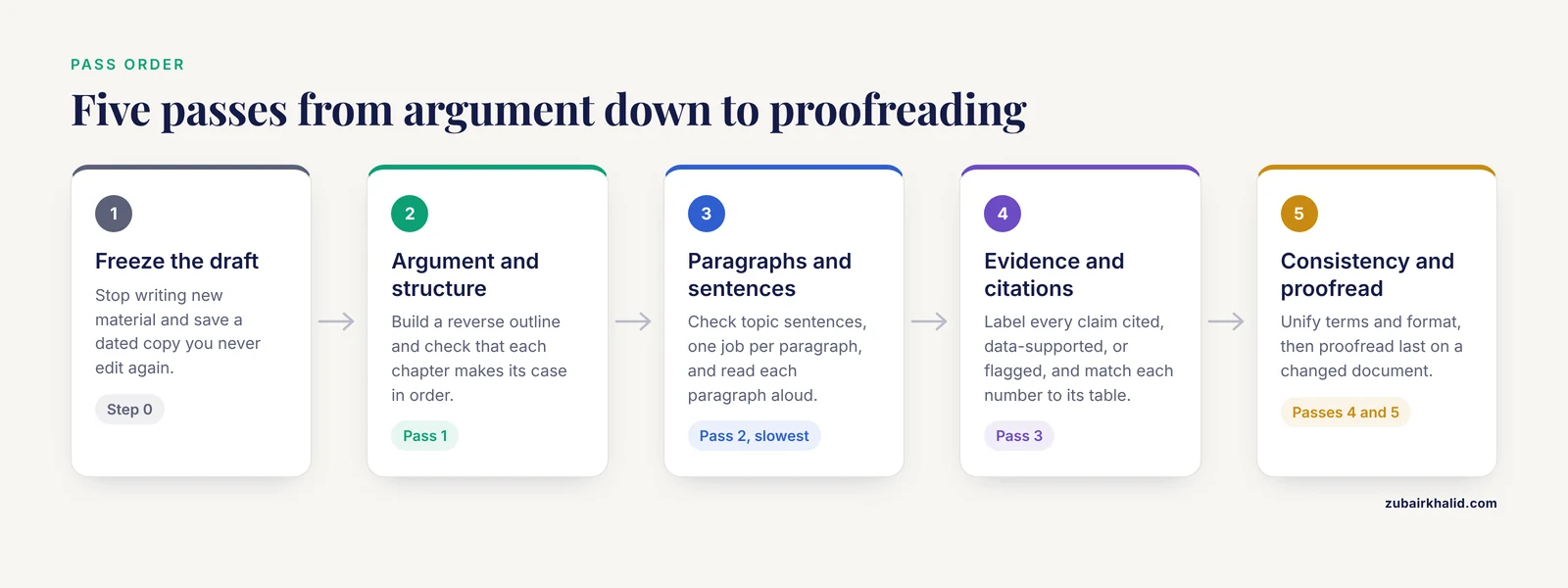
| Pass | Core question | Unit of attention | Typical tools | What you ignore on purpose |
|---|---|---|---|---|
| , - | , - | , - | , - | , - |
| 1 | Does the argument work? | Chapters, sections, paragraphs | Outline view, printed draft | Grammar, typos, citation style |
| 2 | Is every sentence clear? | Paragraphs, sentences | Read-aloud, sentence-by-sentence mode | Whether sources are complete |
| 3 | Is every claim supported? | Claims, numbers, citations | Find and search, reference manager | Style and word choice |
| 4 | Is the document consistent? | Terms, headings, figures, format | Find and replace, style guide | Sentence quality |
| 5 | Is the text clean? | Words, punctuation, spacing | Spell check, printed page | Everything else |
The order matters. You run the largest-scale pass first because there is no point polishing sentences inside a section you may delete. You run proofreading last because any earlier pass can introduce new typos.
Step 0: Freeze the Draft and Plan the Edit
Before the first pass, stop writing new material. Editing while drafting is the single most reliable way to never finish, because every new paragraph drags in three new sources and a new sub-argument. Freeze the draft.
Worked example: freezing and backing up. If you write in plain text or LaTeX, put the frozen draft under version control so every pass is recoverable.
cd dissertation/
git init
git add chapters/
git commit -m "Pre-edit freeze, complete draft"
Expected output:
[main (root-commit) a1b2c3d] Pre-edit freeze, complete draft
 12 files changed, 84,219 insertions(+)
If you work in Word or Google Docs, the equivalent is a dated duplicate. Save a copy named draft_FROZEN_2026-11-11.docx and never edit that file again. Every pass works on a fresh copy named for the pass, such as draft_pass1.docx. If a pass goes badly, you delete the file and start the pass over, and nothing is lost.
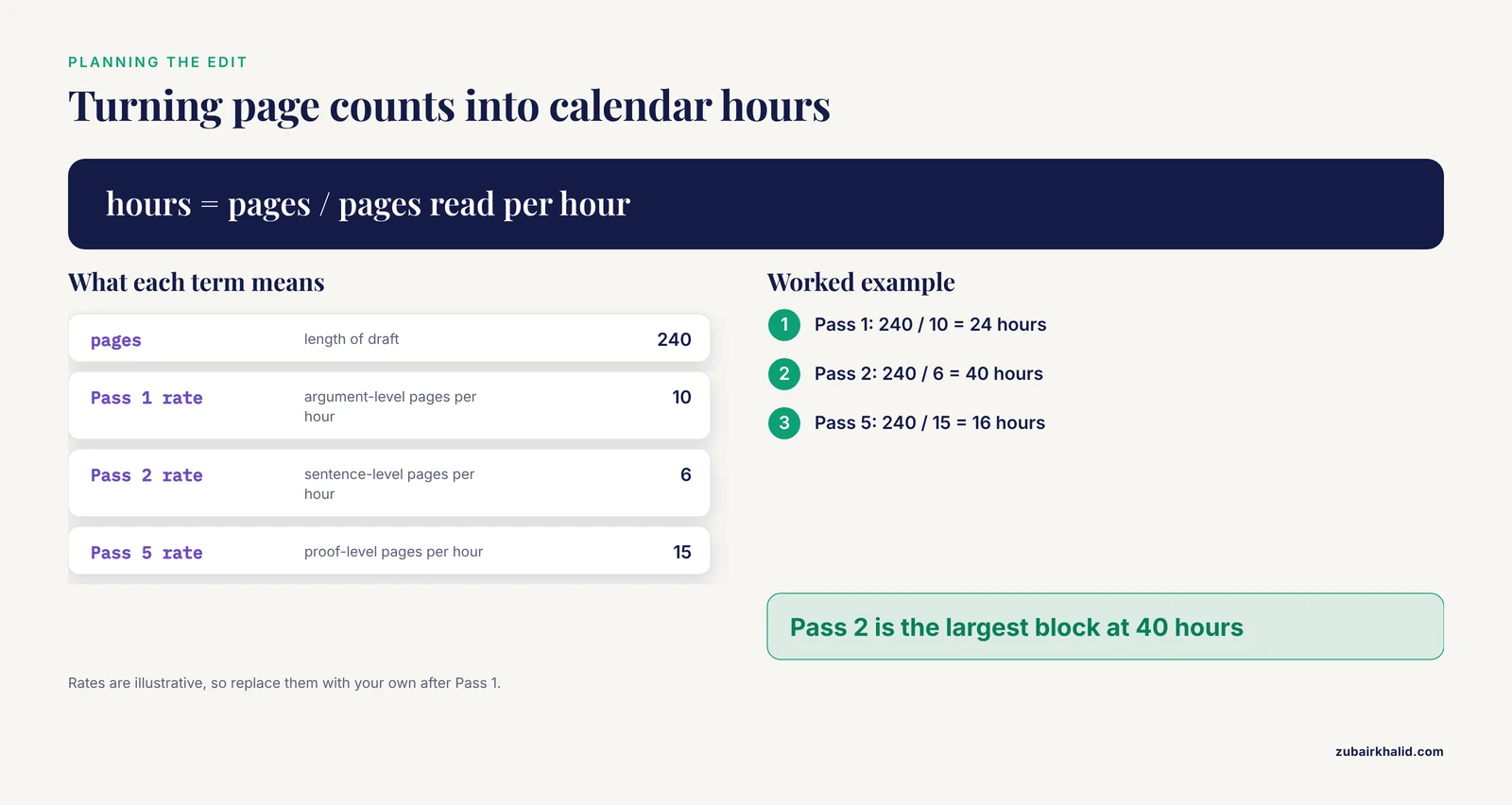
Plan the edit on your calendar. Dissertation planning at the editing stage means converting the five passes into dated blocks. Do the arithmetic for your own document:
Length of draft:        240 pages
Pages I can read
  carefully per hour
  at argument level:    about 10 pages (Pass 1)
  at sentence level:    about 6 pages  (Pass 2)
  at proof level:       about 15 pages (Pass 5)

Pass 1: 240 / 10 = 24 hours
Pass 2: 240 / 6  = 40 hours
Pass 5: 240 / 15 = 16 hours
Those rates are illustrative arithmetic, not measured averages, so replace them with your own after Pass 1. The planning lesson is the shape of the numbers, not the exact values. Sentence-level work is the slowest pass for nearly everyone, and it deserves the largest calendar blocks. A writer who schedules one hour a day needs a full semester. A writer with six weeks free needs roughly 2 hours a day. Put the blocks on the calendar now, including buffer days, because at least one pass always runs long.
Pass 1: Argument and Structure
The single question of this pass: does the dissertation make its case, in this order, to a reader who knows less than you do?
Read Pass 1 on paper or in outline view, at chapter and section level. Do not fix commas. Do not even fix grammar. If you notice a typo, circle it and move on.
Work like this:
- Build a reverse outline. For every chapter, write one sentence stating what the chapter argues. For every section inside it, one sentence stating what the section contributes to that chapter's argument. If you cannot write the sentence, the section does not yet have a job.
- Read only your sentences in sequence. This is the skeleton of the dissertation. Check that each chapter's conclusion follows from what came before, and that nothing essential is asserted for the first time in the discussion chapter.
- Mark three kinds of problems with distinct symbols: structural moves (a section that belongs elsewhere), gaps (a claim with no supporting section), and redundancy (two sections doing the same job).
For LaTeX users, a quick way to extract the existing outline is to search for heading commands:
grep -n "chapter{\|section{\|subsection{" dissertation.texExpected output:
214:\chapter{Methods}
387:\section{Sampling Design}
421:\section{Instrument Validation}
460:\section{Analytic Strategy}
Scan that list for order problems you can feel before you reread anything. If "Analytic Strategy" appears before "Instrument Validation," ask whether the reader can follow the analysis without knowing the instrument was validated.
Exit criteria for Pass 1. You are done when the reverse outline reads as a coherent argument on its own, with no section marked as belonging elsewhere and no gap left unmarked. Structural fixes at this stage can be large. That is the point. Moving a section in Pass 1 costs an afternoon. Discovering the same problem after formatting costs a week.
Pass 2: Paragraphs and Sentences
The single question of this pass: can a tired reader understand every paragraph on first reading?
This is the slowest pass. Work one paragraph at a time, and for each one check three things in order:
- Topic sentence. Does the first sentence state what the paragraph claims? If the claim only appears in the last sentence, move it up.
- One job per paragraph. If the paragraph argues two things, split it.
- Sentence length and rhythm. Read the paragraph aloud. Any sentence you have to breathe twice for is a candidate to split. Three sentences of nearly identical length in a row is a candidate to vary.
Practical dissertation editing passes tips for this stage:
- Read aloud, or use your word processor's read-aloud feature. Your ear catches what your eye forgives.
- Prefer the active voice where the actor matters. "We measured turbidity weekly" beats "Turbidity was measured weekly" because the reader learns who did the work.
- Replace abstract nouns with concrete verbs where you can. "The utilization of the methodology" becomes "we used the method."
- Do not aim for elegance on every line. Aim for zero confusion on every line. Academic prose earns its plainness.
Keep a scratch file of sentences you are unsure about rather than polishing each one to exhaustion. Fix them in bulk at the end of the pass, when you have seen the whole document's voice and can judge consistency.
Exit criteria for Pass 2. Every paragraph has an identifiable topic sentence, and a read-aloud of any three consecutive pages produces no sentence you stumble over twice.
Pass 3: Evidence, Numbers, and Citations
The single question of this pass: is every factual claim either cited, supported by your own data, or clearly marked as your interpretation?
This pass is a hunt, not a read. Move through the document claim by claim. For each one, assign it one of three labels: cited, data-supported, or flagged. A claim left unlabeled at the end of the pass is a problem, because it means you read it without asking the question.
Specific checks that earn their time:
- Every number appears twice. A statistic should appear in the text and in a table, figure, or source. Verify the two match. Find and search each unique number.
- Every citation points to a real reference. Spot-check in-text citations against your reference list. Reference managers such as Zotero or Mendeley can generate the bibliography, but they cannot notice that the in-text citation says 2019 while the paper was published in 2020.
- Every figure and table is called out. Search for "Figure" and "Table" and confirm each is referenced in the text near where it appears.
- Quotations match their sources. If you quote, compare the quotation to the source text during this pass, not later.
A fast find for hedging language that may hide unsupported claims:
grep -n "clearly\|obviously\|it is known that\|undoubtedly" chapters/*.texExpected output:
512:    It is known that enzyme activity declines with storage.
873:    This result obviously generalizes to all field sites.
Each hit is a claim leaning on the reader's trust instead of on evidence. Either attach a citation, attach your data, or soften the claim to match what you can actually support. "Clearly" and "obviously" are flags precisely because careful writers use them where proof is thin.
Exit criteria for Pass 3. Zero unlabeled claims remain, every number matches its table or figure, and every in-text citation resolves to an entry in the reference list.
Pass 4: Consistency and Format
The single question of this pass: does the document follow one set of conventions from first page to last?
Dissertations accumulate inconsistency the way long projects always do. Chapter 2 calls the measure the "Response Scale" while Chapter 4 calls it the "questionnaire." You spelled "data set" in one chapter and "dataset" in another. Pass 4 hunts these down mechanically.
Work through this list with find and replace:
- Key terms. List the five to ten technical terms central to your dissertation. Search each one and confirm every occurrence uses the same form.
- Hyphenation and compounds. Pick one form for contested compounds such as "co-author" or "re-analysis" and apply it everywhere.
- Numbers and units. Decide once whether numbers below ten are spelled out, whether units follow your style guide, and apply the rule uniformly.
- Heading levels and capitalization. Check that "Methods" in Chapter 3 is capitalized the same way as "Results" in Chapter 4, and that heading levels match your department's guide.
- Figure and table formatting. Captions, numbering, and placement follow one pattern.
- Front matter. Title page, abstract, acknowledgments, table of contents, and lists of figures and tables match your institution's current requirements. Requirements change, so check the guide your department distributes now, not the one a colleague used three years ago.
Exit criteria for Pass 4. A find for each key term returns only the approved form, headings follow one pattern throughout, and front matter matches the current institutional guide.
Pass 5: The Clean Proofread
The single question of this pass: is the text free of errors a machine and a fresh eye can catch?
Proofread last, after all other passes, and proofread a document you have changed since Pass 4, because your own edits introduced the newest errors. Effective methods, in combination:
- Change the font or read on paper. Novel presentation defeats the blindness that comes from familiarity.
- Read backward, sentence by sentence, for the typo pass. Reading sentences out of order strips away meaning, which is exactly what you want when hunting spelling and punctuation.
- Run the spelling checker, but treat every flag as a question rather than a verdict. Spell checkers pass real words that are wrong words, such as "trail" for "trial."
- Search for doubled words mechanically:
grep -nE '\b([A-Za-z]+)[[:space:]]+\1\b' chapters/*.texExpected output:
231:  the the samples were incubated overnight.
1044: analysis analysis of variance was used
Every line the search returns is a real typo to fix. The same approach finds doubled spaces if your style guide cares about them.
Exit criteria for Pass 5. One complete proofread with zero new corrections marked on the final ten pages you check, which is a practical sign you have reached the floor.
A Worked Editing Schedule
Here is the whole system compressed into a calendar for a 240-page draft with a 10-week deadline, using the illustrative rates from Step 0. Adjust to your own page count and reading speeds.
| Week | Activity | Output |
|---|---|---|
| , - | , - | , - |
| 1 | Freeze draft, back up, build reverse outline | Outline document, dated frozen copy |
| 2 to 3 | Pass 1, argument and structure | Restructured draft, problem list resolved |
| 4 to 6 | Pass 2, paragraphs and sentences | Read-aloud clean on sample pages |
| 7 | Pass 3, evidence and citations | Zero unlabeled claims, citations verified |
| 8 | Pass 4, consistency and format | Uniform terms, headings, front matter |
| 9 | Pass 5, proofread | Clean read, no new marks in final check |
| 10 | Buffer and advisor review | Final files to committee |
Two features of this schedule deserve attention. First, Pass 2 gets three weeks because sentence-level work is genuinely the slowest. Second, week 10 is buffer, not luxury. If every pass finishes early, the buffer becomes a second Pass 5, which is the highest-value extra read you can do.
How to Check That Each Pass Worked
Each pass has a built-in verification, and skipping the verification is how writers end up doing five passes and still shipping a broken draft.
- Pass 1: hand the reverse outline to a colleague in a different subfield. If they can summarize your argument back to you from the outline alone, the structure holds.
- Pass 2: read three random pages aloud. Record yourself once and listen. Stumbles mark the paragraphs to revisit.
- Pass 3: count flagged claims at the start of the pass and again at the end. The count must reach zero, not "mostly zero."
- Pass 4: run find on each key term. Every result should be the approved form.
- Pass 5: the final-ten-pages test. Zero new corrections on a fresh proofread of the last pages you checked.
If a pass fails its check, run the pass again on the failed region only. Do not restart the whole pass unless the failure is global.
Common Mistakes and Limitations
These are the dissertation editing passes common mistakes that cost writers the most time.
Editing while writing. The draft must be frozen. A draft that grows during editing never converges, and the finish line recedes with every new source.
Fixing the wrong layer. Polishing prose in a chapter that Pass 1 will reorganize is wasted work, and it is the most common wasted work in dissertation revision. Discipline yourself to leave lower-level issues alone on higher-level passes.
Combining passes to save time. Merging Pass 2 and Pass 3 looks efficient and is not. The two passes use different attention, and the combined version degrades into whichever pass you find easier, usually typo hunting. The pass separation is the method.
Trusting the spelling checker for citation accuracy. A checker verifies strings of characters. It cannot notice that you cited a 2019 finding as 2020, or that the source says the opposite of what you wrote. Pass 3 must be done by hand.
Proofreading before the last structural change. Any edit after Pass 5 can introduce errors, so proofread must be the final pass, and any late change should trigger a local re-proofread of the affected pages.
Scheduling passes as marathons. Attention for detailed editing fades measurably within a few hours. Two focused hours a day beats an eight-hour weekend session, because the eighth hour produces edits you will undo in Pass 5.
Skipping the buffer week. Nearly every dissertation has one pass that runs long, and it is usually Pass 2. A schedule with no buffer converts a slow pass into a missed defense date.
Treating editing as a substitute for advisor feedback. The passes make your draft as clean as you can make it alone. They do not replace committee review, and submitting without your advisor's read of the restructured draft risks large-scale revisions at the worst possible time. Individual programs and committees have their own expectations, so confirm timing and submission requirements with your advisor and your graduate office.
Frequently Asked Questions
How long does the 5-pass dissertation editing system take?
For most drafts, plan on six to ten weeks of steady daily work, with Pass 2 taking the largest share. The exact duration depends on your page count, your reading speed at each level, and how much structural change Pass 1 uncovers.
Can I combine two editing passes into one session to save time?
No. Each pass uses a different kind of attention, and combining them reliably degrades into whichever job is easiest, which is typo hunting. Keep the passes separate even when time is short.
Should I edit my dissertation as I write instead of afterward?
Light cleanup while drafting is fine, but full editing during drafting prevents completion, because every editing session generates new material. Finish a complete draft, freeze it, then edit.
What order should the editing passes go in?
Largest scale first. Argument and structure, then sentences, then evidence and citations, then consistency and format, then proofreading last. This order prevents wasted work on sections that later passes may change or delete.
Do editing passes replace feedback from my advisor or committee?
No. The passes produce the best draft you can create alone. Committee and advisor feedback addresses judgments only they can make, such as whether the argument satisfies field conventions, so route the restructured draft through them before final proofreading.
How do I stay motivated across more than 200 pages of editing?
Track progress in units you control, such as pages completed per pass rather than days remaining, and log each finished pass as a dated version. Visible accumulation of finished passes is the most reliable motivation at this stage.
What tools help with dissertation editing passes?
A word processor with find and replace and an outline view, a reference manager for the citation pass, version control or dated file copies for safety, and a text-to-speech or read-aloud feature for the sentence pass. Simple text searches catch mechanical errors such as doubled words faster than any human read.
What is the difference between editing and proofreading?
Editing changes what the text says and how it says it, from argument down to sentence construction, which covers Passes 1 through 4. Proofreading catches surface errors such as typos, doubled words, and punctuation, and it belongs in the final pass only, because earlier passes keep producing new text to check.
Further Reading
- HulluEdit: Single-Pass Evidence-Consistent Subspace Editing for Mitigating Hallucinations in Large Vision-Language Models
- CLaRE-ty Amid Chaos: Quantifying Representational Entanglement to Predict Ripple Effects in LLM Editing
- Scalable Knowledge Editing for Mixture-of-Experts LLMs via Tensor-Structured Updates
Sources
- Wilson, G.H., The Editing of the Hebrew Psalter (SBL Dissertation Series, 76), Chico: Scholars Press, 1985. Pp. xiv + 278. Paper, $11.50 ($7.75). Cloth $17.50 ($11.50). ISBN 0-89130-728-1
- Individualized and Platform-Designated Gene-Editing Studies in the Registered Clinical Record: A Case-by-Case Census Against 148 Eligible Studies
- Distilling Metacognitive Behaviors through Agentic Editing