How to Structure Your Dissertation Defense Presentation
By Dr. Zubair Khalid, DVM, MS, PhD ·

By the end of this guide you will be able to build a complete dissertation defense presentation from a blank deck, allocate your speaking time across each section, script the talk at a realistic words-per-minute rate, and plan the rehearsals that demonstrably raise defense scores. You will need your approved dissertation draft, your committee's formatting rules, a slide program such as PowerPoint, Keynote, or Google Slides, and a timer. A printed copy of your institution's oral defense rubric helps, because many programs grade the talk separately from the written document.
The oral defense is one of the oldest rituals in academic medicine and science. Candidates have stood before a panel of examiners and defended a written thesis since at least the seventeenth century, when the Transylvanian physician Ferenc Pápai Páriz defended a Latin-language medical thesis on three gynecological cases at the University of Basel in October 1674 [1]. The format has changed, but the task has not: summarize the written work clearly, defend its choices, and convince a committee that you are now an independent researcher. Training and rehearsal matter. A real-world cohort study of 816 evaluation rubrics from a Spanish nursing school found that students who completed a short online workshop on oral defense skills scored 0.70 points higher on their defense grade than students who attended no sessions, and full attendees had the highest mean score of any group [2]. Structure and practice are learnable skills, not personality traits.
What the Defense Presentation Must Accomplish
A dissertation defense presentation does three jobs at once.
First, it demonstrates that you understand your own work in context. The committee has read your dissertation, often in draft form, sometimes months earlier. The talk is not a summary for people who know nothing. It is a curated argument that shows you can select what matters.
Second, it demonstrates communication skill. Many programs score the oral presentation separately from the written thesis on the final grade [2]. A committee that watches you present a tight, well-timed talk infers that you can lecture, interview, and write grants.
Third, it frames the discussion. The questions you receive are shaped by the claims you emphasize. A well-structured talk steers the committee toward your strongest ground.
The Core Dissertation Defense Presentation Structure
The format below is a widely used default that fits most experimental and data-driven dissertations in the life sciences. Adjust the proportions to your committee's expectations, but keep the order, because each section sets up the next.
| # | Section | Typical share of talk time | Job of this section |
|---|---|---|---|
| 1 | Title and roadmap | 5 percent | State the title, your name, your committee, and the plan for the talk |
| 2 | Background and knowledge gap | 15 to 20 percent | Establish why the field needs this work |
| 3 | Research questions or hypotheses | 5 percent | State precisely what you tested |
| 4 | Methods | 15 to 20 percent | Show the design, models, instruments, and analysis choices |
| 5 | Results | 30 to 40 percent | Present findings in the order of your questions |
| 6 | Discussion and limitations | 10 to 15 percent | Interpret findings and name weaknesses before the committee does |
| 7 | Conclusions, contributions, future directions | 5 to 10 percent | State what the field now knows because of you |
| 8 | Acknowledgments and backup slides | 0 percent of talk time | Thank funders and advisors, hold extra material for questions |
Slide 1 and 2: Title and Roadmap
The title slide carries the dissertation title, your name, the date, and your committee members. The second slide is a one-line roadmap: "I will cover the background, three research questions, the methods, the main findings, and what these mean for the field." Committees vary in how much they value a roadmap, but it costs one slide and orients everyone.
Background and the Gap
Use two to four slides. Each slide should advance one step from the broad field to the specific hole your dissertation fills. A common life-sciences pattern looks like this:
- Slide A: the biological problem and why it matters.
- Slide B: the current model or standard method and its documented limits.
- Slide C: the specific gap, stated in one sentence, with the evidence for that gap.
End this section with a single sentence that names the gap out loud. Committee members often write their first question based on how cleanly you state it.
Research Questions and Hypotheses
One slide, often two, listing each question or hypothesis exactly as framed in the dissertation. Number them. When you reach the results, you will answer them in the same order, and numbering keeps the mapping visible.
Methods
Two to four slides, depending on how central novel methods are to your contribution. If you used standard techniques, one slide with a schematic of the overall design is enough, and details go into backup slides. If you built a new assay, pipeline, or instrument, methods deserve more time because the committee must judge whether the data support the claims. State sample sizes, model organisms or cell systems, key reagents, and the statistical approach in plain terms.
Results
This is the heart of the talk and should get the largest share of time. Organize results by research question, not by the order of the dissertation chapters if those differ. For each question, show the primary figure, state the finding in one sentence, and state the effect or direction. Resist the temptation to include every secondary analysis. Secondary analyses belong in backup slides or in the dissertation itself.
Discussion, Limitations, and Future Directions
Two to three slides. Interpret the findings against the background you set up, then name your limitations explicitly. Naming limitations first is a strategic choice. Every committee will find them anyway, and a candidate who says "the cohort was modest in size, so the effect estimates carry wide uncertainty" controls the framing of that discussion.
Conclusions and Acknowledgments
One slide with three to five takeaway sentences, each mapping to a research question. Then one acknowledgment slide crediting advisors, funders, collaborators, and lab members. Then a divider slide that says "Questions" or "Backup slides follow," which signals the end of the formal talk.
A Worked Example: The 20-Minute Defense
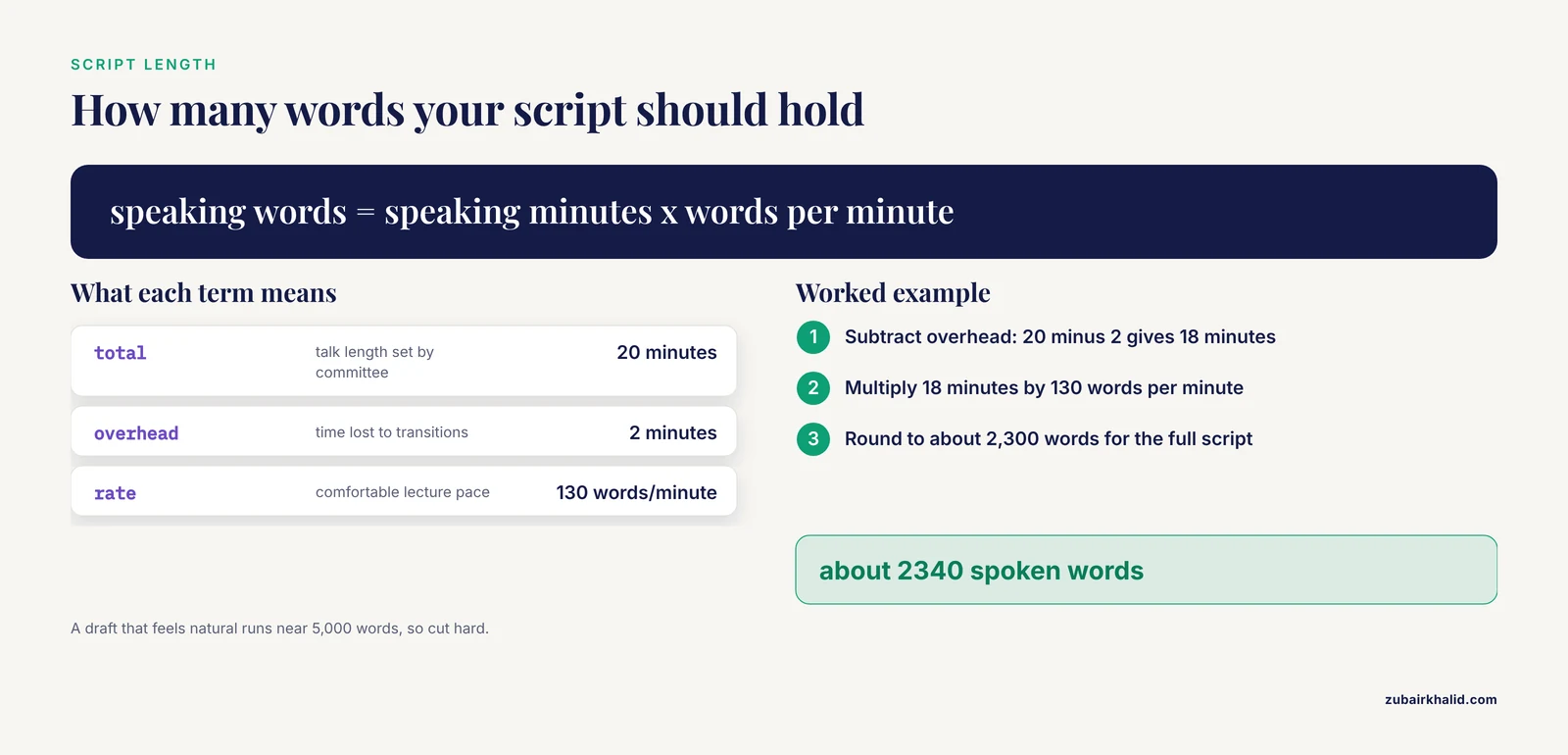
Most US doctoral programs allot 20 to 45 minutes for the candidate's presentation before the question period. Suppose your committee gives you 20 minutes. Here is how to build the talk, with the arithmetic shown explicitly.
Step 1. Reserve overhead time. You will lose roughly two minutes to walking in, advancing the title slide, and transitions. Budget 18 minutes of speaking time.
Step 2. Choose a speaking rate. A comfortable lecture pace is about 120 to 140 spoken words per minute. At 130 words per minute, an 18-minute talk carries this many words:
speaking words = 18 minutes x 130 words/minute = 2340 wordsYour full script, if you write one, should be about 2,300 words, not the 5,000 words that feel natural when drafting.
Step 3. Set the slide count. At a lecture pace, plan roughly one to two minutes of content per slide, which gives 12 to 15 content slides for 18 minutes. Use 15 and let the roadmap and divider slides absorb the remainder.
Step 4. Allocate seconds per slide. Divide your content time across the structure table above.
content time          = 18 minutes
background (18%)      = 3.2 minutes
questions (5%)        = 0.9 minutes
methods (18%)         = 3.2 minutes
results (39%)         = 7.0 minutes
discussion (15%)      = 2.7 minutes
conclusions (5%)      = 0.9 minutes
Step 5. Compute per-slide time automatically. This small script does the allocation for any talk length, so you can reuse it when the committee changes the format:
def slide_budget(total_minutes, overhead_minutes=2, sections=None):
    """Return seconds available per content slide for each section."""
    if sections is None:
        sections = {
            "background": 0.18,
            "questions": 0.05,
            "methods": 0.18,
            "results": 0.39,
            "discussion": 0.15,
            "conclusions": 0.05,
        }
    speaking_seconds = (total_minutes - overhead_minutes) * 60
    budget = {}
    for name, share in sections.items():
        budget[name] = round(speaking_seconds * share, 1)
    return budget

print(slide_budget(20))
Expected output:
{'background': 194.4, 'questions': 54.0, 'methods': 194.4,
 'results': 421.2, 'discussion': 162.0, 'conclusions': 54.0}
Those numbers say the results section gets about seven minutes. With five results slides, each earns roughly 84 seconds. If a results slide cannot be explained in 84 seconds, it needs to become two slides or move to backup.
For a 45-minute talk, the same script with the same shares gives a results budget of about 15.2 minutes, which supports eight to ten results slides.
The Slide Template, Line by Line
Here is the full deck outline for the 20-minute example as a text template you can paste into your slide program's outline view:
1.  Title: dissertation title, name, committee, date
2.  Roadmap: five bullets, one per section
3.  Background 1: the biological problem
4.  Background 2: current model and its limits
5.  Background 3: the gap in one sentence
6.  Research questions: Q1, Q2, Q3 (numbered)
7.  Methods 1: overall design schematic
8.  Methods 2: key model, reagents, sample sizes
9.  Methods 3: analysis plan (or move to backup)
10. Results Q1: primary figure
11. Results Q1: supporting figure
12. Results Q2: primary figure
13. Results Q3: primary figure
14. Results summary: one row per question
15. Discussion: interpretation against the gap
16. Limitations: three named limits
17. Future directions: two or three next experiments
18. Conclusions: three to five takeaways
19. Acknowledgments
20. Divider: "Questions" (backup slides follow)
21+ Backup: full methods, extra figures, power analyses
Notice three design rules embedded in this outline. Every content slide has one message stated in its title, for example "Knockout animals show reduced nest-building at week 6" rather than "Results 2." Figures outnumber text slides three to one in a life-science defense. And nothing appears in the formal talk that you are not prepared to defend, because anything you show is fair game for questions.
Dissertation Planning: Working Backward from the Defense Date
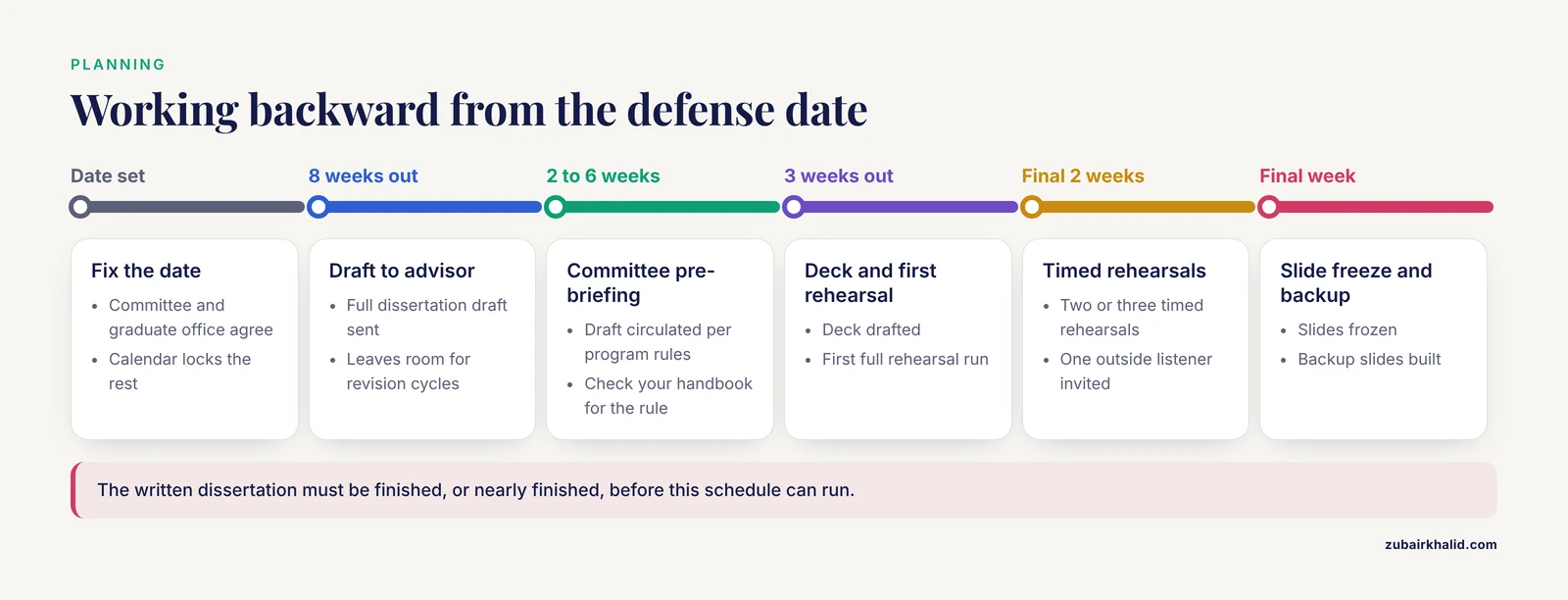
The presentation is the last task of a long schedule, and the structure of the talk depends on decisions made months earlier. Build your plan backward from the defense date your committee sets.
A practical backward plan for a life-science doctoral program looks like this:
- Defense date fixed with the committee and the graduate office.
- Full dissertation draft to the advisor about eight weeks before defense, leaving time for revision cycles.
- Committee pre-briefing or draft circulation per your program's rules, typically two to six weeks ahead.
- Deck drafted and first full rehearsal about three weeks before the defense.
- Two or three timed rehearsals with colleagues, plus one with an outside listener, in the final two weeks.
- Slide freeze and backup-slide build in the final week.
The written dissertation must be finished, or nearly finished, before this schedule can run. If you are still writing, the fastest route to finishing is usually to draft chapters in the order you can finish them rather than the order they will appear, to set a fixed daily word target rather than an open-ended writing session, and to send your advisor chapters as they stabilize instead of waiting for a perfect full draft. A defense presentation built from an unfinished document inherits that instability, so finishing the writing is the true prerequisite.
Practice and Rehearsal: What the Evidence Shows
Rehearsal is the variable you control most directly, and controlled evidence supports it. In the cohort study of nursing students cited above, 816 thesis evaluation rubrics were analyzed across three academic years. Students who attended none of the workshop sessions had the lowest mean oral defense grade, 8.02 out of 10, while students who attended the complete workshop had the highest, 8.76 out of 10, and the multivariable analysis attributed a 0.70-point advantage to full attendance [2]. The intervention was short and delivered online, which means the benefit came from structured practice of the defense task itself, not from extra months of study.
Translate that finding into your plan this way. Run at least one full, timed rehearsal standing up, with your slides advanced by a clicker, in front of an audience that asks hostile questions. Run a second rehearsal after revising. Time each section against your budget table and cut slides that run long. Recording yourself and watching the recording at the section level, rather than the whole talk at once, makes overruns obvious within minutes.
If your program offers a defense workshop, a mock defense, or a presentation course, take it. The grade advantage observed in the cohort study came from exactly this kind of brief, targeted training [2].
Common Mistakes and Limitations
Running over time. The most common failure is a 30-minute talk delivered into a 20-minute slot. Committee members who expected to question you at minute 20 spend the overrun calculating when they will speak. Fix it by rehearsing with a timer and by designating two slides you will skip if you fall behind.
Reading slides aloud. Slides with full paragraphs force you to read them, which signals inexperience. Keep slide text to short phrases and put full sentences in your speaker notes.
Burying the gap. If the committee cannot state your research gap after your background section, the talk has failed at its first task. State the gap in one spoken sentence.
Hiding limitations. Committees respect candidates who name weaknesses first. Defensiveness about limitations invites harder questioning than the limitation itself.
Treating methods as trivial. If your design has unusual choices, unusual models, or small samples, explain them plainly in the formal talk rather than waiting for questions.
Preparing backup slides but not the talk. Backup slides are insurance, not the presentation. Ten backup slides per section is plenty, and each should be labeled with the question it answers.
Ignoring the rubric. Many programs score the oral defense with a rubric separate from the thesis grade, which is exactly what the cohort study measured [2]. Get the rubric from your graduate office and rehearse against its criteria, not against your own sense of what sounds good.
A note on scope. Every program writes its own rules on talk length, slide format, and whether the public presentation precedes or follows the closed questioning. The structure in this article is a default, and your program's handbook overrides it. Individual committee preferences also vary, so ask your advisor or recent graduates from your own lab how defenses run in your department.
Frequently Asked Questions
How long should a dissertation defense presentation be?
It depends on your program, but 20 to 45 minutes is the common range for the formal talk before questions. Ask your graduate office or advisor for your committee's stated limit, then budget two minutes of overhead and allocate the remainder using the section shares in this guide.
What is the best dissertation defense presentation structure format?
The most reliable format moves from background and gap, to numbered research questions, to methods, to results organized by question, to discussion with named limitations, and to conclusions. This order mirrors how committees evaluate scientific reasoning and makes your strongest material, the results, the centerpiece.
How many slides do I need?
Plan one to two minutes of content per slide. A 20-minute talk supports roughly 15 content slides plus title, roadmap, divider, and acknowledgment slides. If a slide needs more than about 90 seconds to explain, split it or move it to backup.
Should I present every result from my dissertation?
No. Present the primary result for each research question and the minimum supporting evidence. Secondary analyses, subgroup findings, and full method details belong in backup slides you can produce during the question period.
What should backup slides contain?
Full statistical details, extra figures, protocol specifics, power or sample-size calculations, and any slide a skeptical committee member might request. Label each backup slide with the question it answers so you can find it in seconds.
How do I handle a question I cannot answer?
Say directly that you do not know, offer the reasoning you would use to find out, and connect it to a limitation or future direction you have already named. Guessing confidently damages credibility more than admitting uncertainty.
How far in advance should I start planning the defense?
Work backward from the defense date by at least two months, with the full dissertation draft to your advisor about eight weeks out, the deck drafted and first timed rehearsal three weeks out, and revisions in the final two weeks. Start earlier if your program requires committee approval of the draft on a fixed calendar.
Does rehearsing the defense actually improve performance?
Yes. Evidence from a large cohort of thesis candidates shows that a structured, short training intervention on oral defense skills produced measurably higher defense grades compared with no training, with the largest gains among those who completed the full program. Timed, audience-tested rehearsals are the practical equivalent.
Sources
- [[Translation from Latin to Hungarian of the thesis of Ferenc Pápai Páriz at the 350th anniversary of his defense and medical inauguration at the University of Basel].](https://pubmed.ncbi.nlm.nih.gov/39550727/)
- An online workshop is effective in improving the oral defense of the bachelor's thesis in nursing students. A real-world cohort study.