A Decision-Making Framework for Research Teams
By Dr. Zubair Khalid, DVM, MS, PhD ·

By the end of this guide, you will be able to set up a working decision-making framework for your research team. You will know how to assign decision rights before a dispute starts, how to structure decision-making in research meetings, how to score genuinely open choices with a transparent weighted method, and how to record, communicate, and revisit every decision your team makes. You will also have a decision log template and a reusable scoring script you can copy into your own project.
To follow the walkthrough, you need three things on hand: a shared document space your whole team can edit, a spreadsheet or a Python 3 installation for the scoring step, and roughly ninety minutes of meeting time to set the framework up once. Nothing else is required. The method works for a two-person collaboration, a ten-person lab, or a multi-institution partnership that includes patient and community partners.
Why an Explicit Framework Beats Ad Hoc Decisions
Most research teams make decisions the same way they make coffee, by habit. The loudest voice in the meeting wins, the principal investigator decides alone and announces it later, or the group drifts toward whatever nobody objects to. These habits work until they do not, and the failure usually shows up at the worst moment, such as during a submission deadline or a disagreement over authorship.
The partnership literature gives a clear picture of where teams need rules. A synthesis of research partnership practices organized its findings into seven practical domains: reporting, communication and meetings, training and education, conflict management, co-authorship, agreements, and collaborative product ownership [1]. Notice how many of those domains are really decision problems in disguise. Who is listed as an author is a decision. How conflict gets resolved is a decision about decisions. Who owns a shared dataset is a decision with downstream consequences for years.
Teams that involve people outside the traditional investigator circle, such as patients, community members, or clinicians from other disciplines, face an extra layer of decision complexity. A French cancer prevention department that built a patient and public involvement group found that the group needed a written mission statement, an engagement charter, and an annual action plan, all co-developed during the group's first two meetings, before any substantive work could proceed [2]. A multi-center collaborative on bleeding disorders reached the same conclusion from the governance side, naming investment in relationships, trust, and transparency as the keys to bringing community members into research conduct and governance [3]. The lesson for any team is simple. Decisions run smoothly when the rules for making them were written down before the contested decision arrived.
A Step-by-Step Decision-Making Framework for Research Teams
The framework has eight steps. Steps 1 through 3 are done once, at the start of a project. Steps 4 through 7 repeat for every significant decision. Step 8 closes the loop.
- Write a short governance charter
- Assign decision rights for each decision type
- Prepare a one-page decision brief
- Structure the decision-making meeting
- Score open choices with a weighted method
- Record the outcome in a decision log
- Communicate the decision and follow through
- Review the framework itself
Step 1: Write a Short Governance Charter
Before your first substantive meeting, write a one-page charter that answers four questions: what the team exists to do, who the members are, how meetings will run, and how anyone raises a concern. The charter does not need legal language. It needs to be specific enough that a new member could read it and know how the team works.
The DIADEME patient involvement group in Lyon used exactly this structure, pairing a mission statement with an engagement charter and an annual action plan, and appointed a dedicated coordinator plus an independent facilitator who provided outside perspective on how the collaboration itself was working [2]. You can copy that structure at any scale. For a small lab, the coordinator is often the project manager or a senior postdoc. The independent facilitator role matters most when the team includes members with unequal power, for example faculty and students, or investigators and patient partners.
A practical charter includes a decision escalation path. Write down that any member who believes a decision violates the charter can pause the decision and trigger a review at the next meeting. Without a written pause mechanism, quiet members tend to stay quiet and disengage later.
Step 2: Assign Decision Rights for Each Decision Type
The most common source of research team friction is not disagreement about the answer. It is confusion about who gets to decide. Fix this with a decision rights table created in your charter meeting. For each recurring decision type, name the method and the owner.
| Decision type | Method | Typical owner | Use when |
|---|---|---|---|
| Routine task allocation | Delegation | Task lead | Work is divisible and reversible |
| Analysis or protocol tweak | Consultation then single decision | Principal investigator | Change is reversible and documented |
| Study scope, endpoints, data sharing | Weighted scoring plus group consent | Full team | Choice is hard to reverse or shapes the paper |
| Authorship and credit | Written policy applied in advance | Full team, set at project start | Order and roles could later become disputed |
| Partnership priorities and goals | Consensus with all partners | Full team including community partners | Partners contribute expertise or lived experience |
| Interpersonal or ethics concerns | Escalation path in the charter | Charter designee | A member raises a formal concern |
The consultation method means the owner hears input from everyone, then decides and explains the reasoning. The consensus method means the decision only proceeds when no member holds a blocking objection. Consent is not the same as unanimous enthusiasm. A member consents when they can live with the outcome and commit to it.
For teams with patient or community partners, decision rights deserve explicit attention. A qualitative study of transplant selection meetings found that participants described participation in terms of rebalancing power and autonomy, and that process understanding itself was experienced as empowering [4]. Translated to a research team, this means partners make better contributions when they understand exactly which decisions they can influence and how. Say it in writing.
Step 3: Prepare a One-Page Decision Brief
No decision enters a meeting without a brief circulated at least 48 hours ahead. The brief has five fields:
DECISION BRIEF
Question:     What exactly is being decided, in one sentence?
Background:   Why now, in three sentences or fewer.
Options:      Two to four named options, each with one cost and one benefit.
Constraints:  Deadlines, funder requirements, ethics rules, budget limits.
Dissent:      Named space for a minority opinion, filled in even if empty.
The brief forces precision. "Should we change the primary outcome?" is not a decision question. "Should we replace the six-month patient-reported quality-of-life score with the twelve-month score as the primary outcome in protocol v2.1?" is. The dissent field is not decoration. A study of pediatric palliative care communication found that ambiguous, coded language and discomfort-driven avoidance were among the main barriers to honest referral conversations, while clear and comprehensive explanations supported good outcomes [5]. The same pattern appears inside research teams. A named dissent field gives hesitant members a legitimate channel that does not require them to interrupt a confident colleague.
Step 4: Structure Decision-Making in Research Meetings
Decision-making in research meetings fails in predictable ways. Items run long, the quietest members speak last or never, and the meeting ends with action items nobody owns. Run every decision meeting with the same four-part structure.
- Frame, five minutes. The brief author restates the question and the options. No new information appears in the meeting that was not in the brief. If new material appears, the decision is tabled and a revised brief is circulated.
- Round-robin input. Each member speaks in turn for up to two minutes before any open discussion. This single rule does more for scientific collaboration across career stages and disciplines than any software tool, because it prevents the first speaker from anchoring the group.
- Discuss, then test for agreement. After open discussion, the chair states the emerging decision and asks each member directly: can you live with this? Any no triggers either a revision or the escalation path from the charter.
- Assign and record. Every decision gets an owner, a deadline, and a log entry before the meeting ends. A decision without an owner is a wish.
Two practices from the partnership literature strengthen this structure. Investigators in small pilot studies reported that building and sustaining authentic stakeholder relationships before online interactions made their larger team meetings dramatically more effective [6]. Practically, that means a fifteen-minute one-on-one call with a partner before a contentious meeting, so the meeting itself is not the first contact. Second, a rapid environmental scan of partnership practices found that formal communication plans and structured meeting practices were among the most commonly reported concrete approaches across partnerships [1]. A standing agenda and a pre-read are not bureaucracy. They are what allows a twelve-person meeting to finish in forty minutes.
Step 5: Score Open Choices with a Weighted Method
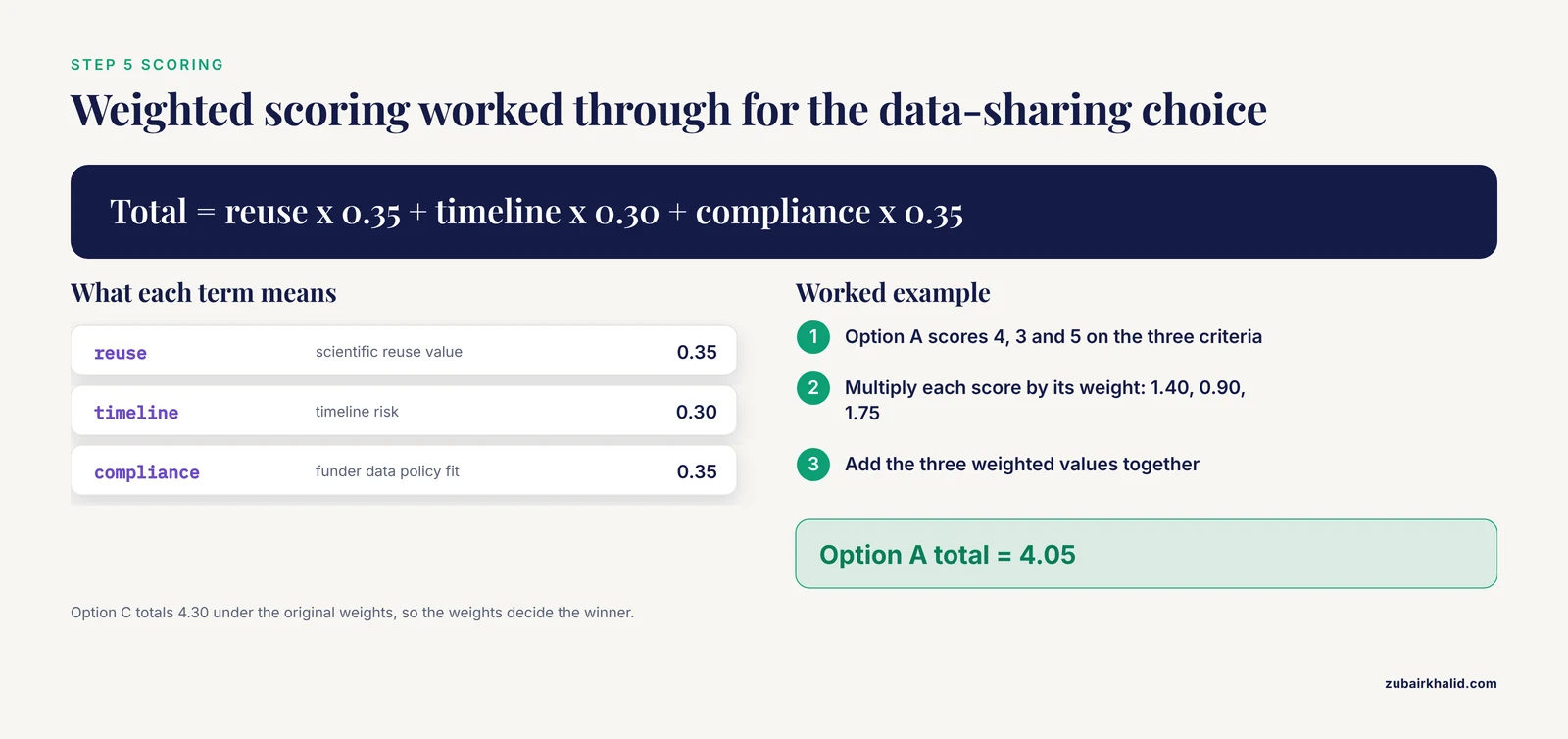
When a choice is genuinely open, with two or more defensible options and no obvious winner, use weighted scoring. This is the framework's one worked calculation, and it is worth doing even when the outcome confirms your intuition, because the scoresheet shows the whole team why the decision went the way it did.
Running example. A nine-person research team must choose a data-sharing plan for a federally funded study. Three options exist: deposit in a controlled-access repository, build an internal data enclave, or release summary statistics only. The team agrees on three criteria and weights: scientific reuse value (0.35), timeline risk (0.30), and compliance with the funder's data policy (0.35). Each option is scored 1 to 5 on each criterion.
options = {
    "A: Controlled-access repository": {"reuse": 4, "timeline": 3, "compliance": 5},
    "B: Internal data enclave":        {"reuse": 2, "timeline": 2, "compliance": 4},
    "C: Summary statistics only":      {"reuse": 5, "timeline": 5, "compliance": 3},
}
weights = {"reuse": 0.35, "timeline": 0.30, "compliance": 0.35}

if abs(sum(weights.values()) - 1.0) > 1e-9:
    raise ValueError(f"Weights must sum to 1.00, got {sum(weights.values()):.2f}")

for name, scores in options.items():
    total = sum(scores[c] * w for c, w in weights.items())
    print(f"{name}: {total:.2f}")
Expected output:
A: Controlled-access repository: 4.05
B: Internal data enclave: 2.70
C: Summary statistics only: 4.30
Option C wins under the original weights. Before accepting that, run a sensitivity check by changing the weights and seeing whether the ranking holds. If the team decides compliance deserves half the weight because the funder mandate is non-negotiable, the picture changes:
weights = {"reuse": 0.30, "timeline": 0.20, "compliance": 0.55}A: Controlled-access repository: 4.55
B: Internal data enclave: 3.35
C: Summary statistics only: 4.15Option A now wins. This is the point of the exercise. The ranking depends on the weights, so the weights themselves are the real decision, and they should be agreed on by the team before anyone sees the option scores. If the weights are set after seeing the scores, members adjust them to favor their preferred option, and the scoresheet becomes advocacy rather than analysis.
Common errors with this step and their fixes:
ValueError: Weights must sum to 1.00, got 0.95You changed a weight and forgot to rebalance the others. Renormalize so the weights sum to exactly 1.
KeyError: 'compliance'An option dictionary is missing a criterion. Every option must be scored on every criterion. If you cannot score one, add the criterion "unknown" and record it in the dissent field of the brief.
NameError: name 'scores' is not definedThe loop variable was renamed in one place and not another. Run the script top to bottom in a fresh interpreter rather than a stale session.
To check the result is right, verify two things by hand: the weights sum to 1, and the top-scoring option's total equals the sum of its three weighted values. For option A under the original weights, that is 4 times 0.35, plus 3 times 0.30, plus 5 times 0.35, which equals 4.05.
Step 6: Record the Outcome in a Decision Log
Every decision gets one log entry, appended to a single file the whole team can read. The log is the team's institutional memory and the fastest way to onboard a new member or answer a reviewer who asks why the protocol changed.
ID:        D-014
Date:      2026-03-04
Question:  Which data-sharing plan applies to study v2.1?
Decision:  Option A, controlled-access repository deposit.
Method:    Weighted scoring, weights agreed before scoring (see brief D-014).
Owner:     Data lead, J. Okafor
Deadline:  Deposit complete by 2026-05-01
Dissent:   One member preferred summary-only release for timeline reasons,
           consented after the compliance weight was raised to 0.55.
Review:    Revisit if deposit timeline slips past 2026-06-01.
The review field is the one teams skip and later regret. Attaching a review trigger to a decision converts it from a permanent ruling into a testable commitment. If the trigger condition arrives, the decision returns to the agenda automatically, which removes the social cost of reopening a topic.
To check your log is healthy, apply three tests at each monthly review: every entry has a named owner, every owner has confirmed the deadline in writing, and no decision older than six months lacks a review trigger. A log entry failing any test is treated as an open item, not a completed decision.
Step 7: Communicate the Decision and Follow Through
A decision that lives only in the meeting room does not exist. Within two business days, the owner sends the log entry to everyone affected, including people who missed the meeting and external collaborators. The message states what was decided, who does what by when, and where the full brief and scoresheet live.
Documentation practices from the partnership scan support this step directly. Across the seven domains studied, reporting practices commonly included describing the context, governance, roles, and reflexivity of the partnership, meaning how members' own positions shaped the work [1]. Your decision log plus your charter already covers most of that. When a funder, ethics board, or collaborating institution asks how the partnership functioned, you can hand them the log instead of reconstructing history from email.
Communication also needs to flow in the other direction. In the DIADEME group, an independent patient facilitator provided feedback on how the collaboration itself was working, which surfaced problems that never appeared in the meeting minutes [2]. Build a standing two-minute slot at the end of each decision meeting for exactly that kind of process feedback.
Step 8: Review the Framework Itself
Twice a year, spend one meeting reviewing the framework. Ask three questions. Which decisions took longer than they should have? Which log entries had to be reopened? Which members have stopped speaking in round-robin? Then change one rule, write the change into the charter, and note the change in the log.
Treat this as an iterative refinement cycle, not a one-time setup. A Ugandan co-design study with young people facing serious illness refined its engagement principles across three workshops and finalized them through consensus with the participants themselves, then continued evaluating the principles as they were put into practice [7]. A collegiate recovery program study applying the Consolidated Framework for Implementation Research found that implementation success hinged on cross-cutting factors including leadership advocacy and sustainability of resources, themes that only become visible over time [8]. Your framework will need the same kind of tuning. The first version is a draft.
Choosing the Right Decision Method
One detail deserves its own section because teams get it wrong so often: matching the method to the decision. Using consensus for routine task allocation exhausts everyone. Using unilateral authority for scope decisions breeds resentment. The table in Step 2 gives the mapping, and two of its rows deserve elaboration.
For authorship, decide the policy before the first data point is collected, in writing, covering authorship criteria, order, and how a member who leaves the project is handled. The partnership scan identified co-authorship as one of the seven recurring friction domains in research collaborations [1], which means it is predictable, and predictable problems can be pre-decided.
For partnership priorities, use consensus with the partners in the room. Pilot study investigators reported that the most effective engagement practice was seeking alignment between stakeholder priorities and study goals before work began, and drawing on stakeholder expertise throughout [6]. A steering structure where community partners advise but never decide tends to produce exactly the mistrust and disengagement documented in the transplant meeting study [4]. If a partner's contribution is genuinely advisory, say so at recruitment. If it is decision-making power, put it in the charter.
Research Collaboration Tools That Keep Decisions on Track
Tools do not create a decision-making framework, but the wrong tool stack can undermine a good one. Match each tool to a specific framework step:
- Shared document space for the charter, briefs, and log. The log must be readable by every member, including partners who are not affiliated with your institution.
- Project tracker for the owner and deadline fields, so decisions generate visible tasks rather than meeting-minute prose.
- Video conferencing for distributed teams, with the round-robin rule enforced by the chair naming speakers in order.
- Version-controlled repository for anything that becomes a formal artifact, such as the analysis plan or the protocol, so each decision that changes it is traceable to a log entry.
A scoping review of communication in intensive care settings categorized communication interventions into technology-based and non-technology-based approaches and found that effective multidirectional, longitudinal communication was the underlying requirement regardless of category [9]. Research teams face the same underlying requirement. A video call without a pre-read is not better than a phone call without a pre-read. The tool amplifies the structure, or the lack of it.
The pilot study investigators quoted earlier also noted that some engagement challenges require system-level changes by funders and research support organizations, not just better practices at the project level [6]. If your institution's grant administration does not support partner compensation or meeting logistics, that is a real constraint on your framework, and it belongs in your charter's constraints section rather than being absorbed silently by individual members.
Common Mistakes and Limitations
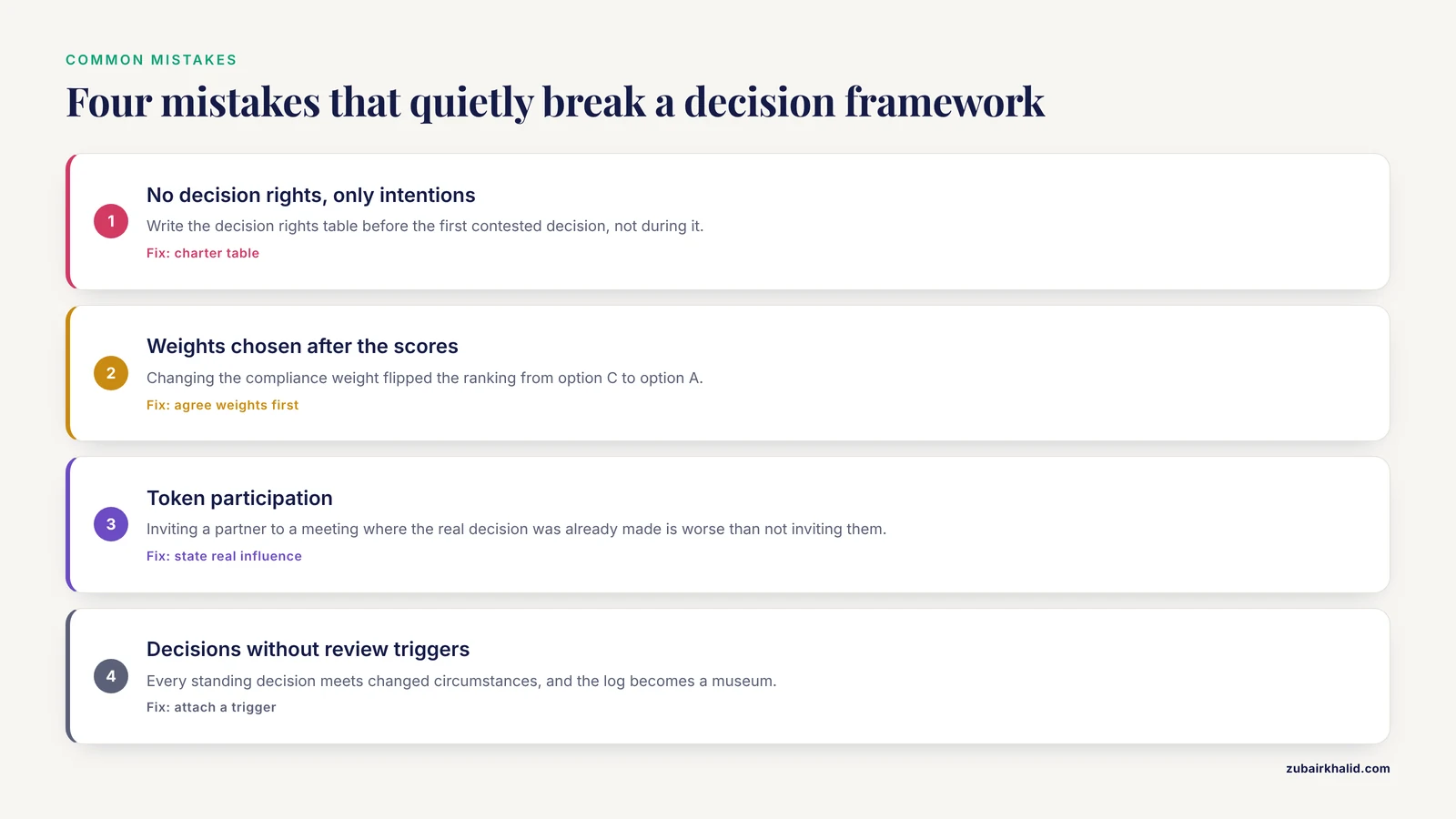
These are the mistakes teams make most often when adopting a decision-making framework, with the fix for each.
- No decision rights, only good intentions. Teams assume fairness will emerge naturally. It does not. Write the decision rights table in Step 2 before the first contested decision, not during it.
- Weights chosen after seeing the scores. As the worked example showed, changing the compliance weight flipped the ranking from option C to option A. Agree on weights first, record them in the brief, and run a sensitivity check openly rather than quietly re-running the script until your favorite option wins.
- Meetings as the only decision channel. When every decision requires a meeting, big and small decisions compete for the same hour. Route routine decisions through delegation and reserve meeting time for the weighted-scoring and consensus decisions.
- Token participation. Inviting a patient partner to meetings where the real decision was made beforehand is worse than not inviting them. The lived-experience collaborative on bleeding disorders framed trust and transparency as prerequisites for moving along an engagement continuum, not outcomes that appear after one meeting [3]. If you cannot give a partner real influence, be honest about the role before they join.
- Decisions without review triggers. Every standing decision eventually meets changed circumstances. Attach a review condition to every log entry, or the log becomes a museum.
- Conflict avoidance dressed up as harmony. The partnership scan devoted a whole domain to conflict management [1] precisely because unmanaged conflict is the norm, not the exception. The dissent field, the round-robin, and the charter escalation path exist to make disagreement cheap and early. Use them.
- Framework without follow-through. A charter that no one re-reads is decoration. The twice-yearly review in Step 8 is what keeps the framework alive.
Two honest limitations. First, the evidence behind many of these practices is descriptive. The partnership environmental scans synthesized what teams actually report doing, and the authors explicitly did not assess effectiveness [1], so treat the practices here as well-documented craft, not proven prescriptions. Second, no framework removes judgment. Weighted scoring organizes a discussion, it does not replace the scientific reasoning that decides what the criteria should be in the first place. And for any question touching clinical care of individual people or animals, this article covers team process only, and those situations need the relevant licensed professional.
Frequently Asked Questions
What is a decision-making framework for a research team?
It is a written set of rules covering who decides what, how options are compared, how meetings run, and how decisions are recorded and revisited. The framework in this article has eight steps, from a governance charter through a decision log and periodic review.
Who should have the final say on a research decision?
It depends on the decision type, which is why you write a decision rights table. Reversible, routine decisions go to a named owner, while hard-to-reverse decisions such as study scope or data sharing go to the full team through scoring plus consent.
How do we make decisions efficiently in research meetings?
Circulate a one-page brief 48 hours ahead, forbid new information mid-meeting, take round-robin input before open discussion, and leave the meeting with an owner, a deadline, and a log entry for every decision.
What should a decision log contain?
Eight fields: a unique ID, the date, the exact question, the decision, the method used, a named owner with a deadline, any recorded dissent, and a review trigger that brings the decision back if conditions change.
How do research teams handle disagreement between members?
Use structured channels rather than avoidance. A named dissent field in the brief, round-robin speaking order, a consent check where every member states they can live with the outcome, and an escalation path written into the charter.
Should patient or community partners take part in research decisions?
If partners contribute expertise or lived experience to the research, they should hold explicit decision rights for questions that touch their contribution, stated in the charter at the time they join rather than discovered later.
Which research collaboration tools support team decisions?
A shared document space for the charter, briefs, and log, a project tracker for owners and deadlines, video conferencing with enforced speaking order, and a version-controlled repository for formal artifacts such as protocols and analysis plans.
How often should a team revisit its decision-making framework?
Twice a year in a dedicated review meeting. Look for decisions that ran long, log entries that were reopened, and members who have stopped speaking, then change one rule and record the change.
Sources
- Identifying practices for meaningful health research partnerships: series of rapid environmental scans.
- Patient and public involvement in a cancer prevention research department: lessons learned from the DIADEME group.
- Lived Experience Expert, community engagement, policy, and health equity, diversity, and inclusion elements of the Bleeding Disorders Research Collaborative.
- Patient Participation in Organ Transplant Selection Meetings: A Qualitative Study.
- Communication Barriers and Facilitators to Specialist Pediatric Palliative Care Involvement in Pediatric Oncology Settings Across Canada.
- Implementation Strategies for Strengthening Community and Stakeholder Engagement in Clinical and Translational Pilot Studies.
- Co-designing engagement principles for involving children and young people in palliative care research in low- and middle-income settings.
- Using the Consolidated Framework for Implementation Research (CFIR) to explore mutual-help group implementation challenges in college recovery programs.
- Patient- and Family-Centered Care, Communication, and Relationship Development Along a Technological Continuum in the ICU: A Scoping Review.