Data Sharing Policies for Research: What You Need to Know
By Dr. Zubair Khalid, DVM, MS, PhD ·

A data sharing policy is a set of rules that determines whether, how, when, and with whom research data can be made available to others. Data sharing policy research is the study and interpretation of those rules, covering who owns data, who can access it, how it is protected, and what obligations come with sharing it.
If you are planning a career in the life sciences, you will meet these policies early. Journals ask you to declare where your data live. Funders ask for data management plans. Collaborators ask you to sign agreements before a single file changes hands. Communities and patients increasingly ask who controls their information. This article explains the whole system in plain language so you can read, interpret, and apply data sharing policies with confidence.
What Does Data Sharing Policy Research Mean?
The phrase has two readings, and both matter.
The first reading treats "data sharing policy research" as a field of study. Scholars examine how institutions write, interpret, and enforce rules about research data. They evaluate whether those rules protect participants, whether they are legally enforceable, and whether they actually result in data being shared. Work in this area includes evaluations of data sharing agreements at research institutions, surveys of research data management practices in universities, and analyses of how privacy concerns shape willingness to share health data [1][2][3].
The second reading treats it as a practical skill. When a researcher says they are doing "data sharing policy interpretation," they mean reading a funder's terms, a journal's data availability statement requirements, or a collaborator's draft agreement, and deciding what those documents require of them. Most working scientists spend far more time on the second reading than the first.
Both readings rest on the same foundation. A data sharing policy answers a predictable set of questions:
- Who owns the data?
- Who may access it, and under what conditions?
- How must it be stored, secured, and protected?
- Who holds intellectual property rights in it?
- Who benefits, financially or otherwise, when it is used?
- What did the research participants consent to?
Those six questions map directly onto the domains researchers use when evaluating real institutional agreements. An evaluative study of genomic data sharing at three research-intensive institutions in Uganda assessed agreements across exactly these domains: data ownership, protection and security, access, intellectual property, and benefit sharing, with informed consent, legal enforceability, and potential community harms emerging as cross-cutting concerns [1].
Why Data Sharing Policies Exist
Data sharing serves science. When the underlying data behind a published result are available, other researchers can verify the analysis, run alternative analyses, and preserve information for future questions that the original team never thought to ask. Journal editors who have studied the question describe these three benefits as the core case for sharing individual-level data [4].
Sharing also multiplies the value of expensive data collection. Disease registers that pool patient outcomes across hospitals and countries let clinicians benchmark results, feed evidence-based medicine, and connect the care a patient receives to measurable value. Experts in arthroplasty registers describe this as a symbiotic relationship, where high-quality register data and value-based health care each strengthen the other [5].
But sharing carries risk, and the risks are not evenly distributed. A small dataset containing rare, distinctive, or potentially stigmatizing health findings can expose a participant even after names are removed. Published tables of individual laboratory values can, in plausible scenarios, lead to identification of a person, disclosure of a diagnosis the person had not shared, and concrete harm [4]. Policies exist to keep the benefits of sharing while managing these risks deliberately rather than by accident.
There is also a trust dimension. People decide whether to share their health data based on their experiences with privacy, and those experiences are shaped by factors including race, ethnicity, and how AI-mediated platforms handle sensitive conversations. Researchers have proposed formal metrics for evaluating how online experiences influence trust, consent behavior, and participation in data sharing, treating these factors as central to the design of data programs rather than optional add-ons [3]. A policy that ignores trust will eventually lose the participants it depends on.
The Layers of Data Sharing Policies for Research
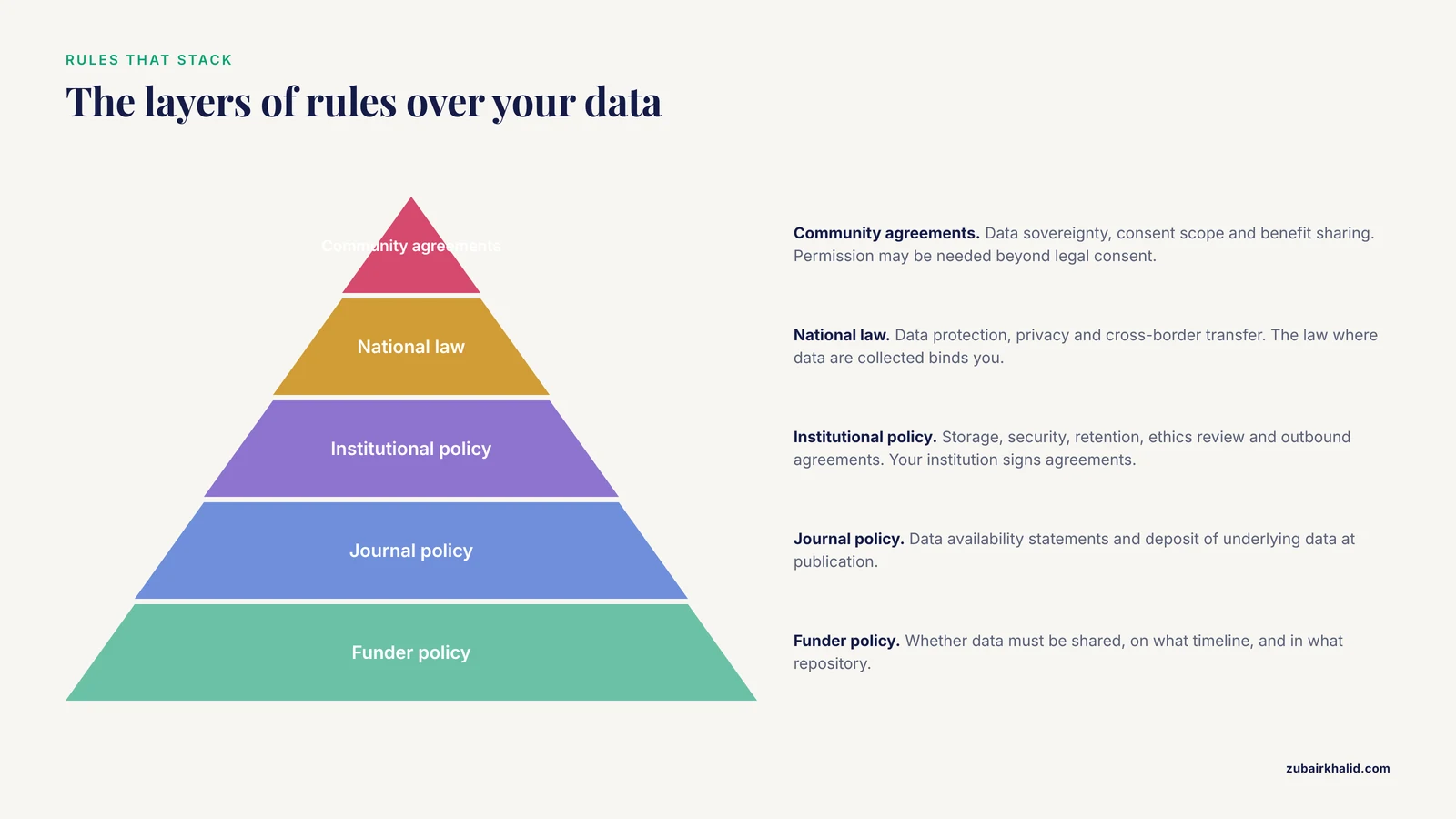
No single document governs your data. Several layers of rules stack on top of each other, and a compliant project satisfies all of them at once. The table below summarizes the main layers.
| Policy layer | Who sets it | What it typically governs | What it means for you |
|---|---|---|---|
| Funder policy | Grant agencies and foundations | Whether data must be shared, on what timeline, and in what repository | You write a data management plan into the proposal and budget for it |
| Journal policy | Scientific journals | Data availability statements and deposit of underlying data at publication | You must declare where data live before your paper is accepted |
| Institutional policy | Universities, hospitals, institutes | Storage, security, retention, ethics review, and outbound agreements | Your institution reviews and signs data sharing agreements [1] |
| National law | Governments and regulators | Data protection, privacy, cross-border transfer, and sector rules | You must follow the law where data are collected, which may differ from where you work |
| Community and participant agreements | Communities, tribes, and participant groups | Data sovereignty, consent scope, and benefit sharing | You may need permission beyond legal consent before data leave the community [6] |
Funder and Journal Requirements
Most major funders now require a data management plan, and most journals require a data availability statement. The details vary, but the pattern is consistent. Expect to name a repository, a timeline for deposit, and any restrictions on access.
Some journals go further and encourage authors to publish anonymized individual-level data as supplementary material. The toxicology and experimental medicine journal EXCLI Journal has a long-standing practice of encouraging responsible sharing of anonymized individual-level data, paired with explicit caution that small datasets containing rare or stigmatizing findings require particular care [4]. Reading a journal's policy carefully before submission prevents the common situation of a paper accepted on the condition of a data deposit you are not prepared to make.
National Law and Regulation
Data protection law has expanded rapidly, and the law where data are collected binds you even if your home institution sits elsewhere. The Ugandan study cited above evaluated institutional practice against two benchmarks, the Malabo Convention (the African Union convention on cyber security and personal data protection) and the Uganda Data Protection and Privacy Act, and found that national regulators require data sharing agreements for collaborative research [1]. The lesson generalizes. When you plan an international collaboration, identify the data protection law at every site where data are collected, not just at your own institution.
Institutional Policy
Universities and research institutes hold the legal relationships with funders, participants, and collaborators, so institutional policy determines much of what you can and cannot do. Research on institutional governance of genomic data found that even well-resourced institutions with agreements in place struggled with legal enforceability, and that capacity gaps persisted in areas such as security and benefit sharing [1]. This tells you something practical. Do not assume your institution's template agreement solves every problem. Ask your technology transfer or legal office how a specific agreement will be enforced if a partner misuses the data.
What a Data Sharing Policy Must Cover
If you are drafting or interpreting a policy, work through the five domains that researchers use when auditing real agreements [1].
- Data ownership. State who owns the data at every stage. Ownership questions become complicated when data are collected in one country, analyzed in a second, and stored in a third.
- Protection and security. Specify encryption, access controls, storage locations, and what happens after a breach.
- Access. Define who can request data, through what procedure, and on what timeline. Controlled-access repositories, where requesters apply for permission, sit between fully open and fully closed models.
- Intellectual property. Decide in advance who may patent or publish what, because disputes after the fact are far harder to resolve.
- Benefit sharing. Agree on how value flows back, whether through co-authorship, capacity building, payment, or community programs.
Across these domains, three themes recur in evaluations of actual agreements [1]:
- Informed consent. Consent forms must match the sharing plan. Data collected under a consent that promised local use only cannot simply be uploaded to a public repository.
- Legal enforceability. A signed agreement is only as strong as the mechanism for enforcing it. The Ugandan institutional study found that even where agreements existed, enforceability remained challenging [1].
- Community harms. Some harms fall on groups rather than individuals. Stigmatization of a community, or disclosure of findings that affect a small population, can occur even when no individual is identified.
Data Sharing Agreements
A data sharing agreement (DSA) is a contract between the parties that governs the transfer and use of data. In many jurisdictions it is not optional. The Uganda National Council for Science and Technology requires data sharing agreements for collaborative research, which is why the institutional study reviewed eight of them across three institutions [1].
A workable DSA answers the five domain questions in enforceable language. It names the data, the purpose, the recipients, the security obligations, the duration, the intellectual property arrangement, and the consequences of breach. When you receive a draft DSA from a collaborator, read it against that checklist before signing. If a clause on ownership or benefit sharing is missing or vague, raise it at draft stage, because amendment after signing is far harder.
Privacy, Anonymization, and Re-identification Risk
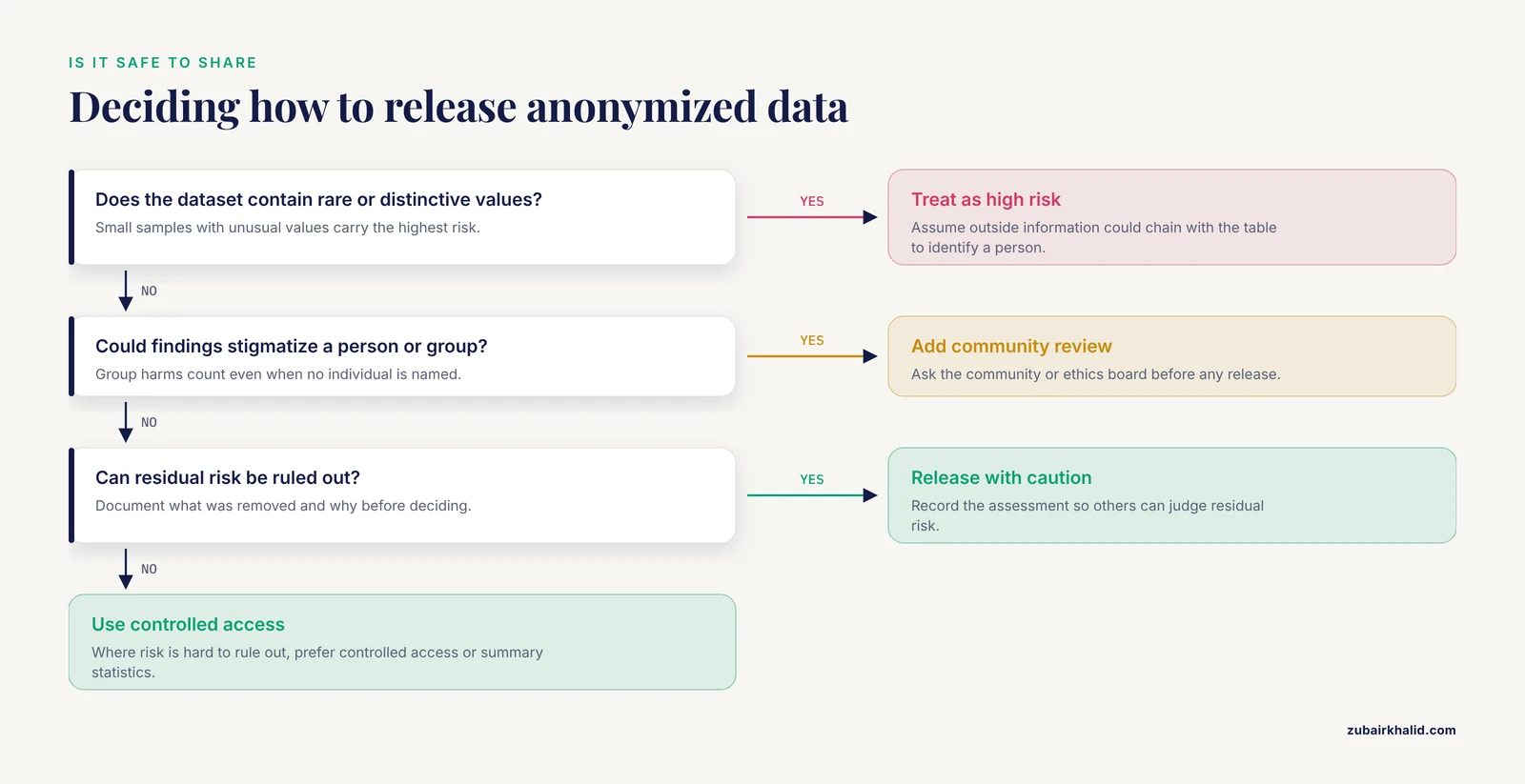
Anonymization is the most common tool for making data shareable, and it is also the most commonly over-trusted. Removing names is not enough. Re-identification risk depends on the characteristics of the dataset and on what information a potential attacker already holds.
The EXCLI Journal analysis worked through hypothetical scenarios in which a published table of individual laboratory values could chain together with outside information to identify a participant, reveal unknown health information, and cause concrete harm. The conclusion was that such a chain is possible but its likelihood depends strongly on dataset characteristics. Small datasets with rare, distinctive, or potentially stigmatizing findings demand the most caution [4]. In practice, this means:
- Assess re-identification risk before release, not after.
- Treat small samples with unusual values as high risk.
- Prefer controlled access or summary statistics where risk is hard to rule out.
- Document what was removed and why, so others can judge residual risk.
Trust shapes these decisions from the other side. People weigh privacy, reputational, algorithmic, and psychosocial risks when deciding whether to donate data, and researchers studying AI-mediated health engagement have proposed paired evaluation metrics, one set tracking how online experiences influence trust and consent behavior, the other tracking fairness and representation in the systems that process shared data [3]. A sharing policy that treats consent as a one-time form signing will underperform against a policy that treats participant trust as an ongoing asset.
Data Sovereignty and Community-Controlled Data
For many communities, especially Indigenous communities, data governance is not only a privacy question. It is a question of who holds authority over information about the community itself.
A partnership between the First Nations Health and Social Secretariat of Manitoba and researchers at the University of Manitoba set out to build a community-led COVID-19 modeling platform that would let First Nations leaders input local data and generate outputs for their own decision-making. The project faced real obstacles, including pandemic-era demands on staff, coordination across multiple technical teams, and a six-month reporting lag on administrative data that limited its usefulness during an emergency. The lessons point toward structural changes, including supporting First Nations information infrastructure and governance, so communities can govern and use their own data [6].
For an early-career researcher, the practical takeaway is this. If your study involves an Indigenous community or any community with its own data governance expectations, build the data sharing conversation into project design from day one. Community approval is a distinct requirement from individual consent, and retrofitting it after data collection usually fails.
Data Sharing in Practice: Registers and Large Data Ecosystems
Some of the most productive data sharing happens through registers, which are organized, ongoing collections of data on defined populations. Register experts interviewed in a study of value-based health care described how clinician-led registers integrate outcome measures, support evidence-based medicine, and link the care patients receive to measured value [5]. Registers work because sharing is built into their design, with defined variables, quality control, and governance from the start.
Large ecosystems also show what happens when sharing is not coordinated. An assessment of the United States cancer screening data ecosystem found that screening rate data come from surveys, electronic health records, and claims data, each with limitations that can misrepresent true participation, and that the ecosystem remains fragmented and poorly characterized. Researchers and advocacy organizations who use these data described the consequences, and a multistakeholder workshop produced actionable proposals for improvement [7]. Fragmentation is a data sharing problem. Data exist, but they sit in incompatible systems with unclear provenance and unequal access.
Even laboratory-level infrastructure touches these questions. In large-scale proteomics, where experiments can involve hundreds or thousands of samples, capturing core project metadata in a structured format has become a bottleneck, and tools such as the open-source WorkListGenerator were built to capture that metadata, perform block randomization, and generate instrument worklists [8]. The general principle transfers to any field. Metadata management is part of data sharing, because data without adequate context cannot be reused.
Research Project Management for Data Sharing
Data sharing fails most often at the planning stage, not the technical stage. Teams that treat data management as a paperwork requirement at the end produce datasets nobody can reuse, and teams that plan for it from the start produce assets that outlive the original project.
Build data sharing into the research project plan
A research project plan template that earns its keep includes data as a first-class work stream, alongside experiments and analysis. At minimum, your plan should specify:
- What data will be collected, in what formats, and with what metadata standards.
- Where data will be stored during the project and how they will be backed up.
- Who can access data at each stage, and how access is recorded.
- Which repository data will be deposited in, and when.
- What consent, ethics, and agreement obligations apply before any transfer or publication.
- Who on the team owns each of these tasks.
This is research project management in the concrete sense, assigning data tasks to named people with dates, rather than assuming someone will handle it later. Undergraduate and graduate researchers report that data collection, time management, and research planning are among the hardest parts of a first research project, and that mentorship and structured support make the difference [9]. If you supervise students, model the planning behavior you want them to adopt by walking through your own data plan at project kickoff.
Institutionalize good practice, do not rely on individual effort
Research on universities in Kenya found that research data management practices were fragmented, that data loss risks were real, and that data sharing and reuse suffered where institutional frameworks were underdeveloped. Drawing on the Australian Research Data Commons Capability Maturity Model and the UK Data Archive Research Data Lifecycle model, the study proposed a comprehensive framework built from surveys of 306 respondents and interviews with university librarians and research leaders across six universities [2]. The maturity model logic is useful anywhere. Institutions move through stages, from ad hoc individual practices toward standardized, supported, and audited processes, and deliberate investment moves them faster.
Local government and community organizations face the same challenge from a different direction. A baseline study of a local authority and voluntary sector organizations in Somerset, United Kingdom, examined how staff perceived research, how they used data and evidence, and where training gaps lay, as groundwork for building research capacity in settings that had little of it [10]. The parallel is direct. If your organization has no data culture, a policy document alone will not create one. Training, templates, and visible leadership support do.
Use templates, then adapt them
A research project plan template saves you from the blank page, but no template fits every project. Adapt whichever template your institution or funder provides so that the data sharing sections reflect your actual consent language, your actual repository, and your actual agreements. An accurate plan you update beats a perfect plan you never revisit.
Common Mistakes and Limitations
- Treating consent as permanent and unlimited. Consent is scoped. Data collected under one consent cannot be repurposed for a different kind of sharing without review.
- Assuming anonymization is sufficient. Small datasets with rare or stigmatizing findings can expose participants even after direct identifiers are removed [4]. Assess risk per dataset.
- Signing agreements without reading them. Ownership, intellectual property, and benefit sharing clauses determine your future options. Raise problems at draft stage.
- Ignoring the law at the data collection site. Data protection obligations follow the data, and requirements in one country do not satisfy those in another [1].
- Postponing data decisions to the end of the project. Metadata, formats, and repository choice are cheap to fix early and expensive to fix after the team disperses [8].
- Assuming individual effort substitutes for institutional systems. Fragmented practices lead to data loss and blocked reuse, and institutional frameworks, including library and research office support, are what make good practice durable [2].
- Overlooking community-level harms and authority. Group harms and community data governance are distinct from individual privacy, and both need explicit attention [1][6].
- Expecting one policy to fit all data types. A policy appropriate for fully open genomic summary data may be entirely wrong for small clinical datasets, and each layer of policy has to be checked against the specific dataset.
One general limitation applies to everything above. Individual projects, datasets, and communities differ, and the rules that apply to your work depend on your funder, institution, jurisdiction, and participants. Confirm specifics with your institutional research office, ethics board, or legal counsel before acting.
Frequently Asked Questions
What does data sharing policy research mean?
It means two things. As a field, it is research into how data sharing rules are written, interpreted, and enforced. As a skill, it is the practical work of reading funder, journal, legal, and institutional requirements and applying them to your own data.
Do I have to share my research data?
Often yes. Many funders require data management plans and deposit, and many journals require data availability statements. Check your specific funder and target journal, because requirements differ.
What is a data sharing agreement?
It is a contract governing the transfer and use of data between parties. It defines the data, permitted uses, security obligations, intellectual property, and consequences of breach. Some national regulators require one for collaborative research [1].
How do I know if my anonymized data are safe to share?
Assess re-identification risk against the specific dataset. Small datasets with rare, distinctive, or potentially stigmatizing findings carry the highest risk, even after names are removed [4]. When risk is hard to rule out, use controlled access or publish summary statistics instead.
What is data sovereignty?
Data sovereignty is the principle that a community, particularly an Indigenous nation, holds authority over data about itself, including where the data are stored and who may use them. Community governance operates alongside, and can exceed, ordinary legal consent [6].
What goes into a data management plan?
A plan describes what data you will collect, in what formats and with what metadata, where they will be stored, who can access them, which repository they will be deposited in, and what consent, legal, and agreement obligations apply. Funders use it to judge whether sharing is feasible.
Can sharing data harm participants?
Yes, in specific circumstances. Re-identification can expose a person and disclose unknown health information, and harms can also fall on whole communities through stigmatization. Careful risk assessment and community engagement are the standard responses [1][4].
How do I build data sharing into my research project plan?
Add a data work stream with named owners and dates for collection, storage, metadata, access control, and deposit. Decide the repository and agreement obligations at project start, and review the plan at each project milestone rather than at the end.
Sources
- An evaluation of the ethical- regulatory practices for genomic data sharing at three research-intense institutions in Uganda.
- From data neglect to data respect: A framework for institutionalising a sustainable research data management culture in Kenyan universities.
- Understanding Race as a Key Analytic Dimension in AI-Enabled, Health-Related Social Engagement Online and Its Role and Impact in Health Research.
- Guidelines for sharing individual level patient data.
- The "symbiosis" between high-quality register data and value-based health care and the role of local, national, and international registers in the development and promotion of value-based healthcare projects.
- Implementing a First Nation data-sovereign and agile modelling platform for pandemic management: lessons from Manitoba.
- Limitations in US Cancer Screening Rate Data and Opportunities to Improve Precision Prevention.
- Automating Large-Scale Experiment Scheduling and Planning with the WorkListGenerator.
- Nursing students' experiences of undergraduate research projects: a qualitative descriptive study.
- Understanding existing research culture and capacity in a local authority (LA) and voluntary, community, faith and social enterprise(VCFSE) in one area of the South West, United Kingdom: a qualitative baseline study.