Data Sharing Plan vs. Data Availability Statement
By Dr. Zubair Khalid, DVM, MS, PhD ·

A data sharing plan is a forward-looking document, written before a project starts, that describes how research data will be managed and shared, while a data availability statement is a backward-looking paragraph, published with a paper, that tells readers where the data behind that specific paper can be found. The rule of thumb is simple. If the document is written for a funder before data exist, it is a data sharing plan. If it is written for readers after the study is done, it is a data availability statement.
This article explains each document on its own terms, puts them side by side, walks through the criteria that decide real choices, and works through concrete scenarios so you can tell them apart and write both well.
Why the confusion exists
Both documents live in the same ecosystem of research data sharing, both concern the same data, and both often sit in the same grant application or manuscript. That overlap creates three predictable problems. Researchers mix up the terms in paperwork. Reviewers flag statements that should have been plans. And teams discover, too late, that a vague availability statement at publication traces back to a vague plan at proposal stage.
The confusion is compounded by naming variation. Funders and sponsors use overlapping labels, including data management plan, data management and sharing plan, and data sharing plan, sometimes for slightly different documents. A survey of the top public and private clinical trial sponsors in Europe found that sponsors maintain a patchwork of relevant documents, including data sharing policies, data management and sharing plans, and data use agreements, with substantial heterogeneity in how these documents are structured and made public [1]. In other words, even large, well-resourced organizations have not standardized the vocabulary, so individual researchers should not expect to find a single universal template.
What a data sharing plan is
A data sharing plan, often called a data management and sharing plan or DMP, is a structured document submitted with a grant proposal or registered at the start of a project. It describes, in advance, how the team will handle the data the project will generate.
A typical plan covers six elements.
- Data description. What data will be collected or generated, in what formats, and at what approximate volume. For example, de-identified survey responses in CSV format, imaging files in DICOM, or sequencing reads in FASTQ.
- Standards and metadata. Which community data standards, file formats, ontologies, or metadata schemas the data will follow, so other researchers can interpret them.
- Storage and preservation. Where data will live during the project and for how long afterward, including backup arrangements and retention periods required by the funder or institution.
- Access and sharing. Which data will be openly deposited, which will be shared under controlled access, and which will not be shared at all, with the justification for each choice.
- Protection and governance. How human subjects protections, consent language, de-identification, and any data use agreements will be handled. Clinical trial sponsors increasingly formalize this layer through dedicated data use agreements that govern who may access participant data and for what purpose [1].
- Roles, timeline, and budget. Who is responsible for each task, when deposit will occur relative to publication or study closeout, and what repository fees or curation costs the budget covers.
Two properties define the genre. First, the plan is prospective. It is written while the study exists only as a design, which is why funders ask for it at application. Second, the plan is institutional. Its audience is a review panel, a data officer, or a sponsor's governance committee, not a journal reader.
A good plan is also a living document. Projects change, instruments fail, and consent language gets amended. Most funders expect the plan to be updated if the data strategy changes materially, and treating the submitted plan as a permanent contract is a common reading error on both sides of the review process.
What a data availability statement is
A data availability statement, sometimes shortened to DAS, is a short declaration published with a research article. It answers one question for the reader. Where can I get the data underlying the findings in this paper?
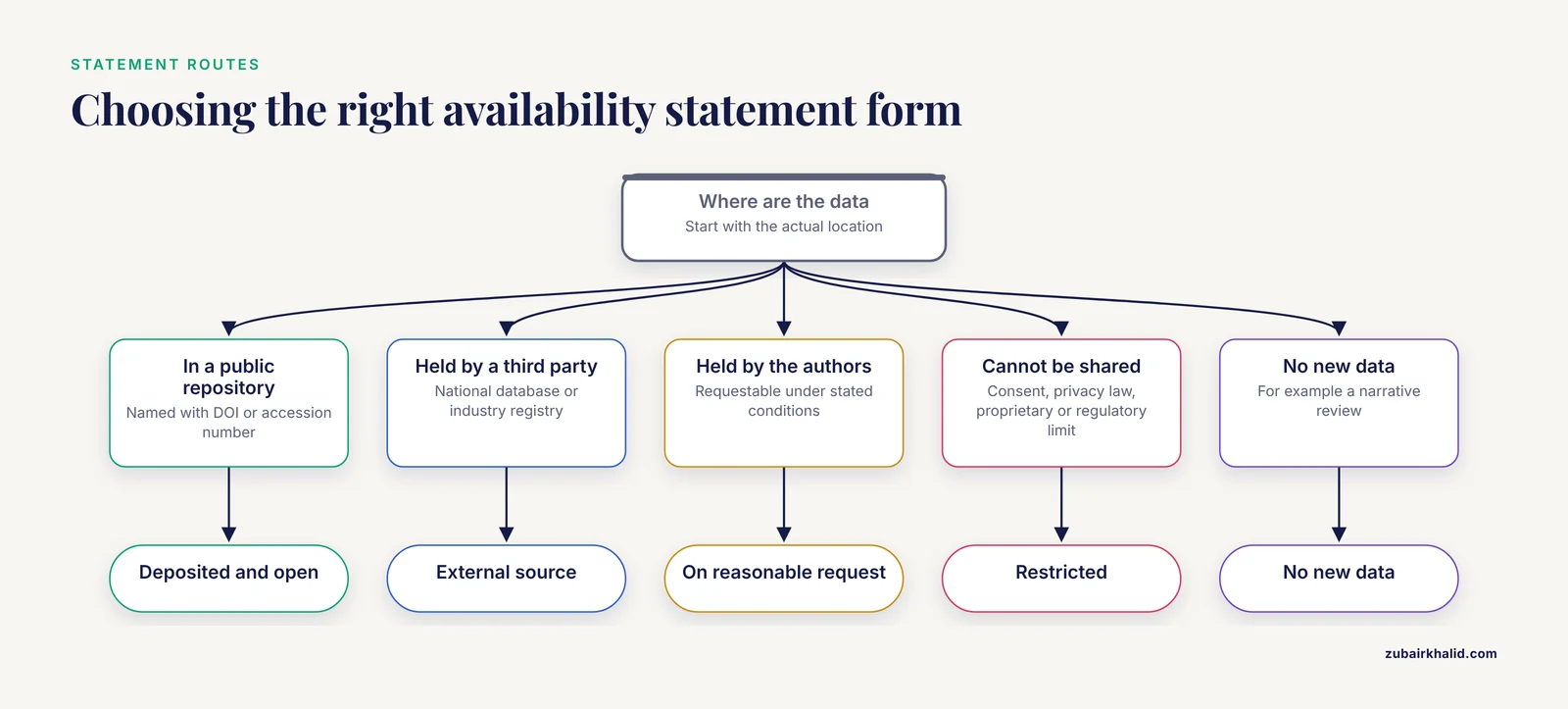
The statement usually takes one of several standard forms.
- Deposited and open. All data are in a public repository, named with a DOI, accession number, or persistent link.
- Available in an external source. Data come from a third party, such as a national health database or an industry registry, and can be obtained from that source under its own access rules.
- Available on reasonable request. Data are held by the authors or their institution and can be requested under stated conditions.
- Restricted. Data cannot be shared because of consent limitations, privacy law, proprietary control, or regulatory restriction, and the statement explains why.
- No new data. The article reports no new data, for example a narrative review.
Evidence from the clinical trial literature shows how much weight journals now place on this statement. In a cross-sectional analysis of the 50 most highly cited randomized trials in neurology published between 2018 and 2022, 36 of 50 publications provided a data sharing statement, and nearly all provided access to the trial protocol (48 of 50) and the statistical analysis plan (46 of 50) [2]. Reporting of some methodological details lagged behind, with fewer than half of trials adequately reporting randomization and trial design elements [2]. The pattern is instructive. Availability statements and protocol documents have become near-routine, which means reviewers and readers increasingly notice when one is missing or hollow.
Three properties define this genre. The statement is retrospective, describing data that already exist. It is article-bound, covering only the data behind the specific publication rather than the whole project. And its audience is the reader, including the meta-researcher who wants to reuse the data or verify the analysis.
Side-by-side comparison
The table below is the core of the distinction. Read any row across, and the difference between the two documents becomes concrete.
| Criterion | Data sharing plan | Data availability statement |
|---|---|---|
| Purpose | Describe how data will be managed and shared | Declare where data can be found |
| Timing | Written at proposal stage, before data exist | Written at submission, after analysis is complete |
| Direction | Forward-looking | Backward-looking |
| Primary audience | Funders, sponsors, data governance committees | Readers, reviewers, reusers |
| Scope | All data the project will generate | Data underlying one specific publication |
| Typical length | One to several pages, structured sections | A paragraph to half a page |
| Enforcement point | Grant review, milestone reporting, sponsor audit | Journal submission and peer review |
| Companion documents | Data use agreements, consent forms, repository deposits | The deposited dataset itself, code, protocols |
| Change over time | Revised as the project evolves | Fixed at publication, with errata if wrong |
| Failure mode | Vague promises that become unachievable | Statements that are untrue, unactionable, or contradicted by coauthors |
The last row deserves emphasis. Because the plan is prospective and the statement is retrospective, the most damaging error in either document is a factual claim that cannot be kept. A plan that promises open deposit of data the consent language will not permit, or a statement that says data are available on request when no process exists to handle requests, both fail in the same way. They trade a short-term approval for a long-term broken commitment.
The criteria that decide real choices
When deciding whether a situation calls for a plan, a statement, or both, four criteria do most of the work.
Timing in the research lifecycle
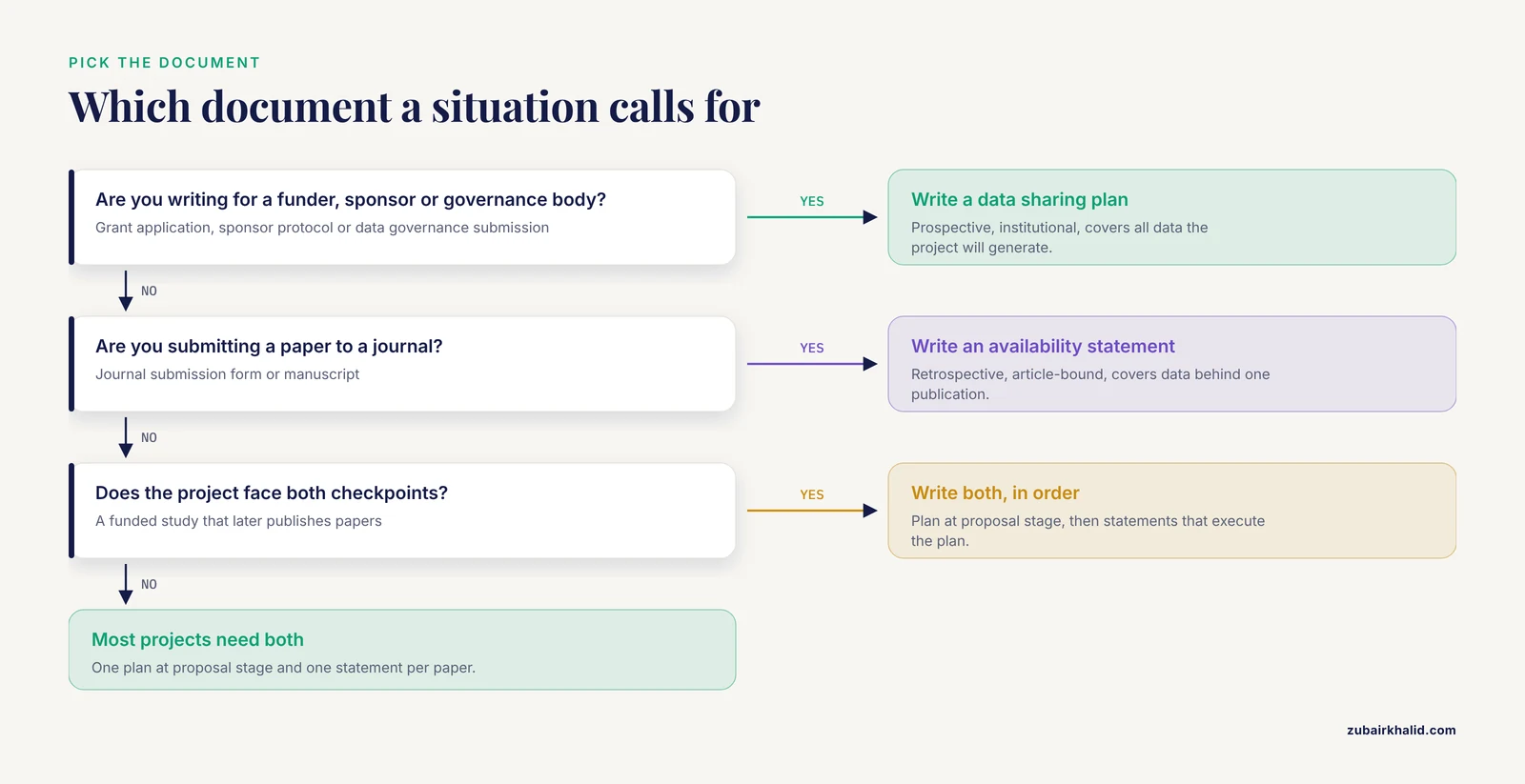
The lifecycle question settles most cases. If you are writing a grant application, a sponsor protocol, or a data governance submission, you are in plan territory. If you are filling out a journal submission form, you are in statement territory. The two checkpoints rarely collide, which is why "data sharing plan or data availability statement" is usually a false choice. Most substantive projects need both, at different moments.
Who is being addressed
A plan addresses an institution that is deciding whether to fund or permit work. A statement addresses a reader who is deciding whether to trust, reuse, or extend the work. Writing for the wrong audience produces the wrong document. A plan addressed to readers reads like marketing. A statement addressed to a funder reads like a compliance memo, with none of the practical detail, such as a working link or an access procedure, that a reuser actually needs.
Scope of the data covered
A plan covers the full data estate of a project, including raw instrument output, derived variables, and the data that will never leave the secure environment. A statement covers only the data needed to support the published claims. A single project that produces three papers will typically generate one plan and three statements, each statement pointing to a different slice of the same data estate.
The access model for the data
The sensitivity of the data determines how both documents treat access. Fully open data admit a short statement and a simple plan. Controlled-access data, such as health administrative records, require a plan that names the custodian, the approval pathway, and the security arrangements, and a statement that explains how a qualified researcher could apply for access. A study of prescribing patterns among older adults with dementia, for example, drew on population-based health administrative databases covering 99,046 individuals, a data environment in which individual-level records are held by data custodians rather than deposited publicly, and where both documents must describe that controlled pathway honestly [3]. Similarly, a multicountry severe asthma registry study drew on data from 24 countries held under registry governance, an arrangement where a bare promise of open sharing would be unworkable and the access route must be described instead [4].
When to use a data sharing plan
The clearest trigger is a funder or sponsor requirement. Many public funders now require a data management and sharing plan with proposals, and clinical trial sponsors increasingly maintain explicit policies, plan templates, and data use agreements as standing organizational documents [1]. If your funder, sponsor, or institutional review process asks for one, the question is settled. Write the plan, and write it well, because panels do read it.
Beyond compliance, there are four situations where writing a plan voluntarily pays for itself.
- Sensitive human data. When consent, privacy law, or participant expectations constrain sharing, deciding the governance pathway early, including whether a data use agreement will be needed, prevents a crisis at publication.
- Large collaborative projects. Multi-site teams need one document that says who formats what, where it is stored, and who can approve a sharing request. The plan becomes the team's operating agreement for data.
- Long-duration projects. Projects spanning years, staff turnover, or equipment changes need written preservation decisions that survive personnel changes.
- Secondary data reuse. Projects that combine datasets from multiple sources benefit from a plan that maps each source, its access conditions, and its citation requirements. An analysis that combined clinical trial data with real-world data across 18,860 individuals and 26,647 paired glucose measurements illustrates how multi-source projects accumulate heterogeneous access terms that are far easier to manage when written down in advance [5].
The plan is also where budget reality gets addressed. Repository deposition fees, curation labor, and long-term storage are real costs, and a plan that names them is more credible than one that assumes sharing is free.
When to use a data availability statement
The trigger here is nearly universal in modern publishing. Many journals require an availability statement at submission, and peer reviewers increasingly check whether the statement matches what the paper reports. Even where a statement is optional, including a specific one strengthens the paper's transparency and citability.
What separates a good statement from a bad one is actionability. Compare two versions.
- Weak: "The data that support the findings of this study are available from the corresponding author upon reasonable request."
- Strong: "De-identified participant-level data supporting Figures 2 and 3 are deposited in a public repository under DOI [identifier]. Materials from the consent-restricted qualitative subset cannot be shared, consistent with the participant consent form, and requests for aggregate data can be sent to [contact] with a description of the proposed use."
The weak version names no identifier, no conditions, and no timeline, which leaves the reader with nothing actionable. The strong version separates what is open from what is restricted, gives a concrete route for each, and explains the basis for the restriction. Journals that follow transparency norms generally favor the second form, and trials literature shows that detailed data sharing statements and accessible protocols are now the norm among high-impact publications [2].
One special case deserves its own note. Prospective trial protocols are themselves documents that shape later availability. A protocol published before enrollment, such as a registered randomized trial protocol specifying outcomes, analysis by intention to treat, and a defined follow-up window, creates a public commitment that the eventual availability statement can be checked against [6]. Writing the protocol and the plan together, before recruitment, is the cheapest way to ensure the later statement is true.
Data repository comparison for both documents
Both documents reference the same infrastructure, so choosing a repository is a shared decision. Repositories differ along six axes, and the right choice depends on which axes matter most for your data.
- Generality versus domain fit. Generalist repositories accept any file type and serve broad audiences. Domain-specific repositories enforce community formats and metadata standards, which makes data more reusable within a field but narrows discoverability outside it.
- Persistence. The critical axis. A repository with a policy-backed commitment to long-term preservation, and that issues persistent identifiers such as DOIs, makes both your plan and your statement durable. A lab website, a cloud folder, or journal supplementary material does not, because none of those carry a preservation commitment or a stable identifier.
- Curation. Some repositories review submissions for completeness, check metadata, and verify file integrity. Curation improves reuse value and catches errors before they become public.
- Access model. Open repositories serve files to anyone. Controlled-access repositories manage approval, data use agreements, and user certification, which is the appropriate model for sensitive human data and for data governed by third-party custodians.
- Licensing and terms. The license you apply at deposit, such as a permissive reuse license or a terms-of-use restriction, becomes part of what your availability statement can truthfully promise.
- Cost and sustainability. Repositories range from free public services to fee-based curation models. The plan is where these costs belong, not the statement.
A practical rule links the two documents. The repository named in the plan should be the one cited in the statement. When a project deposits in one place but the statement points elsewhere, reviewers and readers lose trust in both.
Regional and population data networks illustrate how infrastructure choices extend beyond single projects. In England, the Coda Network brought together local authorities, health services, and universities across coastal regions to share expertise and routinely collected health and administrative data for tackling health inequalities, an example of shared infrastructure built specifically so that member organizations do not each negotiate data access alone [7]. Projects tied to such networks inherit the network's governance, which belongs in the plan, and the network's access route, which belongs in the statement.
Worked scenarios
Scenario 1. Applying for a federal research grant
You are a postdoctoral researcher applying for funding for a prospective cohort study. The funder requires a data management and sharing plan. You write one at proposal stage covering the interview recordings, the derived transcript dataset, the codebook, and the de-identified quantitative file. The plan specifies open deposit of the quantitative data in a generalist repository with a DOI, controlled sharing of transcripts through a data use agreement, deletion of recordings after transcription, and a deposit deadline tied to the final publication. No availability statement is needed yet, because no paper exists. Two years later, when the first paper is submitted, the statement simply executes the relevant slice of the plan, citing the DOI for the quantitative file and the request route for transcripts.
Scenario 2. Submitting a secondary analysis to a journal
Your paper analyzes dispensation records obtained under an agreement with a regional health data center. The data are record-level, cover a large population, and are governed by the custodian's access rules. A public deposit is not possible. Your availability statement names the source, describes the custodian's application process, and states that the analysis code is deposited openly. The paper does not need a new plan, because the original data access agreement serves that governance function, but the statement must still be precise about the route to access.
Scenario 3. A sponsored clinical trial
Your company sponsors a phase 3 program. The sponsor maintains its own data sharing policy, plan templates, and data use agreements, as is increasingly common among major trial sponsors [1]. The plan, written before first patient in, commits to making individual participant data available to qualified researchers through a controlled-access process after the primary publication and applicable regulatory milestones. The later availability statement for each trial paper points to that process rather than to a repository, and states the timeline honestly. A safety review integrating data across eight phase 3 trials and their long-term extensions, covering more than 7,000 patient-years of exposure, is exactly the kind of analysis that later researchers can attempt only if the sponsor-controlled sharing pathway described at the plan stage actually functions [8].
Scenario 4. A multi-country registry study
Your study uses a treatment registry operating across dozens of countries, with data governance set by the registry's steering committee [4]. The availability statement describes registry access procedures and notes that country-level restrictions may apply. The plan, had one been written at project setup, would have flagged early that registry governance, not author preference, controls sharing, preventing the team from promising open deposit it could never deliver.
Common Mistakes and Limitations
Treating the plan as paperwork. The most expensive mistake in this space is writing a plan to satisfy a checkbox and never revisiting it. Projects then reach publication with a plan promising open data and a reality that permits none, and the eventual availability statement inherits the contradiction.
Writing the plan after data collection. A plan drafted once the data exist is a description, not a plan. Consent language, storage decisions, and governance arrangements are hardest to fix after the fact, which is why the prospective timing is not bureaucratic decoration.
The "on reasonable request" default. A statement saying data are available on request is only meaningful if a process exists, requests are actually answered, and the requestable dataset is defined. Meta-researchers who try to act on such statements routinely find that requests go unanswered, and reviewers increasingly push back on the phrase when no details are given.
Depositing supplementary files instead of data. Journal supplementary material is not a repository. It lacks persistent identifiers, preservation commitments, and version control, so a statement pointing to supplementary files ages poorly.
Ignoring the companion documents. Availability statements work best when protocols, statistical analysis plans, and code are accessible alongside the data. Trials in the neurology cohort referenced above showed that near-universal protocol and analysis-plan availability is achievable, and these documents are what make a shared dataset interpretable [2].
Overpromising on human data. Promising open sharing of data collected under consent that restricts redistribution creates a direct conflict with participant expectations. The plan stage is where consent language and sharing ambitions must be reconciled, not the publication stage.
Confusing a data use agreement with a plan. A data use agreement governs a specific transfer of data between parties. A plan describes overall data management. Sponsors maintain both, and they do different jobs.
A limitation on guidance itself. Requirements vary by funder, journal, and institution, and the documents described here continue to evolve. For any specific project, the controlling documents are your funder's current policy, your target journal's instructions, and your institution's data governance office, and individual cases should be checked against those before submission.
Frequently Asked Questions
Can a paper have a data availability statement without a data sharing plan?
Yes. Many published papers have a statement but no plan, because the underlying project never faced a funder requirement. The reverse is also possible, where a funded project with a plan has not yet produced any statements. The documents attach to different checkpoints, so one can exist without the other.
Is a data management plan the same thing as a data sharing plan?
Not exactly, but funders use the labels with varying overlap. A data management plan covers storage, documentation, and preservation, while a data sharing plan emphasizes how data will be made available to others. Many funders have merged the two into a single required document called a data management and sharing plan, so in practice you often write one combined document.
When should I write the data sharing plan?
At proposal stage, before any data are collected. The plan is a forward-looking commitment about data that do not yet exist, and writing it early lets you align consent language, repository choice, and budget with what you promise.
What should I write if I genuinely cannot share my data?
Write an honest restricted-data statement. Name the source of the data, explain the specific reason sharing is not possible, such as consent limitations, third-party custodianship, or regulatory control, and describe any route by which a qualified researcher could apply for access. Reviewers accept well-explained restrictions far more readily than vague refusals.
Do the plan and the statement ever cover the same data?
They can, but from opposite directions. The plan commits in advance to how a dataset will be shared, and the statement later reports what actually happened to that same dataset. When the statement contradicts the plan, reviewers and readers notice, so update the plan if circumstances changed.
What should I look for when choosing a repository for shared data?
Prioritize a persistent identifier such as a DOI, a long-term preservation commitment, metadata support appropriate to your field, and a license that matches what your availability statement will promise. For sensitive human data, choose a controlled-access repository rather than open deposit, and name that access model in both the plan and the statement.
Sources
- Data sharing policies, requirements, and support from public and private clinical trial sponsors: a survey on top sponsors of clinical trials in Europe.
- Evaluation of methodology, reporting and transparency of 50 highly cited randomised trials in neurology: a cross-sectional analysis.
- Using Medication Dispensation Data to Identify Clusters with Similar Prescribing Patterns in Older Adults Living with Dementia.
- Response to Biologics Along a Gradient of T2 Involvement in Patients With Severe Asthma: A Data-Driven Biomarker Clustering Approach.
- Updated glucose management indicator (GMI) better aligns with HbA(1c) than current GMI: implications for clinical practice and reporting.
- Effect of music listening on delirium after hip fracture operations (MLDHFO) in a regional hospital in Taiwan: a randomised controlled trial protocol.
- Using data to improve the health of coastal communities: The Coda Network.
- The Safety Data of Dupilumab for the Treatment of Moderate-to-Severe Atopic Dermatitis in Infants, Children, Adolescents, and Adults.