How to Write a Data Sharing Impact Statement for Grant Applications
By Dr. Zubair Khalid, DVM, MS, PhD ·

By the end of this guide you will be able to draft a data sharing impact statement for a grant application that a reviewer can score line by line, justify your choice of repository, name benefits a program officer can repeat to a review panel, and commit to impact metrics you can actually track. Keep three items on hand before you start: your funder's data sharing policy, a one-page inventory of the data your project will generate, and a shortlist of candidate repositories with their access terms.
A data sharing impact statement is the part of an application that explains why the data your project produces should be shared, who will reuse it, what benefits that reuse will create, and how you will know those benefits occurred. It usually sits inside a broader data management and sharing plan. Since early 2023, the National Institutes of Health has required investigators to submit a Data Management and Sharing Plan with grant applications, with the stated goal of amplifying the benefits of public investment in research by promoting the dissemination and reusability of primary data [1]. Other funders ask for equivalent language under names such as data availability statement or data management plan. Research data sharing has therefore shifted from an aspiration to a funded, reviewed requirement.
The skill this guide teaches is justification. Most applicants describe what they will do with their data. Fewer explain why anyone else should care, and reviewers notice the difference.
Why Reviewers Scrutinize Data Sharing Promises
Stated intentions often fail in practice, and reviewers know it. A cross-sectional review of clinical studies in ten leading ophthalmology journals found that 23.54 percent of 1,385 articles published between 2018 and 2023 included a data sharing statement, with rates ranging from 66.67 percent at the highest journal to 3.88 percent at the lowest [2]. In emergency medicine, 9.6 percent of 875 articles in high-impact journals included such statements. Prevalence rose from 2.12 percent in 2018 to 23.71 percent in 2023, and studies without listed funding sources were significantly less likely to include one [3]. In plastic surgery, 1.51 percent of 727 articles across the top seven journals included a statement [4].
The pattern behind these numbers is consistent. Statements cluster around clinical trials, vary sharply between journals, and often default to the weakest commitment available, some version of data available on request. A statement that names a repository, a persistent identifier, and a measurable benefit therefore stands out in a reviewer stack instead of blending into it.
Data Sharing Impact Statement Format for Grant Applications
Reviewers score faster when the statement follows a predictable shape. The five components below fit on one page and answer the five questions a reviewer actually asks. Treat the proportions as a guide rather than a rule.
- Data description and reusability (about a quarter of the statement). What data will the project produce, in what formats, at what scale, and what makes it reusable? Reusability depends on documentation as much as on openness. A deposit without a data dictionary, standard formats, and validation checks burdens the next user instead of helping them.
- Repository and access model (about a fifth). Name the repository, the persistent identifier it will assign, and whether access will be open, controlled, or mediated. A persistent identifier, typically a DOI (digital object identifier), is a link that keeps resolving after a project website disappears.
- Reuse scenarios (about a fifth). Name two or three concrete user groups and the analyses they would run. Specific scenarios can be checked later, vague ones cannot.
- Expected benefits (about a fifth). Sort claims into scientific (validation, pooled analyses, hypothesis generation), economic (duplication of expensive data collection avoided), and intangible (training, transparency, public trust).
- Metrics and reporting (the remainder). Which indicators you will monitor, where you will check them, and when you will report them.
Data Repository Comparison: Choosing Where the Data Will Live
The repository choice is the most checkable claim in your statement, so make it deliberately. The table compares the main options.
| Repository type | Best suited for | Access model | Identifiers and metadata | Check before committing |
|---|---|---|---|---|
| Generalist (for example Zenodo, Dryad, figshare) | Any data type when no subject repository exists | Usually open, embargoes often supported | DOI, basic descriptive metadata | File size limits, deposition fees, preservation funding model |
| Discipline-specific (for example NCBI sequence read and genotype-phenotype archives, protein structure banks, gene expression warehouses) | Data types with community standards | Open or controlled depending on the archive | Rich community-standard metadata, accession numbers | Required formats, validation rules, submission lead time |
| Institutional repository | Very large files, instrument output, institutional persistence requirements | Usually open, some restricted tiers | DOI or handle, institutional metadata | Whether records are discoverable outside the institution |
| Controlled-access repository | Human subjects data with consent limits | Managed access under data use agreements | Standardized study-level metadata | Consent mapping, approval timelines, access committee workload |
Three refinements strengthen the paragraph you write around this table.
First, for human data, replace blanket sensitivity claims with quantified or procedural reasoning. One published approach models privacy loss using information entropy adjusted for the privacy preferences of the groups represented in the data, which turns a vague assertion into a defensible number [5]. A procedural alternative is mapping each consent category to a matching access tier and stating the mapping in one sentence.
Second, when consent or contracts rule out releasing real records, synthetic data can complement or partially substitute for deposition. Synthetic data are artificially generated records that preserve the statistical structure of a dataset without containing real individuals. A benchmark of 13 tabular data synthesis tools across 15 datasets found wide variation in privacy, machine learning utility, and computational cost, so a synthesis tool must be matched to the intended reuse rather than adopted by default [6]. If you promise synthetic data, state which analyses it will and will not support.
Third, name the quality controls that run before deposition. Data quality assessment in shared settings is complicated by heterogeneous sources and by checks that get evaluated in isolated stages of a processing pipeline, so reviewers respond well to a specific list, for example validation against a data dictionary, range and unit checks, and duplicate detection [7].
Finally, match the repository to the reuse community rather than to your own convenience. A deposit your field already searches earns citations a standalone institutional store will not, and that difference shows up directly in the metrics you promise later in the statement.
How to Quantify the Impact You Promise
Measurement methods fall into two families, and a strong statement draws on both. Bottom-up approaches track activity around the dataset itself, for example dataset citations, repository downloads, and secondary publications. Top-down approaches estimate broader consequences, for example economic savings and intangible benefits. A review of measurement methods concluded that author-level metrics for datasets exist but see limited application, while non-traditional measures, including economic and intangible benefits, currently hold more promise for evaluating the impact of primary data sharing [1].
Commit to indicators you can collect without new funding:
- Dataset citations, checked through the DOI record
- Views and downloads from the repository dashboard
- Secondary publications that cite the accession or DOI
- Requests received through a controlled-access mechanism
- Trainees who used the deposit as practice data
If your project has a training or capacity component, borrow a structure from implementation science. The CaribData project, which built a data handling platform and a training and mentoring program in the Caribbean, evaluates itself with the RE-AIM framework, asking about Reach, Effectiveness, Adoption, Implementation, and Maintenance [8]. Those five questions convert a soft claim such as trainees benefited into a checkable one such as twelve trainees completed the curation module and three went on to deposit their own datasets. That example is illustrative, your own numbers come from your project records.
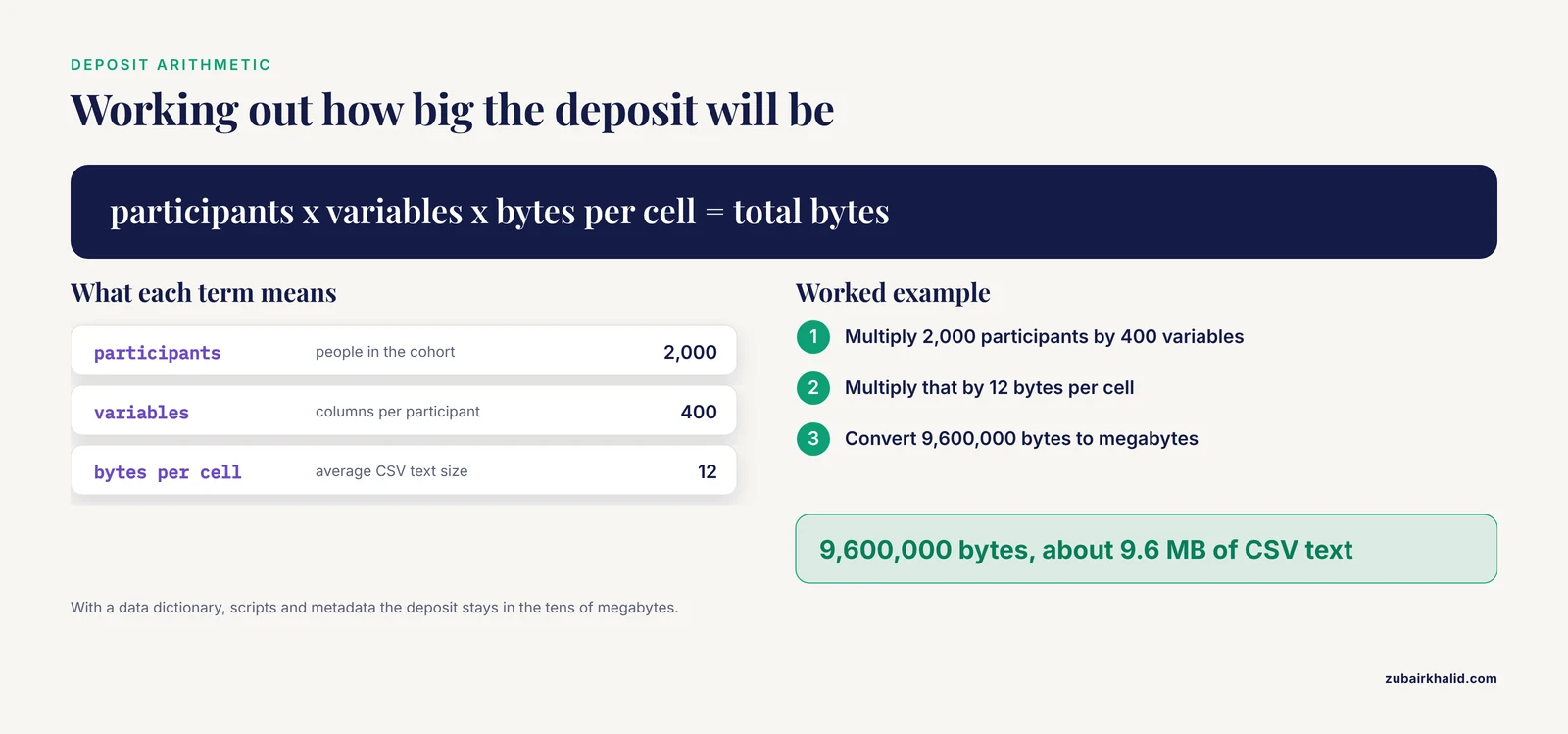
Do the deposit arithmetic before you write the repository paragraph. Suppose a cohort of 2,000 participants contributes 400 variables each, stored as CSV text averaging 12 bytes per cell:
2,000 participants × 400 variables × 12 bytes per cell
= 9,600,000 bytes
≈ 9.6 MB of CSV text
Add a data dictionary, analysis scripts, and metadata files and the deposit stays in the tens of megabytes, small enough for any generalist repository. A single deep-sequenced human genome, by contrast, occupies tens of gigabytes, which pushes you toward a discipline-specific archive or institutional storage. Size determines the realistic option, and reviewers can tell when the arithmetic was done.
Step-by-Step: Drafting the Statement
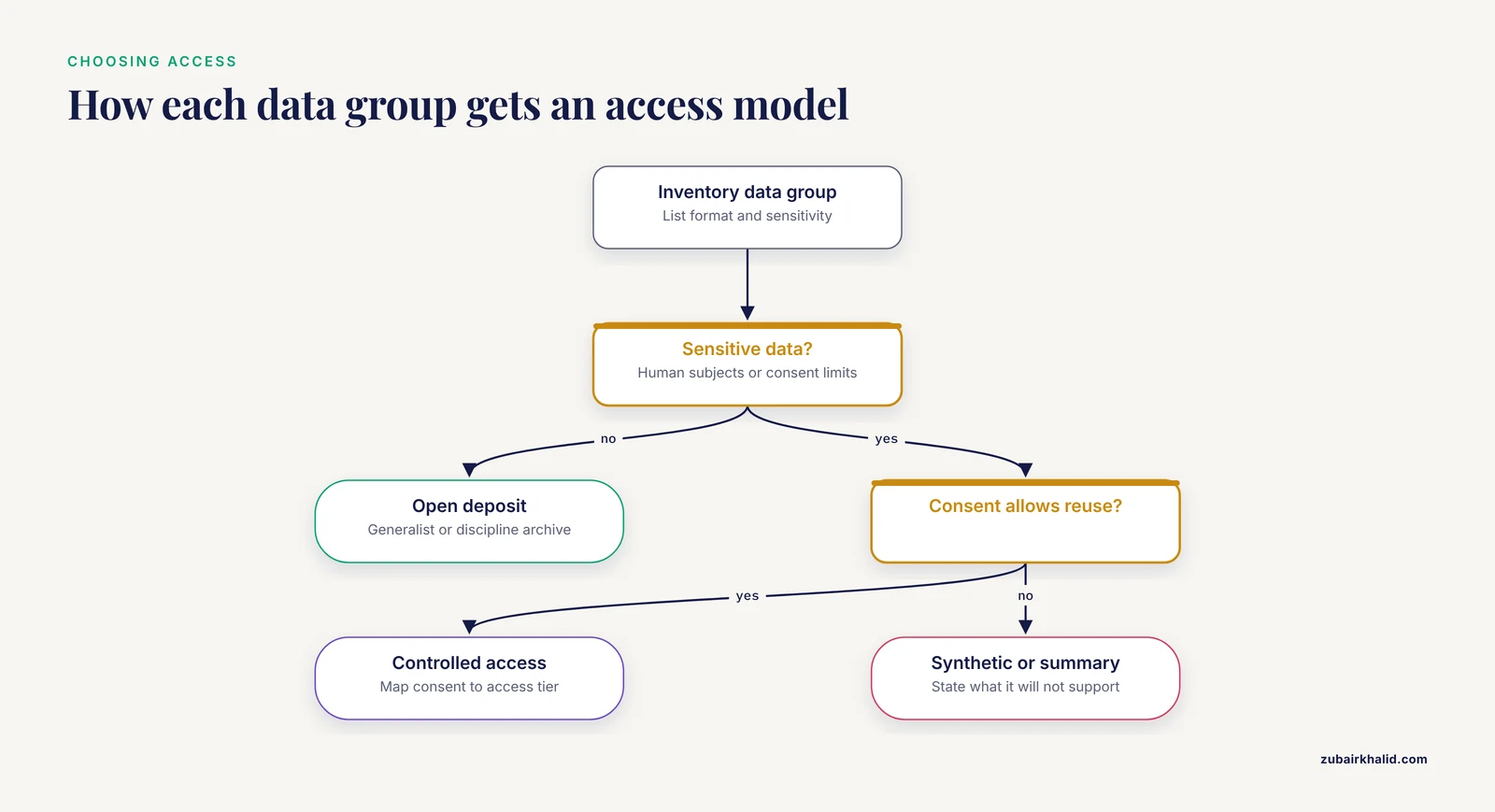
Step 1: Inventory the data. List every data group the project will produce, its format, its sensitivity, and its likely destination. A spreadsheet or plain CSV file is enough.
group,variables,format,sensitivity,destination
demographics,"age, sex, race, ethnicity, BMI",CSV,restricted,controlled-access repository
clinical,"HbA1c, blood pressure, medication codes",CSV,restricted,controlled-access repository
microbiome,"amplicon sequence variants, taxonomy counts",BIOM,open,discipline-specific archive
questionnaire,"diet frequency, physical activity",CSV,open,generalist repository
Confirm the file parses and has the expected number of rows:
wc -l data_inventory.csvExpected output:
5 data_inventory.csvFive lines means a header plus four data groups. A different count usually means a stray blank line or an unquoted comma, the two most common CSV faults at this stage.
Step 2: Assign an access model to each row. Mark each group open, controlled, or synthetic. Restricted human data go to controlled access mapped to the consent form. Groups that cannot be released at all get a synthetic or summary substitute, or an explicit statement of the restriction.
Step 3: Pick and justify the repository. Write one sentence per dataset in this shape: sequence data will be deposited in [archive], which validates [format] submissions and assigns accession numbers on acceptance. If two candidate repositories both work, prefer the one your target reuse community already searches.
Step 4: Write the reuse scenarios. Two or three sentences, each naming a user group, the analysis, and why the deposited form supports it. For example: an epidemiologist can pool the de-identified clinical tables with comparable cohorts for meta-analysis, because the tables carry harmonized variable definitions.
Step 5: Draft the benefits in three registers. Write one scientific sentence (what becomes testable or poolable), one economic sentence (what expense a reuser avoids), and one intangible sentence (what the deposit demonstrates about transparency or training). Keep each sentence falsifiable.
Step 6: Commit to metrics with a schedule. One line is enough: we will report dataset citations, downloads, and access requests in each annual progress report. Tie every promised number to a place you can check it, the DOI record or the repository dashboard.
Step 7: Assemble and check the length. Save the statement as a plain text or Markdown file and count the words:
wc -w impact_statement.mdExpected output:
498 impact_statement.mdA count near 500 fits a one-page statement. If the funder caps the whole plan at a page count, the statement has to share that space, so cut the reuse scenarios to two rather than trimming the metrics.
Step 8: Red-team the draft. Ask three questions. Could a stranger locate the data from the statement alone? Could they run an analysis without emailing the team? Would a program officer repeat your benefit sentence to a review panel? Any no sends you back to the relevant component.
After submission, calendar the first metric check for the month before your first progress report is due. A statement with a reporting rhythm behind it reads very differently from one written and forgotten.
A Data Sharing Impact Statement Template You Can Adapt
Replace every bracketed field. Delete any component a funder does not request, but never delete the metrics line.
DATA SHARING IMPACT STATEMENT
[Project title] [Funding opportunity number]

1. Data produced and reusability
The project will generate [data types] on approximately [N] [participants or samples],
stored as [formats]. Each dataset will carry a data dictionary, [named quality checks],
and the analysis code needed to reproduce all published results.

2. Repository and access
[Dataset 1] will be deposited in [repository], which assigns a [DOI or accession] and
supports [metadata standard]. [Dataset 2] contains [sensitive element] and will be
deposited under [access model] consistent with the participant consent form.

3. Reuse scenarios
[User group 1] can use these data to [analysis]. [User group 2] can [analysis].
[User group 3] can [analysis].

4. Expected benefits
Scientific: [what becomes testable, poolable, or comparable].
Economic: reuse avoids the cost of regenerating [data type] for [purpose].
Intangible: the deposit supports [training, transparency, public trust].

5. Metrics and reporting
We will track [dataset citations, downloads, access requests] through [DOI record,
repository dashboard] and report them in [reporting venue and schedule].
A Worked Data Sharing Impact Statement Example
The example below is hypothetical, a five-year cohort study of gut microbiome and type 2 diabetes, written to show the density a reviewer expects.
PROJECT: Gut microbiome signatures of type 2 diabetes progression
(hypothetical five-year cohort, 1,200 adults)

1. Data produced and reusability
The study will generate stool metagenomic sequences, annual clinical chemistry
panels, and dietary questionnaires for 1,200 adults. Sequence data will be
deposited as FASTQ (the standard text format for raw sequencing reads) with
taxonomy count tables in BIOM format (a standard format for count tables).
Clinical and dietary tables will be de-identified CSV files with a published
data dictionary. Quality control scripts will be versioned and deposited with
the data.

2. Repository and access
Sequence data will be deposited in a sequence read archive that validates FASTQ
submissions and assigns accession numbers on acceptance. De-identified clinical
tables will be deposited in a generalist repository that mints a DOI. The
consent form covers broad clinical and genomic reuse without commercial
restrictions, so no controlled-access tier is required.

3. Reuse scenarios
Diabetes researchers can pool the clinical tables with comparable cohorts for
meta-analysis. Microbiome methods groups can benchmark profiling pipelines
against the sequence data. Nutrition scientists can link dietary patterns to
microbiome composition without new sample collection.

4. Expected benefits
Scientific: the deposit enables validation of published microbiome-disease
associations and pooled analyses no single cohort can support. Economic:
secondary users avoid the multi-year cost of recruiting and sequencing an
equivalent cohort. Intangible: the deposit gives trainees realistic practice
data and demonstrates transparency to the participants who donated samples.

5. Metrics and reporting
We will report dataset citations, downloads, and accession-linked secondary
publications in each annual progress report, with a final summary in year five.
Note what the example does not do. It does not promise download counts in advance, it does not overclaim what the data can support, and it leaves no dataset without a destination.
Common Mistakes and Limitations
Mistake 1: Relying on available upon request. This is the most common and least credible commitment. In emergency medicine journals, thematic analysis of the statements that did exist identified gatekeeping among the prevailing themes, and the study tested follow-through by contacting corresponding authors who had promised data on request [3]. In plastic surgery, corresponding authors who had stated data were available on request produced no responses when contacted, a direct gap between stated intention and practice [4]. Name a repository instead, and reserve on-request language for data that genuinely cannot be deposited, with the reason stated.
Mistake 2: Vague benefit claims. Data will accelerate research cannot be scored. Name the user group, the analysis, and the indicator.
Mistake 3: No named repository. Data will be made available fails the findability test. Every dataset needs a destination and an identifier.
Mistake 4: Promising metrics you cannot collect. If you have no repository dashboard, do not promise download counts. Commit to the DOI record and annual reporting instead.
Mistake 5: Hand-waving privacy. Too sensitive to share invites the follow-up question, too sensitive to fund. Use managed access mapped to consent categories, or a quantified privacy argument.
Mistake 6: Treating the statement as set-and-forget. The plan you write becomes a commitment reviewed at progress reports. Funders generally expect changes in circumstances to be documented and justified rather than made silently.
Limitations to keep in mind. Impact measurement for shared data is immature. Author-level metrics for datasets exist but are rarely applied, and the most promising evaluation approaches today are non-traditional ones such as economic and intangible benefit descriptions [1]. Impact prediction methods are advancing at the article level through network-based techniques, and dataset-level equivalents will lag behind [9]. Finally, your funder's own instructions always override any template, including the one above, and a statement is a plan rather than a guarantee.
Frequently Asked Questions
How long should a data sharing impact statement be?
Aim for one page or roughly 500 words for the statement itself. The cap that matters is usually on the whole data plan, so check the funding announcement before you write.
Is a data sharing impact statement the same as a data management and sharing plan?
No. The plan covers the full data lifecycle from collection through preservation. The impact statement is the justification component, arguing why sharing creates value and how that value will be measured.
Do I have to share human subjects data openly?
No. Controlled-access repositories exist for consent-limited human data. Map each consent category to an access tier and state the mapping in one sentence.
Does synthetic data count as sharing?
It can complement sharing when real records cannot be released, because synthetic records preserve statistical structure without exposing real individuals. Be explicit about which analyses the synthetic version will and will not support.
Which metrics should I commit to?
Commit to indicators you can collect without new funding, such as dataset citations through the DOI, repository downloads, and access requests. Pair one activity metric with one broader benefit described qualitatively.
What if contracts or proprietary rights block sharing?
State the specific restriction and describe the closest achievable alternative, for example depositing derived summary tables or analysis code. Reviewers accept documented constraints and question unexplained silence.
Can I change the plan after the award?
Yes, circumstances change, and funders generally expect changes to be documented and justified in progress reports rather than made silently. Build the reporting habit into your project calendar.
Do journal data policies affect what I write?
They can. Journals increasingly request data sharing statements at publication, so a grant statement that already names a repository and an identifier makes the manuscript step straightforward.
Sources
- Measuring the Impact of Data Sharing: From Author-Level Metrics to Quantification of Economic and Non-tangible Benefits
- Evaluating the prevalence and application of data sharing statements in high-impact ophthalmology journals.
- Evaluating data sharing statements in leading emergency medicine journals: A mixed methods review.
- The State of Data Sharing in Plastic Surgery: An Analysis of Journal Practices and Author Adherence.
- Data Sharing Privacy Metrics Model Based on Information Entropy and Group Privacy Preference
- Benchmarking Tabular Data Synthesis: Evaluating Tools, Metrics, and Datasets on Prosumer Hardware for End-Users
- Data Quality and Trust: Review of Challenges and Opportunities for Data Sharing in IoT
- Implementing and evaluating a project to enable and encourage Caribbean data-sharing
- An Overview on Evaluating and Predicting Scholarly Article Impact