Costs and Sustainability of Data Repositories
By Dr. Zubair Khalid, DVM, MS, PhD ·

The real difference between data repository options comes down to who pays, and when. Some repositories are free to use but live on short grant cycles, some charge subscriptions for full access while keeping a free academic tier, and some are funded inside universities or federal agencies as permanent infrastructure. A good rule of thumb for choosing: match the funding model to your situation. If your funder mandates data sharing, pick a certified domain or generalist repository. If your data is sensitive clinical information, use a controlled-access repository built for that purpose. If nothing else fits, ask your library about an institutional repository.
This guide explains how repositories are funded, what each model costs depositors and users, where each model is vulnerable, and how to make a defensible choice for your own research data sharing plan.
What a Data Repository Actually Costs to Run
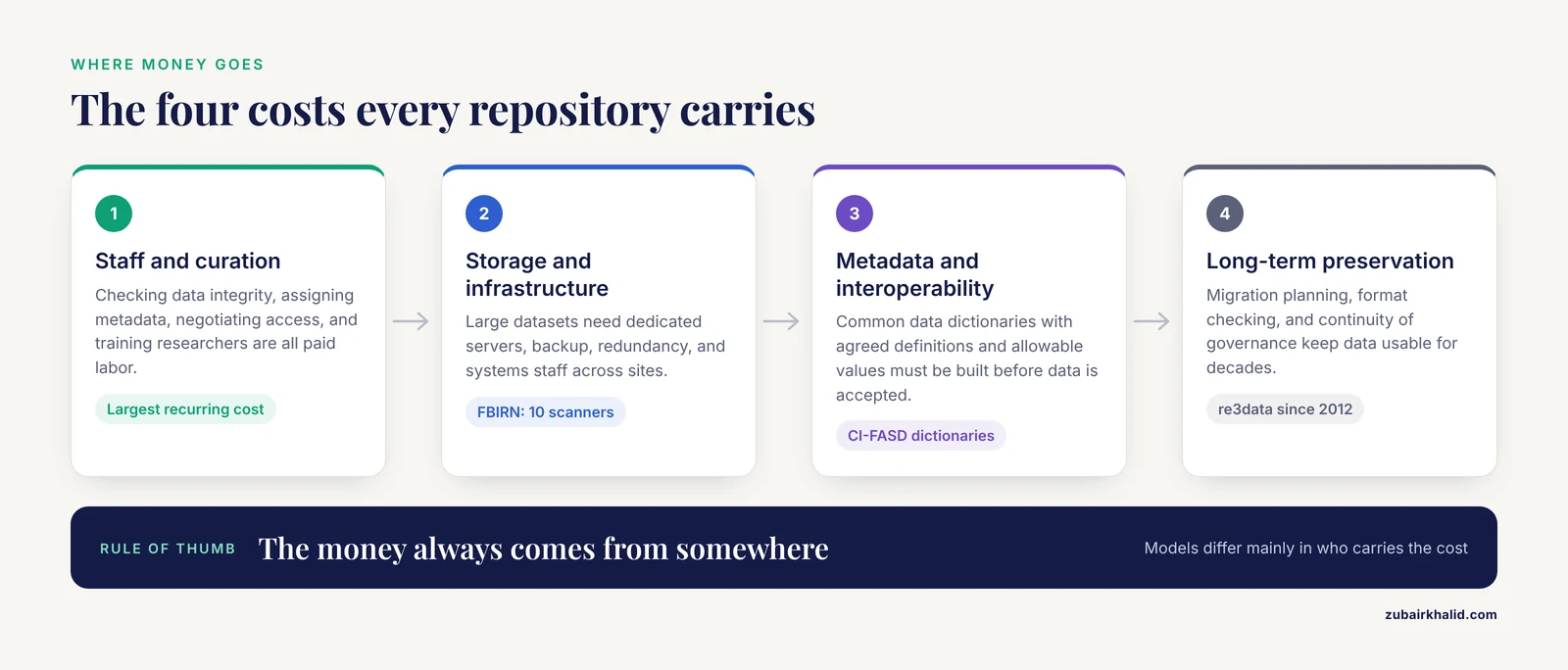
A research data repository (RDR) is a curated service that stores, describes, and distributes datasets over the long term. The registry re3data has tracked this landscape since 2012 and currently describes more than 3,000 repositories across every discipline [1]. Those repositories differ enormously in size and budget, but they share the same basic cost drivers.
Staff and curation. Curation is the largest recurring expense at most repositories. A qualitative study of institutional repository staff at 13 large US research universities documented the full range of curation work: checking data integrity, assigning metadata, negotiating access conditions with depositors, training researchers, and applying workarounds when staffing falls short of demand [2]. Every one of those activities is paid labor. A repository that accepts data "for free" is almost always paying for curation out of some other budget.
Storage and infrastructure. Datasets now routinely reach sizes where storage, backup, and network transfer carry real annual costs. Multi-site imaging studies illustrate the scale. The Function Biomedical Informatics Research Network (FBIRN) built a federated database to host and query functional MRI datasets collected on 10 different scanners, from 1.5 to 4 Tesla, across multiple clinical sites [3]. Infrastructure like that requires dedicated servers, redundancy, and systems staff.
Metadata and interoperability. Making data reusable means standardizing it. The Collaborative Initiative on Fetal Alcohol Spectrum Disorders (CI-FASD) spent significant effort developing common data dictionaries, with agreed definitions and allowable values, before its central repository could even accept data. Data entry restrictions were then enforced so that only dictionary-conforming data reached the repository [4]. That standardization work is expensive up front but is exactly what makes shared data worth using.
Long-term preservation. Data that must remain findable and usable for decades needs migration planning, format checking, and continuity of governance. The ten-year retrospective on re3data discusses these management burdens directly, from maintaining a comprehensive metadata schema to keeping the service usable for funding agencies, libraries, and data centers worldwide [1].
Understanding these drivers reframes the whole question of data repository costs. The money always comes from somewhere. The models below differ mainly in who carries it.
The Main Funding Models for Data Repositories
Free public repositories funded by grants and volunteers
Many discipline repositories are free to both depositors and users. Their operating money comes from grants, host institutions, or volunteer academic labor.
The Systematic Review Data Repository (SRDR) is a clear example. It is a free, web-based, open-source data management and archival platform for systematic reviews, funded by the US Agency for Healthcare Research and Quality (AHRQ). Since its 2012 launch it has accumulated 2,552 user accounts from 80 countries, and data have been made publicly available for 152 of its 735 projects, at an average rate of 24.5 projects per year [5]. The service costs users nothing, but its existence depends on continued agency support.
At the smaller end of the spectrum sits MathRepo, a repository for mathematical research data such as computer algebra notebooks, research software packages, and collections of mathematical objects, maintained at the Max Planck Institute for Mathematics in the Sciences. Its maintainers describe openly the current challenges they face in keeping the repository good, which include the volunteer time required to review and curate diverse contribution types [6]. Small volunteer-run repositories are often the cheapest to operate and the most fragile.
Subscription and licensed repositories
The second model charges for access. The Human Gene Mutation Database (HGMD) is the textbook case. HGMD is a curated collection of germline mutations underlying inherited human disease, containing more than 203,000 gene lesions across over 8,000 genes, with new entries accumulating at more than 17,000 per year. It runs a dual model: a public version freely available to registered academic and nonprofit users, and a subscription version, HGMD Professional, licensed to academic, clinical, and commercial users through QIAGEN [7].
This structure has direct consequences for depositors and readers. Depositors pay nothing, because the curated mutation data originate in the published literature. Readers at commercial companies and clinical laboratories pay license fees, and those fees fund the manual curation of roughly 17,000 new entries annually [7]. For a researcher at a university, the practical cost of using HGMD is often zero. For a biotech company, it is a line item.
Institutional repositories
Many universities have added research data curation services to their existing institutional repositories. These are funded from library and information technology budgets and are usually free to the institution's own researchers. The study of curation practices at 13 US research universities found that institutional repositories handle a wide variety of data, serve multiple audiences, and depend on staff with skills in metadata, data management planning, and disciplinary norms [2]. For an individual researcher, an institutional repository typically has the lowest direct cost of any option. The tradeoff is service depth: a library-run repository may accept almost any file format but cannot offer the domain expertise of a specialist repository.
Government-funded national repositories
Federal agencies fund large-scale repositories as research infrastructure. Two clinical examples show the range. The Biomedical Translational Research Information System (BTRIS) at the National Institutes of Health consolidates clinical research data across 27 institutes and centers, currently holding over 300 million rows of data from three institutes, with records reaching back to 1976 [8]. The Veterans Affairs Precision Oncology Data Repository (VA-PODR) holds nationwide de-identified cancer data, including longitudinal clinical records, targeted tumor sequencing, and imaging such as CT scans and pathology slides. A subset is available through the Genomic Data Commons and The Cancer Imaging Archive, and the full repository is accessible through the Veterans Precision Oncology Data Commons [9].
In this model, taxpayers fund the infrastructure and access is governed by data use agreements rather than fees. Depositors within the system (VA researchers, NIH intramural investigators) deposit as part of their institutional workflow.
Side-by-Side Comparison
| Criterion | Free public repository | Subscription repository | Institutional repository | Government-funded repository |
|---|---|---|---|---|
| Example | SRDR, MathRepo | HGMD Professional | University library IR | VA-PODR, BTRIS |
| Who pays to operate | Grant funders, host institution, volunteers | License fees from commercial and clinical users | University library and IT budgets | Federal agencies |
| Cost to depositor | Free | Free | Usually free for affiliated researchers | Part of institutional workflow |
| Cost to user | Free | Free academic tier, paid professional tier | Free | Free but controlled access with data use agreements |
| Curation depth | Varies from strong to minimal | Very high, professionally staffed | Generalist, depends on staff skills | High for the data domain served |
| Main sustainability risk | Grant cycles end, volunteers move on | Depends on continued commercial demand | Library budget pressure | Shifting agency priorities |
| Best fit for | Datasets matching the repository's scope, especially where funder mandates apply | Annotating sequence data, clinical genetics, industry work | Small or heterogeneous datasets with no obvious domain home | Sensitive clinical data and large national cohorts |
Data Repository Costs Options: Pros and Cons
Free public repositories
Pros. Zero cost for depositors and readers. Wide discoverability, especially when indexed by registries such as re3data, which allows searching and filtering repositories across all disciplines [1]. Open access accelerates reuse. Open clinical data repositories have been shown to rapidly accelerate research, minimize redundancies, and disseminate expertise needed to overcome implementation barriers in fields such as ophthalmic artificial intelligence [10].
Cons. Sustainability is the weak point. A grant-funded repository can shrink or close when funding ends. Volunteer-run repositories depend on a small number of people, as the MathRepo maintainers describe in their account of ongoing challenges [6]. Researchers who deposit in a young repository should treat its longevity as a real risk factor, not a footnote.
Subscription repositories
Pros. The license revenue model can be very stable, because it scales with demand. HGMD's dual structure lets academic users work free while commercial licenses fund curation at scale [7]. Professional curation quality tends to be consistently high.
Cons. Full access costs money, which can exclude researchers at under-resourced institutions and can fragment a field between those who can afford the professional tier and those who cannot. Coverage is also selective: a subscription database curates what its editorial process includes, not everything published.
Institutional repositories
Pros. Free and local, with staff who know the institution's policies and can advise on data management plans. Staff at the surveyed universities actively developed solutions to curation problems and documented workarounds that newer services can adopt [2].
Cons. Generalist repositories usually cannot provide deep domain curation, specialized metadata standards, or the disciplinary visibility that a well-known domain repository offers. Service quality varies considerably across institutions.
Government-funded repositories
Pros. Long planning horizons and substantial resources. BTRIS was designed specifically to unify disparate databases and let investigators reuse existing clinical trial data to answer new questions, supported by a Research Entities Dictionary that harmonizes controlled terminologies across source systems [8]. Large government repositories also enable research at population scale, as VA-PODR does for translational cancer research in the Veteran population [9].
Cons. Access is usually restricted and application-driven. Depositing is generally limited to investigators within the sponsoring system. A centralized repository can also create dependency: a case report from Columbia University found that a centralized research data repository markedly enhanced retrospective outcomes research capacity, which is a benefit, but it means the institution's research depends on that single piece of infrastructure staying funded [11].
What Decides the Real Cost for You
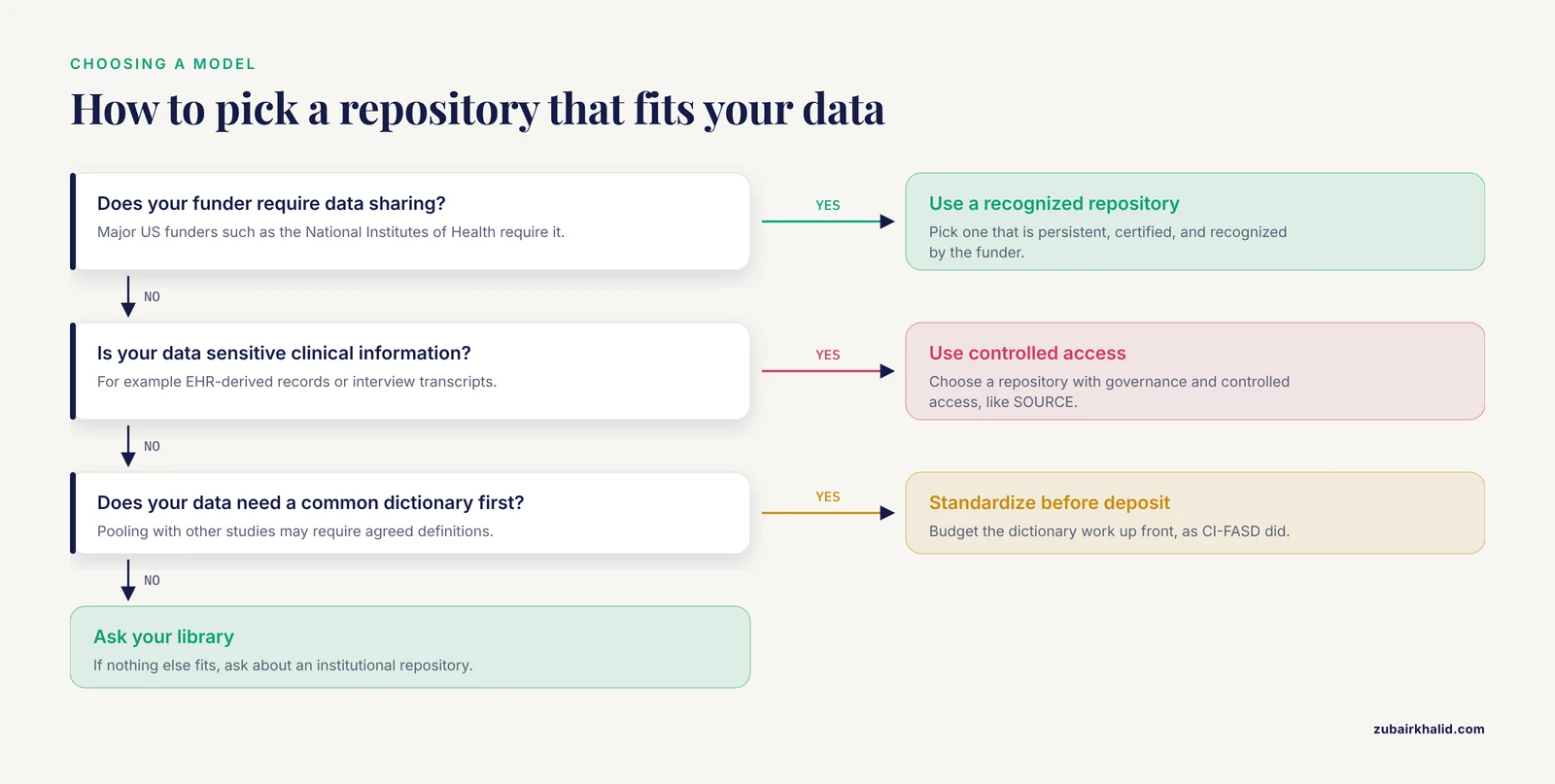
The best data repository cost option is rarely the one with the lowest sticker price. Four factors should drive the decision.
1. Your funder's mandate. Major US funding bodies such as the National Institutes of Health require data sharing from funded projects [12]. A mandate usually narrows your choices to repositories that are persistent, certified, and recognized by the funder. Depositing somewhere free but short-lived can put compliance at risk.
2. Your data type and its curation needs. Specialized data needs specialized handling. Clinical EHR-derived data requires the governance and controlled access of repositories like SOURCE, the Sight Outcomes Research Collaborative ophthalmology data repository, which researchers used to build a risk stratification tool for triaging glaucoma appointments during the COVID-19 pandemic [13]. Standardized experimental data fits domain repositories with established metadata. If your data needs a common dictionary before it can be pooled with other studies, expect the repository or your consortium to invest in that standardization first, as the CI-FASD collaboration did [4].
3. Reuse value versus deposit effort. Depositing well-organized data into a repository with real curation multiplies the value of data that was time- and resource-intensive to collect [12]. Paying nothing to deposit into a repository that nobody can find or trust saves money and loses value. When estimating benefits, health systems that built research patient data repositories have found the calculation worthwhile, and methodological work on calculating those benefits dates back well over a decade in the medical informatics literature [14].
4. Who needs access, and at what level. If your intended users include companies, the subscription model may be what keeps the resource curated at all. If your users are the global research community, open models with strong governance agreements, like those the ophthalmic imaging community draws on for data use and sharing, spread benefits furthest [10].
Worked Scenarios
Scenario 1. A graduate student with sequencing data. Her grant requires data sharing. The pragmatic choice is an established domain repository recognized by her funder, not a homegrown lab server. Cost to her: nothing, plus a few days preparing metadata. The subscription versus free distinction does not affect her as a depositor, though she should check whether the repository's access model matches her funder's expectations.
Scenario 2. A qualitative research team. The team interviewed patients about a sensitive health topic and wants to share transcripts. Interviews with 30 qualitative researchers, 30 data repository curators, and 30 institutional review board staff members found that all three groups were underprepared for qualitative data sharing. Researchers were the least knowledgeable, curators wanted qualitative-specific guidance and standards, and IRB members supported sharing only when legal and regulatory procedures were followed [12]. The practical cost here is not storage. It is the staff time to de-identify, redact, and document transcripts so that confidentiality is protected while enough context remains for secondary analysis. The team should budget that labor into the grant.
Scenario 3. A systematic review team. They extracted data from hundreds of studies and want to reduce wasted duplication across the field. SRDR fits exactly, since it exists to make review data publicly available, reduce unnecessary duplication of effort, standardize data, and support secondary analyses [5]. Cost: free, in exchange for entering data in SRDR's structured format.
Scenario 4. A multi-site imaging consortium. Five sites are running fMRI studies on the same subjects across different scanners. FBIRN solved this problem by building shared protocols and a federated database, and its datasets, including a traveling subject study of 5 healthy volunteers each scanned on 10 scanners at 1.5 to 4 Tesla, are now shared publicly through the BIRN Data Repository [3]. The lesson: multi-site projects should budget for harmonization infrastructure from the start, because retrofitting it later is far more expensive.
Scenario 5. A hospital research office. The office wants to consolidate trials data scattered across departmental databases. BTRIS at NIH shows the design pattern: a unified terminology layer, a hybrid data model, and tiered access so investigators see their own subjects in identified form and everyone else's in de-identified form [8]. The cost is substantial and ongoing, but a centralized repository demonstrably enhances retrospective research capacity [11], and the benefits case can be calculated explicitly [14].
Common Mistakes and Limitations
- Assuming free means costless. Free repositories shift costs onto funders, host institutions, or volunteers. If a repository's funding story is unclear, ask before you deposit anything you cannot afford to lose.
- Depositing in the first repository you find. Use a registry to compare options by discipline, data type, and access model before committing [1]. A poorly matched repository creates curation problems for its staff and discoverability problems for your data [2].
- Ignoring the access model. Depositing human data into a fully open repository, or depositing open data into a subscription-only service, both create mismatches between your obligations and the repository's policies.
- Underestimating qualitative data. Sharing interview transcripts and field notes requires confidentiality review that most researchers and even many curators have not been trained to perform [12]. Plan for it explicitly.
- Skipping standardization. Data that arrives without a common dictionary cannot be integrated across studies, which is precisely why earlier attempts to pool fetal alcohol spectrum disorders research data failed before CI-FASD built shared dictionaries [4].
- Treating sustainability as someone else's problem. Every dataset deposited into a fragile repository becomes a liability the community inherits.
One limitation applies to this article itself. It describes repository models and cost structures, not the policies of any individual service, which change over time. Always check the current deposit agreement and access terms of any repository before you commit data.
How Repositories Sustain Themselves Long Term
Sustainability is the honest test of any repository model, and the evidence points to a few patterns.
Diversified or hybrid revenue is the most robust. HGMD's free academic tier paired with commercial licensing through QIAGEN has sustained curation of hundreds of thousands of mutation records over many years [7]. The commercial side pays for the professional curation that the academic side benefits from.
Institutional and agency backing buys time horizons that grants cannot. BTRIS has consolidated clinical research data continuously since 1976 [8]. SRDR has run as free open-source infrastructure under AHRQ support since 2012 [5]. Both survive because their sponsors treat them as permanent infrastructure rather than as projects.
Longevity itself becomes an asset. re3data's ten-year retrospective notes that the registry is now referenced in the policies of many scientific institutions, funding organizations, and publishers, and that its descriptions are open data used by numerous open science services [1]. That embeddedness protects the service, because too many workflows now depend on it for it to disappear quietly.
Community dependence is a double-edged sword. SRDR's 2,552 users across 80 countries represent genuine demand, yet only 21 percent of its projects have made data publicly available [5]. Sustaining a repository requires not just funding but a community that actually deposits, which is a cost borne by researchers in time and effort.
Curation capacity is the bottleneck everywhere. Across the institutional repository study, staff shortages, skill gaps, and the sheer variety of data types emerged as the recurring constraints on sustainable service [2]. Money that buys storage without buying curation buys an archive, not a repository.
Frequently Asked Questions
What do data repository costs actually cover?
They cover staff curation, storage and backup infrastructure, metadata work, access management, and long-term preservation. Curation, meaning the human labor of checking, documenting, and describing data, is usually the largest recurring cost [2].
Are free data repositories really free?
They are free to depositors and users, but somebody pays. Free repositories run on grant funding, institutional budgets, or volunteer labor, and each of those sources can end. The maintainers of MathRepo, for example, describe ongoing challenges in sustaining a volunteer-run mathematical research data repository [6].
Which repository model is the most sustainable?
Hybrid models with diversified revenue, such as free academic access paired with commercial licensing, tend to be the most stable, as seen with HGMD Professional [7]. Government- and institution-funded repositories are also durable as long as their sponsors treat them as infrastructure. Grant- and volunteer-dependent repositories carry the highest risk.
What is the best data repository cost option for a graduate student?
A free, established domain or generalist repository that your funder recognizes. Deposit is free, compliance is satisfied, and discoverability is strong. Check the repository's listing and characteristics in a registry such as re3data before committing [1].
Do subscription repositories ever become free?
Many run a dual model. HGMD offers a public version free to registered academic and nonprofit users while the professional version is licensed commercially [7]. If your institution has academic status, you may already have access to the free tier of subscription repositories in your field.
How does repository choice affect research data sharing compliance?
Funders increasingly require sharing, and they expect data to land in a repository that is persistent, curated, and appropriate for the data type [12]. Depositing in a fragile or mismatched repository can satisfy the letter of a plan while failing its purpose, so verify the repository's funding model, access controls, and curation practices as part of your data management plan.
Sources
- re3data - Indexing the Global Research Data Repository Landscape Since 2012
- Practices of research data curation in institutional repositories: A qualitative view from repository staff
- The Function Biomedical Informatics Research Network Data Repository
- Implementation of a Shared Data Repository and Common Data Dictionary for Fetal Alcohol Spectrum Disorders Research
- The Systematic Review Data Repository (SRDR): descriptive characteristics of publicly available data and opportunities for research
- The mathematical research-data repository MathRepo
- The Human Gene Mutation Database: towards a comprehensive repository of inherited mutation data for medical research, genetic diagnosis and next-generation sequencing studies
- The Clinical Research Data Repository of the US National Institutes of Health
- The Veterans Affairs Precision Oncology Data Repository, a Clinical, Genomic, and Imaging Research Database
- Accelerating ophthalmic AI research: the role of an open access data repository
- A centralized research data repository enhances retrospective outcomes research capacity: a case report
- Are we ready to share qualitative research data? Knowledge and preparedness among qualitative researchers, IRB Members, and data repository curators
- Application of the Sight Outcomes Research Collaborative Ophthalmology Data Repository for Triaging Patients With Glaucoma and Clinic Appointments During Pandemics Such as COVID-19.
- Calculating the Benefits of a Research Patient Data Repository