How to Track Data Provenance in Multi-Institutional Projects
By Dr. Zubair Khalid, DVM, MS, PhD ·

Data provenance tracking in multi-institutional projects comes down to one choice: you either record each step of a dataset's life in one shared place that all partners can inspect, or you record it locally at each institution and exchange only proofs, summaries, and audit logs. The rule of thumb is simple. If every partner is allowed to see and store the raw data, build a centralized, harmonized repository with a shared data dictionary. If privacy, law, or institutional policy keeps raw data inside each walls, use federated tracking where each site holds its own provenance record and a coordinating layer aggregates the evidence.
This guide explains what provenance actually is, why it gets complicated the moment more than one institution touches the data, and how the main tracking options compare on the criteria that decide real projects.
What Data Provenance Means in Collaborative Research
Provenance is the documented history of a piece of data. It answers four questions for every record, file, or analysis output: where did it come from, who or what process created or modified it, when did that happen, and under what rules was it allowed to happen. In a single-lab project, a well-kept electronic lab notebook and a version-controlled analysis repository cover most of this. In a consortium spanning universities, hospitals, and countries, provenance expands to include the movement of data between sites, the transformations applied to make records comparable, the approvals that authorized each transfer, and the identity of the people and systems that performed each step.
Provenance is distinct from data sharing. Sharing concerns whether partners can access data at all. Provenance concerns whether anyone can later reconstruct how the shared dataset was assembled and whether each step was legitimate. Research programs that address sharing in large genomic collaborations have repeatedly found that partners often negotiate access rules but neglect the day-to-day mechanics of documenting what happens to data after access is granted, which is exactly the gap provenance tracking fills [1].
A practical provenance record usually captures five elements:
- Source. The originating system, registry, biobank, or instrument, identified well enough that a third party could trace back to it.
- Actor. The person, script, pipeline, or automated service that performed an operation.
- Operation. What was done, such as extraction, de-identification, mapping to a common vocabulary, aggregation, or model training.
- Timestamp and version. When the operation ran and which version of the data, code, or dictionary was in effect.
- Authorization. The agreement, protocol amendment, or policy decision that permitted the operation.
Formal standards exist for representing these elements in machine-readable form, and established practice in the field builds on the W3C PROV family of specifications, which model entities, activities, and agents and the relationships among them. You do not need to adopt a formal ontology to benefit, but knowing the vocabulary helps when vendors claim provenance support.
Why Provenance Gets Hard Across Institutions
Three structural problems recur in nearly every multi-institutional project.
Heterogeneity of information models and terminologies. Institutions use different electronic systems, coding vocabularies, and local conventions. A multinational analysis of clinical decision support systems at 20 institutions in 4 nations identified 131 data elements in active use, and the sheer diversity of those models and terminologies was itself flagged as a barrier to scalable cross-institution work [2]. Every mapping step between local formats and a shared format is a provenance event that must be logged, because mappings can silently change meaning.
Absence of prospective rules. In international genomic collaborations, investigators have documented practical problems that arise precisely because international guidelines say little about data sharing within a consortium, and the recommended fix is to negotiate a data sharing policy between collaborators as early as possible rather than improvising mid-project [1]. Provenance rules belong in that early negotiation. If partners agree only later on who logs what, the early months of data flow end up with gaps that cannot be reconstructed.
Regulatory and administrative friction. Before scientific work starts, consortia must navigate a maze of institutional review board approvals, data use agreements, and subawards. Teams in the HMO Research Network showed that deliberately designed approaches to securing approvals, enabling data sharing, and expediting subawards avoided project delays while preserving human subjects protections [3]. Provenance tracking inherits this complexity, because each approval and each agreement version is itself provenance metadata that must be attached to the data.
A fourth, quieter problem is time. Even with electronic source data immediately available, one multi-institutional comparative effectiveness effort in oncology found that building a validated, reliable research database from multiple electronic records and registries took as long as two years [4]. Provenance infrastructure must survive that timeline, which argues for tools that run continuously rather than one-time documentation exercises.
The Main Data Provenance Tracking Options
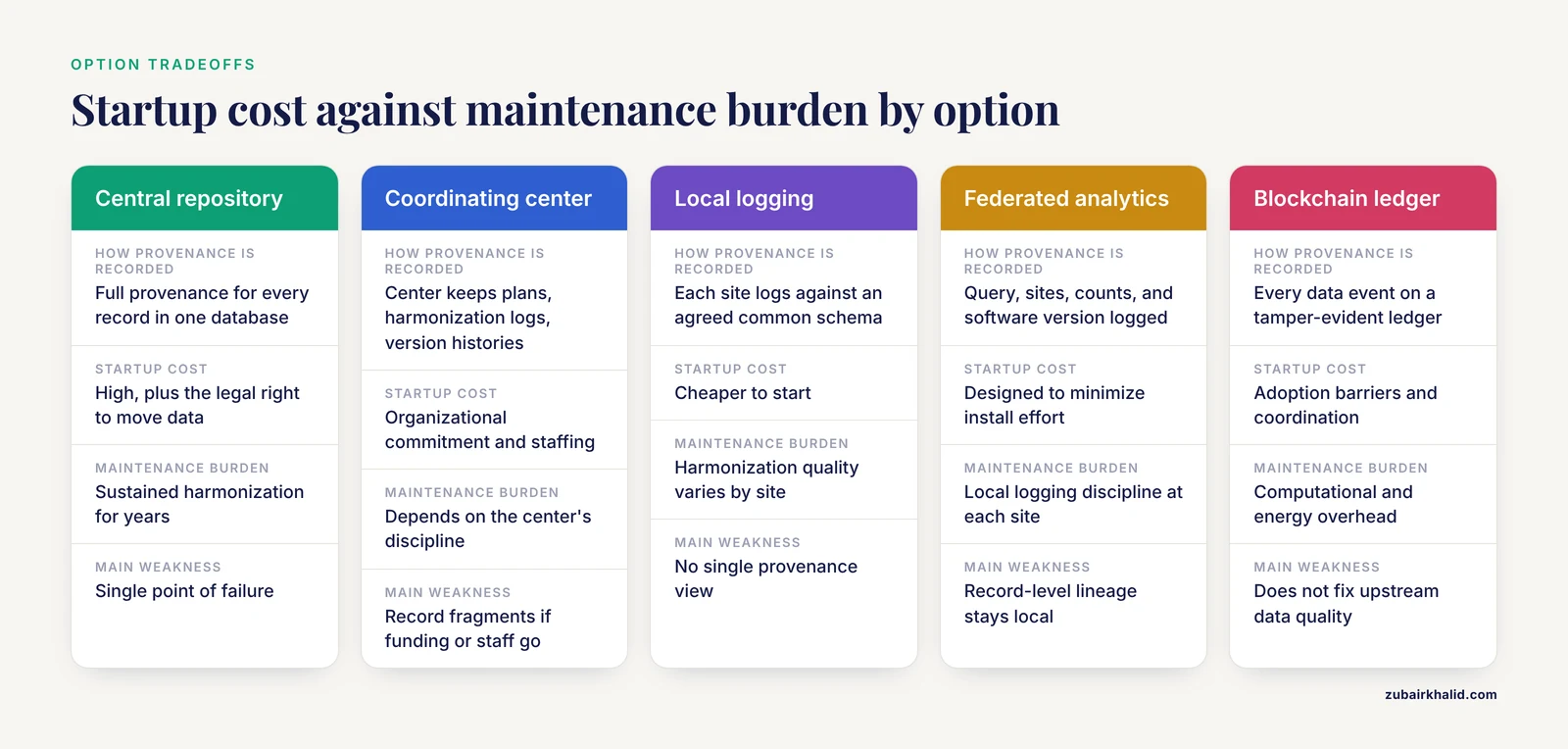
There are six realistic options. Most mature consortia combine two or three of them. The table below is the core comparison, followed by an explanation of each option on its own terms.
| Option | How provenance is recorded | Best fit | Pros | Cons |
|---|---|---|---|---|
| Centralized harmonized repository | Full provenance for every record lives in one database, with a shared data dictionary | Consortia legally permitted to pool identifiable or pseudonymized data | Easiest auditing, single validation effort, simplest queries | Highest legal and governance burden, single point of failure, slow to build |
| Coordinating center model | The center maintains data management plans, harmonization logs, and version histories on behalf of partners | Long-running epidemiology and clinical consortia | Dedicated staffing, consistent operations, clear communication channels | Requires sustained funding, quality depends on the center's discipline |
| Standards-based data dictionary plus local logging | Each site logs operations locally against an agreed common schema | Projects that must respect site-level data ownership | Respects local control, reuse of existing standards, cheaper to start | No single provenance view, harmonization quality varies by site |
| Federated queries and federated analytics | Raw data never leaves the site. Each site returns counts, aggregates, model updates, or audit logs | Privacy-constrained health systems, rare disease networks, genomics | Minimal privacy exposure, provenance attached to the query and result rather than the record | Provenance of the underlying records stays local, harder to reconstruct pooled lineage |
| Governance and agreement layer | Provenance of decisions and permissions tracked in contracts, charters, and policy documents | Every consortium, as a complement to a technical option | Establishes who may do what before data flows, cheap | Not machine-readable by itself, does not track individual records |
| Blockchain or immutable ledger | Every data event written to a tamper-evident, distributed ledger, with smart contracts enforcing access rules | Consortia of organizations that do not fully trust each other's record keeping, multi-party data trading | Tamper-proof provenance, automated enforcement, transparent to all parties | Scalability limits, overhead, adoption barriers, does not solve upstream data quality |
Centralized Harmonized Repository
In this model, partners extract data from local systems, transform it into a common structure, and load it into one repository that the consortium controls. Provenance is strongest here because every transformation happens inside one auditable environment. The Oncoshare project, a multi-institutional breast cancer research database, showed how this works in practice. The team based its data dictionary on existing registry standards, specifically the Surveillance, Epidemiology and End Results (SEER) standard, used a population registry as the efficient starting point for identifying subjects, and drew mortality outcomes from a standardized external source rather than from heterogeneous clinical records [4]. Those choices are provenance decisions as much as data decisions, because anchoring the dictionary to an external standard makes every mapping decision traceable and reviewable.
Regional health data ecosystems follow the same logic at larger scale. The Ouest Data Hub in France links clinical data warehouses across university hospitals in one region, supports both single-site and multi-site research, and in 2023 provided access pathways covering more than 9.3 million patient records. Its operators report that data quality and interoperability demand ongoing harmonization and adherence to standards, which is the recurring maintenance cost of the centralized model [5]. National-scale consortium infrastructure, such as the NIH-supported Access for ALL in ALS program, similarly provides a centralized, accessible repository for longitudinal clinical data and biospecimens collected across many sites [6].
The pros are real. One validation effort serves everyone, and a single provenance chain runs from source extraction to publication. The cons are equally real. Centralization requires the legal right to move data, the staff to run harmonization for years, and a governance body partners trust. If any of those is missing, a federated approach is usually the better fit.
Coordinating Center Model
A coordinating center is a designated organization that runs the collaboration's operations. Analysis of the Asia Cohort Consortium's coordinating center identified four activity areas that make such a center work: collaboration development, operations management, statistical and data management, and communications infrastructure and tool development [7]. For provenance purposes, the coordinating center becomes the custodian of record for the data management plan, the harmonization decisions, the dataset version history, and the correspondence that documents why each decision was made.
This option is less a technology than an organizational commitment, and its success depends on staffing and written procedures. Its weakness is shared with any single-custodian model. If the center loses funding or key staff, the provenance record can fragment. Consortia that pair a coordinating center with written governance rules reduce this risk.
Standards-Based Data Dictionary With Local Logging
Some consortia deliberately avoid pooling raw data. Each site keeps custody of its own records and logs its own operations, while the consortium maintains a shared data dictionary and harmonized measures so the local datasets remain comparable. The CSER consortium, a multi-institutional genomics research program, faced exactly this tension between site-specific measures and the need for consensus, harmonized measures, and found that identifying platforms for swift communication between teams and disciplined management of materials and data were essential to making harmonization work [8]. A biobank network case study from the StoP project, which integrates 33 research teams from 15 countries, likewise identified harmonization of retrospective datasets, updated standard operating procedures, and storage and sustainability questions as the central challenges of connecting national institutions to an international pooling project [9].
The pros are lower legal exposure and respect for institutional autonomy. The cons are that no single provenance view exists, so answering the question "where did this pooled estimate come from" requires assembling local logs after the fact. This works well when the number of transformations per site is small and well documented, and poorly when pipelines change frequently.
Federated Queries and Federated Analytics
Federated architectures invert the centralized model. Data stays inside each institution's firewall, and the network moves questions and answers instead of records. The Federated Aggregate Cohort Estimator (FACE) is a reference implementation built by four institutions with deliberately different database platforms. It deployed lightweight virtual machines at each site and estimated combined research subject availability across sites without moving patient-level data, addressing privacy and security requirements while remaining vendor neutral and easy to install [10]. From a provenance standpoint, the query itself, the sites that answered it, the counts returned, and the software version that produced the answer form the provenance trail.
Federated learning extends the idea to model training. Institutions train a shared machine learning model without exchanging local datasets, and evaluations across diverse strategies for classifying genetic variants showed federated models generally achieving performance comparable to or better than centralized training on independent test sets [11]. Architectures designed for this setting, such as the FLAME platform developed in the German PrivateAIM project, build provenance directly into the design through hub-and-node architecture, a dynamic policy framework specifying permissions and conditions for data access and algorithm execution, fine-grained access control, and audit logging with minimal overhead [12]. Audit logs in such systems are the federated equivalent of a provenance ledger. They record which algorithm ran at which node, under which policy, with which result.
Cloud-native designs can achieve federated behavior without even a virtual private network. One radiology research platform hosts each institution's images and metadata on a local edge server and reverse-proxies only critical metadata to a shared cloud database through REST APIs, so multi-site collaboration proceeds without VPN configuration or hardware shipping [13]. The metadata flow, not the image flow, is where provenance is captured in this pattern.
The pros of federation are strong privacy positioning and easier institutional buy-in. The cons are equally clear. You cannot reconstruct record-level lineage across sites from federated outputs alone, and the aggregate answers are only as trustworthy as each site's local logging discipline.
Governance and Agreement Layer
Every option above depends on a written layer that defines data ownership, permissible uses, and responsibilities. A consortium of pediatric surgery divisions organized itself around four governance pillars, including explicit legal ownership of aggregate data and a horizontal leadership structure, and credited that structure with enabling 24 medical centers to produce dozens of abstracts and manuscripts over five years [14]. Agreements of this kind are provenance infrastructure in a legal sense. They determine whose provenance system is authoritative, who may append to it, and what happens when partners disagree.
Treat this layer as mandatory rather than optional, and negotiate it early. Investigators who have studied international genomic collaborations recommend concluding a data sharing policy between collaborators as early as possible and call on sponsors to issue detailed guidance on intra-consortium sharing issues, because that guidance catalyzes rather than obstructs the science [1].
Blockchain and Immutable Ledgers
Blockchain technology offers a different provenance guarantee than the options above. Instead of trusting one custodian's logs, every data event is written to a decentralized, append-only ledger that no single party can quietly alter. In material genome engineering, a field that combines large-scale materials data with computation across many organizations, researchers describe blockchain as providing tamper-proof provenance with precise tracking of data lifecycles, smart contracts that automate access control and enforce agreed rules upon consensus, and unified protocols that support conditional interoperability between heterogeneous repositories [15]. The same analysis is candid about the drawbacks. Scalability limits, cross-system interoperability problems, computational and energy overheads, and institutional adoption barriers all remain, and the pragmatic pathway proposed is a hybrid architecture that combines blockchain's provenance and trust strengths with centralized infrastructure optimized for high-throughput processing [15].
The honest position for most life science consortia is this. Blockchain is most attractive when partners do not fully trust each other's internal record keeping, when data or derived assets change hands in ways that must be provable later, or when automated enforcement of access agreements has real value. It is rarely the cheapest or fastest option, and it does nothing by itself to fix bad source data.
Comparing the Options on the Criteria That Decide Real Choices
Where does the raw data live? This is usually the first decision, and it is often made for you by law, consent language, or institutional policy. If raw data may be pooled, the centralized repository and coordinating center options apply. If it may not, federated query and federated analytics designs are the fallback, and agreements plus local logging carry more of the provenance burden [10][12].
Who can audit the provenance record? Centralized repositories give auditors one place to look, which is why they suit consortia with external oversight. Ledger-based designs let every participant verify the record independently, which suits partnerships built on mutual verification rather than mutual trust [15]. Local logging suits partners who trust each other's processes but not a shared custodian.
What is the startup cost versus the maintenance cost? Agreements and a shared data dictionary are cheap to start and pay off over years. A harmonized repository has a high, sustained cost, and the Oncoshare experience shows validation alone can take up to two years even when source data are electronic [4]. Federated deployments using virtual machines were designed specifically to minimize installation effort at each site [10]. Blockchain adds ongoing computational and coordination overhead that must be justified by the trust problem it solves [15].
How much harmonization does the science require? If the analysis needs record-level pooling, harmonization is unavoidable and the tools that document it matter most. If the analysis needs only counts, model parameters, or metadata, federation lets each site keep local provenance while contributing to a shared result [11][13].
How dynamic is the pipeline? Pipelines that change frequently generate many provenance events per dataset. Automated capture, whether through audit logging in a federated platform [12] or through smart contracts that enforce rules on every transaction [15], scales better than manual documentation. Stable pipelines with annual updates can run on coordinating-center documentation [7].
Worked Scenarios
Scenario 1. Six hospitals, rare disease genomics, strict privacy rules. Raw genomic and clinical data cannot leave any hospital. The right combination is federated analytics with audit logging, on the FLAME pattern of hub-and-node architecture with a policy framework, fine-grained access control, and audit logs at each node [12], paired with federated learning if a shared classification model is the goal, since federated training has shown performance comparable to centralized training even with modest data fractions at each site [11]. Provenance consists of each site's local data lineage plus the shared log of every query and model update. A lightweight agreement records data ownership before the first query runs.
Scenario 2. An international epidemiology pooling project. Twenty to thirty research teams across many countries contribute processed datasets to pooled analyses, as in the StoP project with its 33 teams from 15 countries [9]. A coordinating center is the backbone, covering collaboration development, operations management, statistical and data management, and communications tooling [7]. Each contributing team's dataset version, harmonization steps, and standard operating procedure version are logged by the center, and harmonization of retrospective datasets is treated as an explicit, documented workstream rather than an afterthought [9]. A central repository is optional. If only summary statistics are pooled, the federated pattern also works.
Scenario 3. A multi-site observational database for outcomes research. Partners are permitted to share data, and the analysis needs record-level detail over years. Build a centralized repository anchored to an existing external standard for the data dictionary, following the Oncoshare lesson that registry standards make the most efficient foundation and that a standardized external source for outcomes such as mortality outperforms assembling the same outcome from heterogeneous clinical systems [4]. Budget realistically, because validated, reliable research data from multiple electronic sources took up to two years to produce in that project [4]. Wrap the repository in a coordinating-center function [7] and a prospective data sharing policy [1].
Scenario 4. A consortium of organizations with unequal trust and a data marketplace. Partners exchange datasets and derived assets among themselves, and each wants proof that nothing was altered after the fact. A hybrid blockchain design fits. Provenance and access enforcement run on the ledger through smart contracts, while heavy computation stays on centralized infrastructure, which is the architecture proposed to make blockchain practical at scale in material genome engineering [15].
A Practical Setup Sequence
Projects that track provenance successfully tend to follow the same sequence, drawn from the experiences documented above.
- Negotiate the data sharing and provenance policy before data flows. Decide who owns aggregate data, who may access what, who keeps which logs, and who is authoritative when logs disagree [1][14].
- Choose the architecture that matches where the raw data may live. Centralized, federated, or hybrid [10][12].
- Anchor the data dictionary to an existing standard where one exists. Building on established registry or terminology standards makes every later mapping step auditable and reviewable [4][2].
- Stand up a coordinating function, formal or informal. Someone must own the data management plan, the version history, and the communication channels, because harmonization fails without swift, documented communication between teams [7][8].
- Automate provenance capture wherever possible. Audit logs, policy frameworks, pipeline metadata, and query records should be written by the systems themselves rather than reconstructed from memory [12][15][13].
- Plan for harmonization as a continuing activity. Data quality and interoperability degrade without ongoing attention, a finding reported by operators of a regional data ecosystem serving millions of records [5].
Common Mistakes and Limitations
- Treating provenance as a document rather than a process. A static data management plan written at grant submission does not record the twelve mapping fixes and three protocol amendments that happen in year two. Continuous, automated capture beats retrospective write-ups.
- Skipping the prospective agreement. Consortia that defer data sharing policy until disputes arise lose the ability to reconstruct early data flows, which is the single most common documented failure pattern in international collaborations [1].
- Assuming electronic data means fast databases. Even with immediate electronic availability, validated multi-institutional research datasets have taken up to two years to build. Project timelines and funder expectations should reflect that.
- Underestimating terminology heterogeneity. With dozens to hundreds of data elements in play across institutions, as seen in a four-nation analysis that catalogued 131 elements in active use [2], unmapped local variation is the leading cause of silent provenance gaps. Every local-to-common mapping must be versioned.
- Expecting blockchain to fix data quality. A ledger proves that events happened and in what order. It cannot make source data accurate or complete, and its overhead, scalability limits, and adoption barriers are real [15][5].
- Believing federation removes the need for local discipline. Federated architectures limit privacy exposure, but the pooled result is only as trustworthy as each site's local logging and harmonization. Federated analytics shift provenance work to the edges of the network, they do not eliminate it [10].
- Ignoring the administrative layer. Approvals, agreements, and subawards take real calendar time, and provenance metadata about those approvals must be kept with the data. Teams that plan for this from day one avoid the delays that stall multi-site projects [3].
- Not naming a coordinating owner. Without a designated center or custodian, even well-intentioned partners produce fragmented, inconsistent records. The coordinating center's four functions, including operations and data management, exist precisely to prevent this [7].
Frequently Asked Questions
What is data provenance in a multi-institutional research project?
It is the documented history of each dataset's origin, movement, transformation, and authorization across all participating institutions. In practice it includes who extracted the data, which standard or dictionary version was applied, when each transfer occurred, and which agreement permitted it.
Do we need blockchain to track provenance properly?
No. Blockchain is one option among six, best suited to situations where partners do not fully trust each other's record keeping or need tamper-proof, automatically enforced data transactions. Most consortia get adequate provenance from a harmonized repository, a coordinating center, or federated audit logging, all of which are simpler and cheaper to operate [15][12].
What should a multi-institutional data sharing agreement cover for provenance to work?
At minimum, data ownership, permissible uses, which party keeps which logs, the shared data dictionary and its versioning, and the process for approving new data uses. Negotiating these points early, before data flows, is the recommendation that comes up most consistently in studies of collaborative genomic research [1].
Can we track provenance without moving data out of each institution?
Yes. Federated query platforms and federated learning let institutions answer shared questions or train shared models while raw data stays local, with provenance carried by query records, policy frameworks, and audit logs rather than by the data itself [10][11][12].
What is the difference between a coordinating center and a data repository?
A repository is a technical system that stores and serves data. A coordinating center is an organizational function that manages the collaboration, including operations, data management, statistics, and communications. Many large projects use both, and the coordinating center is what keeps the repository's provenance documentation coherent over time [7].
How long does it take to build a validated multi-institutional dataset?
Longer than most teams expect. Even when all source data are already electronic, one multi-institutional oncology database project reported that producing validated, reliable research data took as long as two years [4]. Planning, agreements, and provenance infrastructure should start well before analysis begins.
Sources
- Intra-consortium data sharing in multi-national, multi-institutional genomic studies: gaps and guidance.
- Multi-National, Multi-Institutional Analysis of Clinical Decision Support Data Needs to Inform Development of the HL7 Virtual Medical Record Standard.
- Accelerating regulatory progress in multi-institutional research.
- Oncoshare: lessons learned from building an integrated multi-institutional database for comparative effectiveness research.
- The Ouest Data Hub: An Interregional Health Data Sharing Ecosystem for Research.
- Access for ALL in ALS: A large-scale, inclusive, collaborative consortium to unlock the molecular and genetic mechanisms of amyotrophic lateral sclerosis.
- Coordinating centers in cancer epidemiology research: the Asia Cohort Consortium coordinating center.
- Lessons learned about harmonizing survey measures for the CSER consortium.
- Strengthening biobank networks: A Latvian case study within the StoP project.
- Federated Aggregate Cohort Estimator (FACE): an easy to deploy, vendor neutral, multi-institutional cohort query architecture.
- Federated learning for the pathogenicity annotation of genetic variants in multi-site clinical settings.
- Enabling Privacy-Preserving Federated Learning in Healthcare: The FLAME Architecture and Policy Framework.
- Radiology research platform: automating multicenter radiological research workflows using a cloud-native platform.
- The Eastern Pediatric Surgery Network: Creation and implementation of a comprehensive clinical research collaborative in pediatric surgery.
- Blockchain Technology for Big-data Sharing in Material Genome Engineering.