What Makes a Data Paper Peer-Reviewed?
By Dr. Zubair Khalid, DVM, MS, PhD ·

A data paper counts as peer-reviewed when independent experts have examined how the dataset was collected, how completely it is documented, and whether other scientists can realistically reuse it, and the journal has accepted the paper and its linked dataset on that basis before publication. A dataset that merely carries a DOI or sits in a public repository has not been peer-reviewed, because depositing data and reviewing data are two separate acts.
This guide covers the data paper peer review process in plain terms, shows how it differs from the review of a conventional research article, and explains what the peer-reviewed label does and does not promise. It also compares the repositories where datasets live, because the choice of repository shapes what reviewers can check and what reusers can expect.
What Is a Data Paper?
A data paper is a scholarly article whose main contribution is a dataset rather than a new hypothesis or interpretation. It describes what the data measure, how they were collected and processed, what quality checks were applied, where the files are stored, and how a stranger to the project could reuse them. The dataset itself is deposited in a public repository, which is a service that stores datasets, preserves the files over time, and issues a persistent identifier such as a DOI (digital object identifier), a permanent address that keeps pointing to the data even after a project website disappears. The structured information describing each variable, its units, and how it was produced is called metadata, and reviewers examine it closely.
The contrast with a conventional research article is easiest to see in practice. A research article reports that a treatment changed an outcome and argues why. A data paper says here are the measurements, here is how they were made, and here is what you can do with them. Many datasets can support several research articles by different groups, which is one reason the two formats are published separately. Journals built around the format now exist across disciplines, including Scientific Data, Data in Brief, GigaScience, Earth System Science Data, and the Biodiversity Data Journal, and many call the article type a data descriptor.
The need for data papers comes from a long-standing gap in the scientific literature. Peer-reviewed journals publish narratives about and summaries of data, while the underlying data often remain inaccessible to later readers, a problem researchers call dark data [1]. Structural biology shows the pattern clearly. High-throughput laboratories generate vast amounts of raw experimental data, yet a publication contains only a concise compilation of the most important results, an interpretation, and a comparison with the work of other scientists [2]. After years of experiments, most of the raw records never reach a reader. A data paper makes the dataset itself the citable, reviewed object.
What Peer Review Adds to a Data Paper
Peer review is the evaluation of a manuscript by independent experts before publication. In the conventional model, an editor sends the draft to specialists who judge whether the methods support the claims. The system exists because science builds trust through scrutiny. A finding earns confidence when qualified outsiders can examine how it was produced, and when other teams can repeat it.
For a data paper, the object under scrutiny changes, and so do the questions. Instead of asking whether the conclusions are novel, reviewers ask whether the data are what the authors say they are. Can the collection be repeated from the written methods? Are the variables, units, instruments, and processing steps documented completely? Do the numbers in the manuscript match the deposited files? Could a researcher outside the original team load the files and use them?
This shift matters because reviewing summaries alone has known weaknesses. There are reports that a significant fraction of experiments from academic laboratories could not be repeated in an industrial setting, which is one reason the community wants access to raw data rather than summaries alone [2]. Reviewing the data description as the primary object is one direct response to that weakness. Writing at the turn of the digital publishing era, one longtime journal editor observed that new means to share raw data and validate observations were emerging, and that no system of publishing would serve the community well unless the ethical behavior of scientists could be maintained and rewarded [3].
The Data Paper Peer Review Process, Step by Step
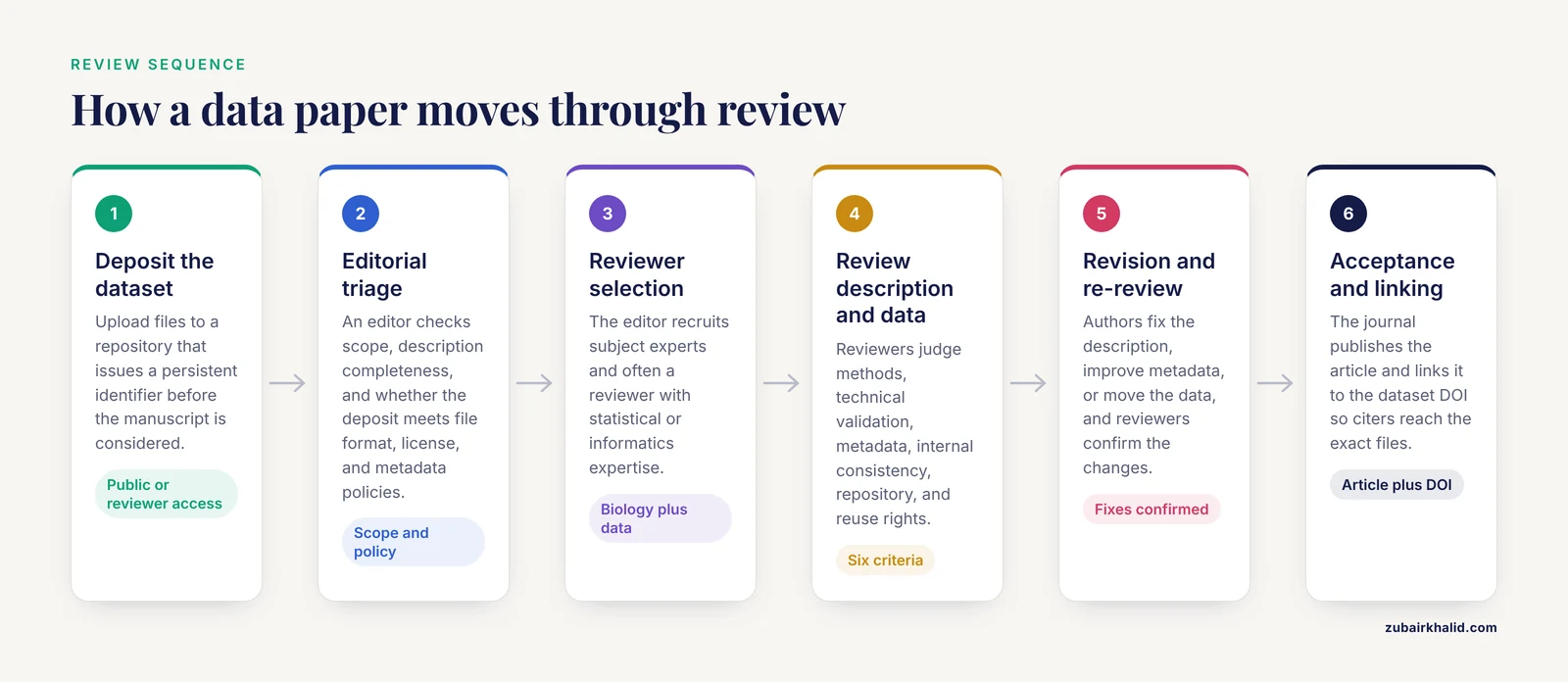
The data paper peer review process, explained as a sequence, follows the same broad path as any journal submission with extra checkpoints for the dataset itself. Details vary by journal, but most data journals work in the following way.
- Deposit before submission. The authors upload the dataset to a repository that issues a persistent identifier. Most data journals expect the data to be publicly available, or at least accessible to reviewers, before the manuscript is considered.
- Editorial triage. An editor checks the scope, the completeness of the description, and whether the deposit meets the journal's policies on file formats, licenses, and metadata.
- Reviewer selection. The editor recruits experts in the subject area, and often a reviewer with statistical or informatics expertise, because the questions span biology and data management at the same time.
- Review of the description and the data. Reviewers evaluate the criteria in the table below. Some journals also ask a repository curator, a staff member who checks deposits, or an in-house data editor to verify file integrity.
- Revision and re-review. The authors correct the description, improve the metadata, or move the data to a more suitable repository, and the reviewers confirm the fixes.
- Acceptance and linking. The journal publishes the article and links it to the dataset's DOI, so that anyone who cites the paper can reach the exact files.
Reviewers for a data paper typically check the following.
| Review criterion | What the reviewer examines | Why it matters |
|---|---|---|
| , - | , - | , - |
| Methodological soundness | Whether the written methods contain enough detail to repeat the collection, including instruments, software versions, and settings | Repeatability is the foundation of scientific trust |
| Technical validation | Whether quality control, calibration, and error checks are reported, together with their results | Evidence that the data are internally sound |
| Metadata completeness | Whether every variable, unit, sample identifier, and processing step is defined | Strangers must be able to understand the files without contacting the authors |
| Internal consistency | Whether numbers in the manuscript match the deposited files, and whether summary statistics are reported correctly | Mismatches are a classic clue to errors |
| Repository and identifier | Whether the data sit in an archive that issues a persistent identifier and commits to preservation | Links must outlive the project |
| Reuse rights | Whether the license permits reuse and whether access restrictions are stated | Reuse needs legal clarity as well as technical access |
The review is a judgment about fitness for reuse, not a certification that every value is correct. That distinction runs through the rest of this article.
Interpreting the Peer-Reviewed Label
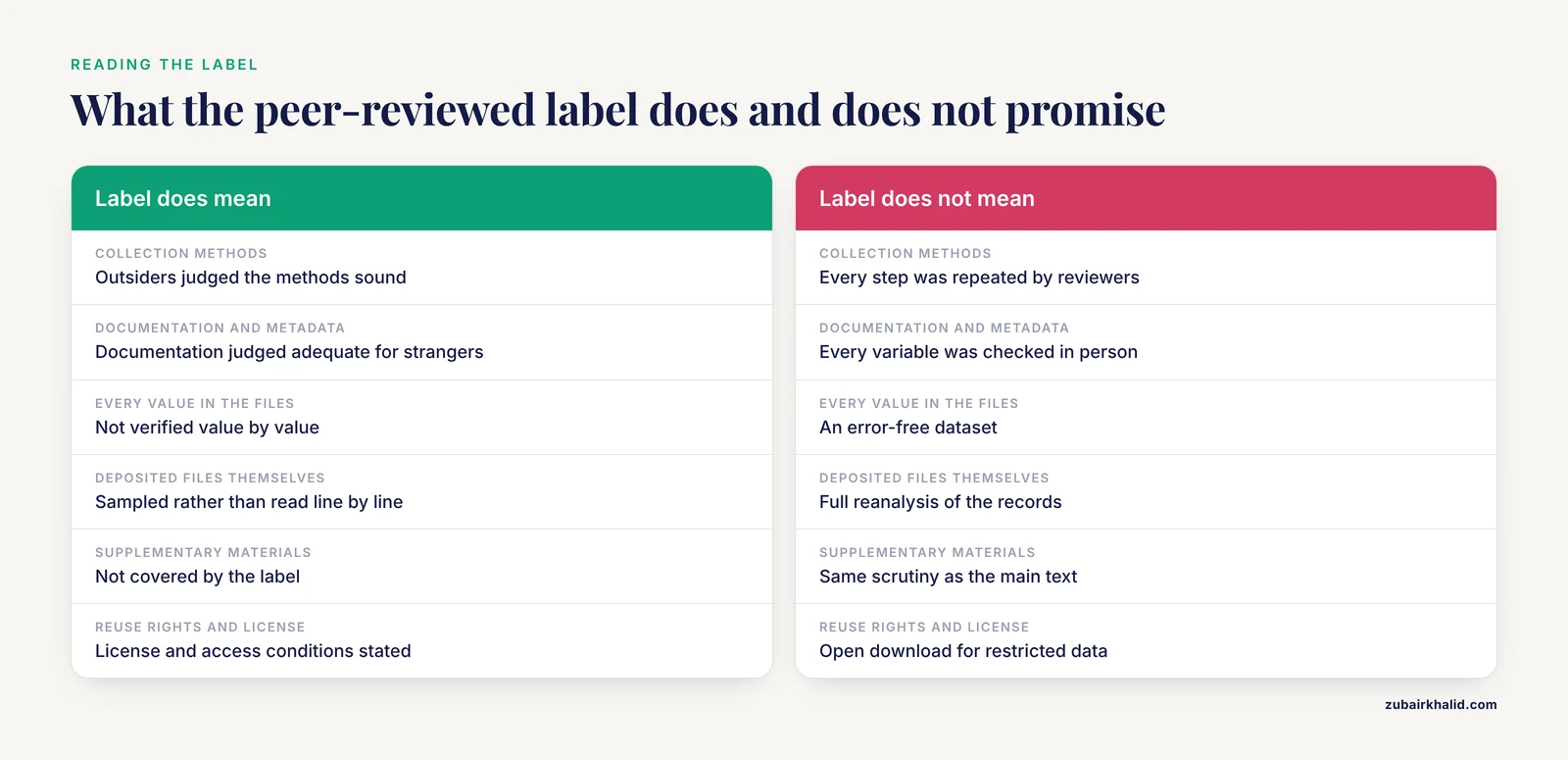
Careful interpretation of the data paper peer review process comes down to one distinction. The review certifies the description and the methods, not every value in the files.
What the label means. Qualified outsiders judged the collection methods sound, the documentation adequate, and the dataset reusable at the time of review. Editorial staff checked the deposit against the journal's policies. The article and the dataset were accepted together.
What the label does not mean. It does not mean every value was verified. Manuscript editors do not have access to the raw data and must rely on clues in the submitted manuscript, looking for inconsistencies in the presented results [4]. A knowledgeable editor can catch problems such as summary statistics that do not fit the reported design, or measures of spread that hide the variability in the data, but this is clue-based checking, not reanalysis [4].
It also does not mean the accompanying files received the same scrutiny as the main text. In many fields, descriptions of experimental methodology, and sometimes even results, are pushed to online supplementary materials that may not be reviewed as thoroughly as the main body of a manuscript [2]. Data papers improve this balance, because the description is the main text, yet the deposited files themselves are usually sampled rather than read line by line.
Two myths follow from these limits. The first is that a peer-reviewed data paper is an error-free dataset. Peer review is a filter, not a guarantee, and errors surface after publication when others reuse the data. The second is the mirror image, the belief that open data without review is just as good. Rapid release maximizes speed, but the scientific community has argued for decades about whether quality control should come first. Repository preservation and expert review answer different questions, and a well-run dataset needs both.
Why Data Papers Exist: Research Data Sharing
The peer-reviewed data paper grew out of a longer fight over research data sharing. The tension between fast release and careful review is old. In 1996, Adams and Venter published a commentary in Science asking whether the scientific community should be forced to release raw DNA sequence data before any peer review, a question that framed the rapid-release practices of the genome era [5].
Sharing does not happen by default. In a prospective study, researchers contacted 29 corresponding authors of original research articles in the British Medical Journal and asked for their data. Only one author released the data. Authors who received a specific request were less likely and slower to respond than those who received a general request, and some replied only with requests for clarification, further information, or authorship [6]. The study's authors argued that publishing in a peer-reviewed journal implies confidence in the interpretation, and that the same confidence should extend to sharing the underlying data [6].
Funders and journals have since pushed in the same direction. Many research funding agencies now require open access to the results they fund, and some require the raw data as well [7]. A review of raw clinical trial data publication identified the recurring obstacles, including patient privacy when explicit consent for publication is missing and disputes over data ownership, and it outlined alternatives to journal publication such as restricted-access repositories [7].
Data papers give these mandates a concrete outlet. A dataset that would otherwise sit on a laboratory computer becomes a citable publication with a DOI, a license, and a record of expert scrutiny. The FAIR principles, short for findable, accessible, interoperable, and reusable, now guide how shared data should be managed across their lifecycle [1]. Communities that manage sharing well will be positioned to pool data across studies, because analyses that combine individual participant data, meaning measurements at the level of each research participant, can reach higher levels of evidence than meta-analyses, which statistically combine published results [1].
Specialized archives show the model at scale. The Functional Magnetic Resonance Imaging Data Center, established in 1999, was built to give the neuroscientific community a mechanism for sharing functional neuroimaging data through a publicly accessible repository of raw data drawn from peer-reviewed studies, so that other researchers could run secondary and meta-analyses on the pooled material [8].
Data Repository Comparison: Where You Deposit Shapes the Review
A data repository is a service that stores datasets, issues persistent identifiers, and preserves files over time. The main types differ in curation, which means checks performed by repository staff, and in scope and access rules.
| Repository type | Typical features | Best suited for | Points to check |
|---|---|---|---|
| , - | , - | , - | , - |
| Domain-specific archive | Community metadata standards, subject-specific curation, format validation | Datasets in fields with shared formats, such as imaging or sequence data | Whether the archive issues its own DOI and supports versioning |
| Generalist repository | Accepts any file type, mints DOIs, offers versioning and license options | Cross-disciplinary data, small datasets, outputs without a field archive | Curation is lighter, so documentation quality depends on the authors |
| Institutional repository | Run by a university or institute, long-term institutional commitment | Theses, institutional outputs, funder compliance | Discovery outside the institution can be weaker |
| Restricted-access repository | Controlled access, data use agreements (contracts setting reuse conditions), approval workflows | Human data with consent limits or privacy risk | Reuse requires permission, so the data are findable but not openly downloadable |
| Journal supplementary files | Hosted alongside the article | Small files tied to one paper | Often lack their own persistent identifier and curation |
Two features matter most for the peer review process. The first is a persistent identifier. A DOI lets the reviewer, and every later reader, link the article to an exact version of the files. The second is curation. Some archives check file integrity, validate formats, and verify metadata before release. That work overlaps with journal peer review but does not replace it. A curator confirms that the deposit works. A peer reviewer judges whether the science behind the deposit is sound.
Sensitive data complicate the picture. For clinical trials, privacy and consent constraints mean that fully open deposition is not always possible, and restricted-access repositories are an accepted alternative that still allows expert review and controlled reuse [7]. A peer-reviewed data paper can therefore describe a dataset that requires an access application, as long as the article states the conditions clearly.
Running an archive well is harder than it looks. The founders of the fMRIDC documented the scientific and practical difficulties of managing data sharing, from submission and request workflows to technical and policy challenges [8]. Those difficulties have not disappeared. Every repository choice trades openness against control, and the trade should be made deliberately before submission, not after a reviewer objects.
When the Peer-Reviewed Label Is Not What It Claims
The label is only as strong as the journal behind it. Predatory journals, which publish for fees without genuine quality control, exploit it. In a recent test, researchers used ChatGPT3 and an AI image generator to produce fabricated manuscripts, each in under 200 seconds, and submitted them to 50 consecutive unsolicited invitations from predatory journals. Fifteen of the 50 journals turned out not to exist. Of the 35 that did, 12 accepted the paper with no changes, 4 with minor revisions, 4 with major revisions, and 2 rejected it. The mean article processing charge, the fee that open-access journals ask authors to pay, was $1,298 [9]. The analysis concluded that the peer review system faces a critical need for maintenance of quality, because it can be exploited by both authors and journals [9].
The lesson for anyone publishing or reading data papers is to verify the venue. A real editorial board, a published review policy, indexing in recognized literature databases, and disclosed fees are the minimum checks. Unsolicited invitations promising fast publication for a fee are a warning sign, and AI-generated text makes that warning sharper than it was a decade ago.
Even legitimate communities formalize their data standards through expert review. The Brighton Collaboration, a vaccine safety network, publishes case definitions with guidelines for data collection, analysis, and presentation of immunization safety data, and its documents undergo peer review by a reference group of stakeholders and subject experts to ensure usability, applicability, and scientific integrity [10]. Structured standards like these give reviewers a benchmark when they judge whether a dataset was collected properly.
Practical Implications for Students and Early-Career Researchers
A data paper is one of the lowest-risk first publications available to a student, because the contribution is the dataset and its documentation rather than a contested interpretation. The practical sequence looks like this.
- Choose the repository first. Match the archive to your field, confirm that it issues a DOI, and check its license options before you finalize file formats.
- Document as you collect. Metadata written during the project is accurate. Metadata reconstructed afterward is guesswork.
- Write for a stranger. Assume the reader has no access to your lab notebook, your code history, or your email.
- Report your quality control. Describe the checks you ran and their results, not just the statement that checks were performed.
- Link everything. Connect the article to the dataset DOI, the dataset to the article, and any protocol documents where they exist.
- Keep versions straight. If the dataset changes after publication, version it and say what changed.
For readers, the mirror image applies. Before you reuse a peer-reviewed dataset, read the methods section of the data paper, check the license, confirm the file version, and run a few sanity checks on the values. The review gives you a starting position of trust, not an end point.
Common Mistakes and Limitations
Mistake 1: Treating a DOI as a quality seal. A DOI is an address, not a verdict. Datasets can carry identifiers without any review. Check whether the associated paper went through journal peer review, and whether the repository added its own curation.
Mistake 2: Assuming every value was verified. Reviewers assess methods, documentation, and internal consistency rather than reanalyzing each record. Plan your own quality checks when you reuse a dataset, because the review samples the files rather than certifying every record.
Mistake 3: Citing the paper but not the data, or the reverse. Cite both. The article carries the review record, and the dataset DOI points to the exact files and version you used. When versions change, cite the version you actually downloaded.
Mistake 4: Ignoring licenses and access conditions. A peer-reviewed data paper can describe a dataset with usage restrictions, especially for human subjects. Read the license and the access statement before you build a project on the data.
Mistake 5: Assuming supplementary files got equal scrutiny. Treat online supplements as lower-assurance material, especially in older papers where methods and results migrated away from the main text.
Limitation: review depth is bounded by reviewer time. No committee can reanalyze a large dataset value by value. Peer review of data papers samples the description, checks internal consistency, and judges fitness for reuse.
Limitation: pooling shared data has costs. Combining individual participant data from many studies requires harmonization, which means standardizing variables across datasets, and the level of granularity chosen for harmonization determines how much information is lost [1].
Limitation: the label depends on the venue. Fabricated manuscripts have passed through outlets that claim to review, so verification of the journal is part of evaluating the data.
What Is Still Uncertain
How deeply data papers can realistically be reviewed remains open, because reviewer time has not grown with dataset size. How much career credit a data paper earns varies across institutions, even as the coming era of funder mandates for data sharing expands the format's importance [1]. The boundary between repository curation and journal peer review continues to shift as archives take on validation tasks that journals once held alone. None of these uncertainties changes the core definition, but they explain why two peer-reviewed data papers can carry different levels of assurance.
Frequently Asked Questions
What makes a data paper peer-reviewed?
Independent experts examined how the data were collected, how completely the dataset is documented, and whether others can reuse it, and the journal accepted the paper and its linked dataset on that basis before publication.
What does the data paper peer review process mean?
It means the sequence of editorial and expert checks that a dataset description passes before a journal accepts it, covering collection methods, metadata quality, technical validation, and reuse value.
Is a dataset with a DOI automatically peer-reviewed?
No. A DOI is a persistent identifier, an address that keeps pointing to the files, and it says nothing about review. Some repositories add curation, which improves quality but is separate from journal peer review.
Do reviewers reanalyze every value in the dataset?
No. Reviewers evaluate the written methods, the metadata, and the internal consistency of the numbers. Editors frequently cannot access raw data and depend on clues within the manuscript.
How is a data paper different from a research article?
A data paper describes what the data are and how they were produced. A research article uses data to test a hypothesis and argue for an interpretation. The two are reviewed separately, even when they describe the same experiment.
Can sensitive human data still be peer-reviewed?
Yes. Consent, privacy, and ownership concerns often place clinical datasets in restricted-access repositories, where experts can review the description and approved users can request access under stated conditions.
How can I tell whether a data journal is legitimate?
Look for a real editorial board, a published review policy, indexing in recognized databases, and disclosed fees. Be wary of unsolicited invitations that promise rapid publication for a fee.
Does a data paper count toward career credit?
Increasingly, yes. Data papers are citable publications with DOIs, and funder mandates for data sharing keep expanding, but how institutions weigh them still varies.
Sources
- Harmonization-Information Trade-Offs for Sharing Individual Participant Data in Biomedicine.
- Data management in the modern structural biology and biomedical research environment.
- Publishing (whatever that means) neuroscience in the new millennium.
- Statistical Data Editing in Scientific Articles.
- Should non-peer-reviewed raw DNA sequence data release be forced on the scientific community?
- Data sharing in medical research: an empirical investigation.
- Towards agreement on best practice for publishing raw clinical trial data.
- The Functional Magnetic Resonance Imaging Data Center (fMRIDC): the challenges and rewards of large-scale databasing of neuroimaging studies.
- The barrier is purely financial: analysis of the acceptance rate and peer review practice of predatory journals using AI generated papers.
- Acute multi-organ dysfunction (aMOD): Brighton Collaboration case definition and guidelines for data collection, analysis, and presentation of immunization safety data.