Data Ownership in Multi-Institutional Research
By Dr. Zubair Khalid, DVM, MS, PhD ·

Data ownership in multi-institutional research determines which organization holds, controls, and may reuse the records a collaboration produces, and it is settled by a written agreement rather than by who collected the data. The rule of thumb is simple. If the analysis requires one combined dataset in one place, negotiate joint or consortium ownership of the pooled data before collection starts. If institutions must keep records behind their own walls for privacy, legal, or contractual reasons, negotiate a federated arrangement in which data stay local and only results move.
Collaborations fail on this point more often than on the science. Reviews of international genomic consortia have found that international guidelines say almost nothing about intra-consortium data-sharing problems, and that the absence of guidance threatens the success of major research ventures [1]. This article walks through the ownership models available, the clauses that decide real outcomes, the trade-offs of each option, and the mistakes that derail otherwise strong projects.
What Data Ownership Actually Means in Collaborative Research
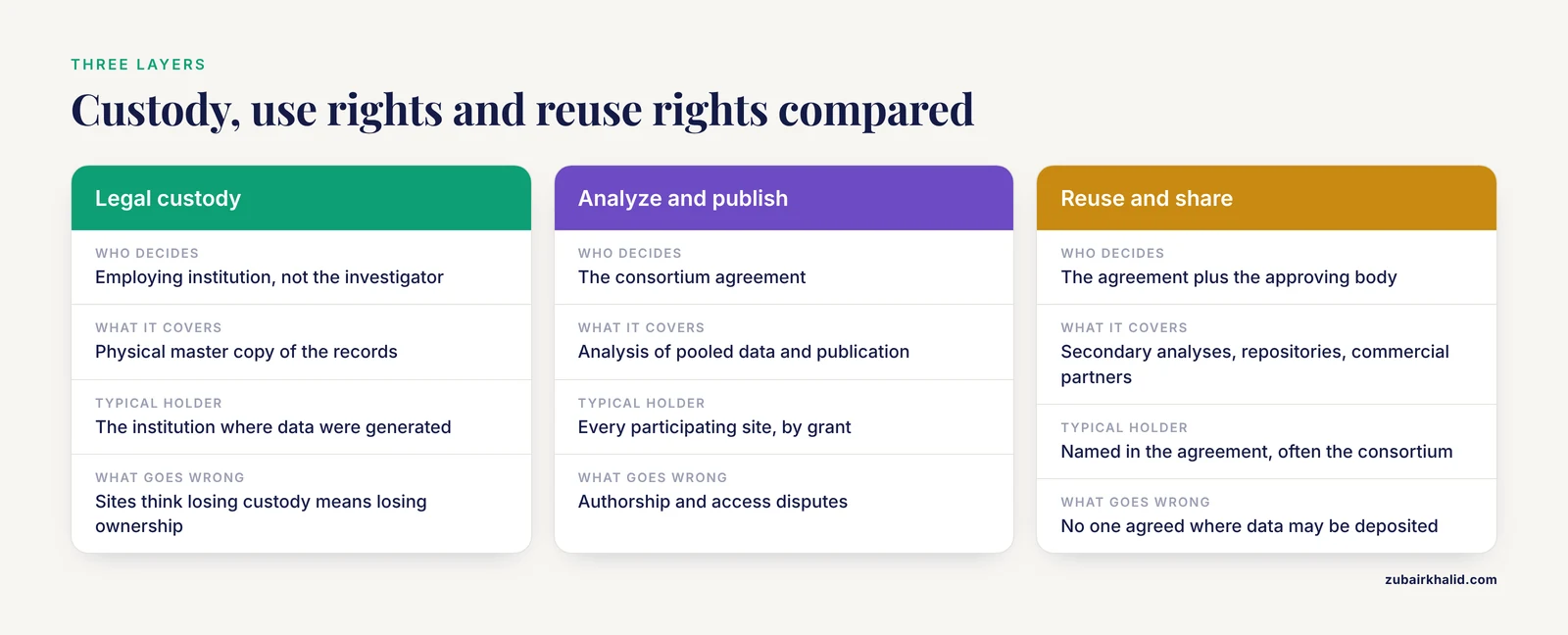
Three separate questions get confused constantly, so separate them first.
Legal custody. In nearly all university and hospital settings, the employing institution, not the individual investigator, holds legal rights to research records. A principal investigator who generates data at site A does not personally own those records in any transferable sense. When that investigator moves to site B, the records generally stay behind. This is standard institutional practice and the default assumption behind every data ownership multi-institutional research agreement.
Rights to analyze and publish. A consortium can grant every participating site the right to analyze pooled data and publish from it while a single institution physically holds the master copy. Custody and use rights are negotiated separately, and confusion between them causes most authorship and access disputes.
Rights to reuse and share onward. This covers secondary analyses, deposition in external repositories, sharing with commercial partners, and transfer to future studies. It is the most contested layer because it determines whether a dataset keeps producing value after the primary paper is published.
A fourth wrinkle matters in health research. Patient-level records carry privacy obligations that limit what any owner can do with them regardless of contractual rights. Privacy concerns and data ownership questions are specifically cited as the two barriers that hinder data sharing and prevent the creation of centralized datasets in multi-hospital AI research [2]. Ownership agreements therefore have to be written to work inside those privacy constraints, not as if they did not exist.
Why the Agreement Must Come First
The single most repeated recommendation in the multi-institutional research literature is timing. A data sharing and ownership policy should be negotiated and concluded between collaborators as early as possible, ideally before any data collection begins [1]. Once data exist, each institution's technology transfer office, privacy office, and general counsel acquire strong opinions, and renegotiating under time pressure rarely produces a fair result.
Early negotiation also pays off procedurally. Staff who ran three multi-institutional studies in the HMO Research Network found that securing data-sharing approvals early, alongside IRB approvals and subawards, avoided the administrative delays that normally stall multi-site projects [3]. Regulatory and administrative staff are essential contributors to these collaborations, and their flexibility and communication can compress approval timelines substantially [3].
A consortium that puts ownership and governance in writing from day one can operate for years on modest funding. The Eastern Pediatric Surgery Network organized itself around four pillars, one of which was explicit legal ownership of aggregate data, and went on to involve 24 medical centers and produce 12 peer-reviewed manuscripts despite limited external grant support [4].
The Four Main Agreement Options
There is no single best data ownership multi-institutional research agreement for every project. The literature describes four workable structures, each with documented use in real consortia.
Option 1. Pooled central database with consortium ownership
All participating institutions contribute cleaned, de-identified records to a single harmonized database. The consortium, or a designated coordinating institution, holds the pooled resource, and contributing sites receive access rights defined in the agreement.
The Oncoshare project built exactly this kind of resource for breast cancer comparative effectiveness research, integrating longitudinal data from multiple electronic medical records and registries into one validated research database [5]. Its practical lessons apply directly to ownership negotiations:
- A state or regional cancer registry is the most efficient starting point for identifying subjects, which means the agreement should secure registry access rights at the outset [5].
- The shared data dictionary should be based on existing registry standards such as Surveillance, Epidemiology and End Results (SEER) whenever applicable, rather than inventing local definitions [5].
- Standardized mortality ascertainment came from the Social Security Administration Death Master File rather than from institutional clinical resources, so the agreement should specify who is licensed to query external data sources on the consortium's behalf [5].
- Even with electronic data already available, building a validated multi-institutional database took about two years [5]. Funding and governance documents must survive that timeline.
This model maximizes analytic power and makes secondary use straightforward. Its costs are the two-year build time, the need for one institution to accept custody, and the need to harmonize definitions across sites before a single record can be pooled.
Option 2. Contributor retains ownership, licensed to the consortium
Each institution keeps title to the records it generates and grants the consortium a defined license to use them. This is the most common structure for consortia involving multiple legal jurisdictions, commercial partners, or institutions with pre-existing data governance policies.
The value of this model is institutional autonomy. Each site can satisfy its own privacy office and honor any pre-existing patient consent terms. The cost is that every reuse beyond the license, such as a new secondary analysis or an external deposit, requires revisiting the agreement. Harmonization also becomes a negotiation rather than a technical task. The CSER consortium, a multi-institutional genomics consortium, had to balance site-specific survey measures against a consensus core set of harmonized measures, and found that securing permissions for data sharing and building swift communication platforms were essential to that harmonization effort [6]. That work is far easier when the license terms anticipate it.
Option 3. Federated analysis, data never leave home
In a federated design, each institution keeps full custody of its data. A central hub sends an algorithm or a query to each site, each site runs it locally, and only aggregate results or model parameters travel back. No patient-level record ever moves.
Several documented implementations show how this resolves ownership friction:
- The Federated Aggregate Cohort Estimator (FACE) let four institutions, including the University of Alabama at Birmingham, The Ohio State University, the University of Massachusetts Medical School, and Denver Health, estimate combined research subject availability by federating diverse SQL data sources and an i2b2 instance, using easily deployed virtual machines that addressed the privacy and security requirements of each participating organization [7].
- A multi-hospital spine imaging collaboration trained deep learning models with federated learning across four hospitals and achieved performance comparable to pooled centralized training, with localization errors of roughly 5 degrees, while consistently outperforming models trained at single hospitals [2].
- In clinical genetics, federated models for variant pathogenicity classification matched or exceeded centralized models trained on curated repositories, and generalized better to independent external sets, even when trained on smaller fractions of the available data [8].
- The FLAME platform, developed in the German PrivateAIM project, uses a hub-and-node architecture with a dynamic policy framework that specifies permissions and conditions for data access and algorithm execution, providing fine-grained access control and audit logging across university hospitals [9].
The advantage for ownership negotiations is severe. When data never move, questions about who holds the master copy mostly disappear, and privacy and regulatory constraints such as GDPR and HIPAA are addressed by architecture rather than by legal drafting [9]. The disadvantages are technical. Each site must deploy and maintain local execution infrastructure, and federated approaches cannot easily support the record-level exploratory analyses that a pooled database allows.
Option 4. Distributed data hubs with shared infrastructure
A newer middle path gives each institution its own governed data asset, often a clinical data warehouse, while a coordinating body links the assets into a shared ecosystem. Each site remains the owner and steward of its local data, and the hub coordinates access, standards, and shared services.
The Ouest Data Hub in France links the Clinical Data Warehouses of university hospitals across the Grand Ouest region into an interregional ecosystem, and in 2023 provided access to data from over 9.3 million patient records for both single-center and multicenter research [10]. Its experience highlights two ownership-relevant lessons. Local and shared resources can be combined productively in one governance structure, and data quality plus interoperability remain the hard problems, requiring continuous harmonization and adherence to shared standards [10].
A related cloud-native pattern keeps image and metadata files on a local edge-node server at each institution while pushing only critical metadata to a shared cloud backend through secure APIs, which lets multi-center studies run without virtual private network setups or hardware transfers [11]. This hybrid design lets each institution satisfy its own data custody rules while the collaboration still operates as one research platform.
Side-by-Side Comparison
| Criterion | Pooled central database | Contributor retains, licensed | Federated analysis | Distributed data hubs |
|---|---|---|---|---|
| Where data physically sit | One harmonized master database | Each contributing site | Each contributing site | Local warehouses or edge nodes at each site |
| Who holds legal title | Coordinating institution or the consortium | Each contributing institution | Each contributing institution, unchanged | Each contributing institution |
| Record-level access for partners | Full, for authorized users | Only as licensed | None, by design | Governed per site |
| Typical build time | Longest, roughly two years in a documented oncology case [5] | Moderate, driven by license negotiation | Fastest to pilot, per-site deployment required [7] | Moderate to long, ongoing harmonization [10] |
| Biggest advantage | Maximum analytic power, clean basis for secondary use and deposit | Institutional autonomy, easiest privacy approval | Ownership disputes largely vanish, privacy by architecture [2],[9] | Scales across regions, balances local control with shared capability [10] |
| Biggest drawback | Custody burden and harmonization delays [5] | Every new reuse needs renegotiation | Cannot support record-level exploration, technical maintenance per site | Interoperability and data quality require continuous work [10] |
| Best fit | Registries, cohort pooling, comparative effectiveness studies | Cross-border consortia, mixed public-private projects | Multi-hospital AI, rare disease cohorts [7],[2],[8] | Regional health systems, learning health networks [10] |
Negotiating the Agreement, Clause by Clause
Whatever model you choose, a data ownership multi-institutional research agreement should contain the following provisions. Treat this as a checklist to work through with every site's research administration office.
1. Definition of the data. Specify exactly which records, biospecimen annotations, images, and derived variables fall under the agreement. The CSER consortium's experience shows why vagueness is dangerous. Harmonizing measures across sites was difficult enough when the scope was known, and identifying platforms for managing materials and data was essential throughout [6].
2. Ownership and custody assignment. State who holds title, who holds the master copy, and what happens to the data if the coordinating institution loses funding, the lead investigator departs, or a site withdraws.
3. Access and use rights. Define who may analyze the pooled or federated data, under what approval process, and whether access is exclusive during a defined analysis period. Consortia with horizontal leadership structures and mandatory participation in adopted studies, such as the Eastern Pediatric Surgery Network, reduce disputes by making participation rules explicit up front [4].
4. Data standards and the data dictionary. Commit to an external standard where one exists. Multinational work on clinical decision support systems identified 131 data elements in use across 20 institutions from 4 nations, precisely to converge on shared definitions through the HL7 Virtual Medical Record standard [12]. Oncoshare anchored its dictionary to SEER registry standards rather than local conventions [5]. A clause requiring standard-based definitions prevents years of mapping work later.
5. External data sources. Name the external sources the consortium will use, such as mortality files, and specify which party holds the license to access them [5].
6. Publication and authorship policy. Define who may submit analyses, how authorship is assigned, and how sites that contribute data but not analyses are credited.
7. Secondary use and repository deposition. State whether pooled data may later be deposited in an external repository, under what access controls, and which body approves it. This clause interacts directly with funder data-sharing requirements.
8. Governance and the coordinating center. A functioning coordinating center is widely recognized as essential to multisite projects, yet published guidance on how to run one is scarce. The Asia Cohort Consortium organizing committee concentrated its coordinating center on four activity areas, collaboration development, operations management, statistical and data management, and communications infrastructure, and found this focus drove real scientific and organizational progress [13]. Name the coordinating center in the agreement and give it defined authority over data management and dispute resolution.
9. Privacy, security, and audit. Specify the technical safeguards at each site. Modern federated platforms demonstrate what auditable, fine-grained control looks like, including distributed policy evaluation and complete audit logging of every algorithm execution [9].
10. Sustainability. Address long-term funding for the shared infrastructure. Biobank network work in the StoP project, which links 33 research teams from 15 countries, identified sustainability and long-term storage among the key challenges that persist even after a consortium succeeds scientifically [14].
Worked Scenarios
Scenario 1. A multi-hospital comparative effectiveness study
Six hospitals want to compare surgical outcomes. Because the question requires record-level adjustment for case mix, a federated design would be limiting. The best fit is a pooled central database with consortium custody at one coordinating institution. The agreement should anchor the data dictionary to an existing standard, secure registry access at the start, plan for a validation period measured in years rather than months, and specify mortality ascertainment through a standardized external source rather than each hospital's own records [5].
Scenario 2. An international genomics consortium spanning high- and low-income countries
Here, sovereignty concerns are acute. Reviewers of multinational genomic collaborations recommend negotiating the full data sharing policy prospectively, before data collection, and note that sponsors, including sponsors in developing countries, should issue detailed guidance to facilitate the work [1]. A contributor-retains model with an explicit license to the consortium, or a federated design, usually fits better than wholesale transfer of data to the wealthiest partner institution. The agreement should also state plainly how samples, data, and publications map to institutions in different resource settings.
Scenario 3. A multi-hospital AI model development project
Privacy and data ownership concerns typically block pooling here [2]. Choose federated analysis. Documented implementations show that federated model performance can match centralized training across hospitals [2], that federated variant classification matches or exceeds centralized approaches [8], and that hub-and-node platforms with policy frameworks and audit logging satisfy institutional legal requirements [9]. The agreement then focuses on model ownership, publication rights, and who may reuse the final trained model, which are far easier questions than patient-record custody.
Scenario 4. A specialty society consortium without major grant funding
A large clinical research collaborative can run on a charter that fixes ownership of aggregate data, horizontal leadership, mandatory participation, and a broad study portfolio [4]. With ownership settled, participating centers contribute data to adopted studies without renegotiating each project, and the consortium produces abstracts and manuscripts steadily despite minimal extramural support [4].
Choosing Among the Options
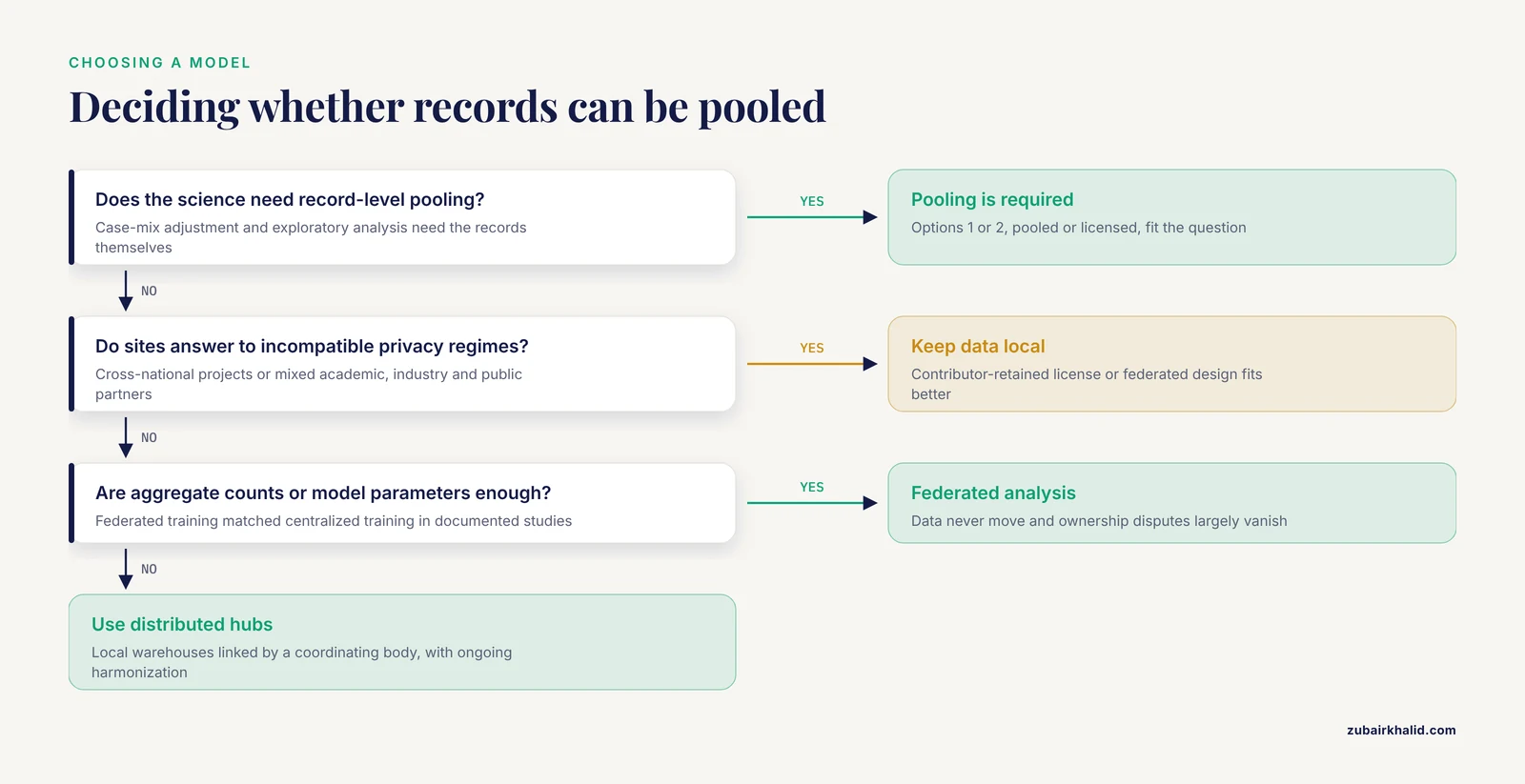
Compare the models on four decision criteria rather than on abstract preference.
Does the science require record-level pooling? If yes, options 1 or 2. If aggregate counts or model parameters suffice, federated designs deliver comparable results without moving data [2],[8].
How different are the institutions' legal environments? Cross-national projects, or projects mixing academic, industry, and public partners, favor contributor-retained or federated structures. Pooling works best when all sites answer to compatible privacy regimes.
Who can sustain the infrastructure? A pooled database needs a coordinating center with statistical, data management, and communications capacity [13]. A federated network needs every site to run local execution environments,[9]. Distributed hubs need continuous interoperability work. Pick the model whose maintenance burden matches the consortium's actual staffing.
What happens after the primary paper? If the consortium intends the dataset to support years of secondary research, or eventual repository deposit, the pooled model with explicit downstream rights is cleaner. If each institution expects to keep reusing its own data independently, federated or hub structures preserve that flexibility.
Common Mistakes and Limitations
Treating ownership as a science-policy problem rather than a legal one. Investigators assume goodwill covers everything. The literature is blunt that the absence of prospective agreements undermines collaborative ventures, and that the fix is negotiation before data exist [1].
Confusing custody with ownership. A consortium may give its coordinating center the master copy while every institution retains title. Projects stall when sites believe that losing custody means losing ownership, or the reverse.
Ignoring the two-year reality of database construction. Teams budget as if pooled data will be ready in months because the source systems are already electronic. A validated multi-institutional resource took about two years to build even with data readily available at every site [5]. Governance and funding must be structured to survive that interval.
Inventing a local data dictionary. Sites that define variables their own way face expensive mapping later. Use registry or standards-community definitions from the start, as the HL7 effort and Oncoshare both did [5],[12].
Underestimating harmonization as a negotiation. Agreeing on shared survey measures and outcome definitions across sites is partly a technical task and partly a political one. The CSER consortium's harmonization work succeeded only because data-sharing permissions and rapid communication platforms were built alongside it [6]. Harmonization problems also persist for years even in mature networks, as the StoP biobank experience shows [14].
Assuming a federated design eliminates all legal work. Federated architectures remove the need to move patient data, but they still require per-site deployment, security review, and an enforceable policy framework governing what algorithms may run and under what conditions [7],[9].
Deferring repository decisions. Teams negotiate patient-level ownership carefully and then discover at publication time that no one agreed on whether, where, or how pooled data can be deposited. Decide the downstream sharing path during initial negotiation, not at manuscript submission.
A final limitation. This article describes agreement structures and documented consortium experience. Your institution's counsel, privacy office, and sponsor terms control what any specific agreement can say, so individual projects need institutional review before signing.
Frequently Asked Questions
Who legally owns data produced by a multi-institutional grant-funded study?
In most academic and hospital settings, the employing institution owns the records its staff generate, and the written consortium agreement reallocates use rights among the institutions. Grant funding does not by itself transfer ownership to the funder, which is why the agreement, not the award notice, is the controlling document.
Can an individual investigator claim ownership of data they personally collected?
No. Institutional policy, not personal effort, determines title to research records. An investigator who moves to a new institution generally leaves the data behind, so multi-institutional agreements should address investigator departure explicitly rather than assume continuity.
What is the difference between a data use agreement and a data ownership agreement?
A data use agreement governs how one party may access and analyze data held by another party, covering permitted uses, privacy protections, and publication rules. A data ownership agreement determines who holds title to the data in the first place. Multi-institutional projects typically need both, and conflating them is a frequent source of dispute.
When should a consortium choose federated analysis over pooling data?
Choose federated analysis when privacy constraints, institutional policies, or cross-jurisdictional legal differences prevent records from moving, or when aggregate outputs are sufficient for the scientific question. Multi-hospital AI studies have shown federated performance comparable to centralized training, which removes the usual scientific objection to keeping data local [2],[8].
What does legal ownership of aggregate data mean in a consortium charter?
It means the charter designates a single legal entity, usually the consortium itself or its coordinating institution, as the title holder of the pooled summary dataset, distinct from each site's ownership of its own raw records. One pediatric surgery network adopted exactly this provision as one of its four founding governance pillars [4].
How early should data ownership be negotiated in a multi-institutional project?
Before the first record or sample is collected. Reviews of international collaborations recommend that the data sharing and ownership policy be prospectively negotiated and concluded between collaborators as early as possible, because renegotiating after data exist is far harder and rarely fair [1].
Sources
- Intra-consortium data sharing in multi-national, multi-institutional genomic studies: gaps and guidance.
- Simulating Federated Learning to Enable Multi-Hospital Collaboration for Lumbopelvic Alignment Estimation.
- Accelerating regulatory progress in multi-institutional research.
- The Eastern Pediatric Surgery Network: Creation and implementation of a comprehensive clinical research collaborative in pediatric surgery.
- Oncoshare: lessons learned from building an integrated multi-institutional database for comparative effectiveness research.
- Lessons learned about harmonizing survey measures for the CSER consortium.
- Federated Aggregate Cohort Estimator (FACE): an easy to deploy, vendor neutral, multi-institutional cohort query architecture.
- Federated learning for the pathogenicity annotation of genetic variants in multi-site clinical settings.
- Enabling Privacy-Preserving Federated Learning in Healthcare: The FLAME Architecture and Policy Framework.
- The Ouest Data Hub: An Interregional Health Data Sharing Ecosystem for Research.
- Radiology research platform: automating multicenter radiological research workflows using a cloud-native platform.
- Multi-National, Multi-Institutional Analysis of Clinical Decision Support Data Needs to Inform Development of the HL7 Virtual Medical Record Standard.
- Coordinating centers in cancer epidemiology research: the Asia Cohort Consortium coordinating center.
- Strengthening biobank networks: A Latvian case study within the StoP project.