Data Management Plan Review Checklist
By Dr. Zubair Khalid, DVM, MS, PhD ·

A data management plan checklist helps you write a plan, while a data management plan review checklist helps you judge whether a finished plan will survive funder and institutional scrutiny. That single difference should drive every tool you pick. The rule of thumb is simple. Draft with the broadest checklist available, review with the narrowest one that matches your funder, and build a custom scorecard only when your job is to evaluate other people's plans.
This article walks through the main data management plan checklist options, their pros and cons, how they compare on the criteria that decide real choices, and where reviewers most often go wrong. Everything here assumes the plan you are writing or reviewing is a Data Management and Sharing (DMS) Plan, the document the National Institutes of Health (NIH) requires from investigators whose research generates scientific data.
What a Data Management Plan Review Checklist Actually Checks
A DMS Plan is a short document, typically two pages or fewer under NIH rules, that describes how data will be managed, preserved, and shared during and after a funded project. Reviewers are not looking for prose. They are looking for a complete, internally consistent set of commitments across a small number of required elements.
The core elements a review checklist covers are:
- Data types and estimated volume. What data the project will generate or collect, in what formats, and roughly how much.
- Related policies, tools, and software. Whether the project will use policies, standards, or software that shape data handling, and how access to proprietary tools will be managed.
- Standards and metadata. The data formats, identifiers, metadata schemas, and documentation practices that will make the data usable by others.
- Repository, preservation, and access. Where the data will be deposited, how long they will be preserved, and how other researchers will find and reuse them.
- Timeline and milestones. When data will be shared, typically at publication or at the end of the award, whichever comes first.
- Budget. Which data management and sharing activities the project will pay for and how those costs fit the requested budget.
A review checklist turns those elements into yes or no questions. Does the plan name a specific repository, or only a vague category? Does the timeline match the award period? Does the budget line correspond to a stated activity? A checklist cannot judge scientific merit, but it can catch the omissions that trigger funder follow-up requests.
The stakes are practical rather than theoretical. Under the NIH DMS Policy, compliance with the approved plan becomes a term and condition of the award, so weaknesses written at the proposal stage become obligations the laboratory must later meet. A survey of researchers at one academic medical center found that although 67 percent understood the DMS Policy, only 47 percent felt comfortable developing a DMS Plan, and 68 percent perceived executing the plan as burdensome [1]. A checklist applied before submission is the cheapest point in the whole process to fix those problems.
Data Management Plan Checklist Options at a Glance
There is no single best data management plan checklist for every situation. Four options cover nearly all real use cases, and each suits a different audience and moment in the grant proposal planning cycle.
| Option | What it is | Best for | Main strength | Main weakness |
|---|---|---|---|---|
| Funder-policy checklist | A question list built directly from the funder's required plan elements, such as the six NIH DMS Plan elements | Final pre-submission review of your own plan | Perfectly aligned with what the funder enforces | Says nothing about quality beyond completeness |
| Generic template checklist | A standard question set from a planning tool such as DMPTool.org or a publisher's data policy | First drafts, training, and quick projects | Fast, structured, low barrier to entry | May miss funder-specific details like budget expectations |
| Institutional rubric or consultation review | A scored review by a data librarian or research office, using a locally developed rubric | High-stakes proposals and sensitive data projects | Human judgment on repository fit and sensitive data | Availability varies, and reviewers may not know your discipline |
| Custom reviewer scorecard | A rubric you build to evaluate plans written by collaborators, trainees, or applicants | Panel review, core facility oversight, mentoring | Tailored to local priorities and repeatable across reviewers | Time to build, and the rubric itself needs validation |
The pros and cons above are structural. Each option trades alignment against effort, and the right choice depends on which side of the review you are standing on.
Option 1: The Funder-Policy Checklist
This option converts a funder's stated requirements directly into review questions. For NIH, that means one question per required element of the DMS Plan, plus questions about internal consistency between the plan, the budget justification, and the resource sections of the application.
A funder-policy checklist for an NIH application looks roughly like this:
- Does the plan describe the data types the project will generate, and are those types consistent with the specific aims?
- Does it list any policies, standards, or software the project will use, and explain access terms for any proprietary tools?
- Does it name the standards, metadata, or identifiers the project will apply to each data type?
- Does it name a repository appropriate for the data type, state where data will be preserved, and describe how others will gain access?
- Does the sharing timeline fall at publication or the end of the award, whichever comes first, and are milestones stated?
- Does the plan identify which DMS activities will be budgeted, and do those costs appear in the budget justification?
The strength of this checklist is authority. It reviews the plan against exactly what the funder will enforce, nothing more. The weakness is completeness bias. A plan can pass every question and still name a repository that cannot actually accept the data, or promise documentation that no one on the team knows how to produce. Use this checklist last, after drafting, and expect it to catch gaps rather than judge quality.
Option 2: Generic Templates and Community Checklists
Generic checklists are the entry point for most researchers. Planning tools such as DMPTool.org provide structured templates that walk you through the standard elements, and some funders and journals publish their own question sets.
The evidence on real-world use is mixed in an instructive way. In the academic medical center survey cited earlier, only 29 percent of respondents had used DMPTool.org, while 87 percent requested tailored templates, and 40 percent reported low confidence in identifying appropriate repositories [1]. Generic templates lower the barrier to starting, but they cannot tell a genomics dataset from a clinical registry, and repository advice in a generic template is often a placeholder rather than a decision.
The pros of this option are speed, low cost, and good structure for first drafts, especially in a research grant writing course where trainees need scaffolding rather than judgment calls. The cons are equally clear. Generic checklists reward generic answers. If you fill in a template mechanically, you can produce a plan that looks complete and still fails on the two questions researchers in that survey found hardest, repository selection and budgeting.
Use a generic checklist to get a draft on paper, then move to a funder or institutional checklist before you commit to a repository or a budget line.
Option 3: Institutional Rubric and Consultation Review
Many institutions now offer DMS Plan review through libraries or research offices, either as a scored rubric or as a consultation. This option adds something no written checklist can, which is a second person who has seen many plans and knows where they typically fail.
The survey evidence explains why this service matters. Researchers in that study emphasized the need for centralized consultation, discipline-specific templates, equitable access to expertise, and budget guidance, and they reported uncertainty in managing sensitive data alongside a sense of administrative overload [1]. A rubric-based institutional review addresses all of those needs at once, because a data librarian can check repository fit, flag consent and privacy issues for human subjects data, and point to the right budget contact in one pass.
The pros are high-quality feedback on the hardest questions and consistency across proposals from the same institution. The cons are capacity and domain distance. A librarian may not know the community standards for your specific data type, and review slots fill up near proposal deadlines. If your institution offers this service, budget a review cycle into your grant proposal planning calendar rather than asking for a review the week the application is due.
Option 4: A Custom Reviewer Scorecard
If your role is to evaluate other people's plans, as a study section member, a core facility director, a department chair, or a mentor, none of the first three options fits. You need a scorecard that produces a consistent judgment across many plans and reviewers.
Build one by combining three ingredients. Start with the funder's required elements as scored items, since those are non-negotiable. Add recurring structural components that comparative analyses of large national and regional programs identify again and again, which include defined priorities, governance and accountability, stakeholder involvement, education, research and data infrastructure, monitoring, and sustainable resources [2]. Those seven components translate cleanly into rubric criteria for a data plan, because a plan with no monitoring arrangement and no sustainable resource commitment is a plan that will not be executed. Finally, anchor the rubric in an established framework rather than personal preference. Implementation science frameworks such as the Consolidated Framework for Implementation Research and the RE-AIM framework, which stand for Reach, Effectiveness, Adoption, Implementation, and Maintenance, exist precisely to make planning and evaluation judgments repeatable across reviewers [3].
Score each item on a simple scale, for example absent, vague, or concrete and verifiable. If several reviewers use the scorecard, pilot it on a small set of plans and have an expert panel check that reviewers interpret the items the same way. This mirrors how validated instruments are developed in other fields, where expert review is combined with structured user testing before the tool is adopted [4]. A scorecard nobody piloted will produce disagreements that look like reviewer error but are actually item ambiguity.
How the Options Compare on the Criteria That Decide Real Choices
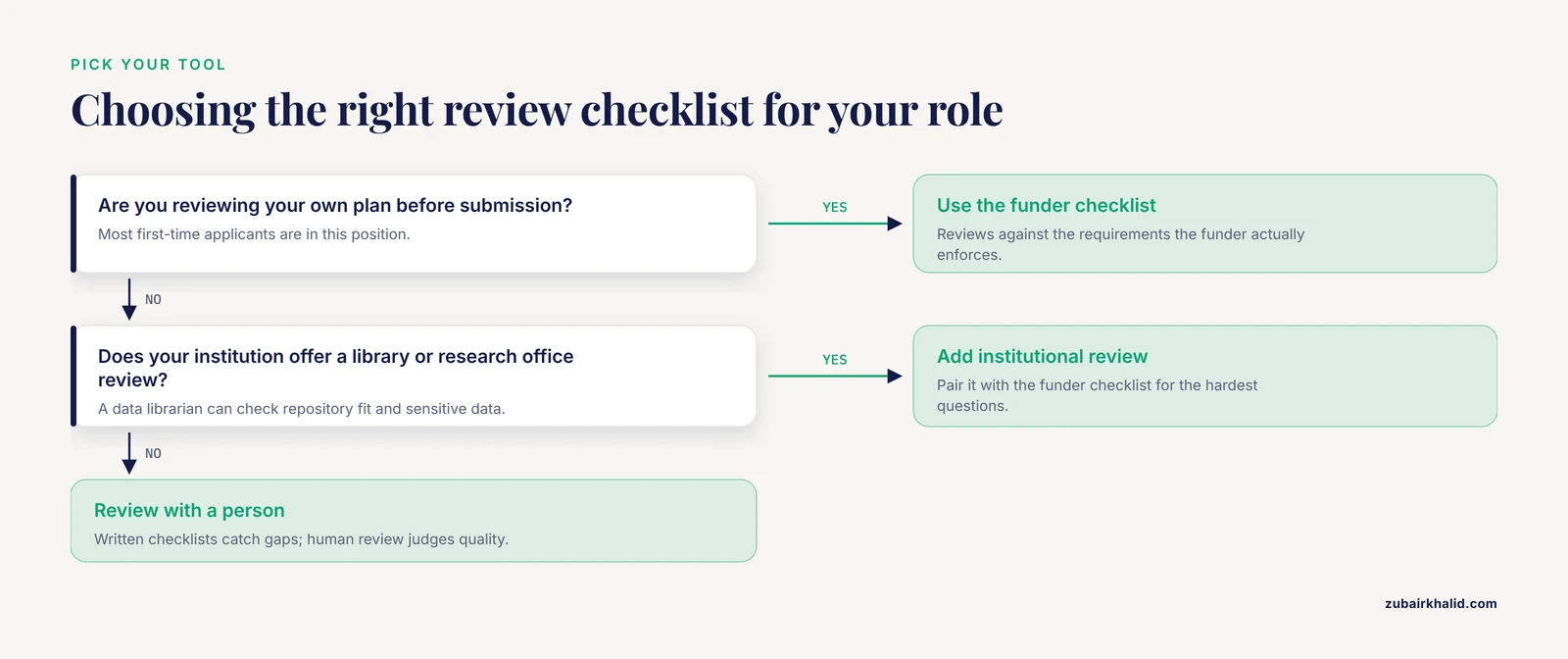
When researchers ask for the best data management plan checklist, they usually want a ranking. Ranking by alignment with your task is more useful.
Authority. The funder-policy checklist wins, because it is built from the document the funder enforces. The institutional rubric ranks second when its reviewers are experienced. Generic templates and custom scorecards rank last, because neither carries external authority.
Effort to use. Generic templates take the least time, often under an hour for a straightforward project. A funder checklist takes another pass through the plan. Institutional review adds coordination time. A custom scorecard costs the most, but the cost is paid once and amortized over every plan you review.
Specificity. The institutional rubric wins on the questions researchers find hardest, repository fit, sensitive data handling, and budgeting, because a person answers them rather than a form. The survey finding that only 40 percent felt confident identifying repositories and 38 percent felt confident budgeting for DMS activities shows exactly where human review adds value [1].
Feedback quality. Consultation beats any written checklist, because it produces answers and not just questions. But written checklists are available at midnight, and consultants are not.
Reusability. A custom scorecard and a funder checklist are reusable across every proposal your group submits. Generic templates are reusable but produce non-specific output. Institutional review is repeatable only if the institution sustains the service.
If you can only pick one, pick the funder-policy checklist, because it reviews the plan against the only requirements that carry consequences. If you can pick two, pair it with an institutional review.
Worked Scenarios
Scenario 1. A first-time R01 applicant. You are writing your first NIH application and generating genomic data. Start with a generic template to get the structure down in one afternoon. Then switch to the funder-policy checklist and answer each question against your draft. You will likely discover that your repository answer is a category, not a name. Fix it by consulting your institutional library, which can confirm whether your chosen repository accepts your data type and what metadata it requires. Finish with a final pass through the funder checklist, checking that the sharing timeline, the budget justification, and the plan all state the same commitments.
Scenario 2. A department reviewing trainee proposals. You mentor three postdoctoral fellows submitting fellowship applications. Build a lightweight scorecard using the six NIH elements scored as absent, vague, or concrete. Pilot it by having two people score the same plan and compare. Where your scores differ, the wording is ambiguous, so revise the item. This costs a few hours once and then standardizes the feedback every trainee receives, which is exactly the equitable access to expertise that researchers told surveyors they wanted [1].
Scenario 3. A data librarian designing an institutional service. Your research office wants to launch plan reviews. Do not build the rubric from scratch alone. Borrow the funder elements, add rubric items for the pain points the literature documents, which are repository selection, budget guidance, and sensitive data handling [1], and add the structural components that recur in comparative program analyses, such as monitoring and sustainable resources [2]. Then pilot the rubric on last year's funded proposals before announcing the service, so the first real users receive feedback that has already been tested.
Where AI Fits in Plan Drafting and Review
Generative AI now appears in structured document authoring, and the evidence base for how to use it safely is growing. In clinical trials, statistical analysis plans, which are regulatory documents defining statistical methodology and data-handling procedures, traditionally take four to six weeks to author. One deployed system drafts them using a knowledge graph and template architecture with four controlled generation modes, ranging from verbatim copying to fully generated text, precisely because uncontrolled generation is unacceptable in regulated documents [5].
That architecture is the lesson for DMS Plans. If you use AI to draft plan text, constrain it. Feed the AI your actual project details, data types, and repository decision, and treat its output as text to be verified line by line, not as advice. The reason is empirical. In a prospective study of AI-generated management recommendations, the appropriateness of the work-up suggested by a large language model was significantly lower than that of infectious disease specialists because it was not specific enough in nearly half of cases [6]. A DMS Plan reviewed by AI alone inherits the same failure mode, plausible but generic answers. The fix is the same one used in the clinical trial study, which paired structured rating scales with independent human expert evaluation of AI output [7]. Write with the tool, review with a person.
Building Your Own Review Checklist When None Fits
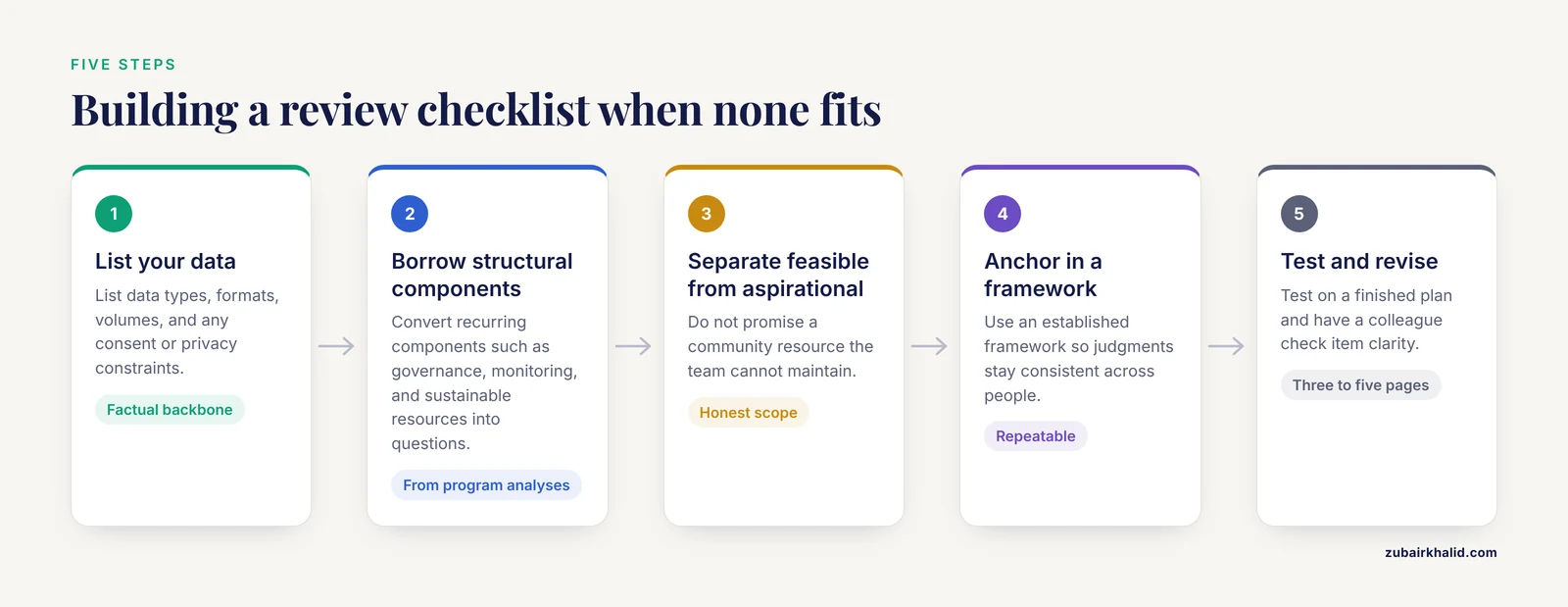
If your funder has no published elements, your institution has no service, and you are not reviewing other people's plans, build a short checklist in five steps.
- List the commitments your data will actually require. Inventory your data types, formats, volumes, and any consent or privacy constraints. This inventory becomes the factual backbone of the plan.
- Borrow structural components from comparable programs. Comparative analyses of national and regional plans converge on a small set of recurring components, including defined priorities, governance, monitoring, and sustainable resources [2]. Convert each into a question about your own project.
- Separate the feasible from the aspirational. Modern framework design distinguishes technically feasible elements from aspirational ones and stages evaluation accordingly [8]. A plan that promises a community resource the team cannot maintain is worse than a modest plan that will be honored.
- Anchor the review in a framework, not a feeling. Frameworks exist to make planning judgments consistent and defensible across people and time [3].
- Pilot and revise. Test the checklist on a finished plan, have a colleague or specialist review the items for clarity, and iterate before relying on it [4].
Three to five pages of notes is enough. A checklist longer than the plan it reviews will not be used.
Common Mistakes and Limitations
Confusing administrative review with scientific review. Under the NIH DMS Policy, the DMS Plan is assessed for compliance with policy expectations rather than scored for scientific merit during peer review. Reviewers sometimes waste effort critiquing sharing strategy as if it were an aims page. A checklist keeps the review on completeness and consistency.
Naming a repository without checking fit. The single most common substantive weakness is a repository choice made for convenience. Confirm the repository accepts your data type, supports your metadata standard, and issues persistent identifiers before the plan is submitted, because the plan becomes an obligation after award.
Treating the budget as optional. Data management costs, such as repository deposit fees and curation time, are allowable when justified. Plans that list activities but no corresponding budget line invite follow-up requests and, later, unfunded obligations.
Reviewing once and never again. A plan reviewed at submission and shelved until the award ends will drift from practice. Reviews of large national programs have documented gaps between what a plan says and what is actually implemented, which is precisely why monitoring and mid-course review appear as recurring components in comparative program analyses [9]. Schedule a brief annual check of your approved plan against what the laboratory is doing.
Relying on AI output without expert verification. Generic, nonspecific answers are a documented weakness of AI-generated management plans, and regulated documents demand controlled generation plus human review [5]. An AI draft can be a starting point, never the review itself.
Assuming one checklist covers every audience. A checklist that helps you draft will not help a panel rank proposals, and a panel scorecard is overkill for a single lab project. Match the tool to the role.
Expecting a checklist to substitute for judgment. A checklist catches omissions. It cannot decide whether a repository is trustworthy, whether consent language permits sharing, or whether a timeline is realistic. Those calls need a person who knows the data, and complex or sensitive cases warrant consultation with your institution's data or compliance specialists.
Frequently Asked Questions
What is a data management plan review checklist?
It is a structured list of questions used to judge whether a finished data management or DMS Plan is complete, internally consistent, and compliant with funder requirements. It differs from a drafting checklist, which helps you write the plan, because its purpose is evaluation before submission or during award monitoring.
Does the NIH review the DMS Plan during peer review?
The plan is checked for compliance with DMS Policy expectations rather than scored for scientific merit. After an award is made, compliance with the approved plan becomes a term and condition of the award, which is why the plan must be accurate and executable at the time of submission.
Which checklist should a first-time applicant use?
Start with a generic template to produce a structured draft quickly, then review that draft against the funder's required plan elements, and request an institutional or library review if one is available. Survey data show many researchers lack confidence specifically in repository selection and budgeting, so prioritize getting human feedback on those two items.
Can AI write or review a data management plan?
AI can help draft plan text, especially when generation is constrained to your actual project details and verified line by line. AI alone should not review a plan, because studies of AI-generated management recommendations show reduced specificity compared with human experts, so the reliable pattern is AI drafting followed by expert human review.
What if my data include human subjects?
Your plan must address the relevant policies governing those data, including informed consent, privacy, and confidentiality expectations. Because uncertainty about sensitive data is a documented pain point for researchers, involve your institution's compliance or data specialists early rather than treating the plan as a formality.
When should I revisit an approved plan?
At minimum, once per award year. Compare what the plan promised, such as the repository, metadata standards, and sharing timeline, against what the project is actually doing, and document any changes. Plans drift from practice when nobody checks, and mid-course review is far easier than explaining a gap at the end of the award.
Sources
- Supporting researcher compliance: assessing institutional readiness for the 2023 NIH Data Management and Sharing Policy.
- National and regional allergy and asthma programs: A comparative analysis and lessons for a German National Action Plan For Allergology.
- Applying the consolidated framework for implementation research to guide the development, implementation, and evaluation of a cardiology transitions of care program (RECARD trial).
- Designing for self-regulation: development and preliminary user evaluation of a student-facing learning analytics app in blended higher education.
- Leveraging generative AI to transform statistical analysis plan authoring in clinical trials.
- A prospective cohort study on the performance of chat-bot artificial intelligence in infective endocarditis management compared to infectious diseases consultation.
- Comparison of DeepSeek-V3.2 and ChatGPT-5.2 in the outpatient diagnosis and treatment of prostate cancer: a multicenter evaluation of application value and multilingual adaptability.
- Supporting engagement, behavior change, and equitable self-management in menstrual and menopausal health: A multi-agent digital-health framework.
- Strengthening insecticide resistance management in malaria vectors control in Côte d'Ivoire: from evidence to action.