Data Sharing in Large Collaborative Projects
By Dr. Zubair Khalid, DVM, MS, PhD ·

By the end of this article you will be able to charter a data management committee for a collaborative project, write an intra-consortium data sharing policy, build a versioned data dictionary, choose between centralized and federated sharing architectures, validate pooled data before analysis, and match each dataset to the right repository. The worked examples need Python 3 with the pandas library, a terminal with standard checksum tools, a text editor or spreadsheet, and a version controlled repository such as Git. Have on hand the consortium's draft agreement, the list of participating sites, and any funder data sharing requirements.
Data sharing in large collaborative projects fails in predictable ways. Partners collect incompatible variables, approvals arrive late, and nobody owns the pooled dataset. A standing data management committee prevents most of this, and the steps below turn the remaining failure points into a checklist you can run.
Why Consortia Share Data, and Where Sharing Breaks
Pooling is often the only route to a usable sample. Rare disease research depends on counting and recruiting eligible patients across many centers, which is why federated cohort tools were built to estimate combined subject availability before a project even starts [1]. Registry based benchmarking in fields such as pediatric and congenital cardiac care follows the same logic, since no single center sees enough procedures to measure outcomes reliably [2]. Pooling also lets investigators combine different kinds of evidence. A Duchenne muscular dystrophy collaboration merged the placebo arm of a phase 3 trial with datasets from two clinical centers and built prognostic models, models that predict how a patient's function will change, that explained far more of the variation in stair climb performance than models from any single source [3]. Biobank networks show the same pattern at international scale, with the Stomach Cancer Pooling project linking 33 research teams from 15 countries and their associated biobanks [4].
The failure points are just as consistent. Information models and terminologies differ across institutions, a barrier serious enough that one international standards effort cataloged 131 clinical data elements in use across 20 institutions in 4 countries before agreeing on a common core [5]. Administrative and regulatory requirements form a maze that delays science before it starts [6]. And public guidance concentrates on how consortia release data to the outside world, leaving the intra-consortium questions, who sees what, on what terms, with what credit, largely unanswered [7].
What a Data Management Committee Does in a Collaborative Project
A data management committee (DMC) is the standing group that owns data policy for a collaborative project. Clinical trialists sometimes use the same abbreviation for a safety monitoring body. Here it means the group that governs research data sharing between partners.
The committee owns six decisions:
- Policy. Which data are shared, at what level of detail, with whom, and on what timeline.
- Standards. The data dictionary, the terminologies, and the file formats every site must follow.
- Architecture. Whether records are pooled in one place or queried where they sit.
- Access. Who may request data, what review an application needs, and what recipients may do with the data.
- Quality. Validation rules, error tracking, and sign-off before pooling.
- Release. Ownership, authorship, embargoes, and public deposit.
Consortia that leave these decisions informal make them site by site under deadline pressure. Consortia that write them down early run better. The Asia Cohort Consortium credits its organizational progress to a coordinating center focused on collaboration development, operations management, statistical and data management, and communications infrastructure [8]. The Eastern Pediatric Surgery Network built its governance on explicit rules from day one and grew from 13 founding divisions to 24 participating centers [9].
Setting Up a Data Management Committee in a Collaborative Project, Step by Step
The eight steps below follow the order working consortia have used. Each step names its deliverable and its pitfall.
Step 1. Charter the committee before the first record is collected
Write the charter while the project is still a draft. Membership should include one voting data lead per site, a chair elected by the steering committee, and standing advisors from the coordinating center, biostatistics, and regulatory affairs. Define quorum, meeting cadence, and how decisions are recorded.
A one page charter in a machine readable format keeps the rules versioned and visible:
committee: Consortium Data Management Committee
membership:
  chair: elected by the steering committee, two-year term
  site_data_leads: one voting member per participating site
  standing_advisors: [coordinating_center_lead, biostatistics_lead, regulatory_lead]
meetings: monthly during active collection, quarterly afterward
quorum: two thirds of voting members
decision_rules:
  dictionary_changes: majority vote, changelog entry required
  external_access_requests: written application, committee review, steering approval
escalation: unresolved disputes go to the steering committee within 30 days
Commit the file to the project repository so every later change has an author and a date:
git add dmc_charter.yaml
git commit -m "Adopt DMC charter v1.0"
Expected output:
[main 1a2b3c4] Adopt DMC charter v1.0
 1 file changed, 12 insertions(+)
Deliverable: a signed charter, a membership roster, and a meeting calendar for year one. Pitfall: a committee that meets only when a dispute erupts. Put the calendar in place before there is anything to fight about.
Step 2. Negotiate the intra-consortium data sharing policy before collection starts
Reviewers of international genomic collaborations found that public guidelines are silent on the questions that actually stall partnerships, and concluded that a data sharing policy should be negotiated and concluded between collaborators as early as possible [7]. The policy answers questions that are political as much as technical:
- Which data move, raw or analyzed, record level or aggregate?
- Which sites receive whose data, and when?
- Who pays for curation, storage, and transfer?
- What happens to the data if a site leaves?
- How are secondary uses approved?
Record level means one row per participant. Aggregate means summaries that describe groups, such as counts and means.
Put the agreed terms into a data use agreement (DUA), the contract that binds each site to defined uses. Expect the administrative work to take real time. Teams running multi-institutional studies in the HMO Research Network reported that enabling data sharing and expediting subawards for data only, minimal risk studies required novel approaches and tight coordination among research, regulatory, and administrative staff [6]. Start those conversations in parallel with the study design, not after it.
Step 3. Build the data dictionary on existing standards
A data dictionary is the contract that makes submissions compatible. It lists every variable with a name, a definition, a data type, units, allowed values, and the external standard it follows. Building on an existing standard beats inventing one. The Oncoshare project, which integrated records from multiple institutions to study breast cancer care, based its dictionary on Surveillance, Epidemiology and End Results (SEER) registry standards and took mortality outcomes from the Social Security Administration Death Master File rather than from clinical records [10]. The CSER genomics consortium harmonized its survey measures the same way, defining a core set of consensus measures while leaving room for site specific additions and keeping participant burden low [11].
Start from a dictionary file:
variable_name,description,data_type,units,allowed_values,source_standard
age_years,age at enrollment,integer,years,0 to 100,SEER
sex,sex recorded at enrollment,categorical,,male|female|unknown,SEER
tumor_stage,stage at diagnosis,categorical,,I|II|III|IV,SEER
vital_status,mortality outcome,categorical,,alive|dead|unknown,SSA Death Master File
Each column matters. data_type tells sites how to encode a value, units prevent the classic mixup between months and years, allowed_values define the only permitted entries, and source_standard names the external reference so nobody argues about definitions later.
Validate the dictionary before anyone submits data:
import pandas as pd

dd = pd.read_csv("data_dictionary_v1.2.csv")
required = ["variable_name", "description", "data_type", "units",
            "allowed_values", "source_standard"]
missing = [c for c in required if c not in dd.columns]
dupes = dd.loc[dd["variable_name"].duplicated(), "variable_name"].tolist()
print("missing columns:", missing)
print("duplicate variable names:", dupes)
A clean dictionary prints:
missing columns: []
duplicate variable names: []
A dictionary with gaps prints exactly what to fix:
missing columns: ['units']
duplicate variable names: ['vital_status']
Every change gets a version number and a changelog entry approved by the committee, and all sites validate against the same version. Otherwise two sites can both be correct and still incompatible.
Deliverable: a versioned dictionary file and a changelog. Pitfall: treating the dictionary as a one time document rather than a controlled artifact.
Step 4. Choose centralized, federated, or hybrid sharing
Two architectures dominate, and many mature networks end up with a hybrid.
In a centralized design, sites send record level copies to one harmonized database. The ALL ALS consortium, funded by the National Institutes of Health, is building exactly this, a centralized and readily accessible infrastructure for longitudinal clinical data and biofluids from people living with ALS and from asymptomatic gene carriers [12]. At regional scale, the Ouest Data Hub links hospital clinical data warehouses in western France and gave research teams access to data covering more than 9.3 million patient records in 2023 [13].
In a federated design, data stay at each site and only queries, aggregate counts, or model updates move. The Federated Aggregate Cohort Estimator (FACE) let three institutions estimate combined research subject availability from diverse local databases using easily deployed virtual machines, with no patient records transferred [1]. The FLAME platform adds a hub-and-node architecture with a policy framework that specifies permissions and conditions for algorithm execution, along with audit logging and fine grained access control [14]. A radiology platform takes the same line, hosting images on a local Orthanc server, an open source server for DICOM medical images, and reverse proxying only metadata, data about the images such as dates and measurements, to a shared cloud database, which removes the need for virtual private network setups [15]. Federated learning extends the idea to model training, and proof of concept work on genetic variant classification found federated models performed comparably to or better than centralized ones [16]. Federated service architectures have also been applied to pathology image analysis across institutions [17].
| Feature | Centralized pool | Federated network |
|---|---|---|
| Where data sit | One harmonized database | Each contributing site |
| What moves between sites | Record level copies | Queries, aggregate counts, model updates |
| Privacy exposure | Higher, because records are transferred | Lower, because only aggregates leave |
| Local infrastructure | Modest, mainly submission tooling | Servers, standard query software, maintenance staff |
| Best suited analyses | Record level pooling of harmonized variables | Cohort discovery, feasibility counts, model training |
A federated feasibility count shows the pattern. Each site runs the same query on its own database:
SELECT COUNT(DISTINCT patient_id) AS eligible
FROM diagnoses
JOIN patients USING (patient_id)
WHERE diagnosis_code LIKE 'C50%'
  AND age_at_diagnosis BETWEEN 20 AND 79
Site A returns:
 eligible
----------
      412
(1 row)
Site B returns 287 and Site C returns 655. The combined estimate is 412 + 287 + 655 = 1,354 eligible patients, and no record left any site.
Choose centralized when the analysis needs record level pooling and the agreements allow transfer. Choose federated when privacy law, consent terms, or institutional policy keep data in place.
Step 5. Clear regulatory and administrative approvals in parallel
An Institutional Review Board (IRB) is the committee that approves human subjects research at each institution. In a multi-site project every site's IRB has jurisdiction over its own participants, so approvals must be secured and maintained at every center. Teams in the HMO Research Network accelerated this by developing shared approaches to securing and maintaining IRB approvals while preserving human subjects protections, and they credited the flexibility, creativity, and communication of research, regulatory, and administrative staff for the gains [6].
Practical moves:
- Name one regulatory lead who tracks every site's approval status in a shared tracker.
- Where the funder allows a single IRB of record, use one, because duplicated review is a common source of delay.
- Draft the DUA and the subaward together, since data terms and money terms move at the same speed.
- Treat privacy law as an architecture input. Constraints such as the Health Insurance Portability and Accountability Act (HIPAA) in the United States and the General Data Protection Regulation (GDPR) in Europe shape whether records can be copied or must be queried in place [14].
Deliverable: an approval tracker, executed DUAs, and activated subawards before the first transfer.
Step 6. Stand up the coordinating center and communication routines
A coordinating center (CC) is the hub that runs daily operations for the consortium. Published guidance on CCs is scarce, but the Asia Cohort Consortium's experience is instructive. Its center concentrated on four activity areas, collaboration development, operations management, statistical and data management, and communications infrastructure and tool development [8].
Routines that keep data moving:
- One file naming convention, for example SITE_DATASET_VERSION_DATE.
- A changelog for the dictionary and every pooled file.
- Checksums on every transfer. A checksum is a short digest computed from a file's bytes, so any corruption in transit changes it:
sha256sum pooled_cohort_v1.csv > pooled_cohort_v1.csv.sha256
sha256sum -c pooled_cohort_v1.csv.sha256
Expected output at the receiving end:
pooled_cohort_v1.csv: OKA mismatch means the file changed in transit:
pooled_cohort_v1.csv: FAILED
sha256sum: WARNING: 1 computed checksum did NOT match
The fix is to re transfer the file, and if the failure repeats, check storage limits and transfer settings before suspecting the data.
- A single ticket queue for data questions, so answers stay searchable instead of buried in email.
- Standing video calls with written minutes.
The CSER consortium named platforms for swift communication between teams, alongside management of materials and data, as essential to its harmonization work [11]. Clinical relevance needs a seat as well. The Ouest Data Hub keeps physicians integrated in its processes so data remain clinically meaningful and interpretations stay accurate [13].
Deliverable: a communications charter, a transfer protocol with checksums, and a question queue.
Step 7. Validate before you pool
Electronic data are not research data until they are validated. The Oncoshare team found that a multi-institutional database effort may take as long as two years to produce validated, reliable data for research, even though the electronic sources were available from day one [10]. Biobank networks report the same lesson, naming data collection, harmonization, storage, funding, and sustainability as their key challenges, and strengthening their work by updating standard operating procedures and harmonizing retrospective datasets [4]. Mature health data ecosystems treat data quality and interoperability as continuous work rather than a one time cleanup [13].
Automate the checks every submission must pass:
import pandas as pd

df = pd.read_csv("pooled_cohort_v1.csv")
checks = {
    "age out of range": int(((df["age_years"] < 0) | (df["age_years"] > 100)).sum()),
    "missing vital_status": int(df["vital_status"].isna().sum()),
    "unknown site code": int((~df["site_code"].isin(["A", "B", "C"])).sum()),
}
for name, count in checks.items():
    print(f"{name}: {count}")
A first run on a real submission typically shows problems:
age out of range: 3
missing vital_status: 0
unknown site code: 0
The fix is procedural. Send the three record identifiers back to the source site, check them against the original chart, correct the values or flag them missing, and re run until every count is zero. Log each error and its resolution in the changelog.
Deliverable: a validation script in version control, an error log, and a signed quality sign-off per submission. Pitfall: signing off on pooled data that nobody has compared against source records.
Step 8. Set ownership, access, and publication rules in writing
Ownership disputes end projects, so write the rules at founding. The Eastern Pediatric Surgery Network made legal ownership of aggregate data one of its four governance pillars, alongside horizontal leadership, mandatory participation in adopted studies, and a broad research portfolio [9]. A common pattern gives each site ownership of its raw records and gives the consortium ownership of pooled aggregate outputs. Any pattern works if it is written, signed, and early.
Define the access pathway for people outside the founding team. The Merkel Cell Carcinoma Patient Registry illustrates the model, a national multi-institutional effort built on a REDCap database, an electronic data capture tool widely used for clinical research, governed by a task force spanning academic centers, industry, the National Institutes of Health, and the Food and Drug Administration, and paired with a secure open access data sharing platform [18].
Publication rules deserve equal precision. Specify who approves an analysis plan, what embargo applies before the primary paper, and how a departing site's contributions are credited. Consortia that skip this spend their first joint paper negotiating authorship instead of writing it.
Deliverable: an ownership clause, an access procedure, and a publication policy in the signed agreement.
Choosing a Home for the Data: A Data Repository Comparison
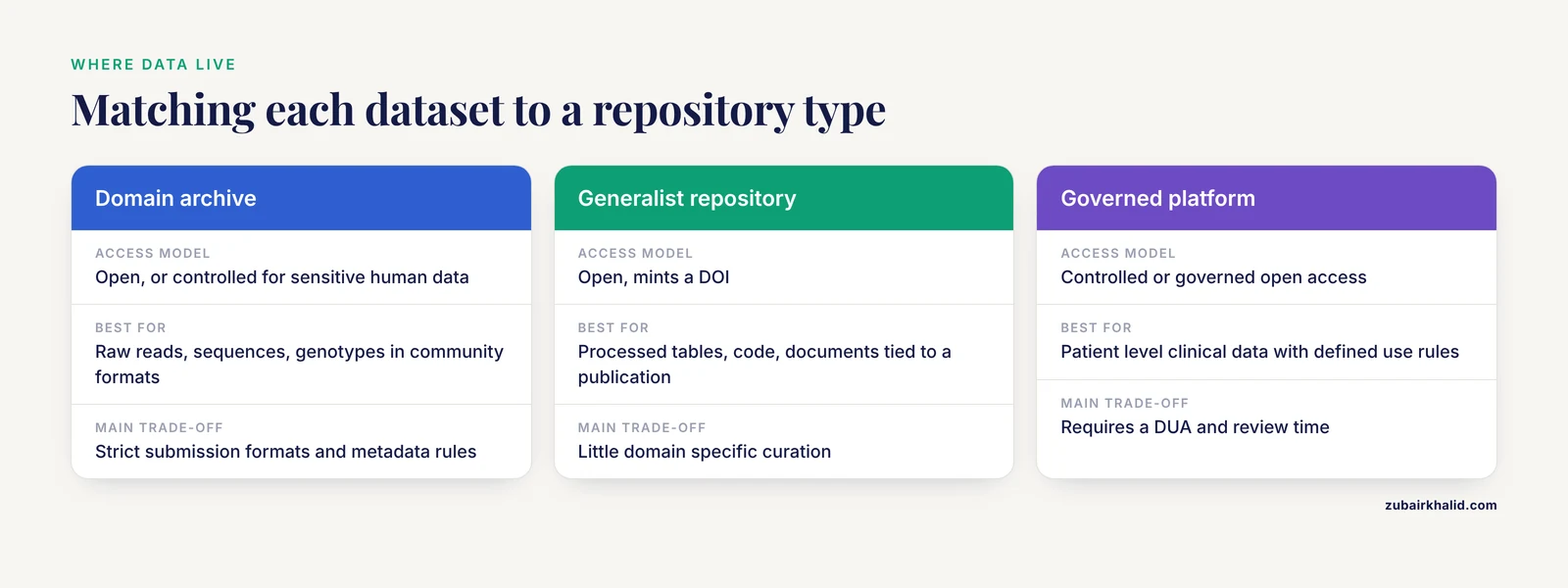
A repository is a service that stores data and makes them findable and retrievable. Consortia usually need more than one, because a raw sequence file and a patient level clinical table have different sensitivity and different audiences. Match each dataset to the access model it requires.
| Repository type | Examples | Access model | Best for | Main trade-off |
|---|---|---|---|---|
| Domain archive | NCBI Sequence Read Archive, GenBank, dbGaP | Open, or controlled for sensitive human data | Raw reads, sequences, genotypes with community formats | Strict submission formats and metadata rules |
| Generalist repository | Zenodo, Dryad, Figshare | Open, mints a DOI | Processed tables, code, documents tied to a publication | Little domain specific curation |
| Institutional repository | University or hospital research data services | Set by local policy | Data with contractual or consent restrictions | Poor discovery outside the home institution |
| Consortium platform | Governed clinical data platforms with review boards | Controlled or governed open access | Patient level clinical data with defined use rules | Requires a DUA and review time |
| Federated network | Hub-and-node query and machine learning systems | Data never leave the site | Privacy constrained records across many institutions | Each site must run local infrastructure |
Three rules make the choice easier. Deposit raw data in the domain archive where your community already looks, since domain archives enforce the formats and metadata that make reuse possible. Use generalist repositories for processed tables, analysis code, and documents tied to a publication, because they mint a digital object identifier (DOI), a persistent link citations can point to. Keep patient level clinical data inside governed platforms or federated networks unless every consent and agreement explicitly allows open deposit. The model reaches far beyond biomedicine, from clinical registries to the ZooMonitor Community, a freely available platform that zoos and aquariums use for multi-institutional data sharing and project management on behavior questions [19].
Record the committee's decision per dataset, the access conditions, and the retention period in the same changelog that tracks the dictionary.
Common Mistakes and Limitations
These errors recur across published consortium experience, with the fix for each.
- Writing the sharing policy after collection starts. Once sites have invested labor, every term reads like a concession. Negotiate prospectively, before enrollment [7].
- Assuming the dictionary harmonizes the data by itself. A document does not clean records. Harmonization is continuous work on quality and interoperability [13],.
- Planning as if electronic data were research data. Validation commonly takes up to two years even when every record is already electronic [10].
- Reconciling terminologies at analysis time. Institutions use different information models and vocabularies, and cataloging the elements early is far cheaper than reconciling them late [5].
- Leaving ownership and publication rules unwritten. Informal understandings fail under authorship pressure, which is why successful networks make ownership a founding pillar [9].
- Running the consortium without a real coordinating center. Operations, statistics, data management, and communications are distinct jobs, and neglecting one stalls the others [8].
- Choosing an architecture the sites cannot support. Federated designs need local servers and staff, centralized designs need transfer approvals. Match the design to infrastructure and law,.
- Treating regulatory and administrative staff as back office. Their flexibility and communication determine how fast approvals move [6].
Limitations. The models described here come from specific consortia in specific legal and funding environments, and none transfers without adaptation. Federated learning results remain largely proof of concept at study scale, so performance on your own data must be measured rather than assumed [16]. Committee structures, approval routes, and repository rules also vary by funder and institution, so treat each step above as a template to argue with, not a regulation.
Sensible next steps. This week, draft the charter and circulate the policy questions. This month, agree the dictionary standards and survey each site's infrastructure and approval status. Before the first transfer, execute the DUAs, freeze dictionary version 1.0, and rehearse the validation script on dummy data.
Frequently Asked Questions
What does a data management committee do in a collaborative research project?
It owns the project's data policy. The committee approves the data dictionary, decides who can access which data, oversees quality checks, and sets the rules for release and publication. It is the single body that resolves data disputes between participating sites.
When should a consortium write its intra-consortium data sharing policy?
Before data collection starts. Sharing rules negotiated after sites have invested effort are hard to agree and harder to enforce, so conclude the policy as early as possible, ideally alongside the charter.
What is the difference between centralized and federated data sharing?
Centralized sharing moves record level copies to one pooled database. Federated sharing leaves data at each site and moves only queries, aggregate counts, or model updates. Choose centralized when analysis needs record level pooling, federated when privacy rules or agreements keep data in place.
What is a data dictionary and why does a consortium need one?
A data dictionary defines every variable with a name, a description, a data type, units, allowed values, and the external standard it follows. It is the contract that makes submissions from different sites compatible, and every site validates against the same versioned copy.
How do I choose a repository for consortium data?
Match sensitivity and format to the access model. Open processed files belong in generalist repositories, raw sequence data belongs in domain archives, patient level clinical data needs a governed platform, and data that cannot move needs a federated network.
Who owns data in a multi-institutional consortium?
Whatever the signed agreement says. A common pattern gives each site ownership of its raw records and gives the consortium ownership of pooled aggregate outputs. The exact split matters less than writing it down at founding.
How long does it take to build a validated multi-institutional database?
Longer than most teams plan for. Even when every site has electronic records, harmonization and validation commonly take years rather than weeks, so build that time into the project schedule from the start.
What is federated learning and when should a consortium use it?
Federated learning trains a shared statistical or machine learning model across sites without moving the underlying data. Use it when privacy law, consent terms, or institutional policy prevent data transfer but a larger combined sample would improve the model.
Sources
- Federated Aggregate Cohort Estimator (FACE): an easy to deploy, vendor neutral, multi-institutional cohort query architecture.
- Databases for assessing the outcomes of the treatment of patients with congenital and paediatric cardiac disease--the perspective of cardiology.
- Prognostic factors for changes in the timed 4-stair climb in patients with Duchenne muscular dystrophy, and implications for measuring drug efficacy: A multi-institutional collaboration.
- Strengthening biobank networks: A Latvian case study within the StoP project.
- Multi-National, Multi-Institutional Analysis of Clinical Decision Support Data Needs to Inform Development of the HL7 Virtual Medical Record Standard.
- Accelerating regulatory progress in multi-institutional research.
- Intra-consortium data sharing in multi-national, multi-institutional genomic studies: gaps and guidance.
- Coordinating centers in cancer epidemiology research: the Asia Cohort Consortium coordinating center.
- The Eastern Pediatric Surgery Network: Creation and implementation of a comprehensive clinical research collaborative in pediatric surgery.
- Oncoshare: lessons learned from building an integrated multi-institutional database for comparative effectiveness research.
- Lessons learned about harmonizing survey measures for the CSER consortium.
- Access for ALL in ALS: A large-scale, inclusive, collaborative consortium to unlock the molecular and genetic mechanisms of amyotrophic lateral sclerosis.
- The Ouest Data Hub: An Interregional Health Data Sharing Ecosystem for Research.
- Enabling Privacy-Preserving Federated Learning in Healthcare: The FLAME Architecture and Policy Framework.
- Radiology research platform: automating multicenter radiological research workflows using a cloud-native platform.
- Federated learning for the pathogenicity annotation of genetic variants in multi-site clinical settings.
- ImageMiner: a software system for comparative analysis of tissue microarrays using content-based image retrieval, high-performance computing, and grid technology.
- The Merkel Cell Carcinoma Patient Registry: From Promise to Prototype to Patient.
- ZooMonitor Community: A Tool for Evaluating Population-Level Behavior Questions.