Data Availability Statement: Template and Examples
By Dr. Zubair Khalid, DVM, MS, PhD ·

By the end of this article you will be able to write a data availability statement that a journal editor, reviewer, or reader can actually act on. You will have a free data availability statement template you can copy, filled-in examples for the six situations that cover most papers, a verification workflow with real commands, and a reproducibility checklist that goes beyond the statement itself. You need nothing installed to start, though the verification section uses a terminal with standard tools such as curl and md5sum.
What a Data Availability Statement Is
A data availability statement is a short section in a published paper that tells readers where the data behind the results can be found, who can access them, and under what conditions. It sits alongside methods and acknowledgments and answers one question: if you want to check or reuse this work, where do you go?
The statement matters because reproducible research, meaning research that others can independently verify by following the same methods and data, depends on access. A Delphi consensus study of 73 experts from 34 countries, spanning researchers, editors, publishers, funders, and policymakers, placed data and material access among the priority measures for strengthening reproducibility [1].
The statement is also distinct from a data citation. A data citation points readers to a dataset as a source that informed the work, for example a reference to a public database. A data availability statement describes where the data generated or analyzed in the current study live. Many papers need both.
What the Evidence Shows
Writing this section well is not an empty formality. Audits of published statements show that many are missing, vague, or wrong.
In a meta-research study of aging research funded by the Nathan Shock Centers, researchers screened 400 articles published between 2017 and 2022. Half had no data availability statement at all, and 92% had no code availability statement. Where statements existed, they most often pointed to a repository (30%) or supplemental files (26%), while 10% claimed data were included in the paper itself and 14% said data were available on request. When the authors tried to actually locate materials described as open, they succeeded for only 63% of data and 81% of code [2]. A statement you write today is a promise a reader will try to collect.
Code sharing shows the same pattern. In a large-language-model-assisted scoping review of clinical prediction model research citing TRIPOD or TRIPOD+AI, only 482 of 3,967 articles (12.2%) included code-sharing statements, and the repositories that were shared varied widely in whether they contained documentation, specified dependencies, or could actually be executed [3]. This review motivated TRIPOD-Code, a reporting guideline that pushes expectations beyond mere availability toward documentation and executable structure.
Mandatory policies change the picture. In a large reproduction project covering 110 articles from leading economics and political science journals with mandatory data and code sharing policies, more than 85% of published claims were computationally reproducible by independent teams. In robustness checks, 72% of statistically significant estimates remained significant in the same direction, and the median reproduced effect size was nearly identical to the published one [4]. Enforcement works.
The gap between policy and practice persists elsewhere. In real world evidence research published in the International Journal of Population Data Science between 2019 and 2024, none of 41 eligible articles met all five open science domains the reviewers checked, and only 14 (34%) included a statement about data availability [5]. Code sharing is especially important in this field because population data often cannot be shared, yet code links were essentially absent.
Journal and Funder Policies You Need to Check
Before you write anything, check three policies, because they determine what your statement must contain.
First, check the journal. A survey of 171 materials science journals across 17 publishers found that nearly all journals now provide a research data policy and most mention data availability statements, but enforceable requirements remain uncommon and public deposition is rarely mandatory. Expectations for software lag behind those for data, with limited attention to versioning, persistent identifiers, and dependency disclosure. Notably, neither impact factor nor access model reliably predicted how strong a journal's policy was, so you cannot judge requirements from prestige [6].
Second, check the funder. A scoping review of documents from 12 members of the Global Cardiovascular Research Funders Forum found that data sharing was the most common mandate at 67% of covered expectations, followed by open access at 58% and prospective registration at 50%. Code sharing requirements were uncommon, and monitoring of compliance was inconsistent [7]. If your grant terms require deposition, the statement must reference the deposit, not just "availability on request."
Third, check any data use agreements attached to your datasets. Governance review of genomic data sharing agreements at three research-intensive institutions in Uganda showed that even when data sharing agreements exist, legal enforceability can remain challenging, and domains such as data ownership, protection, access, intellectual property, and benefit sharing all need explicit treatment [8]. If your data carry a agreement that restricts redistribution, your statement has to describe the restricted route accurately rather than link to files you are not permitted to post.
Anatomy of a Strong Statement
A usable statement has five parts:
- What was created or analyzed, described concretely (for example, raw sequencing files, a deidentified analytic dataset, or simulation code).
- Where it lives, with a persistent identifier such as a DOI or accession number, not a lab website link that will rot.
- Who can access it and under what conditions, including any restrictions, embargoes, or application processes.
- How to access it, with the exact steps or a named contact.
- For which results the data apply, when only part of the study data is being shared.
Vague statements fail on parts 3 through 5. "Data are available from the corresponding author on reasonable request" tells a reader nothing about what to request, how long it takes, or who decides. A radiology AI commentary identified this pattern clearly: limited availability and usability of shared data and code restrict independent verification even when resources are nominally shared, partly because reporting is treated as a final-stage manuscript task rather than a prospectively planned part of study design [9].
Data Availability Statement Template (Free to Copy)
The template below covers every standard situation. Delete the blocks that do not apply and fill in the bracketed placeholders. This format works for most journals that request a statement.
Data availability statement

[Block A: public repository]
All data generated or analyzed during this study are available in the
[REPOSITORY NAME] repository, [DOI or accession number].
Analysis code (LANGUAGE, VERSION) that reproduces the results in
[FIGURES/TABLES] is available at [REPOSITORY URL], archived at [DOI].

[Block B: public + restricted mix]
The [DATASET 1] analyzed in this study is publicly available in the
[REPOSITORY NAME] repository, [DOI or accession number]. The [DATASET 2]
contains [DESCRIPTION OF SENSITIVE CONTENT] and cannot be shared publicly
because of [REGULATION/CONSENT TERMS/AGREEMENT NAME]. Access can be
requested from [NAMED CUSTODIAN OR COMMITTEE] at [CONTACT] through the
[DATA ACCESS PROCESS NAME], and requests are typically reviewed within
[TIMEFRAME IF KNOWN].

[Block C: third-party data]
The data that support the findings of this study were provided by
[PROVIDER] under a license that prohibits redistribution. Data can be
obtained directly from [PROVIDER/WEBSITE] at [URL OR CONTACT], and the
authors applied for and received permission to use them under
[AGREEMENT NAME OR NUMBER].

[Block D: no new data]
Data sharing is not applicable to this article because no new data were
created or analyzed in this study.

[Block E: all data in the article]
All data supporting the findings of this study are included within the
article (and its [Supplementary Information/Supplemental Material] files).

[Optional block: embargo]
Data will be deposited in [REPOSITORY NAME] and made publicly available
by [DATE], in line with [JOURNAL/FUNDER POLICY NAME].
Fill in every bracket. If you cannot fill one, that is a signal the underlying access plan is not finished, not a signal to delete the sentence.
Worked Template Examples for Common Situations
Example 1: Data deposited in a public repository
Raw and processed RNA-seq data are available in the [Gene Expression](/blog/guides/gene-expression)
Omnibus under accession GSEXXXXXX. Analysis code (R 4.3.1) reproducing
Figures 2-4 and Table 1 is available at https://github.com/[org]/[repo]
and archived on Zenodo under DOI 10.5281/zenodo.XXXXXXX.
This is the strongest template format. It names the exact objects, gives persistent identifiers, and ties the code to specific figures so a reader knows what the script should reproduce.
Example 2: Sensitive human data with controlled access
When data contain health narratives or other identifiers, a controlled-access route is standard practice. One framework for Japanese electronic health record narratives shows the pattern: researchers generated deidentified analytic text that preserved contextual information for post hoc auditing while keeping sharing within privacy constraints [10]. A matching statement looks like this:
The source electronic health record narratives cannot be shared because
of patient privacy provisions and the data use agreement with
[INSTITUTION]. A deidentified analytic dataset, the entity extraction
code, and the masking script used to produce it are available from the
corresponding author for audit purposes upon request, subject to a data
use agreement and approval by the [ETHICS COMMITTEE NAME].
Example 3: Genomic data under a data sharing agreement
Genomic data are deposited in the European Genome-phenome Archive under
accession EGAXXXXXX. Access is governed by a data use agreement with
[INSTITUTION] and requires approval from the [DATA ACCESS COMMITTEE].
Applicants must register, submit a signed agreement covering data
ownership, protection and security, and permitted analyses, and receive
approval before download.
This wording mirrors the domains that data sharing agreements typically cover, including ownership, protection, access, intellectual property, and benefit sharing [8].
Example 4: Clinical trial data shared in tiers
Trial data can support different levels of reuse, and stating the tier prevents overpromising. A three-tier framework for trial transparency proposes that tier 1 comprises publication-time reduced datasets that support endpoint-level numerical reproducibility, tier 2 comprises reproducibility packages, and tier 3 comprises individual participant data with full documentation [11].
Deidentified individual participant data will be available three years
after publication through [REPOSITORY OR ACCESS PLATFORM] for
researchers who provide a methodologically sound proposal and sign a
data use agreement. Summary time-to-event data needed to reproduce the
reported endpoints are provided in Supplemental Table S3.
Example 5: Studies using AI models
For machine learning papers, availability extends to model identity and settings. Reporting in rheumatology LLM research was found to be heterogeneous, with most studies relying on closed proprietary models and frequent gaps in reporting access mode and interaction language [12]. A statement in this area should read:
The prompts, model identifiers and versions (including release dates),
and decoding settings used for all analyses are provided in
Supplementary Methods. Because [MODEL] is a closed, proprietary system
that may be updated or retired, we also provide all model outputs as
structured files so results can be reanalyzed without re-running the
model. Analysis code is available at [REPOSITORY URL].
This aligns with the direction of TRIPOD-Code, which emphasizes documentation, dependency specification, and executable structure rather than a bare link [3].
Example 6: Secondary analysis of a public database
This study used publicly available data from the [DATABASE NAME]. No new
data were created. The extraction script and analysis code are archived
at [DOI].
For papers built on heavily mined public databases, stating the exact data version or release you used is worth a sentence of its own, since secondary analyses that skip version reporting are one of the quality concerns raised about large-scale reuse of such databases [13].
Step by Step: Deposit, Link, and Verify
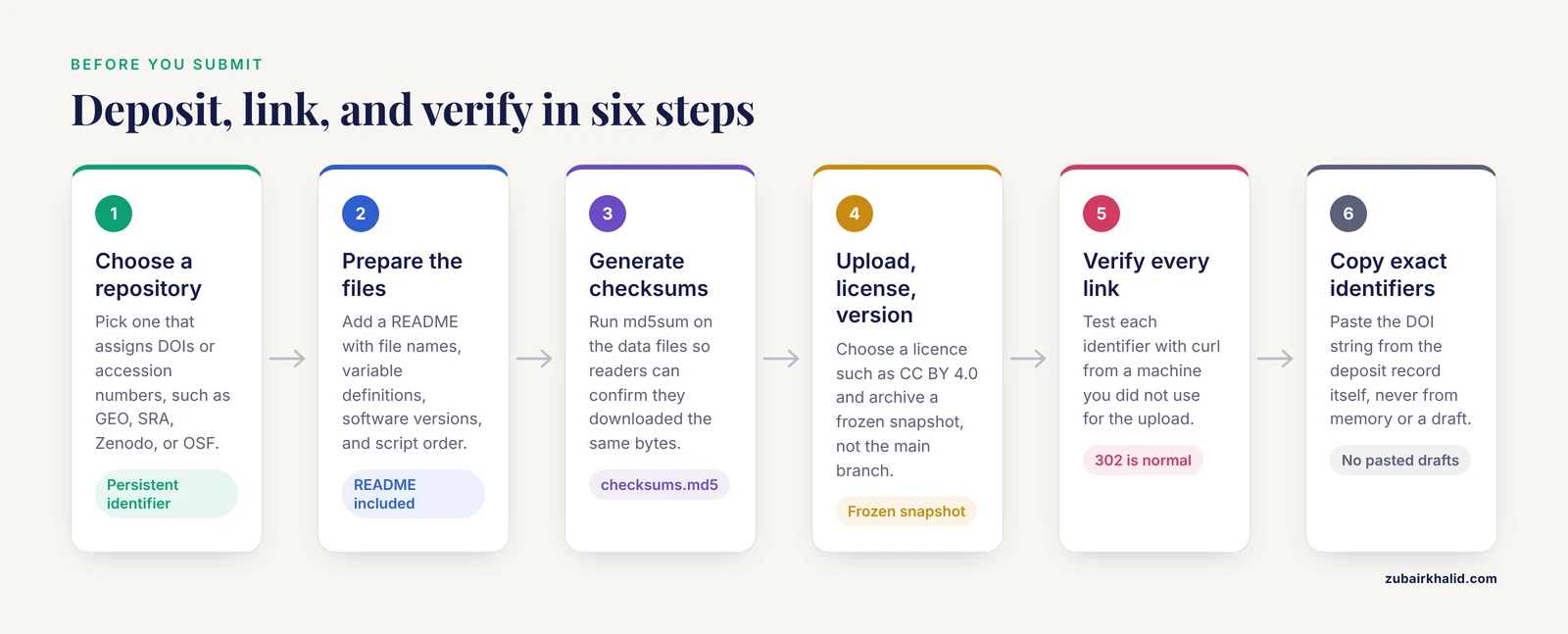
Follow this sequence before you submit. The goal is that every claim in your statement has been tested at least once.
Step 1. Choose a repository and get a persistent identifier. Pick a repository that assigns DOIs or accession numbers (subject repositories such as Gene Expression Omnibus or SRA for sequence data, or general repositories such as Zenodo or OSF for mixed data and code). A persistent identifier is a link guaranteed to keep resolving even if your lab website moves. FAIR principles, short for Findable, Accessible, Interoperable, and Reusable, are the reference standard here, and community resources show how far reuse can go when identifiers, harmonized metadata, and retrieval tools are in place [14].
Step 2. Prepare the files. Include a README that states file names, variable definitions, software versions, and the order in which scripts should run. Generate checksums so anyone can confirm they downloaded the same bytes you uploaded:
md5sum data/*.csv > checksums.md5
cat checksums.md5
Expected output looks like this:
d41d8cd98f00b204e9800998ecf8427e  data/cohort_2019.csv
9e107d9d372bb6826bd81d3542a419d6  data/cohort_2020.csv
A reader can rerun md5sum -c checksums.md5 and should see OK beside each file.
Step 3. Upload, license, and version. Choose a license (CC BY 4.0 is common for data, an open source license for code), and if you deposit code from a repository hosting service, archive a specific version rather than the ever-changing main branch, since a DOI must point to a frozen snapshot.
Step 4. Verify every link resolves. Test each identifier from a machine you did not use for the upload:
curl -I https://doi.org/10.5281/zenodo.XXXXXXXExpected output (truncated) for a working DOI:
HTTP/2 302
location: https://zenodo.org/records/XXXXXXX
A 302 redirect to the repository record is normal. A 404 or a redirect to a login wall means the deposit is private and your statement is inaccurate.
Step 5. Write the statement using the exact identifiers. Copy the DOI string from the deposit record itself, not from memory. Statements are often written last and pasted from drafts, which is how links pointing to the wrong record survive into print.
Step 6. Run the reproducibility checklist. Before submission, confirm each item:
- The statement names every dataset and codebase the results depend on.
- Each named resource has a persistent identifier that resolves.
- The README documents software versions and dependencies.
- A fresh clone or download reproduces at least one figure or table end to end.
- Restricted data have a named custodian and a stated process, not just the phrase "on request."
- Embargo dates match funder or journal requirements.
- The statement matches the journal's policy wording where the policy is mandatory.
Packages designed around these principles show what the target looks like in practice. The eyeris pupillometry package, for example, follows a fixed file management schema and generates interactive output reports for record keeping and quality assurance of preprocessed data, which makes the analysis chain itself inspectable [15]. The Metabonaut educational resource teaches the same idea for metabolomics, carrying FAIR practice from deposited raw files through script-based analysis to reported feature tables [16].
Choosing the Right Statement Type
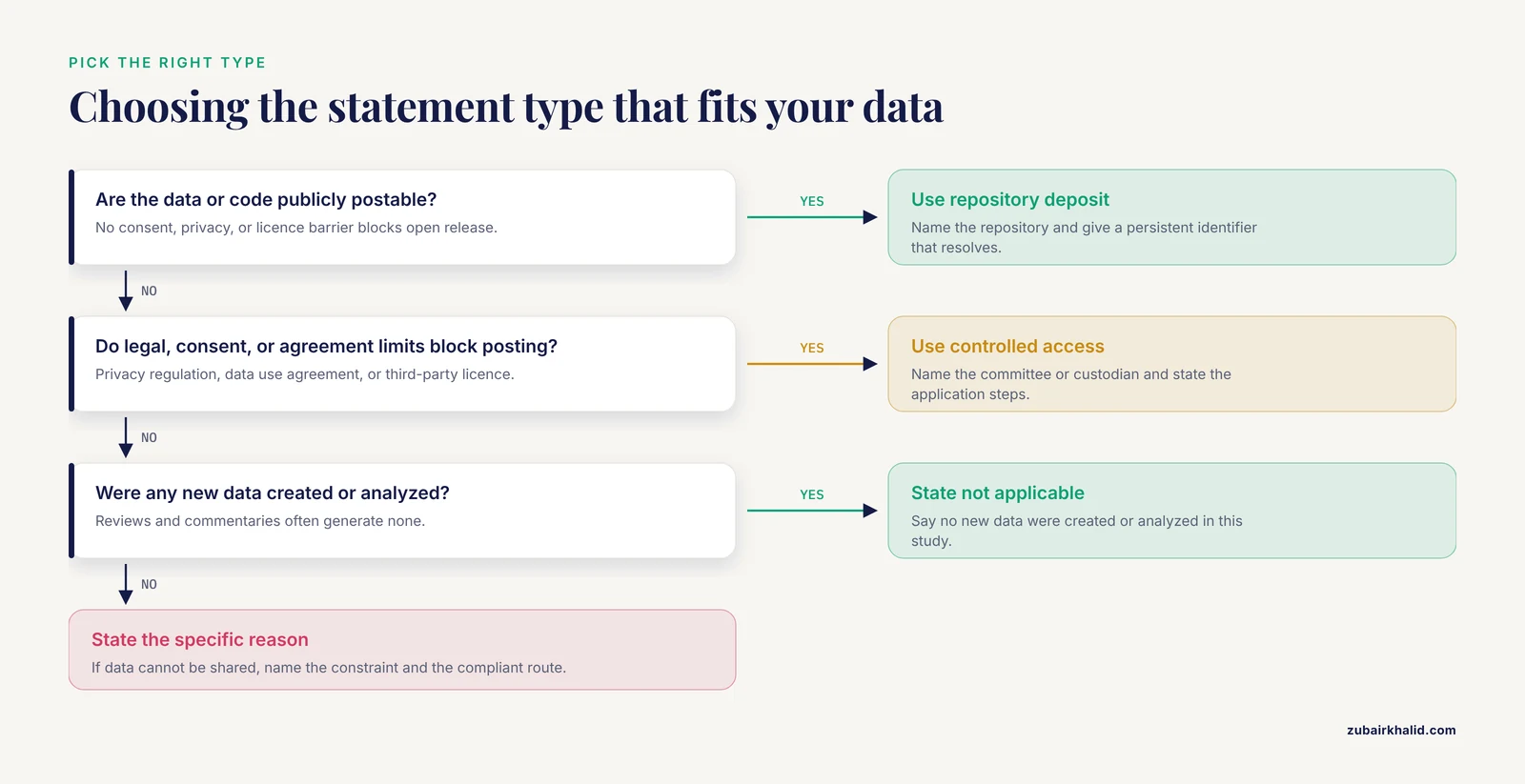
Audits classify statements into a small number of types [2]. The table below matches each type to the situation where it is honest and defensible.
| Statement type | Use when | Key requirement |
|---|---|---|
| , - | , - | , - |
| Repository deposit | Data or code are public | Persistent identifier, tested link |
| Supplemental files | Small datasets ship with the paper | Files actually complete and documented |
| Inclusion in the paper | All numbers appear in tables or figures | Reader can rebuild the analysis from print alone |
| On request | Legal or consent limits block posting | Named contact, defined process, defined scope |
| Controlled access | Sensitive or genomic data | Access committee or agreement named, criteria stated |
| Not applicable | No new data generated | True for reviews and commentaries, not for empirical work |
| Explicitly not available | Data genuinely cannot be shared | Legal or ethical reason stated specifically |
The "on request" option deserves caution. In the Nathan Shock Centers audit, statements claiming open data could be verified only 63% of the time [2], and one radiology commentary noted that nominally shared resources often fail independent verification because of limited usability [9]. If you use "on request," name the contact and describe the process. The word "reasonable" in "reasonable request" is where disagreements start, so define it.
The Reproducibility Checklist Beyond the Statement
A statement is one line. Reproducible research is a system around it. Two findings frame what that system needs. First, when independent teams reproduced 110 economics and political science papers under mandatory sharing policies, the results held up at high rates, which shows that access plus documentation produces verifiable claims [4]. Second, surveys of researchers identify the barriers you are up against: lack of time (60% for data sharing), insufficient funding (44%), and lack of time to prepare code documentation (65%). Journal requirements and institutional incentives ranked as the most effective supports, which is why editors increasingly ask for more than a sentence [17].
Your checklist should therefore cover:
- Data. Deposited, identified, documented, licensed.
- Code. Versioned, archived, with dependencies specified in a requirements file or environment description.
- Protocols. A linked or pre-registered study protocol where the field supports it, since protocol sharing remains rare in real world evidence research even where data statements appear [5].
- Reporting guidelines. The applicable checklist (PRISMA for systematic reviews, TRIPOD and its extensions for prediction models, and specialty variants) cited in your methods.
- Model details. For AI studies, model versions, prompts, and settings recorded at run time, not reconstructed after the fact [12].
- Prospective planning. Decisions about what will be shared made during study design, not during manuscript preparation [9].
Consensus work on reproducibility priorities emphasizes exactly this bundle of standards and interventions rather than any single fix [1].
Common Mistakes and Limitations
Writing the statement last. Statements drafted during submission often describe a deposit that does not exist yet. Plan the deposit during analysis, when you still remember file structure and software versions.
Linking to personal or project pages. Lab websites, cloud folders, and institutional pages fail over time. Use repositories that issue persistent identifiers.
Claiming availability you cannot verify. The gap between claimed and locatable materials is documented, with only 63% of claimed-open data actually found in one audit [2]. Run Step 4 above yourself.
Leaving code out of the statement. Code absence is far more common than data absence, with 92% of audited aging research articles lacking code statements [2]. If your results depend on scripts, simulation code, or model training pipelines, those belong in the statement too, with version and dependency information [3].
Overpromising with "on request." If a committee, agreement, or approval step stands between a reader and the data, say so. Readers who request data described as freely available and receive an application form will report the discrepancy.
Ignoring privacy law in the statement itself. Where health or genomic data are involved, state the constraint (regulation, consent terms, agreement) and the compliant access route, which may include deidentified derivatives or controlled-access archives [10][8].
Secondary analyses with missing versions. If you reuse a public database, record the exact release or version. Analyses of rapidly multiplying secondary-use papers show how missing reporting details make such work hard to evaluate [13].
Assuming policy strength is predictable. Journal policies vary independently of impact factor, and software expectations lag data expectations almost everywhere [6], so read the actual policy text for every submission.
A final limitation of any template: it cannot decide for you what may be shared. Restricted datasets, consent language, and institutional agreements vary, and individual cases need review by your data custodian, ethics committee, or technology transfer office before you publish a statement about them.
Frequently Asked Questions
What is a data availability statement?
It is a short section of a published paper that tells readers where the data behind the results can be found, who can access them, and under what conditions. It is now requested or required by most journals that have a research data policy [6].
What should I write if my data cannot be shared?
State the specific reason, such as patient privacy regulation, consent terms, or a data use agreement, then describe the compliant access route, which may be a controlled-access repository, a deidentified derivative, or a named custodian with a defined application process [10][8].
Where does the statement go in a manuscript?
Most journals place it near the end, after the acknowledgments and before the references, under its own heading. Follow your target journal's author instructions, since placement and wording requirements differ even among journals in the same field.
Is "available on request" acceptable?
It is acceptable to many journals when genuine restrictions prevent posting, but it is the weakest option because audits show claimed-open resources are often not locatable [2]. If you use it, name the contact, describe the request process, and state what exactly can be requested.
Do I need to share code as well as data?
Increasingly yes. Code sharing statements appeared in only 12.2% of surveyed clinical prediction model articles, and new guidelines such as TRIPOD-Code push for documentation, dependency specification, and executable structure beyond a bare link [3]. Funders mandate data sharing far more often than code sharing, so check your grant terms [7].
What is the difference between a data availability statement and a data citation?
A data citation references a dataset you used as a source, listed in your bibliography like any other reference. A data availability statement describes where the data generated or analyzed in your study live and how to access them. Many empirical papers need both.
Which repository should I use?
Use a subject repository for your data type when one exists, such as sequence archives for genomics or metabolomics archives for LC-MS data, and a general repository for mixed materials. The key requirement is a persistent identifier such as a DOI or accession number that will keep resolving.
How long should the statement be?
Most statements run two to five sentences, though a statement covering both public and restricted resources can run longer. Length matters less than completeness. Every named resource needs an identifier or a concrete access process, and every restriction needs its stated reason.
Sources
- Prioritising measures and interventions to strengthen research reproducibility: a Delphi consultation study.
- An assessment of data and code sharing in research funded by the Nathan Shock Centers, 2017-2022: a meta-research study.
- AI-assisted scoping review of code sharing in clinical prediction model research.
- Reproducibility and robustness of economics and political science research.
- Extent of Open Science Practices in the Reporting of Real World Evidence Research.
- Journal research data policies in materials science.
- Funders' Expectations for Open Science in Cardiovascular Research: A Scoping Review of the Largest Cardiovascular Research Funders.
- An evaluation of the ethical- regulatory practices for genomic data sharing at three research-intense institutions in Uganda.
- Transparent reporting is central to reproducible radiological AI research: A call to action.
- Balancing Privacy Protection and Reproducible Entity Extraction in Real-World Data in the Development of a Framework for Deidentified Japanese Electronic Health Record Narratives Using BERT: Retrospective Observational Study.
- Clinical trial data transparency should match data access to scientific purpose: a tiered framework for reproducibility and reuse.
- Large language models in rheumatology-centered research: A scoping review of model openness and reporting practices.
- Paper mill or paper mine? A tentative answer to the sharp increase in research papers based on the Global Burden of Disease database.
- Introducing the Truth Effect Database (TED): An open trial-level resource promoting FAIR data in truth effect research.
- eyeris: A Flexible, Extensible, and Reproducible Pupillometry Preprocessing Framework in R.
- Metabonaut: an open educational resource for learning reproducible, script-based untargeted LC-MS/MS metabolomics.
- Exploratory Insights into Barriers and Open Practices for Computational Reproducibility in Scientific Research.