How to Write a Data Availability Statement That Maximizes Data Reuse
By Dr. Zubair Khalid, DVM, MS, PhD ·

By the end of this article you will be able to write a data availability statement (DAS) that a stranger can act on without emailing you, choose the right repository for your data type, and verify that your statement actually links readers to your data. You need your dataset or a plan for it, a text editor, and about an hour. No special software is required, though a persistent identifier such as a DOI or accession number from a repository is what turns a vague sentence into a working door.
A data availability statement is the short section in a published paper that tells readers where the underlying data live and under what conditions they can get them. Most journals now require one. Yet the gap between willingness and practice remains large. In a worldwide survey of scientists, over 85 percent said they would share their data and would use data collected by others if access were easy, but most also reported that the lack of access to other researchers' data was a real impediment to their work [1]. In clinical research, willingness to share individual participant data is extremely high while actual sharing rates are described as suboptimal [2]. The statement is where that gap either closes or widens.
Why the Statement Matters for Reuse
Reuse is where data earn their value. A bibliometric analysis of PubMed Central literature in the biomedical field found that dataset reuse is common, that papers reusing datasets had higher citation rates than papers without reuse, and that the frequency of dataset reuse correlated positively with the impact of the papers [3]. Survey research on biological scientists found that prior data reuse experience increases perceived community and career benefits of sharing and decreases perceived risk and effort, which strengthens the intention to share [4]. In plain terms, researchers who benefit from other people's data become better data sharers themselves, and a well-written statement is the mechanism that lets the next person benefit.
The statement also matters because most data sharing does not happen through formal channels. In a ten-year study of a large NSF-funded research center, data sharing tended to occur only through interpersonal exchanges, and researchers were willing to share if they received credit and retained first rights to publish [5]. An institutional study at Virginia Tech found a significant gap between limited sharing activity and highly perceived reuse value, meaning the potential value of data was lost right after the original work was done [6]. A specific, linkable statement converts private exchange into public findability, which is exactly what automated systems such as Scholix, the Scholarly Link Exchange framework, use to detect and record links between articles and datasets [7].
What a Reuse-Ready Statement Must Contain
A statement that maximizes reuse has four components. Anything less forces a motivated reader to guess.
- Where the data are. A named repository, not "from the author."
- A persistent identifier. A DOI, accession number, or other stable handle that survives personnel changes and server migrations.
- How to access them. Open download, registration, data use agreement, application review, or controlled request.
- Under what terms. A named license (for example CC BY 4.0) or the access conditions that apply.
These components map directly onto the FAIR principles, which hold that data should be findable, accessible, interoperable, and reusable. The COVID-19 Data Portal, launched in April 2020 as part of the European COVID-19 Data Platform, is a working example of this design in practice, combining open datasets with search and download services so researchers can identify and quickly obtain the datasets they need [9]. When your statement points at a resource with that structure, you inherit its infrastructure.
Data Repository Comparison: Where Should Your Statement Point?
The single biggest decision is repository type, because it determines which template your statement follows. Health data sharing platforms are commonly organized into three implementation models, chosen based on data type and the governance required [8].
| Model | Who can get the data | Typical data types | What your statement says |
|---|---|---|---|
| Open access | Anyone, sometimes after signing a simple terms-of-use agreement | De-identified omics, imaging, aggregate tables, models | Repository name, DOI or accession, license |
| Managed access (gatekeeper) | Applicants who submit a proposal, agree to a data use agreement, and pass review | Human genomics, clinical trials, individual participant data | Repository name, accession, access committee process |
| Closed or private | Members of a single institution or community only | Governance-restricted records | Why the restriction exists and who to contact |
Domain-specific repositories tailored to a particular data type or disease area, broad generalist repositories, and platforms that aggregate previously siloed data sources all exist in the current landscape. The general rule: pick the repository your community already searches. A genomics dataset belongs where genomics reviewers and reusers look first, and the COVID-19 Data Portal demonstrated how domain-scale aggregation accelerates reuse during a public health emergency [9].
For funded work in the United States, the NIH Data Management and Sharing (DMS) Policy, effective January 2023, requires a Data Management and Sharing Plan with funding applications, and guidance on maximizing that plan emphasizes naming the repositories, standards, and access procedures in advance [10]. If you wrote a DMS plan at the proposal stage, your published statement should match it. Discrepancies between the plan and the paper are a common compliance flag.
Step-by-Step Walkthrough: Writing the Statement
Follow these seven steps in order. Each step ends with a checkable result.
Step 1: Inventory your data
List every dataset behind the paper, including processed files, code output, and any third-party data you used. Mark each row with three attributes: who owns or controls it, whether any human subject or licensing restriction applies, and where a copy currently exists.
A simple inventory line looks like this:
file: growth_measurements_2024.csv
rows: 1,412
origin: collected by this study, de-identified
restriction: none
current location: lab laptop only
The "lab laptop only" rows are your deposit targets. Most researchers store data on personal computers, departmental servers, or USB drives, which survey work classifies as high or mediocre risk practices [1]. Step 1 is where you find out how many of those you have.
Step 2: Classify access level
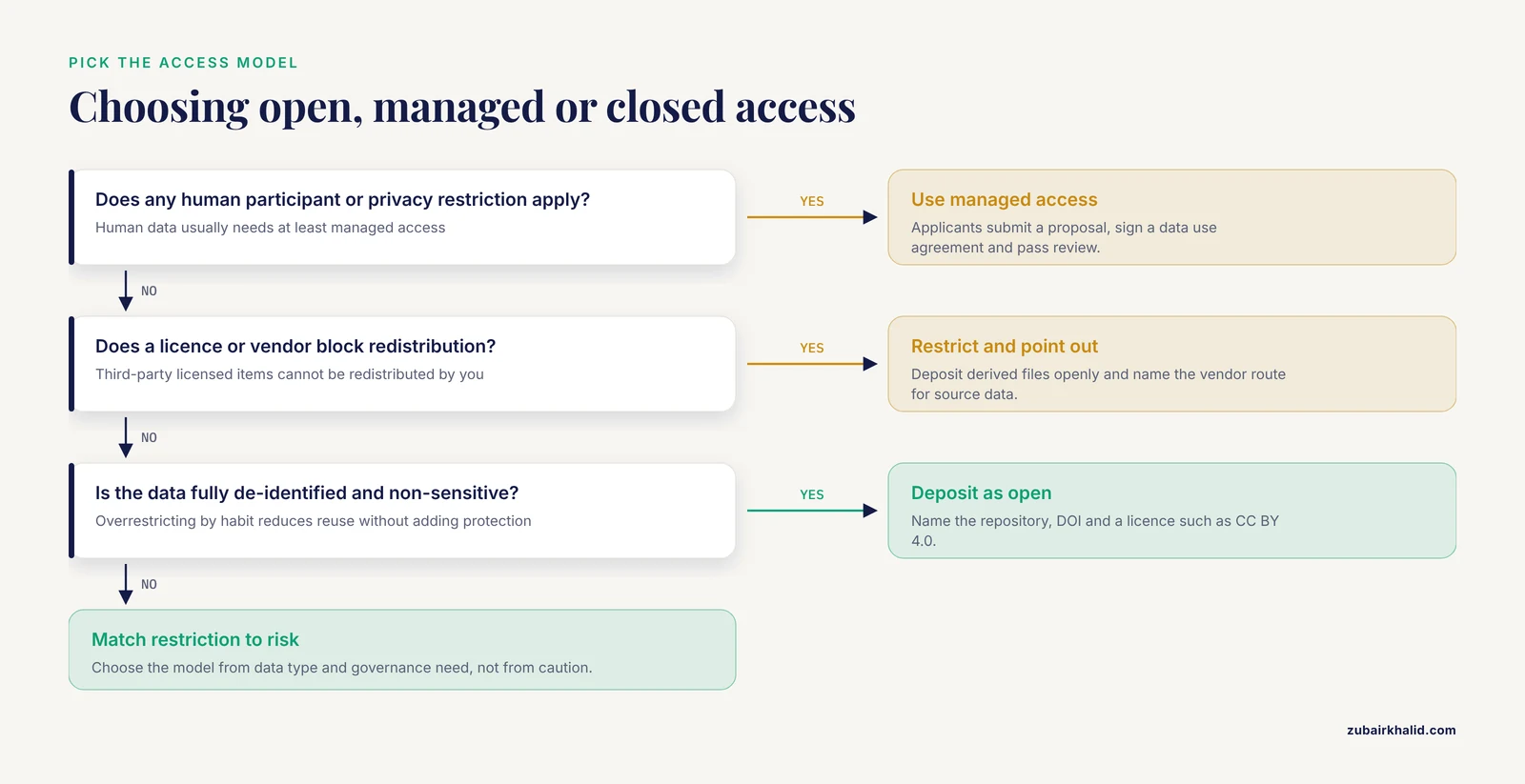
Assign each dataset one of the three models above: open, managed, or closed. Human data usually requires at least managed access to protect participant privacy and confidentiality. The A4 and LEARN Alzheimer's disease studies shared de-identified quantitative and image data, analysis software, instruments, and documentation as early and broadly as possible while still protecting participants, which is a useful model for balancing openness with privacy [11]. If you collected the data yourself and no restriction applies, choose open.
Step 3: Choose a repository and prepare the deposit
Check your target journal's list of recommended repositories first, then your funder's policy, then your discipline's norms. Prepare three things:
- The data files themselves, in open formats where possible (CSV instead of a proprietary spreadsheet format, standard image formats, plain text code).
- A README or metadata record describing variables, units, collection methods, and any processing steps. Documentation is what separates a deposit someone can reuse from a deposit someone can only stare at.
- A license choice. For open data, CC BY 4.0 is a common default that lets others reuse with attribution.
Include the software needed to reproduce analyses. The A4/LEARN sharing effort explicitly included analysis software and instruments alongside the data [11], and a statement that covers only raw files while omitting analysis code invites follow-up emails instead of reuse.
Step 4: Deposit and capture the identifier
Deposit the package and record the persistent identifier the repository issues. Expect output that looks like this:
Deposit accepted
DOI: 10.5281/zenodo.XXXXXXX
Status: publicly available
License: CC BY 4.0
Embargo: none
If the repository assigns an embargo or a review queue, note the dates. You will need them in Step 5. For managed access datasets, record the accession number and the name of the data access committee or the repository's access workflow.
Step 5: Write the statement from a template
Match the template to the access level you assigned in Step 2. The following data availability statement examples reuse format templates cover the four situations that account for nearly every paper.
Template A, all data open in a repository:
Data Availability Statement
All data supporting the findings of this study are openly available
in [Repository Name] at https://doi.org/[DOI], under license
[CC BY 4.0]. The repository deposit includes the raw measurements,
processed data tables, analysis scripts, and a README describing
variable definitions and collection methods.
Template B, managed access data:
Data Availability Statement
De-identified individual-level data are available through
[Repository Name] under accession number [ACCESSION]. Access is
controlled by [data access committee or repository process].
Researchers must submit a brief data use proposal and sign a data
use agreement at [URL]. Metadata and the data dictionary are
openly available at https://doi.org/[DOI] so that the structure of
the dataset can be evaluated before applying.
Making metadata open even when the data are controlled is a reuse maximizer. A prospective user can judge fitness for purpose without waiting on an access decision, and applications become better targeted.
Template C, third-party restrictions:
Data Availability Statement
The survey data contain licensed items owned by [Vendor] and cannot
be redistributed by the authors. Derived analysis files containing
all non-licensed variables are openly available at
https://doi.org/[DOI]. Licensed source data can be obtained
directly from [Vendor] under agreement [name/number] at [URL].
Requests for the derived files should use the repository link above.
Template D, data behind an embargo or forthcoming publication:
Data Availability Statement
Data will be deposited in [Repository Name] upon publication of the
companion methods manuscript, expected [month, year], and will be
available at https://doi.org/[DOI to be assigned] under [license].
Until then, aggregated summary data supporting all figures are
provided in the Supplemental Material.
Template E, data that genuinely cannot be shared:
Data Availability Statement
Restrictions apply to the availability of these data, which were
provided under a data use agreement with [Organization] that does
not permit redistribution. The study protocol and data dictionary
are available at https://doi.org/[DOI], and requests to access the
source data can be directed to [contact/process]. The analysis
code that reproduces all results from the source data is openly
available at https://doi.org/[DOI].
Notice what every template shares: a specific destination, a persistent identifier where one exists, and named conditions. A survey study at TU Delft found that support for researchers should cover the legal, financial, administrative, and practical sides of research data management, and that changing researcher mindset through benefits works better than mandates [12]. These templates are the practical layer of that advice. They are written once and reused for every paper.
Step 6: Cite the dataset in your reference list
Put the dataset in the formal reference list, not only in the statement. This matters for measurement. Scholix-based analysis at the University of Bath showed that linking articles to datasets expanded the detectable set of affiliated datasets enormously, but of ten articles found reusing external repository datasets, only three cited them formally in the references [7]. Formal citation is what makes the connection visible to indexing systems and to your own credit record. Follow your target journal's data citation format, which typically includes the dataset authors, year, title, repository, version, and DOI.
Step 7: Verify before submission
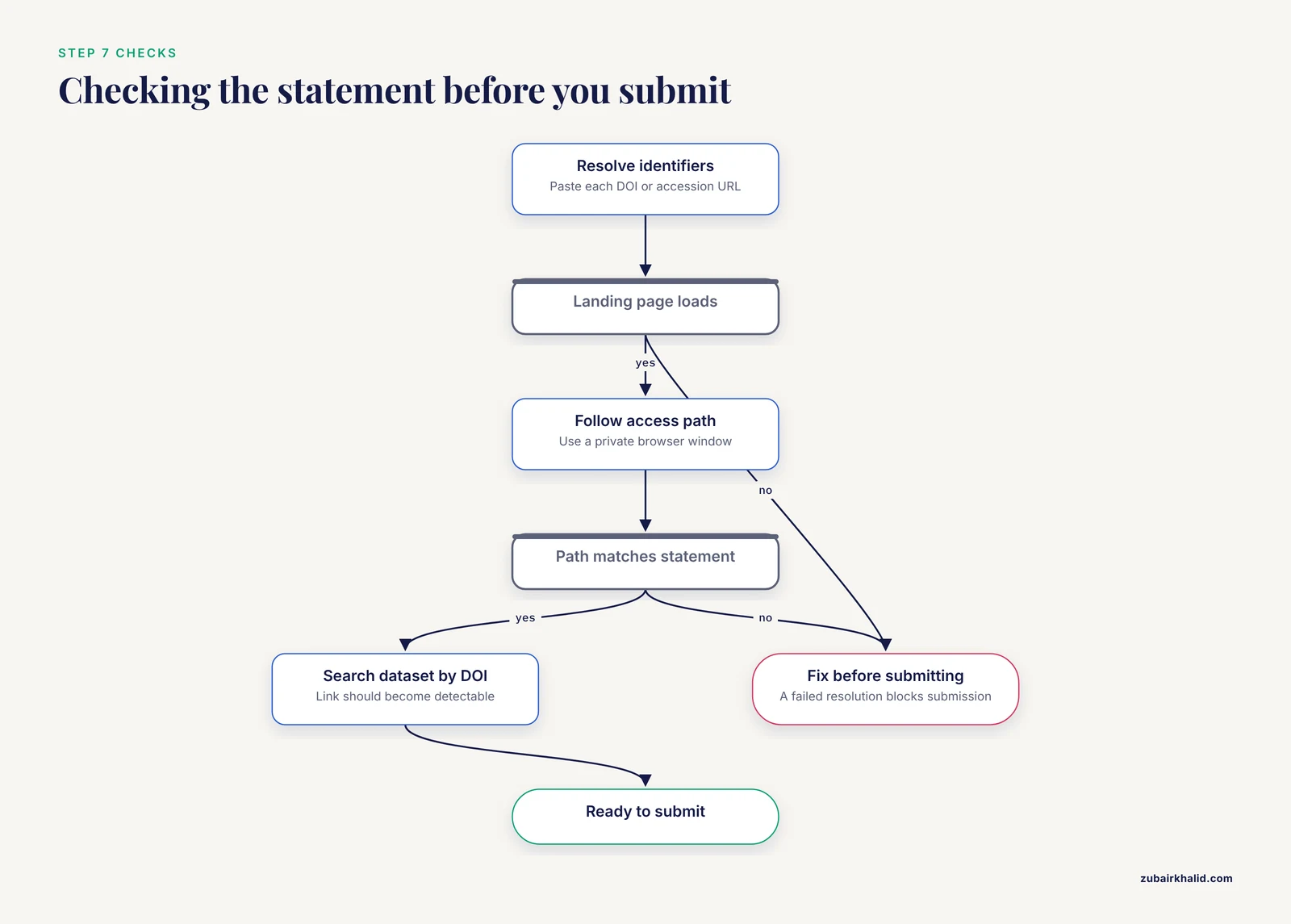
Run these three checks:
- Resolve every identifier. Paste each DOI or accession URL into a browser. The correct landing page is the expected output. A failed resolution is a submission-blocking error, not a cosmetic one.
- Check that the access path in the statement matches reality. Open a private browser window and follow your own instructions exactly as a stranger would. If a step requires something not stated in the DAS, the statement is incomplete.
- Search for your dataset by DOI. If your repository indexes into scholarly link infrastructure, your article-to-dataset link should become detectable over time [7].
A final worked self-test: hand the statement plus the DOI to a colleague outside your lab and ask them to download (or apply for) the data and open the README without any help from you. Their success rate is your reuse rate in miniature.
Common Mistakes and Limitations
"Available from the corresponding author on reasonable request." This is the weakest statement in circulation. It names no repository, no identifier, no conditions, and no timeline, and it transfers the full cost of reuse to the requester. Reviews of clinical trial data sharing consistently find high willingness but low actual sharing, and vague request-based statements are part of the gap [2]. If circumstances force a request-based statement, add a named contact route, the conditions that apply, and the reason no repository copy exists.
Broken or vague identifiers. A URL pointing to a lab page, a project website, or a personal cloud folder fails the persistence test. When an identifier cannot resolve, automated linking systems record nothing and readers give up. Always use the repository's own DOI or accession mechanism.
Citing the dataset only in the statement. As the Bath study showed, formal citation in the reference list is what makes reuse visible and countable [7]. An uncited deposit undercounts your own impact.
Mismatched embargoes. If your journal requires immediate availability and your repository record is under embargo, your statement and your deposit disagree. Fix this by depositing with the correct release date at Step 4, not by writing a statement that papers over the mismatch.
Missing documentation. Deposits without variable definitions, units, and processing descriptions get downloaded and abandoned. Institutional studies of data practice repeatedly identify localized, sporadic documentation as the obstacle researchers themselves hit when trying to reuse existing data [6]. Write the README before you deposit, while the decisions are fresh.
Ignoring the credit loop. Researchers are willing to share when credit and first publication rights are protected [5]. Depositing under a DOI that resolves to a citable record with you listed as the creator, and citing the dataset formally, protects that credit. Showcasing how a dataset has been reused, including through short depositor and user case studies, also incentivizes others to share and improves the quality of data and documentation.
Overrestricting by habit. Managed access exists for genuine governance needs, and the choice of model should depend on data type and required governance. Applying controlled access to fully de-identified, non-sensitive data out of caution reduces reuse without adding protection. Match the restriction to the actual risk.
Statement versus plan drift. For NIH-funded work, the published DAS should be consistent with the Data Management and Sharing Plan submitted with the application [10]. If the plan changed during the project, note the change where the journal permits it.
One honest limitation: a great statement cannot make unusable data reusable. If the underlying files are undocumented or the access process takes months, no wording fixes that. The statement is the front door, and the house behind it still has to be in order.
Frequently Asked Questions
What is a data availability statement?
It is a short section in a published paper that states where the underlying data are located and how a reader can access them. Most journals require one at submission, and a good statement names a repository, a persistent identifier, and the access conditions.
Is "data available on request from the author" acceptable?
It is widely discouraged because it offers no identifier, no conditions, and no guarantee the data will still exist later. Some journals now reject it or require justification. If you cannot deposit, state why, name the access route, and describe the data in enough detail that others can evaluate it.
What should a strong data availability statement include?
Four things: the repository name, a persistent identifier such as a DOI or accession number, the access mechanism (open download, registration, or managed application), and the license or use terms. Adding a note that documentation and analysis code are included further increases reuse.
Where can I find data availability statement examples I can adapt?
Journal author guidelines usually publish model wording, and repository documentation often provides deposit text you can paste into a statement. The templates in this article cover open, managed access, third-party restricted, embargoed, and unshareable data, and you can adapt each one by filling the bracketed fields.
Do I have to share human participant data openly?
No. Human data commonly uses managed access, where applicants submit a proposal, agree to a data use agreement, and pass a review process. Studies such as the A4 and LEARN trials show you can share de-identified data broadly while protecting participant privacy, and you can keep metadata open even when the data themselves are controlled.
What is the difference between a data availability statement and a data management and sharing plan?
The plan is written before or during the project, typically for a funder such as the NIH, and describes how data will be handled across the whole research lifecycle. The statement appears in the published paper and describes where the data ended up. They should be consistent with each other.
Does writing a better data availability statement actually get my data reused?
It removes the barriers that stop reuse. Evidence shows reuse is common in the biomedical literature and correlates with paper impact, that formal citation is needed for reuse to be detected and credited, and that easy access is what most researchers say they need. A specific, linkable statement makes those things possible, though documentation quality determines whether reuse succeeds once someone downloads the data.
Can a data repository restrict who uses my data?
Yes. Repositories operate open, managed access, and closed models depending on data type and governance requirements. Managed access typically involves a proposal, a data use agreement, and a review step. Your statement should describe whichever model applies so readers know what to expect before they apply.
Sources
- Data sharing, management, use, and reuse: Practices and perceptions of scientists worldwide
- Status, use and impact of sharing individual participant data from clinical trials: a scoping review
- The scientific data reuse and intellectual property of data sharing in biomedical field
- The role of data-reuse experience in biological scientists' data sharing: an empirical analysis
- If We Share Data, Will Anyone Use Them? Data Sharing and Reuse in the Long Tail of Science and Technology
- Research Data Sharing and Reuse Practices of Academic Faculty Researchers: A Study of the Virginia Tech Data Landscape
- Identifying Data Sharing and Reuse with Scholix: Potentials and Limitations
- Health Data Sharing Platforms: Serving Researchers through Provision of Access to High-Quality Data for Reuse
- The COVID-19 Data Portal: accelerating SARS-CoV-2 and COVID-19 research through rapid open access data sharing
- Ten simple rules for maximizing the recommendations of the NIH data management and sharing plan
- Maximizing the Utility of Alzheimer’s Disease Trial Data: Sharing of Baseline A4 and LEARN Data
- Open research data: A case study into institutional and infrastructural arrangements to stimulate open research data sharing and reuse