NIH Current and Pending Support: What to Include
By Dr. Zubair Khalid, DVM, MS, PhD ·

Most trouble with current and pending support on NIH applications traces to a single cause: the form ends up listing only the grants that pay the researcher a salary. Pending applications to other funders, projects with no salary attached, donated resources, and unpaid appointments never reach the page. A reviewer or grants management specialist (the NIH administrator who handles award setup and budget matters) then sees an incomplete picture of your commitments, and questions follow.
The first thing to check is simple. Pull every award you hold and every application you have submitted in the past year, from every sponsor, and lay that list next to the form. Anything on the list that is missing from the form is your problem.
This guide explains what the National Institutes of Health (NIH) expects on the Current and Pending (Other) Support document, why errors happen, how to confirm and fix them, and how to build a routine that keeps the form accurate from application through award and every annual progress report.
What Counts as Current and Pending Support in NIH Applications
Current and Pending (Other) Support is the disclosure document NIH requires from every senior or key person named on an application. "Current" means active awards funding work right now. "Pending" means applications submitted to any sponsor and still awaiting a decision. "Other support" is the older name NIH used before the 2022 format change, when the agency aligned the title and content with those of other funders, and grants offices still use both names interchangeably.
Senior or key personnel means the principal investigator (PI), any multiple PIs, co-investigators, and anyone else the application designates as key personnel. That includes Other Significant Contributors, a role for senior scientists who contribute substantially to a project even when the grant pays them nothing. Each of these individuals submits their own document. Postdocs, students, and technicians who are not designated key personnel do not.
Three features of the form surprise people:
- It covers every sponsor, not just NIH. Other federal agencies, private foundations, industry contracts, and institutional awards built on federal funds all belong.
- It covers effort, not just money. A project where you commit time but draw no salary still gets a row.
- It covers resources, not just awards. Since the 2022 format, in-kind support, meaning resources provided free or below cost for a specific project, must be disclosed.
The document follows you across the grant lifecycle. It goes in with the initial application. It returns at Just-in-Time (JIT), the stage after peer review and advisory council when NIH requests updated administrative documents before making an award. It returns again each year inside the Research Performance Progress Report (RPPR), the annual report for continuing awards. A researcher proposed as a new PI on an existing award also submits one as part of the change-of-PI prior approval request, where prior approval means written NIH permission before a change takes effect. Because the document reappears, an error made once tends to resurface.
What to Include, Section by Section
NIH adopted the current format for applications with due dates on or after January 25, 2022, and it requires the document to be built in SciENcv, a tool from the National Center for Biotechnology Information (NCBI) that links to your ORCID record, a persistent researcher identifier, and generates the formatted PDF. The document has three parts: active, pending, and in-kind projects, appointments and positions, and a certification. Build each part deliberately.
Active awards
List every active award where you are senior or key personnel, whether or not it pays your salary. For each row the form asks for:
- Source of support, meaning the sponsor
- Sponsor type, federal or non-federal
- The award number where one exists, or the awarding institution
- Project or proposal title
- PI on the project
- Total award amount for the entire award period, as shown on the notice of award, the official document that establishes the grant
- Start and end dates of the project period, the full funded span rather than a single budget year
- Person months of effort per year
- Location of the work, including any site outside the United States
If you serve as key personnel on a subaward, meaning another institution holds the award and passes funds to yours, list that project too. Enter the PI of record for the overall project, and the dates and effort that apply to your component.
Pending applications
Pending means submitted and awaiting a decision. It does not mean likely to be funded, and it does not mean planned for next year. Include:
- Applications pending at NIH, including resubmissions of unfunded applications
- Applications pending at any other federal agency
- Applications pending at foundations, professional societies, and industry sponsors
- Contracts under review where you would serve as key personnel
Enter the anticipated total amount, the anticipated start and end dates, and the effort you would commit if funded. Reviewers and grants management staff read this section to judge whether your commitments are realistic if everything comes through.
In-kind support
In-kind support is any resource provided at no cost or at reduced cost that supports a specific project. Typical examples include donated instrument time, a sequencing core that waives fees, collaborator-owned animal colonies or cell lines, cloud computing credits, compounds provided by a company, access to a patient cohort or restricted dataset, and laboratory space another institution provides for a joint project. The 2022 format added this section because free resources shape what a project can accomplish, and reviewers need the full picture. Describe the resource, its source, and its value where known.
Appointments, positions, and scientific appointments
List titled positions you hold at any institution, domestic or foreign, paid or unpaid. This catches adjunct and visiting appointments, honorary titles, and scientific appointments that never touch payroll. Many researchers hold an adjunct line at a second university and assume it is irrelevant because it pays nothing. The form treats it as relevant.
This is also the section where foreign relationships matter most. Disclose appointments and affiliations with foreign institutions completely, and route anything involving a foreign government, a foreign government-funded entity, or a foreign talent recruitment program (a structured effort by a foreign government to recruit researchers) through your institution's conflict-of-interest and export control offices, which manage financial disclosure and controlled-technology compliance, before you submit. These disclosures can trigger review beyond the grant itself, so institutional officials should help shape how they are presented.
Person months, with worked examples
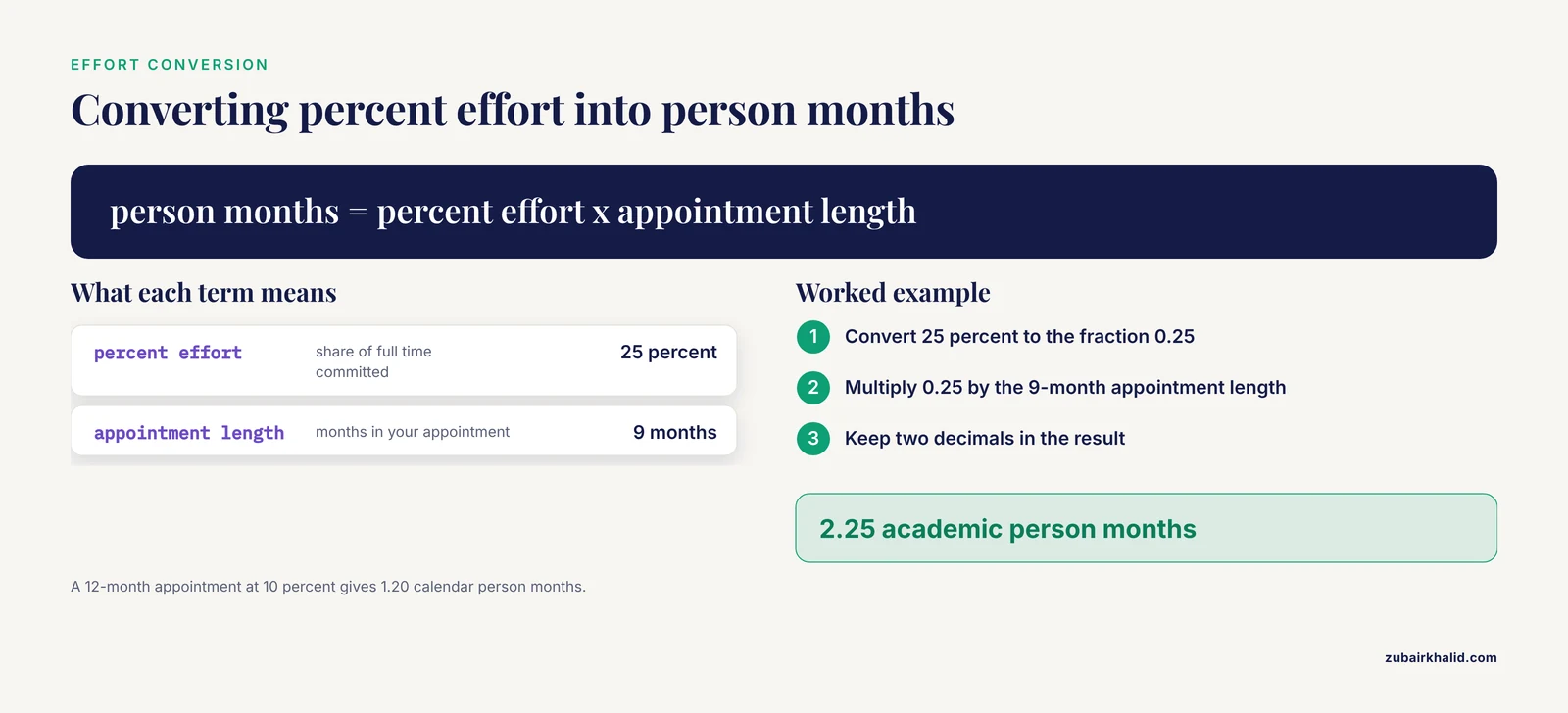
Person months measure committed effort, not dollars and not hours. One person month equals one full-time month of a standard appointment. A 12-month calendar appointment totals 12.00 person months per year, a 9-month academic appointment totals 9.00, and a 3-month summer appointment totals 3.00.
Convert percent effort by multiplying the fraction by your appointment length:
- 10 percent of a 12-month appointment: 0.10 × 12 = 1.20 calendar person months
- 25 percent of a 9-month academic appointment: 0.25 × 9 = 2.25 academic person months
- 50 percent effort across a 2-month summer: 0.50 × 2 = 1.00 summer person month
- 5 percent of a 12-month appointment: 0.60 calendar person months
Keep two decimals. Enter effort even when a project pays no salary, using the time you actually commit. Enter 0.00 only when you participate with no committed effort at all.
Total committed effort across all projects cannot exceed your appointment. A 9-month faculty member can commit at most 9.00 academic person months during the academic year plus up to 3.00 summer months. NIH also polices effort after award and requires prior approval for large reductions in committed effort, which is one reason these numbers follow you into the RPPR.
What stays off the form
The projects section covers external awards, pending applications, and project-linked in-kind resources. Internal money your own institution pays you, such as a startup package, is not an external award and does not take a row there. Donated resources from outside parties do belong, as in-kind support. If a funding stream is a federal pass-through, meaning federal money that flows through one institution to another, for example a university pilot funded through a federal grant, treat it as federal money and list it. When a case is genuinely unclear, ask your sponsored programs office, the unit that submits and manages grants for your institution, before you certify, not after.
Troubleshooting Current and Pending Support Problems
The table below covers the failures grants offices see most often. Work down the symptom column until you find your situation.
| Symptom | Likely cause | How to confirm | Fix |
|---|---|---|---|
| The grants management specialist asks for missing other support | An award or pending application never made it onto the form | Compare the form against your complete award and submission lists, including other agencies | Submit an updated SciENcv document through your sponsored programs office |
| A reviewer questions whether you can lead the project | Committed effort across all projects exceeds your appointment | Add the person months on every row, active and pending | Rebalance effort across projects before award and update the budget |
| Award setup stalls at Just-in-Time | Stale entries, a funded application still listed as pending, or new awards absent | Check each pending row against recent notices of award | Refresh the document so current awards are current and pending rows are truly pending |
| Budget negotiation raises overlap questions | The same specific aims appear on two projects | Read the aims of each listed project side by side | Explain the distinction or revise the aims, and be ready to resolve overlap if both awards are made |
| Your institution flags an undisclosed foreign appointment | A paid or unpaid position at another institution was omitted | Check your personnel file, conflict-of-interest disclosures, and appointment letters | Disclose it in the appointments section and notify your conflict-of-interest office |
| The document bounces back in the wrong format | A hand-built or old-format version was used | Check the current NIH application instructions for the SciENcv requirement | Rebuild the document in SciENcv and resubmit |
| Person months look implausible next to the effort in your log | Percent effort was entered where person months belong | Recalculate each row using your appointment length | Convert percent effort to person months and correct every row |
| A donated resource appears in the budget discussion but not on the form | In-kind support was overlooked | Inventory what each project receives free or below cost | Add the resource with its source, description, and value |
| The RPPR contradicts the application | Committed effort was confused with actual effort | Compare the committed person months in the application with the actual effort in the RPPR | Reconcile the numbers and request prior approval for large effort reductions |
Causes of Current and Pending Support Errors, Most Common to Rarest
Each failure below has a mechanism. Understanding the mechanism tells you which control prevents it.
1. Omitted pending applications (most common). Researchers treat pending as a status that applies only to NIH, or only to applications they expect to win. The definition on the form is mechanical: submitted, decision outstanding, any sponsor. The mechanism is mental rather than technical. Applications to foundations and other agencies live in different inboxes and tracking systems, so they fall out of view. One submission log, capturing every application the day it leaves your institution, closes this gap.
2. Zero-salary projects dropped. The intuition says no salary means nothing to report. The form says otherwise. If you are senior or key personnel on an award or a pending application, your row belongs there with your committed effort, even when the budget shows zero dollars for you. Other Significant Contributors are the classic case, because the role exists precisely for scientists who contribute without drawing salary.
3. Person-month conversion errors. Three appointment types (calendar, academic, summer) and decimal arithmetic create a narrow failure surface. The classic error is typing percent effort into the person-months field. A second error is rounding to whole numbers, which hides small commitments that add up. Both are arithmetic failures with a mechanical fix: multiply against appointment length and keep two decimals.
4. Effort overcommitment across pending awards. Each application is written in isolation, so 30 percent here and 40 percent there feels modest until three pending applications are funded at once. NIH staff compare forms across applications and can see the total. The mechanism is sequential optimism, where every proposal assumes it will be the one funded. Track cumulative committed effort, including pending, and know your ceiling before you write the next budget.
5. Forgotten subaward roles. When another institution holds the award, the paperwork lives in their office and your role can vanish from your own records. Collaborations move slowly, subaward amendments arrive late, and the project drops from memory until a conflict-of-interest questionnaire or a grants management specialist query surfaces it. Confirm your status on every collaboration at least once a year.
6. Overlooked in-kind support. This section is the newest, added in the 2022 format, so the failure is often simple unfamiliarity. Resources that never appear in a ledger, such as waived core fees or a collaborator's mouse colony, do not trigger the mental category of support. Walk through each project and ask what it receives free or below cost.
7. Omitted foreign appointments and affiliations (rarest, most serious). These omissions are uncommon and carry the heaviest consequences. The mechanism is structural. Visiting and adjunct appointments sit in separate human resources systems, unpaid roles generate no payroll record, and researchers assume that without money there is nothing to disclose. NIH treats undisclosed foreign relationships as compliance violations, and discoveries of this kind can lead to findings of research misconduct, award termination, and institutional sanctions. The control is institutional: route every foreign appointment, affiliation, and talent program participation through your conflict-of-interest and export control offices.
A Diagnostic Sequence You Can Follow
Run this sequence before you sign any certification, and again whenever a program officer (the NIH scientist who oversees the programmatic side of an award) or a grants management specialist raises a question.
- Export your award list from your institution's sponsored programs system.
- Export your application history from eRA Commons, NIH's online portal for tracking applications, and from the submission portals of other agencies you use.
- List every project where you are senior or key personnel, including subawards from other institutions.
- Add every pending application from your submission log, regardless of sponsor.
- Add in-kind resources for each project, with source and description.
- Add every appointment and position, paid or unpaid, domestic or foreign.
- Convert percent effort to person months for each row and sum them against your appointment ceiling.
- Compare the assembled list against the draft document row by row.
- Have your department grants administrator review the result.
- Calendar the next checkpoint, at Just-in-Time or the next RPPR, before you close the file.
How to Fix Current and Pending Support Errors
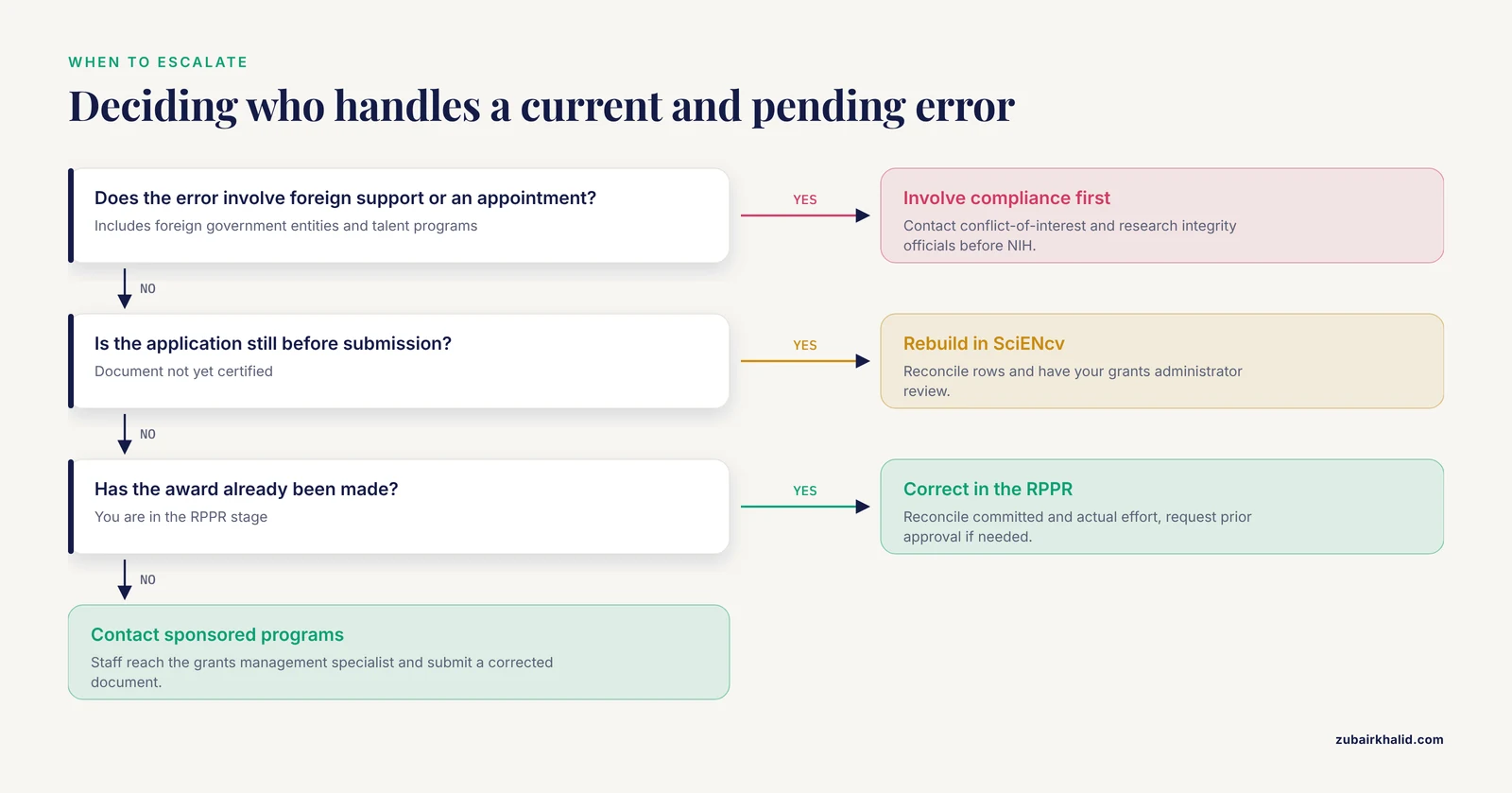
Fixes differ by stage.
Before submission. Rebuild the document in SciENcv, which can pull your award entries from linked accounts such as ORCID and removes transcription errors. Copy your most recent SciENcv document and edit the copy so your history stays intact. Add pending rows and in-kind details manually, then have your grants administrator review before you certify. Most solutions at this stage are procedural: reconcile, recalculate, reread.
Between submission and award. Just-in-Time is the natural correction point. When NIH requests JIT materials, update every row that changed, move newly funded applications into the current section, and remove pending rows that resolved. If you discover an error earlier, contact your sponsored programs office. Staff there communicate with the grants management specialist, often called the GMS, and can submit a corrected document. A correction delivered proactively is routine. The same error discovered by NIH reads differently.
After award. Correct the record in the next RPPR, where actual effort is reported. If committed effort has fallen by 25 percent or more from the level committed at award, request prior approval through your sponsored programs office rather than waiting for the annual report to surface the change.
Serious omissions. If the omission involves foreign support, an undisclosed appointment, or a talent program, involve your institution's compliance officials before contacting NIH. These cases move through conflict-of-interest and research integrity channels, and the institutional response shapes the outcome.
Grant Proposal Planning That Keeps the Form Clean
The document is a snapshot. The system behind it decides whether the snapshot is accurate. Four practices do most of the work.
Maintain a rolling submission log. One spreadsheet, updated the day an application leaves: sponsor, title, your role, requested amount, effort committed, dates, status. Every row in that log is a candidate row on the form.
Keep an effort ledger. Track committed person months across all active and pending projects against your appointment ceiling. Consult it before you write the budget for the next application, not after a GMS question arrives.
Set calendar checkpoints. Update the document at every submission, at every Just-in-Time request, and at every RPPR. Copying last year's version forward is how stale entries survive.
Use delegation and identifiers. Link ORCID, keep My Bibliography, the NCBI tool that stores your publications, current, and grant your department administrator delegate access to your SciENcv account so a trained second set of eyes can maintain the documents.
Investigators who want structured training usually meet this document in a research grant writing course, where it is taught alongside the budget, budget justification, and biosketch, NIH's structured curriculum vitae, because those documents must tell one consistent story. Reviewers notice when the story changes between documents, so treat consistency as part of the writing, not an administrative afterthought.
Common Mistakes and Limitations
Six mistakes account for most avoidable defects:
- Confusing the document with the biosketch. The biosketch presents selected contributions relevant to the application. The current and pending document is a complete disclosure, not a highlight reel.
- Treating zero-salary roles as exempt. Key personnel status triggers the disclosure, not payroll.
- Entering budget periods instead of project periods. The form asks for the project period, which can span many years.
- Rounding person months to whole numbers. Small commitments are still commitments, and the decimals exist to capture them.
- Assuming the department administrator owns accuracy. Administrators prepare, but the individual certifies that the document is true, complete, and accurate.
- Copying the previous version forward without a line-by-line check. Stale rows are the most common defect at Just-in-Time.
Two limitations frame all of the above. NIH revises formats and requirements periodically, so confirm the current NIH Application Guide and NIH Grants Policy Statement before you build the document. Individual situations, particularly those involving foreign appointments, internal funds, or unusual in-kind arrangements, also depend on institutional policy, so your sponsored programs office is the deciding authority for your specific case.
Frequently Asked Questions
What is the difference between current and pending support?
Current support is active funding for work happening now. Pending support is any application submitted to any sponsor and still awaiting a decision.
Who has to submit the form?
Every senior or key person named on the application submits their own document, including the PI, co-investigators, and Other Significant Contributors.
Do I include projects that pay me no salary?
Yes. If you are senior or key personnel, the project belongs on the form with your committed effort, even when the grant pays you nothing.
Do applications to other agencies or foundations belong on an NIH form?
Yes. Pending means submitted to any sponsor and awaiting a decision, so other federal agencies, foundations, and industry sponsors all belong.
What are person months and how do I calculate them?
Person months measure committed effort, not dollars. Multiply percent effort by appointment length, so 20 percent of a 9-month appointment is 1.80 academic person months.
What counts as in-kind support?
Resources provided free or below cost for a specific project, such as donated instrument time, waived core fees, computing credits, or collaborator-owned materials and space.
Does NIH require SciENcv?
Yes. NIH requires the document to be built in SciENcv rather than assembled by hand or in a generic PDF.
What should I do if I find an error after submitting?
Contact your sponsored programs office, correct the document, and provide the updated version to your grants management specialist, most often at Just-in-Time or the next RPPR.