How to Foster a Culture of Integrity in Your Lab: Practical Strategies
By Dr. Zubair Khalid, DVM, MS, PhD ·

By the end of this article you will be able to define what a culture of integrity in lab settings actually requires, draft a lab charter that makes expectations explicit, set up a data and notebook workflow that can survive an audit, run case-based research ethics discussions that people actually engage with, and put reporting pathways and authorship norms in writing before a crisis forces the issue. You will also know the most common mistakes principal investigators and lab managers make when they try to build a culture of integrity, and how to avoid them.
Nothing needs to be installed for most of this. Have on hand your institution's responsible conduct of research (RCR) policy, the authorship guidelines your target journals use, and a shared drive or electronic lab notebook (ELN) where your lab keeps data. If your institution has a research integrity office or ethics committee, find its contact details before you need them.
What a Culture of Integrity in Lab Work Actually Means
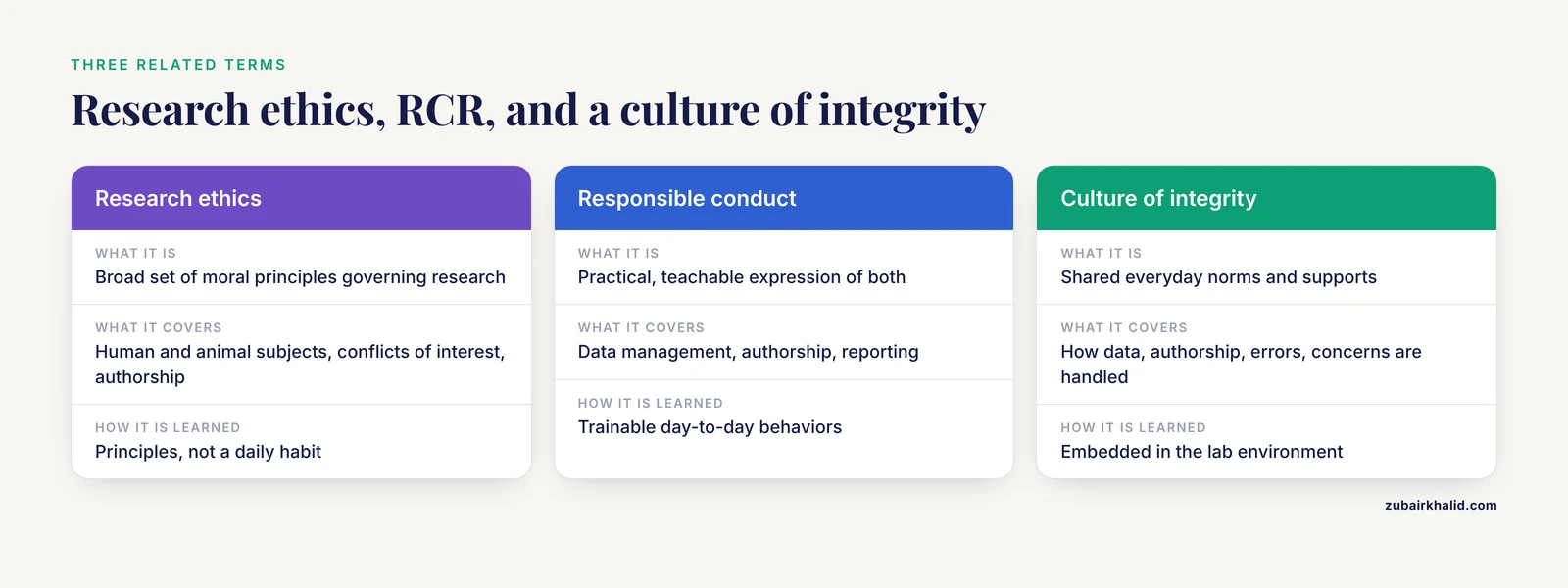
Research integrity is the commitment to honesty, rigor, transparency, and accountability in every stage of research, from planning and data collection to reporting and publication. Research ethics is the broader set of moral principles governing research, including the treatment of human and animal subjects, conflicts of interest, and responsible authorship. Responsible conduct of research (RCR) is the practical, teachable expression of both: the day-to-day behaviors and institutional supports that make ethical research possible.
A culture of integrity is not the same as a compliance requirement. Many institutions satisfy funders with a one-time online RCR course, and the training stops there. Recent analyses of European research integrity training projects show that effective programs share specific pedagogical features: they treat learning as constructive and social, use activating and engaging activities such as case discussion, and aim at higher-order objectives like moral reasoning rather than memorizing rules [1]. That distinction matters because culture lives in daily habits, not in completion certificates.
One caution about recipes. A configurational study of university faculty found that no single factor is a necessary condition for research integrity. Instead, several different combinations of personal attributes and organizational conditions can produce ethical behavior, a property researchers call equifinality [2]. The practical lesson is that your lab's integrity culture has to fit your lab's people, field, and institution. The steps below are a framework to adapt, not a checklist to copy blindly.
Why Culture Beats Compliance
The strongest argument for investing in culture comes from what happens without it. A qualitative study in Japan, built on focus group interviews with 25 researchers and administrators across disciplines, identified recurring structural barriers to integrity: the laboratory environment itself, precarious job security for junior and mid-career researchers, and pressures borne by principal investigators. Participants also noted that integrity regulations were not widely disseminated, meaning policies existed on paper but never reached bench level [3]. Rules that nobody reads do not create integrity. Environments do.
The same pattern appears across settings. A review of academic dishonesty in dental education found self-reported cheating rates between 43 and over 90 percent, with key drivers including intense academic pressure, competitive environments, and a perception of weak enforcement [4]. In higher education broadly, a survey of faculty, administrators, and students in the US Mountain West found persistent gaps in mentoring, grant implementation, and project management even where formal research ethics lectures existed, and students showed limited awareness of foundations such as data lifecycle management [5]. Nursing faculty described limited training, inconsistent administrative support, and difficulty fostering a culture of integrity without clear policies and structured faculty development [6].
Culture is also a leadership product. A structural equation modeling study in medical universities validated a model in which moral justice, meaning fairness in how people are treated and rewarded, connects ethical leadership to organizational integrity [7]. And a case study of a research performing organization that deployed accessible training and supports between 2022 and 2024 documented measurable gains: significant improvements in awareness of reporting pathways for inappropriate research behaviors, in knowledge of open access, data management, and authorship resources, and improved domain-specific knowledge among people who participated in targeted training. Open-ended responses shifted from listing obstacles in 2022 to discussing training, resources, and constructive practices by 2024 [8]. Leadership and institutional scaffolding changed the culture, and the survey captured it.
Building a Culture of Integrity in Your Lab, Step by Step
The following walkthrough takes a new or renewing lab from nothing to a working integrity infrastructure in ten steps. Adapt each one to your size and field. A four-person academic biology lab and a forty-person institute center will make different choices, and that is consistent with the equifinality finding above [2].
Step 1: Write a one-page lab charter
Gather the whole lab for a single meeting. Draft together a document that states, in plain language, how your lab handles data recording, authorship, authorship disputes, error correction, mentorship expectations, and reporting concerns. Keep it to one page. Circulate it, revise it with input from every member including the most junior, and have everyone sign it.
A charter template you can adapt:
# lab-charter.yaml
lab_name: "Example [Molecular Biology](/blog/careers/molecular-biology) Lab"
version: 1.0
data_rules:
  primary_data_location: "ELN + institutional shared drive"
  raw_data_retention: "per institutional policy, minimum 5 years"
  notebook_standard: "dated, signed, no backdating, corrections by strikethrough"
authorship:
  framework: "ICMJE-style contribution based"
  discussion_timing: "at project kickoff and before each submission"
  disputes: "escalate to PI, then department chair"
error_correction:
  rule: "errors are corrected in writing and reported to collaborators within 1 week"
concerns:
  first_contact: "PI or lab manager"
  external_contact: "university research integrity office"
  no_retaliation: true
review_cadence: "annually, first lab meeting of the fall"
Expected output: a signed one-page document stored where every lab member can find it, revisited once a year. The value is not the paper. The value is the conversation that produces it, which makes expectations explicit before anyone has an incentive to bend them.
Step 2: Anchor authorship in transparency, credit, and accountability
Questionable authorship practices persist across science, and guidance from journals and institutions is highly variable [9]. A PNAS consensus paper proposes anchoring authorship in three principles: transparency about who did what, fair credit reflected in the author list and contribution statement, and accountability for the work's integrity [9].
Practically, start every project with an authorship conversation. Record who contributed conceptually, who generated data, who analyzed, who wrote, and revisit the list before each submission. Write the contribution statement during drafting, not at proof stage. Research leaders who initiate early, inclusive, and fair authorship discussions embed these principles into everyday practice, which is exactly what the PNAS authors recommend [9].
Step 3: Set up a data structure that protects you
Data lifecycle management is one of the areas where trainees show the largest awareness gaps [5]. Fix it with structure, not lectures. Create a standard directory layout and document it:
# Run once at project kickoff, from the lab shared drive
mkdir -p projects/2026-drugscreen-x/{raw,processed,analysis,docs,dissemination}
echo "raw = immutable instrument output. Never edit. Add checksums." \
  > projects/2026-drugscreen-x/README.md
echo "processed = scripts only. No manual edits to files here." \
  >> projects/2026-drugscreen-x/README.md
md5sum projects/2026-drugscreen-x/raw/* > projects/2026-drugscreen-x/raw/checksums.md5
cat projects/2026-drugscreen-x/README.md
Expected output:
raw = immutable instrument output. Never edit. Add checksums.
processed = scripts only. No manual edits to files here.
The rules that matter: raw data is read-only, every transformation between raw and final results happens in a script, and analysis is reproducible by someone else in the lab. This is the practical core of responsible conduct of research, and it prevents the most common accidental integrity failure, which is losing the link between a figure and the data behind it.
Step 4: Make the lab notebook audit-proof
Whether you use a bound paper notebook or an ELN, enforce three rules: entries are dated and signed on the day they are made, corrections are made by single-line strikethrough with a dated note rather than erasure, and every entry names who performed the work. For ELNs, use version history as your ally rather than something to fear. A notebook that has been corrected transparently is stronger evidence of integrity than one that looks suspiciously perfect.
Step 5: Run case-based integrity discussions on a schedule
Instead of relying on a compliance module, hold a 30-minute integrity discussion at a regular lab meeting, for example once per quarter. Use real cases: a figure assembled from the wrong experiment, a guest author added at revision, an image duplicated between two papers. The EU project analysis found that constructivist, case-based approaches with activating learning activities are the most pedagogically sound way to deliver integrity training, and that structured learning objectives help trainers communicate intent and learners relate expectations [1]. Rotating who presents the case, including graduate students, turns the session from a lecture into practice.
Step 6: Establish and publicize reporting pathways
People need to know exactly where a concern goes and what happens next. The organizational case study cited above found that deploying clear reporting pathways for inappropriate research behaviors produced significant, measurable improvement in staff awareness [8]. In your lab, this means naming two contacts in the charter: one inside the lab, usually the PI or lab manager, and one outside, usually the institutional research integrity office or ethics committee. Post both on the lab's shared drive. Announce them to new members on day one.
The Kenya Medical Research Institute offers an instructive institutional model. In 2023 KEMRI established a Research Integrity Committee and deployed five complementary strategies: a train-the-trainer program, integrity symposia embedded in national scientific and bioethics conferences, geographically clustered center-specific training tailored to local needs, hybrid in-person and virtual delivery, and digital dissemination through bulletins and the institutional website. The effort reached over 1200 of over 4000 staff across 15 research centers [10]. Even if you lead a single lab rather than an institute, the design principles transfer: train people who can train others, go to where people already gather, tailor to local needs, and use multiple channels.
Step 7: Manage conflicts of interest in writing
Conflicts of interest (COI) are pervasive wherever research intersects with industry, and evidence shows inaccurate disclosures are common, with up to 81 percent of authors failing to report COIs correctly in one hand surgery analysis [11]. In your lab, require every member with external financial ties, consulting arrangements, royalty interests, or relevant personal relationships to declare them to the lab record annually and before any submission. When a person with a conflict would otherwise influence a decision such as selecting an instrument vendor or a seminar speaker, have them recuse from that decision. Full transparency plus recusal is the minimum standard, and institutional COI registries and standardized policies extend it [11].
Step 8: Report results without spin
Spin is the misleading presentation or interpretation of results to make findings appear more favorable, significant, or impactful than they are. It is a reporting bias that misleads readers, clinicians, and policymakers, and small distortions accumulate into a biased scientific record [12]. In a lab, spin usually enters at two points. The first is the abstract and discussion, where "tended toward significance" becomes "was associated with". The second is conference talk slides, where an underpowered result gets promoted to a headline. Counter it with a lab norm: report effect sizes and uncertainty alongside p values, distinguish planned from exploratory analyses, and require that abstracts be checked against the actual results before submission. Training researchers in transparent and responsible reporting is one of the identified countermeasures to spin [12].
Step 9: Set rules for AI tools and publishing pressure
The integration of artificial intelligence, metric-driven publishing, and the publish or perish culture threaten objectivity, reproducibility, and transparency [13]. Set a lab policy now: disclose any use of generative AI in manuscript preparation, follow journal-specific frameworks such as CONSORT-AI where applicable, and never let an AI tool write the interpretation of your own data. At the assessment level, engage with reform efforts such as the San Francisco Declaration on Research Assessment (DORA), which asks institutions to evaluate research on quality rather than publication venue alone, and support journal practices aligned with the Committee on Publication Ethics (COPE) [13].
Step 10: Invest in mentoring, the weakest link
Mentoring is the support area with the largest documented gap across institution types [5], and time for professional development remained low even in the organization that improved everything else [8]. Treat mentoring as an integrity practice. Give every trainee a named mentor with scheduled one-on-one time, and give senior lab members credit for mentoring in performance conversations. If your institution offers mentoring training, take it and send your senior students too. A trainee who feels fairly treated and well supervised is far less likely to cut corners, which is consistent with the moral justice model linking fair treatment to organizational integrity [7].
Quick reference table
| Practice | Owner | Cadence | Concrete artifact |
|---|---|---|---|
| Lab charter | Whole lab, PI facilitates | Annual review | Signed one-page charter |
| Authorship discussion | Project lead and PI | Project kickoff and pre-submission | Dated contribution list |
| Data structure | Lab manager or PI | Once, then enforced | Directory tree with README and checksums |
| Notebook standard | Every member | Daily | Dated, signed, transparently corrected entries |
| Case-based integrity discussion | Rotating presenter | Quarterly | Case summary and discussion notes |
| Reporting pathway | PI plus institution | Posted once, announced to new members | Charter contacts section |
| COI declarations | Every member | Annual and pre-submission | Signed declaration form |
| Spin check | Writing lead plus a second reader | Before each abstract submission | Results-to-abstract comparison |
| AI use policy | Whole lab | Once, then updated | Written policy in charter |
| Mentoring time | PI and senior members | Weekly or biweekly | Scheduled one-on-one meetings |
Culture of Integrity in Lab Tips for PIs and Senior Lab Members
Model the behavior you want. Trainees copy what their PI does with an inconvenient result, a disputed authorship line, or an error discovered after submission, far more than they absorb what the PI says about ethics.
Praise error detection. When a student reports that a control failed or a script had a bug, thank them publicly. Labs where errors are punished learn to hide errors, and hidden errors are how misconduct accusations begin.
Separate evaluation from development conversations. The Japanese focus group study identified pressure on PIs and insecurity among junior researchers as barriers to integrity [3]. If every meeting with your trainee is also a performance judgment, they will filter bad news. A standing monthly meeting that is explicitly about their development, not their output, creates the channel through which problems reach you early.
Use your institution. Most universities have an RCR office, an ombudsperson, or an ethics committee, and many offer resources on data management and authorship. The organizational case study showed that simply improving awareness of access to such resources produced measurable knowledge gains [8]. You do not have to build everything yourself.
If you teach or supervise in a professional program, ask for structured faculty development. The nursing education study found that faculty promoting integrity were hampered by limited training and inconsistent administrative support, and concluded that clear policies, structured development, and consistent support are what strengthen integrity education [6]. Asking your administration for these supports is part of the job, not a complaint.
Common Mistakes and Limitations
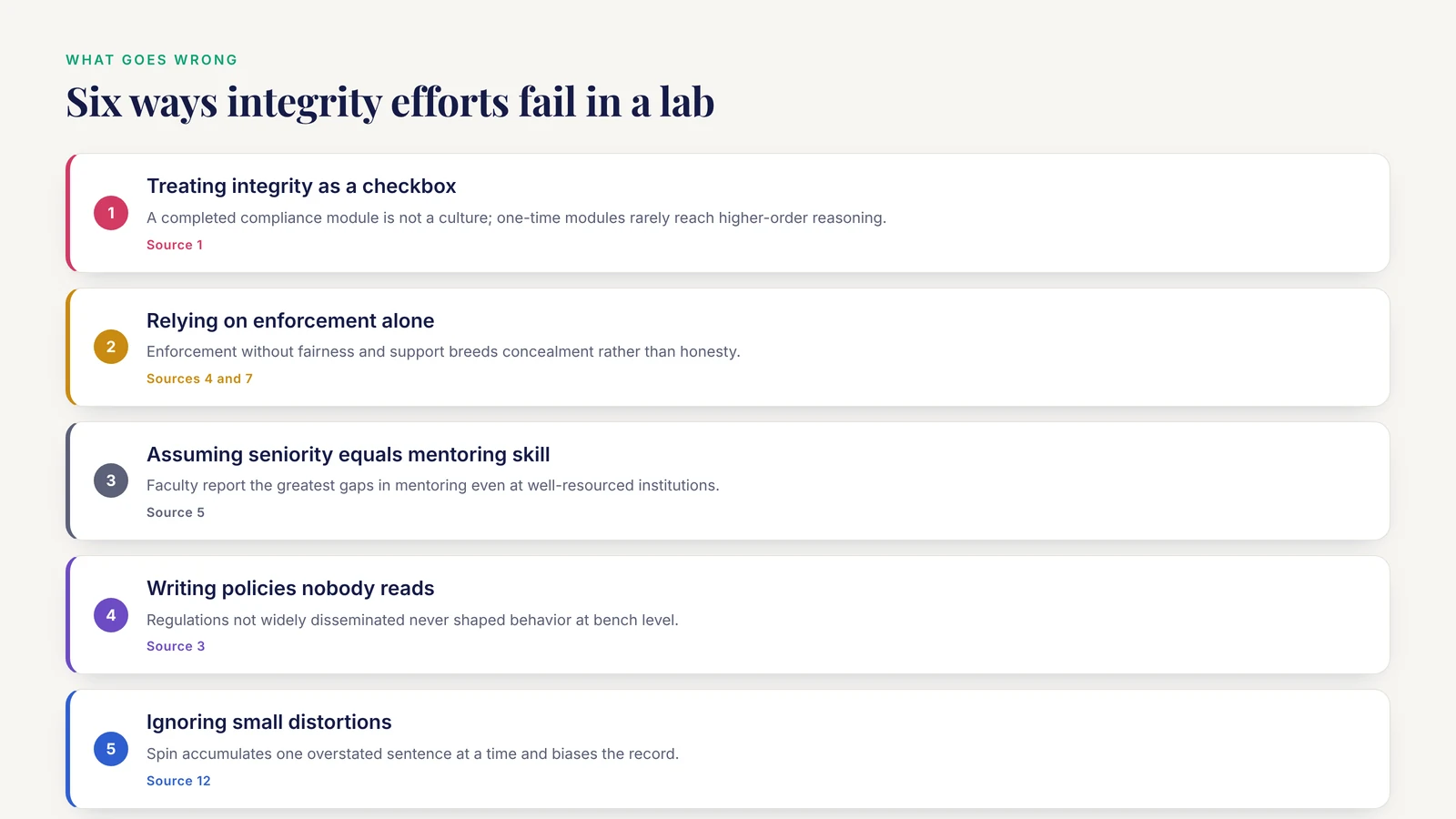
Treating integrity as a checkbox. A completed compliance module is not a culture. The pedagogical analysis of four EU training projects shows effective integrity training engages learners actively and targets higher-order reasoning, which one-time modules rarely do [1].
Relying on enforcement alone. Perceived weak enforcement correlates with dishonesty, but enforcement without fairness and support breeds concealment rather than honesty [4]. Pair rules with the moral justice practices of fair treatment and recognition [7].
Assuming seniority equals mentoring skill. Faculty report the greatest gaps in mentoring even at well-resourced institutions [5]. Seniority is not training. Schedule it.
Writing policies nobody reads. The Japanese study found integrity regulations were not widely disseminated, so they never shaped behavior [3]. If a policy exists only on an intranet page, it does not exist in your lab.
Ignoring small distortions. Spin rarely announces itself. It accumulates one overstated sentence at a time and biases the record. Review abstracts against results before every submission.
Expecting one recipe to fit every lab. Because multiple different configurations of personal and organizational factors can produce integrity [2], what worked at your previous institution may not transplant. Test, keep what your lab actually uses, and drop the rest.
Two honest limitations. First, culture change is slow. The organization in the case study needed two years and repeated surveys to document a shift [8], so measure progress over years, not weeks. Second, a lab-level charter cannot substitute for institutional systems. When a genuine allegation of misconduct arises, take it to your institutional research integrity office or equivalent formal body rather than handling it internally. Individual cases need formal institutional processes.
Frequently Asked Questions
What is a culture of integrity in a lab?
It is the shared, everyday set of norms and supports under which people in the lab do honest, rigorous, transparent, and accountable research without needing to be policed. It shows up in how data is recorded, how authorship is decided, how errors are handled, and how concerns are raised.
How do I build a culture of integrity in lab settings step by step?
Start with a one-page lab charter written together, add early authorship discussions, set up an immutable raw data structure with reproducible analysis, enforce a dated and transparently corrected notebook standard, hold quarterly case-based integrity discussions, publicize reporting pathways, require COI declarations, check abstracts against results, set an AI disclosure policy, and invest scheduled time in mentoring.
What is the difference between research ethics and responsible conduct of research?
Research ethics is the broad set of moral principles for research, including subject welfare, conflicts of interest, and honesty. Responsible conduct of research is the practical, trainable expression of those principles in daily behaviors such as data management, authorship, and reporting. A culture of integrity is what you get when both are embedded in the lab's environment rather than imposed from outside.
How often should a lab revisit integrity training?
Formal institutional training typically happens at intervals set by your institution, but lab-level practice should be continuous. A quarterly 30-minute case discussion at lab meeting, plus an annual charter review, is a realistic cadence that keeps the topic alive without consuming the group.
What should I do if I suspect misconduct in my lab?
Raise it through the pathway your lab charter names, which should include an external contact such as your institutional research integrity office. Do not investigate alone, do not confront the person informally in a way that could compromise a later formal process, and do not retaliate against or tolerate retaliation toward anyone who reports.
How should authorship be decided?
Decide it at project kickoff with a written record of who contributed conceptually, experimentally, analytically, and in writing, and revisit the list before submission. Anchor decisions in transparency about contributions, fair credit, and accountability for the work's integrity.
Does pressure to publish really drive misconduct?
Research consistently identifies pressure as a contributing factor. Studies of research culture cite pressures on PIs and job insecurity among junior researchers as barriers to integrity, and reviews of academic dishonesty identify intense academic pressure and competitive environments as key drivers. Reducing perverse incentives is therefore part of building integrity, alongside training.
What role does leadership play in research integrity?
A central one. Studies of ethical leadership in medical universities link fair treatment, or moral justice, to organizational integrity, and an organizational case study showed that leadership-deployed training and supports measurably improved awareness of reporting pathways, data management, and authorship. PIs set the norms their labs actually follow, regardless of what written policy says.
Sources
- Fostering Research Integrity through Training: The training materials of four EU-funded projects through the lens of pedagogical underpinnings and three taxonomies of learning.
- Toward contextualized research integrity in higher education: a fuzzy-set analysis of individual and organizational configurations among university faculty.
- Research Culture and Integrity in Japan: A Qualitative Study.
- Academic Integrity and Cheating in Dental Education: Prevalence, Drivers, and Career Implications.
- Gaps and Opportunities in Responsible and Ethical Conduct of Research Training: A Survey of Faculty, Administrator, and Student Experiences in Higher Education Across the Mountain West of the U.S.
- Nursing faculty's experiences with managing academic integrity in prelicensure nursing education: A qualitative study.
- A model of moral justice for medical universities: A structural equation modeling approach to ethical leadership and organizational integrity.
- Leadership to strengthen research culture and foster responsible conduct of research: A case study.
- Creating a responsible authorship culture in science: Anchoring authorship practices in principles of transparency, credit, and accountability.
- Institution-wide strategies for research integrity training: experience from the Kenya Medical Research Institute: a descriptive case study.
- Conflicts of interest in hand surgery: recognizing risks, navigating challenges and promoting integrity.
- Spin bias in scientific publishing: upholding integrity in research reporting.
- Preserving scientific integrity in academic publishing: Navigating artificial intelligence, journal policies, and the impact factor as a quality indicator.