Cross-Disciplinary Research Kickoff Meeting Agenda Template
By Dr. Zubair Khalid, DVM, MS, PhD ·

By the end of this article, you will be able to build a complete agenda for the cross-disciplinary research kickoff meeting, run that meeting without losing the room to jargon or turf disputes, and leave with written outputs that keep the collaboration moving. The article walks through a preparation checklist, a reusable agenda format, a filled-in 90-minute example, facilitation moves for mixed-discipline teams, and the collaboration tools that support what follows.
To use the template, you need a few things on hand before the meeting: a one-paragraph project summary everyone has read, a draft list of the problems the project will address, a proposed roster with each person's role, a shared document for live note-taking, and a calendar hold of 90 minutes to 2 hours. Nothing else is required. The template itself is plain text you can paste into any document, email, or project tracker.
Why the Kickoff Meeting Makes or Breaks a Cross-Disciplinary Project
Cross-disciplinary research brings together people whose training taught them different vocabulary, different standards of evidence, and different assumptions about what counts as a finished task. A review of atomic force microscopy (AFM) collaborations in materials science, for example, notes that effective implementation is often challenged by technical complexity and varied domain expertise among collaborators, and that validated, shared protocols are what make results reproducible across those groups [1]. A soft matter hackathon program reached a similar conclusion from a different angle. Its organizers found that inconsistencies in metrics, definitions, and analysis algorithms across research groups had hindered progress, and that success required clearly defined goals and deliverables along with deliberate cross-pollination of ideas [2].
The kickoff meeting is where you confront those problems early, on purpose, in a structured way. Without an agenda, these meetings drift into two failure modes. The first is a sequence of departmental seminars in which each participant presents their own work and nobody agrees on the actual plan. The second is an enthusiastic but vague conversation that produces excitement and no decisions. A written agenda prevents both by forcing the group to produce specific outputs on a clock.
A well-run kickoff also does something quieter and equally valuable. It sets the collaboration's culture. The hackathon model deliberately enforces a flat hierarchy, pairing participants from students to faculty so that contributions are judged by merit rather than rank [2]. You do not need to copy that structure wholesale, but deciding explicitly, in the kickoff, how decisions get made and how junior voices get heard prevents the silent-dominance dynamic that quietly kills many cross-disciplinary teams.
What Goes Wrong Without Shared Vocabulary
Before laying out the agenda, it helps to name the specific problems the meeting must solve. Published cross-disciplinary projects report a consistent set of friction points, and each one maps to an agenda item.
| Problem reported in cross-disciplinary work | Kickoff agenda item that addresses it |
|---|---|
| Inconsistent metrics, definitions, and analysis algorithms across groups [2] | Agree on shared definitions and success metrics |
| Varied domain expertise and technical complexity barriers [1] | Plain-language problem briefing and glossary building |
| Low awareness of another field's findings among non-specialists [3] | Homework reading plus a facilitated term-by-term discussion |
| Data standardization inconsistencies blocking translation [4] | Data governance and sharing agreement session |
| Poorly characterized real-world contexts and team performance obstacles [5] | Field observation and stakeholder input plan |
| Ethical and practical challenges in deploying new methods [6] | Ethics, oversight, and responsible-use discussion |
| Unclear roles in interprofessional teams [7] | RACI-style role assignment |
Two of these deserve a short explanation. First, non-specialist awareness is a documented barrier in clinical collaborations. A Canadian review of metabolic dysfunction-associated steatohepatitis (MASH, a liver disease tied to diabetes and obesity) found that awareness of the disease's risks, diagnosis, and management was low among non-liver specialists, and that ongoing cross-disciplinary education was required for timely, coordinated care [3]. Translated to a kickoff meeting, the lesson is that you cannot assume the cardiologist in the room understands the hepatologist's endpoints, or that the engineer understands either of them. The agenda must build vocabulary, not assume it.
Second, data problems surface late and cost enormously when they do. A narrative review of machine learning and bioinformatics integration in retinal vein occlusion research concluded that clinical translation requires resolving data standardization inconsistencies and model generalizability limitations, ideally through multicenter validation frameworks built on cross-disciplinary collaboration [4]. A similar review of artificial intelligence in polysaccharide research lists inconsistent data quality among the field's central challenges [8]. An hour of data governance discussion in week one is cheaper than six months of unusable datasets.
Preparation Checklist Before the Meeting
The meeting succeeds or fails before anyone sits down. Complete these five tasks in the week prior.
- Write the need statements. A need statement is a short, specific description of a problem the project will address, phrased so that a non-specialist can understand it. This practice has precedent in structured cross-disciplinary programs. The patient safety research laboratory described by Halamek and colleagues organized its exploratory work around eighteen Need Statements covering threats to newborns during resuscitation, developed through interviews, direct observation, and task analysis [5]. For your kickoff, draft between three and eight such statements. Each should fit in two sentences.
- Do a landscape scan. Assign one participant to produce a one-page summary of who publishes in this space and what the active themes are. Bibliometric mapping tools such as CiteSpace, which builds co-occurrence networks of authors, institutions, and keywords, are one documented way to visualize research hotspots and collaboration patterns across a literature [9]. Even a rough version of this analysis gives the meeting a factual anchor and often reveals that a "new" idea already has an established literature.
- Draft the roster with roles. Every named person should have a proposed role, a time commitment, and a statement of what their discipline contributes. Send this out for comment before the meeting rather than negotiating it live.
- Choose provisional research collaboration tools. Pick a shared document platform, a communication channel, a file repository, and a task tracker. These are placeholders. The group ratifies or replaces them in the meeting.
- Circulate a plain-language project brief. One page, no more. The brief is the test of whether the team can describe its own work to outsiders, which is the same skill the meeting itself will demand.
The Agenda Format: Seven Blocks
The cross-disciplinary research kickoff meeting agenda format below works for projects of almost any size. Adjust the time allocations to fit a 60, 90, or 120-minute meeting, but keep the blocks in this order. Each block ends with a written output, and those outputs are the real product of the meeting.
- Context and stakes (10 percent of meeting time). The project lead states why this problem matters, who it affects, and why it needs multiple disciplines. Keep this to one presenter. The goal is a shared factual starting point, not a symposium.
- Plain-language problem briefing (10 percent). Each disciplinary lead explains, in two minutes and without slides, what their field would call this problem and what tools they would bring. The facilitator enforces the no-jargon rule and records every technical term on a running glossary list.
- Need statements and scope negotiation (25 percent). The group reviews the draft need statements, merges overlapping ones, cuts weak ones, and ranks the survivors. This is the heart of the meeting. Output: a ranked list of three to eight need statements with owners.
- Method and protocol alignment (20 percent). The group sketches how each need statement will be attacked and, critically, where methods from different disciplines must interlock. Where a shared protocol matters, name the owner who will draft it. The AFM review's finding that validated approaches are needed to ensure reproducibility across collaborators applies to any technique a mixed team shares [1].
- Data, ethics, and governance (15 percent). The group agrees on data formats, storage, access rules, authorship principles, and any oversight requirements. Teams incorporating machine learning should discuss evaluation metrics explicitly. In one nursing-focused cross-disciplinary review, models were evaluated mainly with accuracy, area under the receiver operating characteristic curve (AUROC, a measure of discrimination across thresholds), precision-recall, and F1-score for classification tasks, or mean absolute and squared error for regression [6]. Agreeing on such metrics at the start prevents the definitional drift that hackathon organizers identified as a barrier to comparing results across groups [2].
- Roles, timeline, and decision rules (10 percent). Confirm the roster, assign a single coordinator, set the meeting cadence, and agree on how disagreements are resolved. A flat-hierarchy norm, in which contribution matters more than rank, is one documented pattern that helps mixed-experience teams work [2].
- Commitments and next steps (10 percent). Every attendee states aloud what they will do before the next meeting and by when. The scribe records it. Output: an action list with names and dates.
Worked Example: Building the Agenda for a 90-Minute Kickoff
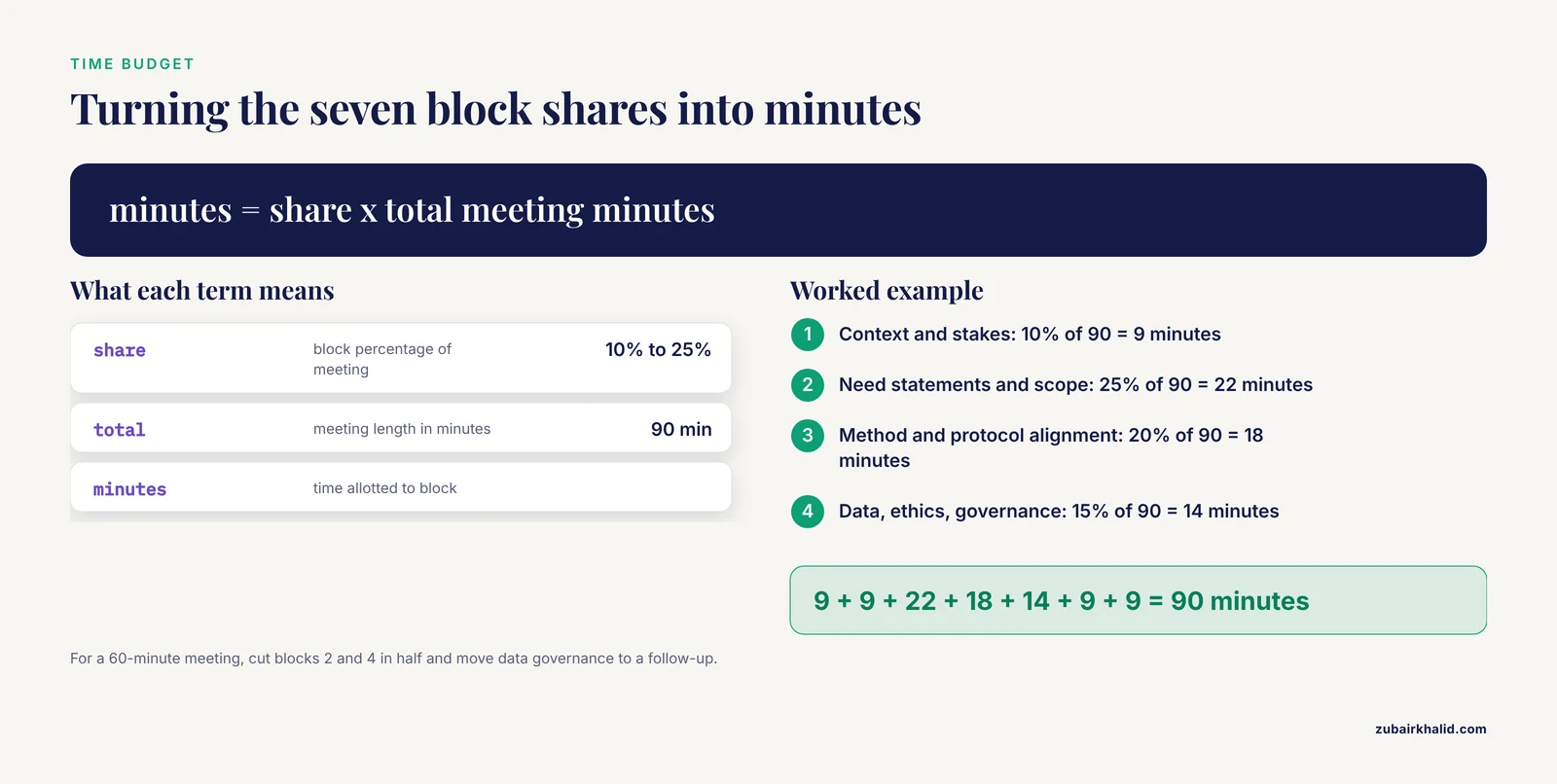
Here is a concrete scenario. Suppose you are coordinating a project on detecting early physiological deterioration in newborns during resuscitation. The team includes a neonatologist, a human factors engineer, a machine learning scientist, a labor and delivery nurse, and a biostatistician. You have 90 minutes.
Step 1. Convert the seven-block percentages into minutes.
Block                                    Share    Minutes
1. Context and stakes                     10%        9
2. Plain-language problem briefing        10%        9
3. Need statements and scope              25%       22
4. Method and protocol alignment          20%       18
5. Data, ethics, and governance           15%       14
6. Roles, timeline, decision rules        10%        9
7. Commitments and next steps             10%        9
                                    Total          90
Step 2. Write the agenda into the template and circulate it 48 hours ahead.
KICKOFF AGENDA: Neonatal Deterioration Detection Project
Date: [date]   Time: 90 min   Location / link: [X]
Facilitator: [name]        Scribe: [name]

Pre-reads (sent 48h ahead):
  - One-page project brief
  - Draft need statements N1-N6
  - Draft roster with roles

1. Context and stakes (9 min) - Lead: PI
   Output: one-paragraph shared problem statement, recorded live
2. Plain-language briefing (9 min) - Leads: neonatology, engineering,
   ML, nursing, [biostatistics](/blog/data-analysis/what-is-biostatistics) (2 min each, no slides, no jargon)
   Output: running glossary list
3. Need statements and scope (22 min) - Facilitator
   3a. Read each draft need statement aloud (6 min)
   3b. Merge, cut, reword (8 min)
   3c. Rank by importance and feasibility (8 min)
   Output: ranked need statements, each with an owner
4. Method and protocol alignment (18 min) - Leads per need statement
   4a. One approach sketch per top-ranked need statement (12 min)
   4b. Name shared-protocol owners and integration points (6 min)
   Output: method sketch per need statement, protocol owners named
5. Data, ethics, and governance (14 min) - ML lead + biostatistician
   5a. Data formats, storage, access, de-identification (7 min)
   5b. Authorship principles and oversight (7 min)
   Output: one-page draft data and authorship agreement
6. Roles, timeline, decision rules (9 min) - PI
   Output: confirmed roster, coordinator, cadence, dispute path
7. Commitments (9 min) - All
   Each person states their next action and deadline aloud.
   Output: action list with names and dates
Step 3. Prepare the need statements. Modeled on the structured approach used in the obstetric and neonatal safety laboratory, where interviews, focus groups, direct observation, and task analysis fed a set of explicit need statements [5], your drafts might read like this:
N1: Clinicians cannot reliably detect the transition from
    successful to failed resuscitation using current monitors.
    (Owner: neonatologist)
N2: Existing monitor data streams are not synchronized or
    timestamped in a form usable for algorithm development.
    (Owner: ML scientist)
N3: The physical layout of resuscitation teams creates workflow
    disruptions that delay interventions. (Owner: human factors)
N4: Nurses lack a decision aid that surfaces deterioration
    signals without adding alarm fatigue. (Owner: nursing lead)
Step 4. During the meeting, the scribe maintains three live documents: the glossary, the ranked need list, and the action list. The facilitator's job is to keep each block to time and to convert every opinion into one of those documents. A comment that does not land in a document did not happen.
Step 5. Close by reading the action list aloud. Expected output at the end of the meeting looks like this:
ACTIONS (owner - action - due)
- ML scientist: draft data schema v0.1 for monitor streams - Mar 14
- Human factors: schedule 2 observation sessions at partner site - Mar 21
- Biostatistician: propose primary endpoint and analysis plan - Mar 21
- PI: file draft data/authorship agreement with team - Mar 17
- All: comment on need statement wording in shared doc - Mar 10
Next meeting: Mar 24, 60 min, agenda to follow 48h ahead
Step 6. Send the notes within 24 hours, while memories are fresh.
If your meeting runs 60 minutes instead, cut blocks 2 and 4 in half and move the data governance discussion to a dedicated follow-up session. If it runs 120 minutes, expand block 3 rather than block 1. Scope negotiation is where cross-disciplinary projects most often go wrong, so that block deserves the extra time.
Facilitation: Handling the Predictable Failure Points
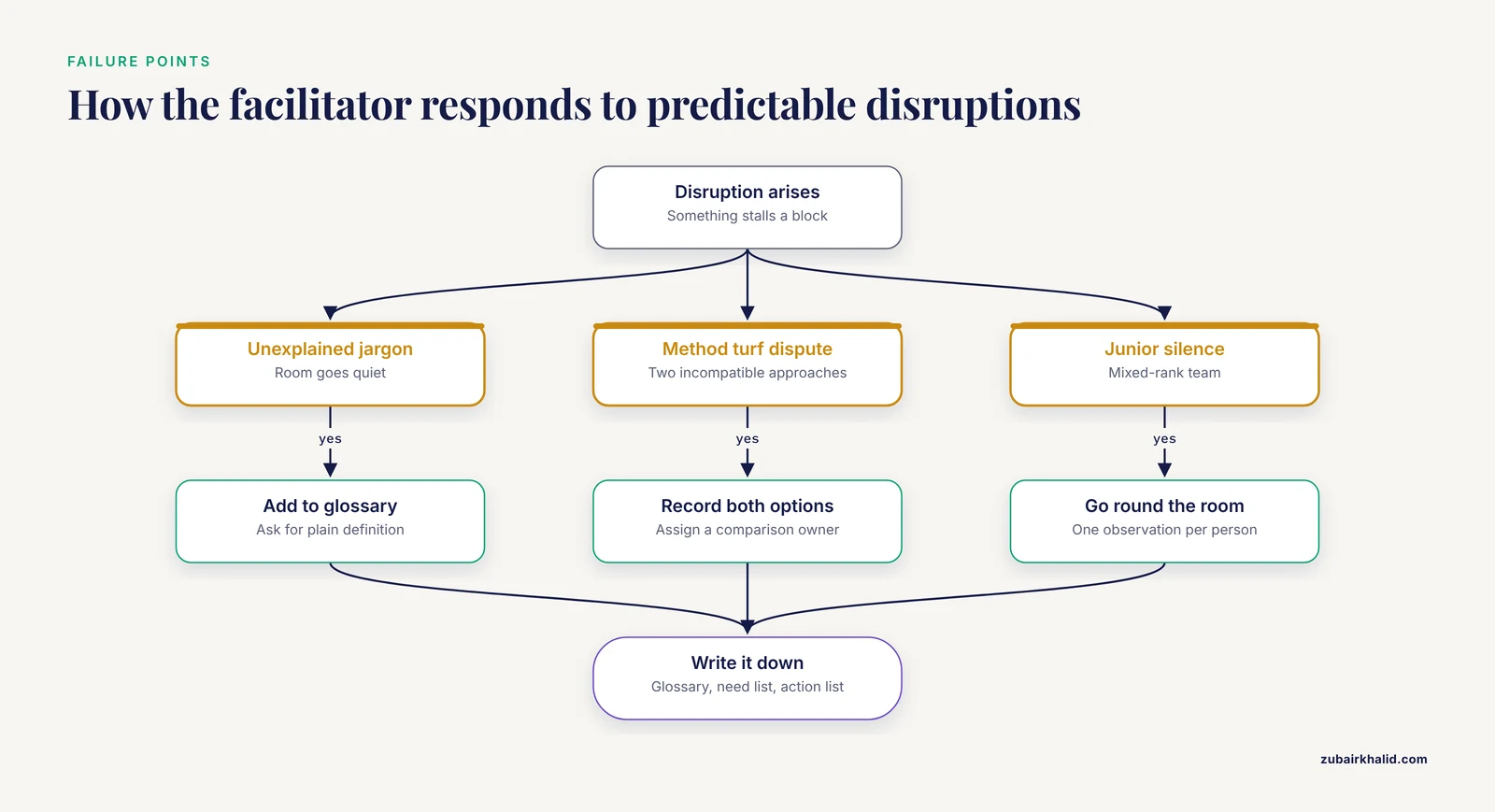
Certain moments recur in almost every cross-disciplinary kickoff. Plan your responses in advance.
The jargon stall. A specialist uses an unexplained term and the room goes quiet. The facilitator interrupts, asks for a plain-language definition, and adds the term to the glossary. Over the life of the project this glossary becomes one of the team's most used documents. The underlying problem is real and documented. Reviews across fields, from clinical medicine to traditional medicine modernization efforts, identify the need for interdisciplinary integration precisely because terminology and standards differ across silos [3], [10].
The method turf dispute. Two disciplines propose incompatible approaches. Do not adjudicate on the spot. Write both approaches into the method sketch as competing hypotheses to be tested against the need statement, and assign a comparison owner. The systems engineering approach used in the patient safety laboratory, which proceeds through problem analysis, design, development, implementation, and evaluation, offers one model for sequencing such work so that competing designs get evaluated against the same problem analysis [5].
The junior silence. In mixed-rank teams, junior participants often hold the most current technical knowledge but speak least. The hackathon model's flat hierarchy, which deliberately paired participants from high school students to faculty and gave all of them a role in data acquisition, ideation, coding, testing, and dissemination, is a documented structural fix [2]. At minimum, go around the room once per block and ask each person for one observation.
The metric argument. When a data science collaborator proposes a model, clinical collaborators will ask what the number means for patients. Agreeing on evaluation metrics early resolves this. The point is not to force one metric on everyone but to make explicit, for example, that a classifier will be reported with sensitivity, specificity, and AUROC, and that those terms get defined once in the glossary [6].
The role blur. Interprofessional clinical reviews emphasize that clear orchestration, with each professional understanding their specific responsibilities within a shared pathway, is what makes collaboration functional rather than decorative [7]. Write roles down in the meeting. A simple RACI table, where each task is marked as Responsible, Accountable, Consulted, or Informed, takes ten minutes and prevents months of ambiguity.
Research Collaboration Tools to Support the Agenda
The kickoff meeting should end with ratified tooling, because tool choices made casually get relitigated expensively later. Four categories cover most teams.
- Shared documents and notes. A platform where the glossary, need statements, action list, and meeting notes live in one place with version history. This is the team's single source of truth.
- Task and project tracking. A tracker where every action item from block 7 becomes a card with an owner and a due date. Review it at the start of every subsequent meeting.
- Version control and code sharing. Any project with analysis code needs a repository with clear ownership rules. The hackathon program treated community coding, where participants collectively contribute to code development and testing, as a core collaboration practice rather than an afterthought [2].
- Data management. A defined repository for datasets with documented formats and access rules. The data standardization problems reported in multimodal clinical research [4] and in AI-driven biomaterials work [8] both trace back to teams that improvised data handling instead of deciding it in week one.
Institutional infrastructure matters too. Programs that succeeded in sustaining medicine and engineering collaboration often did so through deliberate platform construction and cross-institutional education mechanisms rather than through individual goodwill alone [11]. If your institution offers a cross-disciplinary research commons, core facility, or grant development office, mention it in block 6 and assign someone to investigate what support it offers.
What to Do in the 48 Hours After the Meeting
Send three documents within two days: the final agenda with notes attached, the ranked need statements, and the action list. Then schedule the first working meeting before the follow-up tasks are due, so momentum carries into execution rather than waiting for another large gathering. At the next meeting, start by reviewing the tracker, then spend the session on the top-ranked need statement rather than on general updates. Teams that repeat the kickoff format weekly burn out. The kickoff is a one-time structuring event. Everything after it should be smaller, more specific, and anchored to the documents the kickoff produced.
Common Mistakes and Limitations
- Treating the kickoff as a social event. Enjoyment matters, but the meeting has three deliverables: ranked need statements, a method sketch, and an action list. If any of the three is missing, the meeting did not finish its job.
- Skipping the glossary. Teams assume vocabulary differences will resolve themselves. They do not. The documented awareness gaps between medical specialties [3] and the definitional inconsistencies across research groups [2] both persist until someone forces the terms into the open.
- Presenting instead of deciding. If more than one person gives a slide deck, the meeting has become a seminar. Briefings in this meeting should be spoken, short, and jargon-flagged.
- Leaving data governance for later. Every review that examined why data-driven collaborations underdeliver points to data standardization and quality problems [8], [4]. Decide formats, access, and de-identification rules while the project is small enough that changing them is cheap.
- Avoiding the ethics conversation. Teams deploying algorithms in clinical or human-subjects settings face documented ethical and practical challenges, from bias to appropriate use [6]. Naming these in block 5 does not slow the project down. Discovering them in year two does.
- Letting hierarchy decide technical questions. Seniority and correctness are different axes. The flat-hierarchy norm exists because the junior person in the room often knows the most about the newest method.
- Overloading the first meeting. If your draft agenda has fifteen items, cut it. A 90-minute meeting can hold the seven blocks and nothing more. Everything else belongs in follow-up sessions.
- Assuming the agenda guarantees alignment. The template structures the conversation, but a kickoff cannot substitute for the ongoing work of shared protocols, periodic re-alignment, and continued cross-disciplinary education that published programs describe as necessary over the life of a collaboration [5], [1], [3]. Individual projects differ, and no template replaces judgment about your specific team, funders, and institutional rules.
Frequently Asked Questions
How long should a cross-disciplinary research kickoff meeting be?
Ninety minutes is the practical sweet spot for a team of five to ten people, because it fits all seven agenda blocks without truncating the scope negotiation. Use 60 minutes for very small teams and split data governance into a separate session, or 120 minutes if you have more than eight need statements to negotiate.
Who should be invited to the kickoff meeting?
Invite every person who will do sustained work on the project, plus one representative from each discipline even if that person is not a daily contributor, and the person who will administer data or compliance. Missing a discipline at kickoff almost always means that discipline's constraints get discovered after the design is locked.
What is the difference between a kickoff meeting and a regular lab meeting?
A kickoff meeting is a one-time structuring event that produces need statements, a method sketch, and an action list, while a lab meeting is a recurring working session that reviews progress and data. The kickoff sets definitions, roles, and decision rules that all later meetings inherit.
How do I write a need statement for the agenda?
Write two sentences that name a specific problem, the people it affects, and why current solutions fall short, in language a non-specialist understands. Then assign a single owner to each statement so the ranked list that comes out of block 3 has a person attached to every item.
What should the facilitator do when disciplines disagree on methods?
Do not adjudicate on the spot. Record both approaches as competing options under the relevant need statement, assign one person to compare them against explicit criteria before the next meeting, and move on to protect the time budget.
Should the kickoff meeting cover data sharing and authorship?
Yes, at least in draft form, because data standardization and authorship disputes are among the most expensive problems to fix after data collection begins. A one-page draft agreement produced in block 5, even if imperfect, gives the team something concrete to refine.
How soon after funding should the kickoff happen?
Within two to four weeks of funding or team assembly, once the project brief and draft need statements exist. Waiting longer lets private assumptions harden into conflicting plans that are much harder to reconcile in a meeting.
Can a kickoff meeting work remotely?
Yes, with adjustments. Send pre-reads earlier, require cameras on for the briefing and scope blocks, use a shared document for live note-taking so remote participants contribute in writing, and extend the meeting by 15 minutes to account for turn-taking delays in discussion-heavy blocks.
Sources
- Atomic Force Microscopy for Cross-Disciplinary Materials Research.
- Hacktive matter: data-driven discovery through hackathon-based cross-disciplinary coding.
- A review of multidisciplinary care in metabolic dysfunction-associated steatohepatitis and cardiometabolic disease, with a focus on Canada.
- Multimodal data-driven approaches in retinal vein occlusion: A narrative review integrating machine learning and bioinformatics.
- The Value of a Cross-Disciplinary Approach to Human and System Performance Research in Obstetrics and Neonatology: AHRQ's Patient Safety Learning Laboratory.
- Machine Learning in Nursing: A Cross-Disciplinary Review.
- Implementing Evidence-Based, Phase-Specific Multimodal Analgesia for Total Joint Arthroplasty: An Interprofessional Review for Nursing Practice and Management.
- Artificial Intelligence Reshaping Non-Starch Polysaccharides Research: A Comprehensive Review of Intelligent Integration From Extraction Optimization to Functional Design.
- Research Hotspots and Trends in Ciliopathies: A Bibliometric and Visualization Analysis.
- Artificial intelligence and synthetic biology in traditional Chinese medicine: revolutionizing public health applications.
- [[Exploration and Practice of Talent Cultivation in Allied Health in the Context of the Integration of Medicine and Engineering].](https://pubmed.ncbi.nlm.nih.gov/41113422/)