The Cross-Disciplinary Research Communication Plan
By Dr. Zubair Khalid, DVM, MS, PhD ·

By the end of this article you will be able to draft a complete cross-disciplinary research communication plan, run a structured kickoff session with your team, choose tools that keep a mixed-discipline group aligned, and set up simple checks that show whether your communication is actually working. You will need your team roster, your project aims, a shared document tool such as a wiki or cloud document, a shared calendar, and about ninety minutes of scheduled time with your collaborators.
Cross-disciplinary research brings together people whose training shaped how they define problems, collect data, and judge evidence. A communication plan is the written agreement that keeps those people talking to each other instead of past each other. This guide covers the cross-disciplinary research communication plan format, a reusable template, a filled-in example, and the evaluation methods used to tell whether scientific collaboration is improving.
What a Cross-Disciplinary Research Communication Plan Is
A cross-disciplinary research communication plan is a short written document that records how a research team with members from different fields will exchange information. It specifies who is on the team, what each person contributes, which channels carry which messages, how often the team meets, what vocabulary the team shares, how data and samples move between groups, and how decisions and credit are handled.
The idea comes from the Science of Team Science, a research field that studies how scientific teams form, function, and perform. One of its most practical products is Collaboration Planning, a facilitated session in which a new team answers a set of structured questions about how it will work together before friction develops. A team at the University of Wisconsin tested a ninety-minute facilitated Collaboration Planning intervention with questions in ten areas, designed for participants with no prior knowledge of team-science methods, and had teams submit written collaboration plans alongside their first quarterly progress reports [1].
The plan differs from a data management plan or a grant timeline. A data management plan describes data for funders. A timeline describes tasks. The communication plan describes people and information flow. It answers questions the other documents ignore, such as what a "case" means to a clinician versus a statistician, or who decides when a disagreement about methods cannot be resolved by discussion.
The plan also differs from a rigid research protocol. Writers on transdisciplinary research, in which investigators integrate concepts from separate disciplines into one framework, caution that the benefits of cross-disciplinary communication are hard to predict in advance and that an overly detailed process can impede novel insights. Open-minded communication is a prerequisite for transdisciplinary work, but no single predetermined plan guarantees it [2]. A good communication plan therefore fixes the logistics of collaboration while leaving the science flexible.
Why Cross-Disciplinary Teams Need a Written Plan
Mixed-discipline teams fail in predictable ways. The failures are documented across fields, and each one points to something a communication plan can prevent.
Vocabulary divergence. The same word means different things in different fields, and teams rarely notice until results conflict. A hackathon-based program in active matter and biomaterials research found that inconsistencies in metrics, definitions, and analysis algorithms across research groups hindered the identification of performance patterns, even when the groups studied closely related systems [3]. A communication plan that forces the team to write a shared glossary surfaces these conflicts in week one rather than month twelve.
Different problem-solving habits. Biomedical engineering students and bioscience students approach the same physiology problem with different reasoning styles, and instructional designs that bridge those differences are needed to break down stereotypes between the disciplines [4]. On a research team, the same effect appears as methodological disagreement that feels personal unless the team names it early.
Uneven technical fluency. In atomic force microscopy, a technique that maps surface properties by scanning a sharp probe across a sample, effective cross-disciplinary implementation is often challenged by technical complexity and varied domain expertise among collaborators, so validated protocols and clear documentation are needed for reproducibility [5]. The same pattern holds for machine learning projects, where limited formal education leaves many nurses hesitant to integrate AI tools into care, which is why cross-disciplinary reviews now translate core concepts and evaluation metrics into discipline-specific examples [6].
Communication lapses under pressure. In a patient safety research program spanning obstetrics and neonatology, investigators following a five-step systems engineering approach (problem analysis, design, development, implementation, and evaluation) identified common lapses in verbal communication during obstetric emergencies [7]. Research teams show a milder version of the same failure when deadlines compress: the verbal handoffs get skipped, and the engineer learns about the protocol change after the experiment.
Distance and sector boundaries. A Sino-Swedish collaboration on antibiotic resistance reported that long-distance cross-disciplinary work demands deliberate investment in effective communication, shared conceptual frameworks, and leadership [8]. Distance amplifies every communication weakness, which is why international teams benefit most from writing things down.
The pattern across these examples is consistent. The failure is never a lack of talent. The failure is unmanaged information flow, and a written plan is the management tool.
The Cross-Disciplinary Research Communication Plan Format
Most working plans, including the ones produced in the Wisconsin Collaboration Planning pilot, share a common format: a short document, roughly one to three pages, produced in a single facilitated meeting, revisited on a fixed schedule. The Wisconsin team deliberately assumed no previous knowledge of team science among attendees and later revised its questions because some were confusing and too grounded in team-science jargon, a useful lesson for anyone writing a plan template [1].
The format has seven load-bearing sections:
- Team composition and roles. Names, disciplines, institutions, and what each person owns.
- Shared vocabulary. A glossary of terms the disciplines define differently.
- Channels and cadence. Which tool carries which conversation, and which meetings happen when.
- Data, sample, and code flow. How materials and files move between groups and who controls them.
- Decision-making and conflict. How the team decides, and what happens when discussion fails.
- Credit and authorship. How contributions map to authorship and acknowledgment.
- Evaluation. How the team will know the plan is working.
Section seven deserves emphasis because teams rarely build it in. The QUERI Impact Framework, developed to measure the real-world impact of implementation science, organizes metrics into five domains abbreviated ACTION: Alignment, Commitment, Tailoring, Informing the field, and Observing healthcare changes and generating New questions [9]. A team-level communication plan can borrow that structure at a smaller scale by tracking alignment with shared goals, member commitment, tailoring of messages to each discipline, contributions to the wider field, and observable changes in how the team works.
Step-by-Step Walkthrough: Building Your Plan
Follow these ten steps in order. The whole sequence takes one facilitated meeting of about ninety minutes plus two to three hours of follow-up writing.
Step 1: Draft the roster before the meeting
List every current member, their discipline, and their role. Then list the disciplines that are missing. The Wisconsin pilot found that teams struggled to know who to invite [1], so decide this in advance. A useful rule: for every method the project depends on, someone in the room must have produced results with that method before.
Team roster (draft)
Name            Discipline            Role                  Institution
A. Okafor       Nursing science       Clinical lead         City Medical Center
B. Lindqvist    Data science          Model development     State University
C. Ramaswamy    Health informatics    Data governance       State University
D. Chen         [Biostatistics](/blog/data-analysis/what-is-biostatistics)         Analysis validation   State University
Missing: implementation partner on the clinical units
Step 2: Schedule the ninety-minute kickoff
Book one ninety-minute session within the first two weeks of the project. Send the agenda and the blank template (Step 3) at least three days ahead so members arrive with positions rather than reacting live. The Wisconsin intervention used a facilitated format with questions in ten areas and produced a written plan as a deliverable [1].
Step 3: Circulate the template
Use this cross-disciplinary research communication plan template as the working document. Every member edits the same copy.
# Cross-Disciplinary Research Communication Plan

**Project:** [title and one-sentence aim]
**Version / date:** [v1.0, YYYY-MM-DD]
**Plan owner:** [name responsible for keeping this current]

## 1. Team composition and roles
| Name | Discipline | Contribution | Owns |
|------|-----------|--------------|------|

## 2. Shared vocabulary
| Term | Definition this team agrees to use | Source discipline |
|------|------------------------------------|-------------------|

## 3. Channels and cadence
| Purpose | Channel | Frequency | Chair or owner |
|---------|---------|-----------|----------------|

## 4. Data, sample, and code flow
- What moves, in which direction, in what format, on whose approval

## 5. Decision-making and conflict
- Routine decisions: [rule]
- Deadlocked decisions: [rule and tiebreaker]

## 6. Credit and authorship
- Authorship criteria: [rule]
- Acknowledgment and data citation: [rule]

## 7. Evaluation
- Check-in schedule for the plan itself: [frequency]
- Indicators the plan is working: [2 to 4 indicators]
Step 4: Build the cadence table first
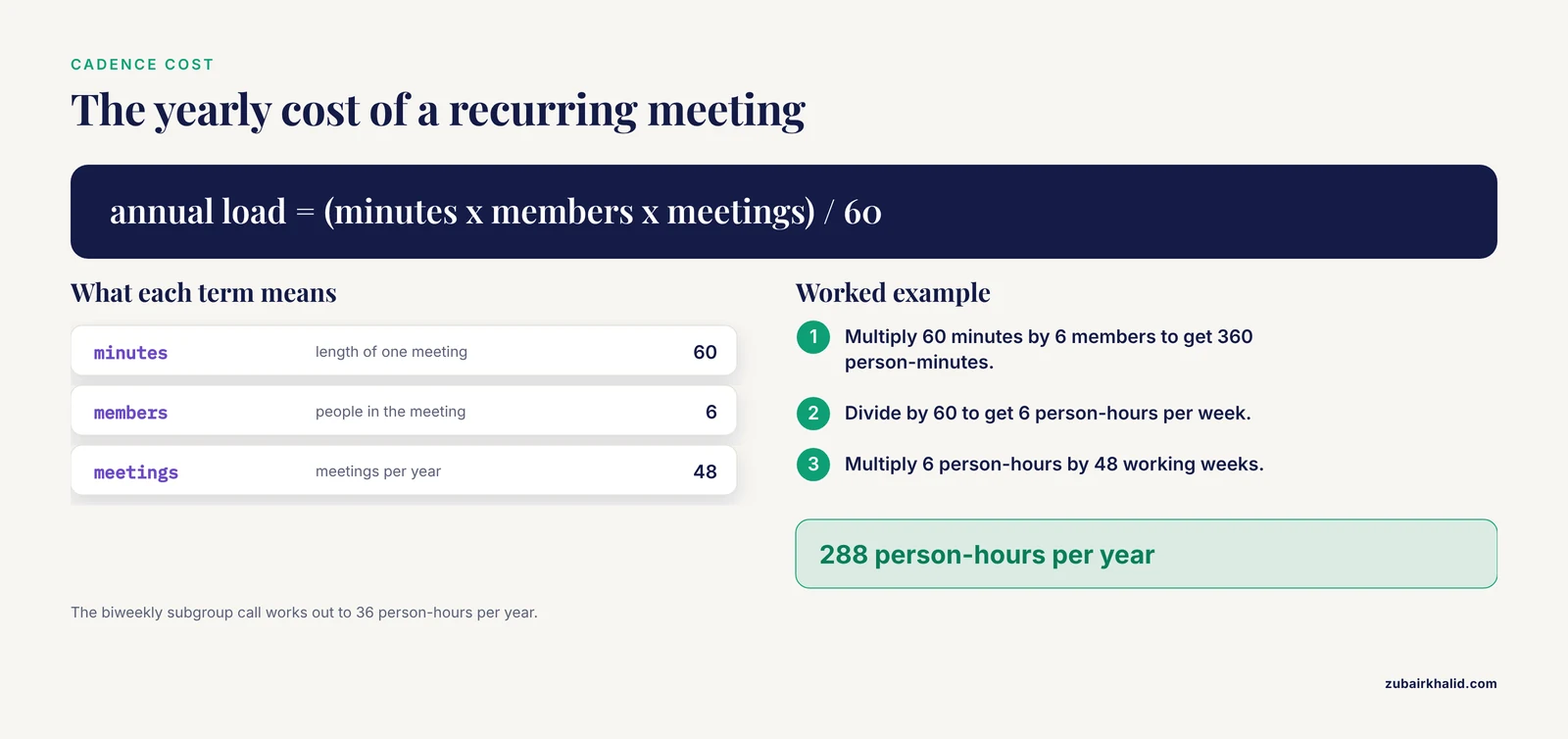
Cadence is where most plans earn their keep. Work through the meeting load explicitly, because every recurring meeting is a recurring cost in person-hours:
Weekly all-hands: 60 min x 6 members = 6 person-hours per week
Annual load:       6 person-hours x 48 working weeks = 288 person-hours

Biweekly subgroup call: 30 min x 3 members = 1.5 person-hours per meeting
Annual load:            1.5 x 24 meetings   = 36 person-hours
If the total meeting load exceeds roughly ten percent of team capacity, cut meetings and move their content into asynchronous written updates. Push the other direction and the plan decays. The output of this step should be a one-page cadence table that every member can recite: what meets, where, when, and who runs it.
Step 5: Write the glossary out loud
Spend fifteen minutes of the kickoff on terms each discipline uses differently. Ask each member to name one term from their field that others are using loosely. Record the agreed definition in the template. For a clinical data science team this typically resolves terms such as "case," "outcome," "feature," and "validation" in the first session.
Step 6: Map data and sample flow
Draw the movement of every shared artifact: datasets, biological samples, code, and analysis outputs. For each, record the format, the direction of travel, and the approval needed. Projects that integrate methods from another discipline into an existing study, such as adding molecular genetics analyses to a clinical project, show what this looks like in practice: the collaborating team established a partnership with genetics researchers and laboratory facilities, developed a plan to manage biologic samples, and incorporated the new methods into the informed consent process [10]. Those three items, partnership, sample management, and consent, are the minimum entries for any plan section covering new material flows.
Step 7: Set the decision rules
Agree on two rules. First, routine decisions: state who decides what without a meeting. Second, deadlocked decisions: name a tiebreaker, usually the principal investigator or a designated integration lead. Write both rules down. Unwritten decision rules produce the conflicts that end collaborations.
Step 8: Fix credit early
Record the authorship criteria in the plan, before any results exist. If the project involves groups with different authorship traditions, resolve the differences now. A literature review of collaboration between medical educators and health sciences librarians found that coauthorship between the two groups, supported by a shared online citation management service, marked a productive collaboration built around a common research interest [11]. Shared tools and explicit credit rules reinforced each other.
Step 9: Store the plan where everyone edits it
Place the plan in the same shared workspace as the data documentation and the analysis code. A plan filed in one person's email is a plan that does not exist. Tag it with a version number and date.
Step 10: Review the plan quarterly
Schedule a fifteen-minute plan review once per quarter. Ask three questions: Is the cadence table still accurate? Has any vocabulary dispute appeared? Has any data flow changed? Update the version number each time. Treat revisions as normal, since the teams in the Collaboration Planning pilot identified improvements to their own process after the first round and revised their questions accordingly [1].
A Cross-Disciplinary Research Communication Plan Example
The following excerpt shows a completed plan for a hypothetical project in which nurse scientists, data scientists, and an informaticist build an early-warning model for hospitalized patients, a project type common in the nursing machine learning literature [6]. The values are illustrative, not sourced.
# Cross-Disciplinary Research Communication Plan

**Project:** Early-warning model for inpatient deterioration on medical units
**Version / date:** v1.0, 2026-11-11
**Plan owner:** A. Okafor

## 2. Shared vocabulary
| Term | Definition this team agrees to use | Source discipline |
|------|------------------------------------|-------------------|
| Case | One hospital admission, not one patient | Nursing |
| Event | Any escalation-of-care activation | Clinical |
| Label | The coded outcome used for model training | Data science |
| Validation | Testing on a time period after the training period | Biostatistics |

## 3. Channels and cadence
| Purpose | Channel | Frequency | Owner |
|---------|---------|-----------|-------|
| Full team decisions | Video call | Weekly, 60 min | Okafor |
| Model debugging | Chat thread | Continuous | Lindqvist |
| Clinical workflow questions | Chat thread + Friday summary | Continuous + weekly digest | Okafor |
| Results and milestones | Written report in shared workspace | Monthly, rotating author | All |
| Plan review | 15 min at end of monthly report meeting | Quarterly | Ramaswamy |

## 4. Data, sample, and code flow
- Deidentified extracts move from the informatics group to the modeling
  group as versioned files with a data dictionary, on informatics approval.
- No model output reaches clinical staff without review by the clinical lead.
- All analysis code lives in the shared repository. No local-only versions.

## 5. Decision-making and conflict
- Routine: each workstream owner decides within their lane.
- Deadlock: clinical lead and modeling lead confer. Unresolved items go to
  the principal investigator within five working days.

## 6. Credit and authorship
- Authorship follows contribution, documented in the monthly reports.
- Data engineers and unit nurses who contributed substantially are named
  authors or acknowledged by specific contribution, not listed generically.

## 7. Evaluation
- Quarterly review checks: cadence table accuracy, open vocabulary
  disputes, data flow changes.
- Indicators: monthly written reports delivered on schedule, no decision
  older than two weeks without a recorded outcome, all members able to
  state the current milestone unprompted.
Notice what the example does that a bare project plan does not. It assigns every channel an owner. It defines terms per discipline. It sets a deadline for resolving deadlocks. Those specifics are what separate a plan from an intention.
Choosing Research Collaboration Tools
Research collaboration tools should be selected to match the plan, not the other way around. The table below summarizes the decisions each plan must make and what happens when the decision is skipped.
| Plan element | What to specify | Minimum viable version | Failure mode if omitted |
|---|---|---|---|
| Meeting cadence | Purpose, channel, frequency, owner per meeting | One weekly all-hands plus written monthly updates | Meeting overload or total silence between meetings |
| Glossary | Agreed definitions for contested terms | Ten to twenty entries in the plan itself | Results that cannot be compared across groups |
| Data flow | Format, direction, approval for each artifact | A short numbered list of what moves and who approves | Duplicated or unusable datasets, governance gaps |
| Decision rules | Routine and deadlock paths | Named tiebreaker with a response deadline | Stalled projects and quiet resentment |
| Credit | Authorship and acknowledgment criteria | One written paragraph in the plan | Authorship disputes at submission time |
| Shared references | Citation library access and conventions | One shared citation manager library [11] | Lost sources and duplicated literature work |
| Evaluation | Review schedule and two to four indicators | Quarterly fifteen-minute review | Plan drifts until it describes a team that no longer exists |
Two tool choices deserve specific mention. First, a shared citation management library pays for itself immediately on cross-disciplinary teams, because literature searching habits differ sharply between fields, and the librarian-educator collaboration literature shows shared libraries supporting productive joint scholarship [11]. Second, for projects where analysis methods must match across groups, adopt a common protocol or workflow document early. The AFM materials literature recommends validated protocols and quantitative analysis guidance precisely to ensure reproducibility across collaborators with different expertise [5], and the same logic applies to any shared analytical technique, from image processing to statistical modeling.
For teams that form around short, intensive events rather than long grants, the plan can be compressed. Hackathon-based cross-disciplinary programs have shown that a flat hierarchy, pairing participants from students to faculty, combined with clearly defined goals and deliverables, lets mixed groups contribute to data acquisition, coding, testing, and dissemination within days [3]. The hackathon is essentially a communication plan executed at maximum speed, and its two transferable rules are flat hierarchy and explicit deliverables.
Matching the Plan Format to Your Project Type
The template above needs adjustment for different collaboration shapes.
Clinical and translational teams. Health-focused teams should anchor the plan to a structured improvement or engineering framework. The obstetric and neonatal patient safety program organized its work around the five-step systems engineering approach, moving from problem analysis through design, development, implementation, and evaluation, with methods including interviews, focus groups, direct observation, teamwork scales, and simulation-based testing [7]. A communication plan for such a team assigns an owner to each step and specifies which meeting reviews each transition.
Clinical care coordination projects. Where the deliverable is a care pathway rather than a paper, the plan must include the disciplines involved in actual care. Reviews of multidisciplinary management in metabolic liver and cardiometabolic disease note that awareness of the condition and its management is low among non-liver specialists, so ongoing cross-disciplinary education and systemic changes are required for timely identification and coordinated care pathways [12]. For such teams, add an education workstream to the plan: who briefs whom, and how new evidence reaches every participating specialty.
Public-facing and society-level initiatives. Large collaborative programs, such as multidisciplinary brain health initiatives that position specialists as champions working with a broad range of partner organizations [13], need a communication plan tier that most lab teams skip: external messaging. Add a section naming who speaks publicly for the collaboration and how internal documents differ from public materials.
International collaborations. Add time zone windows, language norms for written documents, and an explicit escalation path, reflecting the reported experience that long-distance cross-disciplinary work succeeds only with deliberate investment in communication, shared conceptual frameworks, and leadership [8].
Data-intensive collaborations. For projects joining machine learning with clinical or biological data, add a data standardization section. Reviews of multimodal data integration in retinal vascular disease identify inconsistent data standardization and limited model generalizability as the main barriers to clinical translation, and recommend multicenter validation frameworks, interpretable tools, and patient-focused data platforms built through cross-disciplinary collaboration [14]. Concretely, the plan should fix file formats, coding dictionaries, and validation splits before the first model is trained.
Measuring Whether the Plan Works
A plan without measurement is a memo. Three approaches are established in the literature, in ascending order of effort.
Self-audit against the plan. At the quarterly review, check the indicators you wrote in section seven. Missed monthly reports, unresolved decisions older than the deadlock deadline, and members who cannot state the current milestone are early warning signs. This is the team-scale version of the QUERI approach, which derives key impact metrics, such as numbers of sites, staff trained, and people served, directly from stated performance goals [9].
Coauthorship and output tracking. Joint publications, shared citation libraries, and cross-group contributions to manuscripts indicate that communication is producing scholarship. The librarian and medical educator literature treats coauthorship between the two groups as evidence of a productive collaboration [11], and bibliometric collaboration networks are a standard way to visualize these ties across institutions and countries [15].
Social network analysis. For teams embedded in clinical services, encounter data can be turned into a network of who works with whom. A study of a Huntington disease clinic used social network analysis, constructing weighted networks from provider co-occurrence across shared patient-days and computing metrics such as modularity, a measure of how divided a network is into separate communities, and centrality measures, which identify who occupies key connecting positions [16]. The same logic applies to research teams: if your collaboration map shows isolated clusters that never connect, your plan has a structural gap that no amount of goodwill will fix.
Pick one approach at the start, record the baseline, and repeat it on the same schedule as the plan review.
Common Mistakes and Limitations
Treating the kickoff as a formality. The most common failure is running the session, filing the document, and never opening it again. The plan review in Step 10 is not optional. Teams that skip it revert to default behavior within a quarter.
Using jargon in the plan itself. The Wisconsin pilot found that some of its own facilitated questions were confusing because they were grounded in the language of team science [1]. Write your plan in plain words every member already uses. If a term needs defining, define it in the glossary.
Leaving information management out. The same pilot reported that groups lacked plans for managing their information and communications [1]. That gap is exactly what sections three and four of the template close. Do not let the plan become a discussion of goals with no operational content.
Over-structuring the science. Open-minded communication is a prerequisite for cross-disciplinary insight, and the benefits of such communication are hard to predict in advance, which means a detailed process imposed on the science itself can impede novel findings [2]. Structure the logistics. Leave the hypotheses flexible.
Assuming shared methods knowledge. Teams routinely assume a colleague's discipline shares their standards for evidence, validation, or measurement. It usually does not, whether the divide is between nursing and data science [6], between engineering and bioscience reasoning [4], or between imaging specialists and their collaborators [5]. The glossary and the data flow section exist to expose those assumptions.
Ignoring standardization until late. Data standardization inconsistencies are a recurring barrier to translating cross-disciplinary data science into practice [14]. Fix formats and definitions at the plan stage, not after the first conflicting result.
One limitation applies to every plan. A communication plan coordinates people. It cannot substitute for domain expertise, adequate data, or sound methods, and individual projects vary enough that any template requires adaptation to the team, the institutions involved, and the funding and oversight requirements that apply to the work.
Frequently Asked Questions
What is a cross-disciplinary research communication plan?
It is a short written document that records how a research team spanning multiple disciplines will exchange information, covering roles, shared vocabulary, meeting cadence, data flow, decision rules, credit, and evaluation.
Where can I find a cross-disciplinary research communication plan template?
Use the seven-section template in the walkthrough section of this article, which covers team composition, vocabulary, channels and cadence, data and sample flow, decisions, credit, and evaluation, and adapt it to your project.
How long does it take to create the plan?
Plan on one ninety-minute facilitated session with the full team, based on the tested Collaboration Planning format, plus two to three hours of follow-up writing and circulation.
When should the team write the plan?
Write it within the first two weeks of the project, before any results exist, because decision rules and authorship criteria are far easier to agree on before outcomes create stakes.
What is the difference between multidisciplinary, interdisciplinary, and transdisciplinary research?
Multidisciplinary teams work side by side within their own frameworks, interdisciplinary teams integrate methods across frameworks, and transdisciplinary teams merge concepts into a single new framework, with open-minded communication as the prerequisite for that integration.
How do we handle jargon differences between disciplines?
Run a glossary session in the kickoff meeting where every member names one term their discipline uses differently, record the agreed definitions in the plan, and add new terms whenever a dispute surfaces at the quarterly review.
What research collaboration tools does a cross-disciplinary team need?
At minimum, a shared document workspace for the plan and reports, a shared citation management library, a chat channel with a named owner, a version-controlled repository for code and data documentation, and a shared calendar for the cadence table.
How do we know if the communication plan is working?
Check your own indicators quarterly, track coauthorship and cross-group contributions over the project's life, and for clinical settings consider social network analysis of who actually interacts with whom.
Sources
- Operationalization, implementation, and evaluation of Collaboration Planning: A pilot interventional study of nascent translational teams.
- Transdisciplinary approaches enhance the production of translational knowledge.
- Hacktive matter: data-driven discovery through hackathon-based cross-disciplinary coding.
- Demand for interdisciplinary laboratories for physiology research by undergraduate students in biosciences and biomedical engineering.
- Atomic Force Microscopy for Cross-Disciplinary Materials Research.
- Machine Learning in Nursing: A Cross-Disciplinary Review.
- The Value of a Cross-Disciplinary Approach to Human and System Performance Research in Obstetrics and Neonatology: AHRQ's Patient Safety Learning Laboratory.
- Building bridges to operationalise one health - A Sino-Swedish collaboration to tackle antibiotic resistance.
- The Quality Enhancement Research Initiative (QUERI) Impact Framework: Measuring the Real-world Impact of Implementation Science.
- Integrating molecular genetics analyses into clinical research.
- Evidence-based medicine at the intersection of research interests between academic health sciences librarians and medical educators: a review of the literature.
- A review of multidisciplinary care in metabolic dysfunction-associated steatohepatitis and cardiometabolic disease, with a focus on Canada.
- The Brain Health Imperative in the 21st Century-A Call to Action: The AAN Brain Health Platform and Position Statement.
- Multimodal data-driven approaches in retinal vein occlusion: A narrative review integrating machine learning and bioinformatics.
- Research hotspots and frontier trends in the field of 3D printing in medical education from 2010 to 2025: a bibliometric analysis.
- Quantifying multidisciplinary collaboration in Huntington's disease before and after service redesign: a social network analysis.