How to Handle Conflicting Reviewer Requests in Major Revisions
By Dr. Zubair Khalid, DVM, MS, PhD ·

The most common cause of conflicting reviewer requests is simple: two reviewers read the same manuscript with different goals in mind, and each one writes comments that serve their own goal without checking whether the other reviewer's goal exists. One reviewer cares about statistical rigor, another about narrative clarity, a third about whether the study fits the journal's scope. When their priorities pull in different directions, you receive instructions that seem impossible to satisfy at the same time.
The first thing to check is whether the conflict is real. In a large share of cases, the requests only appear to contradict each other. One reviewer says "shorten the introduction" and another says "add more background on the study system." Read closely, the first reviewer usually means "cut the literature review that repeats what we already know" and the second means "explain methods-specific background that a general reader needs." Both can be satisfied in the same revision once you separate the underlying concern from the literal instruction. Before you draft any response or escalate anything, restate each request as the concern behind it. If the concerns are compatible, your problem is a writing problem, not a diplomacy problem.
This guide walks through the causes of conflicting reviewer requests, a diagnostic sequence you can follow, a troubleshooting table for the situations you will actually meet, and the mechanics of writing a reviewer response letter that resolves the conflict without antagonizing anyone.
What a Major Revision Actually Asks of You
Revision is the normal outcome of peer review, not a warning sign. Very few manuscripts are accepted without any request for changes, and most go through several rounds of review by experts in the subject. Editors classify decisions into minor and major revisions, although the exact terminology varies across journals. Minor revisions involve small changes such as adding information, trimming redundant material, or fixing language. Major revisions require more fundamental reworking of the manuscript, which is precisely where conflicting requests become painful, because you may need to restructure analysis, add experiments, or rewrite sections while reviewers disagree about the direction of that rework.
The revision stage matters for a practical reason. Handling reviewer comments well can considerably improve the quality of a paper and its suitability for publication. A major revision is an invitation, not a rejection. Treat the conflicting requests as constraints to be engineered around rather than as a verdict on your work.
Why Reviewer Requests Conflict: The Causes, Most Common to Rarest
Cause 1: Different expertise, different priorities
Peer reviewers are usually chosen so that each covers a different facet of the work. A methods reviewer reads your statistics section the way a home inspector reads a foundation. A domain reviewer reads your interpretation the way a buyer reads the kitchen. Both inspections are legitimate, and their demands can collide. The methods reviewer asks for a stricter analysis, which produces a more qualified result. The domain reviewer asks for a bolder claim, which the stricter analysis will not support. Neither reviewer is wrong. They are optimizing different things.
Cause 2: Apparent conflicts that share one goal
This is the most frequent situation and the cheapest to fix. Reviewer A says your results section is too long. Reviewer B says you failed to report a control condition. Both are asking for a results section that is complete on substance and efficient on prose. Once you rewrite the section so the control result appears in one tight paragraph, both reviewers are satisfied. Many apparent conflicts dissolve when you translate each literal instruction into the underlying concern.
Cause 3: Genuine methodological disagreement
Sometimes reviewers disagree about the correct analysis, the appropriate model, or the interpretation of the same data. This kind of conflict is real, and you cannot paper over it with prose. The constructive response is empirical. In phylogenomics, for example, competing tree topologies for pancrustacean relationships were settled not by argument but by expanded taxon sampling and explicit topology tests that rejected the previously published trees in favor of the new maximum likelihood trees [1]. When reviewers disagree about an analysis, ask whether an additional analysis, a sensitivity check, or a clearly labeled alternative result can let both perspectives appear in the paper honestly.
Cause 4: Scope and framing disagreement
A reviewer invested in one subfield may want your paper reframed around their question, while another wants the original framing preserved and the discussion narrowed. These conflicts are about what the paper is for. They are rarer than methodological disputes but harder to resolve, because no extra experiment settles them. Resolution usually comes from the editor, who knows what the journal commissioned and what its readers expect.
Cause 5: Reviewers reacting to different things
The rarest cause is mechanical. One reviewer reviewed an earlier version, missed a shared supplementary file, or misread a figure, and their comments contradict comments based on the correct version. This is worth checking before anything else when a request flatly denies something your manuscript clearly states. Confirm the version and files the editor actually sent, because a request built on a missing file is not a scientific disagreement at all.
A Five-Step Diagnostic Sequence
Run every conflicting pair of requests through this sequence before you respond to anyone.
- Restate each request as a concern. Write one sentence per reviewer: "Reviewer 1 is worried that X is not justified by the data." Strip out the imperative language.
- Test for compatibility. Place the two concerns side by side. Ask whether a single revision can satisfy both. If yes, the conflict was apparent, and you can proceed to the response letter.
- Check for factual error. Confirm that each request refers to content that actually exists in the manuscript and in the files the editor distributed. If one request rests on a misreading, note that gently and correct the misunderstanding with a page and line reference.
- Ask whether data can decide it. If the conflict is methodological, list the analyses that would distinguish the two positions. A sensitivity analysis or an alternative model, presented side by side, often lets you report honestly under both readings.
- Escalate to the editor if steps 1 through 4 fail. When the conflict is about scope, framing, or a request that would compromise the study, the editor is the decision maker. Escalation is a normal, expected part of the process, not an accusation against the reviewers. Formal revision processes in other scholarly and technical communities work the same way, with a designated authority arbitrating when independent reviewers reach different conclusions [2].
Troubleshooting Table
| Symptom | Likely cause | How to confirm | Fix |
|---|---|---|---|
| Reviewer 1 wants a longer introduction, Reviewer 2 wants a shorter one | Apparent conflict, different prose concerns | Reread the surrounding sentences of each comment for the actual complaint | Rewrite so background needed for methods appears early and literature recap is cut, then explain to each reviewer how their concern was addressed |
| Reviewer 1 wants a stronger conclusion, Reviewer 2 says the data do not support one | Priorities conflict, rhetoric versus rigor | Check whether the stronger claim requires evidence you do not have | Adopt the conservative claim in the abstract and conclusion, add the qualified speculation the bolder reviewer wants in the discussion, clearly labeled as such |
| Reviewer 1 wants method A, Reviewer 2 wants method B | Genuine methodological disagreement | Determine whether both methods answer the same question or different questions | Run both where feasible and report them side by side, or run the decisive analysis and justify the choice with a citation, noting the alternative in the response letter |
| One reviewer asks you to delete a figure, another asks you to expand it | They value different content in the same figure | Check what each reviewer actually uses the figure for | Split the figure, move the contested panel to supplementary material, and point each reviewer to the location of the content they need |
| A reviewer demands an experiment that another reviewer calls unnecessary | Cost and scope disagreement, common in major revisions | Estimate what the new experiment changes in the strength of the conclusions | Present the reasoning to the editor, propose the cheapest decisive version of the experiment, or argue formally that the conclusion does not depend on it |
| A reviewer's comment contradicts a statement clearly printed in the manuscript | Reviewer misread or received an incomplete file | Search your submitted files for the disputed content and note the page and line number | Reply with the exact location and a quoted sentence, politely, without speculating about why it was missed |
| Reviewers disagree about whether the paper fits the journal at all | Scope and framing conflict | Reread the journal's stated aims and the editor's decision letter | Escalate to the editor with a one-paragraph summary of both positions and a proposed resolution, and let the editor decide |
| Requests arrive that contradict each other and the journal's own author guidelines | Process breakdown or reviewer overreach | Compare the requests against the guide for authors and the editor's letter | Cite the journal guideline in your response letter and flag the contradiction to the editor in a separate, courteous note |
How to Fix Conflicting Reviewer Requests: Solutions by Type
Fix 1: Satisfy both with parallel changes
When the underlying concerns are compatible, make both changes and let the manuscript absorb them. Add the missing control description and tighten the prose elsewhere. The response letter then shows each reviewer their own concern addressed with a specific location in the revised manuscript. This solution covers the majority of conflicting requests you will encounter, because most apparent contradictions come from reviewers reading the same text with different complaints in mind.
Fix 2: Sequence the changes
Some requests conflict only if performed in the wrong order. Reviewer 1 asks for a cleaner results section, Reviewer 2 asks for three additional analyses. If you add the analyses first and then reorganize, the two requests stop competing. In your response letter, describe the sequence explicitly: "At Reviewer 2's suggestion, we added the analyses now shown in Figures 3 and 4, and at Reviewer 1's suggestion we restructured Section 3.2 around the revised figure set." Sequencing turns an apparent contradiction into a plan.
Fix 3: Reframe around a shared goal
When two requests pull toward different framings, look for the goal both reviewers share. Almost always, it is a reader who can follow and trust the paper. Write your response around that shared reader. Explain that the revision preserves the accessible framing Reviewer 1 asked for while adding the technical transparency Reviewer 2 demanded, and show exactly where each element now lives. This technique works well in the response letter even when the underlying disagreement persists, because it moves the conversation from taste to reader outcome.
Fix 4: Let new analysis settle it
For genuine methodological disputes, evidence beats argument. The principle is well established in quantitative fields. In the pancrustacean phylogeny work cited above, competing published topologies were tested directly against new maximum likelihood trees with expanded taxon sampling, and the topology tests rejected the older hypotheses [1]. Your version of this may be smaller. Report both plausible models, state which inferences are robust to the choice, and let the manuscript show reviewers the boundary of the disagreement rather than hiding it. A useful triage habit comes from usability inspection practice, where each identified problem is rated on a severity scale and the revision is planned against those ratings, with the expectation that most problems get fixed, a few get partly fixed, and fixing some can introduce new issues that must themselves be checked [3]. Rate every reviewer request the same way before you spend a single week of laboratory time on it.
Fix 5: Escalate to the editor with a neutral summary
When the conflict cannot be resolved by prose, sequencing, or data, write to the editor. The message should be short, factual, and free of complaint about either reviewer. Structure it in three parts: what Reviewer A asked, what Reviewer B asked, and why the two cannot both be followed as written. Then propose a resolution and ask the editor to confirm it. Editors expect this. A revision process needs an authority who can arbitrate between independent reviewers, and in every well-run review system that authority is the editor, functioning much as a designated process owner does in other formal revision frameworks [2]. Do not send different answers to different reviewers behind the editor's back, and do not contact reviewers directly, since reviewer identities and channels belong to the journal.
Writing the Reviewer Response Letter When Requests Conflict
The reviewer response letter is where conflicting requests are either resolved or escalated, and its quality determines how the editor reads your revision. Authors need to handle returned manuscripts and reviewer comments proficiently, and the response letter is the main instrument for doing so.
Structure of the letter
A strong response letter has four components.
- A short opening summary addressed to the editor, thanking the reviewers and stating, in two or three sentences, the major changes made. If requests conflicted, flag it here in neutral language and note where the editor's guidance was followed.
- A point-by-point response, quoting each reviewer comment in full, followed by your response and the location of the change in the revised manuscript, with page and line numbers.
- A visible treatment of the conflict. Where two requests collided, place their responses adjacent or cross-reference them, and state the resolution you adopted. Never answer the two requests in different sections of the letter and hope nobody compares them.
- A change log or marked-up manuscript so reviewers can find every edit without hunting.
Worked example
Suppose Reviewer 1 asks you to remove the Bayesian analysis because it duplicates the maximum likelihood results, and Reviewer 2 asks you to expand the Bayesian analysis because maximum likelihood alone can be misleading. A workable response reads like this:
Reviewer 1, Comment 4: "The Bayesian analysis adds little and should be removed for concision." Response: We agree that the two analyses give nearly identical support values for the main nodes. To address both Reviewer 1's concern about concision and Reviewer 2's concern about the robustness of the maximum likelihood inference, we have moved the full Bayesian output to Supplementary Table S4 and retained in the main text a single sentence noting that Bayesian inference recovered the same topology, with a pointer to the supplementary table (page 14, lines 3 to 7). Reviewer 2, Comment 2: "The authors should justify the maximum likelihood result with an independent method." Response: Please see our response to Reviewer 1, Comment 4. The Bayesian analysis is retained as a robustness check in Supplementary Table S4 and is now cited in the main text at the point where the maximum likelihood tree is introduced.
This format does three things at once. It shows each reviewer their concern was heard, it demonstrates to the editor that you engineered a compromise rather than picking a winner, and it puts the reasoning on the record so the next review round cannot reopen the question silently.
Tone rules
State disagreements as questions about evidence, never as judgments about the reviewer. "We were unable to perform the requested analysis because the raw data from 2019 are no longer available, as noted in the Data Availability statement" is factual and complete. "The reviewer apparently did not read our data statement" is not. When you decline a request, always give the reviewer something in return, such as a limitation paragraph in the discussion that acknowledges the gap their request was pointing at.
Common Mistakes and Limitations
- Treating the conflict as a contest you must win. The goal is a publishable, accurate paper, not a victory over Reviewer 2. Authors who fight every comment spend more revision rounds than authors who pick their battles deliberately.
- Answering the literal instruction instead of the concern. If Reviewer 1 said "delete Table 2" and you delete Table 2, you may destroy the evidence Reviewer 3 relied on. Always fix the concern, and if the concern was mistaken, say so with specifics.
- Hiding the conflict from the editor. Editors read response letters carefully. A contradiction resolved silently, with one reviewer told one thing and another told another, is the fastest route to a second round of major revisions or a rejection.
- Assuming every request must be performed. Reviewers advise and editors decide. Declining a request is legitimate when you justify it, but declining requires a written argument in the response letter, not silence.
- Ignoring new problems your revision introduces. Revisions can create fresh issues. In one documented design revision cycle, resolving fifteen problems partly fixed another and introduced two new ones that had to be caught afterward [3]. After completing your revision, reread the whole manuscript once, as a hostile reviewer would, before submitting.
- Missing the deadline without warning. Major revisions usually come with a fixed window. If the conflicting requests mean you need extra time or an extension, request it from the editor early, explaining that the requests require coordination.
- Over-revising. Some authors, frightened by conflicting comments, rebuild the entire study and lose the original contribution in the process. Revise what the comments demand, keep the rest stable, and say in the letter what you deliberately did not change.
- A limitation on general advice. Every journal and every editor handles conflicts somewhat differently, and a specific disagreement in your own review may call for a judgment this general guide cannot make. When the stakes are high, your mentor or a senior colleague who has published in that journal is the best next consultation.
Prevention Practices for Your Next Submission
Conflicts are easier to manage when your original manuscript removes their fuel.
- Write a precise methods section with an explicit data statement. Many reviewer disagreements begin because one reviewer assumed an analysis was possible and another knew it was not.
- State your main claim at the strength the evidence supports. A conservatively worded abstract leaves less room for one reviewer to demand bolder claims that another will strike down.
- Anticipate the standard alternative analysis. If two defensible methods exist for your key result, report the main one and put the second in supplementary material before anyone asks. This single habit prevents the most common genuine methodological conflict.
- Label speculation clearly. Reviewers who want bolder interpretation can point to your clearly marked speculation, and reviewers who want rigor can see it is marked as speculation.
- Keep a response letter template and a severity-rating habit from the first submission. Rating every anticipated weakness before submission, the way usability inspectors rate problems before a redesign [3], tells you which comments you can absorb cheaply and which will require editor mediation.
- Check the journal's guide for authors before submitting. Requests that contradict journal policy are far easier to decline politely, with the policy quoted, than requests that merely contradict another reviewer.
Frequently Asked Questions
Should I contact the editor about conflicting reviewer requests?
Yes, when the requests genuinely cannot both be followed. Write a short, neutral message that summarizes both requests, explains the contradiction, and proposes a resolution. Editors resolve these situations routinely and prefer early notification over a response letter that quietly ignores one reviewer.
Can I decline a reviewer request?
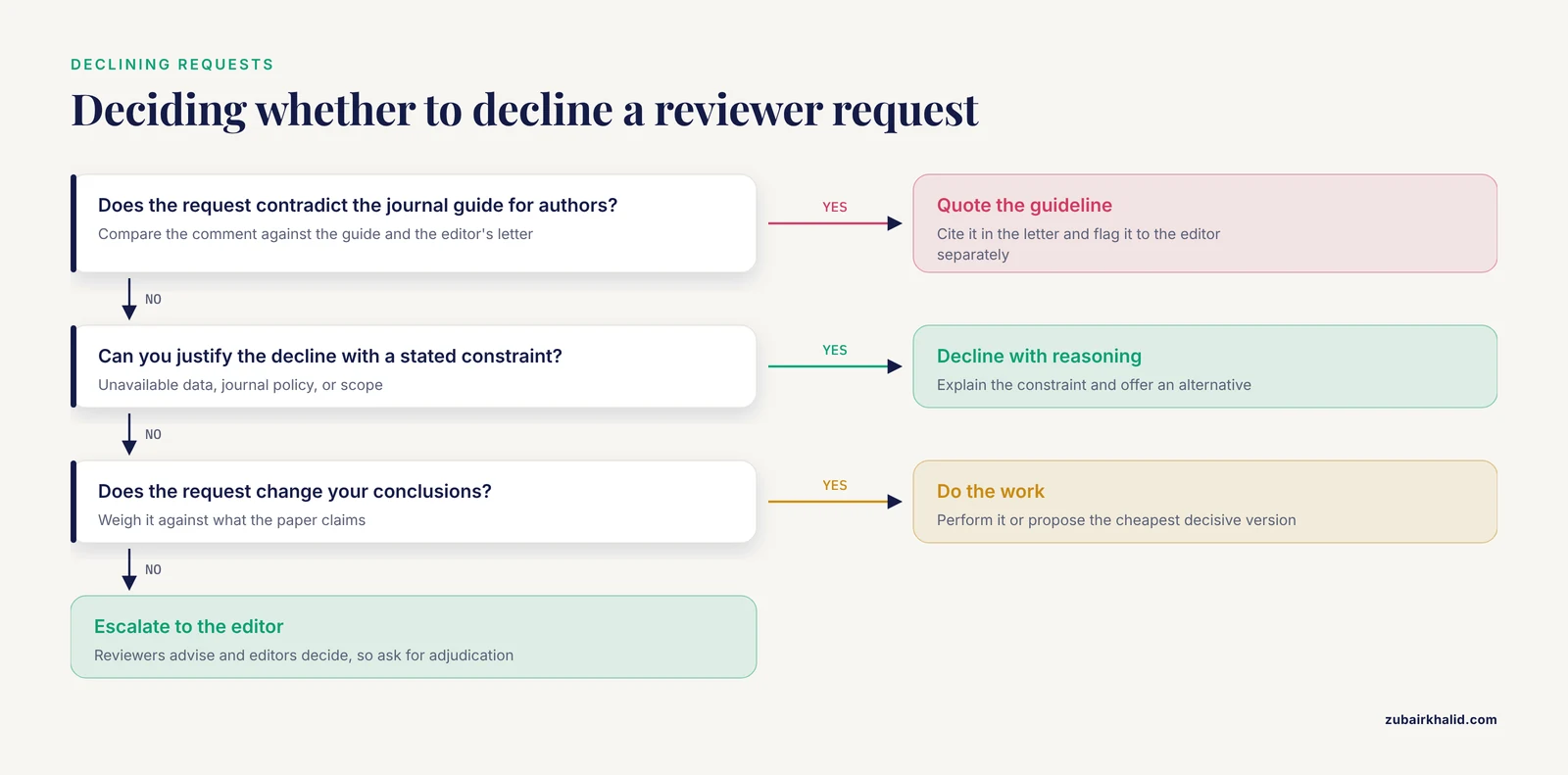
Yes, if you justify the decline in your response letter. Explain the reasoning, cite the relevant constraint such as unavailable data, journal policy, or scope, and offer an alternative that addresses the reviewer's underlying concern. Unexplained declines are what damage your standing, not declines themselves.
What if one reviewer asks for something another forbids?
First check whether the requests target the same element or different elements of the manuscript. If they truly collide, escalate to the editor with both comments quoted verbatim. The editor, not you, arbitrates between reviewers, and a documented escalation protects you in the next review round.
How long should a reviewer response letter be?
Long enough to answer every comment point by point, and no longer. Quote each comment, respond to it, and give the location of each change with page and line numbers. For major revisions, letters of several pages are normal, but padding with repeated justifications slows reviewers down and invites new objections.
Do I need to perform every additional experiment a reviewer requests?
No. Reviewers advise, editors decide. Weigh each request against what it changes about your conclusions, respond to the substantive concern, and route genuine disputes about scope or cost through the editor. A well-argued decline with an alternative is a standard and accepted outcome of peer review.
What if the reviewers contradict the journal's author guidelines?
Quote the guideline in your response letter and note the contradiction politely. Then flag the issue to the editor in a separate note so the editor can correct the record before the next round. Journal policy outranks an individual reviewer's preference.
Should I show reviewers each other's comments?
Usually no, and never on your own initiative. In single-blind and double-blind review, reviewer identities and comment distribution are the editor's to manage. Referencing the conflict in your response letter is sufficient, and the editor will handle communication between reviewers if needed.
What if I disagree with both reviewers?
Say so, once, with evidence. State your position in the response letter, support it with citations or analysis, and ask the editor to adjudicate. If the editor sustains the reviewers, comply with the decision and record your residual disagreement as a labeled limitation in the discussion rather than fighting it across multiple rounds.
Further Reading
- An Investigation into Major Causes for Postharvest Losses of Horticultural Crops and Their Handling Practice in Debre Markos, North-Western Ethiopia
- Optimising reliability of mouse performance in behavioural testing: the major role of non-aversive handling