How to Handle Conflicting Feedback from Dissertation Committee Members
By Dr. Zubair Khalid, DVM, MS, PhD ·

Conflicting dissertation committee feedback is disagreement between two or more readers who both hold formal authority over your dissertation, and the rule of thumb is simple: clarify first, triage what you can resolve alone, and only escalate the conflicts that change your data, your timeline, or your ability to graduate. Most disagreements look bigger than they are once you sort them into substantive, stylistic, and procedural conflicts. A smaller number are real contradictions that you cannot resolve by editing alone, and those need a deliberate response rather than silent obedience to whoever spoke last or loudest.
This article lays out the main options, compares them on the criteria that actually decide which one to use, walks through worked scenarios, and lists the mistakes that cost doctoral students the most time.
What Conflicting Committee Feedback Actually Is
Before choosing a response, name the conflict precisely. Committee disagreement comes in at least four forms, and each one calls for a different move.
Substantive conflict. Two members disagree about the content of the science or scholarship. One reader says your sample is too small to support the claim, another says the sample is adequate and the real problem is your statistical model. One wants an additional experiment, the other wants the chapter shortened. Substantive conflicts are the most consequential because they can change what you do in the lab or the archive.
Stylistic conflict. One reader wants shorter sentences and active voice, another marks up your draft for missing hedging language and theoretical framing. One wants every abbreviation spelled out at first use, another finds that pedantic. Stylistic conflicts are real, because a committee signs the page, but they rarely change your findings.
Procedural conflict. Two members give instructions about process rather than content. One tells you to send whole chapters, another insists on nothing until the full draft exists. One wants weekly meetings, another answers email twice a semester. Procedural conflicts often generate the most emotional heat while mattering the least for the final document.
Contradictory directives. The rarest and hardest form. One member says a chapter must be cut entirely, another says the same chapter is the heart of the dissertation. One requires a specific analysis, another calls that analysis inappropriate. When two people with signature authority issue incompatible requirements, you have a genuine deadlock that only they, or their department, can break.
Sorting feedback into these four buckets takes an hour with a printed stack of comments and a highlighter, and it usually shrinks the problem. Students who feel whipsawed by their committees are often responding to three stylistic notes and one substantive one as if all four carried equal weight.
Your Options for Handling Conflicting Feedback
Five options cover nearly every situation. The side-by-side table below is the core of this article, and the sections after it explain each option on its own terms.
| Option | What you do | Best for | Time cost | Relationship risk | Main downside |
|---|---|---|---|---|---|
| 1. Clarify | Ask each member what they meant and how firm the comment is | Any conflict, always the first step | Hours to days | Very low | Delays a decision if you let the email thread stall |
| 2. Triage and synthesize | Resolve the conflict yourself with a written rationale | Stylistic and many substantive conflicts | Hours to weeks | Low | You guess wrong about whose judgment mattered |
| 3. Return it to the committee | Send a written summary showing the contradiction and request a ruling | Contradictory directives on methods, scope, or claims | Days to weeks | Moderate | Looks adversarial if framed as blame |
| 4. Escalate to chair or director | Ask the chair or graduate director to arbitrate | Deadlock, or conflict involving the chair | One to two weeks | Higher | Burns goodwill, may be seen as going over heads |
| 5. Document, decide, defend | Make a reasoned choice, record it, and own it at the defense | Low-stakes disagreements after other options fail | One hour | Low | A dissatisfied reader can still stall the final sign-off |
Option 1: Clarify Before You Decide
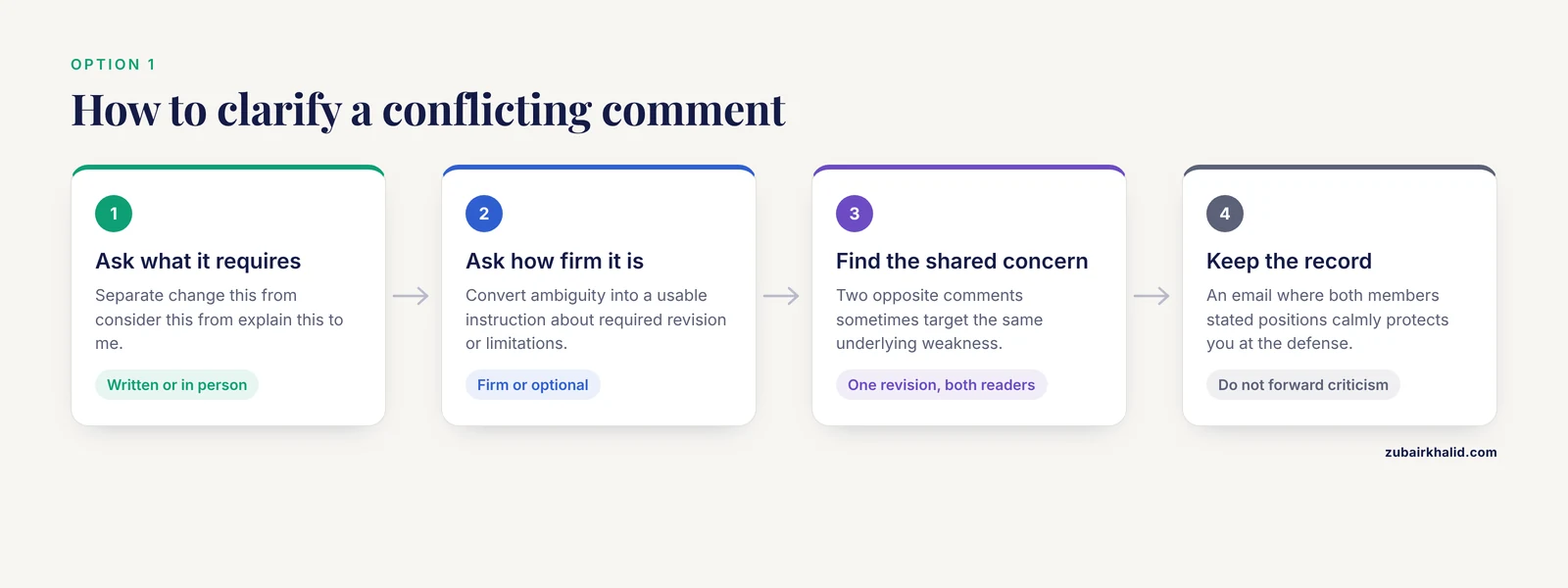
Most conflicting feedback dissolves under questioning. A comment that reads as a command is often a suggestion, and two seemingly opposite comments sometimes target the same underlying weakness.
Ask three questions of every conflicting comment, in writing where your program uses email for this purpose and in person where that is the norm:
- What does this comment require? Distinguish "change this" from "consider this" from "explain this to me." Faculty write quickly and their tone does not always match their intent.
- How firm is it? A direct question such as "Would you treat the sample size concern as a required revision or a point to address in the limitations section?" converts ambiguity into a usable instruction.
- What is the underlying concern? A member who objects to your discussion chapter may actually be worried about overclaiming, and the member who wanted more theory may share exactly that worry from the opposite direction. When you find the shared concern, you can often satisfy both readers with one revision.
Written clarification has a second benefit. It creates a record. If a disagreement resurfaces at your defense, an email in which both members stated their positions calmly is the single most useful document you can have.
One practical caution. Do not send a clarification email that quotes Member A's comment to Member B. That feels like forwarding criticism, and faculty remember it. Ask each member about their own comments.
Option 2: Triage and Synthesize the Feedback Yourself
Some conflicts are yours to resolve. Graduate programs delegate content authority to the committee as a body, and no rule says every comment must be adopted. What the committee will hold you to is a document that is defensible and a revision process that is good faith.
Triage with three categories:
- Must address. Comments tied to validity, ethics, compliance with your program's formatting requirements, or anything either member flagged as required.
- Should address. Comments that improve the work but would not block a signature. Most stylistic feedback lands here.
- Decline with rationale. Comments you considered and rejected. This is a real category, and treating it as one is what separates synthesis from silent cherry-picking.
For conflicting pairs, write one to three sentences recording the conflict, your decision, and your reason. Example: "Member A suggested moving the literature review into Chapter 1, Member B wanted it as Chapter 2. I kept it as Chapter 2 because the methods chapter references it directly, and I added signposting in Chapter 1 so the structure reads cleanly either way."
Then close the loop. Send each member a short revision memo listing what you changed in response to their comments and, where relevant, what you chose not to change and why. Faculty who see their feedback treated seriously rarely escalate over a declined suggestion, especially one where another member took the opposite position. Silence is what turns a low-stakes disagreement into a grudge.
This option works best for stylistic conflicts, for substantive conflicts where one position is clearly a preference and the other is clearly a requirement, and for conflicts where both members' concerns can be met by one change in wording or structure.
Option 3: Put the Conflict Back to the Committee
When two members issue incompatible requirements about the substance of the work, resolution is not yours to fake. A defense attended by readers who hold irreconcilable views of your methods chapter is a defense that can fail. The right move is to surface the contradiction directly, in writing, framed around the dissertation rather than around the people.
A workable message has four parts:
- A neutral statement of the two positions, each attributed only to "a comment on Chapter X" rather than to a name, unless the exchange is already fully public.
- A statement of why the conflict matters for the timeline, for example that the choice determines whether you rerun an analysis before or after your pre-determined committee meeting date.
- A concrete request for a ruling, with a deadline stated politely, such as asking for direction by a date two weeks before your next milestone.
- A proposed resolution, if you have one. Committees resolve framed choices far faster than open-ended problems.
The natural venue is the next scheduled committee meeting. Many programs expect the chair to convene the committee at least once at the proposal stage and again near the final defense, and a written pre-meeting summary that flags the disagreement gives the chair exactly what they need to put the item on the agenda. If your program has no such expectation, a short email to the whole committee still works, because it puts every reader on notice that a ruling is needed and spares you the role of messenger between two offices.
The framing rule is absolute. You are asking the committee to reconcile its own advice so that you can produce one coherent document. You are not asking them to judge who is right. A message that reads as "Professor Smith and Professor Lee disagree, please decide who is wrong" damages every relationship it touches. A message that reads as "I have received guidance on the handling of missing data that points in two directions, and I need the committee's unified direction before I rerun the models" gets a ruling and often gets thanks.
Option 4: Escalate to the Chair or Graduate Director
When the committee cannot resolve its own disagreement, or when one of the disagreeing members is the chair, the formal escalation path is the graduate director, the department chair, or whichever role your program designates for student concerns. Every doctoral program has such a path, and using it is a normal part of the process rather than an act of rebellion.
Escalation is warranted in three situations:
- Two members have issued contradictory requirements and neither will move after a direct, well-framed request.
- The disagreement involves the chair, so the usual tiebreaker is a party to the conflict.
- The disagreement has hardened into something personal, with one member signaling hostility toward you or toward a colleague on the committee.
Before escalating, write a one-page chronology. Dates of drafts, dates of comments, the two conflicting instructions quoted as briefly as possible, and what you have already tried. Graduate directors resolve problems quickly when the record fits on one page and slowly when it arrives as a fifteen-email attachment chain.
Understand the costs as well as the benefits. Escalation takes the decision out of your hands, which is the point, but it also marks you, fairly or not, as a student with a committee problem. Some faculty respond to that label for years. Use the option when it is genuinely needed, not when you are merely frustrated that one reader's comments contradict another's. Frustration is normal and is not an escalation trigger.
Option 5: Document, Decide, and Defend
A last resort that is more legitimate than it sounds. When a conflict is low-stakes, when clarification has failed to produce a firm answer, and when the committee meeting is months away, you can make the call yourself, record the reasoning, and be prepared to defend it.
The conditions that make this defensible are strict:
- Both readings of the conflict are academically respectable, and neither, if you chose it, would invalidate your results.
- You made a genuine attempt at clarification and at synthesis.
- Your written record shows both positions and your reasoning.
- You flag the choice in the revision memo and at the pre-defense meeting, so no member learns of it for the first time at the defense itself.
The defense-day version of this sounds like: "The committee gave guidance in two directions on the treatment of the 2019 cohort. I followed the exclusion approach and documented the sensitivity analysis showing the results hold under the inclusion approach. I am glad to walk through that." A student who says this, with the analysis in hand, has handled the conflict well regardless of which member originally pushed which position.
Comparing the Options on the Criteria That Matter
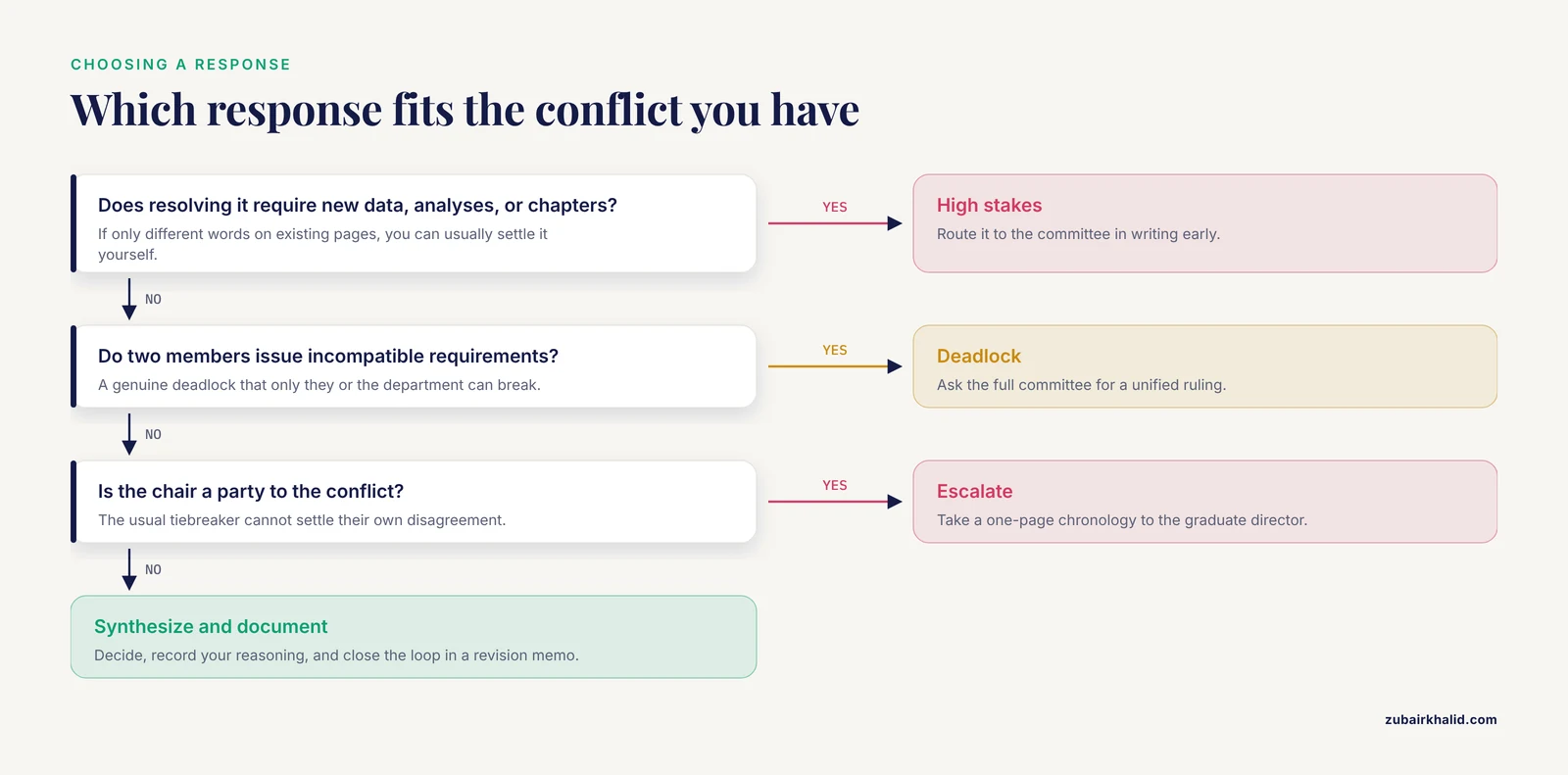
The table gives you the shape of the choice. Three criteria do most of the deciding in real life.
Does the conflict change what you still have to do? If resolving it requires new data, new analyses, or new chapters, the stakes are high and options 3 and 4 come into play early. If resolving it requires only different words on existing pages, option 2 is almost always sufficient. Students deep in dissertation planning should map each conflict against their remaining timeline before choosing a response, because a substantive conflict discovered in month one is a planning problem and the same conflict discovered in month five is a crisis.
Who holds the authority you need? Stylistic and preference conflicts can be settled by you. Requirements about validity and scope belong to the committee as a body. Deadlocks belong to the chair or the graduate director. Matching the conflict to the correct authority is the single most reliable predictor of a fast, low-friction resolution.
What does the record look like? Whichever option you choose, the outcome should end up in writing somewhere, a revision memo, a meeting summary, or an email confirmation. The record protects you at the defense and protects the committee from relitigating a settled question. Faculty disagree with each other routinely and forget it routinely, and a short written confirmation of the agreed resolution, sent to everyone involved, prevents the same conflict from returning next semester.
Worked Scenarios
Scenario 1: The Methods Deadlock
Your committee member in biostatistics says your repeated-measures analysis must switch to a mixed-effects model. Your advisor, who runs the lab, says the original approach is standard for the dataset and should stand. Clarification confirms both positions are firm.
This is a contradictory directive about the substance of the work, and it affects your remaining timeline directly, since rerunning analyses changes your chapter five draft. The right option is 3, followed by 4 if needed. Send a written summary to the full committee describing the two approaches and asking for unified direction before your next milestone, with your advisor copied. If the committee stalls, take the one-page chronology to the graduate director. Do not try to satisfy both readers by running both analyses and reporting whichever looks better. That maneuver, besides being poor practice, usually satisfies neither reader and invites a much harder conversation at the defense.
Scenario 2: The Scope Collision
One member says Chapter 4, a secondary analysis, should be cut to finish faster. Another calls Chapter 4 the most original part of the work and wants it expanded.
Notice that the two comments share a hidden premise, that time is limited. Restate the conflict around that shared ground in a committee meeting: "Both comments bear on how I use my remaining months. Can the committee advise whether Chapter 4 should be a condensed section of the results chapter or a standalone chapter?" This reframing converts a personality clash into a scheduling decision the committee can actually make, and it often produces a compromise nobody would have proposed individually, such as a shortened standalone chapter with the expansion saved for a journal article.
Scenario 3: The Style War
Reader one returns your introduction bleeding red ink over passive constructions and a 40-word sentence. Reader two writes in the margin that the same passage needs more caution and more citations. You feel whipsawed.
This is a stylistic conflict with a shared underlying concern, precision. One reader wants you to commit to clear claims, the other wants you to qualify them accurately. The resolution is almost always sentence-level surgery: state the specific claim plainly, attach the exact qualification that the evidence supports, and cite the study that justifies the boundary. One sentence can satisfy both readers when it says precisely what was found and precisely what was not. Resolve this yourself under option 2, note the decision in your revision memo, and move on. Escalating a style disagreement is the most common misuse of option 4 in doctoral education.
How This Fits Into Dissertation Planning
Conflicting feedback is cheaper to prevent than to resolve, and prevention is mostly a matter of dissertation planning structure.
Get alignment in writing at the proposal stage. A proposal approval with a committee meeting creates the record that later prevents most substantive conflicts. When all five readers have signed a document describing the design, the analyses, and the scope, later disagreement about those items refers back to an agreed text rather than to memory.
Sequence committee input deliberately. Sending full chapters to all members simultaneously invites contradiction. A common and effective sequence is to clear a chapter with the member whose expertise is most engaged, then circulate it to the rest with a cover note saying what that reader approved. Contradictions that still arise can then be handled as committee questions rather than as private disagreements you referee.
Build conflict checkpoints into your timeline. Plan a full committee meeting at the proposal, at the mid-point of analysis, and before the final draft goes out. Each meeting is a scheduled opportunity to surface and settle contradictions while there is still time to act on the ruling. Students who ask how to finish dissertation work faster are usually asking, in practice, how to avoid rework, and unresolved feedback conflicts are among the largest sources of rework in a doctoral timeline.
Keep a feedback log from day one. One spreadsheet, one row per comment, with columns for the member, the chapter, the comment, your response, and the status. When conflicts appear, the log shows you instantly whether this is a new problem or a recurring one, and recurring problems are exactly the ones that deserve committee-level discussion.
Common Mistakes and Limitations
These are the errors that turn a manageable disagreement into a semester lost.
- Obeying whoever commented last. The most recent comment is not the most authoritative one. Feedback weight depends on expertise and on what the committee has formally agreed, not on email timestamps.
- Refereeing in private. Shuttle diplomacy between two faculty offices, relaying each one's complaints about the other, is the fastest way to make a content disagreement permanent. Keep members' comments attributed to the document, not to each other.
- Silent cherry-picking. Declining feedback is legitimate. Declining it without a recorded rationale is how a reader discovers, at the defense, that their central concern was ignored, and defenses have failed over exactly this.
- Escalating on frustration. The graduate director is a resolver of deadlocks, not a sounding board for irritation that a revision came back long. Save the formal channel for real contradictions.
- Treating every comment as a requirement. Committees generate far more advice than mandates. Confusing the two multiplies apparent conflicts, because you end up trying to satisfy contradictory preferences that no one required you to satisfy.
- Losing the written trail. Verbal rulings evaporate. After any meeting where a conflict is settled, send a three-line confirmation email to the participants while the discussion is fresh.
- Letting the conflict stall the writing. Chapters that no conflict touches should keep moving while a substantive disagreement is being resolved. Waiting for total consensus before writing another paragraph is how a two-week conflict becomes a six-month delay.
One limitation applies to everything above. Programs differ in their formal rules for committees, in who holds final authority, and in the local politics of escalation, and an individual situation with real stakes may warrant advice from your graduate director, your student ombuds office, or a campus conflict-resolution service before you choose among these options. The options and criteria here are general practice, not a substitute for knowing your own program's handbook.
Frequently Asked Questions
Should I just follow my advisor when committee members disagree?
Not automatically. Your advisor usually carries the most day-to-day authority and knows the project best, but other members hold signature authority too, and a requirement from any of them can block your defense. For low-stakes disagreements, following your advisor and documenting the choice is often the practical answer. For contradictory directives about methods, scope, or claims, put the conflict back to the full committee rather than choosing a side yourself.
How do I tell a committee member their feedback contradicts another member's?
In writing, framed around the document rather than the people. State the two positions as guidance you received on a specific chapter, explain why the contradiction matters for your timeline, and ask for unified direction by a specific date. Do not quote one member's comment to the other in a one-on-one message. If your program holds committee meetings, flagging the item for the next meeting is the most natural venue.
What if my advisor and another committee member flatly disagree?
Treat it as a deadlock, because it is one. Attempt a direct, well-framed request for a ruling through the committee as a whole first. If neither position moves, escalate to the graduate director or department chair with a one-page chronology of drafts, comments, dates, and what you have already tried. Going around your advisor quietly, or quietly going around the dissenting member, tends to resurface at the defense in the worst possible form.
How much conflicting feedback is normal?
Disagreement among readers is a normal feature of dissertation work, not a sign that your committee is broken. Faculty read a draft through different lenses, and multiple lenses are the point of a committee. What is not normal is hostility, contradictory hard requirements that never get reconciled, or feedback that keeps changing after you have addressed it. Those patterns justify a conversation with your graduate director.
Can I push back on committee feedback I disagree with?
Yes, with a rationale rather than an argument. Write down the comment, your reasoning, and any evidence that supports your position, then send it as part of a revision memo or raise it at a meeting. Faculty routinely accept a well-reasoned decline, especially when another member has taken the opposite position and the committee needs to reconcile itself anyway. Pushing back silently, by ignoring the comment, is the version that creates problems.
How do I keep feedback conflicts from delaying my graduation?
Map every conflict against your remaining timeline the day you spot it. Resolve stylistic and preference conflicts immediately through synthesis and revision memos, route substantive contradictions to the committee in writing within a week, and schedule committee meetings at fixed milestones so rulings land while you can still act on them. Keep writing the chapters no conflict touches. A documented decision made in two weeks is almost always faster and safer than an undocumented one made in five months.