How to Identify and Declare Conflicts of Interest in Peer Review
By Dr. Zubair Khalid, DVM, MS, PhD ·

A conflict of interest in peer review is a circumstance that could tilt your judgment of a manuscript, while bias is the tilt itself, and the difference matters because you declare circumstances and manage bias. The rule of thumb for choosing what to do is simple. If you would hesitate to say the relationship out loud in front of the authors, either decline the invitation or declare it before you read a single line of the manuscript.
This guide covers what counts as a conflict, the three options you have when an invitation meets one, how to write a declaration an editor can act on, worked scenarios, and the mistakes that turn honest reviewers into problems. It is written for students, early-career researchers, and anyone asked to review in the life sciences.
What a Conflict of Interest in Peer Review Actually Is
Peer review is the evaluation of a manuscript by independent experts before a journal publishes it. A conflict of interest in peer review is a set of circumstances, a financial tie, a personal relationship, or a competing professional stake, that creates a risk your judgment serves a secondary interest instead of the science.
A conflict is a risk, not a verdict. Declaring one is not an admission of bias, and answering "no conflicts" is not a certificate of virtue. The system works because it moves the judgment about your situation from you, the person who holds the stake, to an editor who does not.
Expertise is not a conflict. You were invited because you know the methods. A conflict is about who gains or loses from your recommendation, not about how much you know.
The stakes are not theoretical. Reviews of documented professional failures in forensic medicine, where expert judgment carries legal weight, list disclosure failure and role ambiguity among the recurrent vulnerabilities behind those cases [1]. The pattern generalizes to any expert task. Where disclosure is optional, vague, or left to memory, conflicts survive.
The three types of conflict
Financial. Money that rises or falls with the manuscript's fate. Funding from a company whose product the paper tests, equity in that company, paid consulting or advisory work, expert witness engagements, patent royalties, and active job negotiations all belong in this category.
Personal. Relationships that bend judgment through loyalty or grievance. Current mentors and trainees, recent co-authors, family members, close friends, and people involved in an open dispute with you. Loyalty biases as reliably as money, and a grudge biases more quietly.
Professional and intellectual. Stakes in the scientific contest itself. A competing manuscript under review elsewhere, a rival method your own group published, a grant application whose fate the paper's conclusions could influence, a dataset you are currently analyzing, or a public position you would have to retract.
Why Reviewer Independence Is a Research Ethics Issue
Peer review is not a rubber stamp. It changes papers. A 2026 psychology paper states in its own abstract that its theoretical model was re-specified during peer review [2]. Reviewers moved the analysis. That influence is the point of the system, and it is also the danger, because influence steered by a hidden stake is still influence.
A narrative ethics review of forensic pathology found that loss of independence and adversarial alignment, the drift toward serving one side in a contest, recur across documented regulatory and judicial cases [1]. The same review counts inadequate peer review itself among the recurrent vulnerabilities, and its historical cases show how far expert judgment can bend when independence is subordinated to institutional self-protection or political authority [1].
Handling reviewer conflicts well is part of responsible conduct of research, the shared standards for honesty and accountability in professional science. The standard applies at the review desk as much as at the bench, because a conflicted reviewer silently inside the process converts a safeguard into a risk.
The Three Options for Handling a Conflict of Interest in Peer Review
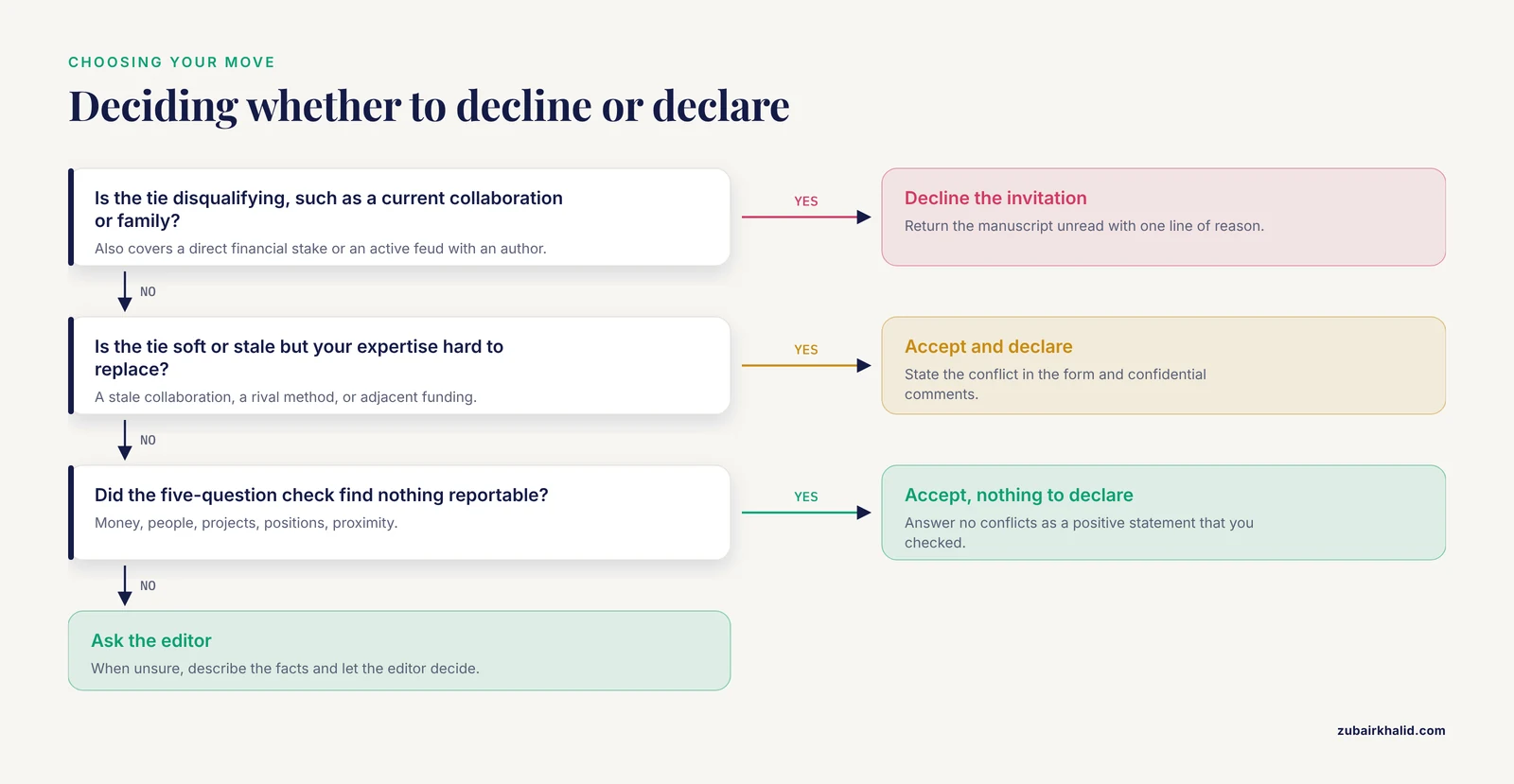
These are the standard conflict of interest in peer review options, and each fits a different situation. Journals give you three honest moves. Everything else, silent acceptance, a reasonless decline, or a confession made only after the review is written, is a variation on hiding.
Option 1: Decline the Invitation
You return the manuscript unread, ideally with one line of reason so the editor can find a replacement quickly. Most review systems accept a plain statement such as "I have a conflict of interest with this work" and nothing more. Decline when the tie is disqualifying: a current collaboration, a direct financial stake, a family relationship, or an active feud with an author.
Pros. Your bias never touches the process. The editor loses minutes, not weeks. You owe no detailed confession.
Cons. Overuse slows publishing. A vague decline hides information the editor might need. If your expertise is rare, the manuscript may lose its best-qualified reader.
Option 2: Accept and Declare
You agree to review and state the conflict in the reviewer form and in your confidential comments to the editor. The editor then decides whether to keep you, add a second reviewer, or reassign the manuscript. Choose this when the tie is manageable and your expertise is hard to replace: a stale collaboration, a rival method you can still grade on its evidence, or funding from a company adjacent to but not competing with the work.
Pros. Rare expertise stays in the process. The risk decision moves to the person responsible for it. The declaration creates a written record.
Cons. A declared conflict can still bias a review if the editor under-reacts. The declaration raises the standard your review must meet, because it will be read with the conflict in mind.
Option 3: Accept With Nothing to Declare
You run the check honestly, find nothing reportable, and answer "no conflicts" on the form. This is the right answer for most invitations. Treat it as a positive statement that you checked, not as a shrug.
Pros. The fastest path, and the lightest burden on everyone.
Cons. The answer is only as good as the check behind it. A reviewer who skips the check has converted this option into silent bias.
Side-by-Side Comparison
| Criterion | Decline the invitation | Accept and declare | Accept, nothing to declare |
|---|---|---|---|
| What you tell the editor | A relationship exists that should disqualify or worry them | A relationship exists that may be manageable | You checked and found no reportable tie |
| Best for | Current collaborators, financial stakes, family, active feuds | Rare expertise plus a soft or stale tie | Most invitations |
| Bias risk to the manuscript | None from you | Real but visible and managed | Only the ordinary risk every reviewer carries |
| Burden on the editor | Must find a new reviewer | Must judge and possibly manage your conflict | Minimal |
| Transparency | Private, but the conflict never touches the review | On the record with the editor | On the record |
| Main risk | Overuse slows publishing, and a vague decline hides why | A declared conflict can still steer a review if the editor under-reacts | An unexamined "no" hides a conflict you did not want to see |
When you are unsure which option fits, there is a fourth move that is really a version of Option 2. Write to the editor, describe the facts, and ask. "I served on a grant panel with one author two years ago. Please advise whether I should proceed." That single sentence transfers the decision to the person paid to make it, which is the whole point of declaring.
How to Identify Your Own Conflicts Before Accepting
Run the same five questions every time an invitation arrives. Most take under five minutes if you keep the underlying records current.
- Money. Do you or your laboratory receive funding, consulting income, equity, or patent royalties from any entity that would gain or lose if this manuscript were published, rejected, or revised? Include expert witness work and any job negotiation in progress.
- People. Have you co-authored, shared a grant, mentored, or been mentored by any author in recent years? Family, close friends, and people in an open dispute with you all count. Journals differ on how far back "recent" reaches, so read the definition in the invitation letter instead of guessing.
- Projects. Does the manuscript compete with your own unpublished paper, grant application, patent application, or dataset? Would its conclusions strengthen or weaken your standing in a live debate?
- Positions. Do you hold a role the paper supports or attacks, such as an officer of a society, a guideline author, or a named critic of the approach?
- Proximity. Are you part of the professional world the paper studies? Research in which investigators examine their own community is a recognized design, and small fields make author-reviewer overlap routine. A 2026 scoping review of 53 autoethnography studies found that collaborative autoethnography, conducted jointly with colleagues in a shared professional world, was the most common approach at 51 percent [3]. In fields that close, invitations will regularly land on the desks of people who know the authors, which makes question 2 a habit rather than a formality.
Finish with the open-review test. If the journal publishes reviewer names alongside reviews, would you be comfortable seeing your declaration printed next to your assessment? Discomfort is data. It usually means the tie is real enough to name.
How to Declare a Conflict, Step by Step
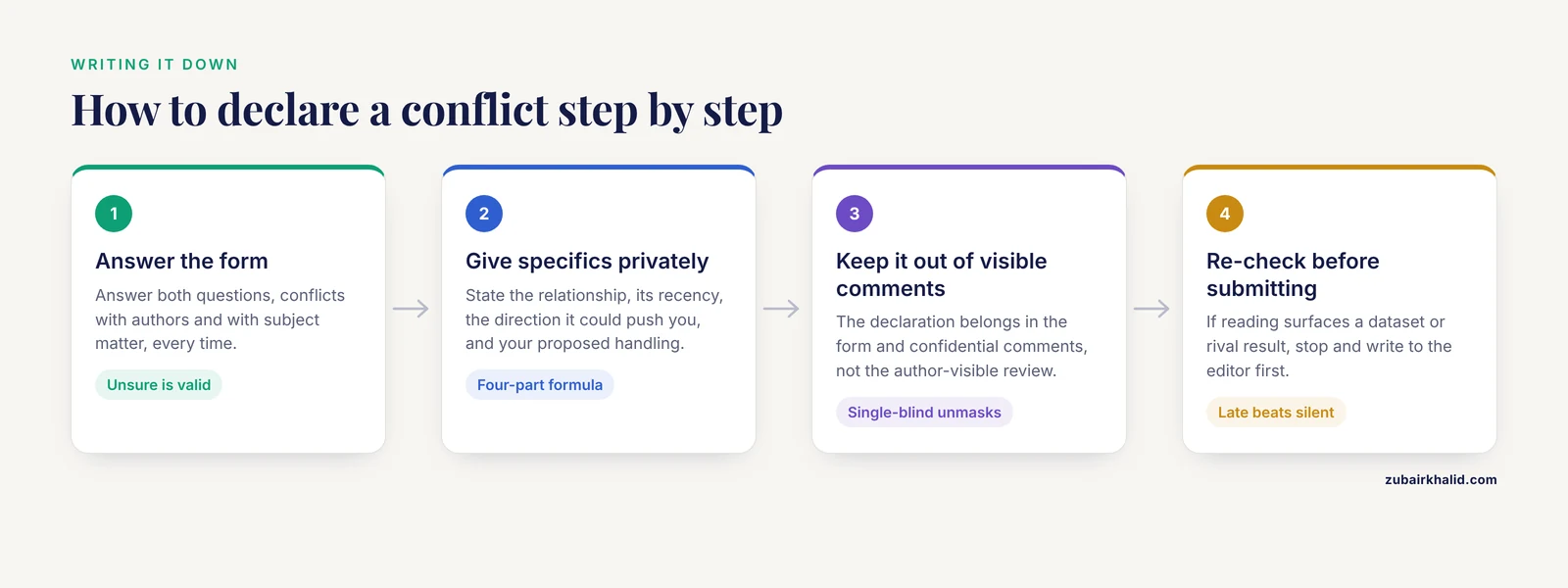
Step 1: Answer the form in writing
Most submission systems ask two questions when you accept: whether you have a conflict with the authors, and whether you have one with the subject matter. Answer both, every time. "Unsure" is a valid answer if you attach the facts, because facts let the editor judge what you cannot.
Step 2: Put specifics in the confidential comments
Use a four-part formula: the relationship, its recency, the direction it could push you, and your proposed handling. Vague declarations force the editor to interrogate you. Specific ones let the editor act. In documented expert failures, technical language has been used to obscure uncertainty [1], so write plainly.
Worked examples you can adapt:
- Collaboration: "I co-authored a paper with the first author in 2023. I believe I can assess the methods fairly, but please judge whether that history disqualifies me."
- Finance: "My laboratory receives support from a company that sells a competing assay. I can review the statistics and study design, but the editor should weigh any claims about comparative performance."
- Rivalry: "This manuscript critiques a method my group published. I will score the critique on its evidence, but a second reviewer would be a reasonable safeguard."
- No conflict: "I have no conflicts of interest to declare."
Step 3: Keep the declaration out of the author-visible review
Single-blind review means the authors do not learn the reviewers' identities. Double-blind review hides the authors from you as well. In single-blind review, naming your relationship inside the visible comments would unmask you and change the social dynamics of the exchange. The declaration belongs in the form and the confidential comments unless the journal's policy says otherwise. In double-blind review you may not know the authors at all, but subject-matter conflicts, a competing product or a rival method, remain fully live, so the form still matters.
Step 4: Re-check before you submit
Conflicts surface during reading. You recognize a dataset, a figure you last saw in a conference talk, or a result that undercuts your own grant. If that happens, stop and write to the editor before finishing. A late declaration costs the editor some inconvenience. A silent one costs the record its integrity.
What the editor does with your declaration
The editor weighs the statement and then keeps you, adds a reviewer, or reassigns the manuscript. The ethics review of forensic pathology failures lists transparent documentation and explicit disclosure duties among the preventive safeguards that keep expert judgment trustworthy [1], and your written declaration is exactly that documentation. You are not responsible for the final ruling. You are responsible for making the ruling possible.
Worked Scenarios
Scenario 1: Your former advisor submits a manuscript
The facts. Your doctoral or postdoctoral advisor, the person who trained you and may still shape your career, is an author.
The call. Most journals treat current or recent mentorship as disqualifying. Decline with one line: "I have a close prior mentoring relationship with an author." If you are genuinely the only qualified reviewer and the journal presses, accept only with a full declaration and expect the editor to add a second reviewer.
Scenario 2: The paper evaluates your employer's competitor
The facts. You work in industry, and the manuscript compares products, one of which competes with the one your salary depends on.
The call. A direct financial stake in the comparison is disqualifying, so decline. If the paper concerns the product class but not a head-to-head with your employer's product, declare the employment relationship and let the editor decide whether your methods expertise can be used safely.
Scenario 3: The manuscript attacks your method
The facts. The authors argue that a technique your group published is unreliable, and they cite your paper as the problem.
The call. This is an intellectual conflict, not an automatic disqualification, because you may be the best-qualified person to judge whether the critique is sound. Declare it, propose a second reviewer as a check, and grade the critique on its evidence rather than its tone. Over-certainty in defense of one's own work is a documented failure pattern in expert judgment [1], so build the safeguard before you need it.
Scenario 4: Double-blind review, but you recognize the work
The facts. The authors are anonymized, yet you recognize the dataset, the writing, or the conference version, and you believe you know the group.
The call. Recognition is itself a soft conflict, because you are reviewing with knowledge the process intended to withhold. Write to the editor: "I believe I recognize this group's earlier work on this topic. Please advise." Never let recognition sharpen a review.
Common Mistakes and Limitations
Treating expertise as a conflict. Knowing the field deeply is the reason you were invited. A conflict is a stake in the outcome, not familiarity with the methods.
Confusing "I can stay objective" with "no conflict exists." The declaration system does not measure your virtue. It documents the situation and hands the judgment to someone without the stake.
Declaring in the wrong place. A conflict mentioned only in author-visible comments, or only in conversation at a conference, is not declared. Use the reviewer form and the confidential comments to the editor.
Declaring after the fact. Reading the full manuscript and mentioning the tie in your final paragraph wastes the safeguard. The editor needed the information before you started.
Using a declaration as a license. "I disclosed my rivalry, so my harsh review is fair" has the logic backwards. A declaration raises the scrutiny your review receives. It never lowers your duty to read fairly.
Assuming anonymity cancels disclosure. Single-blind review hides your name from the authors, not from the editor, and not from the obligation.
Writing vague declarations. "No relevant conflicts" means nothing if you did not check. When you are unsure, write the facts and let the editor interpret them.
Over-declining out of anxiety. Declining every invitation that involves a distant co-author starves journals of willing experts. Soft, stale, or trivial ties are usually declare-and-continue cases, and the editor, not your anxiety, should make that call.
A limitation of any general guidance, including this article, is that journals differ on what counts as reportable and on how far back relationships reach. The invitation letter and the journal's reviewer policy outrank general advice. The handling editor holds the final decision on whether a declared conflict disqualifies a reviewer, and when a specific case feels genuinely hard, ask that editor directly instead of deciding alone.
The Best Conflict of Interest in Peer Review Practice Comes Down to One Habit
The best conflict of interest in peer review practice is the boring one. Declare early, in writing, with specifics, every time, and let the editor judge. The habits below make that routine.
- Keep a running list of your recent co-authors, funders, and advisory roles so you can answer forms in minutes rather than days.
- Declare at the invitation stage, not when you submit the review.
- Write declarations a stranger could act on: relationship, recency, direction of possible bias.
- Re-run the five-question check before submitting, because reading surfaces conflicts that abstracts hide.
- Treat "no conflicts to declare" as a statement that you checked, and make it true.
- Hold your own manuscripts to the same standard, because the reviewers and editors handling your submissions owe you the honesty you owe theirs.
Frequently Asked Questions
Do I still need to declare a conflict if I am confident I can stay objective?
Yes. The declaration exists because self-assessment of one's own fairness is unreliable, and the editor, not the reviewer, decides whether a tie is disqualifying. Confidence belongs inside the declaration as a stated belief, never as a reason to skip it.
What is the difference between a conflict of interest and ordinary bias?
A conflict of interest is an external circumstance, such as money, a relationship, or a rival project, that creates a risk of bias. Bias is the tilt itself, which can also arise from honest scientific conviction. You declare circumstances, and you manage bias through fair method.
Should I declare a conflict in my review comments or privately to the editor?
Privately, in the reviewer form and the confidential comments to the editor, unless the journal's policy says otherwise. In single-blind review, naming a relationship in author-visible comments would reveal your identity, and the declaration is meant for the person managing the process.
Can I review a manuscript that competes with my own unpublished work?
Only with a declaration, and often the honest answer is to decline. State the competing manuscript or grant and let the editor judge whether your assessment of the rival claims can be trusted. Many editors will replace you for direct head-to-head competition and keep you for adjacent topics.
What happens after I declare a conflict of interest in peer review?
The editor weighs your statement and then keeps you, adds a second reviewer, or reassigns the manuscript. Nothing punitive happens in the ordinary case. A declaration that ends your invitation is the system working, not a mark against your record.
Are conflicts of interest in peer review always financial?
No. Personal ties, mentorship, recent collaboration, competition over data or credit, and strong public positions can all create reportable conflicts. Financial ties are the easiest to verify, which is why forms emphasize them, but they are one category among several.
Further Reading
- 'UNCLOUD' young lives: development and evaluation of a national peer-to-peer anti-vaping campaign for young people in Australia.
- Distinguishing artificial intelligence from robotic execution in total knee arthroplasty: a narrative review and evidence map.
- Explainable AI-based techniques for disease classification: a systematic review and future work.
Sources
- When Forensic Pathology Fails: Ethical Lessons From International Regulatory, Judicial, and Historical Human-Rights Cases.
- Peer victimization and family dynamics in the association between childhood abuse and adolescent non-suicidal self-injury: a cross-sectional moderated mediation study.
- A scoping review of autoethnographic approaches in medical education research.