Communication Protocols for Multi-Institutional Research
By Dr. Zubair Khalid, DVM, MS, PhD ·

By the end of this guide you will be able to draft a communication protocol for a multi-site study, stand up the channels and reporting rhythm that hold a consortium together, write an escalation ladder for urgent problems, and keep community partners and decision-makers informed without flooding anyone's inbox. You need little on hand beyond the partner list, a charter or memorandum of understanding, a chat platform, a shared drive, a video conferencing account, and a Python installation if you want to run the short compliance script in the walkthrough.
A communication protocol for multi-site research is the written agreement that specifies who communicates what, to whom, through which channel, how often, and what happens when something urgent or unexpected occurs. Multi-institutional projects fail in predictable ways. In a qualitative study of care for opioid use disorder spanning four US jurisdictions, stakeholders named poor inter- and intra-institutional communication as one of seven major barrier themes [1]. The usual cause is not a shortage of goodwill. It is the absence of explicit, shared rules, and those rules can be written down.
What a Communication Protocol Is (and What It Is Not)
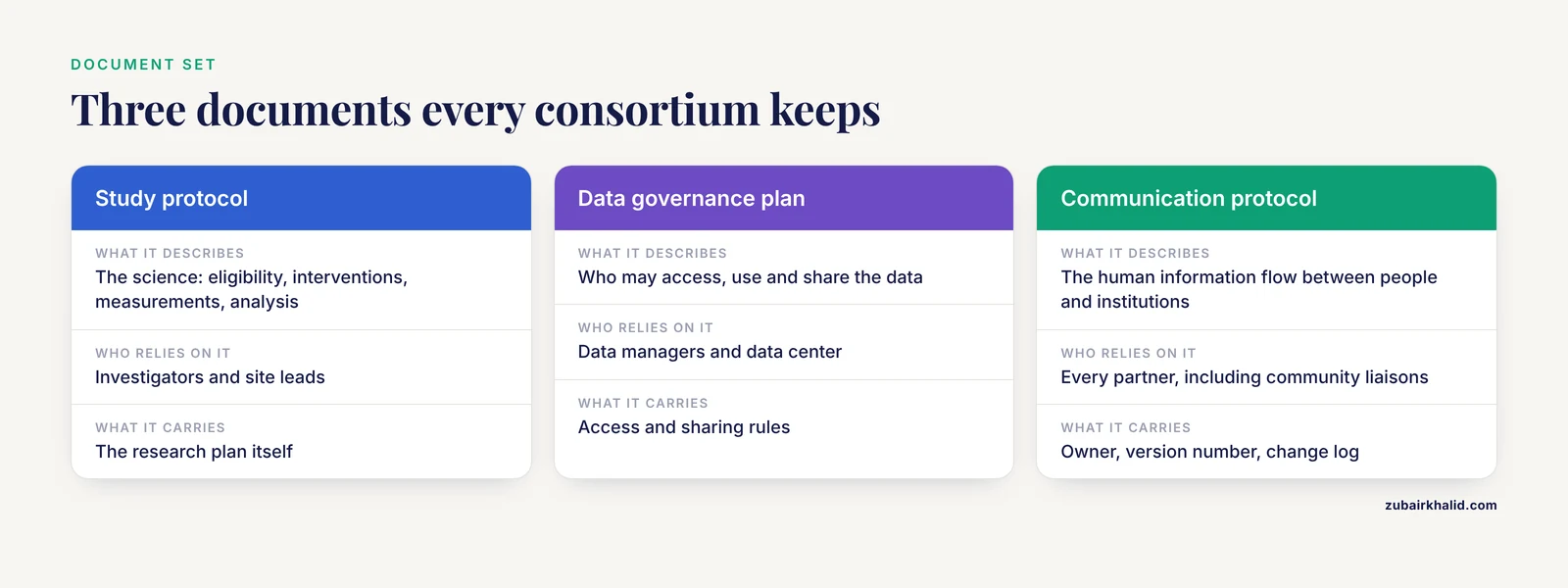
A communication protocol is a controlled document, meaning it has a named owner, a version number, and a change log. It sits beside two other documents every consortium produces. The study protocol describes the science: eligibility, interventions, measurements, and analysis. The data governance plan describes who may access, use, and share the data. The communication protocol describes the human information flow that makes the other two usable.
Three properties separate a real protocol from a good intention.
- It names people as well as roles. "The site coordinator reports weekly" is weaker than "the coordinator listed in roster.csv files a report every Monday by 5 pm Eastern."
- It covers failure, not only routine. Most consortium communication is routine, and most risk sits in the unusual cases.
- It carries an owner and a review date. An unowned protocol decays within one staff turnover.
Coordination has also become a formal part of multi-site methodology. The ten principles for high-quality multi-site evidence generation with privacy-preserving distributed algorithms, methods that let each site analyze local data and share only summary results, cover study preparation, protocol development, analysis, and final reporting, and they name heterogeneity within and across sites plus data sharing difficulties as core challenges [2]. Communication design belongs in the preparation phase, next to the budget and the statistical analysis plan.
Communication Protocol for Multi-Site Research, Step by Step
The eight steps below take a consortium from a partner list to a working system. A running example threads through them: a three-site longitudinal cohort study called HOPE, with two clinical sites and one data center.
Step 1: Map every partner, role, and contact
Information cannot be routed to people who are not on a list. The STRIPE project, which documented lessons from the Global Polio Eradication Initiative, began by defining a target population, or "universe," of all polio-related actors in each study area, then enumerating the specific individuals within it, and only then administering its survey [3]. Copy that sequence. List every institution, then every function (principal investigator, site lead, coordinator, data manager, community advisory liaison, funder project officer), then the person filling each function, with email, phone, and time zone.
Keep the roster as a plain file every tool can read:
site_id,site_name,function,role,person,email,timezone
01,University A,clinical site,principal investigator,R. Chen,[email protected],America/New_York
01,University A,clinical site,coordinator,J. Patel,[email protected],America/New_York
02,University B,clinical site,principal investigator,L. Okafor,[email protected],America/Chicago
02,University B,clinical site,coordinator,M. Diaz,[email protected],America/Chicago
03,Institute C,data center,principal investigator,S. Weber,[email protected],America/Denver
03,Institute C,data center,data manager,K. Nunn,[email protected],America/Denver
Review the roster at every steering committee meeting. Contact drift is the quietest way a consortium loses its ability to communicate.
Step 2: Write decision rights into the charter
A RACI table assigns each recurring decision four labels: responsible (does the work), accountable (owns the outcome, exactly one person), consulted (gives input before the decision), and informed (hears about it afterward). Assign labels at minimum to protocol amendments, publication authorship, data access requests, media inquiries, and budget reallocation.
Record every decision in one log, in one format:
DEC-014 | 2026-11-04 | Add optional 6-month visit
Proposed by: Site 02
Decision: pilot at Sites 01 and 02 for 12 months
Decided by: E. Ford (PI), per charter section 4.2
Effective: 2026-11-11
Comms: posted to announcements list, protocol updated to v2.3
The log is the consortium's memory. When a coordinator leaves, the successor reads the log instead of asking six people what was decided and why.
Step 3: Stand up the channel stack
Create a small, named set of channels instead of letting channels sprout:
hope-announce      read-only, decisions and milestones, archived
hope-coordinators  daily working talk, site coordinators and project manager
hope-data          data managers and data center, ingestion and quality control
hope-help          anyone in the consortium, answered within 1 business day
Three rules keep chat from rotting. Decisions made in chat are copied into the decision log the same day. Participant data never enters chat. Every channel has a named owner who archives it when it goes quiet.
Step 4: Set a reporting rhythm with a fixed template
Every coordinator files the same short report on the same weekday, saved as siteID_weekly_YYYY-MM-DD.txt:
Site: 02 (University B)
Week ending: 2026-11-06
Enrolled this week: 7 (cumulative 84 of 120 target)
Protocol deviations: 1 (visit window exceeded by 2 days, logged DEV-023)
Data submitted: yes (batch 2026-11-06, 7 records)
Blocked by: none
Help needed: none
A fixed template matters more than a fancy tool because it makes silence visible. The data center of the Adolescent Brain Cognitive Development (ABCD) Study built its internal processes around paired metrics: data ingestion and quality control on one side, recruitment, retention, and protocol completeness on the other, with both feeding results-based accountability reviews with each site [4].
Step 5: Make compliance visible with a simple check
Audit and feedback means collecting performance information and feeding it back to the people who can act on it. The BEST-ICU trial is testing real-time audit and feedback through an electronic dashboard as one strategy for raising adoption of the ABCDEF bundle, a package of evidence-based intensive care practices, across twelve intensive care units [5]. You do not need a dashboard on day one. A short script over the weekly reports gives the same visibility:
import csv, pathlib

roster = list(csv.DictReader(open("roster.csv")))
submitted = {p.name.split("_") for p in pathlib.Path("reports").glob("site*_weekly_*.txt")}
missing = [r for r in roster if r["site_id"] not in submitted]
for r in missing:
    print(f"MISSING: site {r['site_id']} ({r['site_name']}) -> email {r['coordinator_email']}")
print(f"{len(roster) - len(missing)}/{len(roster)} weekly reports received")
Run it with python weekly_check.py. Expected output when Site 03 has not yet filed:
MISSING: site 03 (Institute C) -> email [email protected]
2/3 weekly reports received
The script reads every file name matching site*_weekly_*.txt in the reports folder, splits each name on the underscore, and compares the prefix with the site_id column of the roster. Two errors appear most often. FileNotFoundError: [Errno 2] No such file or directory: 'roster.csv' means the script ran from the wrong folder, so start it from the directory holding both files. KeyError: 'site_id' means a CSV header is misspelled, so compare the header line with the keys the script reads. To confirm the check works, save an empty file named 03_weekly_2026-11-13.txt in reports and rerun. The output should become 3/3 weekly reports received.
Step 6: Write the escalation ladder before you need it
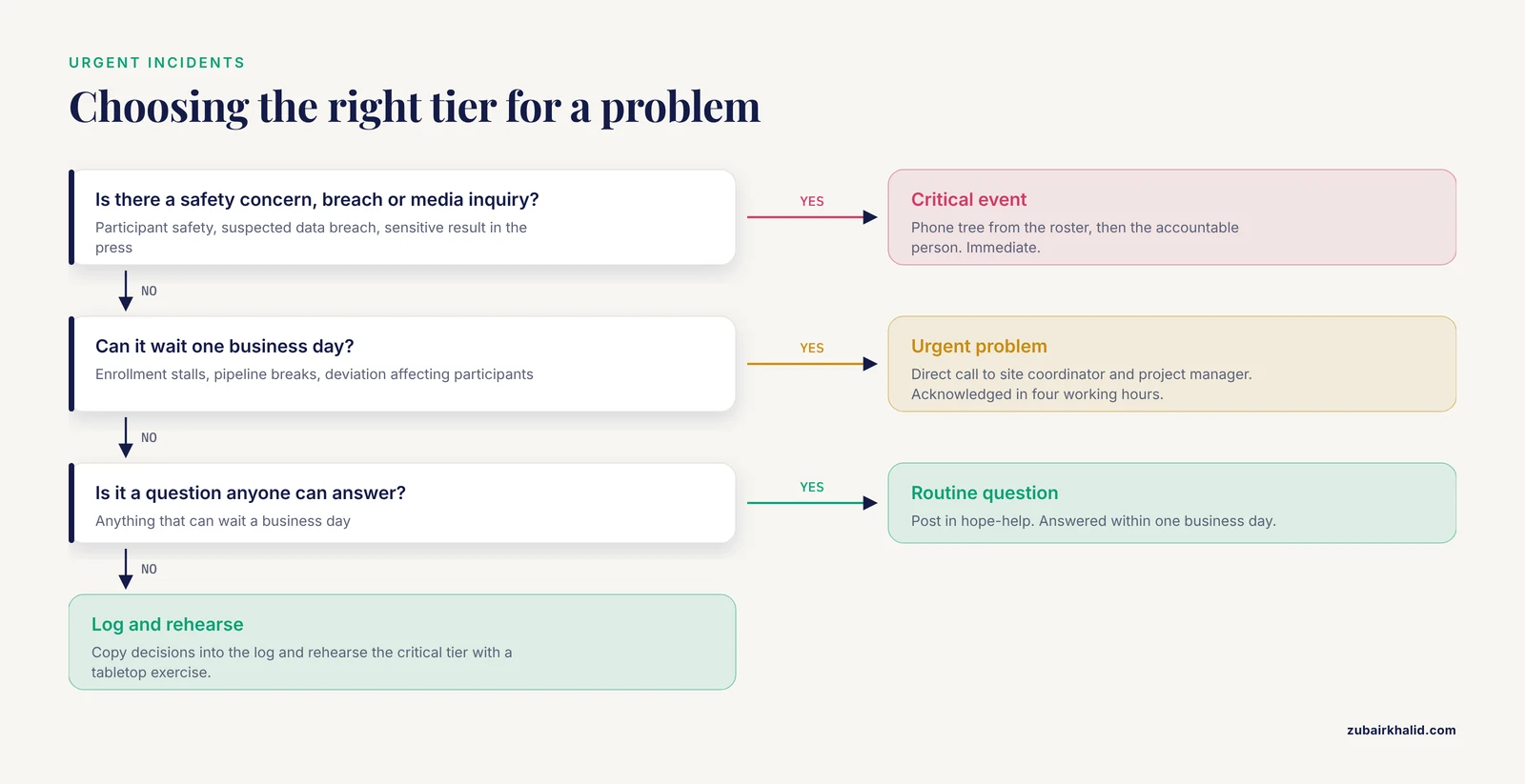
Define three tiers, each with a trigger, a channel, and a clock.
- Routine question. Trigger: anything that can wait a business day. Channel: hope-help. Clock: answered within one business day.
- Urgent problem. Trigger: enrollment stalls, a data pipeline breaks, a deviation affects participants. Channel: direct call to the site coordinator and the project manager. Clock: acknowledged within four working hours, mitigation plan within one business day.
- Critical event. Trigger: participant safety concern, suspected data breach, media inquiry about a sensitive result. Channel: the phone tree built from the roster, then the accountable person named in the charter. Clock: immediate.
The ABCD Study planned this layer years in advance. Its bioethics and medical oversight group anticipated issues including confidentiality of sensitive participant disclosures, clinically significant findings, and mandatory reporting duties, and sites operate with site-specific emergency management plans and standard operating procedures (SOPs), written instructions that trained staff follow exactly, supported by a network of site clinicians and a crisis and communications group that was engaged for a data misuse incident [6]. Write your equivalent before launch, then rehearse it with a tabletop exercise, a simulated walkthrough of a hypothetical crisis involving everyone named in the ladder.
Step 7: Control protocol changes with versioning
Every controlled document carries a version number and a change log. A change follows one path: proposal filed in the tracker, decision logged per Step 2, document updated, announcement sent to the read-only list, training materials updated when the change affects site procedures. A change that circulates only as a chat message will be missed by at least one site.
Step 8: Close the loop and learn across sites
Communication that only flows upward produces compliance, not learning. The I-TRANSFER care transition study, run across five health systems and 16 hospitals, identified barriers and facilitators at each site, summarized them, presented them back to the site implementation teams, and mapped the strategies each site used onto the Expert Recommendations for Implementing Change (ERIC) taxonomy, a shared catalog of implementation strategies, covering 62 percent of its 73 categories [7]. Build the same loop: quarterly cross-site calls where sites compare deviations and fixes, plus an annual lessons-learned report written against the Step 1 roster so no actor group goes silently missing.
Once the weekly check runs cleanly, sensible next steps are collecting reports through a form instead of email, adding a dashboard if the consortium grows, and scheduling the first tabletop exercise within the first quarter.
Choosing Research Collaboration Tools
Tools implement the protocol. They never replace it. Six categories cover nearly every consortium, and the table summarizes how each earns its place.
| Channel or tool | Use it for | Cadence | Owner | Keep off it |
|---|---|---|---|---|
| Announcements email list | Decisions, protocol version changes, milestones | As needed, archived | Project manager | Debate, troubleshooting |
| Chat channels | Daily working questions, quick links | Continuous | Site coordinators | Formal approvals, participant data |
| Video calls | Coordinator huddle, steering committee, all-hands | Weekly to quarterly | Chair named in charter | Anything needing a written record |
| Project tracker | Tasks, owners, due dates, change requests | Updated at least weekly | Project manager | Long discussions |
| Shared drive and wiki | SOPs, templates, minutes, decision log, roster | Versioned on change | Document controller | Raw participant data |
| Data platform | Submissions, quality control reports | Per submission schedule | Data center lead | General chat |
| Phone or pager | Safety events, breaches, urgent clinical questions | Immediate | On-call roster from Step 1 | Routine requests |
Two data-layer decisions deserve extra thought. When privacy rules, contracts, or data volume prevent moving participant data to a central server, a distributed research network lets each site run the same analysis locally and share only aggregate results, the model underlying the ten principles cited earlier [2]. Whatever platform you choose, invest in curation standards and sharing infrastructure early, because the ABCD data center found that organized, documented data release lowers barriers for secondary users and supports reproducibility [4].
Reporting Rhythms That Keep a Consortium Honest
Four meetings carry most consortia:
- Weekly, 30 minutes: site coordinators plus the project manager. Agenda is the weekly reports, blockers, and escalations.
- Monthly, 60 minutes: steering committee. Decisions, budget, protocol changes.
- Quarterly, 90 minutes: all-hands. Cross-site learning, community advisory updates, upcoming milestones.
- Annually, in person where funding allows: the informal ties that video cannot build.
Two upgrades come from the implementation literature. Ongoing facilitation, in which a trained facilitator works with a site over months rather than delivering one workshop, is the contrast condition in the CHARMED trial, which randomizes 25 safety-net clinics, clinics that disproportionately serve marginalized populations, across three public healthcare delivery systems to baseline training in remote blood pressure monitoring versus training plus ongoing practice facilitation [8]. Budget facilitator time rather than a single kickoff webinar. Also decide in advance how the rhythm adapts under disruption. The AVISA cohort ran eleven sites in Brazil during the COVID-19 pandemic, and enrollment ran slower than planned as vaccination, loosened distancing rules, and the shifting epidemic changed field conditions, forcing adaptive solutions [9]. State which meetings may convert to asynchronous written updates, and who decides.
Talking With Communities and Decision-Makers
A multi-institutional communication protocol has an outside edge, and consortia usually draw it too tightly. Three practices widen it usefully.
Integrated knowledge translation (IKT) means researchers and decision-makers shape the study together so results arrive in usable form. The CEBHA+ consortium implemented and evaluated an IKT approach across five countries in Sub-Saharan Africa, enrolling 36 researchers and 19 decision-makers from policy and practice, and its process evaluation examined how that collaboration worked at the project level [10]. Operationally, this means external partners get named rows in the roster and standing seats on the steering committee, rather than a spot on a distribution list.
Community engagement studios are structured feedback sessions in which community experts critique study materials and procedures. Three academic health science centers ran a joint multi-site version for a research program with older adults: their engagement cores wrote one shared guide, each site ran the studio iteratively with local experts, and the teams compared themes across sites on recruitment, the study protocol, reminders, and recording technology [11]. Eighteen older adults and care partners in three states produced concrete changes to invitation wording, information sheets, and reminder schedules [11]. The pattern generalizes: one shared guide, local delivery, structured comparison.
Trust can be measured rather than assumed. A multi-institutional pilot across three Clinical and Translational Science Award (CTSA) programs used concept mapping, a mixed method in which stakeholders brainstorm factors and sort them into related clusters, with community, healthcare, and academic partners to develop trust measures usable across institutions [12]. Longevity compounds the returns. The Meharry, Vanderbilt, and Tennessee State University cancer partnership, the longest continuously funded site in the National Cancer Institute's CPACH program, interviewed 43 stakeholders and documented impacts spanning new funding, institutional collaboration, educational advancement, and community engagement [13].
Keeping Technical Communication Harmonized Across Sites
Scientific collaboration across sites fails technically when each site quietly does things slightly differently. Four practices hold the line.
- Manualized procedures with fidelity checks. A manualized procedure is written so trained people deliver it the same way every time, and fidelity means delivery matched the manual. The Picture Exchange Communication System (PECS), a manualized teaching protocol for children with autism, was evaluated in a multi-site community study that measured caregiver teaching integrity after a standardized training package and found significant gains with a large effect size, maintained at follow up [14]. If your procedure is manualized, measure adherence and route the results through the weekly report.
- A shared test artifact run identically at every site. A point-of-care 3D printing consortium, where models are produced on-site rather than in a central facility, printed 400 identical quality assurance cubes across four printers at two medical centers, had trained personnel measure the same dimensions on every cube, and found no statistically significant difference in error by machine, site, or personnel [15]. A shared test object plus a shared measurement script is communication in physical form.
- Traveling subjects for instrument harmonization. In multi-site brain imaging, a traveling subject is one volunteer scanned at every scanner. An analysis of 6,524 scans across 21 sites and 13 machine types used traveling subjects to quantify machine- and protocol-specific bias and found that agreement between two volume estimation methods, measured with an intraclass correlation coefficient (a statistic from 0 to 1 where 1 is perfect agreement), ranged from 0.62 to 0.94 across scanning procedures [16]. Publish each site's instrument parameters in the wiki, and rerun the traveling subject check whenever a site upgrades equipment.
- One versioned analysis script, run everywhere. When every site executes the same code, discrepancies surface as output differences instead of email arguments.
Common Mistakes and Limitations
- Writing the communication plan after launch. The highest-leverage coordination decisions happen during preparation, so draft the protocol while the proposal is being written and review it at kickoff.
- Letting chat become the decision record. Chat is for speed, the log is for memory.
- Building the escalation ladder during the first crisis. Rehearse it instead.
- Fixing only the between-institution flow. Information also fails inside institutions, at the front desk, the bench, and the clinic hallway, so each site needs an internal mirror of the protocol.
- Collecting reports and never responding. Reporting without feedback trains sites to stop reporting.
- Letting the roster rot. Review contacts at every steering meeting and pair every new hire with a buddy for their first month.
- Assuming all sites share the same resources, approval speeds, and norms. Calibrate clocks and channels per site.
- Treating community partners as an audience. Announcements are not engagement, and feedback requested after decisions are locked arrives too late to change anything.
- Leaving protocol documents unversioned, so sites work from different editions.
Limitations. The evaluations cited here come from specific consortia with their own governance, funding, and regulatory settings, so treat their figures as illustrations of mechanisms rather than benchmarks. Adapt the templates to your charter, your institutional review board or ethics agreements, and your funder's data sharing terms. Where participant safety is involved, the escalation ladder must align with each institution's official policies, and specific clinical or ethical questions belong with the oversight people your sites have designated.
Frequently Asked Questions
What is a communication protocol in multi-site research?
A communication protocol in multi-site research is the written agreement that specifies who communicates what, to whom, through which channel, how often, and what happens when something urgent occurs. It is a controlled document with an owner, a version number, and a change log, kept beside the study protocol and the data governance plan.
How is a communication protocol different from a study protocol?
The study protocol describes the science: eligibility, interventions, measurements, and analysis. The communication protocol describes the human information flow between people and institutions that lets the science run. A consortium needs both, and the charter should reference each.
Which research collaboration tools does a multi-site project actually need?
Six: an announcements email list, chat channels, video conferencing, a project tracker, a shared drive with a wiki, and a data platform, plus a phone path for emergencies. Tools implement the protocol, they do not substitute for it.
How often should multi-site research teams meet?
A typical cadence is a weekly 30-minute coordinator huddle, a monthly 60-minute steering committee, a quarterly all-hands, and an annual in-person meeting when funding allows. Adjust during startup and closeout, and pre-decide which meetings convert to written updates during disruption.
Who owns the multi-institutional communication protocol?
The project manager or consortium coordinator usually drafts it, the principal investigator approves it, and every site lead signs it. Name one owner and a review date in the document itself, because an unowned protocol decays after the first staff turnover.
How should a consortium handle urgent incidents across sites?
Use a three-tier ladder: routine questions through the help channel within one business day, urgent problems by direct call with a four-hour acknowledgment clock, and critical events through a pre-built phone tree to the accountable person. Rehearse the critical tier with a tabletop exercise before launch.
How do you keep community partners informed without overwhelming them?
Give them a separate stream: plain-language summaries, standing advisory board seats, and structured feedback sessions focused on specific decisions such as invitation wording or visit schedules. Ask for input at moments when it can still change the protocol.
How do you onboard a new site or new staff member mid-study?
Send a welcome packet containing the charter, the communication protocol, the current SOP list with version numbers, the roster, and a one-page escalation card, then run a recorded orientation and assign a buddy for the first month. Add the new contacts to the roster at the next steering meeting.
Sources
- Major barriers and facilitators of care for patients with infectious complications of opioid use disorder: A multi-site, qualitative analysis of expert stakeholders from the CHOICE protocol.
- PDA (Privacy-Preserving Distributed Algorithms) in action: ten principles for high-quality multi-site clinical evidence generation.
- Sampling method for surveying complex and multi-institutional partnerships: lessons from the Global Polio Eradication Initiative.
- Strategies for collection, management, and release of data for multi-site longitudinal studies: Lessons from the ABCD Data Analysis, Informatics, & Resource Center.
- Behavioral Economic and Staffing Strategies To Increase Adoption of the ABCDEF Bundle in the Intensive Care Unit (BEST ICU): study protocol for a multi-site stepped-wedge cluster randomized controlled trial in the USA.
- Bioethics and medical oversight in multi-site observational neuroimaging studies with children and adolescents: 10 years of ABCD experience.
- Strategies to address implementation barriers in sepsis survivors' care transitions to home health and outpatient care: a multi-site, type 1 hybrid implementation study.
- Championing Hypertension Remote Monitoring for Equity and Dissemination (CHARMED): A multi-site factorial randomized controlled trial protocol.
- Implementing a multi-centric cohort study during the SARS-CoV-2 pandemic in a resource-constrained setting: challenges, adaptive solutions, and lessons from Brazil.
- Evaluating the implementation of integrated knowledge translation in a multi-country research consortium in Sub-Saharan Africa - a mixed methods comparative case study.
- Community Engagement Studios to advance multi-site research with older adults.
- Trust in Community-Engaged Research Partnerships: A Methodological Overview of Designing a Multisite Clinical and Translational Science Awards (CTSA) Initiative.
- Understanding and evaluating the impact of a multi-institutional academic partnership to reduce cancer health disparities.
- Telehealth Picture Exchange Communication System Caregiver Training: A Multi-Site Community Evaluation.
- Multi-Site evaluation of a novel point-of-care 3D printing quality assurance protocol for a material jetting 3D printer.
- Estimation of the Intracranial Volume Is Crucial in Multi-Site Studies: Reliability for Longitudinal Investigations and Traveling Subjects.