Communication Norms for Research Teams: Step-by-Step Guide
By Dr. Zubair Khalid, DVM, MS, PhD ·

By the end of this guide you will be able to draft a one-page communication charter for your lab or multi-site project, set response-time expectations that people actually follow, structure meetings so every voice is heard, and choose research collaboration tools that match your data governance needs. You need no special software to start. A shared document, your team roster, and one hour of meeting time are enough to complete the first three steps.
Communication norms are the explicit agreements a team makes about who talks to whom, through which channel, how fast, and with what tone. Teams that leave these agreements implicit tend to develop invisible hierarchies, missed messages, and quiet members whose data or opinions never reach the decision table. Teams that write their norms down solve a surprising share of scientific collaboration problems before they start.
Why Explicit Norms Beat Good Intentions
Group communication research shows that the type of messages a team exchanges, not just the volume, shapes outcomes. In a 13-week team-based intervention study in Shanghai, researchers sorted workplace chat messages into four types: nudging (encouraging members toward a goal), sharing (reporting completion of daily targets), feedback (responding with suggestions), and other (off-topic talk). Teams whose communication followed these patterns sustained measurable behavior change over the study period, with the intervention group gaining roughly 2,500 additional weekly steps compared with controls [1]. The lesson for a research team is direct. If you want a channel to be useful, define in advance what kinds of messages belong there.
Team functioning has also been described in terms of structures (such as the mix of expertise on the team), processes (such as how information moves), and affective features (such as trust) [2]. Communication norms sit at the junction of all three. They are structures you can write down, processes you can practice, and the daily evidence on which trust is built or lost.
Finally, a well-documented finding from team decision science: performance improves when team members actively inquire about information held by others. In hidden-profile experiments, teams where members asked questions and pulled information from each other shared more unique information and made better decisions than teams that merely waited for information to surface [3]. A norm that says "if you have not heard from a member in a while, ask them directly" is not politeness. It is a performance intervention.
What You Need on Hand
Gather these four items before the walkthrough:
- Team roster. Names, roles, institutions, and time zones for everyone who touches the project, including community partners and data managers.
- A shared, versioned document. Anything from a plain text file in a repository to a cloud document. It must be editable by all team members and findable from your project's home page.
- Your current tool inventory. Email, chat, video conferencing, reference manager, electronic data capture system, code repository. List what you already use.
- One dedicated meeting. Book 60 minutes. The charter drafting session in Step 2 works best live.
Step-by-Step: Building Your Team's Communication Norms
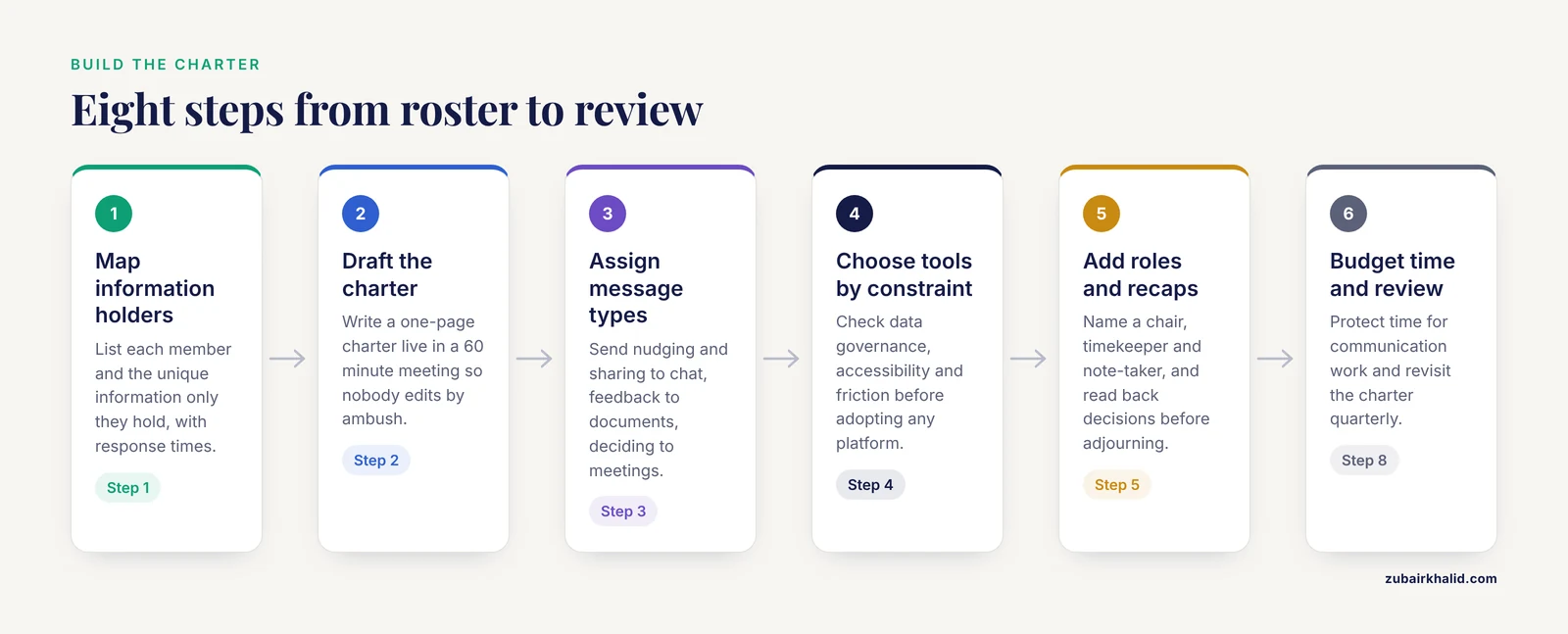
Step 1: Map Who Holds What Information
Draw a simple list, not a diagram. For each team member, write down the unique information they hold: a dataset only they can access, a regulatory relationship only they manage, a community perspective only they represent. In multi-institution collaborations, this map exposes an early problem. Power imbalances between high-income and low- and middle-income country partners often show up as information asymmetry, where one site controls data, analysis, or publication decisions that others depend on [4].
A worked example for a five-person clinical research team:
Team roster and unique information map

Priya   PI, grant reporting, sponsor contact          Email, 48h response
Dan     Data manager, REDCap admin, dataset access    Slack #data, 24h
Mei     Field coordinator, site recruitment status    Slack #field, 24h
Carlos  Biostatistician, analysis code, preprints     GitHub + email, 48h
Amina   Community advisory liaison, participant views Weekly call + email
The time-zone and response-time columns matter as much as the information column. A norm without a number attached to it is a wish.
Step 2: Draft a Communication Charter in One Meeting
Environmental scans of health research partnerships identify communication and meeting practices as one of seven domains where concrete, actionable guidance makes partnerships work, alongside reporting, training, conflict management, co-authorship, agreements, and product ownership [5]. The scan literature consistently points to formal written plans and charters as the anchor practice. Write yours live, in the meeting, so nobody drafts alone and edits by ambush later.
Use this template in a fenced block so you can copy it directly:
# Communication Charter: [Project Name]
Version 1.0, dated [YYYY-MM-DD]. Review due [YYYY-MM-DD].

## Channels
- Chat (Slack/Teams/WeChat): daily coordination only. Not for decisions.
- Email: external contacts, formal requests, anything needing a record.
- Video calls: decisions, disagreements, anything sensitive.
- Shared repository: data, code, drafts, meeting notes.

## Response-time expectations
- Chat mention: within one business day.
- Email from collaborator: within two business days.
- Decision request to PI: within five business days.

## Meeting rules
- Agenda posted 24 hours before, or meeting is optional.
- Every meeting ends with a structured recap: decisions, actions,
  owners, deadlines, read back aloud before adjournment.
- Notes posted to the repository within two business days.

## Escalation
If a decision stalls for more than [X days], the person who raised
it may put it on the next meeting agenda as an explicit vote item.

## Review
This charter is reviewed at [quarterly] team meetings and after any
new member joins.
Expected output when a real team fills it in:
# Communication Charter: SamaCohort Study
Version 1.0, dated 2026-11-11. Review due 2027-02-11.

## Response-time expectations
- Chat mention: within one business day (Dan, Mei, Amina).
- Email from collaborator: within two business days (all).
- Decision request to PI: within five business days (Priya).
Keep it to one page. A charter nobody rereads is worse than no charter, because it creates the appearance of agreement without the substance.
Step 3: Assign Message Types to Channels
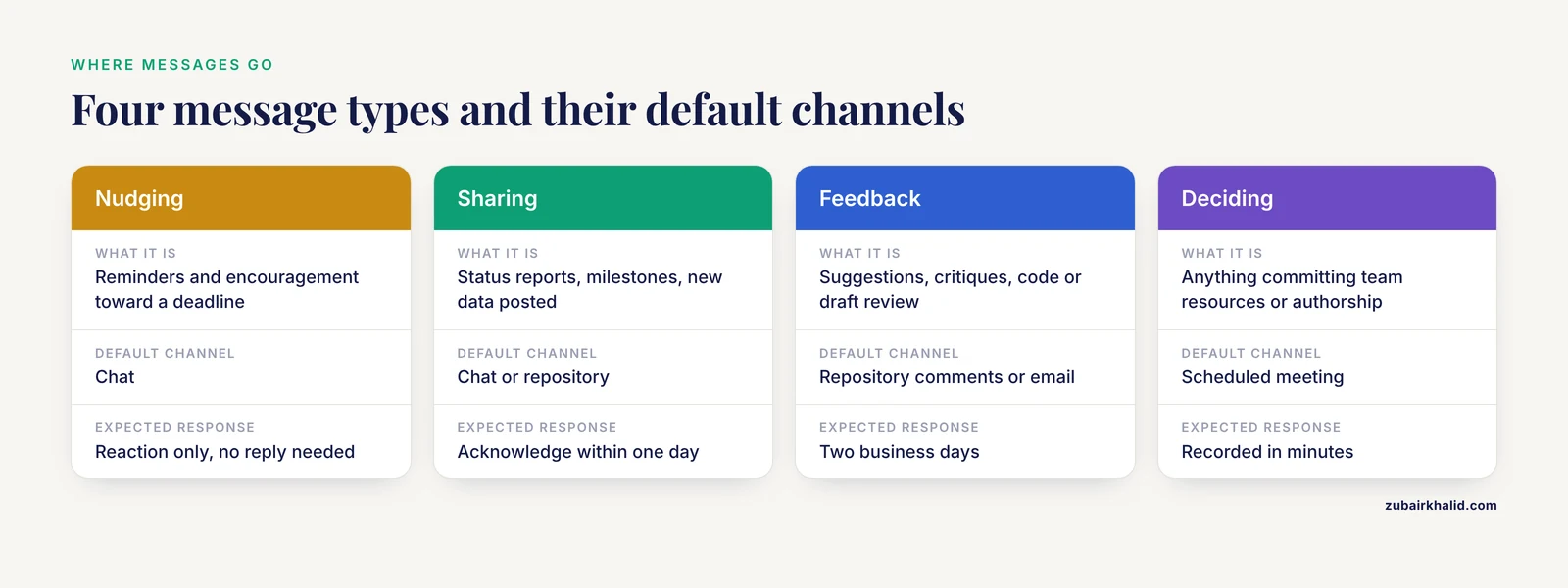
Borrow the four-category taxonomy validated in the group communication study [1] and adapt it for research work:
| Message type | Definition | Default channel | Expected response |
|---|---|---|---|
| , - | , - | , - | , - |
| Nudging | Reminders and encouragement toward a deadline | Chat | Reaction only, no reply needed |
| Sharing | Status reports, completed milestones, new data posted | Chat or repository | Acknowledge within one day |
| Feedback | Suggestions, critiques, code or draft review | Repository comments or email | Two business days |
| Deciding | Anything that commits team resources or authorship | Scheduled meeting | Recorded in minutes |
The table gives you the practical answer to the most common chat failure: people posting a decision in a channel where half the team has notifications muted. Deciding is a meeting activity. Feedback is a document activity. Only nudging and sharing belong in ephemeral chat.
One caution from the same intervention literature: a channel filled with nudging alone becomes noise. The Shanghai study teams that benefited from dedicated chat groups exchanged all four message types, not just reminders [1]. If your project channel contains nothing but deadline pressure, expect members to mute it.
Step 4: Choose Research Collaboration Tools That Match Your Constraints
Tool choice is a norms question, not a shopping question. Evaluate any candidate tool against three constraints.
Data governance first. For teams handling sensitive health data, the tension between open science and privacy regulation is real, and generic cloud folders often fail it. Purpose-built trusted research environments now exist to solve this. The TRACE platform, for example, provides granular variable-level access control, auditable and reproducible analysis workflows, and provisioning of data into a sealed analysis environment, operated by existing institutional staff [6]. If your project shares patient-level data across sites, a tool with variable-level permissions and audit logs is not optional. Build the norm "no participant-level data leaves the approved environment" into your charter and name the tool that enforces it.
Accessibility second. If any team member or participant population is deaf or hard of hearing, or communicates in a language other than the project's dominant one, your tools must support captioning, sign-language video, and translated materials. A methodological reflection on inclusive mixed-methods research with deaf and hard-of-hearing participants found that knowing sign language facilitated direct communication and trust-building, but that additional adaptations across every research phase, from recruitment to dissemination, were still essential for equity [7]. The norm to adopt: ask each member, in the charter session, what adaptations they need, and record them.
Friction third. A tool the team will not open is worse than a worse tool they already use. When the Covid-19 pandemic forced interviews onto Microsoft Teams, researchers conducting health-services interviews found the platform workable for reaching providers across Canada without travel [8]. The point is not that Teams is special. The point is that the team converged on one platform and used it consistently.
Step 5: Structure Meetings Around Role Allocation and Recaps
Training research on team-based clinical work offers two practices that transfer directly to research meetings. First, explicit role allocation: assign a chair, a timekeeper, and a note-taker by name for every meeting. Second, structured recaps: end with a read-back of decisions and action items. In an observational study of 54 live maternity emergencies, teams trained in a structured framework used the recaps most consistently, while explicit role allocation was the least observed element, and uptake depended heavily on leadership and team culture [9]. The pattern generalizes. Recaps survive because they help everyone. Role allocation fails when leaders skip naming roles because it feels awkward in the moment.
A meeting agenda that enforces both:
## Lab meeting 2026-11-18
Chair: Mei  Timekeeper: Dan  Notes: Carlos

1. (5 min) Recap of last meeting's actions. Owner states status.
2. (15 min) Mei: recruitment update, site B lagging.
3. (15 min) Carlos: preliminary analysis, questions wanted.
4. (10 min) Decision needed: extend enrollment at site B?
5. (5 min) Structured recap. Chair reads back:
   DECISIONS: ...
   ACTIONS: owner, task, deadline
Expected output, the recap line you should hear at minute 55: "Decision: site B extends enrollment to March 1. Action: Mei drafts the amendment by Friday. Dan updates the database field Monday."
Step 6: Decide in Advance How Disagreements Get Heard
Communication norms must include a rule for dissent, or the loudest voice wins by default. The problem has a name in the ethics literature. In multi-professional healthcare teams, medical dominance produces institutional epistemic injustice, meaning the systematic deflation of credibility given to non-physician perspectives, which harms both providers and patients [10]. Research teams replicate this whenever senior investigators' views are weighted by rank rather than by evidence.
Practical norms that counteract it:
- Round-robin first comments. The chair calls on each member by name for a first comment before open discussion. This forces information inquiry, the behavior shown to improve team decision quality regardless of team composition or performance expectations [3].
- Written proposals for contested decisions. A member who disagrees writes one paragraph in the shared document. Rank does not delete paragraphs.
- A named devil's advocate for major decisions, rotating monthly.
Teams collaborating across countries should go further and negotiate which decisions are made where. Interviews across a five-country global health collaboration showed that research capacity strengthening activities can simultaneously reinforce and challenge power asymmetries, and that explicit negotiation over who decides what was central to making the collaboration feel like mutual learning rather than extraction [4].
Step 7: Include Participants and Community Partners in the Loop
If your research involves human participants, community organizations, or advisory boards, communication norms extend beyond the core team. A tuberculosis research program in urban Bangladesh operationalized community engagement through a three-step model: Connect (early trust-building and needs exploration), Co-Create (joint development of materials), and Collaborate (sustained partnership through delivery) [11]. Applied to internal team communication, the same arc works for onboarding any partner: connect before you need something, co-create the plan rather than presenting a finished one, and keep collaborating after the deliverable.
For participatory projects, the involvement of advisory boards requires deliberate norms of its own. A three-year youth advisory board embedded in a large adolescent mental health project in Bengaluru adopted systematic approaches to recruitment, engagement, and capacity building so that young members could make genuine decisions rather than serve as decorative consultants [12]. The transferable norm: advisory members get agenda items of their own, prep materials in plain language, and real votes on defined questions.
Step 8: Budget Time for Communication, Then Review the Norms
Time is a finite, negotiable resource that must be deliberately allocated to new practices. A reflection on a global health quality improvement program found that time scarcity constrained every improvement effort in low-resource hospitals, that new practices demanded coordination work from people already at capacity, and that without protected temporal space, skill development and team adaptation simply did not happen [13]. Communication norms consume time. Charter meetings, structured recaps, and written proposals all cost minutes. Budget for them openly rather than treating them as free.
Then close the loop. A process mapping exercise on a collaborative antibiotic stewardship study in Argentina documented eleven stages of the research process and roughly 1,020 person-hours of total effort, with the stages of highest perceived difficulty being ethical approvals, data collection, analysis, and dissemination, which together absorbed about half that effort [14]. Use a lightweight version of this thinking at your quarterly review: ask which communication practice cost the most time and whether it produced proportional value. Retire norms that cost more than they return, and rewrite the charter.
Qualitative work on interprofessional collaboration adds one more review criterion. Interviews with experienced care managers identified communication skills, specifically clarity and specificity, alongside professional attitudes and knowledge, as core enablers of successful collaboration with physicians [15]. At each charter review, ask a blunt question: are our messages clear and specific, or are we relying on shared background that new members do not have?
Tips That Make the Norms Stick
- Post the charter where work happens, not in a folder. Link it from your chat channel topic and your repository readme.
- Model the response times from the top. If the PI replies to chat mentions in two hours, two business days becomes the floor for everyone. If the PI replies in two weeks, no charter fixes it.
- Write recap messages in the channel within an hour of the meeting. Members who missed the meeting get the decisions without watching a recording.
- Use the nudge category deliberately. A short "reminder, abstracts due Friday" message is a legitimate, researched form of team communication [1], not a personality flaw.
- Check accessibility annually. Captioning settings, screen-reader compatibility, and language needs change as membership changes [7].
- Welcome disagreement in writing. A norm that treats a written dissent paragraph as a contribution, not an attack, protects the team from the credibility hierarchies documented in multi-professional settings [10].
Common Mistakes and Limitations
Writing the charter once and never revisiting it. A charter is a living document. Partnerships in the environmental scan literature treat communication plans as ongoing practices, not one-time deliverables [5]. Review quarterly.
Confusing channel volume with communication quality. A chat channel with 200 daily messages can carry less usable information than one well-run meeting with a recap. The four-type taxonomy helps here: if your channel is dominated by the "other" category, the channel is social, not operational.
Letting decisions live in chat. Ephemeral threads bury commitments. Decisions belong in meeting minutes or a decision log in the repository.
Assuming silent members agree. Teams that do not practice active information inquiry lose exactly the unique knowledge that makes collaboration valuable, because members withhold what nobody asks about [3].
Ignoring power gradients inside the team. Seniority, discipline, institution, and language all create credibility gradients. Without counteracting norms such as round-robin first comments, medical or PI dominance quietly filters which perspectives reach decisions [10].
Treating tool adoption as automatic. Collaborative competence does not emerge on its own. Research on collaborative learning found that participation patterns changed only under specific conditions, including emotional safety and guided mediation that redistributed who spoke [16]. A new tool or a new norm needs the same scaffolding: demonstrated use by a respected member, explicit permission to ask basic questions, and early low-stakes practice.
Skipping time accounting. If communication practices are not budgeted as real work, they collapse under deadline pressure, especially in resource-constrained settings [13].
One general limitation applies. This guide describes practices supported by published partnership and team research, but every team is different. A two-person collaboration needs a fraction of this structure, and a twelve-site consortium needs more. Adjust the scope to your team and revisit it as the project changes.
Frequently Asked Questions
What are communication norms in a research team?
They are the explicit, written agreements about which channels carry which messages, how fast members respond, how meetings run, and how disagreements are handled. They replace unspoken habits with rules every member can see and question.
How do we start building communication norms step by step?
Map who holds what information on the team, draft a one-page communication charter in a live meeting, assign message types to channels, then add meeting roles, response times, and a review schedule. The eight steps in this guide follow that order.
Which research collaboration tools should a small lab use first?
Start with what you have: one chat platform, one email convention, one versioned shared document, and one meeting series. Add a trusted research environment for shared sensitive data only when your governance requirements demand access control and audit trails [6].
How fast should team members respond to messages?
Pick numbers your team can keep and write them in the charter. A common starting point is one business day for chat mentions, two business days for email, and five business days for formal decision requests to the principal investigator.
How do we keep junior members and students from being ignored?
Use round-robin first comments so the chair hears from every named member before open discussion, accept written dissent paragraphs in shared documents, and rotate roles such as note-taker and devil's advocate. These norms counter the credibility hierarchies that otherwise silence junior voices [10].
What is a structured recap and why does it matter?
It is the end-of-meeting read-back of decisions, actions, owners, and deadlines. Observational research on team-based clinical work found recaps were the most consistently used element of a structured teamwork framework, because they give absent members a reliable record [9].
How do communication norms work in multi-country or cross-cultural collaborations?
Name the asymmetries and negotiate decision rights explicitly. Evidence from a five-country global health program shows that capacity strengthening efforts can reinforce power imbalances unless partners negotiate together who decides what, and how information and authorship flow [4].
How often should a team review its communication norms?
Quarterly is a practical default for active projects, plus after any new member joins. Ask at each review which practices cost the most time, whether messages are clear and specific, and which norms should be retired or rewritten [15].
Sources
- Effects of group communication norms on daily steps in a team-based financial incentive mobile phone intervention in Shanghai, China.
- Patient Perspectives of Health Care Teams: A Narrative Review.
- Collaborative Decision-Making in Human-AI Versus Human-Human Teams: The Influence of Information Inquiry and Team Performance Expectations on Team Processes and Outcomes.
- Research capacity strengthening methods and meanings: negotiating power in a global health programme on violence against women.
- Identifying practices for meaningful health research partnerships: series of rapid environmental scans.
- FAIR by design (TRACE): A Trusted Research Access & Collaboration Environment.
- Inclusive mixed-methods research design with deaf and hard-of-hearing participants: methodological reflections.
- Factors Affecting Healthcare Provider Referral to Heart Function Clinics: A Mixed-Methods Study.
- Do they practise what we teach? A mixed-methods investigation into learning transfer of the maternity team approach in maternity emergencies.
- Multi-professional healthcare teams, medical dominance, and institutional epistemic injustice.
- Embedding community engagement in tuberculosis (TB) research: evidence from urban Bangladesh.
- Progressing participatory research with young people in India: how a youth advisory board supported a large mental health project in Bengaluru.
- Time for change in implementation research and practice.
- Process mapping of a collaborative quality improvement study to optimise the use of antibiotics in intensive care units in Argentina: a Pathfinder study.
- Care managers' experiences of interprofessional collaborative practice with physicians in community-based integrated care: a qualitative study.
- A design-based approach to collaborative learning in flipped classrooms: Fostering socio-cognitive and psychological competencies among female Saudi postgraduates.