Common Mistakes in Foundation Grant Proposals and How to Fix Them
By Dr. Zubair Khalid, DVM, MS, PhD ·

Most foundation grant proposals are lost before anyone judges the science. The single most common cause is a mismatch between the project and the foundation's mission. Program staff screen every incoming application against what the foundation says it funds and what it actually paid for in recent cycles. A technically strong study aimed at the wrong outcome loses to a modest study aimed at the right one.
The first thing to check is the funder's own record, not your draft. Read the current guidelines, then read the list of grants the foundation awarded in the last one or two cycles. Private foundations report the grants they pay each year on their Form 990-PF, the annual tax return that private foundations file, and many funders also post award announcements on their websites. If your project would not look at home on that list, the fix is to reframe the proposal around the funder's stated outcomes or to find a better-matched funder.
This guide walks through the common mistakes in foundation grant proposals in order of how often they sink an application. For each one, it explains the cause behind the failure and the concrete fix. It closes with a troubleshooting table, a diagnostic sequence for reading a rejection, and the grant proposal planning habits that prevent the entire category of errors.
How Foundation Review Actually Works
Most failures are mechanical once you see the machinery. A foundation application passes two gates, and every mistake below maps to one of them.
Gate one is administrative. A grants manager checks that the application arrived on time, follows the formatting rules, and contains every required attachment. Proposals that fail this gate are returned or discarded without scientific discussion. No amount of brilliance rescues a missing signature or a late upload.
Gate two is merit and mission review. The panel usually includes the program officer, the foundation staff member who manages the grant program, along with foundation leadership or trustees, sometimes outside scientific experts, and sometimes lay reviewers from the community the foundation serves. They ask three questions in order. Does this project fit our current priorities. Can this team deliver it. Will we be able to show our board what the money accomplished.
Foundations differ from federal research agencies in ways that trip up trained scientists. Most have small staffs, mission-restricted funds, short proposals, and a strong preference for measurable impact on people or communities. Many cap or refuse indirect costs, the overhead charges for facilities and administration that federal awards typically allow. A proposal formatted like a federal application often reads as bloated to a foundation panel, and one formatted like a journal manuscript reads as evasive about outcomes.
Common Mistakes in Foundation Grant Proposals, From Most to Least Frequent
1. Poor fit with the foundation's mission
The proposal describes good work that the foundation cannot fund. Foundations are mission-bound. Their boards can only spend restricted funds on purposes written into their charters, so program staff reject out-of-scope applications no matter how strong the science is.
Applicants pick funders by reputation or by a single keyword match, then submit without reading the current priorities. Priorities also shift between cycles, so last year's fit is not this year's fit.
Read the current call for proposals, the RFP, which is the funder's official solicitation, then read the abstracts of recently funded projects. Write your opening paragraph as an explicit bridge from the funder's stated outcome to your project. If the bridge requires a long detour, you have a fit problem, not a writing problem. Either reframe honestly around the funder's outcome or move the application to a better-matched foundation.
2. Writing for the wrong audience
The proposal reads like a journal manuscript or a federal application, dense with methods and jargon, and the panel cannot tell what the project will change.
Life scientists are trained to write for peer reviewers who share their vocabulary. Foundation panels rarely do. They include program staff, trustees, and community reviewers who read for purpose, beneficiaries, and results.
Lead with the problem and who bears it, not with the methods. Add a plain-language summary that a non-specialist can restate after one reading. Define every technical term at first use. Move heavy methods detail to appendices where the guidelines allow them. A useful test is to hand the specific aims, the short paragraph stating what the project will do, to a colleague outside your field and ask for a one-sentence summary back.
3. Vague aims and no measurable outcomes
Objectives use words like explore, assess, or better understand, and reviewers cannot tell what will be measured, in whom, or by when.
Foundations answer to their boards and to regulators for the impact of every award. A proposal without measurable outcomes gives them nothing to report, so it scores poorly on the question every panel asks.
Rewrite each objective in SMART form, meaning Specific, Measurable, Achievable, Relevant, and Time-bound. A weak version reads "better understand vaccine hesitancy in rural clinics." A strong version reads "measure the change in vaccination intent, using a validated survey scale, an instrument formally tested for reliability, among 200 patients at two rural clinics before and after a 6-month counseling intervention." Each objective should name a metric, a measurement method, a baseline, and a deadline.
4. Budget errors
The finance reviewer finds costs that do not match the work plan, unallowable items, or arithmetic that does not add up, and the whole proposal loses credibility.
Budgets are often written last, pasted from an older application, or rounded to look tidy. Common errors include effort that exceeds 100 percent across all funding sources, missing fringe benefits (the employer-paid costs such as health insurance and payroll taxes), equipment the funder will not pay for, and indirect costs that ignore the funder's cap.
Build the budget line by line from the work plan, not from a template. If the plan calls for a research technician at 50 percent effort for 12 months, the budget shows 12 months of salary and fringe benefits at 50 percent effort, not a rounded full-time slot. Write a budget narrative, a short justification for every line that ties the cost to a named activity. Ask your institution's sponsored programs office, the unit that reviews and submits grant budgets, to check the math and the allowability rules before submission.
5. Overambitious scope and unrealistic timelines
Reviewers read three aims, a 12-month budget, and one full-time-equivalent person, and conclude the team cannot deliver.
Applicants inflate aims to impress panels, then defend the inflated version. Recruitment delays, regulatory approvals, and staff turnover all consume time that the timeline pretended did not exist.
Cut to one central aim the budget can genuinely support, and phase secondary work into later years or future directions. Add quarterly milestones, concrete checkpoints such as protocols approved or first 50 participants enrolled, so reviewers can see that progress is checkable. State a contingency for the most likely delay, which is usually recruitment. Reviewers reward realism because they have watched many projects slip.
6. Ignoring the submission instructions
The proposal is returned unreviewed for a page-limit violation, a missing letter, or a late upload.
Instructions feel trivial compared with the science, so applicants treat them as clerical. Foundations treat them as a first test of whether the grantee will follow reporting rules.
Build a compliance checklist directly from the RFP, listing every required section, attachment, format rule, and deadline. Give one person, not the whole team, ownership of that checklist. Required attachments commonly include letters of support, biosketches (short biographical forms describing each key person's qualifications), a data management plan describing how data will be stored and shared, and, for human studies, evidence of Institutional Review Board (IRB) approval or a submission plan. An IRB is the committee at each institution that approves research involving human participants. For animal studies, the equivalent committee is the IACUC, the Institutional Animal Care and Use Committee. Submit at least 48 hours before the deadline.
7. Weak letters of support and missing partnerships
Reviewers see generic, identical letters and conclude the partnerships are decorative.
Letters are requested a week before the deadline from busy colleagues who sign whatever arrives. Many foundations fund work embedded in clinics, schools, or communities, and they want evidence that partners will actually open doors, share data, or recruit participants.
Request letters early, and tell each partner exactly what to confirm, for example access to a clinic population, a named data share, or staff time. Ask for specificity and signatures on letterhead. Where the funder expects community engagement, involve community partners in the design rather than as signatories only.
A short caution on privacy: never include identifiable patient or participant information in a proposal, letter, or attachment, and get written consent before naming individuals or sharing unpublished data with external letter writers.
8. Missing evaluation and sustainability plans
Reviewers ask how success will be measured after the award ends and who continues the work, and the proposal is silent.
Applicants treat evaluation as the funder's problem and sustainability as a later problem. Panels treat both as evidence of seriousness.
Add a short evaluation section naming each metric, the data source, the collection schedule, and who analyzes the data. A simple logic model, a one-page table linking resources to activities to outputs to outcomes, is usually enough for a foundation proposal. Add a sustainability paragraph naming the specific routes you will pursue, such as follow-on federal funding, institutional commitment, or fee-for-service revenue, with dates.
9. Overclaiming impact and hiding limitations
An experienced reviewer meets a promise to cure a disease or transform a field on pilot data, the preliminary results from a small-scale version of the project, discounts everything else in the proposal, and writes a skeptical comment the panel follows.
Applicants fear that admitting limitations invites rejection. The opposite is true. Panels assume limitations exist, and naming them signals that you see the project clearly.
State the expected outcome in proportion to the design. A pilot can support a feasibility conclusion and a preliminary estimate of effect, not a public-health claim. Name the top two limitations and the specific mitigation for each, for example single-site recruitment limits how far the findings extend, which the multi-site expansion in year 2 addresses.
10. Skipping the program officer
The proposal misses a priority shift, misreads an eligibility rule, or duplicates a project the foundation already funds, all of which a short conversation would have caught.
Applicants assume program officers are unreachable or that contact looks like favoritism. Most foundations invite pre-submission inquiries and expect them.
Send a one-paragraph email describing the project, the fit you see, and two specific questions. Ask whether the project falls within the current cycle's priorities. Program officer guidance is informal, so confirm anything consequential in writing. Contact improves fit. It never guarantees an award.
11. Submission-day failures
The portal rejects the file format, the institutional sign-off arrives late, or the applicant discovers the day before the deadline that portal registration takes several business days.
Portals, registrations, and internal routing are treated as details to handle later.
Register in the portal and in your institution's routing system as soon as you decide to apply. Many institutions require internal approval several business days before the funder deadline. Upload a complete draft early, then replace files as needed. Keep the compliance owner's calendar clear on submission day.
12. Resubmitting without changing anything
A revised proposal lands in front of the same reviewers, who find the same flaws and add a note that the applicants ignored the previous feedback.
Rejection stings, and resubmitting quickly feels like momentum.
Before any resubmission, write a response memo listing every reviewer comment and the change made in response. If you cannot make a substantive change a comment requests, explain why in the proposal itself. If the flaws are unfixable at that funder, take the project to a better-matched one instead.
Troubleshooting Table for a Rejected or Struggling Proposal
| Symptom | Likely cause | How to confirm | Fix |
|---|---|---|---|
| Returned without review, no comments | Noncompliance with instructions | Compare the submission against the RFP checklist line by line | Rebuild the checklist, assign a compliance owner, submit early |
| Comments say the project does not fit the priorities | Mission misalignment | Read the current guidelines and the list of recently funded awards | Reframe around the funder's stated outcome or choose a different funder |
| Comments call the proposal too technical or unclear | Written for expert peers, not the panel | Ask a non-specialist to restate the aims after one reading | Add a plain-language summary, define terms, lead with the problem |
| Comments ask how success will be measured | No measurable outcomes or evaluation plan | Check whether each objective has a metric, method, and deadline | Rewrite objectives in SMART form, add an evaluation section |
| Budget questioned as unjustified or misaligned | Costs not tied to activities, unallowable items, or math errors | Compare each budget line to the work plan, re-read the allowable cost rules | Rebuild the budget from the work plan, write a line-by-line narrative, have the sponsored programs office check it |
| Comments say too ambitious or overpromised | Scope exceeds the timeline, budget, and personnel | Count deliverables against months and staff | Cut to one central aim, phase the rest, add milestones and a contingency |
| Reviewers doubt feasibility | No pilot data, thin methods, or single-person dependency | Check for preliminary results and named collaborators | Add pilot data, specific letters of support, and a feasibility paragraph |
| Rejected with no feedback offered | Many foundations do not send reviews | Send a short debrief request to the program officer | Run a mock review inside your own team before the next submission |
| Partial award offered | Funder liked the project but not the full budget | Read the award letter for the reduced amount and any scope conditions | Accept, then renegotiate deliverables to match the funded amount |
| Second rejection from the same funder | Resubmission ignored prior feedback | Compare the new draft against the previous comments | Write a response memo, make the flagged changes, or move to a better-matched funder |
A Diagnostic Sequence for a Rejection
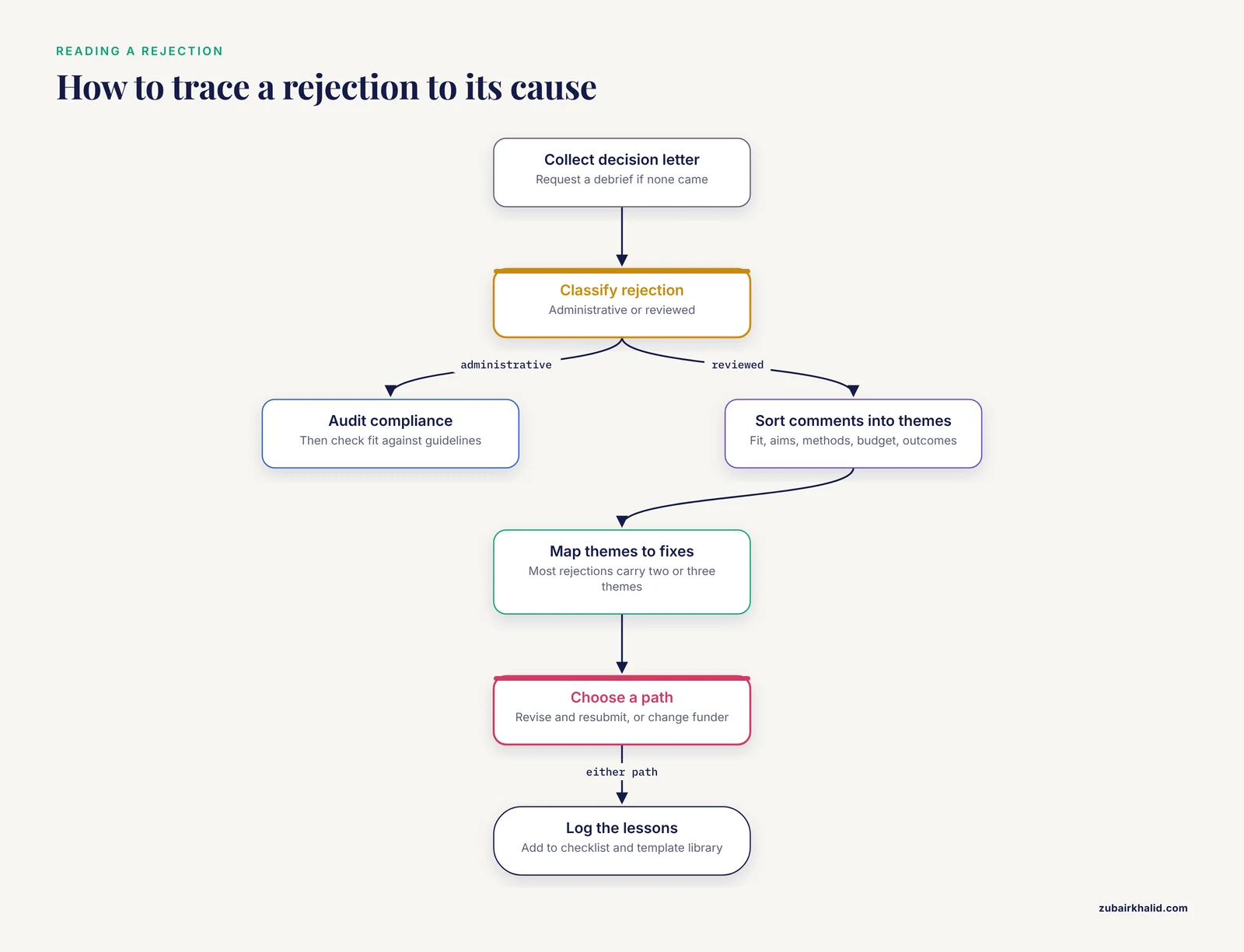
Work the sequence in order and stop when the cause is clear.
- Collect the decision letter and any reviewer comments. If none came, request a debrief from the program officer in a short, polite email.
- Classify the rejection. Administrative rejections arrive without scientific comments and point to gate one. Reviewed rejections come with scores or comments and point to gate two.
- For an administrative rejection, audit compliance first and fit second. Both are fixable before the next cycle.
- For a reviewed rejection, sort every comment into themes: fit, aims, methods, budget, outcomes, feasibility, writing.
- Map each theme to its solution in the table above. Most rejections carry two or three themes, not ten.
- If the comments are vague or contradictory, ask the program officer for a short debrief and take notes.
- Decide between two paths. Revise and resubmit where the funder allows it, or move the project to a better-matched foundation. Fit problems are cheaper to fix by changing funders than by bending the project.
- Log the lessons in your compliance checklist and template library so the same error cannot recur.
Grant Proposal Planning That Prevents Mistakes
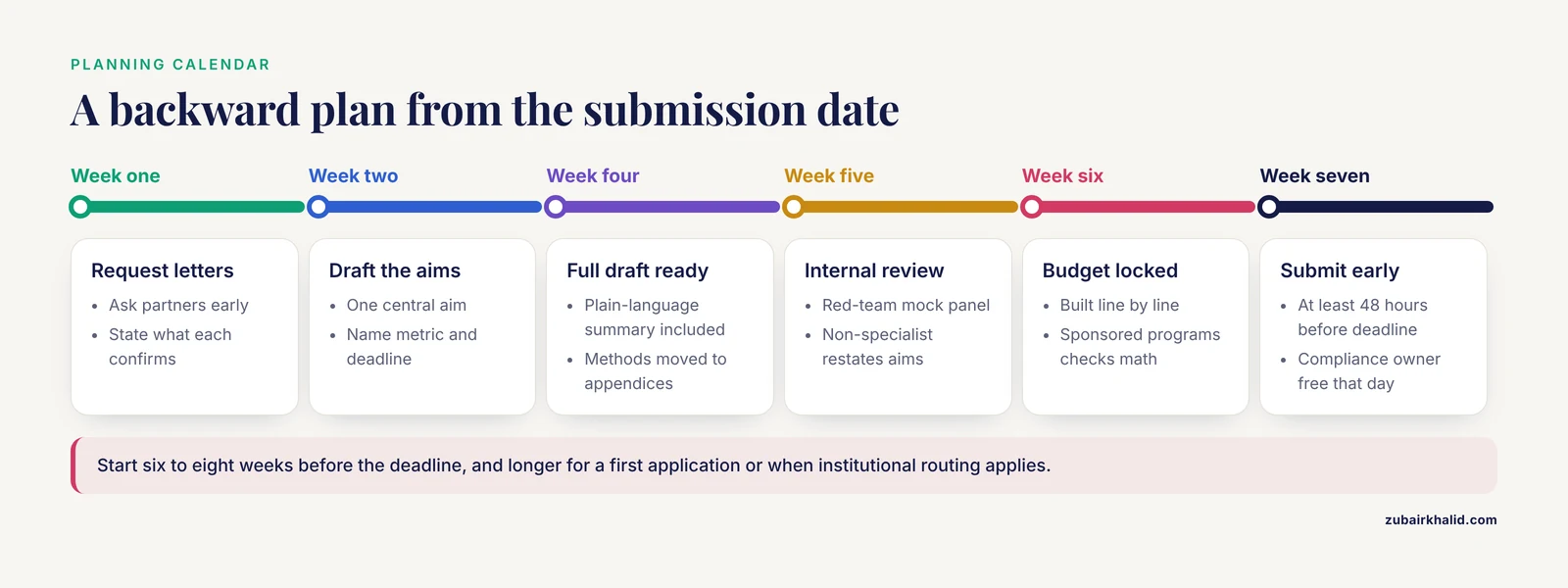
Most of the mistakes above are planning failures wearing disguises. The durable solutions are habits.
Start six to eight weeks before the deadline. A foundation proposal is short, but the letters, approvals, internal routing, and budget review consume the calendar. Build a backward plan from the submission date: letters requested in week one, draft aims in week two, full draft in week four, internal review in week five, budget locked in week six, submission in week seven.
Maintain a boilerplate library, a folder of reusable, current descriptions of your institution, your team, your facilities, and your standard methods. Update it after every submission so the next proposal starts from reality rather than from memory.
Read funded abstracts every cycle. Most foundations publish the projects they award, and the Form 990-PF lists grants paid. Fifteen minutes a quarter keeps your fit radar current.
Run a red-team review, a mock panel in which colleagues simulate the funder's reviewers, before every major submission. Give them the RFP, not your opinions about it, and ask for the three questions they would raise.
Invest in training. A structured research grant writing course compresses years of trial and error into weeks, and most research institutions offer workshops, mentoring from funded colleagues, and writing groups. Pair any course with one live exercise, a real proposal for a real deadline, because the skills only stick under review pressure.
Keep the relationships warm between cycles. Attend the funder's webinars, send a one-paragraph update when a funded project hits a milestone, and thank program staff after decisions. Foundations fund people they know across multiple grants, not single shots.
Common Mistakes and Limitations
A few specific cautions round out this guide.
The funder's current guidelines override every general rule here, including the advice in this article. When a guideline and a general best practice conflict, the guideline wins.
Program officer guidance is informal and can change. Confirm anything consequential in writing, and remember that a positive pre-submission conversation is not a funding commitment.
Priorities shift between cycles. Verify fit against the current guidelines and the most recent funded-grants list every time you apply, even to a foundation that funded you before.
The dollar figures, timelines, and example objectives in this article are illustrative teaching examples, not benchmarks for what any foundation will fund.
Institutional rules add constraints that vary by campus. Your sponsored programs office may require internal routing days before the funder deadline, may cap effort, or may require cost-share approval. Learn those rules once, then build them into every backward plan.
Privacy is a hard line. Proposals, letters, and attachments must never contain identifiable patient or participant information, and unpublished data should only be shared outside the team under written consent and a confidentiality agreement.
For any specific application, the definitive answers come from two places, the funder's current guidelines and your institution's research administration office. Everything in this guide is preparation for reading those two sources well.
Frequently Asked Questions
What is the most common mistake in foundation grant proposals?
Applying to a foundation whose mission and current priorities do not match the project. Check the funder's guidelines and its list of recently paid grants before writing anything.
How do I find out why my proposal was rejected?
Ask the program officer for reviewer comments or a short debrief in a polite email. Some foundations provide feedback and some do not. If none comes, run an internal mock review on the rejected draft.
Should I contact the program officer before submitting?
Yes, whenever the foundation invites pre-submission inquiries, and most do. Send a one-paragraph summary with two specific questions, and confirm any consequential guidance in writing.
Can I submit the same proposal to more than one foundation?
Yes, if each funder allows it and you tailor every proposal to that funder's priorities. Disclose overlapping requests when asked, and never let two funders pay for the same cost.
How do I write measurable outcomes?
Give each objective a metric, a measurement method, a baseline, and a deadline. For example, state the change you will measure, on what scale, in how many people, and by what date.
What belongs in the budget narrative?
A short justification for every line that ties the cost to a named activity and shows the calculation. If the work plan needs a technician at 50 percent effort for 12 months, the narrative says exactly that.
How early should grant proposal planning start?
Six to eight weeks before the deadline for an experienced applicant, and longer for a first application or when institutional routing applies. Build the plan backward from the submission date.
Do I need a research grant writing course?
No, but structured training shortens the learning curve. A research grant writing course, institutional workshops, and mentoring from funded colleagues all work, ideally combined with one real proposal under a real deadline.