How to Create a Collaborative Writing Agreement for Your Team
By Dr. Zubair Khalid, DVM, MS, PhD ·

By the end of this guide you will be able to draft, agree on, and store a collaborative writing agreement for a research paper, review, grant, or thesis chapter. The agreement records who writes which section, who qualifies for authorship, how authorship order is set, how drafts and figures are shared, how AI tools may be used, and what happens when a coauthor goes quiet. You will also get a free collaborative writing agreement template for research teams that you can copy into any shared document and adapt in about an hour.
Here is what you need on hand before you start:
- A shared, editable document (a cloud document or a plain text file in a shared repository both work)
- The current list of everyone who has contributed ideas, data, analysis, or writing so far
- The target journal or venue, if you know it, because journals differ on authorship statements and contribution disclosures
- Roughly one hour for a kickoff meeting and about 30 minutes for each revision round
Nothing needs to be installed. If your team uses version control, one optional step at the end shows how to track the agreement itself in the same repository as the manuscript.
Why a Collaborative Writing Agreement Matters in Scientific Collaboration
Multi-author writing is now the norm across the life sciences. A bibliometric study of avoidable mortality research from 2000 to 2024 found an average of 5.2 coauthors per article, with international coauthorship on 23.8% of publications [1]. More collaborators means more hands on the manuscript, and it also means more chances for disputes about credit, workload, and timing.
The two most common failure modes are well documented. The first is honorary authorship, the practice of listing people as authors despite minimal or absent contributions. Commentators have warned about this since at least 1983, when Moulopoulos and colleagues argued in the British Medical Journal for explicit disclosure of individual contributions in multi-author papers [2]. The second, newer failure mode is undisclosed AI-assisted writing, which can blur the boundary of genuine scholarly contribution in the same way cosmetic authorship does [2]. A written agreement forces the team to settle both questions before emotions run high.
Clear agreements also protect scientific collaboration at the project level. Studies of retractions show that problems such as unreliable results and referencing failures often surface late, after publication, and that correction is slow (one analysis of retracted social media-related publications found a median of 541 days between publication and retraction) [3]. Most of those failures are avoidable when expectations about verification, data access, and accountability are written down early.
Finally, a good agreement doubles as a project management tool. Structured writing activities, such as mentored writing retreats with scheduled 45 to 90 minute writing blocks, produce measurable output when they are planned deliberately. In one hospital medicine program, 12 of 24 papers worked on at writing retreats were accepted and 6 more were under review shortly afterward [4]. An agreement gives your team the same kind of deliberate structure without needing to leave campus.
What a Collaborative Writing Agreement Contains
A usable agreement is short. Most fit on two pages. It has eight standard parts:
- Project scope. The working title, the article type (original research, review, case series, methods paper), the target venue, and the intended submission window.
- Authorship criteria. What qualifies someone for authorship on this specific paper, and what does not.
- Authorship order and rationale. How first author, last author, and middle positions are decided.
- Section assignments and deadlines. Who owns each section, who reviews it, and when each draft is due.
- Writing standards. The quality bar the team agrees to, ideally captured in a shared rubric.
- Tool and workflow rules. Which research collaboration tools hold the manuscript, the data, the figures, and the reference library.
- AI use policy. Which AI-assisted tasks are allowed, which require disclosure, and which are off limits.
- Dispute resolution and exit rules. What happens if a coauthor misses deadlines, stops responding, or wants to leave.
Each part is negotiable. The point of the agreement is not to impose rules but to make implicit expectations explicit while everyone still agrees on them.
Collaborative Writing Agreement Template for Research Teams (Free Format)
This is a complete collaborative writing agreement template research teams can copy directly. Paste it into a shared document, delete what does not apply, and fill in the brackets. The format is deliberately plain so it works in any editor.
# Collaborative Writing Agreement

Project: [working title]
Article type: [original research / review / other]
Target venue: [journal or conference, backup venue]
Agreement date: [YYYY-MM-DD]
Version of this agreement: [v1.0]

## 1. Working authorship list
| Name | Affiliation | Proposed position |
|------|-------------|-------------------|
| [name] | [institution] | [first / middle / last] |

## 2. Authorship criteria for this paper
Authorship requires all three of the following:
- [define contribution threshold, e.g., substantial work on design, data,
  analysis, or interpretation]
- [define drafting/review duty, e.g., wrote or substantively revised at
  least one section]
- [approval duty, e.g., approves the final version before submission]
People who contribute data, reagents, materials, or funding but do not
meet these criteria will be acknowledged, not listed as authors.

## 3. Authorship order
First author is determined by [rule, e.g., contribution points in Section 6
plus lead-writer duty]. The last author is [role, e.g., supervising PI,
responsible for study concept and final approval]. Middle authors are
ordered by [rule, e.g., descending contribution points, or alphabetical
by agreement].

## 4. Section assignments and deadlines
| Section | Owner | First draft due | Reviewer(s) |
|---------|-------|-----------------|-------------|
| Abstract | [name] | [date] | [name] |
| Introduction | [name] | [date] | [name] |
| Methods | [name] | [date] | [name] |
| Results | [name] | [date] | [name] |
| Discussion | [name] | [date] | [name] |
| Figures/Tables | [name] | [date] | [name] |
| References + formatting | [name] | [date] | [name] |

## 5. Writing standards
We use the shared rubric stored at [link]. Minimum standard for any
section before it goes to a reviewer:
- the argument of the section is stated in the first paragraph
- every claim is supported by data from this project or a cited source
- numbers include units, sample sizes, and statistical test names

## 6. Contribution points (for ordering and ICMJE-style statements)
Each author receives a share of 100 points.
| Name | Concept/design | Data | Analysis | Writing | Revision | Total |
|------|----------------|------|----------|---------|----------|-------|
| [name] | [pts] | [pts] | [pts] | [pts] | [pts] | [pts] |

## 7. Workflow and research collaboration tools
- Manuscript file: [location and platform]
- Data and analysis code: [location]
- Figures: [location, source file format required]
- Reference library: [location, shared group]
- File naming: [e.g., manuscript_vYYYYMMDD_initials.docx]
- Only the manuscript location is authoritative. Copies sent by email
  are not the working version.

## 8. AI use policy
- Permitted without disclosure: [e.g., grammar and spelling checks]
- Permitted with disclosure in the methods or acknowledgments:
  [e.g., drafting plain-language text, code comments]
- Not permitted: [e.g., generating study results, writing the Methods
  section, fabricating or paraphrasing citations]
- Every author is accountable for any AI-assisted text they submit.
- No author names, confidential data, or unpublished results are entered
  into AI tools without written group approval.

## 9. Review and response plan
Internal full draft due: [date]
All comments returned within: [e.g., 5 business days]
Journal submission target: [date]

## 10. Disputes, delays, and exits
- If a section is more than [N] days late, the corresponding author
  reassigns it after one reminder.
- If an author is unresponsive for [N] weeks, the team may move them to
  the acknowledgments by majority decision, documented in writing.
- Any author may withdraw before submission by written notice. Their
  contribution points are reallocated and the authorship list is updated.
- Disputes about authorship go first to [named neutral person, e.g., the
  department chair or an ombudsperson].

## Signatures
| Name | Role | Date | Signature |
|------|------|------|-----------|
| [name] | [role] | [date] | [signature or typed consent] |
Save the template as a single file. Do not split it across email threads, because a scattered agreement is effectively no agreement.
Worked Example of the Template, Filled In
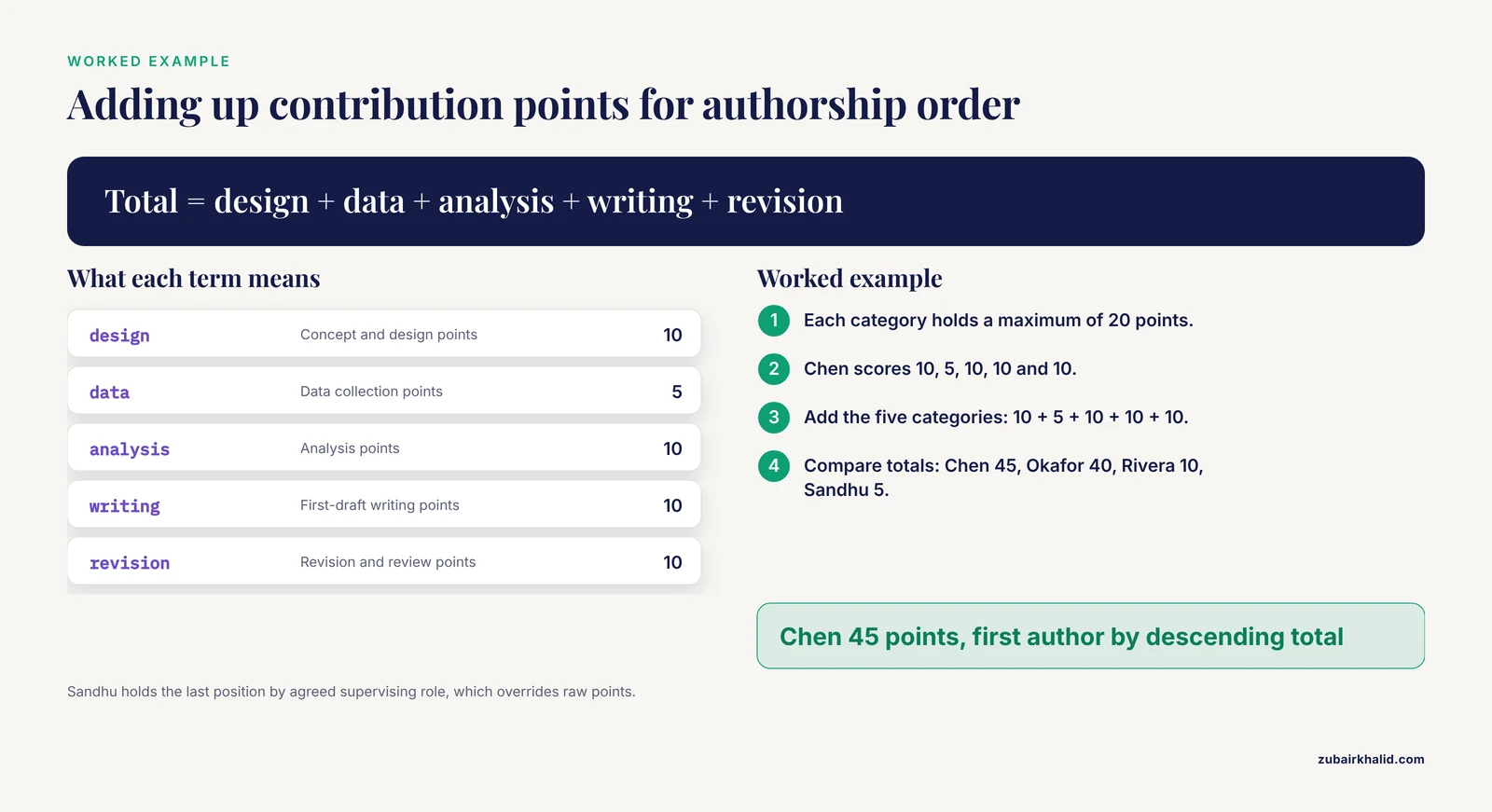
A four-person team writing a methods paper on point-of-care test evaluation might fill in the contribution table like this. The rule is simple: every author starts from zero, each category holds a maximum number of points, and the 100 points must sum correctly. The arithmetic is easy to check with a calculator or a one-line spreadsheet formula.
Contribution categories and maximum points:
  Concept and design: 20
  Data collection:    20
  Analysis:           20
  First-draft writing: 20
  Revision and review: 20

Example allocation:
  Chen    : design 10, data  5, analysis 10, writing 10, revision 10 = 45
  Okafor  : design  5, data 15, analysis  5, writing  5, revision 10 = 40
  Rivera  : design  0, data  0, analysis  5, writing  5, revision  0 = 10
  Sandhu  : design  5, data  0, analysis  0, writing  0, revision  0 =  5

Order rule: descending total points.
Result: Chen (first), Okafor, Rivera, Sandhu (last, supervising role
agreed separately, which overrides raw points per Section 3).
The expected output of this exercise is not the numbers themselves. It is the conversation. When Okafor sees 40 points against Chen's 45, the team can discuss whether the data collection workload was underestimated before submission rather than after acceptance.
A second worked example concerns screening agreement in review-type papers. Teams coauthoring a scoping or systematic review often state the level of agreement reached during study selection. In one published scoping review of child health policy, all authors participated in selection and data extraction, and over 90% agreement was reached on which articles to include [5]. If your paper involves dual screening, write the target agreement level and the method for resolving conflicts directly into Section 9 of the template, for example "two reviewers screen independently, conflicts resolved by discussion with a third reviewer."
How to Run the Agreement Meeting Using a Lightweight Consensus Method
The agreement works only if every coauthor genuinely accepts it. Borrow a page from formal consensus methods used in clinical research. A Delphi process, for example, refines statements across multiple rounds of expert feedback and defines consensus as at least 80% agreement or disagreement on each statement, using a structured rating scale [6]. Multi-group research consortia use the same logic in person, developing, refining, and adopting consensus statements through structured debate [7].
You do not need a formal panel. Adapt the idea in four steps:
- Draft the agreement yourself (the corresponding author or first author) and send it 48 hours before the meeting.
- Rate the contested clauses. Ask each coauthor to mark each of the ten sections as accept, accept with changes, or reject. A simple shared spreadsheet with one column per person works.
- Discuss only the contested clauses. Change wording until at least 80% of the team accepts each clause. Anything below that threshold gets revised and re-rated once.
- Record final acceptance. Each coauthor types their name and date into the signature table, or replies in writing on the thread containing the final version. Written acceptance matters, because the signature table is your record if a dispute arises later.
Total meeting time for a typical five-author paper is 45 to 60 minutes. If the team is spread across time zones, run the rating round asynchronously and hold a short synchronous call only for clauses below the 80% threshold.
Defining Your Writing Standards With a Shared Rubric
Section 5 of the template references a rubric. Build it with the team rather than imposing it, because participation changes how people write. In a pharmacology course exercise, students who generated their own scoring rubric assigned significantly higher weights to the quality of ideas and significantly lower weights to sentence fluency, favoring content over mechanics, when compared with a faculty-generated rubric [8]. The lesson for research teams is concrete: if your rubric weights style heavily, your scientists will optimize for polish. If your team weights argument and evidence, they will optimize for substance. Agree on the weights as a group.
A minimal four-criterion rubric for a methods section might look like this:
Rubric: Methods section (weights sum to 100)
  Completeness (could a stranger repeat the work?):  40
  Accuracy (numbers match the data and analysis):    30
  Clarity (logical order, defined terms):            20
  Mechanics (grammar, units, consistent notation):   10
Store the rubric at the link named in Section 5 and score each draft section against it before internal review. This makes review comments objective and shortens revision cycles.
Choosing Research Collaboration Tools and Setting the Workflow
Section 7 of the agreement only works if the named tools are real and current. Most scientific collaboration stacks need five slots filled: the manuscript, the analysis code or data pipeline, the figures, the reference library, and the decision log. Pick tools the whole team can access, including any coauthor without an institutional license, and record the exact locations in the agreement.
If your team uses version control, keep the agreement itself under version control alongside the manuscript. That gives you a permanent, dated record of who agreed to what and when the terms changed. A minimal workflow:
# inside your shared project repository
mkdir agreements
cd agreements

# save the filled template here, then track it
git add collaborative_writing_agreement.md
git commit -m "Add v1.0 collaborative writing agreement, signed by all authors"
git log --oneline -- agreements/
Expected output of the last command is a line per agreement revision, for example:
a41c9f2 Add v2.0 authorship order update after revision round
7d8e3b1 Add v1.0 collaborative writing agreement, signed by all authors
Any coauthor can now run git diff 7d8e3b1 a41c9f2 to see exactly what changed between versions. This is far stronger evidence than a chain of email attachments, and it costs nothing.
Setting Your AI Use Policy
The AI clause is now the most contested part of most agreements, so decide it deliberately. Reviews of AI in research practice describe tools that help with literature organization, citation management, and communication across research centers, while stressing that AI-driven work requires supervision by human experts for accuracy, coherence, and credibility [9]. The same theme appears in practical tutorials on iterative human-LLM collaboration, where researchers write prompts, evaluate and refine outputs, and verify reliability against human judgment rather than trusting raw model output [10]. A useful framing is to treat a chatbot as a collaborator whose routine drafting help is welcome but whose work on methodological and bibliographic content stays under human control, because those parts carry the scientific validity of the paper [11].
Translate that into the three-tier policy in Section 8 of the template. A realistic filled-in example:
Permitted without disclosure: spell check, grammar suggestions
Permitted with disclosure:    plain-language summary drafting,
                              rewriting for brevity after the author
                              supplies the substance
Not permitted:                drafting the Methods section, generating
                              citations, interpreting data, writing any
                              text the named author did not verify
Note that disclosure categories are your team's internal policy. Separately, journals impose their own rules, and some output formats carry their own published standards. Plain language summaries of publications, for example, have an agreed cross-publisher definition requiring that they be standalone, peer-reviewed, open access summaries with their own digital object identifier, written to plain language principles with meaningful graphics [12]. If your agreement commits the team to producing such a summary, assign it an owner in Section 4 and cite the applicable standard in Section 5.
Summary Table of Key Agreement Options
| Clause | Common option A | Common option B | When to prefer |
|---|---|---|---|
| Authorship order | Descending contribution points | Negotiated and fixed at kickoff | Points for egalitarian teams, negotiation when seniority conventions apply |
| First-draft model | Section owners draft independently | One lead author drafts everything, others revise | Section owners for reviews, lead writer for tightly argued papers |
| Consensus threshold | 80% acceptance per clause [6] | Unanimous acceptance | 80% to keep momentum, unanimous for authorship order |
| Screening agreement (reviews) | Two independent screeners, conflict resolution by a third [5] | Single screener with spot checks | Dual screening when the review will state an agreement level |
| AI policy | Three-tier permitted, disclose, banned | Blanket ban on generative drafting | Three-tier for most teams, ban where the journal prohibits it |
| Delay rule | Reassignment after one reminder and N days | Escalation to the neutral party | Reassignment keeps timelines, escalation preserves relationships |
| Version control | Cloud document with version history | Git repository with commit messages | Git when the code and manuscript share a repository |
Common Mistakes and Limitations
- Waiting too long to write the agreement. Terms settled after the first full draft exist are negotiated under pressure. Write the agreement before the first draft, even if it is only half filled in.
- Leaving the AI clause blank. Undisclosed or excessive AI use risks the same dilution of genuine contribution as honorary authorship [2]. If the team cannot agree on tiers, at minimum ban unverified citations and require each author to vouch for text bearing their name.
- Treating acknowledgments as a consolation prize. Decide acknowledgment criteria in the same meeting as authorship criteria. People who supplied reagents, datasets, or computing resources without meeting authorship thresholds belong in the acknowledgments, and saying so plainly prevents later friction.
- Confusing point totals with fairness. The point system in Section 6 is a conversation starter, not an objective truth. Senior or supervising authors often hold the last position by role rather than raw points, which is why the worked example above overrides points with an agreed role rule.
- Assuming a signed agreement prevents all disputes. It prevents most and narrows the rest. Some disputes need an external neutral party, which is why Section 10 names one in advance.
- Letting the agreement drift from reality. If the team abandons the tool stack named in Section 7, update the agreement or the agreement stops being the reference document.
- Copying another team's template wholesale. The template here is a starting format. A three-person lab meeting paper and an 11-country consortium paper need different levels of detail, and consensus-heavy projects may need more formal rounds modeled on structured consensus conferences [7].
Individual disputes, especially those touching employment, visas, or supervisor relationships, may need institutional resources such as an ombudsperson or research integrity office rather than anything a template can resolve.
Frequently Asked Questions
What is a collaborative writing agreement in research?
A short written document that records who authors a paper, in what order, who writes each section, which tools hold the files, how AI tools may be used, and how disputes are resolved. It is signed or accepted in writing by every coauthor before drafting begins.
When should our team write the agreement?
At project kickoff, before anyone writes a first draft. Terms agreed before drafts exist are negotiated on facts, while terms agreed afterward are negotiated under deadline pressure.
Does authorship order have to be fixed before writing starts?
The method for deciding order should be fixed before writing starts, but the final order can be provisional. Agree now on whether order follows contribution points, negotiation, or field conventions, then confirm the final order before submission.
How should we handle AI writing tools in the agreement?
Use a three-tier clause: uses permitted without disclosure, uses permitted with disclosure in the methods or acknowledgments, and uses that are banned. Require every author to verify and vouch for any AI-assisted text published under their name.
What happens if a coauthor stops responding?
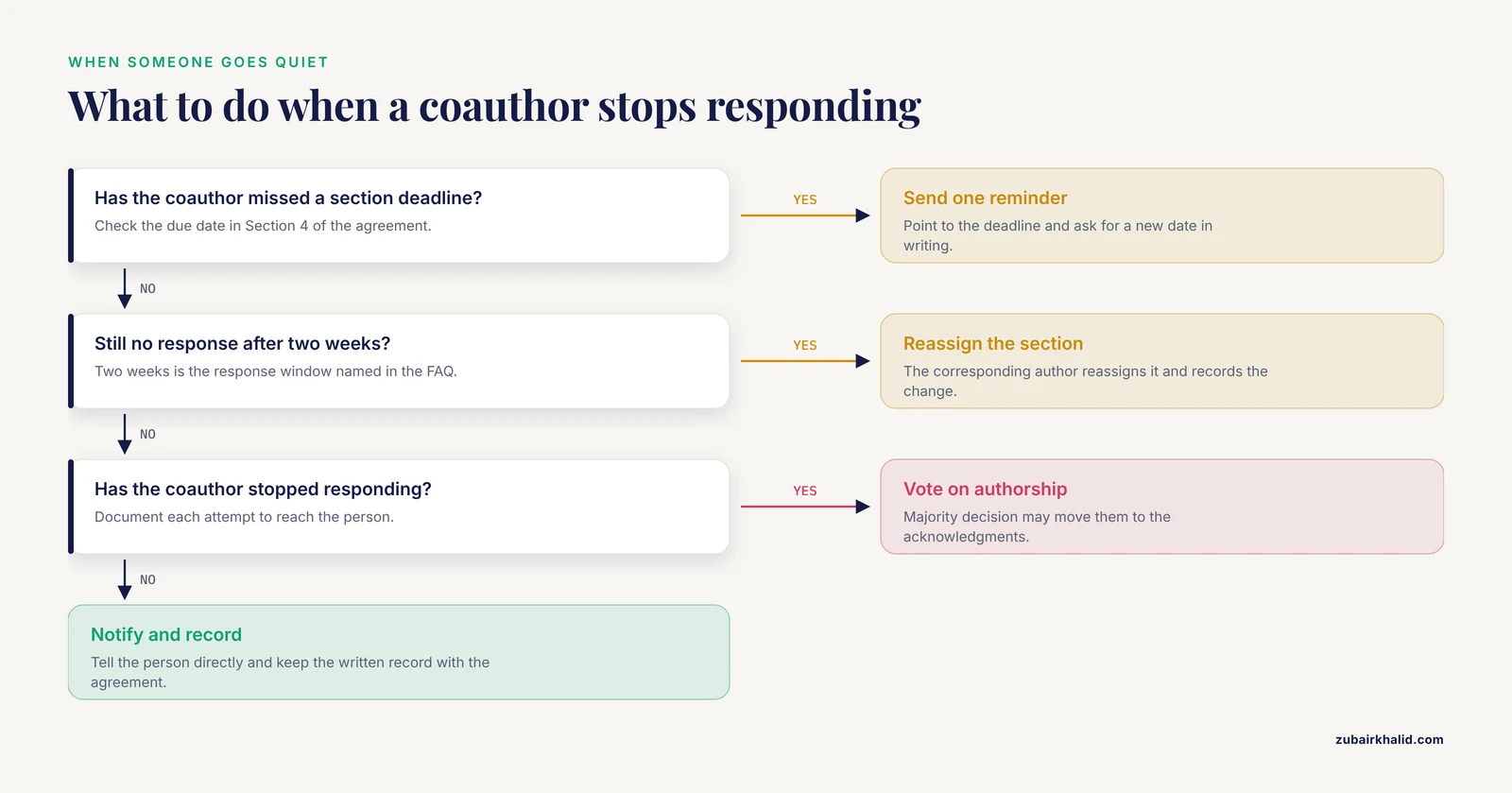 The agreement should state a response window, such as two weeks, after which the team may reassign their sections and, by majority decision, move them to the acknowledgments. Document the decision in writing and notify the person directly.
Can we revise the agreement after drafting has started?
Yes, and you should. Treat revisions like manuscript versions, record the date, the change, and written acceptance from all authors. In a version-controlled repository, commit each revision so the history is permanent.
Is a verbal agreement enough?
No. Verbal agreements depend on memory and are nearly impossible to enforce when authorship disputes arise months later. Written acceptance, even a reply on an email thread, gives the team a shared record.
Do we need a lawyer to write the agreement?
Usually not for a standard research article agreement. These documents are working agreements among colleagues, not contracts for payment or intellectual property transfer. Involve your technology transfer or legal office when the agreement touches patents, industry sponsors, or material transfer terms.
Sources
- Collaboration Networks, Trends, and Scientific Impact in Avoidable Mortality Research (2000-2024): A Bibliometric Study.
- From honorary authorship to AI-assisted writing: two challenges to genuine scientific contribution.
- Altmetric Activity and Scientific Integrity: A Retraction Analysis of PubMed-Indexed Social Media-Related Publications.
- Development and evaluation of a writing retreat program to build community and promote productivity in academic hospital medicine.
- Mapping child health and development policies and implementation challenges in South Africa: A scoping review.
- Managing Enterococcus faecium bloodstream infection: a Delphi document on clinical recommendations and research agenda.
- Consensus statements from the first Gynecologic Cancer InterGroup Cervical Cancer Consensus Conference in Clinical Research.
- Student perceptions of scientific writing in pharmacology: Student generation of collaborative rubrics to score a social pharmacology writing project.
- Use of Artificial Intelligence Tools for Research by Medical Students: A Narrative Review.
- An AI-powered research assistant in the lab: A practical guide for text analysis through iterative collaboration with LLMs.
- [[On the shoulders of Chatbots: academic writing and artificial intelligence].](https://pubmed.ncbi.nlm.nih.gov/41716093/)
- Cross-publisher agreement on the defining principles of plain language summaries of publications (PLSPs).