How to Draft a Scientific Paper Collaboratively
By Dr. Zubair Khalid, DVM, MS, PhD ·

After working through this guide you will be able to set up a shared manuscript, assign sections with clear owners, draft in parallel without chaos, merge everyone's text into a single voice, and run an internal review that catches problems before a journal does. Before you start, have these on hand: a shared writing platform (Google Docs, Microsoft Word with tracked changes, or Overleaf for LaTeX, the typesetting system common in equation-heavy manuscripts), a shared reference manager such as Zotero, your project's data files and figure scripts, and the author guidelines of your target journal. A Git repository is optional but pays off for LaTeX manuscripts and code-generated figures.
Team science is the norm. Bibliometric studies, which quantify publication patterns across thousands of papers, report an average of about 5.2 coauthors per article, with international coauthorship on roughly 24% of publications in one active research field [1]. In one dataset on infrared thermography in dentistry, 206 authors produced 41 papers and not a single paper had one author [2]. Learning how to draft a scientific paper collaboratively is therefore a core research skill, and one that most training programs still expect you to absorb by osmosis. This guide makes the process explicit.
What Collaborative Drafting Actually Involves
Collaborative drafting means several named contributors write, review, and revise one manuscript under an agreed process, with each person's contribution visible and each decision recorded. It is a workflow, not a free-for-all inside a shared document.
The contrast matters because the literature documents what happens when collaboration is faked or left unmanaged. Commentators trace concerns about honorary authorship, the practice of listing people as authors despite minimal or absent contributions, back to a 1983 call in the British Medical Journal for explicit disclosure of individual contributions, and they now treat unreported AI-assisted writing as the same underlying problem of diluted scientific credit [3]. At the fraudulent extreme, researchers matched more than 4,000 paper titles offered for sale by paper mills (commercial operations that produce fake papers) against published work and identified 2,062 compromised papers in IEEE conference proceedings, whose author lists showed collaboration anomalies, unusually high diversity of affiliations per paper, and a striking predominance of six-author papers [4]. An audit of withdrawn and rejected journal submissions found a simpler warning sign: in six cases the authors named on the final published version differed from the original submission by more than two thirds, and in four cases the author lists were completely different, because purchased authorships get swapped between journals [5].
Genuine collaborative drafting is the disciplined opposite of these patterns: a small accountable team, a transparent record of who did what, and one manuscript that every author has actually read.
Agree on Governance Before Anyone Writes
Scientific collaboration works best when the rules are written down before the first sentence. A governance planning group for a global evidence synthesis initiative defined its guiding principles as equity, transparency, agility, and subsidiarity, and organized its work into four functions covering advocacy and partnerships, inclusive engagement, standards and tools, and regional technical support [6]. Translated to a manuscript team, those principles become concrete rules:
- Equity: every contributor can raise a concern about any section, and nobody is excluded from decisions that affect their name on the paper.
- Transparency: keep a decision log recording what was agreed, when, and by whom.
- Agility: work in short cycles, for example one section draft per week, rather than one long silence followed by a crisis.
- Subsidiarity: the person who owns a section decides its wording, while the whole team decides claims, authorship, and the target journal.
Subsidiarity deserves a definition: it means decisions are made at the lowest level with enough information to make them well. Your methods writer does not need the team to approve every sentence, but the team must approve the claim the paper makes.
Larger collaborations formalize this further. A five-year co-creation effort for a bleeding disorders research network organized seven multidisciplinary working groups, each with a defined scope, and centered people with lived experience alongside researchers [7]. The lesson scales down cleanly: give each working group, or each section pair, a charter, a deliverable, and a deadline.
Authorship and Contribution Rules
Decide three things in writing before drafting starts:
- Who qualifies as an author. Use the criteria most journals apply: each author substantially contributed to the work, drafted or revised the manuscript, approved the final version, and agrees to be accountable for it.
- Who is the corresponding author, the single contact point who handles the journal, approves proofs, and fields reviewer correspondence.
- How contributions will be disclosed, using a structured role list such as conceptualization, methodology, investigation, data curation, writing of the original draft, and supervision. Structured contribution statements exist precisely to prevent the cosmetic authorship described above [3].
Set Up Your Research Collaboration Tools
| Task | Common options | What it does best | Main pitfall |
|---|---|---|---|
| Shared manuscript | Google Docs, Word with tracked changes, Overleaf | Live co-editing, comments, version history | Silent overwriting when two people edit one paragraph |
| Version control | Git with GitHub or GitLab | Line-level history, branches per section, clean merges | Merge conflicts when two owners edit one file |
| References | Zotero group library, Mendeley, EndNote | One shared bibliography with consistent citation keys | Duplicate or unverified entries entering the library |
| Task tracking | Trello, Asana, GitHub Projects | Visible owners and due dates per section | Boards that go stale after week two |
| Discussion | Slack, Microsoft Teams, email threads | Searchable decisions and quick polls | Decisions buried in chat instead of the log |
| Data and figures | Shared repository with R or Python scripts, plus a deposit service for supplementary files | Figures regenerated from data on demand | Figures pasted as images with no source script |
Two definitions before you choose. Tracked changes means the editor records every insertion and deletion so coauthors can accept or reject each edit individually. Version control means every save becomes a labeled snapshot, called a commit, that you can compare, restore, or merge.
Pick one manuscript platform and stay with it. Migrating between Word and Google Docs mid-project strips comments and breaks tracked changes.
Collaborative Drafting Step by Step: From Empty Folder to Submission
The following nine steps take a team from an empty folder to a submitted manuscript. Adapt the deadlines to your project, but keep the order.
Step 1: Write a One-Page Charter
Before any prose, the team agrees on one page containing:
- The one-sentence story: "We show that X changes Y in Z, which explains W."
- The target journal with its word limit, figure limit, and reference style.
- The author list and contribution policy from the section above.
- A timeline with internal due dates per section.
The charter prevents the most expensive failure in collaborative writing: discovering at merge time that two coauthors have been writing different papers.
Step 2: Build a Shared Outline
Create the outline in the shared platform so everyone edits the same file. A workable template:
# Working title: X reduces Y in a Z model
## One-sentence story
We show that X changes Y, which explains W.
## Target journal
Journal name, article type, word limit: 3500
## 1. Introduction (owner: Rivera, draft due Friday)
- Paragraph 1: the field-level problem
- Paragraph 2: what is known, with citations
- Paragraph 3: the gap
- Paragraph 4: the question and the approach
## 2. Methods (owner: Chen)
- 2.1 Study design and samples
- 2.2 Assays and instruments
- 2.3 Statistics (agree on the tests now)
## 3. Results (owner: Okafor)
- 3.1 Figure 1 story
- 3.2 Figure 2 story
- 3.3 Table 1 statistics
## 4. Discussion (owner: Rivera)
- Answer the question, limitations, implications
## Figures and tables
F1, F2, T1, each with its source data file
The expected output is a file every coauthor can open, comment on, and accept within a day. If anyone cannot summarize the story sentence from memory, the outline is not finished.
Step 3: Assign Sections and Roles
Give every section one owner. Owners draft, everyone else comments. Also assign three cross-cutting roles:
- Style editor, who owns terminology, abbreviations, and tense conventions across sections.
- Data steward, who verifies every number in the text against the analysis output.
- Submission coordinator, who tracks journal requirements, ORCID identifiers (unique researcher ID numbers), and disclosure forms.
A machine-readable assignment keeps this unambiguous:
sections:
  introduction: {owner: "A. Rivera", due: 2026-11-20}
  methods:      {owner: "J. Chen",  due: 2026-11-18}
  results:      {owner: "T. Okafor", due: 2026-11-22}
  discussion:   {owner: "A. Rivera", due: 2026-11-25}
roles:
  style_editor: "M. Haddad"
  data_steward: "J. Chen"
  submission_coordinator: "T. Okafor"
Step 4: Create the Manuscript and Reference Library
For LaTeX projects, put the manuscript under Git from day one and create a branch per section so parallel drafts never collide:
git init manuscript
cd manuscript
git checkout -b intro-draft
# edit sections/introduction.tex, then:
git add sections/introduction.tex
git commit -m "Draft introduction: gap statement and question"
git checkout main
git merge intro-draft
Expected output at the merge step:
Merge made by the 'ort' strategy.
sections/introduction.tex | 62 ++++++++++
1 file changed, 62 insertions(+)
Build the shared reference library at the same time. In Zotero, create a group library, invite the team, and agree on one citation style per the journal's guide. Every coauthor adds references to the group library rather than to private folders, which prevents the classic failure of a submitted paper citing sources nobody can find.
Three tool errors you will eventually hit, with fixes:
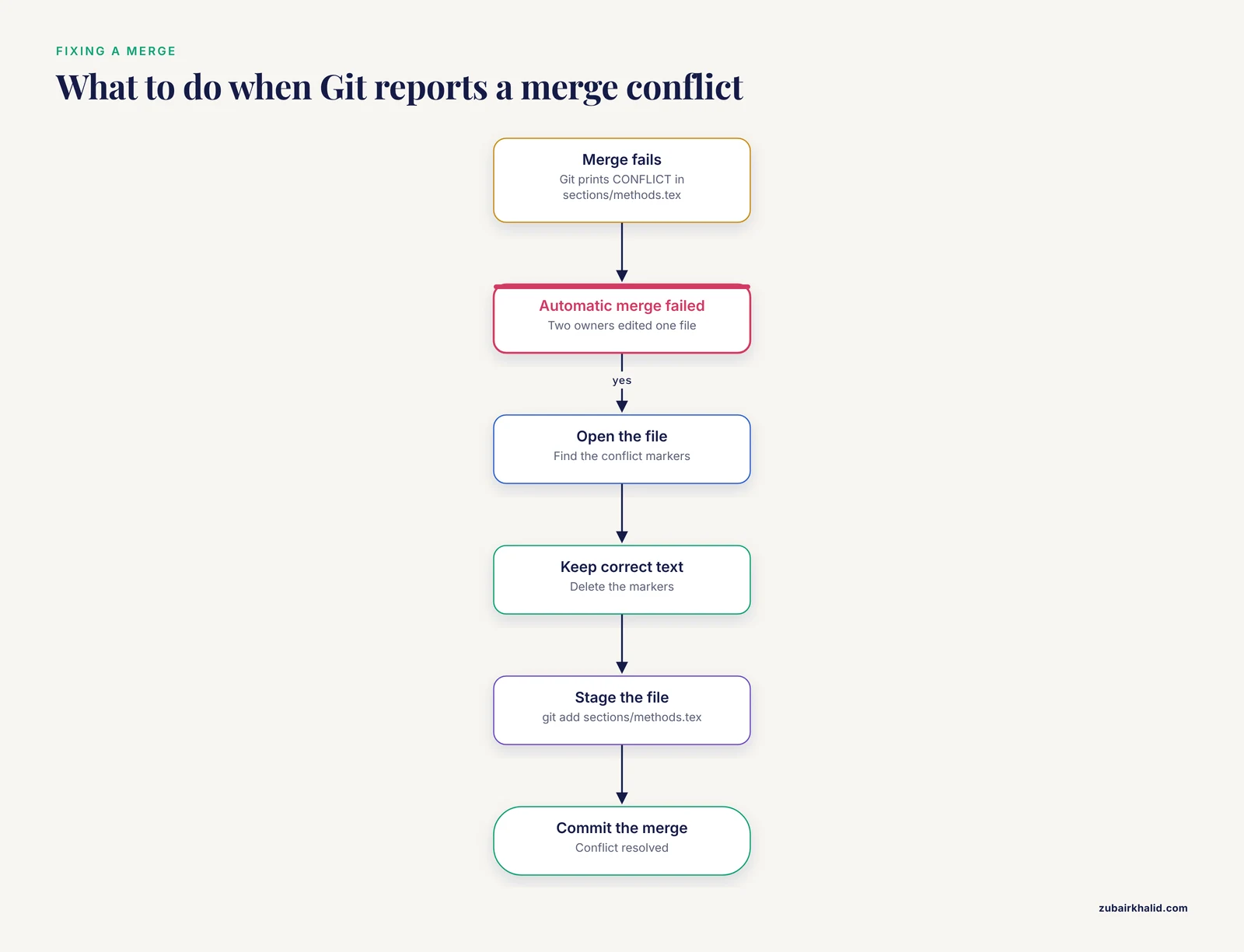
- Git merge conflict. Git prints
CONFLICT (content): Merge conflict in sections/methods.texand tells you the automatic merge failed. Open the file, keep the correct text between the conflict markers, delete the markers, then rungit add sections/methods.texand commit. Prevent most conflicts by keeping one owner per file. - LaTeX citation warning. The log shows
LaTeX Warning: Citation 'smith2024' on page 3 undefined on input line 45.The BibTeX key is missing from the shared library or misspelled. Fix the key, then run the full compile chain (pdflatex, BibTeX, pdflatex, pdflatex) so the bibliography rebuilds. - LaTeX missing package. The log shows
! Undefined control sequence.pointing at a command such as\includegraphics. Add the required package, for example\usepackage{graphicx}, to the preamble. In Overleaf, a failed compile ends withNo pages of output., which means read the first error in the log, not the last.
For Google Docs, the equivalent failure is a coauthor hitting "You need access" on the link. Fix it by adding each collaborator by email with Editor rights rather than relying on open-link sharing.
Step 5: Draft in Parallel With Ground Rules
Four rules keep parallel drafting clean:
- Write in your own section. If another section needs a change, leave a comment rather than editing it.
- Draft, do not polish. A rough methods section today beats a perfect one next month.
- Log decisions. When the team chooses, for example, to drop a subgroup analysis, record it in the decision log with the reason.
- Cite from the shared library only. Never paste a reference from memory.
Step 6: Run an Internal Review With a Rubric
A rubric is a scoring guide that lists the qualities a text must have and how much each counts. Rubrics work best when the team builds them together. In a pharmacology course exercise, students who generated their own rubric assigned significantly higher weights to ideas and significantly lower weights to sentence fluency than the faculty rubric did, favoring content over mechanics, and papers scored under the two rubrics differed by about half a letter grade, a difference that was not statistically significant [8]. The practical takeaway is to set the weights deliberately rather than by habit.
Build your team rubric with weights that sum to 100:
| Element | Weight | What excellent looks like |
|---|---|---|
| Ideas and originality | 40 | Clear question, novel framing, claims matched to evidence |
| Evidence and analysis | 25 | Every claim tied to data, statistics correct, alternatives addressed |
| Organization | 20 | Logical paragraph order, signposting, IMRaD logic |
| Sentence fluency | 15 | Plain sentences, consistent tense, abbreviations defined |
IMRaD stands for Introduction, Methods, Results, and Discussion, the standard structure for most life science articles.
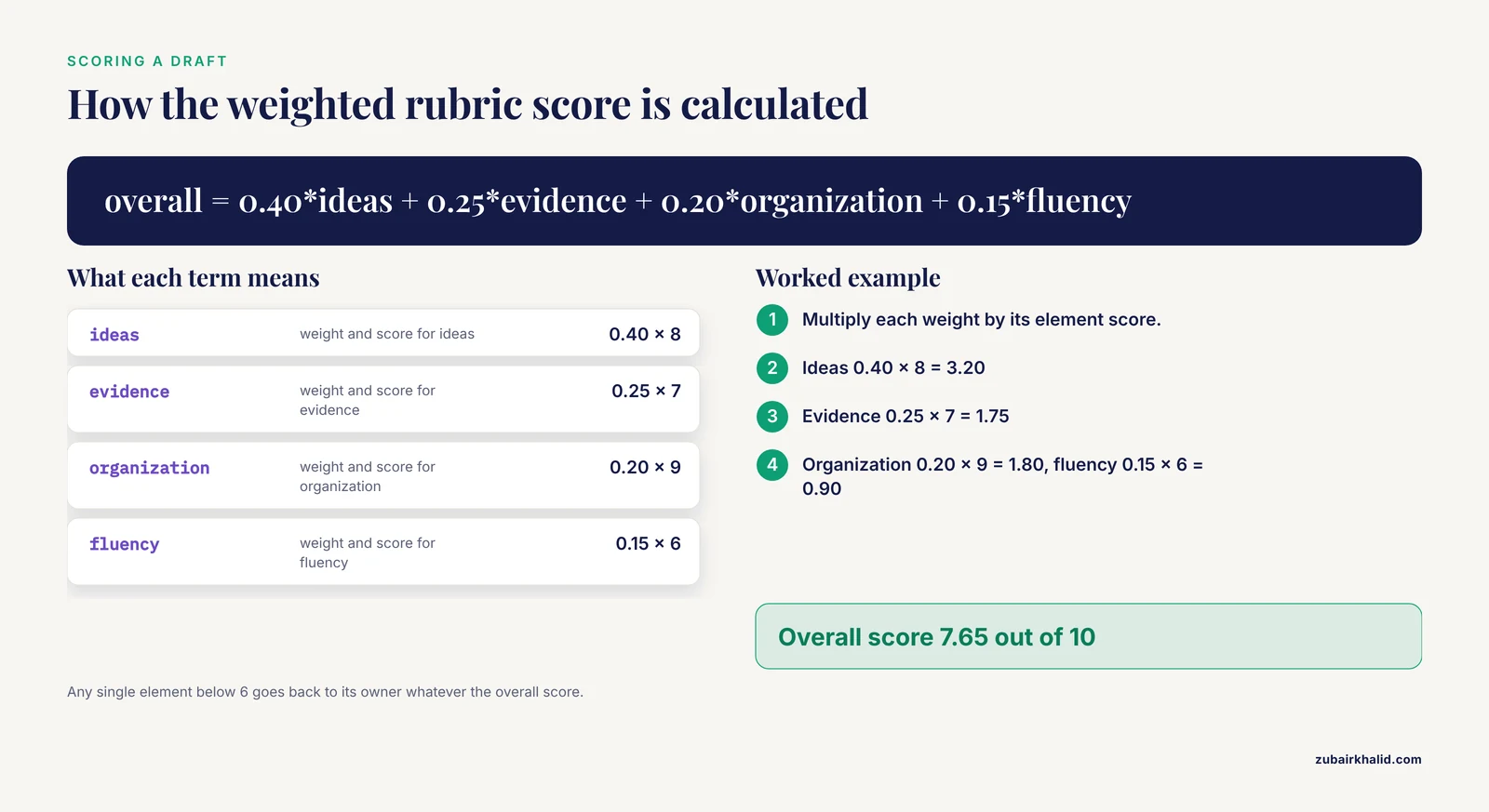
Score a draft with a weighted calculation:
rubric  = {"ideas": 0.40, "evidence": 0.25, "organization": 0.20, "fluency": 0.15}
scores  = {"ideas": 8, "evidence": 7, "organization": 9, "fluency": 6}
overall = sum(rubric[k] * scores[k] for k in rubric)
print(round(overall, 2))
# Expected output: 7.65
A draft scoring below 6 on any single element goes back to its owner with the reviewer's comments, regardless of the overall score.
Step 7: Merge Into One Voice
After individual reviews, one style editor, not the whole team, rewrites for consistency in a single pass:
- One term per concept. Choose "mice" or "animals", "participants" or "subjects", then enforce it everywhere.
- One tense convention: past tense for what you did and found, present tense for what the literature says.
- Abbreviations defined at first use in the abstract and again in the main text.
- Paragraph openings that state the point, not the history.
Then read the merged manuscript aloud as a team, one section per meeting. The ear catches redundancy and tonal jumps that the eye forgives.
Step 8: Verify Numbers, Figures, and Integrity
Before anyone approves the final version:
- The data steward re-derives every statistic in the text from the analysis scripts and matches it to the tables.
- Every figure regenerates from its source script, and every legend is self-contained.
- Every citation in the text exists in the shared library and supports the sentence it is attached to.
- The contribution statement matches what people actually did, and every author has read the final manuscript and approved it in writing.
This step is where teams protect themselves, because problems are expensive to fix after publication. In one set of 55 retracted publications, the median time from publication to retraction was 541 days, and the most common trigger was investigation by the journal or publisher rather than the authors coming forward [9]. Plagiarism is a documented leading cause of retraction, and in one national analysis none of the retracted articles were single-authored, which means multi-author teams signed off on copied text that any careful coauthor should have caught [10]. Run a similarity check (software that compares your text against published literature) on the merged manuscript before submission.
Step 9: Submit and Share the Revision Work
The submission coordinator uploads the files, verifies compliance with the author guidelines, and records the submission date. When reviews return:
- Convert each reviewer point into a numbered row in a shared response document.
- Assign each point an owner, usually the section owner.
- Set a team deadline for the response letter, which is itself drafted collaboratively and merged like the manuscript.
- Re-run the Step 6 rubric on any substantially rewritten section.
Sensible next steps after acceptance: post a preprint (a public draft posted before or alongside journal publication) if the journal allows it, deposit data and code in a recognized repository, and circulate the final paper to everyone who contributed, including technical staff who appear in the acknowledgments.
Collaborative Drafting Tips That Move the Manuscript Forward
Run a Writing Retreat
A writing retreat is a scheduled block of days in which a team writes away from routine duties. One academic hospital program ran 3-day, 2-night retreats within a 2-hour radius of the institution, with writing blocks of 45 to 90 minutes interspersed with breaks, feedback sessions, exercise, and shared meals, at a cost of $296 per attendee per retreat. Nearly 80% of attendees rated the retreats extremely helpful, and of 24 papers worked on at the retreats, 12 were accepted and 6 more were under review at follow-up [11]. The design details matter more than the venue: protected writing blocks, mentoring present in the room, and no clinical or administrative interruptions.
Use AI as a Junior Collaborator, Not a Ghostwriter
Large language models can draft routine text, suggest rewording, and check consistency, while humans keep control of the methodological and bibliographic core that determines scientific validity. One analysis frames chatbots as artificial collaborators and warns that every capability a technology absorbs replaces a human competency while generating new ones, a dynamic that slides into cognitive laziness if teams stop practicing the skills themselves [12]. Practical rules: never let a model generate citations, verify every factual sentence it produces, and follow the target journal's policy on disclosing AI assistance, because unreported AI use is now treated as a modern form of misrepresenting genuine contribution [3].
Keep a Decision Log and a Terminology Sheet
Two small files save weeks. The decision log is a dated list with four columns: date, decision, rationale, who decided. The terminology sheet lists chosen terms, abbreviations with their definitions, and banned synonyms. Both live next to the manuscript in the shared folder, and both are shown to any coauthor who joins late.
Schedule the Merge Before the Deadline
Work backward from your target submission date and give Steps 7 and 8 their own full week. Teams that schedule drafting up to the deadline eat the review and verification time, which is exactly the time that protects them.
Common Mistakes and Limitations
- Adding names without work. Honorary authorship dilutes accountability and is now discussed alongside unreported AI writing as the same integrity failure [3]. Every author must be able to defend the paper in public.
- Letting the author list drift. Swapped or reshuffled author lists between submission and publication are a recognized signature of purchased papers [5]. Freeze the author list at charter time and change it only with a documented team decision.
- Assuming someone else checked for plagiarism. Multi-author papers get retracted for copied text, so run a similarity check on the merged manuscript and treat reuse of your own prior text as seriously as reuse of anyone else's [10].
- Building the rubric after the draft. If reviewers invent criteria during review, feedback becomes a matter of taste. Agree on the weights first, and decide deliberately how much mechanics count relative to content, because students and faculty weigh these differently [8].
- Outsourcing judgment to AI. Models can draft routine sections, but methods, data interpretation, and references define the paper's validity and stay under human control [12].
- Skipping the decision log. Six months later nobody remembers why the subgroup analysis was dropped, and the reviewer response stalls.
- Ignoring governance in large teams. Consortia that skip explicit principles drift into inequitable workloads. The equity, transparency, agility, and subsidiarity set is a tested starting point [6].
Limitations: journal policies differ on authorship criteria, AI disclosure, and data deposition, so treat your target journal's author guidelines as the final authority. If your situation involves a genuine dispute over credit or data, involve your institution's research integrity office or a senior mentor early rather than at submission.
Frequently Asked Questions
How many authors can a scientific paper have?
There is no universal cap, and author counts keep rising as science becomes more collaborative. List everyone who met the agreed authorship criteria and no one else, and be prepared to justify each name to the journal.
How do we decide author order?
Decide it in the charter, before drafting starts. Most life science fields place the largest hands-on contributor first and the supervising lead last, order middle authors by contribution, and mark the corresponding author separately.
What are the best research collaboration tools for drafting a manuscript?
Use one shared manuscript platform, one shared reference library, one task tracker, and one decision log. The specific brand matters less than having exactly one of each, because parallel systems are where drafts and citations get lost.
How do we keep one voice when several people write the same paper?
Assign a single style editor to do one consistency pass over the merged draft, enforce one term per concept and one tense convention, then read the full manuscript aloud as a team. Editing by committee produces patchwork, so consolidate in one pass.
Can we use AI to help draft a scientific paper?
Yes, for routine sections and wording, provided humans keep control of the methods, data interpretation, and references, and the use is disclosed according to journal policy. Never accept an AI-generated citation without verifying it.
What is a writing retreat and is it worth organizing?
A writing retreat is a protected block of days, usually offsite, where a team writes in scheduled blocks with mentoring and feedback built in. Published evaluations report high satisfaction and strong manuscript output, so it is worth organizing if your department can fund the modest per-person cost.
How do we handle a coauthor who misses deadlines?
Raise it at the next team meeting against the charter dates, redistribute the section if needed, and record the change in the decision log. If the pattern continues before submission, the team decides in writing whether that person still meets the authorship criteria.
When should we start drafting relative to the experiments?
Start the outline and charter while the last experiments run, and draft the Methods and Introduction first, because they depend least on final results. Teams that wait for complete datasets lose the freshest knowledge of what was actually done.
Sources
- Collaboration Networks, Trends, and Scientific Impact in Avoidable Mortality Research (2000-2024): A Bibliometric Study.
- Trends, Collaborative Networks, and Impact of Infrared Thermography and Thermal Therapies in Dentistry: A Bibliometric Study.
- From honorary authorship to AI-assisted writing: two challenges to genuine scientific contribution.
- Opening Pandora's box: Paper mills in conference proceedings.
- Fake paper identification in the pool of withdrawn and rejected manuscripts submitted to Naunyn-Schmiedeberg's Archives of Pharmacology.
- ESIC series: paper 8. Governance Principles and Considerations: Evidence Synthesis Infrastructure Collaborative Governance Planning Group.
- Bleeding Disorders Research Collaborative: an opportunity for impact.
- Student perceptions of scientific writing in pharmacology: Student generation of collaborative rubrics to score a social pharmacology writing project.
- Altmetric Activity and Scientific Integrity: A Retraction Analysis of PubMed-Indexed Social Media-Related Publications.
- Retraction of biomedical publications with Tunisian affiliation: causes, characteristics, and legislation regarding breaches of scientific integrity.
- Development and evaluation of a writing retreat program to build community and promote productivity in academic hospital medicine.
- [[On the shoulders of Chatbots: academic writing and artificial intelligence].](https://pubmed.ncbi.nlm.nih.gov/41716093/)