How to Choose an Authorship Clause for a Collaboration Agreement
By Dr. Zubair Khalid, DVM, MS, PhD ·

The one-sentence difference is this: an authorship clause decides who gets named on the paper and in what order, while the rest of a collaboration agreement decides who owns the data, the materials, and the intellectual property. The rule of thumb for choosing: if your team can document contributions with dated records as the work proceeds, use a criteria-based clause. If contributions are unpredictable or the team spans unequal levels of power, use a deferred clause with a neutral decision procedure written in from the start.
This article walks through the main collaboration agreement authorship clause options, compares them side by side, works through realistic scenarios, and lists the mistakes that most often turn collaborations into disputes.
What an Authorship Clause Does in a Collaboration Agreement
A collaboration agreement is a written contract between two or more research groups, institutions, or individual investigators that governs a joint project. It usually covers data ownership, material transfer, publication review timelines, confidentiality, and intellectual property. The authorship clause is the section that answers four questions:
- Who is eligible to be listed as an author on publications arising from the collaboration?
- In what order will authors appear?
- Who decides if the list changes, and by what procedure?
- How will contributors who do not meet authorship criteria be recognized?
None of these questions is answered automatically by goodwill. Recent reviews of academic publishing describe persistent authorship inflation, in which people with minimal contributions appear as co-authors because of institutional or political norms, a practice often called gift authorship [1]. A written clause is the practical defense against that pressure, because it replaces hallway negotiation with a documented standard that both sides agreed to before results existed.
The clause matters for a second reason that has nothing to do with ethics paperwork. Bibliometric studies of scientific collaboration show that international, multi-institution teams now dominate many fields, with the United States, China, and the United Kingdom contributing the largest shares of highly cited surgical research and dense cross-institution collaboration networks [2]. The more institutions involved, the more credit becomes a zero-sum negotiation unless the rules were fixed in advance [3].
The Main Collaboration Agreement Authorship Clause Options
There are five clause types that cover nearly every real agreement. Each is described here on its own terms before the comparison table.
Option 1: The Fixed Named-Author Clause
This clause lists the authors by name at signing, often with the order fixed as well. For example: "Publications arising from this collaboration shall include A. Rivera, J. Chen, and M. Okafor as co-authors, listed in that order, unless all three consent in writing to a change."
This option works when the team is small, the roles are known, and the project scope is narrow. A two-lab collaboration with one postdoc on each side is the classic case. The clause is easy to enforce because there is nothing to interpret.
The weakness is rigidity. Real projects change shape. A technician leaves, a new funder requires participation from a site that was not anticipated, or one partner contributes far less than planned. A fixed clause then forces an amendment, which requires the same negotiation the clause was supposed to avoid.
Option 2: The Criteria-Based Clause
This clause does not name authors. Instead, it defines what a person must do to earn authorship, and states that anyone meeting the criteria will be included. Most criteria-based clauses in biomedical science adapt the widely used International Committee of Medical Journal Editors (ICMJE) framework, which requires, in substance, four things: substantial contribution to the work design, data collection, or analysis, drafting or critically revising the manuscript, approval of the final version, and accountability for the work. Some agreements adopt the Contributor Roles Taxonomy (CRediT), which breaks contributions into standardized categories such as conceptualization, methodology, investigation, data curation, writing, and supervision.
A typical criteria-based clause reads: "Authorship shall be offered to every individual who meets the following criteria, as documented in the project contribution log. Author order shall reflect relative contribution, with the lead author being the individual who performed the primary analysis and drafting."
The strength of this option is that it converts an emotional dispute into a factual check. You either kept a dated contribution log or you did not. The weakness is that someone must judge borderline cases, and criteria do not by themselves fix the order problem, which is usually the more contested issue.
Option 3: The Deferred Clause With a Decision Procedure
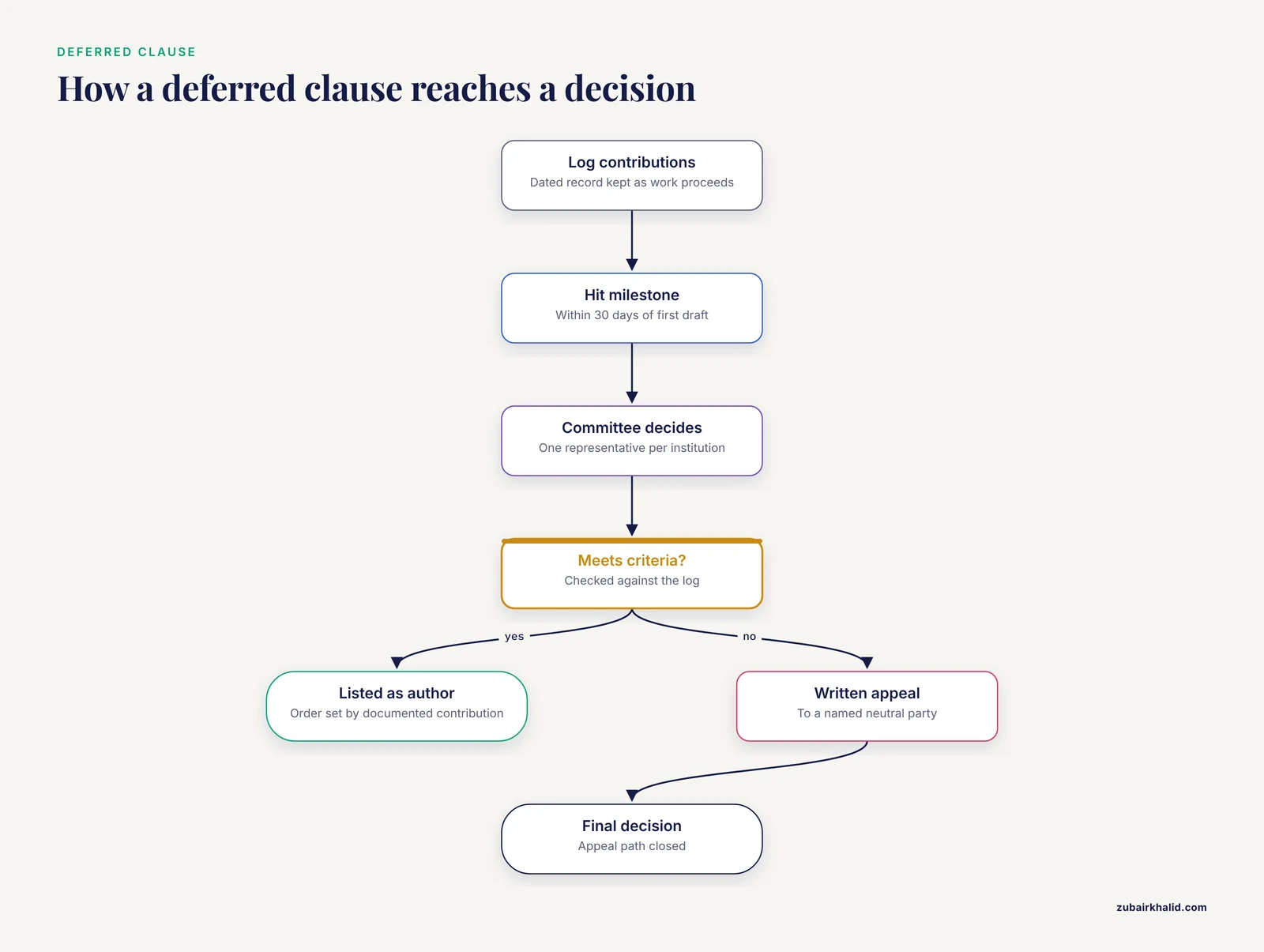
This clause postpones the authorship decision to defined milestones, but it locks in the decision process now. A well-drafted deferred clause specifies the milestone (for example, within 30 days of manuscript first draft), the decision-maker (a designated authorship committee of one representative per institution, or a named neutral party), the evidence the decision-maker considers (the contribution log, meeting minutes, data deposition records), and the appeal path.
This is the right choice when the team cannot predict contributions at signing, which describes most grant-funded multi-site projects. Its weakness is that "deferred" without a real procedure is simply a decision to fight later. A deferred clause with no named decision-maker and no deadline is worse than a fixed clause, because at least a fixed clause can be enforced.
Option 4: The Group Authorship Clause
This clause names a corporate author, such as "The EXAMPLE Consortium," on the manuscript, with individual members listed in an appendix, supplementary file, or public registry. Large-scale collaborative science uses this model because thousands of contributors cannot all appear on a byline in a meaningful order. Landmark efforts such as the Human Genome Project and large COVID-19 studies illustrate how group authorship operates at scale, and the same literature notes that such large collaborative works can distort citation metrics and complicate individual recognition [1].
A group authorship clause must answer questions that individual authorship clauses never face: Who controls the consortium name? What is the minimum contribution for inclusion in the member list? Who approves the final manuscript on behalf of the group? How will trainees prove their contribution for job applications, typically through a citable contribution statement or an individual contribution index?
Option 5: The Shared-Credit Clause
This clause handles equal or contested credit positions explicitly. It defines when co-first authorship applies (for example, when two individuals contributed comparably to analysis and drafting), how equal contribution is denoted on the manuscript, how journals are instructed to record it, and how the senior or corresponding author position is assigned. It also addresses the other end of the byline, since the last author position carries supervisory meaning in many biomedical fields.
This clause rarely stands alone. It is most often a module attached to a criteria-based or deferred clause, resolving the two positions, first and last, that carry the most career weight.
Side-by-Side Comparison of the Five Options
The table below is the core comparison. Read it against your team size and how predictable each person's contribution is.
| Criterion | Fixed named-author | Criteria-based | Deferred with procedure | Group authorship | Shared-credit module |
|---|---|---|---|---|---|
| Decision made when | At signing | At signing (the rule), at submission (the list) | At milestones after signing | At signing (the rule), continuously (the roster) | At signing for the rule, at submission for equal-contribution flags |
| Best fit | Two or three people, roles known and stable | Small to medium teams with documented contributions | Multi-site, unpredictable work | Consortia, dozens to thousands of contributors | Any clause, wherever two people may tie |
| Main strength | Simple, enforceable, no interpretation needed | Converts disputes into factual checks against a log | Flexibility without surrendering process | Scales to any team size | Resolves the highest-stakes byline positions |
| Main weakness | Brittle when the project changes | Borderline cases still need a judge | Useless without a named decision-maker and deadline | Individual credit is diluted and needs extra paperwork | Does not cover the middle of the byline |
| Dispute risk | Low while roles hold, high after changes | Low if records exist, moderate otherwise | Low only if the procedure is real | Moderate, concentrated in roster inclusion | Low |
| Career-stage fairness | Can freeze in early assumptions | Fair if logs are honest and complete | Fair if the referee is genuinely neutral | Depends entirely on the member-list criteria | High, because ties are named rather than split arbitrarily |
| Journal compatibility | High | High | High | Requires journals that accept group authorship | Requires journals that support equal-contribution notation |
The pros and cons line up cleanly. Fixed clauses buy certainty at the cost of flexibility. Criteria-based clauses buy fairness at the cost of record-keeping discipline. Deferred clauses buy adaptability at the cost of needing a functioning governance mechanism. Group clauses buy scale at the cost of individual visibility. Shared-credit modules buy precision where the career stakes are highest.
How to Choose Among the Options
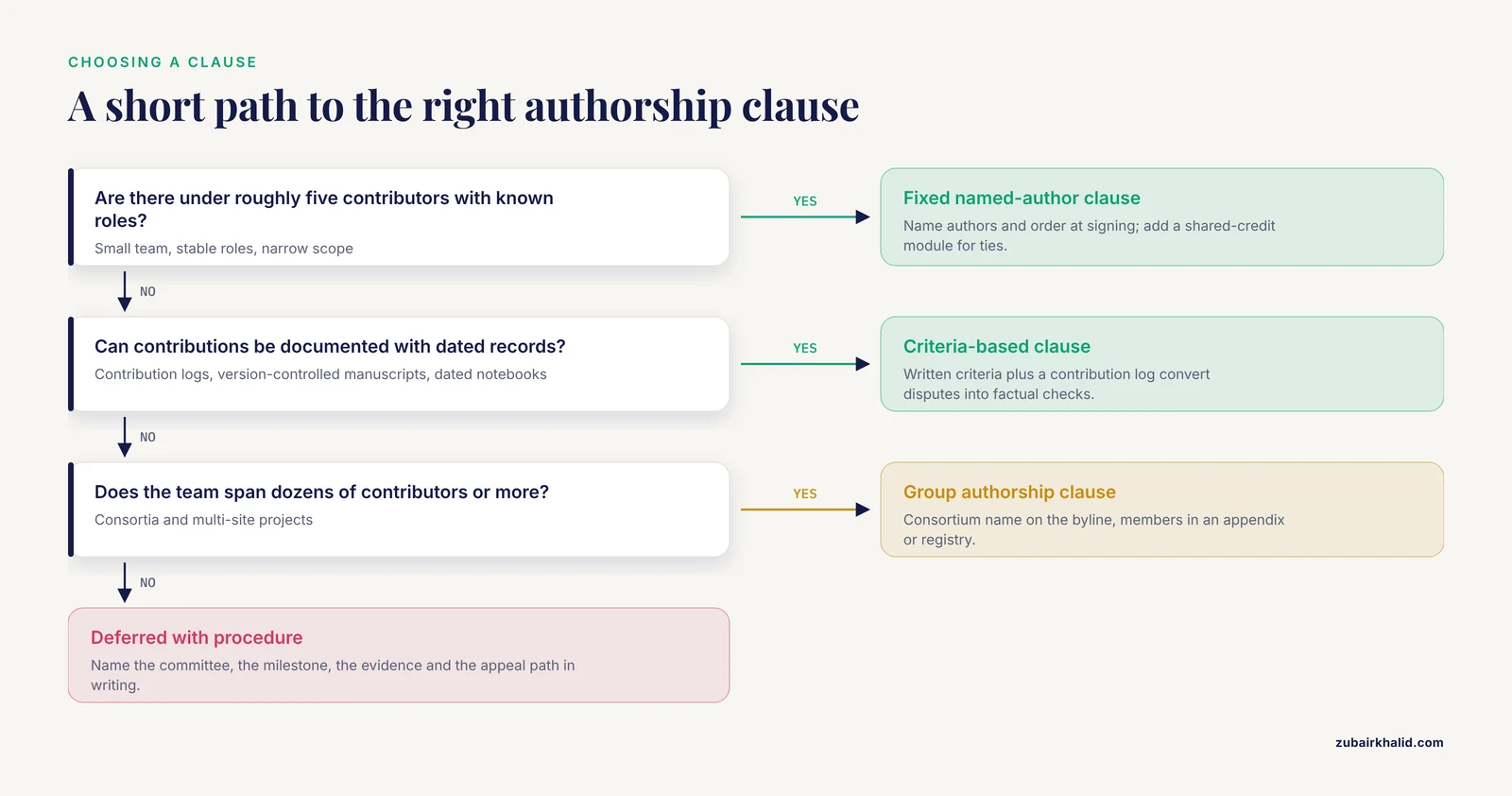
Five criteria decide most real choices. Work through them in order.
Team size and predictability
Count the people who will generate data or text. Under roughly five contributors with known roles, a fixed clause is defensible. Between five and a few dozen, a criteria-based clause with a contribution log is the standard answer. Beyond a few dozen, group authorship becomes the only workable structure.
Verifiability of contribution
A criteria-based clause is only as strong as its evidence. Research collaboration tools make the record-keeping feasible: shared project management boards, version-controlled manuscripts that attribute each edit, laboratory information systems that timestamp sample processing, and dated analysis notebooks all serve as contribution logs. If your collaboration already generates this evidence as a byproduct of good practice, choose the criteria-based option. If your workflow produces no attribution trail, either build one before signing or choose the deferred option with a neutral referee.
Power balance across the team
Authorship disputes are rarely symmetric. A graduate student negotiating with a senior investigator on another campus is not negotiating as an equal. Qualitative research on collaborative projects shows that power imbalances shape decisions throughout the research process and that reducing them requires proactive, deliberate structuring rather than good intentions [4]. Studies of student and trainee research experiences find that mentorship and guidance are central to whether trainees succeed in collaborative projects, which means the senior partner usually controls both the work and the credit structure [5]. If your team includes trainees, staff scientists, or community partners with less institutional power, the clause should protect them structurally, through written criteria and an appeal path, rather than relying on negotiation at submission time.
Career stage of the most vulnerable participant
Ask who has the most to lose. A tenure-track investigator needs first or last author positions on specific papers. A doctoral student may need a first-author paper to graduate. Studies of trainee-led research document that students value mentorship and peer support in completing projects, and that barriers, not lack of motivation, are what derail them [5]. A clause that guarantees a defined credit position for the trainee role, contingent on documented contribution, prevents the most common and most damaging outcome, which is a trainee who did the work and appears in the acknowledgments.
Journal and funder compatibility
Before signing, confirm that your target journals accept the structure you plan to use. Most biomedical journals accept individual authorship with equal-contribution notation without difficulty. Group authorship is accepted by major journals but requires following each journal's consortium-name policy. Funder plans for data sharing and dissemination should also be checked, because some funders require acknowledgment of specific personnel. In community-engaged research, practitioners and community partners have been documented as difficult to engage meaningfully from project design through dissemination, and authors working in such settings recommend actively engaging those partners from the beginning [6]. If your collaboration includes such partners, the clause should state plainly whether they will be authors, not merely acknowledged.
Which Option Is Best for Your Collaboration
The phrase "best collaboration agreement authorship clause" has no single answer, but it has a short answer per scenario. These three worked examples cover the common cases.
Scenario 1: Two laboratories, one shared experiment
A structural biology lab and a cell biology lab agree to co-crystallize a protein complex one lab purified and the other characterized functionally. Each side has one postdoc doing the hands-on work. The predictability is high and the team is small.
Best choice: a fixed named-author clause with a shared-credit module. Name both postdocs as co-first authors if the analysis is genuinely joint, name both PIs as co-senior authors, and write the order down. Add one sentence stating that any personnel change requires a written amendment. This takes twenty minutes at signing and prevents the entire category of dispute.
Scenario 2: A multi-site grant consortium
Six sites, twenty investigators, several technicians and analysts, and no way to know at signing which site will produce the pivotal dataset. This is the domain of the deferred clause with a real procedure, or a hybrid in which core investigators are named as guaranteed authors and additional authors are added under criteria-based rules as the work matures.
The clause should name the authorship committee, set the decision milestone relative to manuscript milestones, require a dated contribution log as evidence, and give any excluded person a written appeal to a neutral party. International consortia should note that cross-border teams are now the norm in many fields, with collaboration network analyses of highly cited surgical literature showing dense multi-country authorship [2], which means the procedure must work across time zones and institutional policies, not just across the hallway.
Scenario 3: A partnership with a community organization
A university team collaborates with a service organization whose staff and clients contribute expertise that neither side could supply alone. Research on such partnerships shows that co-constructed projects can produce outcomes valuable to both theory and practice when the collaboration is structured deliberately, and that interpersonal relationships carry much of the working load [4]. The same body of work shows that when logistical barriers accumulate, ethical problems follow, including difficulty engaging partners meaningfully from design through dissemination [6].
Best choice: a criteria-based clause that defines the partner organization's contributions in advance (recruitment, contextual interpretation of data, review of interpretations) as qualifying activities, plus a named partner representative with a guaranteed authorship or co-authorship position on any paper drawing substantially on partner-generated insight. Vague intentions to "involve the partner" do not survive contact with a submission deadline.
Drafting the Clause: Language That Holds Up
Whatever option you choose, a usable clause contains the following elements. Missing any one of them is the most common drafting failure.
- The eligibility standard. Either named individuals, or written criteria (ICMJE-style or CRediT-mapped), or both. State that meeting the criteria confers a right to authorship, not merely eligibility for consideration.
- The order rule. State the default (for example, descending order of documented contribution) and the exception (shared first or shared last positions, denoted with the journal's standard notation).
- The evidence requirement. Name the contribution log or equivalent record, who maintains it, and how often it is updated. A log updated only at submission is a post-hoc rationalization, not a record.
- The change procedure. Who may propose adding or removing an author, what notice is required, and what consent is needed. For fixed clauses, this means a written amendment. For deferred clauses, this is the committee process itself.
- The corresponding author designation. Name the person and the successor if they leave.
- The acknowledgment pathway. Define how contributors who do not meet authorship criteria will be recognized, because honest acknowledgment is also a defense against gift authorship pressure, which the authorship-inflation literature identifies as a persistent driver of inflated author lists [1].
- The dispute path. A named neutral party, a response deadline, and a final decision mechanism. Without this, every other element is aspirational.
- Persistent identifiers. Require ORCID identifiers for all authors so that credit attaches to the person across institutions and name changes, a standard practice in modern research infrastructure.
A final drafting point on measurement. The same literature that documents authorship inflation also documents how citation metrics and the Matthew Effect, the tendency of already prominent researchers to accumulate further credit regardless of individual contribution, skew recognition in collaborative work [1]. A clause that ties credit to documented contribution is the contractual counterweight to that dynamic, because it anchors the byline to the project record rather than to reputation.
Common Mistakes and Limitations
These are the errors that appear repeatedly when otherwise well-run collaborations fail over credit.
- Treating the clause as finished at signing. Teams sign an agreement, file it, and never revisit it until the first manuscript. Schedule a review of the authorship section at each project milestone, and update the contribution log continuously.
- Leaving the deferred clause empty. A clause that says authorship "will be determined by mutual agreement" delegates the fight to the worst possible moment, the submission deadline, when leverage is highest and goodwill is lowest. If you defer, defer to a named mechanism.
- Conflating authorship with ownership. Authorship and intellectual property ownership are separate legal questions. Someone can own patent rights in an invention and appear nowhere on the resulting paper, and vice versa. Keep the clauses separate and cross-reference them rather than merging them.
- Assuming trainees will be protected by senior authors. Power imbalance research shows that informal reliance on the goodwill of the more powerful party reproduces the imbalance [4]. Put trainee credit positions in writing.
- Using authorship as a currency. Adding a funder, an administrator, or a department head who did not meet the criteria is gift authorship, and it is the behavior most directly implicated in authorship inflation [1]. It also weakens your own claim the next time you need to enforce the criteria against someone else.
- Ignoring the acknowledgments section entirely. Teams that have no defined acknowledgment pathway end up either excluding genuine contributors or inflating author lists to avoid conflict. Define the boundary in the clause.
- Assuming the clause binds journals. A journal applies its own authorship policies to the manuscript in front of it. The clause binds the collaborators to each other, which is its purpose, and a well-documented contribution record also satisfies most journal integrity inquiries.
One limitation applies to everything above. This article describes standard contracting practice for research collaborations, not legal advice for a specific agreement. Institutional technology transfer offices, research integrity officers, and counsel should review any agreement before signature, and individual disputes may need advice from a qualified professional.
Frequently Asked Questions
What is an authorship clause in a collaboration agreement?
It is the contract section that defines who will be listed as an author on publications from the collaboration, in what order, and by what procedure the list can change. It sits alongside, and is legally separate from, the sections covering data ownership and intellectual property.
Which authorship clause option is best for a small two-lab collaboration?
A fixed named-author clause, usually with a shared-credit module, is the best fit when the team is small and roles are stable. Name the individuals and the order at signing, and require a written amendment for any change.
Can an authorship clause be changed after signing?
Yes, through the amendment mechanism the agreement itself provides. Most agreements allow written amendment with the signature of an authorized representative from each party, and a change that affects only the authorship section can often be handled with a short standalone amendment rather than renegotiating the whole agreement.
How does a group authorship clause handle individual credit?
The manuscript carries the consortium name, and individual members are listed in an appendix, supplement, or public registry, with each member's specific contributions described in an accompanying statement. Members should keep their own documented contribution records for CVs, grant applications, and promotion cases, because the consortium byline alone does not convey individual credit.
What should a junior researcher look for in an authorship clause?
Look for written, criteria-based eligibility, a guaranteed credit position contingent on documented contribution, a defined order rule, and an appeal path that does not run solely through their own supervisor. Trainee research experiences show that mentorship and structured support determine whether trainees complete collaborative projects successfully, so structural protections matter more than verbal assurances [5].
Do journal and funder policies override an authorship clause?
They operate in parallel rather than one overriding the other. The clause binds the collaborators to each other, while the journal applies its own authorship policies to the submitted manuscript and the funder enforces its own dissemination requirements. A clause aligned with widely accepted authorship criteria will rarely conflict with either.
Sources
- Challenges in Academic Authorship and Citation Metrics: Navigating Inflation, Biases, and the Rise of Evidence Synthesis.
- Citation landscape and research themes of robotic-assisted total hip arthroplasty: a bibliometric analysis of the 100 most-cited English-language publications in the Web of Science Core Collection.
- Advances in intelligent assistance operative adjuncts for unicompartmental knee arthroplasty: A bibliometric analysis of research trends and developments.
- Navigating power imbalances in research with children and young people in shelters for domestic violence.
- Undergraduate Nursing Students' Experiences in Graduation Research Projects: A Descriptive Phenomenological Study.
- When practical barriers create ethical challenges to research with women in prison: Recommendations for researchers to advance women's health.