How to Improve Clarity in Your Grant Writing
By Dr. Zubair Khalid, DVM, MS, PhD ·

By the end of this article, you will be able to plan a grant proposal around a single readable argument, draft each required section so a tired reviewer can follow it on the first pass, run a concrete revision checklist on your own text, and avoid the writing mistakes that reviewers at funding bodies report most often. You will need three things on hand before you start: the funder's solicitation or program guidelines, your current draft or outline, and the scoring rubric or review criteria your funder publishes.
Clarity in grant writing is not a style preference. It is the difference between a reviewer who can reconstruct your logic in one reading and a reviewer who must guess what you meant. Reviewers read many proposals in a short window, often outside working hours, and they score what they understand. Editorial analyses of submitted manuscripts find the same recurring weaknesses again and again, including vague problem framing, weak organization, and grammatical noise that distracts from the science [1][2]. Grant writing inherits every one of those weaknesses and adds a layer of high stakes.
Why Clarity Decides Funding Outcomes
Grant review is a timed, structured exercise. A reviewer assigned to your proposal usually reads it once, closely, and then scores it against published criteria such as significance, approach, innovation, investigator, and environment. Anything the reviewer cannot find or cannot follow works against you, because there is no second chance to explain. Experienced grant writers and proposal development specialists describe this as the core constraint of the genre: the document must make the case on its own, to a part-expert audience, under time pressure [3].
Grant writing has also become a standardized, institutionalized practice in academia, with conventions that reviewers expect to see honored [4]. When your proposal deviates from the expected structure, the reviewer spends effort on navigation instead of evaluation. That effort is rarely neutral. The practical conclusion is simple: clarity is a scoring strategy, not a decoration.
Grant Proposal Planning Comes Before Sentences
Most unclear proposals are not written badly. They are planned badly, then written to hide the gaps. Structured guides to proposal development treat planning as its own stage, with defined components that must exist before drafting begins: a needs statement grounded in evidence, a project description, a budget, an evaluation plan, and supporting documents [5]. A structured approach to the full grant cycle, from identifying funders through post-submission management, makes the same point across every chapter: decide what you are arguing before you argue it [6].
Effective grant proposal planning answers four questions in writing before any prose is drafted:
- What problem does the project address, and why does it matter to this funder right now?
- What gap in knowledge or capacity does the project fill?
- What will the project do, in what sequence, and how will you know it worked?
- Why is this team, at this institution, the right one to do it?
A workshop-based introduction to grant writing frames the same sequence as core skills: decode the funder's language, develop a realistic budget, write a persuasive narrative, and anticipate common application pitfalls [7]. Notice the order. Budget and narrative come after decoding the funder, not before. Teams that skip the planning stage usually produce prose that circles the research question instead of answering it, and reviewers notice the circling within the first page.
Clarity in Grant Writing Step by Step
The walkthrough below assumes a standard investigator-initiated research proposal with a short narrative summary page and a longer research plan. Adapt the page limits to your funder. Each step produces a checkable output.
Step 1. Convert the solicitation into a compliance checklist
Open the program guidelines and extract every requirement into a plain list. Copy the funder's own words for page limits, formatting, required sections, and review criteria.
COMPLIANCE CHECKLIST (example)
Funder: (name and program)
Deadline: (date and time zone)
Page limits:
  Project summary: ___
  Research narrative: ___
  References: ___
  Budget justification: ___
Required sections in order:
  [ ] Specific aims / objectives
  [ ] Background and significance
  [ ] Approach / methods
  [ ] Timeline
  [ ] Broader impacts / evaluation plan
Review criteria, in the funder's words:
  1. ...
  2. ...
  3. ...
Formatting rules: font ___ margins ___ spacing ___
The output is one page. If you cannot fill it from the guidelines, you do not yet understand the solicitation, and no amount of good prose will fix that.
Step 2. Build a one-page argument skeleton
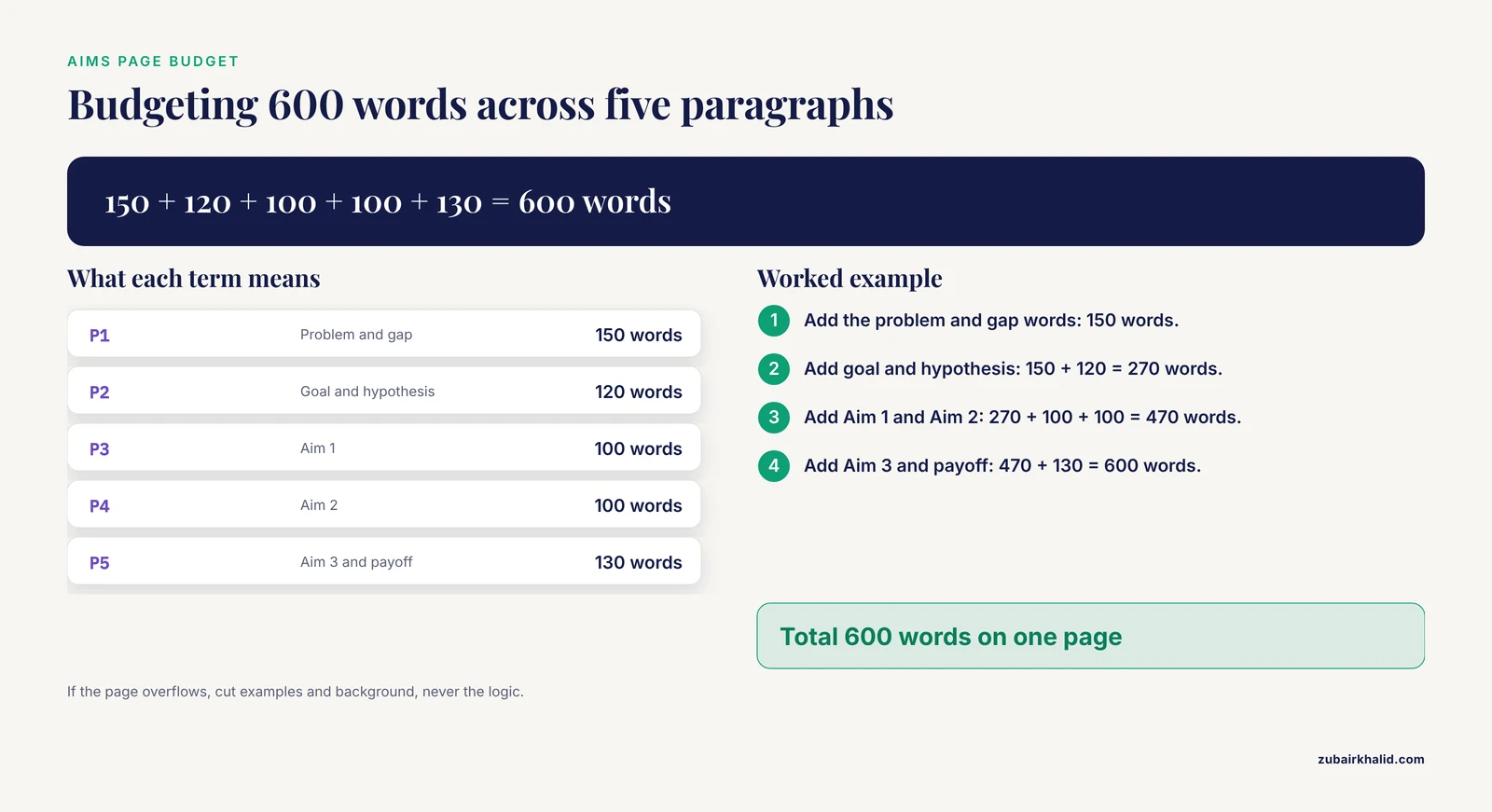
Write the whole proposal as a single page before writing any section. For research proposals this page is often called the specific aims page. Allocate words deliberately so the argument fits the space.
AIMS PAGE WORD BUDGET (one page, approximately 600 words)

Paragraph 1  Problem and gap            ~150 words
Paragraph 2  Long-term goal and
             central hypothesis         ~120 words
Paragraph 3  Aim 1 (what, how, why now) ~100 words
Paragraph 4  Aim 2                      ~100 words
Paragraph 5  Aim 3 + payoff statement   ~130 words

Check: 150 + 120 + 100 + 100 + 130 = 600 words
The arithmetic matters because overflow is the most common cause of creeping unclearness. When a page overflows, writers compress by cutting connective tissue, and the logic becomes invisible. Budgeting words per paragraph forces compression where it is safe, inside examples and background, rather than inside the argument.
Step 3. Write the gap statement as a funnel
Introductions fail in predictable ways. Analyses of common introduction mistakes across scientific writing identify lack of clarity, ineffective framing of the research problem, inadequate synthesis of prior work, and poor structure as the leading problems [1][8]. The fix is a four-sentence funnel:
GAP STATEMENT TEMPLATE

Sentence 1  What is known.        "Prior work has established X."
Sentence 2  What is unknown.      "However, Y remains unresolved."
Sentence 3  Why the gap matters.  "This gap blocks Z."
Sentence 4  Your question.        "This project asks Q."
Each sentence should name concrete content, not categories. "However, the cellular mechanism linking A to B remains unresolved" is clear. "However, more research is needed in this area" is not, because it could head any paper in the field. Weak gap statements are the single most common reason an introduction reads as filler, and reviewers begin discounting everything that follows [1][8].
Step 4. Draft aims as testable sentences
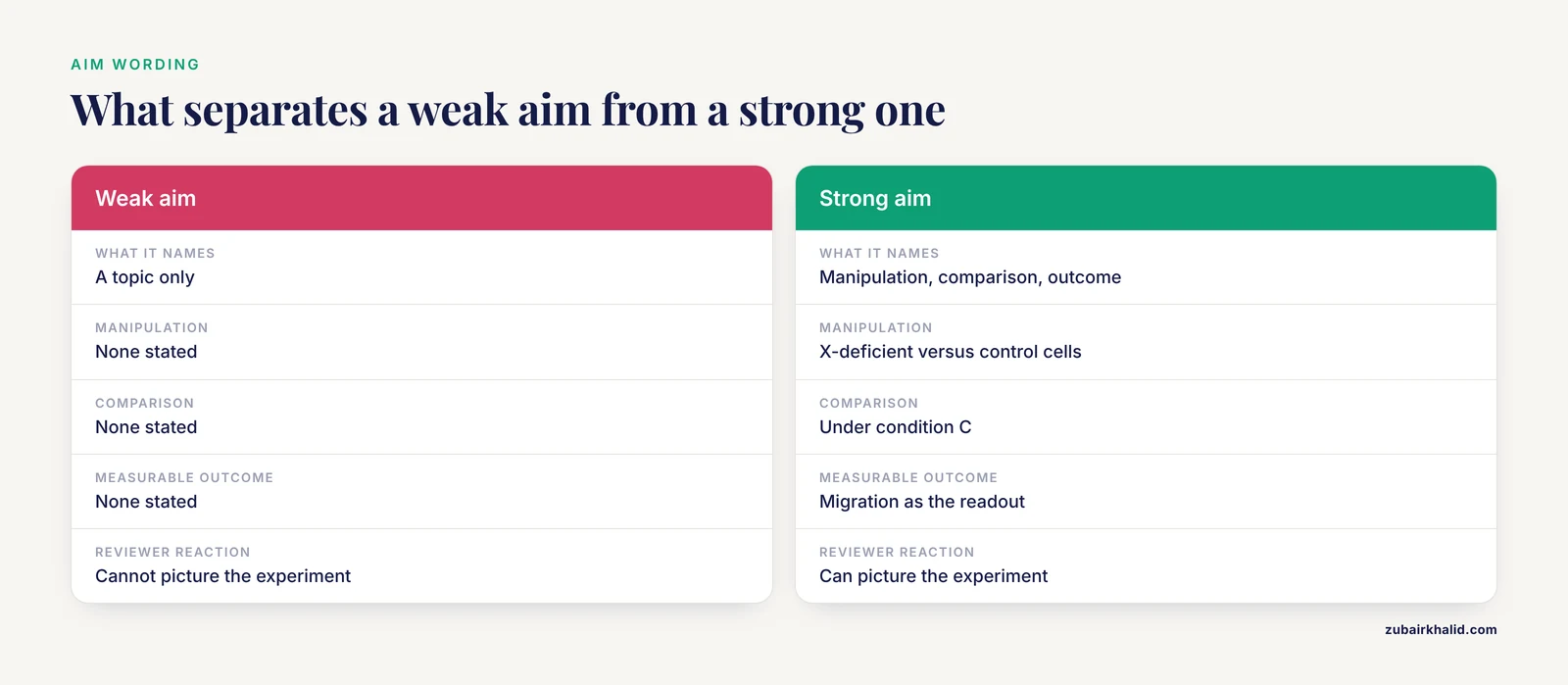
An aim is clear when a reader can imagine the experiment that would satisfy it. Test each aim against three questions: What will you do, on what material or population, and what result would count as success?
WEAK AIM
  "To better understand the role of protein X."

STRONG AIM
  "Determine whether protein X is required for
   cell migration, by comparing migration in
   X-deficient and control cells under condition C."
The weak version names a topic. The strong version names a manipulation, a comparison, and a measurable outcome. Guides on writing research papers repeatedly flag vague objectives and underdeveloped arguments as quality killers, and the same defect is fatal in a grant because the aim is the unit the reviewer scores against [9].
Step 5. Match every aim to methods, data, and analysis
Clarity at the proposal level means the reviewer can trace a straight line from question to method to expected result to interpretation. Build the map explicitly and keep it in front of you while drafting.
| Aim | Method or design | Data produced | Analysis | Decision the result supports |
|---|---|---|---|---|
| Aim 1 | (specific technique) | (specific readout) | (specific test) | (what you conclude if positive or negative) |
| Aim 2 | ... | ... | ... | ... |
| Aim 3 | ... | ... | ... | ... |
If any row cannot be filled in, that aim is not ready to be written. Proposal development specialists who help faculty avoid common pitfalls report that gaps between aims and methods are among the issues they catch most often before submission [3].
Step 6. Do a sentence-level clarity pass
Once the architecture is sound, revise sentences for directness. The transformations below are mechanical, so you can apply them as a checklist rather than as taste.
BEFORE (buried action, passive, hedged)
  "It is suggested that investigations into the
   mechanisms whereby X influences Y may be of
   value in informing therapeutic development."

AFTER (actor, action, object)
  "We will test whether X drives Y, which would
   identify a new therapeutic target."
Three rules generate most of the improvement. Put the actor before the verb. Replace nominalizations, nouns built from verbs such as "investigation," "characterization," and "utilization," with the verbs themselves. Delete hedges that signal nothing, such as "may somewhat," "it could be argued," and "further study is warranted." Editors who catalog recurring manuscript problems put exactly these defects, grammatical noise, wordiness, and imprecise language, at the top of the list of issues that make reviewers lose patience [2].
Step 7. Run a cold read and a reverse outline
Hand the near-final draft to a colleague outside your subfield and ask for one thing only: a paragraph-by-paragraph summary in their own words. Then compare their summary to your intended argument.
COLD READ CHECK
For each paragraph, record:
  [ ] Reviewer's one-line summary of the paragraph
  [ ] Your intended one-line message
  [ ] Match? Y / N

Pass criterion: every paragraph matches, and the
sequence of summaries retells your argument in order.
If the summaries drift from your intent, the prose is failing, not the reader. Fix the mismatched paragraphs and repeat. If the summaries match but the sequence is wrong, fix the outline and repeat. This two-loop check catches both sentence-level and structure-level unclearness, and it takes an afternoon.
Clarity in Grant Writing Tips That Survive Review
The tips below are the ones that make a measurable difference on a second draft.
Signpost every section. Open each major section with one sentence that states what the section will establish and how it connects to the previous section. Reviewers who put a proposal down and pick it up later rely on these markers to resume without rereading.
Define terms once, early, and use them consistently. If you call the same construct "resilience" in one section and "recovery capacity" in another, a reviewer will wonder whether you mean two things. Analyses of thematic writing in qualitative research make the parallel point that labels must be specific and revealing rather than generic summaries, and that evidence, such as quoted material, should be interpreted within your argument rather than dropped in as decoration [10]. The same discipline applies to grant prose: every term, acronym, and measure gets one name and one definition.
Write numbers where a reader would ask for them. Sample sizes, timeframes, effect sizes you consider meaningful, and milestones belong in the text, not only in tables. A reviewer who has to hunt for a number assumes it is unfavorable.
Use headers that make claims, not labels. "Aim 2 tests whether X is required for Y" carries information that "Aim 2" does not. Claim-style headers let a skimming reviewer absorb your argument from the headings alone, which is exactly how many reviews actually proceed.
Keep one idea per paragraph. Organizational errors, meaning paragraphs that mix topics or bury the topic sentence, are among the most frequent defects found in audits of academic writing [9][11]. In a grant, a mixed paragraph reads as fuzzy thinking about the experiment itself.
Edit in separate passes. Do one pass for logic, one for sentence mechanics, one for formatting and citation accuracy. Trying to fix everything at once is how grammatical errors and broken references survive to submission [9].
Common Mistakes and Limitations
The mistakes below recur across grant-writing guides and editorial reviews of submitted work. Each comes with its fix.
Mistake 1. Framing the problem vaguely. Introductions that never state a specific gap force reviewers to infer your contribution. Fix it with the four-sentence funnel in Step 3.
Mistake 2. Summarizing prior work instead of synthesizing it. A list of citations arranged chronologically is not an argument. Group prior studies by what they established and what they left open, so the gap appears as the natural conclusion of the paragraph.
Mistake 3. Proposing more than the timeline and budget support. Ambition reads as unclearness when the workplan cannot carry it. Structured proposal templates place the budget, timeline, and evaluation plan alongside the project description precisely so their consistency can be checked [5]. If your aims require three staff years but the budget funds one, say so and cut an aim.
Mistake 4. Vague objectives and unmeasurable outcomes. "To explore," "to assess," and "to gain insight into" are red flags. Replace them with verbs that commit to a deliverable.
Mistake 5. Grammatical and formatting noise. Spelling inconsistencies, broken citations, and formatting drift signal carelessness to a reviewer who must judge the care you will take with data. Practical guides recommend a dedicated final pass for mechanics and citation accuracy, performed on a printed or reformatted copy so the eye cannot slide over familiar text [9].
Mistake 6. Ignoring the funder's own vocabulary. Review criteria are written in specific words. Proposals that answer the criteria in the funder's terms are easier to score favorably than proposals that answer a parallel question in the applicant's terms [7].
Mistake 7. Treating the budget narrative as an afterthought. A budget that a reviewer cannot reconcile with the workplan undermines trust in the entire proposal. Justify each line against a specific activity.
Two limitations of any clarity advice deserve honest statement. First, clarity cannot rescue a weak scientific premise. If the preliminary data do not support the hypothesis, the clearest prose in the field will not save the proposal. Second, individual funding decisions depend on the specific program, review panel, and competition cycle, so treat the guidance here as a craft checklist rather than a prediction of any single outcome.
Writing Clearly as a Team
Many proposals are written by several people, and multi-author drafting is a special threat to clarity because sections arrive in different voices with different assumptions. Experience with collaborative federal proposal development points to practical controls: agree on the argument skeleton before anyone drafts, assign one person as the single editor of the final voice, and schedule integrated editing sessions where the whole group reads the assembled document aloud [12]. Campus-level grant-writing programs add a complementary practice, using internal peer review from colleagues who know the funder but not the project, which simulates the reviewer's position [13]. A team that skips integration produces a proposal that reads like an anthology. Reviewers score it accordingly.
Getting Better Faster
Clarity in grant writing improves fastest with feedback cycles, and structured training shortens the loop. Workshop-based courses in grant writing pair instruction with practical examples from successful applications and interactive exercises, which lets you practice decoding funder language and revising narratives with immediate feedback [7]. Comprehensive texts on the grant process provide templates, sample proposals, and budget structures you can imitate directly [6][5]. The most efficient path combines the two: take a research grant writing course or workshop for the framework and worked examples, then apply the step by step workflow in this article to your live draft under a mentor's or colleague's cold read.
Frequently Asked Questions
What does clarity in grant writing actually mean?
It means a reviewer can state your problem, approach, and expected payoff after one reading, without guessing. Every section names its purpose, every aim is testable, and every number the reviewer needs is where the reader needs it.
How early should I start grant proposal planning?
Start weeks or months before drafting, as soon as you know the funder. Planning answers the problem, gap, workplan, and team questions first, so the prose has an argument to carry instead of one to discover.
What is the fastest way to test whether my proposal is clear?
Give the draft to a colleague outside your subfield and ask for a paragraph-by-paragraph summary. Compare their summaries to your intended argument, and revise wherever the two diverge.
Do sentence-level issues really affect scores?
Yes. Reviewers read under time pressure, and recurring defects such as passive buried verbs, hedging, and grammatical noise cost attention that the science needs. Editors report these as the most common weaknesses in submitted manuscripts.
How do I keep a specific aims page clear?
Budget roughly 600 words across five paragraphs, funnel from known to gap to question, and write each aim with a manipulation, a comparison, and a success criterion. If the page overflows, cut examples, never logic.
Should I take a research grant writing course or learn by doing?
Do both if you can. A course gives you the framework, decoded funder language, and worked examples in a compressed time frame, while applying the workflow to a live draft with a cold reader converts that framework into skill.
How do we keep clarity when several people write one proposal?
Agree on the one-page argument skeleton first, assign a single final editor for voice, and hold integration sessions where the full team reads the assembled draft aloud against the compliance checklist.
How much detail belongs in the budget narrative?
Enough that a reviewer can match every major line item to a specific activity in the workplan. Justify personnel, equipment, and travel against named aims rather than presenting totals without support.
Sources
- Writing an Impactful Introduction in Business and Management Research: Avoiding Common Pitfalls
- Avoiding Common Writing Mistakes That Make Your Editors and Reviewers Cringe
- Facilitating Proposal Development: Helping Faculty Avoid Common Pitfalls
- The Way We Ask for Money… The Emergence and Institutionalization of Grant Writing Practices in Academia
- Teaching Paper: Writing a Grant Proposal
- Grant Writing Mastery
- Intro to Grant Writing
- Common mistakes in writing introduction of a scientific journal article
- Navigating the Pitfalls in Research: Avoiding Common Errors While Writing a Paper
- Thematic Analysis in Qualitative Research: Common Pitfalls and Practical Insights for Academic Writing
- Examining University Students' Business English Writing Performance: Frequent Errors and Pitfalls
- Strategies for Increasing the Efficacy of Collaborative Grant Writing Groups in Preparing Federal Proposals.
- Campus Level Grant Writing: Leveraging Teacher Talent to Access External Funding