How to Write a Lab Report Introduction: Chemistry Example
By Dr. Zubair Khalid, DVM, MS, PhD ·

By the end of this guide you will be able to write a chemistry lab report introduction that moves from broad context to a specific purpose, states a testable hypothesis, cites prior work correctly, and fits your course rubric. You will work through a step-by-step walkthrough built on a classic experiment, the synthesis of aspirin, and you will see a complete model paragraph you can compare against your own draft.
Have three things on hand before you start: your lab handout or procedure sheet, your raw data and observations from the bench, and the grading rubric your instructor distributed. A published paper from your subfield also helps as a style model, and this article points to two real examples you can study.
What a Lab Report Introduction Actually Does

An introduction is a short argument, not a summary of the procedure. It answers four questions in order:
- Why does this topic matter to chemists?
- What is already known about it?
- What is missing, unresolved, or untested in the context of your experiment?
- What did you set out to do, and how?
This structure is called a funnel. It starts wide and narrows to a single sentence of purpose. Professional papers follow the same shape. A review of isocyanide-based polymer chemistry opens with the historical origin of the field, noting that interest in isocyanide reactions traces back to the Passerini reaction first reported in 1921, before narrowing to the modern problem that most of these reactions had not been developed into efficient polymerization methods, which limited large-scale preparation and applications [1]. The gap statement and the purpose statement arrive only after the reader knows the history.
The same funnel appears outside chemistry. A study of HIV-1 genetic subtypes in Italy begins with the global classification of the virus into groups and subtypes, narrows to the subtype B epidemic sustained by intravenous drug users and men who have sex with men, and then narrows further to the specific shift toward heterosexual transmission and the introduction of non-B variants [2]. The reader reaches the study's justification without ever feeling lost. Your lab report introduction should give a teaching-lab version of that same experience in one or two paragraphs.
Where the Introduction Sits in the Lab Report Format
Most chemistry courses use a variant of the standard lab report format. The order below matches what most general and organic chemistry instructors expect.
| Section | What it contains | Typical length |
|---|---|---|
| Title | Descriptive name of the experiment, not the manual's name | 5 to 15 words |
| Abstract | Full report in miniature, including one key result | 100 to 200 words |
| Introduction | Context, prior work, gap, purpose, hypothesis, approach | 1 to 2 paragraphs |
| Methods (Experimental) | Reagents, amounts, instruments, conditions, in past tense | 0.5 to 2 pages |
| Results | Data, tables, figures, observations, no interpretation | 1 to 3 pages |
| Discussion | Interpretation, error analysis, comparison to literature | 1 to 3 pages |
| References | Cited sources in your course's required style | Varies |
The introduction is the third element a reader encounters, but experienced writers draft it last or revise it last, after the results and discussion exist. Writing it first risks a mismatch between what you promised and what you actually measured. Drafting a rough version before the lab and rewriting it after data analysis is the most efficient approach.
Chemistry Lab Report Introduction Example Step by Step
This walkthrough uses a common general chemistry experiment, the synthesis of aspirin (acetylsalicylic acid) from salicylic acid and acetic anhydride. Follow the seven steps in order and write your draft in a plain text file as you go.
Step 1: Collect your inputs
Open three documents side by side: the lab handout, your notebook, and the rubric. From the handout, extract the reaction, the reagents, and the analytical tests. For the aspirin experiment those are usually salicylic acid, acetic anhydride, a few drops of phosphoric acid or sulfuric acid as a catalyst, a hot water bath around 80 to 90 degrees Celsius, and purity checks by ferric chloride test and melting point. From your notebook, note your actual masses and your melting point range. From the rubric, note how many points the introduction is worth and whether a hypothesis is explicitly required.
Step 2: Write the context sentences
Answer the question "why does anyone care about this reaction?" in one or two sentences, at a level a first-year student can follow. Avoid encyclopedia history. For aspirin, the context is that salicylates have been used for pain relief for over a century, but salicylic acid itself irritates the stomach, so chemists modify it by acetylation to produce a better-tolerated drug.
Step 3: State what is known
Summarize the relevant chemistry in two or three sentences. This is where you identify the functional group transformation, the mechanism family, and any literature values you will compare against. For the aspirin experiment, the known chemistry is that acetic anhydride acetylates the phenolic hydroxyl group of salicylic acid, that the reaction is acid-catalyzed, and that pure acetylsalicylic acid has a published melting point near 135 degrees Celsius. Cite your textbook or a reference source for the literature melting point.
Step 4: State the gap in one sentence
In a teaching lab, the gap is usually a question the experiment is designed to answer, not a hole in the scientific literature. Be honest about this. A course lab does not claim to resolve an open research problem. The gap sentence for aspirin looks like this: "This experiment tests whether the acetylation of salicylic acid can be carried out on a bench scale with high yield and whether the product's purity can be verified by simple melting point and ferric chloride analysis."
Notice how published authors phrase the equivalent sentence. The isocyanide polymer review states plainly that the major challenge was the lack of highly efficient polymerization methods and that this limited large-scale preparation, then announces that the authors' investigations into catalyst exploration and polymerization methodology enabled a series of new polymers [1]. The sentence has two halves: the obstacle, and what the work does about it.
Step 5: State the purpose and, if required, the hypothesis
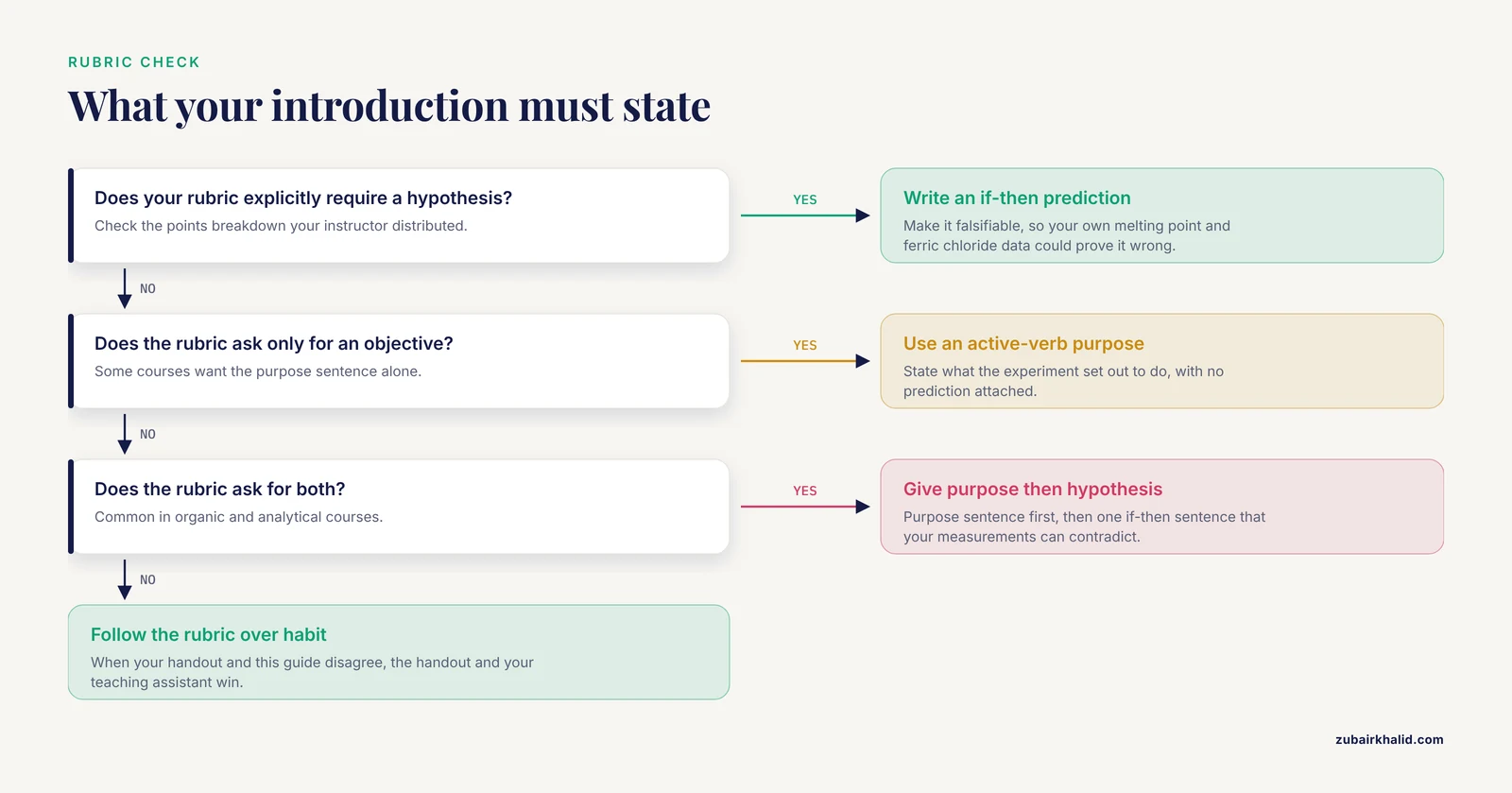
The purpose sentence begins with an active verb: "The purpose of this experiment was to synthesize acetylsalicylic acid from salicylic acid and to evaluate its purity." A hypothesis is a falsifiable prediction. For aspirin, a reasonable hypothesis is: "If the phenolic hydroxyl group of salicylic acid is successfully acetylated, then the product will show a negative ferric chloride test and a melting point range close to the literature value for pure acetylsalicylic acid." Check your rubric. Some courses want a hypothesis, some want an objective, and some want both.
Step 6: Describe the approach briefly
One sentence tells the reader how you did it: "The reaction was carried out with acetic anhydride in the presence of a phosphoric acid catalyst, followed by crystallization from water and characterization by melting point determination." Do not reproduce the procedure. The Methods section does that.
Step 7: Assemble, trim, and verify
Combine the pieces into one or two paragraphs. Then run three checks described later in this article: a length check, a reverse outline, and a read-aloud pass. To check length mechanically, save your draft and count the words:
python3 -c "print(len(open('intro_draft.txt').read().split()))"Expected output for a well-scoped introduction:
214Anything between roughly 150 and 300 words suits a typical course report. If your count exceeds 350, you are probably narrating the procedure or reviewing too much history.
The Complete Model Introduction
Here is a full example assembled from the seven steps. It is deliberately ordinary, the kind of writing that earns full marks without showing off.
Salicylic acid and its derivatives have been used to relieve pain and
fever for more than a century, but the free acid irritates the lining
of the stomach. Chemists reduced this irritation by acetylating the
phenolic hydroxyl group, producing acetylsalicylic acid, known
commercially as aspirin. Acetic anhydride is the standard acetylating
agent for this transformation, and the reaction is catalyzed by a
strong acid such as phosphoric acid. Pure acetylsalicylic acid melts
at approximately 135 degrees Celsius, which provides a convenient
benchmark for assessing product purity, and the phenolic hydroxyl
group of unreacted salicylic acid gives a characteristic purple
color with ferric chloride [1].

This experiment tested whether the acetylation of salicylic acid can
be carried out on a bench scale with acceptable yield and whether the
purity of the product can be verified by melting point determination
and the ferric chloride test. The hypothesis was that a successfully
acetylated product would show a narrow melting point range near the
literature value and a negative ferric chloride test. The reaction
was performed with salicylic acid and excess acetic anhydride in the
presence of a few drops of phosphoric acid, followed by crystallization
from water.
That model is about 200 words. It contains every required element in order and nothing else. Compare it sentence by sentence against your own draft.
A Second Model: Reading a Published Introduction as a Template
Published papers are the best free templates available, and you can borrow their architecture even when the chemistry is far beyond your course. The isocyanide polymer review mentioned above is worth reading only for its first paragraph. Its opening moves through three jobs in order: it names the historical anchor (the 1921 Passerini reaction), it names the obstacle (efficient polymerization methods for isocyanide-based polymers), and it names the contribution (catalyst exploration and new polymerization methodology that produced functional polymers with properties such as aggregation-induced emission) [1]. Strip away the specialized vocabulary and you have exactly the three-sentence spine your own introduction needs.
The HIV-1 study offers a different lesson. Its introduction funnels from the global classification of the virus, through the composition of the Italian epidemic, to the specific concern that heterosexual transmission had become prevalent and that new subtypes were entering the epidemic, ending with the statement that these changes may have significant implications [2]. The lesson for your writing is proportion. Each narrowing step gets roughly one sentence, and the reader never encounters a detail that has not yet been framed. Students most often break this rule by opening with a specific reagent before the reader knows why the reaction class matters at all.
Introduction Elements at a Glance
The table below summarizes the five load-bearing elements of a chemistry introduction, their function, and how much of the paragraph each should occupy.
| Element | Function | Share of introduction | Example opener |
|---|---|---|---|
| Context | Establish why the topic matters | 1 to 2 sentences | "Salicylates have been used..." |
| Prior work | State the relevant known chemistry | 2 to 3 sentences | "Acetic anhydride is the standard..." |
| Gap or question | Name what the experiment addresses | 1 sentence | "This experiment tests whether..." |
| Purpose and hypothesis | State exactly what you did and predicted | 1 to 2 sentences | "The purpose of this experiment was..." |
| Approach | Preview the method in one sentence | 1 sentence | "The reaction was carried out with..." |
A reusable scaffold built from this table looks like this in plain text:
[CONTEXT]    <topic> matters because <one concrete reason>.
[PRIOR WORK] It is known that <key reaction or principle>, and that
             <second established fact, with citation>.
[GAP]        This experiment tests whether <specific question>.
[PURPOSE]    The purpose of this experiment was to <action verbs>.
[HYPOTHESIS] If <condition>, then <measurable prediction>.
[APPROACH]   The reaction was performed using <reagents and method>,
             followed by <characterization method>.
Fill each bracket with one or two sentences and delete the labels before submitting.
Chemistry Lab Report Introduction Example Tips
These tips address the choices students ask about most often.
Use past tense for what you did. "The purpose of this experiment was to synthesize..." is correct because the work is finished. Use present tense only for established facts: "Acetic anhydride acetylates phenols."
Prefer passive voice or third person unless your instructor permits first person. "The product was recrystallized from hot water" is the default register in chemistry. Conventions vary between courses, so follow the rubric over any general rule.
Cite every factual claim that is not common knowledge. The literature melting point of aspirin, the mechanism class of the reaction, and any historical claim about salicylates need a citation. Your textbook, the CRC Handbook, or a primary paper all work. Match the citation style your department requires, commonly ACS style in chemistry courses.
Match the introduction to the level of the course. A general chemistry introduction can stay at the level of functional groups and purity tests. An organic chemistry or analytical chemistry introduction should engage the mechanism and the analytical method more precisely. The isocyanide review illustrates how a research-level introduction assumes expert readers and goes straight to the methodological problem [1], which is the opposite of what a first-year report should do.
Keep the hypothesis falsifiable. "The reaction will work" is not a hypothesis. "The product will show a melting point within 2 degrees Celsius of the literature value and a negative ferric chloride test" is one, because the data can prove it wrong.
Write the introduction last, but outline it first. A five-minute outline before the lab keeps your notebook focused. The full prose comes after you know your percent yield and melting point, so the purpose statement matches what the report actually delivers.
Common Mistakes and Limitations
These are the errors that cost the most points in graded reports, listed with the fix for each.
- Copying the handout. Instructors recognize their own sentences instantly. Restate the chemistry in your own words, or paraphrase with a citation.
- Narrating the procedure in the introduction. If a sentence names glassware, quantities, or step order, move it to Methods. The introduction's final approach sentence is the only exception, and it stays general.
- Revealing results. "The reaction produced a 78 percent yield" belongs in Results and, in summary form, in the Abstract. The introduction states what you set out to determine, not what you found.
- History dump. Three sentences on Felix Hoffmann and the Bayer company add nothing analytical. One sentence of context is enough for a course report.
- Missing or unfalsifiable hypothesis. If the rubric requires a hypothesis, write one that your data could contradict, as shown in Step 5 above.
- Uncited claims. A literature melting point or mechanism claim with no citation reads as borrowed material. Cite it.
- Wrong tense. Future tense ("we will synthesize") signals a proposal, not a report. Past tense throughout the purpose and approach sentences.
- No funnel. Opening with "In this experiment we synthesized aspirin" skips context and prior work entirely, and graders notice.
One limitation applies to everything above: rubrics differ between instructors and institutions, and some courses want a combined introduction-and-discussion format or a one-paragraph introduction. When your handout and this guide disagree, your handout and your teaching assistant win.
How to Check That Your Introduction Is Right
Run three verification passes on the finished draft.
Reverse outline. Label each sentence of your draft with its job: context, prior work, gap, purpose, hypothesis, approach. Every job should appear exactly once, in order. If two sentences share a label, merge them. If a sentence has no label, cut it or reclassify it.
Read-aloud pass. Read the paragraph out loud. Sentences you stumble over are usually too long or contain misplaced modifiers. Split them.
Consistency check against the Discussion. Open your Discussion section and confirm that every question raised in the introduction is answered there. If the introduction promises a purity assessment and the Discussion never interprets the ferric chloride result, one of the two sections needs revision.
A quick word-count and draft-history check can be run in the terminal:
wc -w intro_draft.txt
git diff --stat intro_draft.txt
Expected output on a healthy draft:
     214 intro_draft.txt
 1 file changed, 14 insertions(+), 9 deletions(-)
Heavy revision between the first draft and the final one is normal and usually improves the grade.
Frequently Asked Questions
How long should a chemistry lab report introduction be?
One to two paragraphs, or roughly 150 to 300 words, covers a typical course report. Follow your rubric if it specifies a length.
Should I write the introduction before or after the experiment?
Write a short outline before the lab so your data collection targets your stated purpose, and write the full prose after analyzing your results so the introduction matches what the report actually shows.
Do I include results in the introduction?
No. Results belong in the Results section and, compressed to a sentence, in the Abstract. The introduction states purpose and hypothesis only.
What tense should a lab report introduction use?
Past tense for what you did and why you did it, present tense for established scientific facts. "The purpose was to synthesize aspirin, which is known to melt near 135 degrees Celsius."
How do I write a hypothesis for a chemistry lab?
Write a single sentence in if-then form that your measurements can falsify, such as "If the phenol is acetylated, then the ferric chloride test will be negative and the melting point will match the literature value."
How many references should the introduction cite?
Two to four is typical for a course report: a textbook for background facts, a handbook for physical constants, and optionally one primary paper. Cite every claim that is not common knowledge.
What is the difference between an introduction and an abstract?
The abstract summarizes the entire report including your key result, while the introduction only sets up context, prior work, gap, purpose, and approach, and never states your findings.
Can I use first person in a lab report introduction?
Follow your instructor's stated policy. Traditional chemistry writing prefers passive voice or third person, but some courses now accept "we" as long as the writing stays formal.