Building Research Capacity in Low-Resource Settings
By Dr. Zubair Khalid, DVM, MS, PhD ·

By the end of this article you will be able to design a research capacity building plan for a low-resource institution, run a structured needs assessment, build a tiered training program that includes research ethics and the responsible conduct of research, and put systems in place so that capacity survives after the initial funding ends. You will also be able to recognize the failure patterns that sink most capacity building projects before they produce lasting results.
You need only a few things on hand to follow the worked example in this article: a spreadsheet or a basic Python installation, access to your institution's research office or ethics committee records if you have one, and a partner institution or network willing to share curriculum materials. Everything else is planning discipline.
What Research Capacity Building Actually Means
Research capacity building is the sustained development of people, systems, and institutions so that a setting can design, review, conduct, and use high quality research on its own terms. In global health, the term covers four connected layers: individual skills, institutional infrastructure, governance and policy, and the networks that tie them together.
Three terms appear throughout this article and deserve precise definitions.
Research ethics is the system of principles, committees, and procedures that protects people who take part in research. Its operational core is the research ethics committee (REC), sometimes called an institutional review board (IRB), which reviews study protocols before work begins.
Responsible conduct of research covers the day-to-day professional behaviors that make research trustworthy: honest data handling, authorship fairness, conflict of interest disclosure, proper mentorship, and safe treatment of specimens and records.
Capacity building (often written as research capacity strengthening) is the deliberate process of building all three layers above so that local investigators lead research rather than only host it. A large review of nine US National Institutes of Health (NIH) Fogarty-funded training programs in Sub-Saharan Africa found that sustained investment trained 275 professionals, strengthened research ethics committees in 19 countries, and produced new national policies on human tissue storage, export, and compliance monitoring [1].
Why Research Ethics Capacity Comes First
Many capacity building efforts start with laboratory skills or grant writing. The evidence points the other way. Without functioning ethics review, no study can proceed lawfully, and slow or weak review blocks everything behind it.
The numbers are stark. In many African institutions, complex research proposals wait an average of about 1.5 years for ethics clearance [2]. That delay carries real human costs when vaccines, medicines, and diagnostics sit untested. The same analysis argued that competent and efficient research ethics committees save lives and reduce costs, and that training courses alone, the mainstay of ethics capacity building for decades, are no longer sufficient on their own [2].
Long-term investment changes this picture. Between 2000 and 2012, Fogarty-funded programs in Sub-Saharan Africa built basic research ethics infrastructure across the region, creating curricula at many institutions and bioethics centers [1]. A follow-up review of 2014 to 2024 programs in Southern Africa showed the maturation of that investment. Trainees now include clinicians, researchers, REC members, REC administrators, lawyers, and ethicists, with deliberate efforts toward gender parity, and graduates have improved the membership and leadership of research ethics committees across the region [3].
Ethics capacity also protects local communities from extractive research. When local investigators and committee members understand trial design, consent standards, and data governance, they negotiate as equals. Reviews of global health research programs repeatedly find that power imbalances between high-income country (HIC) and low- and middle-income country (LMIC) collaborators are either redressed or reinforced through the way research capacity strengthening is designed, so ethics literacy is a negotiation tool as much as a safety tool [4].
The Capacity Pyramid: A Framework You Can Use
The most widely used planning model in this literature is the capacity framework of Potter and Brough (2004), which organizes capacity building into four layers arranged as a pyramid. An assessment of implementation research capacity building across eight countries (Ghana, Guatemala, India, Kenya, Malawi, Nepal, Rwanda, and Vietnam) mapped every partner site's activities onto this model [5].
| Pyramid layer | What it contains | Example activities | Typical tools and outputs |
|---|---|---|---|
| Tools (top) | Specific instruments and job aids | Protocol templates, consent form libraries, checklists | Standard operating procedures, REDCap tracking databases [6] |
| Skills | Individual competencies | Protocol writing, ethics review, statistics, grant writing [7] | Workshops, degree programs, mentored projects |
| Staff and infrastructure | People in defined roles with time and equipment | Research administrators, REC coordinators, lab space | Offices of research administration, trained staff [6] |
| Structures, systems, and roles (base) | Governance, policy, organizational design | National ethics committees, institutional policy, coordination agreements | REC networks, national guidelines, clear role definitions [8] |
The eight-country assessment found a consistent pattern worth internalizing: every site ran activities in all four layers, but the largest number of activities clustered in Skills and Tools, the top of the pyramid, because those are the most technical and easiest to deliver. Every site also completed a baseline needs assessment before designing its activities [5]. The lesson is that institutions drift toward teaching workshops because workshops are easy, while the harder governance work at the base of the pyramid is what makes capacity durable.
A Step-by-Step Walkthrough
Here is a practical workflow for capacity building in global research ethics, step by step. It assumes you are coordinating capacity building for an institution or small network in a low-resource setting, or partnering with one.
Step 1. Run a Baseline Needs Assessment
Before any training, measure where the gaps are. Every site in the eight-country GRIT Consortium assessment did this first [5]. A needs assessment has three parts:
- An inventory of existing structures. Does the institution have an ethics committee, a research office, written policies, any trained reviewers?
- A skills survey of the people who will conduct and review research.
- A mapping of the research pipeline. Where do protocols stall in practice?
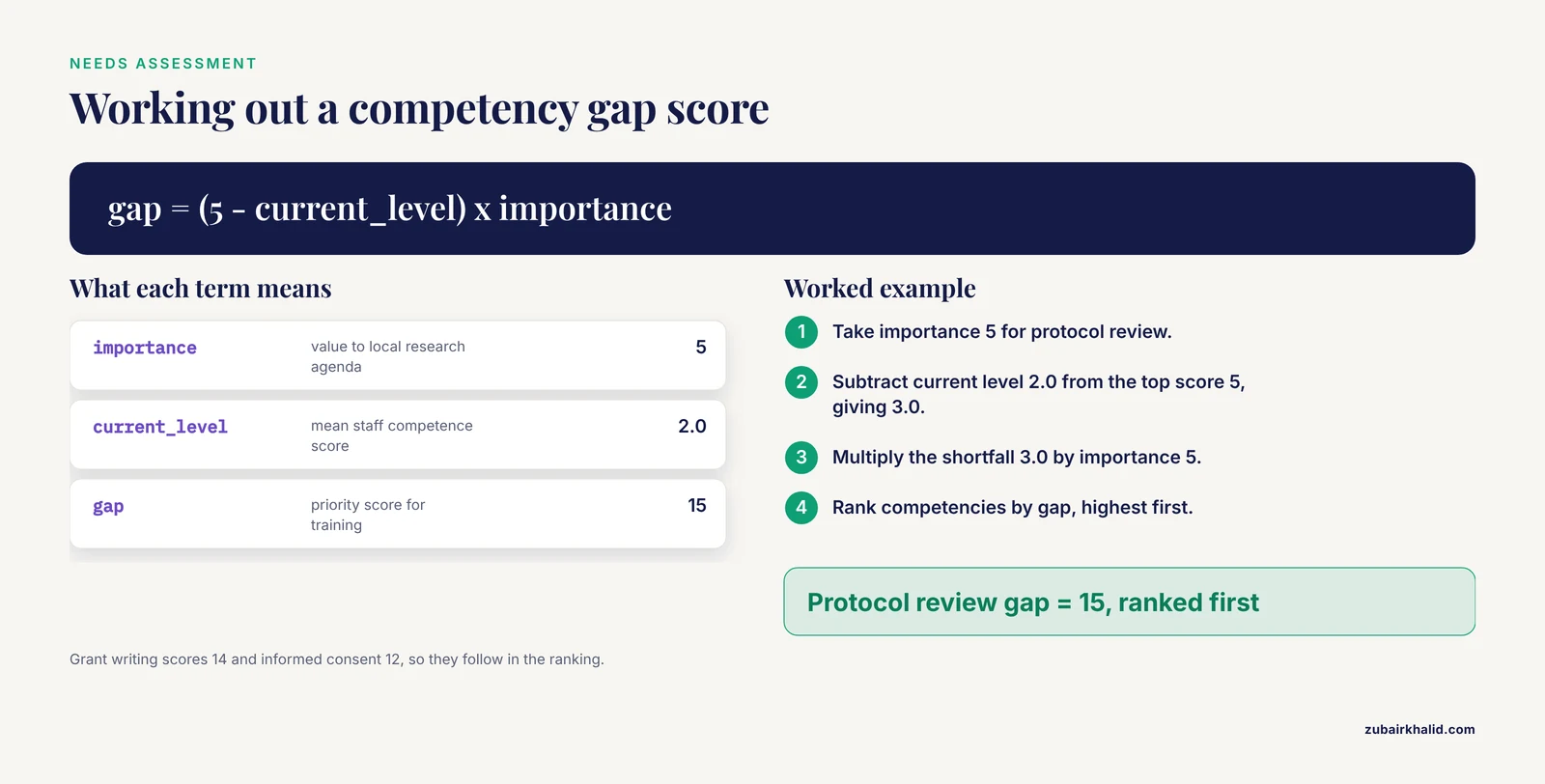
A simple, defensible way to prioritize is to score each competency on two dimensions: how important it is for the local research agenda (1 to 5) and the current average competence of staff (1 to 5). The gap score is importance multiplied by the shortfall. You can compute this in a spreadsheet or with a short script.
import pandas as pd

# Survey results: mean staff competence (1-5) and importance to mission (1-5)
data = {
    "competency": [
        "protocol_review",
        "informed_consent",
        "data_management",
        "grant_writing",
        "research_admin",
    ],
    "importance": [5, 5, 4, 4, 3],
    "current_level": [2.0, 2.5, 3.0, 1.5, 1.0],
}
df = pd.DataFrame(data)
df["gap"] = (5 - df["current_level"]) * df["importance"]
df = df.sort_values("gap", ascending=False)
print(df[["competency", "importance", "current_level", "gap"]])
Expected output:
      competency  importance  current_level  gap
0  protocol_review           5            2.0   15
1  informed_consent           5            2.5   12
3    grant_writing           4            1.5   14
2   data_management           4            3.0    8
4    research_admin           3            1.0    12
Read the output by the gap column. Protocol review (gap 15) is the first priority, grant writing (14) second. This simple ranking, discussed with local stakeholders rather than applied mechanically, becomes the spine of your plan. The numbers themselves are illustrative. Your survey produces your own values.
Step 2. Map Governance and Fix Coordination Gaps
Structural work comes before training, because training people inside a broken system wastes the training. The Sudan research ethics strengthening project is a clear template. Its team reviewed and updated the national guidelines governing human subjects research, clarified the roles and coordination channels between national authorities and institutional committees through an endorsed consensus document, and only then trained committees. Thirty-nine research ethics committees from across Sudan were trained, and pre/post tests showed increased knowledge scores among trainees [8].
Ask three questions at this stage:
- Who has legal authority over research review, and is that authority written down?
- Do national bodies and institutional committees know whose role is whose?
- Is there a network or forum where committees share decisions and precedents?
Where the answers are no, your first deliverables are policy documents and a coordination agreement, not a workshop.
Step 3. Design Tiered Training, Not a Single Workshop
One-off workshops produce short-lived gains. The programs that changed national systems used layered training [1]. A tiered design looks like this:
- Awareness level. Short sessions on research ethics fundamentals and the responsible conduct of research for all research staff. Annual workshops for IRB members on human subjects protection fit here [9].
- Practitioner level. Structured courses in protocol review, consent processes, and data integrity for REC members and study coordinators.
- Expert level. Degree programs and international practicums that create leaders. The Vanderbilt-Nigeria Research Ethics Training Program (V-NET) illustrates the full stack: a Master of Science degree program in research ethics training 15 students, a genomics-focused curriculum for eight Nigerian researchers at Vanderbilt University Medical Center, a practicum for 12 Nigerian IRB members to sharpen protocol review skills, annual workshops reaching roughly 150 trainees, a tailored curricular toolkit, and quarterly webinars [9].
Match delivery format to audience. A digital capacity building program for 988 participants, built around academic writing in the IMRaD format (Introduction, Methods, Results, and Discussion) plus ethical AI use, raised participants' mean self-assessed knowledge from 2.90 to 3.60 on a five-point scale and generated strong satisfaction with content, delivery, and trainers [10]. Interactive, inclusive formats with both technical and ethical content outperformed pure lecture models.
For clinical research skills, project-based learning anchored to real protocols works well. A series of five regional workshops in pediatric oncology (2020 to 2025) combined online modules with on-site work in which participants brought their own abstracts and refined them through structured guidance, drawing about 35 applicants per workshop from 17 countries and seven disciplines [11]. Requiring applicants to submit an abstract at registration forces the training to operate on real work rather than hypothetical cases.
Step 4. Build Tools and Systems, Especially for Ethics Review
This is where "beyond training" becomes concrete. The Research for Health and Innovation Organiser (RHInnO Ethics) is both an information management system and an expert decision support system for research ethics committees, installed in 29 RECs across 8 African countries. It enables online, standardized reviews and can reduce review time for complex multicenter trials by 12 months or more [2]. A review system that documents every step also produces the audit trail that funders and regulators increasingly demand.
You do not need a commercial platform to start. A protocol tracking database and written standard operating procedures (SOPs) deliver much of the benefit. The V-RAMP program in Nigeria built exactly this: a needs assessment of the administrative environment, a newly capacitated Office of Research Administration, training and mentoring for committee members and staff, a REDCap protocol tracking database, and SOPs covering the responsible conduct of research and rigor and reproducibility [6].
A minimal reviewer assignment log can start in a spreadsheet and migrate later:
import pandas as pd

rec_log = pd.DataFrame({
    "protocol_id": ["REC-2026-001", "REC-2026-002", "REC-2026-003"],
    "received": ["2026-01-10", "2026-01-14", "2026-01-21"],
    "primary_reviewer": ["Reviewer A", "Reviewer B", "Reviewer A"],
    "decision_due": ["2026-02-10", "2026-02-14", "2026-02-21"],
    "status": ["under review", "approved", "revisions requested"],
})
rec_log["days_open"] = (pd.Timestamp("2026-02-01")
                        - pd.Timestamp(rec_log["received"])).dt.days
print(rec_log)
Expected output:
       protocol_id    received primary_reviewer decision_due              status  days_open
0  REC-2026-001  2026-01-10       Reviewer A   2026-02-10        under review         22
1  REC-2026-002  2026-01-14       Reviewer B   2026-02-14           approved         18
2  REC-2026-003  2026-01-21       Reviewer A   2026-02-21  revisions requested         11
Track median days from receipt to decision each quarter. When that number falls, you have evidence of capacity, not just activity.
Step 5. Pair Skills with Career Structures
Trainees leave when there is nowhere to go. A structured approach to career development at every career stage, accompanied by performance monitoring and support, proved successful in mental health research capacity programs in Sub-Saharan Africa, including the Mental Health and Poverty Project, which focused on core transferable research skills [12].
Practical structures include:
- A written mentorship plan with named mentors and scheduled reviews.
- Protected research time written into job descriptions.
- A sequence from trainee to independent investigator with defined milestones.
- South-to-south networks so expertise circulates within the region, not only from north to south. The Canada-Africa Prevention Trials network was created specifically to facilitate both north-south and south-south partnerships, alongside a Benin-Canada partnership that trained investigators, helped create Benin's national ethics committee for health research, and established an HIV/STI prevention research unit within the Faculty of Health Sciences [7].
Step 6. Build Shared Knowledge Resources
Low-resource settings lose enormous time re-deriving materials that partners already hold. The Virtual Library project addressed this with a web-based repository of context-relevant resources for LMIC health researchers, built through a Nepal-US collaboration. Fourteen team members reviewed 564 potential resources with a standardized screening guide (mean quality score 7.02 out of 10), and the published library organized 298 resources into 15 topics and 45 sub-topics, with more than 76 percent of screened resources meeting criteria for relevance, reputable sourcing, accessibility, and understandability [13].
Replicate the method cheaply: agree on quality criteria, screen with a shared guide, review each other's decisions, and publish the result where your trainees already look.
Step 7. Monitor, Adapt, and Sustain
Define indicators before the program starts and review them on a fixed schedule. Useful indicators include time to ethics clearance, number of locally led protocols, trainee retention, publications with local lead authors, and committee member turnover. The decade-long Honduran experience at the Universidad Nacional Autónoma de Honduras shows what sustainability looks like when it works. A Canadian-funded initiative (2007 to 2012) established the country's first research-oriented MSc program, a non-clinical ethics board, and modern laboratories. By 2025, more than 30 MSc graduates had strengthened national institutions, several had completed doctoral training abroad and returned, and the research institute created in 2014 had produced over 170 publications, more than 20 percent of the university's health-related output since 2012 [14]. Enablers were long-term commitment and institutional anchoring. Barriers were minimal national research and development investment and limited infrastructure, which no single program can fix alone [14].
Practical Tips
These tactics recur across successful programs and are worth adopting directly.
- Use crowdsourcing to find trainees. The STAR program for HIV and implementation science opened with a crowdsourcing call asking students how to promote HIV prevention in their communities, then moved finalists into a two-day designathon followed by structured mentoring [15]. Open calls surface motivated people that conventional nomination channels miss.
- Bring ethicists into emerging domains early. The Global Forum on Bioethics in Research, organized by the World Health Organization and supported by major funders, convened 87 participants from 31 countries in Cape Town in 2022 to work through the ethics of artificial intelligence in global health research through case studies and structured group discussion [16]. Session-based forums like this let committee members stress-test unfamiliar protocols before such protocols arrive at their door. The same logic drove a webinar program that paired writing skills with ethical AI integration, raising perceived knowledge across a large participant group [10].
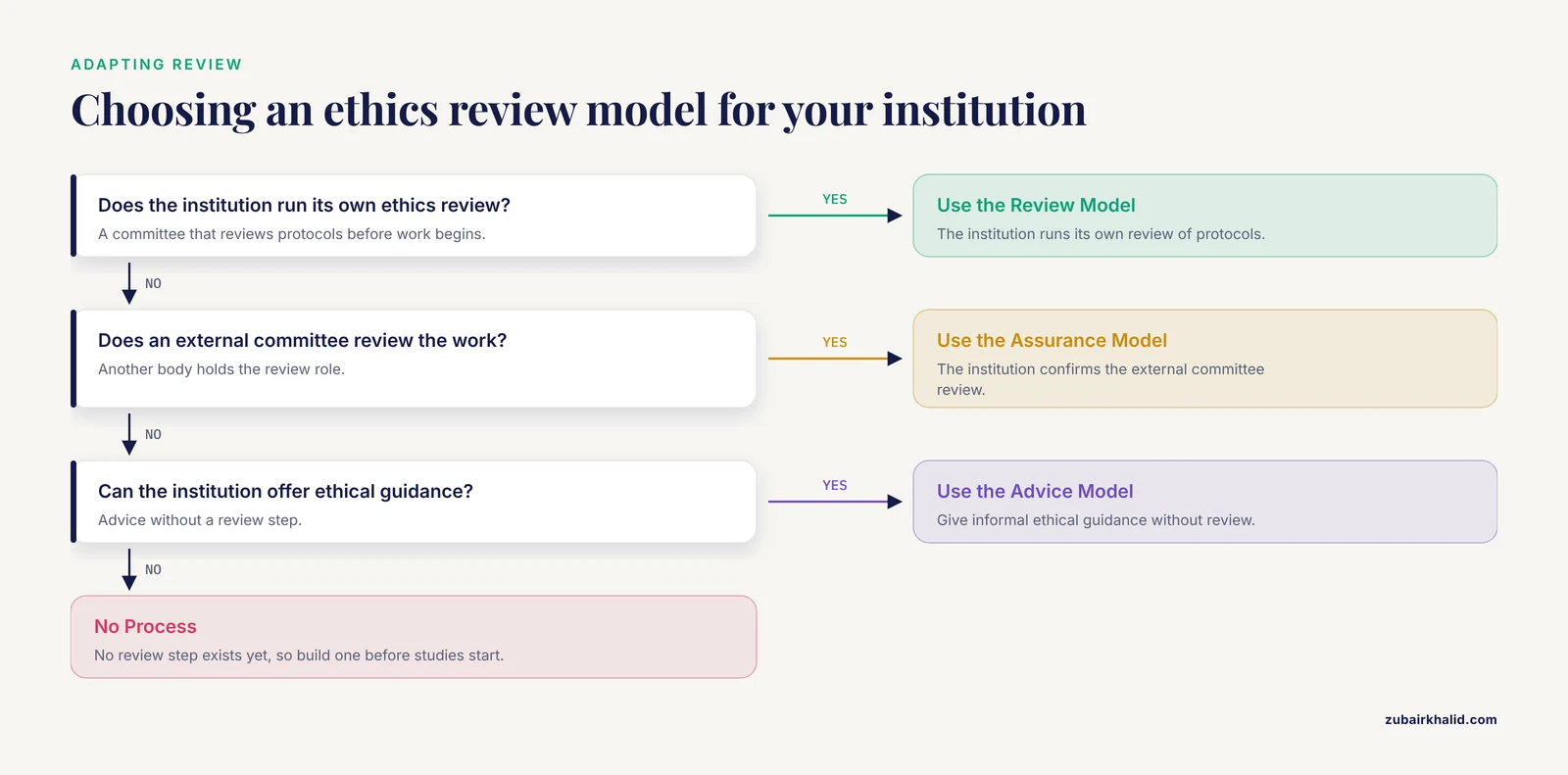
- Adapt ethics processes to the local institution. A qualitative study of 15 English local authorities found four distinct models of ethics review in practice: No Process, an Assurance Model (the institution confirms external committee review), an Advice Model (informal ethical guidance without formal review), and a Review Model (the institution runs its own formal review) [17]. The salient design factors, including how research is defined and who owns it, differ by setting, so a process imported wholesale from elsewhere usually fits poorly.
- Budget for the practicalities of partnership. Reflections from a UK-Kyrgyz Republic partnership concluded that most global health partnership literature avoids the practical work of doing research itself, and that research methods are not culturally neutral, since dominant modes of inquiry vary across time and place [18]. Plan for translation, differing data conventions, and communication time as first-class budget items.
- Treat capacity building as mutual learning. Interviews across a five-country program on violence against women found that participants understood research capacity strengthening as an opportunity for mutual learning and career development, and that program activities simultaneously reinforced and challenged power asymmetries operating at the environment, group, and individual levels [4]. Naming those dynamics openly, rather than pretending they are absent, is what lets a partnership manage them.
- Train the reviewer pipeline alongside the researcher pipeline. Programs that trained REC administrators and committee staff, not only principal investigators, produced the most durable review improvements [3], [6].
Common Mistakes and Limitations
These are the errors that most often derail capacity building projects, drawn from the documented experience of the programs above.
- Stopping at training. Training courses were the mainstay of research ethics capacity building for decades, yet platforms and process reform, not courses alone, are what cut review times and strengthen governance [2]. A workshop calendar is not a capacity strategy.
- Skipping the needs assessment. Every successful site in the eight-country implementation research assessment ran a baseline needs assessment before designing activities [5]. Programs that skip it teach skills the institution already has while leaving the real bottleneck untouched.
- Ignoring the administrative layer. Research cannot run on scientists alone. Grants must be administered, contracts signed, protocols tracked. The V-RAMP program exists precisely because a major Nigerian teaching hospital needed dedicated research administration infrastructure before its research volume could grow [6]. Underinvesting here stalls everything upstream.
- Importing ethics processes without adaptation. Ethics review models that work in one legal and institutional context may fail in another. The local authority study in England found four distinct viable models even within one country, shaped by local definitions of research and relationships with participants [17]. Copy-paste governance rarely survives contact with local reality.
- Overlooking power dynamics. Capacity building activities can perpetuate the very inequities they claim to fix when high-income partners control agendas, authorship, and funding. Programs should design for mutual learning and shared decision making at the outset, then audit their own dynamics rather than assuming good intent settles the question [4].
- Assuming methods are culturally neutral. Dominant research modes vary across settings, and ignoring this produces tools and curricula that local teams cannot use. Adapt instruments, consent language, and examples to the local context.
- Ignoring heterogeneity in trainee backgrounds. The Fogarty program review documented persistent challenges from varied trainee knowledge of ethics, limited training time, differing English language skills, and administrative obstacles [1]. Tiered curricula and pre-assessments exist to handle exactly this variation.
- No sustainability plan. The Honduran case succeeded because capacity was anchored in a degree program and a permanent institute, not a project office that closes when the grant ends [14]. Ask at the proposal stage who pays for the REC coordinator's salary in year five.
- Counting activity instead of outcome. Workshops delivered and certificates issued are inputs. Time to ethics clearance, locally led protocols, and retained graduates are outcomes. Report the outcomes.
One honest limitation applies to this whole field: much of the evidence is descriptive program reporting rather than controlled comparison, and the challenges of increasing research volume and complexity in LMICs remain substantial even after documented successes [1], [3].
Frequently Asked Questions
What is capacity building in global research ethics?
It is the sustained development of people, committees, policies, and systems so that low-resource institutions can design, review, and oversee ethical research themselves. It goes well beyond one-off training to include governance, tools, and career structures.
How long does ethics review take in many African institutions, and can it be shortened?
Complex proposals have waited an average of about 1.5 years for clearance in many African institutions. Online, standardized review systems can reduce review time for complex multicenter trials by 12 months or more [2].
What is the difference between training and capacity building?
Training transfers knowledge to individuals. Capacity building changes the surrounding systems, governance, infrastructure, and career paths so the knowledge produces lasting institutional function. Experts describe the field as moving "beyond training" for this reason [2].
What is the responsible conduct of research?
It is the set of professional standards covering honest data handling, fair authorship, conflict of interest disclosure, mentorship, and proper treatment of human participants and specimens. It is a core curriculum element in modern ethics training programs [9].
Which skills should a research ethics curriculum cover?
Successful programs combine epidemiology and study design, community and stakeholder engagement, research management, research ethics, and grant writing, with newer curricula adding genomics ethics [9] and ethical use of artificial intelligence [10].
How do you run a needs assessment for research capacity?
Inventory existing structures, survey staff competence and skill importance, and map where protocols stall in the pipeline. Rank competencies by an importance-weighted gap score, as shown in the worked example above, and validate the ranking with local stakeholders.
How can global research partnerships avoid power imbalances?
Design explicitly for mutual learning, share agenda-setting and authorship decisions, name the three levels where power operates (environment, group, and individual), and audit the partnership's own dynamics rather than assuming good intent resolves them [4].
How do you sustain research capacity after funding ends?
Anchor capacity in permanent institutional structures such as degree programs, standing research institutes, and funded staff positions. The Honduran experience shows that institutional anchoring plus alumni career pathways keeps productivity growing after the original grant closes [14].
Sources
- Research Ethics Capacity Building in Sub-Saharan Africa: A Review of NIH Fogarty-Funded Programs 2000-2012
- RESEARCH ETHICS CAPACITY BUILDING FOR THE NEXT DECADE - ‘BEYOND TRAINING’ - RHINNO ETHICS AS MODEL TO IMPROVE AND ACCELERATE ETHICS REVIEW OF HEALTH RESEARCH
- Health Research Ethics in Southern Africa: Building Capacity and Cultivating Excellence
- Research capacity strengthening methods and meanings: negotiating power in a global health programme on violence against women
- Global implementation research capacity building to address cardiovascular disease: An assessment of efforts in eight countries
- The V-RAMP Program: Building Research Administration and Management Capacity in Nigeria
- P06-05. Building capacity for HIV/AIDS prevention trials in Africa: Evidence from three projects supported by the Global Health Research Initiative
- OC 8716 ENHANCING RESEARCH ETHICS REVIEW CAPACITY IN SUDAN
- Building Capacity for the Ethical Conduct of Genetic and Genomic Research in Nigeria: The Vanderbilt-Nigeria Research Ethics Training Program
- Assessing a Digital Capacity-Building Initiative: Scholarly Writing and AI Ethics Training for Global Academic Stakeholders
- Clinical Research Capacity Building in Pediatric Oncology in Resource-Limited Settings: Application and Early Results of Regional Educational Workshops.
- Capacity Building in Global Mental Health Research
- Building a ‘Virtual Library’: continuing a global collaboration to strengthen research capacity within Nepal and other low- and middle-income countries
- A decade of health research capacity building in Honduras: institutional transformation, challenges, and lessons learned
- Building capacity for HIV and implementation science among students in the United States: the stimulating training and access to HIV research experiences (STAR) program
- Research ethics and artificial intelligence for global health: perspectives from the global forum on bioethics in research
- Local authorities need tailored research ethics processes to support research capacity building
- Qualitative research capacity building: Reflections from a UK-Kyrgyz Republic global partnership